
Think of managed IT services for your small business as a strategic partnership. Instead of just hiring someone to fix things when they break, you’re bringing on a dedicated team of tech experts to manage your entire IT setup for a straightforward, predictable monthly fee. Their job is to keep everything running smoothly, securely, and efficiently, stopping problems before they can ever disrupt your workday.
What Are Managed IT Services Really?
It’s helpful to think of it like your electricity or water supply. You don’t have to worry about maintaining the local power grid; you just pay a consistent bill and trust the lights will come on when you flip the switch. Managed IT services bring that same reliability and peace of mind to your business’s technology.
This is a world away from the old ‘break-fix’ IT support model, where you’d only call for help after a server has crashed or a crucial piece of software has stopped working. That reactive approach almost always means unexpected bills, frustrating downtime, and lost productivity while you scramble for a solution. A Managed Service Provider (MSP), on the other hand, takes full, proactive ownership of your technology.
A Partnership Focused on Prevention
An MSP’s goal isn’t to wait for your call. It’s to make sure you never have to make that panicked call in the first place. They use sophisticated monitoring tools to keep a watchful eye on your network, servers, and computers around the clock. This lets them spot and fix potential issues—like a failing hard drive or a new security vulnerability—long before they can cause any real damage.
This proactive approach completely flips the script. Your IT partner is now motivated to keep your systems stable and secure because their success is directly linked to your uptime. It builds a genuine partnership where the MSP often acts as a virtual Chief Information Officer (vCIO), providing strategic advice to ensure your technology supports your business ambitions.
A study reveals that small and medium-sized businesses have seen IT cost reductions of up to 40% when transitioning to managed IT services, while improving overall operational performance by up to 60%.
What This Means for Your Business
Handing over the reins of your technology to an MSP gives you far more than just technical support. It unlocks a whole host of benefits that let you get back to focusing on what you do best—running and growing your business.
Key advantages include:
- Predictable Budgeting: A single, fixed monthly fee covers all your IT needs. This puts an end to surprise repair bills and converts unpredictable capital spending into a simple, manageable operational cost.
- Access to Expertise: You instantly gain access to a whole team of certified specialists in areas like cybersecurity, cloud computing, and network architecture—all without the huge expense of hiring them directly.
- Enhanced Security: MSPs implement robust, multi-layered security strategies to protect your critical data from the constant threat of cyberattacks.
To get a deeper understanding of how these partnerships work, you can explore more insights into IT services from Managed Service Providers (MSPs). The bottom line is that this model lets you offload the complex and time-consuming job of IT management, knowing your company’s tech backbone is in expert hands.
Ready to build a more secure and efficient technological future for your business? Phone 0845 855 0000 today or send us a message to discuss your needs.
What Are the Real Benefits of Outsourcing Your IT?
Partnering with a managed IT service provider is about much more than just having someone to call when a computer breaks. For a small business, it’s a strategic shift that delivers a real return on investment, changing the entire relationship you have with technology. It’s about moving away from constantly fighting fires and into a forward-thinking, proactive position.
Instead of just waiting for something critical to fail—often at the worst possible moment—a good IT partner works behind the scenes to stop problems from happening in the first place. This constant monitoring and maintenance dramatically cuts down on expensive downtime. For a small business, that can be the difference between a profitable week and one filled with lost revenue and unhappy customers. When your systems just work, your team can get on with their actual jobs.
You Gain Enterprise-Grade Cybersecurity
One of the single most important benefits of managed IT services for a small business is getting access to a level of cybersecurity that would be almost impossible to build and manage on your own. In the current climate, protecting your business from online threats isn’t just a good idea; it’s essential for survival.
The reality for UK businesses is pretty sobering. The UK Government’s Cyber Security Breaches Survey found that 43% of businesses had a security breach or attack in the last year. For medium-sized companies, that number jumped to a staggering 70%. This puts enormous pressure on smaller businesses that simply don’t have a dedicated security team. You can find out more about the IT challenges facing UK SMEs from the latest survey.
A managed service provider acts as your digital shield, typically including:
- 24/7 Threat Monitoring: Keeping a constant watch over your network to spot and stop threats as they happen.
- Advanced Firewalls: Setting up a robust barrier to block unwanted access to your systems.
- Employee Security Training: Helping your staff learn how to spot and avoid phishing emails and other common scams.
- Data Encryption: Making sure your sensitive business and customer information is protected and unreadable if it falls into the wrong hands.
You Get a Deep Bench of Experts on Your Team
Another game-changer is having a whole team of specialists on tap. Think about it: hiring a cybersecurity analyst, a cloud expert, and a network engineer would come with eye-watering recruitment costs and salaries. With a managed IT partner, you get all that combined expertise for one predictable monthly fee.
This model means you’re no longer relying on the knowledge of one or two people in-house. You have an entire team of certified professionals ready to give you strategic advice and help you make smart tech decisions that actually support your business goals.
This level of expert guidance is what makes genuine digital transformation possible. Whether you’re thinking about moving to Microsoft Azure, looking to boost productivity with Microsoft Copilot, or need help with Dynamics 365, your IT partner has the experience to make sure the project is a success. We explore this in more detail in our guide to the full benefits of managed IT services.
Your IT Can Scale as You Grow
Finally, managed services are designed to be flexible. As your business expands, your technology needs will evolve right along with it. A good IT partner can easily adjust your services to match, whether that means adding new team members, increasing your cloud storage, or rolling out new software.
This flexibility ensures your IT is never holding you back. Instead of being a bottleneck, it becomes a powerful tool that helps you grow. Your provider handles all the technical headaches, leaving you free to focus on the big picture.
Ready to see what these benefits could mean for your business? Give us a call on 0845 855 0000 today or send us a message to have a chat.
What’s Actually in a Managed IT Service Package?
When you bring a managed IT service provider on board, you’re not just buying a single product. You’re getting a whole team and a suite of tools dedicated to keeping your business running smoothly, securely, and efficiently. Think of it as an entire IT department, ready to go, for a fraction of the cost.
So, what should you actually expect to find in a good managed IT services agreement? It’s much more than just a helpline for when your printer breaks. It’s about being proactive—spotting problems before they happen and providing the strategic advice that helps your business grow. Let’s peel back the layers and look at the core services.
This is all about building a foundation for growth. When your security is solid, your team is efficient, and you have experts on hand, your business is in a prime position to scale up.
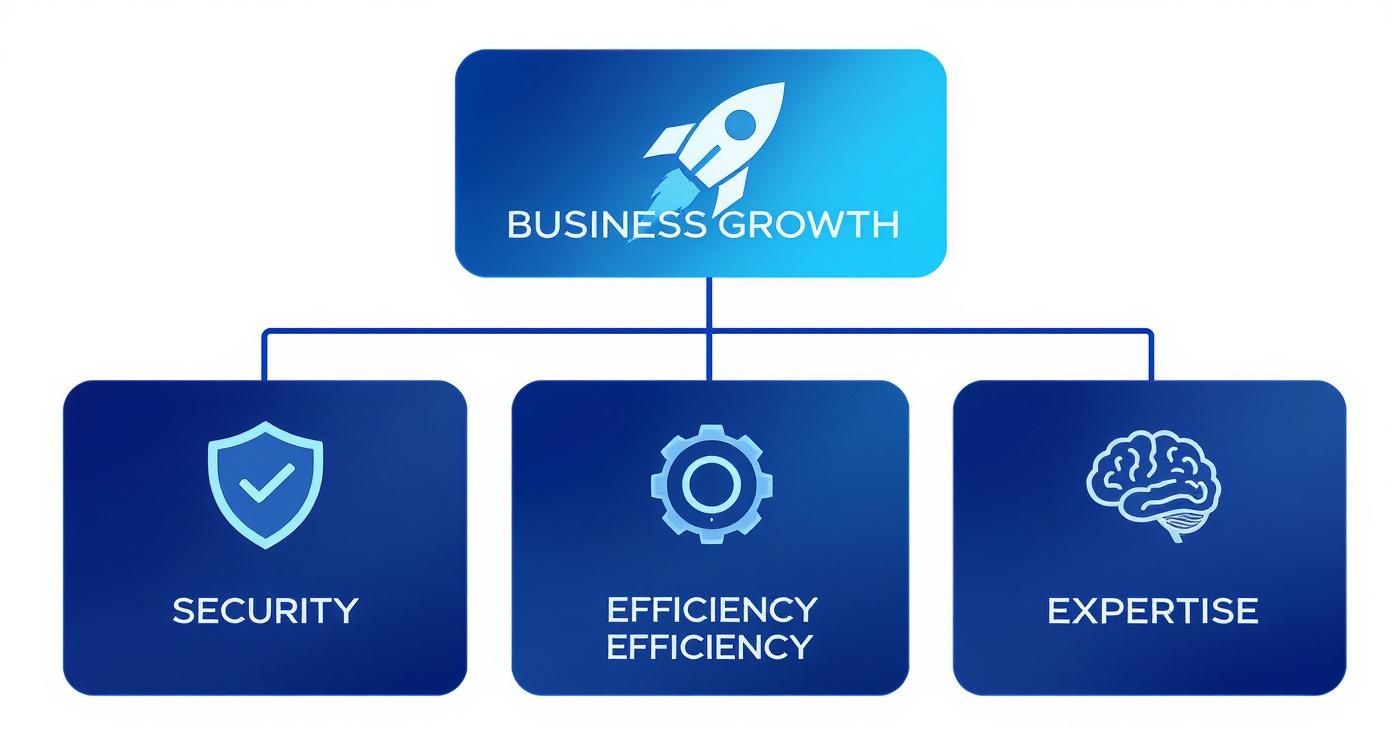
As the image shows, all these pieces work together. Strong security and efficient operations, powered by expert knowledge, directly fuel your company’s ability to expand.
To give you a clearer picture, here’s a breakdown of the typical services that form the backbone of a managed IT support package for a small business.
Typical Managed IT Service Offerings for Small Businesses
| Service Category | Description | Key Business Benefit |
|---|---|---|
| Foundational Support | Includes a 24/7 IT helpdesk for immediate support, proactive network monitoring to prevent issues, and full IT asset management. | Minimises downtime and keeps your team productive with fast, reliable assistance for day-to-day tech problems. |
| Data & Backup | Automated data backup and a clear disaster recovery plan to get you back online quickly after a major incident. | Peace of mind. Your critical business data is safe and can be restored, ensuring business continuity no matter what. |
| Cybersecurity | Multi-layered protection including firewall management, advanced threat detection (for malware, phishing, etc.), and security awareness training. | Protects your sensitive data, client information, and reputation from the ever-present threat of cyberattacks. |
| Cloud Management | Expert support for cloud platforms like Microsoft 365, Azure, and Dynamics 365 to manage infrastructure and applications. | Boosts collaboration and efficiency by ensuring your cloud tools are secure, optimised, and working for your business. |
| Strategic IT | Guidance on new technologies like Microsoft Copilot and the Power Platform, plus strategic planning and technology roadmapping. | Moves your IT from a cost centre to a growth driver, helping you innovate and gain a competitive edge. |
These service categories represent a complete approach to business technology, covering everything from keeping the lights on to planning for the future.
The Bedrock: Everyday IT Support and Management
At the very core of any package are the essentials that stop IT headaches from derailing your workday. This is about keeping your team productive and your systems reliable.
- IT Helpdesk on Demand: This is your team’s lifeline. A password problem, a software glitch, a connection issue—they get fast, friendly support to solve it and get back to work. No more lost hours trying to fix things internally.
- Proactive System Monitoring: We don’t wait for things to break. Your IT partner uses sophisticated tools to keep a constant eye on your network, servers, and devices, often fixing potential problems before you even notice them.
- Data Backup and Disaster Recovery: This is non-negotiable. Regular, automated backups of your crucial business data mean that if the worst happens—a flood, a fire, a major cyberattack—you can restore your information and keep the business running. It’s your ultimate safety net.
The Shield: Essential Cybersecurity Services
In today’s world, strong cybersecurity isn’t a luxury; it’s a fundamental requirement. A managed service provider acts as your dedicated security team, putting multiple layers of protection in place to guard your business. An experienced partner will also guide your small business in implementing effective IT Asset Management best practices to track your hardware, improve security, and plan for future upgrades.
Core security services should always include:
- Firewall and Network Defence: This is about building a strong digital perimeter to block unauthorised access and malicious traffic before it can get anywhere near your network.
- Advanced Threat Protection: Simply having an antivirus isn’t enough anymore. You need sophisticated software that can spot and stop the latest viruses, malware, ransomware, and phishing scams.
- Security Awareness Training: Technology can only do so much. A great partner helps educate your staff on how to spot and avoid common cyber threats, turning your team into your strongest line of defence.
You can learn more about how we structure these protections in our guide to https://www.f1group.com/cybersecurity-managed-services/.
The Engine: Modern Workplace and Cloud Solutions
A truly valuable IT partner doesn’t just fix what you have; they help you build for the future. For most modern businesses, this means getting the most out of powerful cloud platforms that drive collaboration and efficiency.
For many small businesses, the Microsoft ecosystem is the heart of their operations. A great MSP will have deep, practical expertise in managing these tools to unlock their true value for your team.
This means you should expect specialised support for:
- Microsoft 365: It’s so much more than just email. Your partner should be managing Teams, SharePoint, and OneDrive to ensure your team can work together securely, whether they’re in the office or on the road.
- Microsoft Azure: If you’re using or moving to the cloud, an MSP can manage your Azure environment to make sure it’s secure, cost-effective, and configured perfectly for your business needs.
- Dynamics 365: For businesses using Microsoft’s CRM or ERP, your partner provides the technical backbone to keep your sales, customer service, and operations platforms running without a hitch.
On top of that, a forward-thinking provider will help you embrace innovation. They can offer practical support for implementing game-changing tools like Microsoft Copilot to bring AI assistance into your daily work, and the Power Platform to build custom apps and automate those time-consuming manual tasks. This kind of support turns IT from a necessary expense into a real catalyst for business growth.
How Managed IT Services Pricing Works
Let’s talk about the money side of things. Figuring out the cost of managed IT services is, quite rightly, a top priority for any small business owner. The great news is that the old days of unpredictable, lumpy IT bills are largely behind us. Modern managed services are all about shifting your IT costs from a reactive, capital expense to a predictable, monthly operational one.
Think of it like this: instead of getting hit with a huge, unexpected bill when a server suddenly gives up the ghost, you pay a consistent monthly fee. This fee covers everything from the day-to-day helpdesk tickets to the long-term strategic advice that helps your business grow. It also neatly aligns our goals with yours – it’s in our best interest to keep your systems running smoothly to avoid expensive, time-consuming firefighting.
The Per-User Per-Month Model Explained
By far the most common and transparent way to price IT support is the per-user, per-month model. It’s as simple as it sounds: you pay a flat fee for each person in your company who uses the IT systems. We find this works brilliantly for small businesses because it’s completely clear and scales up or down with you.
Just hired a new team member? You simply add another user to the plan. If your team shrinks, your costs drop accordingly. This flexibility means you’re only ever paying for what you actually need, which is a far more efficient way to budget for your technology.
The real beauty of this model is its predictability. Your IT spend becomes a fixed operational cost, just like your rent or your phone bill. This takes the guesswork out of budgeting and lets you plan for the future with much more confidence.
For instance, if you have a team of 15 people, you’ll pay a set fee for each of them. That single fee covers everything from helping them with a laptop glitch to ensuring their email is secure and their data is backed up.
What Influences the Monthly Cost?
While the per-user model is straightforward, the exact price will, of course, vary. Here in the UK, you can typically expect to see prices for managed services ranging from £35 to £175 per user per month. The final figure depends entirely on the depth of support your business actually needs. There’s a great breakdown of how these UK IT support models are structured if you want to dive deeper.
A few key things will influence your monthly fee:
- Level of Support: Do you just need someone on hand during standard business hours, or is your operation running 24/7/365 and needs that level of cover? Naturally, round-the-clock service will sit at the higher end of the scale.
- Cybersecurity Services: A basic plan will always include essentials like antivirus and firewall management. More comprehensive packages will add advanced threat detection, security awareness training for your staff, and proactive vulnerability checks.
- Complexity of Your Setup: A business with one office and standard software is simpler to manage than a company with multiple sites, a complex server room, and specialised industry software.
- On-Site Support: Some issues just can’t be fixed remotely. While many plans are remote-first to keep costs down, others include a set number of on-site visits for when you need a physical pair of hands.
Other Common Pricing Models
The per-user model is king, but it’s not the only option out there. You might also come across:
- Per-Device Pricing: This is very similar to the per-user model, but the monthly fee is calculated based on the number of devices you have—desktops, laptops, servers, and sometimes even company mobiles.
- Tiered Packages: Many IT partners, including us, offer different service tiers. Think ‘Essential’, ‘Pro’, and ‘Premium’. Each tier builds on the last, adding more services and a higher level of support so you can pick the one that fits your budget and business needs perfectly.
Ultimately, a good pricing model isn’t about being the cheapest; it’s about providing clear value and giving your business access to enterprise-grade IT management at a cost that makes sense.
If you’re ready to get a firm grip on your IT budget with a predictable, effective support plan, let’s have a chat. Give us a call on 0845 855 0000 or send us a message to find a solution that’s right for your business.
How to Choose the Right IT Partner

Choosing a provider of managed IT services for your small business is a huge decision. It’s not just about hiring someone to fix a glitchy laptop; you’re trusting them with the technology that runs your entire operation. A great partner can help you grow faster and smarter, but the wrong one can become a source of constant frustration and risk.
The market is crowded, and it’s easy to feel a bit lost. The trick is to look past the slick sales pitches and really get under the bonnet of what they offer, how they work, and what their existing clients think.
Your Essential Vetting Checklist
Before you get anywhere near a contract, you need to do your homework. This is all about verifying their credentials and making sure they have a real track record of helping businesses like yours.
Here’s where to start:
- Technical Certifications: Look for official proof of their skills. A provider with Microsoft Partner status, for instance, has been verified by Microsoft for their expertise. That’s a huge reassurance if your business runs on tools like Microsoft 365 or Azure.
- Customer Case Studies and Testimonials: Don’t just take their word for it. Ask for real-world examples of their work. Good case studies will show you the specific problem they solved for another business and, crucially, the results they delivered.
- Relevant Industry Experience: Do they get your world? A provider that understands the pressures and compliance rules of your industry—be it manufacturing, legal, or something else—can offer far more valuable and relevant support.
Critical Questions for Potential Providers
Once you’ve got a shortlist, it’s time for the direct questions. Their answers will tell you everything you need to know about their service quality, their honesty, and how they perform when the pressure is on.
Here are a few must-ask questions for any potential partner:
- What are your guaranteed response and resolution times? You need to know exactly what their Service Level Agreement (SLA) promises. Is a response guaranteed in 15 minutes or four hours?
- How do you handle cybersecurity? Get specific. Ask what security tools they use, what their protocols are, and how they would manage a security breach.
- What does your onboarding process involve? A professional provider will have a clear, step-by-step plan to get your systems moved over with minimal disruption.
- Can you tell me about the team’s qualifications? You want to know about the people who will actually be taking your calls and solving your problems. What experience do they have?
Understanding the Service Level Agreement (SLA) is non-negotiable. This is the document that holds your provider to account. Look for clear, measurable promises like guaranteed uptime (e.g., 99.9%) and specific timeframes for both acknowledging a problem and getting it fixed.
If you want a more structured way to compare providers, using a template can be a massive help. We’ve put together a guide to help you build your own request for proposal with our free IT RFP template.
The Local Advantage
For businesses here in the East Midlands, choosing a local IT partner has some real-world advantages that you just don’t get with a big, faceless national firm. It’s about more than just a postcode; it’s about being on the same page.
When a major problem hits that can’t be solved over the phone—think a dead server or a total network failure—having a team that can be on-site in a flash is priceless. A local provider from Lincoln, Nottingham, or Leicester can get to you far quicker, which means less damaging downtime for your business.
A regional partner also just gets the local business scene. They’re part of our community, they understand the local economy, and they’re more invested in building genuine, long-term relationships. That local insight can make all the difference in finding a partner who is a true fit for your company culture.
Phone 0845 855 0000 today or Send us a message
Take the Next Step to Proactive IT Management
Ultimately, managed IT services for small business are far more than just another expense. They’re a strategic investment in your company’s security, stability, and future growth.
Making the move from a reactive, ‘break-fix’ mindset is one of the most powerful decisions you can make for your business. Instead of waiting for a critical system failure to bring your operations to a halt, a proactive approach keeps you ahead of threats and unlocks genuine efficiency. It’s about building a technology foundation that actually supports your ambitions, rather than constantly holding you back.
Build a More Secure Future
This is the perfect moment to take a hard look at your current IT setup. Are you genuinely confident in your cybersecurity defences? Does your team get the fast, effective support they need to do their jobs without frustration?
The UK’s managed services sector is a major force. In 2025, there are around 12,867 active managed service providers (MSPs) across the country, generating an estimated £51 billion in revenue. The government’s own research on managed service providers shows they contribute £22.3 billion in Gross Value Added (GVA) to the economy. This thriving market means you have plenty of choices, but finding the right local partner who understands your world is what really counts.
Partnering with an expert MSP shifts your IT from being a reactive cost centre to a proactive driver of business value. It’s time to build a more secure and efficient technological future for your business.
Your technology should be an asset that helps you hit your goals, not a constant source of stress. By adopting a proactive IT strategy, you can get back to focusing on what you do best—running and growing your business—with complete peace of mind that your digital infrastructure is in expert hands.
Ready to see how we can help? Phone 0845 855 0000 today or Send us a message to have a chat about your needs.
Frequently Asked Questions
Stepping into the world of managed IT can feel like a big move, and it’s only natural to have a few questions. We get it. Here are some of the most common things we’re asked by small business owners, with straightforward answers to help you see things clearly.
Is My Business Too Small for Managed IT Services?
That’s a common worry, but honestly, no business is too small. There’s a persistent myth that managed IT is only for big corporations with sprawling offices, but that’s simply not the case anymore.
Modern managed IT services for small business are built to be flexible. Whether you’re a one-person operation or a growing team of 50, the support scales with you. It’s all about getting the right level of help right now, with the freedom to add more services or users as your business takes off. Think of it as accessing big-business tools and security, but on a small-business budget.
What Is the Onboarding Process Like?
The last thing you want is for your business to grind to a halt just to get new IT support. A good Managed Service Provider (MSP) knows this, and their goal is to make the switch feel seamless and painless. It shouldn’t be a jarring change, but a carefully planned transition.
Typically, getting you started looks something like this:
- Initial Assessment: First, we’ll take a proper look under the bonnet of your current IT setup. We need to understand what’s working, what isn’t, and where any hidden risks might be lurking.
- Strategic Planning: Together, we’ll map out a clear migration plan and timeline that fits around your schedule, not ours.
- Seamless Implementation: Our technical team then gets to work, moving your systems, installing the necessary software, and locking down your security. The focus is always on getting your team supported and protected with as little disruption as possible.
Can an MSP Work with Our In-House IT Staff?
Absolutely. In fact, it’s one of the most effective ways to structure your IT support. This setup is often called co-managed IT, and it’s not about replacing your internal expert—it’s about giving them superpowers.
A co-managed partnership turns your MSP into a powerful extension of your own team. You get the best of both worlds: your staff’s invaluable knowledge of your business, combined with the MSP’s specialised tools and deep bench of expertise.
Your MSP can handle the time-consuming daily grind—things like 24/7 monitoring, helpdesk tickets, and security patching. This frees your in-house people from firefighting, allowing them to focus on the strategic projects that really push your business forward.
Ready to build a more secure and efficient technological future for your business? The team at F1Group is here to help.
Phone 0845 855 0000 today or Send us a message to discuss your needs.