
Think of SD-WAN managed services as handing over the keys to your entire business network to a team of dedicated experts. Instead of grappling with outdated, rigid network connections, you get a flexible, high-performance solution that's fully managed for you. This service bundles the sophisticated SD-WAN technology with constant oversight, monitoring, and support from a specialist provider.
The real beauty of this approach? It frees up your internal IT team from the daily grind of complex network management, letting them focus on bigger-picture projects that actually grow the business.
What Are SD-WAN Managed Services And Why Do They Matter?
Let’s try a simple analogy. Imagine your traditional business network is like relying on old A-roads to connect all your offices. It gets the job done, but it's often congested, slow to adapt if there's a problem, and a single accident can bring everything to a standstill.
Now, picture a smart traffic control system that constantly monitors every available route—motorways, dual carriageways, even local B-roads (think broadband, fibre, and 4G/5G). This system automatically sends each vehicle (your data) down the fastest, most reliable path at that exact moment, avoiding traffic jams entirely.
That's the core idea behind SD-WAN (Software-Defined Wide Area Network). The "managed" part simply means you have an expert crew running that entire traffic control centre for you, 24/7. This isn’t just a tech upgrade; it’s a fundamental shift in how you run your network.
The Modern Business Case For Outsourcing Network Management
For most UK businesses, building and maintaining an enterprise-grade network in-house is a huge undertaking. Handing this responsibility to a specialist partner gives you all the benefits without the overhead of a large, dedicated IT department. This model is a key part of what we call managed IT services, designed to tackle the real-world challenges modern companies face.
You can get a broader view of this approach in our guide to understanding what managed IT services are.
This shift is more than just a trend; it's a significant movement. The UK market is a real leader here, accounting for a massive 30.9% share of the entire European SD-WAN market. This is largely driven by our advanced digital infrastructure and a widespread move to the cloud.
It’s particularly catching on with small and medium-sized enterprises (SMEs). Recent figures show that 40% are now investing in SD-WAN specifically to cut down on operational costs and get more reliable connectivity.
Solving Today’s Key Network Problems
Managed SD-WAN is designed to solve several persistent headaches that stifle productivity. Once you see the problems it fixes, its value becomes crystal clear.
- Sluggish Cloud Apps: Does your team constantly complain about Microsoft 365 lagging or Teams calls dropping? That's often down to your data taking an inefficient route to the cloud. Managed SD-WAN prioritises this critical traffic, sending it directly across the best connection available for a seamless experience.
- The High Cost of Old Connections: Traditional MPLS lines are dependable but notoriously expensive and inflexible. A managed service lets you intelligently combine affordable broadband, fibre, and even 4G/5G mobile data, giving you more bandwidth and resilience for a fraction of the cost.
- The Hybrid Working Security Puzzle: With staff working from home, the office, and everywhere in between, keeping your network secure is a nightmare. Managed SD-WAN centralises your security policies, wrapping the same protective layer around every user, no matter where they connect from.
At the end of the day, managed SD-WAN creates a foundation for a more agile, secure, and cost-effective business. It's not about just keeping the internet running; it's about building a network that actively helps you hit your goals.
The Real-World Benefits of Managed SD-WAN for Your Business
Switching to a managed SD-WAN service isn't just another IT project; it's a strategic move that delivers real, measurable improvements to your business. When you step away from older, more rigid networking, you open the door to major gains in four key areas: performance, cost, security, and resilience. Let's break down what these benefits actually look like for your day-to-day operations.
Supercharge Your Cloud App Performance
In today's world, your business runs on the cloud. When access to critical tools like Microsoft Teams, SharePoint, or Azure services slows to a crawl, it's not just an annoyance—it's a direct hit to your team's productivity.
This is where managed SD-WAN truly shines, thanks to a clever feature called dynamic path selection. Instead of forcing all your data down a single, often congested, pipeline, the system constantly assesses all your available internet connections—fibre, broadband, even 4G/5G. It then intelligently sends traffic for your most important apps, like a Teams video call, down the fastest and most reliable path at that very moment.
What does this mean for your team? No more frustrating lag, dropped calls, or painfully slow file transfers. It creates a consistently smooth and responsive experience, giving your staff the reliable connection they need to do their best work, whether they're in the office or at home. For those looking to get the most out of their network, having an understanding the role of a managed Ethernet switch can be a game-changer in maximising efficiency.
Real, Predictable Cost Savings
One of the biggest draws for businesses making the switch is the immediate and significant impact on the budget. Traditional MPLS lines, the old gold standard for business connectivity, are notoriously expensive and inflexible, locking you into long, costly contracts.
SD-WAN completely changes the game by letting you mix and match different, more affordable internet connections to get even better performance and reliability.
Think about this common scenario: A business is paying over £1,000 per month for a single, dedicated MPLS line. With a managed SD-WAN solution, they could combine a primary fibre broadband line with a 4G/5G backup for around £250 per month. They end up with more bandwidth and built-in resilience, all for a quarter of the original cost.
This approach doesn't just slash your monthly bills. It shifts your network costs from a rigid capital expense to a flexible, predictable operational expense (OpEx) that can grow and change right alongside your business.
Security That's Built-In, Not Bolted-On
With teams working from anywhere, keeping your security consistent across every location and user is a huge headache. A managed SD-WAN service solves this by weaving security directly into the network itself.
Instead of trying to manage separate security tools at each site, you get a single, centrally managed security policy that protects everyone, everywhere. This includes powerful features that are applied consistently across the board.
- Next-Generation Firewall (NGFW): This isn't your basic firewall. It inspects data deeply to block sophisticated threats before they can ever reach your network.
- Intrusion Prevention Systems (IPS): Think of this as a 24/7 security guard, actively watching for suspicious behaviour and automatically shutting down potential attacks.
- Secure Web Gateways: Ensures every user, no matter where they are, is protected from online threats and that your company's web filtering policies are always enforced.
This integrated approach wraps a robust and uniform security shield around your entire operation, from the head office right down to your remote workers' home connections.
Keep Your Business Online, No Matter What
For any business, downtime is lost money. Period. Managed SD-WAN is built from the ground up to prevent this, making sure you stay connected when things go wrong. By using multiple internet connections from different providers, it creates powerful, built-in redundancy.
If your main fibre line goes down, the SD-WAN system instantly and automatically reroutes all your traffic to a backup link, like your broadband or 4G/5G connection. This automatic failover happens so fast that someone on a video call wouldn't even notice the switch. It delivers the kind of business resilience that a single-connection setup simply can't promise, keeping your operations running smoothly through any disruption.
Choosing Your Path: Managed SD-WAN vs. DIY and MPLS
When it comes to your business network, you're essentially at a crossroads with three distinct paths ahead. Each has its own set of challenges and rewards, and the best route for you really boils down to your resources, in-house expertise, and what you want to achieve. Let's weigh up the old-school approach of MPLS, the hands-on 'do-it-yourself' SD-WAN, and the partnership model of managed SD-WAN services.
The Traditional Route: MPLS
For years, Multi-Protocol Label Switching (MPLS) was the undisputed champion for business connectivity. Think of it as your own private motorway network—it’s secure, predictable, and incredibly reliable for linking your sites. Its reputation for being rock-solid is well-earned.
But here's the catch: MPLS was designed for a different era. For modern businesses that live and breathe in the cloud, its cracks are starting to show. It’s notoriously expensive, often costing thousands of pounds a month for just one connection. It's also inflexible; getting a new line or upgrading your bandwidth can take an age, which is a real drag on business agility. In short, while dependable, MPLS is a costly and rigid solution that often struggles to keep pace with cloud tools like Microsoft 365 and Azure.
The Do-It-Yourself SD-WAN Approach
Seeing the limits of MPLS, some companies think about building their own SD-WAN network. This DIY path can look tempting, especially for big organisations with large, skilled IT teams. It gives you ultimate control over every nut and bolt of your network.
However, this control comes with a heavy, often underestimated, price. The learning curve for SD-WAN is steep, demanding specialist skills that are hard to find and expensive to hire. The day-to-day work is relentless—endless patching, constant performance monitoring, and the headache of juggling multiple suppliers for hardware, software, and internet lines. This route requires a huge investment, not just in equipment but, more critically, in the people needed to run it all.
For many businesses, the DIY approach seems empowering at first but quickly becomes a resource drain. The ongoing responsibility of managing a complex, business-critical system can divert your most valuable IT staff away from strategic projects that actually drive growth.
This flowchart helps visualise which path might be right based on your main business drivers.
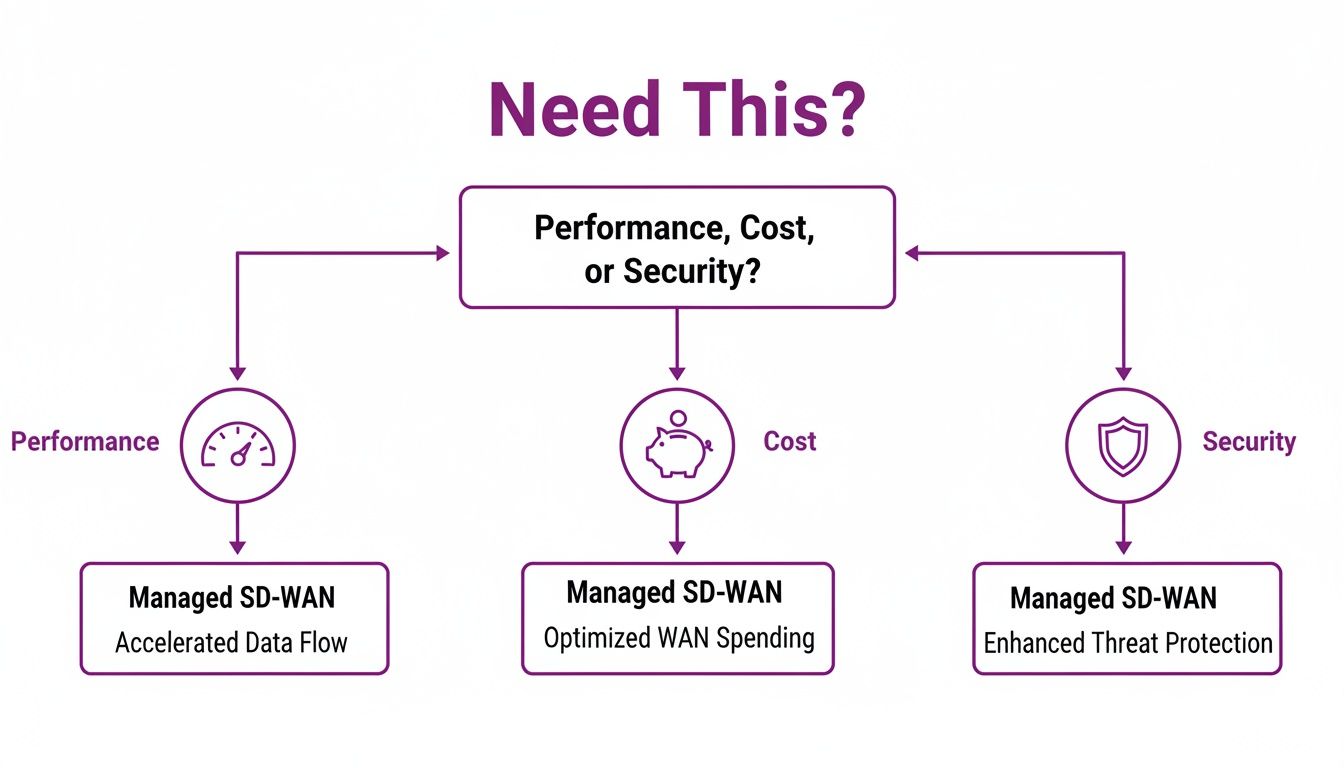
As you can see, a managed service directly answers the core business needs for better performance, cost control, and stronger security, all without the operational burden.
The Strategic Choice: Managed SD-WAN
This brings us to the third path, which has become the go-to strategic choice for most UK businesses. Managed SD-WAN gives you all the advanced benefits—better performance, more agility, and tight security—without the operational headaches or hefty upfront costs of a DIY project.
With this model, you partner with a specialist provider who essentially becomes an extension of your own IT team. This partnership brings some huge advantages to the table:
- Expertise on Tap: You instantly get access to a team of certified engineers who live and breathe this stuff. They handle the complex design, rollout, and day-to-day management.
- Proactive Management: A managed service isn't just about fixing things when they break. It’s about proactive, 24/7 monitoring to spot and sort out potential issues before they ever affect your business.
- Predictable Costs: Instead of a massive upfront capital spend, your network becomes a simple, predictable operating expense. This makes budgeting a whole lot easier and ties your IT costs directly to your business needs.
Ultimately, choosing managed SD-WAN services lets you focus on what you do best—running your business—safe in the knowledge that your network is a powerful, reliable, and secure asset helping you grow.
Ready to see how a managed service could work for you? Phone 0845 855 0000 today or Send us a message to start the conversation.
How To Choose The Right SD-WAN Managed Service Provider
Picking a partner for your SD-WAN managed services is easily the biggest decision you'll make in this whole process. The right provider feels like an extension of your own team—a genuine asset that helps you move forward. But get it wrong, and you're in for a world of performance headaches, security holes, and constant frustration.
To make the right call, you need to look past the slick sales presentations and dig into the details that actually matter. This isn't just a technology purchase; it's a partnership. A good outcome relies on your provider’s technical know-how, their operational discipline, and a real commitment to your business goals. It’s always smart to learn the best practices for vetting an IT service provider before you sign on the dotted line.

To cut through the noise, we've put together a checklist to help you ask the right questions and evaluate potential partners systematically.
Provider Evaluation Checklist
Use this table as a practical guide during your discussions. It’s designed to help you compare providers on an even footing and make sure no crucial details are missed.
| Evaluation Criteria | Question to Ask | Why It Matters |
|---|---|---|
| Technical Expertise | What SD-WAN vendor certifications do your engineers hold? Can we see case studies for businesses like ours? | Certifications prove they've been formally trained. Real-world examples show they can actually deliver. |
| Security Approach | How do you integrate security? Is SASE included, or is it an add-on? What about NGFW and ZTNA? | Security must be built-in, not bolted on. A modern provider should lead with a comprehensive, integrated security model. |
| Service Level Agreement (SLA) | Can you show me a sample SLA? What are the specific guarantees for uptime, latency, and support response? What are the penalties for missing these? | The SLA is their promise. Vague terms are a red flag. It needs to have real teeth to protect your business operations. |
| Support Structure | What does your 24/7/365 support look like? Will I speak directly to an engineer or a call centre? | When things go wrong, you need fast access to experts who can solve the problem, not just log a ticket. |
| Local Presence & On-site Support | Do you have a local team in the East Midlands? What’s the process for getting an engineer on-site if needed? | Remote support is great, but for critical issues, nothing beats having a local expert who can be there in person. |
| Migration & Onboarding | What does your implementation plan look like? Who manages the project, and how will you minimise disruption? | A smooth, well-planned migration is crucial. A good partner will have a clear, battle-tested process. |
| Pricing Model | Can you explain your pricing structure? Are there any hidden costs for things like hardware or software updates? | Transparency is key. You need a predictable monthly cost without any nasty surprises down the line. |
This checklist isn't exhaustive, but it covers the core areas that separate an average provider from a great one. A potential partner should be able to answer these questions confidently and back up their claims with evidence.
Assessing Technical Expertise And Certifications
First things first, you have to gauge their technical depth. Don't let buzzwords fool you; get into the nitty-gritty of their engineering team's qualifications. Ask about their certifications with major SD-WAN vendors. This is your proof that they have the recognised expertise to design, deploy, and manage your network properly.
A provider with real engineering talent won’t just hand you a one-size-fits-all box. They'll take the time to build a network around your specific applications, traffic patterns, and business priorities. That level of tailoring is what makes the service truly valuable.
Scrutinising Security Offerings
In today's world of ever-present cyber threats, security can't be an afterthought—it has to be front and centre. A provider’s approach to security tells you a lot about their quality. You need to ask them directly about their strategy for Secure Access Service Edge (SASE), which combines networking and security into a single, cloud-based service.
This is a deal-breaker. A mature provider will include integrated security features as a standard part of their package, not as expensive extras. Make sure their service includes:
- Next-Generation Firewall (NGFW): Absolutely essential for inspecting traffic and blocking modern threats.
- Intrusion Prevention Systems (IPS): To proactively spot and shut down malicious activity before it causes damage.
- Zero Trust Network Access (ZTNA): This verifies every user and device before granting access, a critical principle for protecting a modern, hybrid workforce.
When a provider leads with a robust, built-in security posture, it shows they’re serious about protecting your business from the start.
Understanding Service Level Agreements
A Service Level Agreement (SLA) is more than just a piece of paper; it’s the provider’s binding promise to you. But they aren't all created equal. You must look for concrete guarantees that cover what you actually care about: network uptime, application performance, and how quickly they'll respond to a support ticket.
Don't settle for vague promises. An effective SLA should clearly define penalties if the provider fails to meet their obligations. This ensures they have a strong financial incentive to deliver the high-quality service they promised and gives you recourse if they don't.
Pay very close attention to how they define "uptime" and what gets excluded. The best managed services companies provide clear, easy-to-understand SLAs that match your business needs. For a closer look at what separates the good from the bad, see our guide on choosing managed services companies.
Evaluating Support And Local Presence
When a network problem pops up, you need quick, effective help from people who actually understand your setup. Take a hard look at their support structure. Do they offer 24/7/365 support from qualified engineers, or will your call get lost in a first-line support queue?
For many businesses, particularly here in the East Midlands, having a local presence is a massive advantage. A partner who can provide on-site help when things get serious offers a level of reassurance a remote-only provider just can’t match. That combination of remote monitoring and hands-on support is often the ticket to fixing problems fast. A provider willing to invest in a local team is also showing you they're committed to the region for the long haul.
Ready to find a partner who ticks all these boxes? Give us a call on 0845 855 0000 today or Send us a message to start the conversation.
Your Implementation Journey: From Planning To Go-Live
Switching your entire business network can feel like a massive, daunting project. But with an experienced SD-WAN managed services provider, it's less of a disruptive overhaul and more of a structured, carefully managed process. Think of it as a detailed roadmap, handled by experts who guide you at every turn to minimise disruption and get you the best possible results.
The whole journey is broken down into four clear phases, giving you complete visibility and control from start to finish. This isn't just about plugging in new boxes; it’s a partnership focused on building a network that actually helps your business achieve its goals.
Phase 1: Discovery And Design
You can't build a great network without first understanding what it needs to do. This is where it all begins. We'll work closely with your team to create a comprehensive blueprint that’s built around your specific operational needs.
This means we’ll be:
- Mapping Traffic Flows: Getting a clear picture of how data moves between your head office, branch sites, and remote staff.
- Prioritising Critical Applications: Identifying the tools that are absolutely vital for your business—like Microsoft Teams or your CRM—and ensuring they get the performance they need.
- Building a Custom Blueprint: Designing a network architecture that's secure, resilient, and perfectly aligned with how you work.
This phase is all about making sure the final solution is tailored to your business, not just a generic product off the shelf. It’s the difference between buying a suit off the rack and having one properly fitted by a tailor.
Phase 2: Staged And Smooth Deployment
Once the design is signed off, we get to the physical rollout. This is where modern SD-WAN really shines, thanks to a technology called zero-touch provisioning (ZTP). For any business with more than one site, this is a genuine game-changer.
Instead of sending engineers out to every single office, we can ship new hardware directly to your locations. Once a device is plugged in, it automatically connects to the central management system, pulls down its unique configuration, and securely joins the network.
This approach massively cuts down on deployment time and keeps business disruption to an absolute minimum. A project that could have taken months with old technology can often be wrapped up in a matter of weeks, rolled out in stages that suit your schedule.
Phase 3: Seamless Network Migration
The 'go-live' day is often the most stressful part of any big IT project. With a managed service, this switch is meticulously planned to be as smooth as possible. Your provider will coordinate the cutover from your old network to the new SD-WAN, often scheduling it outside of your core business hours to avoid any impact on your team.
The aim is simple: your staff leave work one day on the old, sluggish network and come in the next to a faster, more reliable connection without even noticing the change happened. This kind of careful management is crucial for maintaining business continuity.
Phase 4: Ongoing Optimisation And Support
The journey doesn't just stop once the network is live—in many ways, that's just the beginning of the partnership. After migration, the service transitions into a continuous cycle of management and improvement. This is where you'll see the real, long-term value of managed SD-WAN services.
Your provider takes full responsibility for:
- Proactive 24/7 Monitoring: Keeping a constant eye on your network to spot and fix potential issues before they can affect your team.
- Performance Reporting: Giving you clear, regular reports on network health, application performance, and how your bandwidth is being used.
- Security Management: Actively managing firewalls, keeping threat protection up-to-date, and ensuring your security is always robust.
This ongoing support means your network not only runs perfectly today but also evolves to meet the future demands of your business. And it’s all backed by an expert team you can call on whenever you need them.
Ready to start your journey to a better network? Phone us on 0845 855 0000 today or Send us a message to learn more.
How SD-WAN Gets The Best Out Of Your Microsoft Cloud And AI Tools
If your business runs on the Microsoft ecosystem, just having an internet connection isn't good enough anymore. To get real value from powerful cloud and AI tools, your network needs to be more than a passive utility; it has to be a strategic asset. This is precisely where SD-WAN managed services step in, creating a smart foundation that unlocks peak performance.
Think of it as building a private, low-latency superhighway for your data. Instead of sending traffic on a long, winding trip across the public internet, SD-WAN intelligently creates the most direct and efficient path straight to Microsoft's cloud. The difference is immediate—all your cloud-based applications feel faster and far more responsive.
A Flawless Microsoft 365 Experience
Let's talk about the tools your team uses every single day. For most modern businesses, Microsoft 365 is the operational heartbeat, but its performance is completely dependent on the quality of your network. A managed SD-WAN solution tackles this head-on by identifying and prioritising traffic for these essential apps.
This intelligent traffic management creates a consistently excellent user experience where it counts:
- Microsoft Teams: Video calls are suddenly crystal-clear and stable. No more frustrating lag, jitter, or dropped connections that bring a productive meeting to a halt.
- SharePoint and OneDrive: Syncing and accessing large files becomes a quick, seamless process. Those long waits disappear, keeping your team's workflow in motion.
- Exchange Online: Email and calendars are instantly responsive, ensuring the core communication tool your business relies on just works, flawlessly.
By guaranteeing the best possible route for this critical data, managed SD-WAN turns Microsoft 365 from a tool that simply functions into one that actively improves your team's efficiency.
Getting Ready For An AI-Powered Future
The next big shift in business productivity is already here, and it's powered by artificial intelligence. Tools like Microsoft Copilot and custom apps built on the Power Platform are becoming essential, but they are incredibly hungry for data. Trying to run these advanced applications on a traditional network is like trying to stream a 4K film on an old dial-up connection—it just won't work.
A solid SD-WAN network is non-negotiable for getting the full power out of these AI tools. It provides the high-bandwidth, low-latency foundation required to process huge amounts of data in real-time. This ensures that when your team asks AI to analyse data or automate a process, the experience is instant and effective, not slow and frustrating.
Investing in a managed SD-WAN is a direct investment in your digital transformation. It creates the resilient and high-performance network fabric required to fully support not just your current cloud tools, but also the data-heavy AI and automation platforms of tomorrow.
As you begin to explore these new technologies, having a network that can keep pace is critical. You can learn more about the business impact by reading our guide on getting started with Microsoft AI Copilot, which shows just how a powerful network underpins the move to a smarter way of working. Choosing SD-WAN managed services is a decision that prepares your business for the future.
Ready to optimise your Microsoft tools? Phone 0845 855 0000 today or Send us a message.
Got Questions About Managed SD-WAN?
It's completely normal to have questions when you're looking at a new way of running your network. To help clear things up, here are some straight-talking answers to the questions we hear most often from UK businesses.
What's The Real Cost Of A Managed SD-WAN Service In The UK?
The great thing about managed SD-WAN is that it shifts your spending from a hefty one-off capital expense to a predictable monthly operating cost. The exact price tag really depends on what you need – things like the size of your site, the amount of bandwidth you use, and the level of security you want baked in.
As a rough guide, a small office might be looking at something in the range of £50 to £70 per month. For a larger head office with more complex needs and advanced security, that could be closer to £200 to £300+ per month. It's a very different financial conversation compared to the high initial cost of a do-it-yourself setup or the often eye-watering price of traditional MPLS circuits.
Is SD-WAN Actually Secure Enough For A Business?
Yes, absolutely. This is probably one of the biggest myths out there. People worry that moving off a private MPLS line opens them up to risk, but a properly managed SD-WAN solution will almost certainly make you more secure, not less.
It’s not just about connectivity; security is woven directly into the network's DNA. Think next-generation firewalls, end-to-end encryption for all your data, and the foundations of a modern Secure Access Service Edge (SASE) architecture. This gives you consistent, powerful protection everywhere, from your main office to your team members working from home.
How Long Does It Take To Switch Over?
The planning and design stage is always thorough – we need to get it right from the start. But the actual rollout to your sites can be remarkably quick, and that’s down to something called zero-touch provisioning.
It sounds technical, but the concept is simple. We configure all the hardware centrally, then ship it to your locations. All someone on-site has to do is plug it in. The device then automatically connects to the central controller, downloads its configuration, and gets itself up and running. This means we can get multiple sites live in a matter of weeks, rather than the months it used to take for old-school network rollouts, keeping disruption to an absolute minimum.
Ready to get answers tailored specifically to your business? Give us a call on 0845 855 0000 today or send us a message to start the conversation.
Let's Talk About Your Network's Future
If you're ready to see what a faster, more secure, and genuinely cost-effective network could do for your business, we should talk. Our team is here to help you design a managed SD-WAN solution that fits what you actually do day-to-day, turning your IT from a cost centre into a real strategic advantage.
Picking the right partner is everything. With our roots firmly in the East Midlands, we combine deep technical experience with the kind of proactive, local support that makes all the difference. We’re not just a supplier; we're here to help you build a network that works for you now and is ready for whatever comes next.
Phone 0845 855 0000 today or Send us a message to get the conversation started.