
So, what exactly is a business intelligence consultant? In simple terms, they're an expert who helps organisations turn raw, messy data into clear, actionable insights. Their work is about connecting different data sources, building easy-to-understand dashboards with tools like Power BI, and giving you a solid framework to measure what really matters. They take your company's scattered information and transform it into a powerful strategic asset.
The Real Value of a Business Intelligence Consultant
Let's cut through the jargon. What does a business intelligence consultant actually do for a small or mid-sized business? It’s far more than just creating colourful charts; it's about solving real-world problems and giving you a genuine competitive edge.
Think about a manufacturing firm in Leicester struggling with constant supply chain delays. A BI consultant could step in and connect the data from their inventory system, logistics partners, and production schedule, pulling it all together in Microsoft Power BI. This single, unified view would suddenly reveal bottlenecks in real-time, allowing them to manage stock levels proactively and dodge costly disruptions.
Or picture a charity in Nottingham trying to understand its donors better. By integrating their Dynamics 365 CRM with various fundraising platforms, a consultant can build dashboards that show exactly which campaigns attract the most valuable, long-term supporters. That kind of insight means they can focus their limited resources where they’ll have the biggest impact.
Pinpointing When You Need an Expert
Many businesses hit a wall where their old ways of handling data just don't cut it anymore. If any of these pain points sound familiar, it’s a strong sign you could benefit from bringing in an expert:
- Unreliable Reports: Your sales team has one set of figures, and finance has another. Meetings dissolve into arguments about whose numbers are right, and nobody trusts the data.
- Data Silos: Critical information is trapped in separate systems. Sales data is in the CRM, marketing data is in another platform, and finance data is in the accounting software. You can't get a single, coherent view of the business.
- Stagnant Growth: You have a gut feeling you're missing opportunities but can't prove it. Key decisions are based on intuition rather than hard evidence.
- Manual Reporting Overload: Your team wastes hours—or even days—every month manually exporting data into spreadsheets. It's a tedious, soul-destroying process that's just asking for errors.
A consultant’s ability to set up automated data integration is often where they deliver immediate, immense value, finally getting all your data sources to speak the same language.
A Strategic Investment in Your Future
The demand for these skills is no surprise. The UK consulting market, which includes BI specialists, shot up from £10.56 billion in 2018 to £20.4 billion by 2023—nearly doubling in just five years. This boom is being fuelled by businesses getting serious about digital transformation, with sectors like manufacturing accounting for a 9.4% share of that demand in 2023.
Bringing in a business intelligence consultant isn't just about hiring temporary help to fix a problem. It is a strategic move to build a data-driven culture that will fuel your company's growth for years to come.
Ultimately, a good consultant makes complex data simple, accessible, and meaningful. By giving your team the right tools and insights, they empower everyone to make smarter, faster decisions. Exploring our specialised business intelligence consulting services can show you how a tailored approach makes all the difference. The result? Sharper decisions, more efficient operations, and a real, sustainable advantage over your competition.
Defining What You Need in a Project Brief
Before you even think about looking for a business intelligence consultant, the most important work has to happen right inside your own business. If you go out with a vague idea of what you want, you’ll get vague proposals back, and the whole project will likely miss the mark. To catch the eye of a real expert, you need a clear, compelling project brief. Think of it as your project's roadmap.
This document does more than just tick off a list of requirements. It tells the story of your business—your challenges, your goals, and where you want to go. It immediately shows a consultant that you’ve done your homework and are a serious, organised partner. Without that clarity, you’re just setting yourself up to waste time and money on a solution that doesn’t actually fix your core problems.
Start with an Honest Look at Your Data
First things first: get a clear, honest picture of your current data situation. You don't need to be a tech wizard for this, but you do need to understand where your information lives and what kind of shape it's in. This internal audit is the foundation for everything that follows.
Get key people from across the business in a room—sales, finance, marketing, operations—and start asking some simple but crucial questions:
- Where is our data? Is it all neatly tucked into Microsoft Dynamics 365, or is it scattered across an old CRM, countless spreadsheets, and a dozen other systems? Be honest.
- Who owns it? Which team is ultimately responsible for keeping each dataset accurate and up-to-date?
- What are the biggest headaches? Listen to what your teams are complaining about. Is it inaccurate reports? Painfully slow manual processes? The feeling that they can't get simple answers from the data they have?
- What tools are we already using? Are you heavily invested in the Microsoft 365 ecosystem? This is a critical piece of information for any consultant who specialises in Power BI.
This process will almost certainly uncover some pain points and inconsistencies. That’s a good thing. These are the exact problems your project brief needs to highlight, giving a consultant a crystal-clear view of the challenges they’ll be helping you solve.
Pinpoint Your Most Critical Business Questions
Once you have a handle on your data landscape, you can focus on the "why." A BI project isn't about building pretty dashboards for the sake of it. It’s about answering specific, high-value business questions that actually help you make better decisions.
You need to get more specific than "we want to be more data-driven." For example, if you’re an East Midlands logistics company, your questions might sound more like this:
- Which of our delivery routes are killing our profits once we factor in fuel costs and driver time?
- What was the real cost-per-acquisition for customers we won through that last marketing campaign?
- Can we use historical sales data from Dynamics 365 to accurately forecast our warehouse staffing needs for next quarter?
These are tangible, real-world problems that a business intelligence consultant can get stuck into. Defining these questions shows you’re focused on a real business outcome, not just a technical exercise.
A great project brief is less about dictating a technical solution and more about clearly articulating the business problems you need to solve. The "how" is what you hire the expert for; your job is to define the "what" and "why" with absolute clarity.
Setting Measurable Goals and Pulling It All Together
The final piece of the puzzle is turning those questions into measurable goals. This is non-negotiable. It’s how you’ll hold your consultant accountable and measure the project's return on investment. If you can't measure it, you'll never know if you've actually succeeded.
For example, let’s turn those questions into solid goals:
-
Question: "How long does our sales cycle take?"
-
Goal: "Reduce the average sales cycle from 45 days to 35 days within 6 months."
-
Question: "Are we wasting time on manual reports?"
-
Goal: "Cut the time our team spends on manual report generation by 80% by Q3."
-
Question: "Which products have the best profit margins?"
-
Goal: "Increase sales of our top 10% most profitable products by 15%."
Once you have your audit findings, your key questions, and your measurable goals, you’ve got the heart of a powerful project brief.
Putting this all together into a formal Request for Proposal (RFP) is the next logical step. You need to present this information in a way that’s easy for potential partners to digest and respond to. Below is a breakdown of what to include.
Essential Components for Your Project Brief
This table outlines what you should include in your RFP or project brief to attract the perfect BI consultant for your SME.
| Section | Key Information to Include | Example for an East Midlands Firm |
|---|---|---|
| Company Background | Who are you, what do you do, and what’s your mission? Briefly describe your business and market position. | "We are a family-owned manufacturing firm based in Leicester, specialising in bespoke metal components for the automotive sector for over 30 years." |
| Project Overview | A high-level summary of the problem you're trying to solve and what you hope to achieve. | "We need to consolidate sales, production, and financial data from Dynamics 365 and various spreadsheets into a single source of truth to improve our profitability analysis." |
| Current Situation & Challenges | Describe your existing systems, data sources, and the specific pain points you’re experiencing. Be candid. | "Our sales team works from spreadsheets, while production uses an old system. Reports are manual, take days to build, and often contain conflicting figures, leading to poor stock management." |
| Key Business Questions | List the 3-5 most critical questions you need this project to answer (like the examples above). | "Which product lines have the highest and lowest gross margins? What is our true on-time delivery rate? Where are the biggest bottlenecks in our production process?" |
| Measurable Goals (KPIs) | Define what success looks like with specific, quantifiable targets. | "1. Reduce reporting time by 80%. 2. Increase inventory accuracy to 98%. 3. Improve production forecasting to within a 5% margin of error." |
| Technical Environment | List the key software and platforms you use, especially within the Microsoft ecosystem. | "We run on Microsoft 365 E3 licences, with our core financials in Dynamics 365 Business Central. Some data is in Azure Blob Storage." |
| Budget & Timeline | Provide a realistic budget range and an ideal go-live date. This helps filter out unsuitable candidates. | "We have a budget of £15,000-£20,000 for this initial phase and would like the core dashboards to be live by the end of Q4." |
A brief built on this solid groundwork will do more than just get you quotes; it will attract a consultant who genuinely understands your vision and has the skills to deliver it. For more detailed guidance on structuring the full document, our IT project RFP template is a fantastic starting point.
Finding and Vetting Your Ideal BI Partner
Right, you’ve got your project brief sorted. Now comes the crucial part: finding the right person for the job. You're not just looking for a tech wizard; you need a partner who gets the Microsoft ecosystem and understands what it’s like to do business here in the East Midlands. This isn’t about a quick Google search; it’s about finding someone who can genuinely become an extension of your team.
So, where do you start looking?
Your professional networks are often the best place. LinkedIn is more than just a digital CV; it's a goldmine for finding local consultants with proven expertise in Power BI, Azure, and Dynamics 365. Look for detailed case studies, testimonials from businesses like yours, and official Microsoft certifications. These aren't just badges; they're proof of real-world experience.
Another solid approach is to connect with specialised IT partners. A local firm that’s already embedded in the community will have a network of trusted consultants or can point you towards them. The big advantage here is you're tapping into a pre-vetted pool of talent who already know the unique challenges and opportunities for businesses in places like Leicester, Nottingham, and Lincoln.
What Really Matters in a BI Consultant
When you start evaluating people, it's easy to get lost in a sea of technical jargon and qualifications. But a great partnership goes much deeper than that. From my experience, you need to zero in on three core areas to find a consultant who will truly deliver.
- Technical Prowess: Do they live and breathe the Microsoft stack you use? This goes way beyond a basic Power BI certificate. You need someone who can talk confidently about using Power Query for messy data cleanup, writing DAX for complex calculations, and leveraging Azure for secure data storage.
- Business Acumen: This is massive. A consultant who's worked with other manufacturing firms or service businesses in the region will hit the ground running. They’ll already speak your language, understand your key metrics, and know the common operational headaches you face.
- Cultural Fit and Communication: This is the one that often gets missed, but it can make or break a project. The best consultants are brilliant listeners and clear communicators. They should be able to break down complicated technical concepts into plain English, making you feel informed, not overwhelmed.
The initial work you did on your project brief directly feeds into this vetting process, ensuring you’re judging every candidate against what your business actually needs.
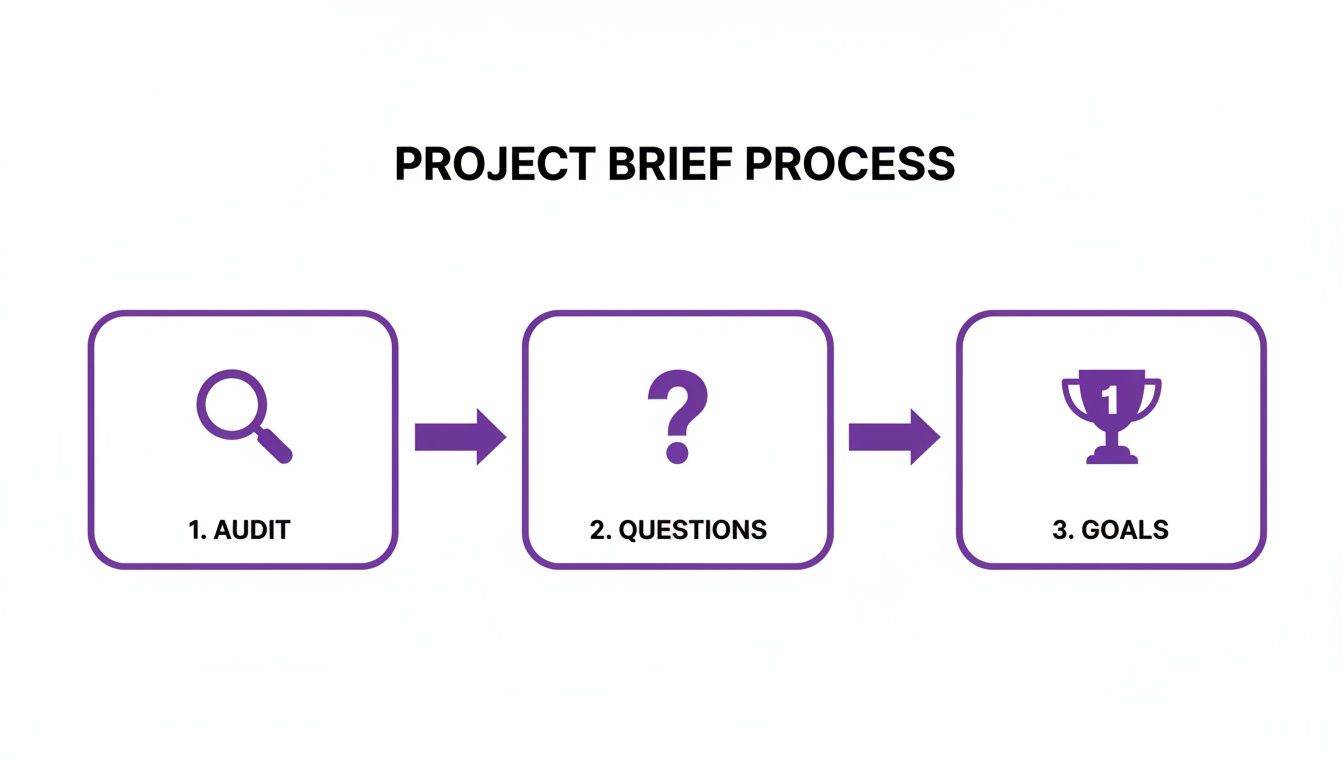
Starting with that deep audit, asking the right questions, and having clear goals gives you a solid framework for evaluating potential partners on their ability to deliver tangible results.
Insightful Interview Questions to Ask
Once you’ve got a shortlist, the interview is your chance to get past the sales pitch and see how they really think. Forget the standard, predictable questions. You need to dig deeper to uncover their problem-solving skills and see if you can actually work with them.
Here are a few questions I’ve found that really reveal what a business intelligence consultant is made of:
- "Walk me through a project where the client's data was an absolute mess. What were your first three steps, and how did you manage expectations with the stakeholders?" This tells you everything about their diagnostic skills and how they handle tough conversations when things aren't perfect.
- "Looking at our brief, what potential risks or roadblocks do you see? How would you suggest we tackle them before they become a problem?" A great consultant is always thinking a few steps ahead. This shows if they're proactive and strategic, not just waiting for instructions.
- "Let's say we build the dashboards, but the team isn't using them. What's your plan to drive adoption and prove the value of what we've built?" This is the killer question. It separates a pure technician from a true business partner who knows that success is about people, not just software.
The answers to these questions will tell you far more than any CV. You're listening for someone who instinctively talks about business outcomes first and technology second.
The UK market for BI expertise is booming. It saw 5.6% growth last year, and with cloud BI now a £3.5 billion market, finding a genuine expert is the only way to get a real return on your investment. For more insight into selecting a strategic partner, this guide on engaging a marketing automation consultancy has some brilliant, universally applicable advice.
Ultimately, finding the right consultant is about building trust. It should feel like a collaborative partnership right from that very first conversation.
To get expert advice on your business intelligence needs, Phone 0845 855 0000 today or Send us a message.
Getting to Grips with Consultant Costs and Deliverables
Talking about money can be tricky, but it’s absolutely essential for a successful project. When you bring a business intelligence consultant on board, getting the financial side straight from the outset builds a foundation of trust and transparency. Let’s break down the common ways consultants charge and what you should expect to see for your investment.

Getting this clarity ensures your budget is tied to real, measurable outcomes. No one likes nasty surprises on an invoice, and a well-defined contract based on a clear pricing structure protects both you and the consultant.
How Consultants Typically Charge
You'll usually find that BI consultancy fees fall into one of three main categories. The right one for your business really depends on the size, scope, and predictability of your project.
Here’s a quick overview of the pricing models you'll likely encounter, with some typical UK rates to give you a ballpark idea.
Comparing BI Consultant Pricing Models
| Pricing Model | Description | Best For | Typical UK Price Range (GBP) |
|---|---|---|---|
| Hourly/Daily Rate | You pay for the consultant's time. It's a direct, pay-as-you-go approach. | Ad-hoc tasks, troubleshooting, or projects where the scope is fluid and hard to pin down initially. | £600 – £1,200 per day |
| Fixed-Price Project | A total cost is agreed upon for a specific set of deliverables. You know the final price upfront. | Well-defined projects with a clear scope, like building a specific set of sales dashboards. | Varies by project (e.g., £5k – £25k+) |
| Retainer Agreement | A set monthly fee is paid for an agreed number of hours or a certain level of ongoing support. | Long-term strategic advice, regular system maintenance, and continuous improvement of your BI setup. | £1,000 – £4,000+ per month |
As you can see, there’s a model to fit most needs. A fixed-price project gives you budget certainty, while a daily rate offers flexibility for smaller, undefined tasks.
The two biggest factors driving cost are the complexity of your data and the consultant's experience. A straightforward dashboard using clean data from Dynamics 365 will naturally cost less than a project that involves untangling and integrating data from multiple legacy systems.
A Checklist for What You’re Actually Getting
So, what should you get for your money? It's not just about billable hours; a professional engagement must produce tangible assets and clear outcomes. Your contract needs to spell out these deliverables so there’s no grey area around what "done" looks like.
Here’s what a typical BI project should deliver, broken down by phase.
Phase 1: Discovery and Strategy
- Data Systems Audit: A proper report detailing the state of your current data sources. It should flag any issues with quality, accessibility, or structure.
- Requirements Document: This is crucial. It's a formal document that translates your business goals into concrete technical requirements for the project.
- BI Strategy Roadmap: Think of this as the master plan. It should outline the project phases, key milestones, timelines, and the proposed technical architecture.
Phase 2: Development and Implementation
- Data Model: The engine of your BI solution. This is the logical structure, usually built in Power BI, that connects your data sources into a "single source of truth."
- Interactive Dashboards and Reports: The main event! This is where you see your data brought to life in a visual, interactive format. If you want a deeper dive, our guide on how to create a Power BI dashboard has some valuable pointers.
- Security Configuration: Simple documentation showing how data access is managed (often using row-level security) to ensure your team only sees the data they're supposed to.
Phase 3: Training and Handover
- User Training Sessions: Essential for adoption. This should be hands-on training for your team, showing them how to use, interpret, and get real value from the new reports.
- Technical Documentation: A "user manual" for your IT team. It needs to explain how the solution is built, how to maintain it, and how to troubleshoot common problems.
- Post-Project Support Plan: A clear agreement outlining what happens next. It should define the terms for ongoing support, whether that’s ad-hoc help or a more formal retainer.
By insisting on these deliverables, you shift the engagement from a vague expense to a measurable investment—one with a clear path to delivering genuine business value.
To get a clear quote for your BI project, Phone 0845 855 0000 today or Send us a message.
Onboarding Your Consultant and Measuring Success
You’ve signed the contract. Great. But that’s just the starting line—the real work begins now. A successful partnership with a business intelligence consultant lives and dies by two things: a smooth, organised onboarding and a crystal-clear way to measure success. Get this right from day one, and you set the project up for a win.
The first few days are absolutely critical for building momentum. A messy start means your consultant wastes precious, billable hours just figuring out who to talk to or how to get into the systems they need. A structured onboarding gets them productive immediately.
Hitting the Ground Running
The first order of business is getting your consultant properly integrated into the team. This is more than just a welcome email; it’s about giving them the tools and access they need to actually do their job. You wouldn't ask someone to drive your car without giving them the keys first, right?
Here’s what you need to sort out straight away:
- System Access: Get them access to the essentials without delay. That means Microsoft 365, Dynamics 365, Azure portals, and any other data sources they’ll be working with. Holding this up is a classic project-killer.
- Key Introductions: Line up short, sharp meetings with the main project sponsor and the heads of key departments like sales, finance, or operations. This gives the consultant vital business context and puts a face to a name for when they have questions.
- Clear Communication Lines: Set up a dedicated space for project chat. A channel in Microsoft Teams or a recurring check-in call works well. Consistent communication nips misunderstandings in the bud and keeps everyone on the same page.
Handling these practical steps efficiently shows you’re organised and professional, establishing a great working relationship from the get-go.
Defining What a "Win" Looks Like
Once your consultant is in and settled, the focus has to shift to defining what success actually looks like. Vague goals like “we want better insights” are completely useless. You need concrete, quantifiable Key Performance Indicators (KPIs) that leave zero room for interpretation.
This is where you take the goals from your initial brief and turn them into hard targets. It's not just about proving the project's value at the end; it's about holding everyone accountable for the results along the way.
Don't make the mistake of waiting until the project is over to think about ROI. Your success metrics need to be defined before a single dashboard is built. This is how you ensure every bit of work is directly tied to a tangible business outcome.
For example, if one of your biggest headaches was the hours your team wasted building manual reports, a brilliant KPI would be to reduce report generation time by 50% within three months. It’s specific, measurable, and demonstrates immediate value.
Tracking KPIs That Actually Matter
The KPIs you choose have to be directly linked to the business problems you’re trying to solve. They should reflect genuine improvements in how your business runs—whether that’s in efficiency, accuracy, or profitability.
Here are a few real-world examples of powerful KPIs for a BI project:
- Improved Data Accuracy: Aim to achieve a 99% accuracy rate in financial reporting, which you can validate by cross-referencing against source systems. This builds trust in the numbers across the whole organisation.
- Faster Decision-Making: Start tracking the time it takes to get answers to critical business questions. A great goal is to slash the query-to-answer time from a few days down to just a few minutes.
- Increased Revenue: Use the new insights from your BI solution to spot cross-selling opportunities, with a target of increasing the average customer spend by 10% in the next quarter.
This data-driven approach is no longer a "nice-to-have". The UK’s Business Intelligence market hit a value of £3.5 billion in 2023. Forecasts predict it will surge at around 8% annually, potentially reaching £5 billion by 2028. This shows the massive opportunity for businesses right here in the East Midlands to turn their data into a serious competitive advantage. You can discover more insights about the UK BI market on marketreportanalytics.com.
By setting these benchmarks early on, you create a clear roadmap for success. It ensures your investment in a business intelligence consultant delivers a tangible, measurable return that genuinely moves your business forward.
Ready to define your success metrics and get started? Phone 0845 855 0000 today or Send us a message.
Ready to Make Your Data Work for You?
You now have a clear roadmap to find a business intelligence partner who can genuinely help your business grow. It’s not just about building flashy dashboards; it’s about empowering your team to make smarter, faster decisions backed by real data. The potential sitting inside your business systems is enormous, and you're now equipped to unlock it.
Following a structured process—from defining what you really need to properly vetting consultants and setting clear success metrics—is the key to a great return on your investment. This is how you move from guesswork to confident, informed action and build a lasting data-driven culture.
The next step is a simple conversation to see how this could look for your business.
Let's talk about how a tailored business intelligence strategy can help your SME. Call us on 0845 855 0000 or send us a message to get started.
Common Questions Answered

When you're thinking about bringing in a business intelligence consultant, it's only natural to have a few questions. We get asked these all the time by SMEs across the UK, so here are some straightforward answers to help you move forward with confidence.
How Long Does a Typical BI Project Take for an SME?
Honestly, there's no single answer—it really depends on the scope and complexity of what you need to achieve. It’s crucial to set realistic expectations from day one.
A tightly focused project, like building a specific set of sales dashboards in Power BI from a clean, well-organised Dynamics 365 data source, could be wrapped up in about 4-6 weeks. That's assuming the data is ready to go and the goals are crystal clear.
On the other hand, a more comprehensive initiative can easily take 3-6 months. This might involve building a new data warehouse from the ground up, pulling in information from multiple legacy systems, doing a major data clean-up, and then training your team. A good consultant will insist on a discovery phase to properly scope the work and give you an accurate timeline.
Is Microsoft Power BI Our Only Option for Tools?
While we're Microsoft specialists and genuinely believe Power BI offers fantastic value, it certainly isn't the only BI tool out there. We just find it's often the best fit for SMEs, especially those already embedded in the Microsoft ecosystem with tools like Microsoft 365 and Azure.
The seamless integration makes it an incredibly efficient and cost-effective choice. That said, other powerful platforms like Tableau and Qlik have their own merits.
A consultant worth their salt won't just push their preferred tool. They'll take the time to understand your current IT setup, your business needs, your budget, and where you want to be in a few years. Only then will they recommend the platform that truly fits your unique situation.
The right tool is simply the one that solves your business problem most effectively. For many of the SMEs we partner with, the synergy already present in their Microsoft stack makes Power BI the logical and powerful choice.
What Ongoing Support Is Needed After the Project Ends?
A BI solution should never be a 'fire and forget' project. To get real, long-term value from your investment, you'll need some form of ongoing support. Your business will change, and your data strategy has to keep pace.
After the initial build, support usually falls into three main areas:
- Technical Support: This is about keeping the engine running—fixing software glitches, troubleshooting data refresh failures, or optimising performance as your data grows.
- User Support: As your team starts using the reports and dashboards, they'll inevitably have questions or want to try new things. This support ensures they don't get stuck.
- Strategic Support: Your business priorities will shift. Strategic support helps you adapt your reports, build new dashboards, and make sure your BI platform continues to answer your most critical questions.
We offer flexible support contracts, from ad-hoc help when you need it to a fully managed service, ensuring your BI solution remains a valuable asset.
Can a BI Consultant Help with Data Security and GDPR?
Not only can they, they absolutely must. Any reputable business intelligence consultant has to be an expert in data governance, security, and UK regulations like GDPR. Frankly, it's a non-negotiable part of the job.
They'll help you implement practical security measures, like row-level security in Power BI reports. This is a clever way to ensure team members only see the data they are authorised to see—essential for sensitive information like HR records or sales commissions.
Beyond that, they’ll guide you on best practices for storing and handling personal data in platforms like Azure. As your partner, we build security into every project from the very beginning. This gives you peace of mind that your data is being managed responsibly, ethically, and in full compliance with UK law.
Ready to unlock the potential hidden in your data? The experts at F1Group are here to help.
Phone 0845 855 0000 today or Send us a message to start the conversation.