
Think of business IT solutions as the digital toolkit that a modern company uses not just to function, but to thrive. It’s all the systems, software, and expert services that help you operate efficiently, grow your customer base, and keep your data safe. We’ve moved a long way from just calling IT when a computer crashes; today, technology is woven into the very fabric of business strategy.
Beyond Break-Fix: The New Role of IT
The old way of thinking about IT was simple: something breaks, you call for a fix. This reactive model is outdated and, frankly, expensive. Modern business IT solutions turn this idea on its head. The focus now is on proactive management and strategic planning, preventing problems before they ever start.
Instead of being a cost you have to bear, technology is now a powerful driver for growth, security, and getting things done better and faster. This isn’t just a trend; it’s a massive shift, reflected in the huge investments UK businesses are making in their digital foundations.
The UK IT services market is booming, currently valued at somewhere between £105-112 billion. Experts predict it will surge to an incredible £180 billion by 2032, fuelled by the race to the cloud, the need for digital transformation, and ever-present security threats.
What Modern IT Solutions Actually Involve
So, what are we really talking about when we say ‘IT solutions’? It’s less about individual bits of hardware and more about a complete, tailored approach to achieving your business goals.
The key ingredients usually include:
- Proactive Management: Keeping a constant, watchful eye on your systems to spot and fix potential issues before they can cause any downtime. It’s about ensuring everything just works.
- Strategic Security: Building multiple layers of defence to shield your critical data and networks from the constantly evolving world of cybercrime.
- Scalable Infrastructure: Using flexible technologies like cloud services that can easily grow or shrink with your business needs, so you never pay for more than you need.
- Efficiency and Automation: Putting smart tools and workflows in place to handle the repetitive, manual tasks, freeing up your team to focus on what really matters.
The Real-World Business Impact
At the end of the day, any investment in IT has to deliver a clear return. This isn’t just about saving money on hardware. It’s about creating a more robust, agile, and productive company. A well-designed cloud setup, for instance, can slash your server costs while making it easier for your team to collaborate from anywhere.
Take automation as another example. A simple tool like a chatbot for IT support can handle common queries instantly, freeing up your support team for more complex problems. By embracing these kinds of solutions, technology stops being a necessary evil and becomes one of your greatest assets for success.
To see how F1Group can build a robust IT strategy for your business, give us a call on 0845 855 0000 today or Send us a message.
The Components of a Modern Business IT Strategy
Think of your IT strategy not as a single product, but as the blueprint for how your business runs. The individual IT solutions are the crucial components—the wiring, the plumbing, the security systems—that make everything work together seamlessly. Without a smart, integrated plan, you’re just patching things together, which makes growth slow, difficult, and risky.
Let’s break down the core technologies that form the foundation of any modern, efficient, and secure organisation. We’ll look at each one in plain English, explaining what it does and the real-world value it brings to your business every single day.
The diagram below shows how these solutions slot together to help you hit key business goals: boosting efficiency, locking down security, and paving the way for growth.
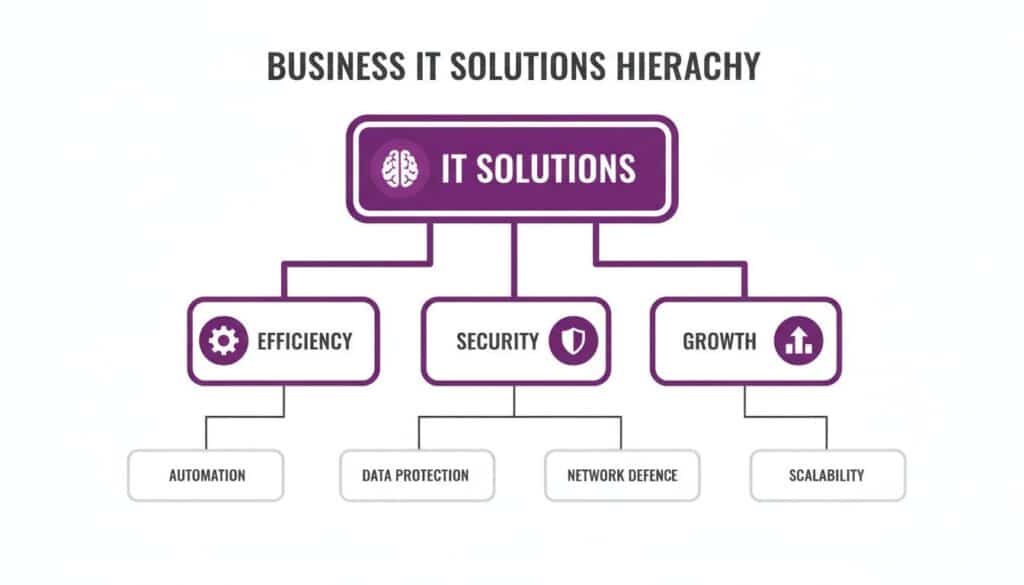
As you can see, a powerful IT strategy isn’t just about the tech itself. It’s about using the right tools to achieve solid business outcomes.
Proactive Managed IT Services
The first and most important component is Managed IT Services. This is a complete departure from the old “break-fix” way of thinking, where you only call for help after something has already gone wrong and brought work to a standstill. Instead, managed services take a proactive approach, focused on keeping your entire technology infrastructure healthy from the outset.
Imagine having a dedicated team of experts constantly monitoring your systems. They spot potential issues before they cause downtime and make sure everything from your network to your software is running just as it should be. It’s a model that gives you predictable monthly costs, minimises frustrating disruptions, and frees up your own team to focus on their jobs, not on fighting with technology.
A good managed service provider (MSP) also acts as your strategic partner. They offer expert advice on where to invest in technology and help align your IT with your long-term business ambitions. This partnership is the bedrock of any stable and secure IT environment.
Flexible Cloud Services with Microsoft Azure
Next up is the cloud. Cloud services, especially powerful platforms like Microsoft Azure, give modern businesses the flexibility and scale they need to compete. Rather than buying and maintaining expensive physical servers in your office, you can access all the computing power, storage, and software you need directly over the internet.
It’s a bit like switching from running your own power generator to plugging into the national grid. You get reliable, powerful resources on-demand and only pay for what you actually use. This “pay-as-you-go” approach dramatically cuts down on upfront capital costs and makes enterprise-level technology accessible to businesses of any size.
For instance, a retailer can instantly scale up server capacity to handle the Christmas rush and then scale it right back down in January, optimising costs. Azure lets you host applications, store huge amounts of data securely, and run complex operations without the headache of managing physical hardware.
Empowering Collaboration with Microsoft 365
While Azure handles the heavy lifting in the background, Microsoft 365 is the suite of tools your team uses every day to work together effectively, whether they’re in the office or at home. It’s so much more than just Word and Excel; it’s a complete ecosystem designed for modern communication and collaboration.
Microsoft 365 brings together familiar applications and integrates them with powerful cloud services, including:
- Teams: The central hub for chat, video meetings, and file sharing that keeps projects and conversations in one place.
- SharePoint and OneDrive: Secure cloud storage that makes sharing documents and collaborating in real-time completely seamless.
- Exchange Online: A robust, professional-grade email platform you can access securely from any device.
By bringing these tools under one roof, Microsoft 365 breaks down the barriers between departments and creates a single, unified environment for getting work done. This is absolutely critical for supporting today’s remote and hybrid work models.
A well-implemented IT strategy is not about adding more technology; it’s about integrating the right technology to remove friction, enhance security, and create new opportunities for the business to grow and succeed.
Specialised and Custom Solutions
Beyond the core infrastructure, many businesses need more specialised tools to run specific parts of their operation. This is where platforms like Dynamics 365 and the Power Platform come in, offering advanced features and the ability to create custom solutions.
Dynamics 365 is a suite of intelligent business apps for managing key functions like sales, customer service, and finance. It brings data from different departments together into one place, giving you a single source of truth for making smarter, data-driven decisions. For instance, your sales team can get deep insights into customer behaviour, leading to better engagement and more closed deals. For a deeper look at this, you might find our guide on creating a successful IT strategy useful.
The Microsoft Power Platform (including Power BI, Power Apps, and Power Automate) takes this a step further. It allows your business to build custom apps and automate repetitive workflows with little to no coding knowledge. An employee could build a simple app to track stock from their phone or automate the process of sending out monthly reports, saving countless hours of manual effort. These tools put the power to innovate directly into the hands of your team.
The Non-Negotiable Layer of Cybersecurity
Finally, wrapping around all of these components is the absolute non-negotiable layer of cybersecurity. In a world where digital threats are constant and always evolving, a strong defence isn’t just a good idea—it’s essential for survival. Modern cybersecurity isn’t a single product; it’s a multi-layered strategy.
A comprehensive defence should always include:
- Managed Firewalls: Your first line of defence, controlling all the traffic that comes into and goes out of your network.
- Endpoint Protection: Securing individual devices like laptops and mobiles against malware, ransomware, and viruses.
- Multi-Factor Authentication (MFA): A crucial extra login step that makes it much harder for criminals to gain unauthorised access.
- Employee Training: The human element. Teaching your team to spot phishing emails and other scams is one of the most effective defences you can have.
A security breach can be financially devastating and cause irreversible damage to your reputation. The only way to protect your data, your customers, and your business’s future is by weaving a strong, proactive cybersecurity plan into every part of your IT infrastructure.
To summarise how these solutions fit together, the table below provides a quick overview.
Key Business IT Solutions at a Glance
| IT Solution | Primary Function | Key Business Benefit |
|---|---|---|
| Managed IT Services | Proactive monitoring, maintenance, and strategic support of all IT systems. | Minimises downtime, provides predictable costs, and enables focus on core business activities. |
| Microsoft Azure | Scalable on-demand cloud computing power, storage, and infrastructure. | Reduces capital expenditure, improves flexibility, and provides enterprise-level reliability. |
| Microsoft 365 | Integrated suite of collaboration and productivity tools (Teams, Office, etc.). | Enhances teamwork, enables remote/hybrid work, and unifies communication channels. |
| Dynamics 365 | Intelligent business applications for sales, service, and operations. | Unifies business data, provides actionable insights, and improves customer relationships. |
| Power Platform | Low-code tools for building custom apps, dashboards, and automated workflows. | Empowers staff to solve problems, automates manual tasks, and drives innovation. |
| Cybersecurity | Multi-layered protection against digital threats (firewalls, MFA, etc.). | Protects critical data, prevents financial loss, and safeguards business reputation. |
Each of these building blocks plays a vital role. When combined correctly, they create a powerful, resilient, and secure technology foundation that doesn't just support your business—it actively helps it grow.
To discuss how these components can form a winning strategy for your business, call us on 0845 855 0000 today or send us a message.
How AI Is Reshaping How We Work
Artificial Intelligence (AI) isn't just science fiction anymore; it's a practical tool that’s changing how businesses get things done. It’s no longer reserved for massive corporations with deep pockets. Today's business IT solutions are bringing AI to companies of all sizes, with a focus on intuitive tools that work like a smart assistant for your team.
This tech is brilliant at automating the tedious, repetitive jobs that eat up so much time. It can also uncover powerful insights hiding in your business data, helping your staff make faster, more informed decisions. Think of it as giving every employee their own personal analyst to handle the grunt work, freeing them up to focus on the big picture.
This isn't just a future trend; it's happening right now. AI adoption among UK businesses has really taken off. In the wider market, 39% of organisations are already using AI, and another 31% are seriously exploring it. That means nearly 70% of businesses are either on board or getting ready to be. You can get a better sense of the trend by reading more about the state of AI adoption in UK businesses.
Making AI Practical with Microsoft Copilot
One of the biggest game-changers for bringing AI into the workplace is Microsoft Copilot. This isn't some new, complex application you have to learn from scratch. Instead, it’s an intelligent assistant built directly into the Microsoft 365 apps your team already uses every single day—Word, Excel, Teams, and Outlook.
Copilot literally acts as a 'co-pilot' for your work, helping with a massive range of tasks. Its real magic is its ability to understand the context of what you're doing. It securely accesses your company’s data—emails, documents, calendars—to give you genuinely helpful, relevant assistance. The goal is to enhance your team's skills, not replace them.
For instance, an employee can ask Copilot to:
- Summarise a long, confusing email thread in Outlook to get the key points instantly.
- Draft a proposal in Word using notes from a Teams meeting.
- Analyse sales figures in Excel and create charts that highlight important trends.
- Pull together a list of action items from a recorded meeting.
Tasks that used to take hours can now be done in minutes. To see how you could get this working in your own business, take a look at our guide on getting started with Microsoft AI Copilot.
The Real-World Impact on Productivity
The bottom line? Integrating AI like Copilot delivers a major boost to productivity and efficiency. When you automate the routine stuff, your people are freed up to focus on the creative, strategic, and high-value work that actually pushes the business forward.
By handling the administrative heavy lifting, AI empowers your team to work smarter, not just harder. It transforms data from a passive resource into an active asset that informs decision-making at every level of the organisation.
Imagine your marketing manager preparing for a quarterly review. Instead of spending a day digging through spreadsheets, they can just ask Copilot to analyse campaign performance, pinpoint the best-performing channels, and create a presentation summarising it all. This gives them the time to actually think strategically about what to do next quarter.
This is the real value of modern AI solutions. They give you a tangible advantage that increases output, improves the quality of work, and ultimately leads to smarter business outcomes.
To explore how AI can be integrated into your business strategy, phone 0845 855 0000 today or Send us a message.
Choosing the Right IT Partner in the East Midlands
Picking a provider for your business IT is a huge decision. It's less like hiring a supplier and more like bringing on a long-term business partner. You're not just buying technical skills; you’re looking for a team that genuinely gets your goals, communicates openly, and is there for you when things go wrong. For businesses here in the East Midlands, having that partner nearby can make all the difference.

The best IT partners feel like an extension of your own team. They need to be able to fix most things remotely for speed and efficiency, but also provide the peace of mind that comes with rapid on-site support for businesses in Lincoln, Nottingham, and Leicester. It’s vital to see past the sales pitch and find a provider whose culture and vision for growth actually align with yours.
Key Questions to Ask Potential Partners
Before you sign any contracts, you need to do your homework. Asking the right questions will quickly reveal a provider’s true capabilities and their attitude towards customer service. It’s the easiest way to see if they’re a good fit for your company.
Start with these fundamentals to get a feel for their expertise and reliability:
- What are your technical credentials? You’re looking for official certifications, especially from big names like Microsoft. This isn't just a badge; it proves they’ve met some pretty tough standards for knowledge and skill.
- Can you provide local case studies or references? Nothing beats hearing from another business in the East Midlands that has worked with them. It gives you invaluable, real-world insight into how they actually perform.
- What does your support model look like? Get into the details. Will you have a dedicated account manager? What are their guaranteed response times for different problems?
- How do you take ownership of problems? This one is critical. A great partner doesn't point fingers. If an issue involves a third-party supplier (like your internet provider), you need to know they will chase it and manage it until it’s sorted.
These questions help you cut through the marketing fluff and get to the core of what a potential partner can really offer.
The Importance of Local Presence and Expertise
While so many IT problems can be fixed from afar, you can't overestimate the value of having a local partner. When a server dies or your entire network goes down, you need skilled engineers on-site, fast. A provider based hours away just can't compete in a real emergency.
A local IT partner understands the regional business environment and can offer a more personalised, responsive service. It’s the peace of mind that comes from knowing hands-on help is just a short drive away when you need it most.
There’s another side to it, too. A local team has a vested interest in the success of the community. Their reputation is built on the service they provide to neighbouring businesses, which naturally leads to stronger, more accountable relationships. It feels like a genuine partnership, not just another transaction. You can see how this works for specific areas by looking into managed IT support in Nottingham and the surrounding region.
Verifying Technical and Security Standards
Finally, any provider you trust with your critical systems must have an ironclad commitment to security and professional standards. You need to be sure their own house is in order, not just the solutions they’re selling you.
Here are a few non-negotiables to check:
- Certifications: Are they accredited by bodies like Microsoft? This is a strong indicator of a high level of expertise.
- Staff Vetting: It’s a simple question: are their engineers and support staff DBS-checked? This is essential if you’re giving them access to your premises and sensitive data.
- Service Level Agreements (SLAs): Ask to see their SLAs. They should be clear, contractually binding documents that define service commitments, including uptime guarantees and response times.
Choosing the right IT partner is a direct investment in your company’s stability and future. By asking tough questions and prioritising local expertise and proven credentials, you can find a team that will help you grow for years to come.
Measuring the Real Return on Your Technology Investment
So, you've invested in new business IT solutions. How can you be absolutely sure that money is actually working for you? It’s a perfectly fair question, and the answer isn’t found on the initial invoice. To see the true value of your tech, you need to measure its Return on Investment (ROI), which lays bare the real financial impact on your business.
Justifying any significant spend means getting a clear picture of both the costs and the concrete benefits it brings. This isn't about vague feelings or guesswork; it's about tracking specific, measurable improvements in how your business runs – the kind that directly impact your bottom line.
Moving Beyond the Upfront Cost
The first hurdle is to stop thinking about the purchase price as the whole story. It's just the beginning. A proper ROI calculation looks at the total value the technology delivers throughout its life. This means you need to add up not only the direct cost savings but also the less obvious gains that give your business a serious boost.
Take a proactive managed IT service, for example. You see a fixed monthly fee, but what does it prevent? Recent studies show that the average cost of IT downtime can hit small businesses for hundreds, even thousands, of pounds an hour. If that service stops just one major outage a year, it has likely paid for itself several times over.
Calculating ROI forces a shift in mindset. You stop seeing IT as just another business expense and start treating it as a strategic investment – one that generates real returns through better productivity, lower risk, and a more capable team.
This approach arms you with hard data, letting you make smarter decisions and prove the value of your technology choices to anyone who asks.
Pinpointing the Right Things to Measure
To get an accurate ROI, you need to focus on specific, quantifiable metrics. These are the real-world changes you can actually track and put a number on.
Here are a few key areas to watch:
- Employee Productivity Gains: How much time are people saving on tasks that are now faster or automated? If a new cloud platform saves each of your 20 employees just two hours a month, you've just clawed back 40 hours of productive time. Every single month.
- Reduced System Downtime: Work out what past outages cost you in lost sales and staff wages. Now, compare that to the rock-solid uptime you have with your new, reliable systems. That difference is pure financial gain.
- Stronger Data Security: This one can feel tricky to measure, but think of it as risk avoidance. You can easily estimate the potential cost of a data breach – often tens of thousands of pounds for a small business. Investing in solid cybersecurity is an investment in preventing that catastrophe.
A Practical ROI Example
Let's put this into practice with a quick example. Imagine your business invests £5,000 in a new cloud server and a managed support package. Over the next twelve months, you track the results:
- Efficiency Gains: Your team saves a combined 50 hours per month thanks to faster systems and easy remote access. Based on average wages, that’s worth £9,000 over the year.
- Downtime Avoidance: You swerve two major system failures that, based on past experience, would have cost at least £4,000 in lost revenue and emergency repairs.
- Hardware Savings: You get to scrap the planned £2,000 purchase of a new physical server.
In this simple scenario, your initial £5,000 investment has delivered £15,000 in tangible value in just one year. That’s a powerful, data-driven story that proves the strategic importance of getting your IT right.
To learn how to measure the potential ROI for your own business, phone 0845 855 0000 today or send us a message.
What's the Next Step for Your IT Strategy?
Pulling the trigger on a new IT strategy is a big decision, one that can genuinely shape the future of your business. As we've walked through in this guide, getting it right isn't just about fixing what's broken. It's about weaving together proactive managed IT, powerful Microsoft tools like Azure and Copilot, and a seriously robust cybersecurity defence. If any of those threads are weak, you risk leaving your business open to costly downtime, sluggish performance, and ever-present security threats.
This is where F1Group comes in. We specialise in taking all these critical components and building a single, joined-up strategy for businesses right here in the East Midlands. We know that companies in our region need more than an anonymous helpdesk on the other end of a phone line. They need a real, local partner—someone they can trust, who responds quickly, and who brings top-tier skills to the table. Our team is dedicated to providing that hands-on support, making sure your technology is an engine for growth, not a source of frustration.
A great IT strategy isn’t a one-and-done project. It’s a continuous commitment to staying secure, efficient, and ready for what's next. Having the right local partner is what turns that commitment into a real advantage.
If you’re ready to build an IT foundation that can actually keep up with your ambitions, we're here to help you map out the journey. We'll start by getting to grips with your specific goals, then design a solution that delivers tangible results and a clear return on your investment.
It's time to build a more secure and productive future.
Give us a call on 0845 855 0000 or send a message through our website to start the conversation.
Your Questions About Business IT Solutions, Answered
Stepping into the world of business IT often throws up a lot of practical questions. It's completely normal. To give you a bit more clarity, we’ve put together answers to some of the queries we hear most often from business owners just like you.
How Much Should a Small Business Really Budget for IT?
This is a classic "how long is a piece of string?" question, but there's a solid rule of thumb. Most small and medium-sized businesses find that setting aside 3% to 6% of their annual revenue for technology is a healthy benchmark. This pot of money generally covers everything from hardware and software subscriptions to the essential support that keeps you running.
So, if your business turns over £1 million a year, you'd be looking at an IT budget somewhere between £30,000 and £60,000. Of course, the exact figure depends on your specific industry, how tight your security needs to be, and where you plan on taking the business. The best way to get a real number is to chat with an IT partner who can map out a budget that actually fits your goals.
What's the Real Difference Between Managed IT and 'Break-Fix' Support?
The old-school way of doing IT support is what we call 'break-fix'. It's purely reactive. Something breaks, you call for help, and you get a bill for the time spent fixing it. The big downside here is the unpredictability – both in terms of sudden costs and the business-stopping downtime you suffer while waiting for a fix.
Managed IT services, on the other hand, are proactive. For a predictable, fixed monthly fee, a provider like us constantly monitors and maintains your systems. The whole point is to spot and sort out issues before they become problems that halt your business. It's a strategic approach that dramatically reduces downtime, boosts your security, and makes your IT spending far more manageable.
How Long Does It Actually Take to Move to the Cloud?
The timeline for a cloud migration really hinges on what we're moving. The complexity of your current setup and the sheer amount of data you have are the two biggest factors.
- A simple move, like getting a small team’s emails and files onto Microsoft 365, might only take a few weeks.
- A more complex project, such as shifting custom-built applications and entire servers over to Microsoft Azure, could take a few months to plan and execute properly.
Any good IT partner will start by giving you a detailed project plan. It should lay out clear stages and realistic timelines to make sure the switch is as smooth as possible, with next to no disruption to your daily work. For more answers to common queries, you might find this page of general IT solution FAQs useful.
Do We Genuinely Need a Local IT Provider?
While it’s true that many IT issues can be fixed remotely, having a local team here in the East Midlands is a massive advantage when things get serious. If a critical server fails or your network goes down completely, a local engineer can be on-site and fixing it far faster than someone from a national call centre.
Beyond just emergencies, a local partner understands the regional business community and offers a more personal touch. There's real peace of mind in knowing that expert help is just around the corner, not hundreds of miles away.
Ready to build an IT strategy that actually works for your business? Get in touch with F1Group to talk through what you need.
Phone 0845 855 0000 today or Send us a message.