
Cybersecurity solutions are the technologies, processes, and services that work together to protect your company’s computer systems, networks, and data from attacks, damage, or anyone trying to get in without permission. This is about building multiple layers of defence that go way beyond basic antivirus software to handle a whole host of digital threats.
Why Modern Cybersecurity Is More Than Just Antivirus
Trying to get your head around cybersecurity can feel like a mammoth task for any business owner. It’s easy to think that a decent antivirus programme is all you need, but the kind of sophisticated threats we see today demand a much stronger defence. Relying on antivirus alone is a bit like putting a single guard on the front gate of a fortress and leaving the walls completely undefended.
Real security requires a strategy with multiple, overlapping layers. If you think of your business as that fortress, a proper cybersecurity plan is all about shoring up every single potential weak point. That means reinforcing the walls with network firewalls, setting up 24/7 surveillance with continuous monitoring, and controlling who gets in and out with robust identity management.
The Limitations of Off-the-Shelf Software
Your standard antivirus software is built to spot and block known viruses and malware by looking for recognised digital “signatures.” That’s a good first step, but it’s a purely reactive approach, leaving gaps that cybercriminals are all too happy to exploit. Newer threats, like zero-day attacks and advanced ransomware, are often cleverly designed to slip right past these simple checks.
These modern threats don’t play by the old rules. For example:
- Sophisticated Phishing: These aren’t just spam emails anymore. They are targeted attacks that trick your staff into handing over their login details, which makes signature-based software totally useless.
- Ransomware: This type of malware can lock up your entire network and demand a huge payment to get it back. It often spreads so fast that a basic antivirus can’t react in time.
- Fileless Malware: This is a particularly sneaky attack that uses your own legitimate system tools to do its dirty work, meaning there are no suspicious files for an antivirus to even scan.
A complete security strategy is no longer just an IT expense; it has become a core business function. It is essential for protecting your reputation, ensuring operational continuity, and maintaining the invaluable trust of your customers.
Building a Resilient Defence Strategy
A proactive security posture works on the assumption that a threat could come from anywhere, at any time. It’s about moving beyond just blocking what you already know is dangerous and focusing on building resilience. This means having systems in place to not only prevent attacks but also to quickly detect, respond to, and recover from them when they do happen.
This is where that layered approach is so crucial. Each layer of your defence has a specific job, from protecting individual laptops and phones (endpoints) to securing your company data in the cloud with platforms like Microsoft 365 and Azure. By combining these different cybersecurity solutions, you create a truly formidable barrier that is far harder for attackers to break through.
Bringing in a specialist IT partner gives you the expertise to manage these defences, effectively patrolling the walls of your fortress and making sure it stays secure around the clock.
Ready to build a stronger defence for your business? Phone 0845 855 0000 today or Send us a message to speak with our security experts.
The Real Threats Facing UK Businesses Today

It’s easy for business owners to fall into the trap of thinking, ‘it won’t happen to us.’ But the hard truth is that organisations right here in the East Midlands are being targeted by incredibly sophisticated attacks every single day. These aren’t just abstract warnings; they are real-world situations playing out in businesses across Lincoln, Nottingham, and Leicester.
Today’s cyber threats are no longer random, scattergun attempts. They are personal, targeted, and cleverly designed to exploit the natural trust we all have in our daily communications.
Picture this: someone in your finance team gets an email that looks like it’s from a trusted supplier. The branding is perfect, it mentions a recent project, and there’s a sense of urgency. But one click on an attachment or a link is all it takes to unleash ransomware, which silently encrypts all your critical files in Microsoft 365. Suddenly, your entire operation grinds to a halt.
This escalating threat is precisely why investment in solid defences is skyrocketing. In 2024, the UK cybersecurity sector generated a staggering £13.2 billion in revenue—a 12% jump from the previous year. This isn’t just a statistic; it shows a nationwide scramble as businesses invest in robust cybersecurity solutions to stand against this relentless tide. You can dive into the full government report on the UK’s growing cybersecurity sector on GOV.UK.
Common Attacks and Their Impact
To build a proper defence, you first need to understand the attacker’s playbook. While their toolkit is varied, a few methods consistently cause the most damage to small and mid-sized businesses.
The table below breaks down some of the most prevalent threats targeting UK businesses and highlights the real-world consequences they can have on your operations and reputation.
| Threat Type | How It Works | Potential Business Impact |
|---|---|---|
| Business Email Compromise (BEC) | Attackers impersonate a senior executive or supplier, sending an urgent email to trick your finance team into making a fraudulent bank transfer. | Direct financial loss, reputational damage, and potential legal issues. |
| Phishing & Spear Phishing | Phishing is a wide-net attack using generic emails. Spear phishing is highly targeted, using personal details from social media to craft convincing emails that steal login details. | Compromised accounts, data breaches, malware installation, and financial fraud. |
| Ransomware | Malicious software that encrypts your files, making them inaccessible until a ransom is paid. Often delivered via phishing emails or software vulnerabilities. | Complete operational paralysis, significant financial loss (ransom and recovery costs), and data loss if backups fail. |
| Credential Stuffing | Criminals use lists of stolen usernames and passwords from other data breaches to try and log into your business systems, like Microsoft 365. | Unauthorised access to sensitive company and client data, leading to further attacks and compliance violations. |
Understanding these tactics isn’t about scaremongering; it’s about recognising the tangible risks and preparing your defences accordingly.
The consequences of a breach go far beyond the immediate financial hit. Think about the operational downtime, the lasting damage to your hard-earned reputation, and the erosion of customer trust that can take years to rebuild.
A successful attack isn’t just an IT problem—it’s a business survival issue. Proactive, layered cybersecurity solutions are no longer an optional extra reserved for big corporations. They are an absolute necessity for any business that wants to operate securely and thrive.
Phone 0845 855 0000 today or Send us a message to find out how to protect your business from these threats.
Building Your Digital Defence: A Layered Approach
A solid defence against today’s cyber threats isn’t about finding one magic solution. It’s about building multiple layers of protection that work together, much like a medieval castle with its moat, high walls, and vigilant guards. If one layer is breached, another is always ready to stop the attack.
This approach creates a formidable barrier, making it significantly harder for attackers to get through. Let’s break down the essential pieces of a modern, layered security strategy in a way that makes sense for any business owner.
Endpoint Security: Shielding Your Devices
The first line of defence starts with the devices your team uses every day. Every laptop, desktop, and mobile phone is an endpoint—and a potential doorway for an attacker. Modern endpoint security goes far beyond old-school antivirus by actively hunting for suspicious behaviour, not just scanning for known viruses.
Think of it as having a dedicated security guard for every single device. These solutions can spot unusual activity—like a programme suddenly trying to encrypt all your files (a classic sign of ransomware)—and instantly quarantine that device to stop the threat from spreading across your network.
Network Security: Your Digital Perimeter
Next up, you need to protect the digital perimeter of your business. Network security acts like the castle walls and gatehouse, controlling all the traffic flowing in and out to ensure only legitimate data and authorised users can pass. This layer is built with a few key technologies:
- Firewalls: These are your digital gatekeepers. They inspect all incoming data and block anything that doesn’t follow the security rules you’ve set.
- Virtual Private Networks (VPNs): When people work remotely, a VPN creates a secure, encrypted tunnel back to your company network. This is crucial for protecting data from being snooped on when using public Wi-Fi.
- Intrusion Detection Systems: These systems are like digital watchdogs, actively monitoring network traffic for any signs of an attack and alerting your team to jump into action.
A layered approach means that even if a threat gets past one defence, like a clever phishing email, other layers like endpoint and network security are there to contain it. This resilience is what effective cybersecurity is all about.
Email Security: The Frontline Defence
With over 90% of cyber attacks starting with a phishing email, your email security is probably the most critical frontline defence you have. Attackers have become masters of disguise, crafting convincing emails that trick even the most careful employees into clicking malicious links or opening dangerous attachments.
Advanced email security solutions scan every incoming message for red flags associated with phishing, malware, and impersonation attempts. They use sophisticated analysis to spot things a human eye might miss—like tiny variations in a sender’s email address or links that secretly point to a fraudulent website. This filtering happens before the threat ever has a chance to land in someone’s inbox.
Identity and Access Management
Who holds the keys to your digital kingdom? Identity and Access Management (IAM) is your virtual bouncer, checking IDs and making sure people only go where they’re supposed to. The goal is simple: ensure the right people have access to the right information at the right time, and absolutely no one else. This is a central idea in modern security, and you can learn more about how this works by exploring the fundamentals of Zero Trust security.
This is typically handled with two key practices:
- Multi-Factor Authentication (MFA): Requiring a second proof of identity, like a code from a mobile app, makes it exponentially harder for an attacker to get in, even if they’ve stolen a password.
- Principle of Least Privilege: This is a simple but powerful concept. Employees are only given access to the specific data and systems they absolutely need to do their jobs. It drastically limits the potential damage if one of their accounts is ever compromised.
For companies that build their own tools, creating a comprehensive defence also means mastering software development security best practices.
Backup and Disaster Recovery
Finally, even with the best defences in the world, you have to be prepared for the worst-case scenario. A Backup and Disaster Recovery (BDR) plan is your ultimate safety net. It’s about making regular, secure copies of your critical data and having a well-rehearsed plan to get your systems back online quickly after a disaster, whether that’s a ransomware attack or a server failure. A solid BDR solution is what keeps your business running, minimising downtime and financial loss when things go wrong.
Ready to build a stronger, layered defence for your business? Phone 0845 855 0000 today or Send us a message to speak with our security experts.
Unlocking Security Inside Microsoft 365 and Azure
For many businesses, a powerful suite of security tools is already hiding in plain sight within their existing Microsoft 365 and Azure subscriptions. You might think you need to buy more software to be secure, but often the key is to properly unlock the enterprise-grade cybersecurity solutions you’re already paying for.
This isn’t about just ticking boxes on a feature list. It’s about taking these tools, configuring them correctly, and making them solve real-world problems. With the right expertise, your Microsoft environment can be transformed from a simple productivity suite into a formidable, active defence system.
Beyond the Basics of Your Microsoft Licence
It’s a common story: an organisation invests in Microsoft 365 but only ever scratches the surface of what’s possible. While everyone uses Teams and Outlook daily, powerful security features often lie dormant, just waiting for a specialist to switch them on.
Take Microsoft Defender, for instance. It’s far more than a simple antivirus; it’s a complete endpoint protection platform that can detect and automatically respond to sophisticated threats on your laptops and servers. Then there’s Microsoft Sentinel, which acts as your security nerve centre. It pulls in data from across your entire digital estate—from cloud apps to network devices—to spot the subtle signs of a coordinated attack.
The diagram below shows how different security layers, like those in Microsoft’s ecosystem, work in harmony to protect the heart of your business.
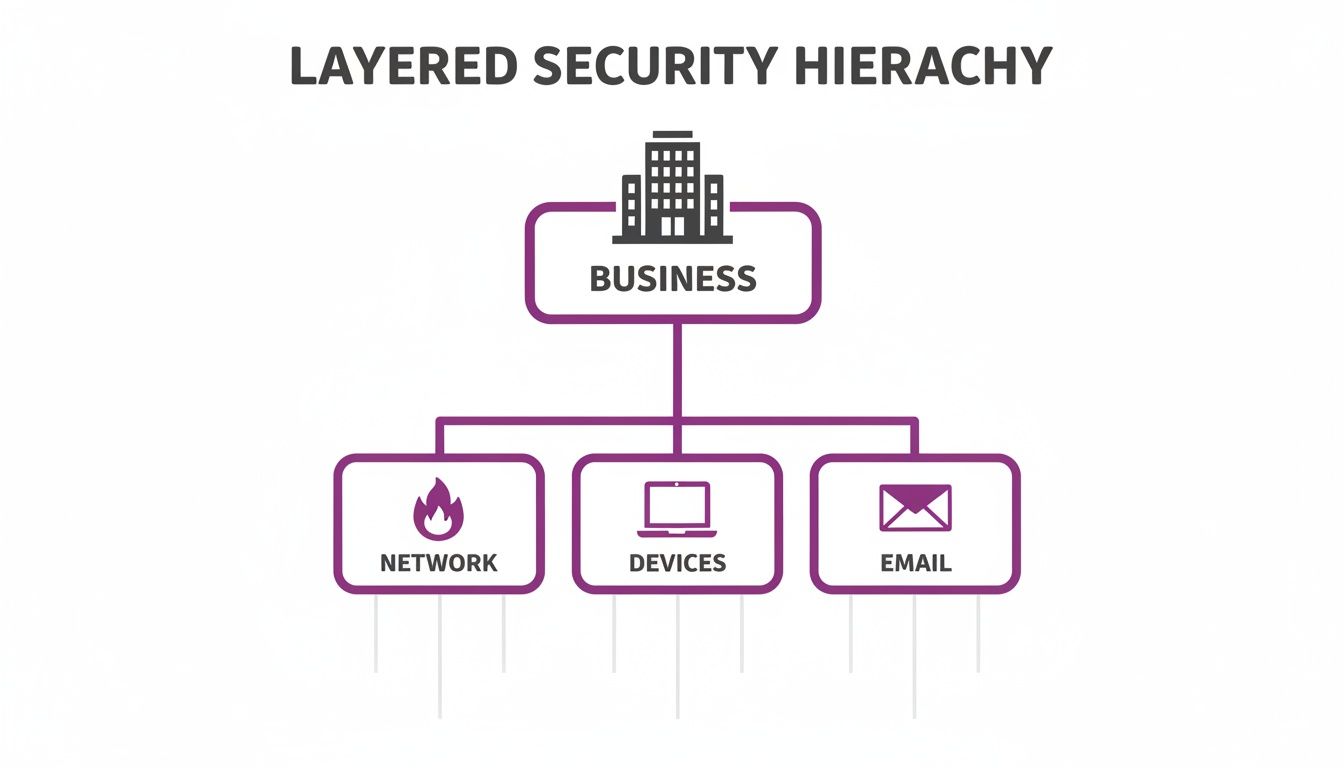
This layered approach is crucial. True protection comes from coordinating your defences across critical areas like the network, company devices, and email systems—all of which can be managed directly within the Microsoft security stack.
Putting Security Policies into Action
The real strength of the Microsoft ecosystem comes alive when you start putting automated policies to work. Conditional Access policies are a perfect example of this.
Imagine an employee tries to log into their Microsoft 365 account from an unusual location at 3 AM. A well-configured Conditional Access policy will instantly recognise this suspicious behaviour. It can then either block the sign-in entirely or demand extra proof of identity, like a multi-factor authentication (MFA) prompt. This is real-time, automated action that can stop a breach before it even begins.
Of course, controlling who can access what is just as important. For any business with multiple users and sensitive data in platforms like Microsoft 365 and Azure, implementing strong Role Based Access Control Best Practices is essential. It’s all about giving people the minimum access they need to do their job, and no more.
By intelligently combining tools like Microsoft Defender, Sentinel, and Conditional Access, you create a security posture that is not just reactive, but proactive. It actively hunts for threats and enforces your security rules automatically, 24/7.
Managing Data and Meeting Compliance
Protecting your business isn’t just about keeping attackers out; it’s also about controlling the sensitive data you hold. This is where Microsoft Purview comes in. It’s specifically designed to help you discover, classify, and protect sensitive information—like financial records or customer data—no matter where it lives.
For example, you could set up a policy that automatically applies a “Confidential” label to any document containing credit card numbers. This would then prevent that file from being shared externally. This kind of capability is vital for meeting compliance standards like GDPR and showing you’re taking your data protection duties seriously.
This integrated approach is more important than ever as businesses embrace hybrid working. With the old office perimeter gone, cloud security has become the main line of defence, expected to capture 63.84% of the UK cyber market by 2025. For East Midlands businesses, mastering these Microsoft tools is the key to giving your team consistent, reliable protection, wherever they are.
Phone 0845 855 0000 today or Send us a message to unlock the full security potential of your Microsoft investment.
Why a Managed Security Partner Is a Smart Investment
Let’s be honest: keeping up with the relentless pace of cyber threats is a full-time job. It’s a constant battle. For most small and mid-sized businesses, trying to build an in-house team with all the right skills and tools just isn’t realistic. This is where a managed security partner can be a real game-changer.
Outsourcing your security isn’t just about handing over a to-do list. It’s a strategic move. You instantly gain a team of certified experts, round-the-clock threat monitoring, and proactive defence systems, all for a predictable monthly cost. It’s about achieving a robust security posture without breaking the bank.
The Clear Business Case for Outsourcing
When you actually sit down and crunch the numbers, the financial logic is hard to ignore. The annual salary for just one qualified cybersecurity analyst in the UK can easily top £60,000. That’s before you even think about recruitment costs, training, benefits, and the very expensive software they need to be effective.
With a managed service partner, you get the collective brainpower of an entire team—analysts, engineers, and strategists—often for a fraction of that single salary. You’re tapping into enterprise-grade technology and 24/7 vigilance that would be prohibitively expensive to build from scratch. After all, effective security risk management is about more than just software; it needs constant, expert human oversight.
The market reflects this shift. The UK cybersecurity market, valued at around £7.06 billion in 2024, is expected to explode to over £23.09 billion by 2035. Services are projected to make up a massive 62.73% of that market as more businesses realise that outsourcing is the smartest way to tackle skills shortages and tight budgets. You can see the full UK cybersecurity market forecast on marketresearchfuture.com.
A managed security partner transforms cybersecurity from a reactive, unpredictable cost centre into a proactive, budgeted investment. It frees you up to focus on running your business, knowing your digital assets are in safe hands.
The Advantage of Local Expertise
While many providers operate nationally or even globally, there’s a real, tangible benefit to working with a local team that knows the regional business landscape. For businesses across the East Midlands, having a partner who can be on-site quickly when you need them most is invaluable.
A local partner brings more than just technical skill; they offer a relationship built on trust and accessibility. Think about what that means in practice:
- Rapid On-Site Response: During a critical incident, having an expert physically there to support your team can slash resolution times and minimise the damage to your business.
- Deeper Understanding: A local team gets the specific challenges and opportunities that businesses in places like Lincoln, Nottingham, and Grimsby face every day.
- Accountability and Trust: There’s a different level of partnership when you can put a face to a name. You’re not just another ticket in a queue; you’re a valued client they know and understand.
By turning a complex, costly problem into a managed, cost-effective solution, a local security partner empowers your business to operate securely and with confidence.
Phone 0845 855 0000 today or Send us a message to discuss how a managed security partnership can benefit your business.
How to Choose the Right cybersecurity Partner
Choosing an IT partner is one of the most important decisions you’ll make for your business. It’s not just about finding someone who knows the tech; it’s about finding a team that gets your business, understands how you work, and genuinely wants to see you succeed. Let’s cut through the sales pitches and look at what really matters when finding a partner who can truly protect you.
Making a smart choice means asking the right questions—the tough ones. A good potential partner will welcome your diligence and give you straight, confident answers. Use this checklist as your guide to make sure you’re picking a provider who has the muscle to keep your business secure.
Essential Questions for Any Potential Provider
Before you sign on the dotted line, you need to be sure of their skills, their track record, and their commitment. Vague promises won’t cut it when your business is on the line.
Here are the non-negotiables you need to ask:
-
What are your guaranteed response times for a critical incident? Knowing their Service Level Agreement (SLA) is crucial. If something serious like a ransomware attack hits, you need to know exactly how quickly they’ll jump into action.
-
Are your engineers certified and DBS-checked? This is about trust. You need to know their team has proven technical skills and that they are reliable people you can trust with your sensitive data.
-
How will you help us meet standards like Cyber Essentials? A proactive partner won’t just fix problems; they’ll guide you through certifications. Achieving these standards shows your commitment to security and can even help lower your insurance premiums.
-
Can you provide genuine local support in Grimsby or Newark? For any business in the East Midlands, having a partner who can be on-site quickly is a massive advantage. It means getting real, hands-on support when it matters most, not just a call centre hundreds of miles away.
Verifying Technical Expertise and Focus
Beyond the basics, you need a partner whose technical focus matches your own systems. For a huge number of UK businesses, that means having deep expertise in the Microsoft ecosystem. A specialist partner can unlock the full potential of security tools you might already be paying for.
Choosing a partner is more than a technical decision; it’s about trust. You need a team that takes full ownership of your security, allowing you to focus on growing your business with complete peace of mind.
This is exactly why finding a Microsoft-focused provider is so important. Their specialised knowledge means that powerful tools like Microsoft 365 and Azure aren’t just switched on—they’re expertly configured to give you the best protection possible. You can see how this works by exploring a dedicated managed security service.
Ultimately, the right partner becomes an extension of your own team. They bring together local presence with world-class expertise to deliver the security and reassurance your business needs to thrive.
Phone 0845 855 0000 today or Send us a message to discuss how we can become your trusted cybersecurity partner.
So, What Are Your Next Steps?
Taking that first step to beef up your security can feel like a huge task, but it doesn’t have to be a complicated one. It all boils down to one thing: understanding where your business is most vulnerable and creating a sensible plan to fix it.
Maybe you’re just a bit unsure about your current defences, or perhaps you’re ready to build a proper security strategy from the ground up. Whatever your situation, we’re here to help you figure it out.
We’ve been giving clear, no-nonsense advice to businesses across the East Midlands for years. If you want to have a straightforward chat about how to protect your organisation, we’d be happy to talk.
Give us a call on 0845 855 0000 or send us a message to get the conversation started.
For robust, reliable cybersecurity solutions, Phone 0845 855 0000 today or Send us a message.