
Endpoint protection services are essentially your business's digital frontline defence, standing guard on every single device connected to your network. These services work tirelessly, 24/7, to block cyber threats like malware and ransomware before they have a chance to do any real damage. In short, they are a non-negotiable part of modern business security, locking down every potential entry point, from laptops to servers.
What Do Endpoint Protection Services Actually Do?
Imagine your business network is a high-security building. In the old days, you might have poured all your resources into a massive, impenetrable front door—your main office firewall. But today’s work environment isn’t like that. It has countless windows and back doors. Every laptop, smartphone, tablet, and server is an "endpoint," a potential way in for a cybercriminal.
With remote and hybrid work now the norm, the number of these endpoints has skyrocketed. An employee's home laptop connecting to your company server, a director's smartphone checking emails in a coffee shop – these are all endpoints. This explosion of devices drastically expands your company's "attack surface," which is simply the total number of points an attacker could try to break through.
Why Endpoints Are a Prime Target
Cybercriminals are opportunistic; they know that endpoints are often the weakest link in a company's defences. It’s no surprise that research consistently shows a huge percentage of security breaches start right at these devices. Attackers go after them for a few key reasons:
- The Human Factor: People make mistakes. An employee might accidentally click a malicious link or download an infected file, unknowingly opening the door for an intruder.
- Direct Access to Data: Endpoints are where the work gets done, meaning they often store or access sensitive information, from financial records to client details.
- A Gateway to the Wider Network: Once an attacker compromises a single device, they can use it as a foothold. From there, they can often move deeper into your IT infrastructure, escalating the attack and causing far more damage.
This is precisely where endpoint protection services step in. They are far more than just basic antivirus software; they are a comprehensive suite of security tools and expert management designed to defend these vulnerable entry points. To understand the bigger picture of how this fits into a complete security plan, it's worth exploring what managed cybersecurity services encompass.
A robust endpoint security strategy changes the game. Instead of just protecting the central network, you’re securing every individual device. It's the difference between only guarding the bank vault and placing a guard at every single door and window of the bank.
Ultimately, these services provide a critical defensive layer that’s essential for keeping your business running. They act as your first line of defence against the overwhelming majority of cyber threats, stopping problems that could easily lead to costly downtime, data loss, and a damaged reputation. Securing these individual points isn't just a good idea anymore—it's a core strategy for survival and growth.
Phone 0845 855 0000 today or Send us a message
The Building Blocks of Modern Endpoint Security
To really get to grips with modern endpoint protection services, it helps to look under the bonnet at the technologies working together to keep your business safe. This isn't about a single piece of software; it's an interconnected system where every component has a critical job to do. Think of it as assembling a specialised security team, not just hiring one guard for the front door.
Each part of this team watches over the different devices—laptops, phones, servers—that connect to your network, creating a protective bubble around your operations.
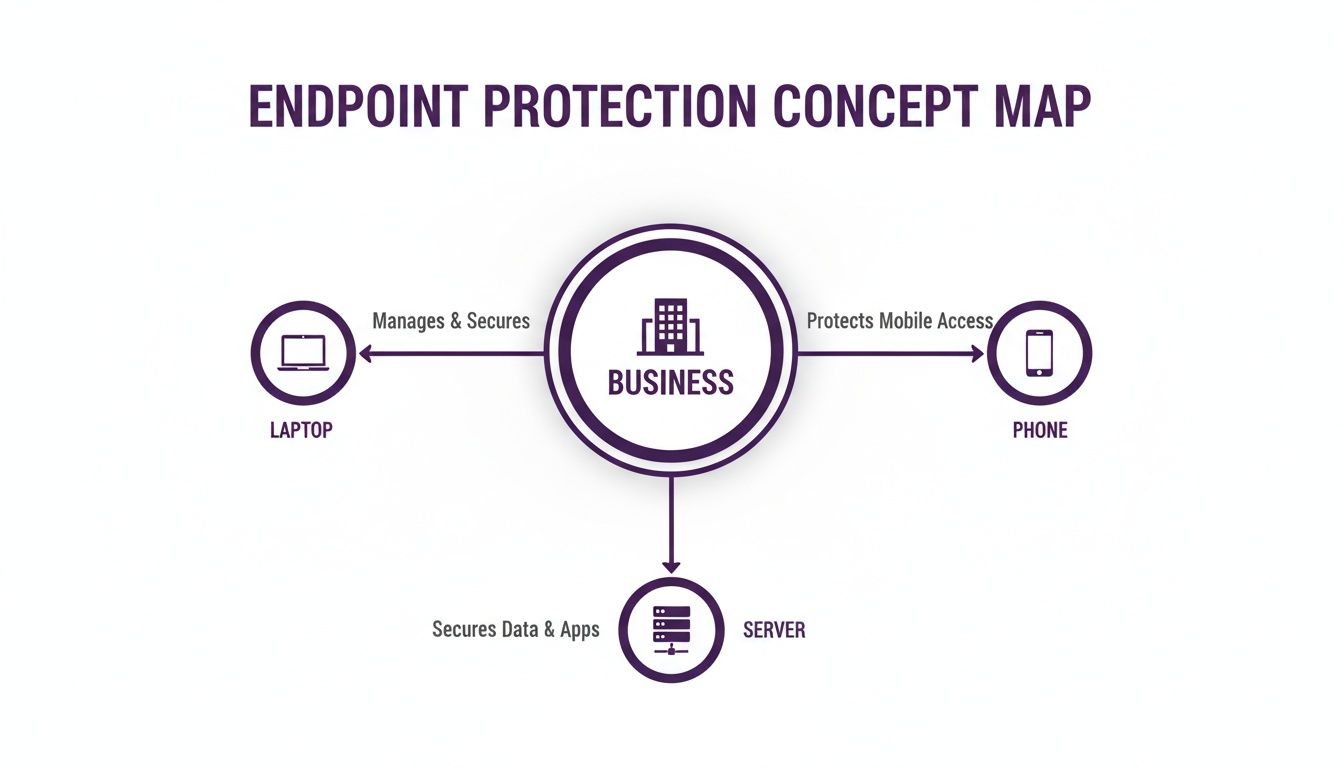
This picture really drives home the point that security can no longer be confined to the office. It has to go wherever your people and your data go.
Next-Generation Antivirus (NGAV)
The first and most familiar layer is antivirus, but what we use today is a world away from the clunky software of the past. Traditional antivirus was reactive. It worked off a list of known threats, a bit like a bouncer with a photo book of troublemakers. If a new threat wasn't in the book, it could stroll right in.
Next-Generation Antivirus (NGAV) is far more intelligent. It uses artificial intelligence (AI) to analyse behaviour and spot suspicious activity. Instead of looking for a known face, it looks for the tell-tale signs of an attack, allowing it to stop brand-new threats it’s never seen before.
Endpoint Detection and Response (EDR)
While NGAV is your proactive gatekeeper, Endpoint Detection and Response (EDR) is your on-site security detective. It constantly monitors and logs activity across all your devices, hunting for subtle clues that an intruder might have slipped through the cracks.
If it spots something odd—say, an everyday program suddenly trying to encrypt files it shouldn't—it raises the alarm instantly. This continuous surveillance gives security experts the deep visibility they need to hunt for threats, investigate what happened, and shut down an attack before it can cause real damage.
Extended Detection and Response (XDR)
If EDR is a detective focused on one crime scene (the endpoint), then eXtended Detection and Response (XDR) is the chief inspector overseeing the entire investigation. XDR takes things a step further by pulling in and connecting security data from your whole IT environment, not just your devices.
This includes intelligence from:
- Network traffic: Spotting unusual data flows between systems.
- Cloud applications: Checking services like Microsoft 365 for compromised accounts.
- Email systems: Analysing for sophisticated phishing attempts.
By connecting these dots, XDR builds a single, unified picture of an attack as it unfolds, which means the response can be far faster and more effective.
Essential Supporting Functions
Beyond these core detection tools, a complete endpoint protection service layers on several other critical functions to toughen up your defences and make life easier.
Here's a quick summary of how these key technologies fit together.
Key Endpoint Protection Components at a Glance
| Component | Primary Function | Business Benefit |
|---|---|---|
| NGAV | Proactively blocks known and unknown malware using AI. | Prevents most common cyberattacks from ever gaining a foothold. |
| EDR | Continuously monitors endpoints to detect and investigate threats. | Provides deep visibility to stop sophisticated, stealthy attacks. |
| XDR | Correlates data from endpoints, networks, and cloud services. | Delivers a unified view for faster, more accurate threat response. |
| Patching | Automatically applies security updates to software. | Closes vulnerabilities before they can be exploited by attackers. |
| Device Control | Manages which peripherals (e.g., USBs) can connect. | Prevents data theft and the introduction of malware from external devices. |
| Encryption | Scrambles data on hard drives to make it unreadable. | Protects sensitive information if a device is lost or stolen. |
These components work in concert to create a truly resilient security posture.
"A robust endpoint security strategy is built upon effective IT Asset Management best practices, which ensure all devices are accounted for and properly secured throughout their lifecycle."
Automated Patching: Cybercriminals love hunting for outdated software with known security holes. Automated patching takes this job off your plate, consistently applying the latest security fixes to close those dangerous gaps.
Device Control: This feature lets you decide which devices can connect to your computers. You can block unauthorised USB sticks or external hard drives, which is a simple but powerful way to stop malware from being introduced and prevent data from walking out the door. We cover this in more depth for mobiles in our guide to https://www.f1group.com/intune-mobile-management/.
Encryption: Lastly, endpoint encryption scrambles the data on a device’s hard drive, turning it into unreadable code without the right key. So, if a laptop is ever lost or stolen, your confidential data stays exactly that—confidential.
The Real Business Value of Managed Protection
Thinking about endpoint protection services as just another IT cost is missing the bigger picture. It's actually a strategic investment—one that delivers real, measurable value by making your business smarter, safer, and far more resilient. For small and medium-sized businesses across the East Midlands, shifting your mindset from security as a cost centre to a growth enabler is the key. After all, the damage from a security breach goes way beyond a simple financial hit.
The true value really shines through when you compare the predictable, manageable cost of working with a managed partner against the eye-watering expense and complexity of trying to build the same thing yourself.
The In-House vs Managed Cost Equation
Trying to create a professional security service from scratch internally is a mammoth task, especially for an SME. The costs can quickly spiral out of control when you start adding up all the moving parts.
- Expert Salaries: Finding and keeping certified cybersecurity professionals is both difficult and expensive. A single senior security analyst can easily command a salary upwards of £70,000 a year, and you'll need a whole team of specialists for proper coverage.
- Software Licensing: The enterprise-level security tools you need, like powerful EDR and XDR platforms, come with hefty licensing fees that can run into thousands of pounds every year.
- 24/7 Monitoring: Cyber threats don’t work 9-to-5. To be properly protected, you need a round-the-clock Security Operations Centre (SOC), which means hiring analysts to cover multiple shifts. That’s an investment very few SMEs can realistically make.
- Continuous Training: The threat landscape changes constantly. Keeping an in-house team’s skills up to date means a non-stop investment in training courses and certifications.
When you tally it all up, the total cost of an in-house solution is almost always far higher than the predictable monthly fee from a managed service provider. Managed endpoint protection services wrap up all that expertise and technology into one scalable cost, turning a volatile capital expense into a straightforward operational one.
Boosting Operational Resilience and Eliminating Downtime
One of the biggest returns you’ll see from managed protection is in business continuity. A single successful cyberattack, like ransomware, can grind your entire operation to a halt. We’re not talking hours; it could be days or even weeks.
The financial fallout from that kind of downtime is staggering. Think about the direct and indirect costs:
- Lost revenue because you can't sell your products or deliver your services.
- Paying staff who are sat at their desks, unable to work.
- The huge expense of recovery, which might include ransom payments and emergency IT consultant fees.
- The long-term damage to your hard-earned reputation with customers and suppliers.
By proactively stopping these incidents before they happen, managed security services directly protect your bottom line and keep your business running. That’s why understanding how to prevent ransomware attacks is absolutely fundamental to building a resilient business.
Protecting Your Most Valuable Asset: Your Reputation
In today's market, trust is everything. A security breach that exposes customer data can do irreparable harm to your company's reputation. People are simply less likely to do business with an organisation they feel can't keep their information safe. The long-term damage to customer loyalty and brand perception can be devastating.
Investing in robust endpoint security is an investment in customer trust. It signals that you take your data protection responsibilities seriously, safeguarding not just your own assets but those of your clients and partners.
This isn't just a hunch; it's reflected in market trends. The UK's endpoint security market was valued at a massive £585 million in 2024. This figure, which is projected to grow, shows just how seriously UK businesses are taking this. It underscores a growing realisation that strong security isn't a defensive move—it's a direct investment in your company's future.
To secure your company's future and boost its resilience, phone 0845 855 0000 today or send us a message to discuss your security needs.
How to Choose the Right Security Partner
Choosing a partner to manage your company's security is one of the most critical decisions you can make. This isn't just about buying a piece of software; it’s about placing a core part of your business's resilience in someone else's hands. Get it right, and you gain robust protection and genuine peace of mind. Get it wrong, and you could be left dangerously exposed when it matters most.
For businesses here in the UK, especially across the East Midlands, finding a partner who genuinely gets your local operational landscape is key. A generic, one-size-fits-all service simply won't do. You need a provider who feels like an extension of your own team—someone who aligns their security strategy with your specific goals, budget, and real-world risks. That means you need to go in armed with the right questions.
To help you cut through the sales noise and make a confident choice, we've put together a practical checklist. Use these points to really dig into what a potential partner can offer.
Your Essential Security Partner Checklist
Before you even think about signing a contract, you have to look beyond the slick presentation. A truly capable partner will be transparent, deeply knowledgeable, and more than willing to give you straight answers.
Here’s what you need to be asking:
1. Incident Response Plan and Expertise
- What is your documented process for handling a security breach? Don't just take their word for it; ask to see the plan. You need to know how quickly they respond and the exact steps they take from detection to full recovery.
- What qualifications and certifications does your security team hold? Look for established, industry-recognised credentials like CompTIA Security+, CySA+, or specific qualifications from the technology vendors they use.
- Can you share some anonymised case studies of recent incidents you’ve handled? This is crucial. It shows they have real-world, battle-tested experience, not just theoretical knowledge.
2. Technology and Integration
- What core technologies are you using for endpoint protection? Are they relying on industry-leading tools for next-gen antivirus and EDR, or something less proven?
- How will your solution integrate with our existing IT systems? A good partner ensures a seamless fit, not a clunky add-on that causes more headaches than it solves.
- How do you source and apply threat intelligence? Are they plugged into global threat feeds? Do they proactively hunt for threats that are specifically targeting your industry?
A great security partner doesn't just install software and walk away. They weave a security-first mindset into your operations. They should be able to explain complex threats in plain English and show you exactly how their service stops those risks from harming your business.
3. Service Level Agreements (SLAs) and Reporting
- What are your guaranteed response times for different alert levels? Get this in writing. Vague promises like "a fast response" are a red flag. You need concrete numbers.
- What will your reports look like? Ask for a few samples. A good report is clear, insightful, and gives you a regular, easy-to-understand overview of your security posture, the threats they’ve blocked, and the actions taken on your behalf.
- What happens if we're not happy? What are the contract's exit clauses? Understanding how to leave a partnership is just as important as knowing how to enter one.
The Importance of Local Support
For organisations in places like Nottingham, Lincoln, or Leicester, having a local partner can make a world of difference. While most monitoring happens remotely, a local presence means the provider understands the regional business climate. Even more importantly, when a major incident demands on-site help, having a team that can physically be there is invaluable. This is a fundamental part of how F1 Group delivers our it managed security services—by combining world-class technology with hands-on, local expertise.
A local partner isn't just another vendor; they're part of your community. They have a vested interest in your success because their reputation is built on the success of the businesses around them. Choosing a provider who offers both advanced remote protection and accessible local support gives you the best of both worlds, ensuring your business is looked after by people who truly get it.
To start a conversation about securing your business with a trusted local partner, Phone 0845 855 0000 today or Send us a message.
What Does Endpoint Protection Actually Cost?
When you start looking into professional endpoint protection, one of the first questions is always about the price. The good news is that the costs are usually very predictable, turning security from a lumpy, unpredictable capital expense into a manageable monthly operational cost. No more nasty surprises on the budget spreadsheet.
Most providers, including us, use a straightforward subscription model. You’ll typically pay a set fee per device or per user each month. This is fantastic for growing businesses because it scales with you. As you bring new people on board, you just add them to the plan. If someone leaves, you can remove them. You only ever pay for what you’re actively protecting.
What Goes into the Final Price?
So, what factors actually determine that monthly fee? It's more than just a software licence; the price reflects the depth of protection and the level of expert management wrapped around it. A basic service will naturally be at the lower end, while a comprehensive package with a team of experts watching your back 24/7 will sit higher up the scale.
Here’s what typically influences the final figure:
- The Core Tech: Is it a solid next-generation antivirus (NGAV), or does it have the more advanced Endpoint Detection and Response (EDR) technology that allows experts to actively hunt for threats?
- Monitoring and Management: Does the service include round-the-clock monitoring from a Security Operations Centre (SOC), or is it a more automated system with standard business-hours support?
- The Scope of Service: Are essential features like automated software patching, device encryption, and controlling USB port access included as part of the deal?
- Advanced Capabilities: Adding premium features like eXtended Detection and Response (XDR), which pulls together security data from your entire IT environment (not just endpoints), will also be a factor in the cost.
Typical Managed Endpoint Protection Pricing Tiers
To give you a real-world idea of what to expect, services are often bundled into tiers. While every provider has their own structure, this approach lets you choose a level of protection that matches your risk and budget. For most UK businesses, you should be budgeting somewhere in the region of £5 to £15 per endpoint, per month.
Here’s an example table breaking down what those tiers might look like.
| Service Tier | Typical Features Included | Estimated Monthly Cost (GBP per Endpoint) |
|---|---|---|
| Essential | Next-Generation Antivirus (NGAV), Automated Patching, Web Filtering. | £5 – £8 |
| Advanced | All Essential features, plus Endpoint Detection & Response (EDR), 24/7 Monitoring. | £8 – £12 |
| Premium | All Advanced features, plus Extended Detection & Response (XDR), Proactive Threat Hunting. | £12 – £15+ |
This kind of tiered model means there’s a sensible starting point for any business. You can build a solid security foundation and then decide to ramp things up as your business grows or as new threats emerge.
Breaking it down like this makes the investment much clearer. You’re not just buying a tool; you’re investing in the stability and future of your business.
To get a precise quote that’s built around your specific needs, give us a call on 0845 855 0000 today or Send us a message.
Your Local East Midlands Security Partner
It’s one thing to get your head around the theory of endpoint protection, but it’s another thing entirely to find a partner who can translate that knowledge into real-world, robust security for your business. This is where big concepts need to become local, actionable support.
For businesses across the East Midlands—from Lincoln and Nottingham to Leicester—having a security partner on your doorstep isn’t just a nice-to-have. It’s a genuine strategic advantage.
At F1 Group, we don’t just supply software licences. We deliver the confidence that comes from knowing you’re properly protected. Think of us as an extension of your own team, taking full ownership of your security so you can get back to what you do best: running your business.
Why a Local Partner Makes All the Difference
Choosing a local provider gives you so much more than a remote helpdesk. You get a partner who is genuinely invested in your success and the community we both share. Our DBS-checked engineers provide a level of trust and accountability that a faceless national firm simply can’t offer. If a situation calls for it, we’re right here, ready to be on-site when you need us most.
We live and breathe the Microsoft security ecosystem, which means we’re experts at getting the most out of the tools your business probably already has. This lets us build a powerful, integrated security setup that’s not only effective but also makes smart use of your existing investments.
We believe the best security partnerships are built on trust, transparency, and a shared commitment to your goals. Our role is to act not just as a provider, but as a strategic ally in your journey towards a more secure and resilient future.
The need for this kind of hands-on partnership has never been more pressing. The National Cyber Security Centre (NCSC) reported a staggering 64% jump in ransomware attacks against UK organisations in 2022. It’s no wonder British firms now spend an estimated £1.9 billion a year on endpoint security. If you’re interested in the numbers, you can explore the market data on endpoint security in Europe to see the full picture.
Our commitment is straightforward: we help organisations just like yours work more securely, so you can focus on your goals with complete peace of mind.
Ready to secure your business with a trusted, local expert? Give us a call on 0845 855 0000 or send us a message to get started.
Your Endpoint Protection Questions Answered
It’s one thing to understand the theory, but quite another to commit your business to a new security service. It’s only natural to have a few practical questions before you take that step, and getting straight answers is key to making the right decision.
We get asked these questions all the time by business owners. Here are the most common ones, along with some straightforward, no-nonsense answers to help you feel confident about the path forward.
What’s the Real Difference Between Antivirus and Endpoint Protection?
This is probably the most important question of all. The simplest way to think about it is this: traditional antivirus is like a basic burglar alarm on your front door. It’s designed to recognise known threats and make a noise when one of them shows up. It’s a useful first step, but it only works against dangers it already has on its list.
Modern endpoint protection is a completely different beast. It’s more like having a full, 24/7 security team on-site. You get an AI-powered guard (that’s the next-gen antivirus, or NGAV) who can spot suspicious behaviour from a threat it’s never seen before. You also get a detective (the EDR component) who is constantly patrolling the entire premises, looking for subtle clues that something isn’t right. It’s a proactive, intelligent system designed to stop the kind of sophisticated attacks that simply walk straight past a basic antivirus.
How Quickly Can We Get It Set Up?
One of the best things about a managed service is how fast it all happens. For most businesses, the rollout is surprisingly quick and painless. Because the whole system is based in the cloud, there’s no need to install clunky servers or hardware in your office.
A good partner can usually get the lightweight software agents deployed to all your devices remotely in just a few days. That means you can go from being exposed to fully monitored and protected in a very short amount of time, without your team’s work being disrupted.
Is This Going to Slow All Our Computers Down?
A very fair question, especially if you’ve ever dealt with old-school security software that hogged all your system’s resources. Thankfully, things have moved on significantly. Today’s endpoint protection tools are built to be incredibly lightweight and efficient.
Modern security agents do most of their heavy lifting in the cloud, not on your device. This means the impact on performance is tiny, leaving your computers fast and responsive so your team can get on with their work without any frustrating delays.
You genuinely won’t notice it’s there, but it will be working hard in the background to keep you safe.
Will This Help Us with Compliance Rules Like GDPR?
Absolutely. Meeting data protection regulations like GDPR isn’t optional, and having the right security in place is a massive part of that. In fact, GDPR legally requires you to implement “appropriate technical and organisational measures” to protect personal data.
Bringing in professional endpoint protection services is a huge, tangible step towards meeting that requirement. It helps you demonstrate due diligence to regulators. Specifically, it supports compliance by:
- Preventing Breaches: It stops the very attacks that lead to costly data theft and regulatory fines.
- Enabling Encryption: It secures the data on lost or stolen laptops, a key part of GDPR.
- Providing an Audit Trail: It gives you detailed logs of security events, which are essential for investigating and reporting a breach if the worst should happen.
Ready to secure your business with a trusted, local expert? The team at F1Group is here to help.
Phone 0845 855 0000 today or Send us a message to get started.
Kim