
Imagine you hired a single security guard to watch your office's front door. Now, picture replacing that one person with an entire team of elite digital bodyguards, protecting every window, door, and digital entry point, 24/7. That's the essence of managed cybersecurity services. You're outsourcing your entire security operation to a specialist third-party provider for complete, around-the-clock protection.
What Are Managed Cybersecurity Services, Really?
In a world where digital threats are a constant reality, a reactive security stance just doesn't cut it anymore. For businesses of all sizes across the East Midlands, being proactive is essential. Managed cybersecurity services offer a strategic way forward, shifting your protection from a reactive, in-house chore to a continuous, expert-led operation.
It's about entrusting your digital safety to a dedicated team whose sole job is to anticipate, find, and shut down cyber threats before they can cause any real damage. This model gives you immediate access to top-tier security professionals, sophisticated threat-hunting technology, and that all-important 24/7 vigilance.
Let’s be honest, building an equivalent team in-house is practically impossible for most small and mid-sized businesses. The costs and complexity are just staggering. A single cybersecurity analyst can easily command a salary north of £50,000, and a full team equipped with the necessary software? You're looking at hundreds of thousands.
Gaining a Strategic Advantage
Choosing managed services is more than just a defensive move; it's a smart business decision. It frees up your internal IT team from the relentless pressure of security alerts, allowing them to focus on projects that actually drive growth and make your business better. Instead of constantly firefighting, they can finally concentrate on innovation.
By outsourcing security, you're not just buying a piece of software. You're investing in a guaranteed outcome—a partner who is contractually committed to protecting your assets, monitoring your networks, and responding to incidents with genuine speed and expertise.
Understanding the Model
To really get why this is so powerful, it helps to understand the difference between models like staff augmentation vs. managed services. While staff augmentation simply adds a person to your existing team to fill a gap, a true managed service takes complete ownership of your entire security function. This means the provider is responsible for the strategy, the tools, and most importantly, the results.
This approach delivers some serious benefits:
- Reduced Costs: You swap the massive capital outlay and ongoing salaries of an in-house security team for a predictable, manageable monthly fee.
- Access to Expertise: You instantly get a whole team of certified professionals on your side, with deep experience across countless industries and threat scenarios.
- Advanced Technology: Managed providers use enterprise-grade security tools and platforms that are often far too expensive for a single SME to buy and maintain on their own.
- 24/7/365 Monitoring: Cybercriminals don't work 9-to-5, so your protection shouldn't either. Constant vigilance means threats are caught and dealt with, day or night.
The Core Components of Your Digital Defence
When you partner with a managed cybersecurity provider, you're not just buying a single piece of software. You're bringing in a multi-layered defence system, where each part works together to keep you safe. Think of it like a specialist security team for your business, providing robust, around-the-clock protection.
It helps to imagine it as a modern digital fortress. You've got scouts actively looking for threats (threat hunters), engineers reinforcing the walls (patch management), and a central command centre coordinating the entire defence (the SOC). Every single part is critical; take one away, and the whole structure is weaker.
This comprehensive approach is precisely why so many UK businesses are rethinking their strategy. The market for services like Managed Detection and Response (MDR) is projected to climb at a 13.1% compound annual growth rate, easily outpacing standard product sales. And while large companies still account for the biggest spend, it’s the SMEs that are the fastest-growing group, with an impressive 13.8% growth rate as they look for ways to close the cybersecurity skills gap.
This diagram illustrates the relationship perfectly: your business is shielded by a provider that manages the essential pillars of expertise, technology, and constant vigilance on your behalf.
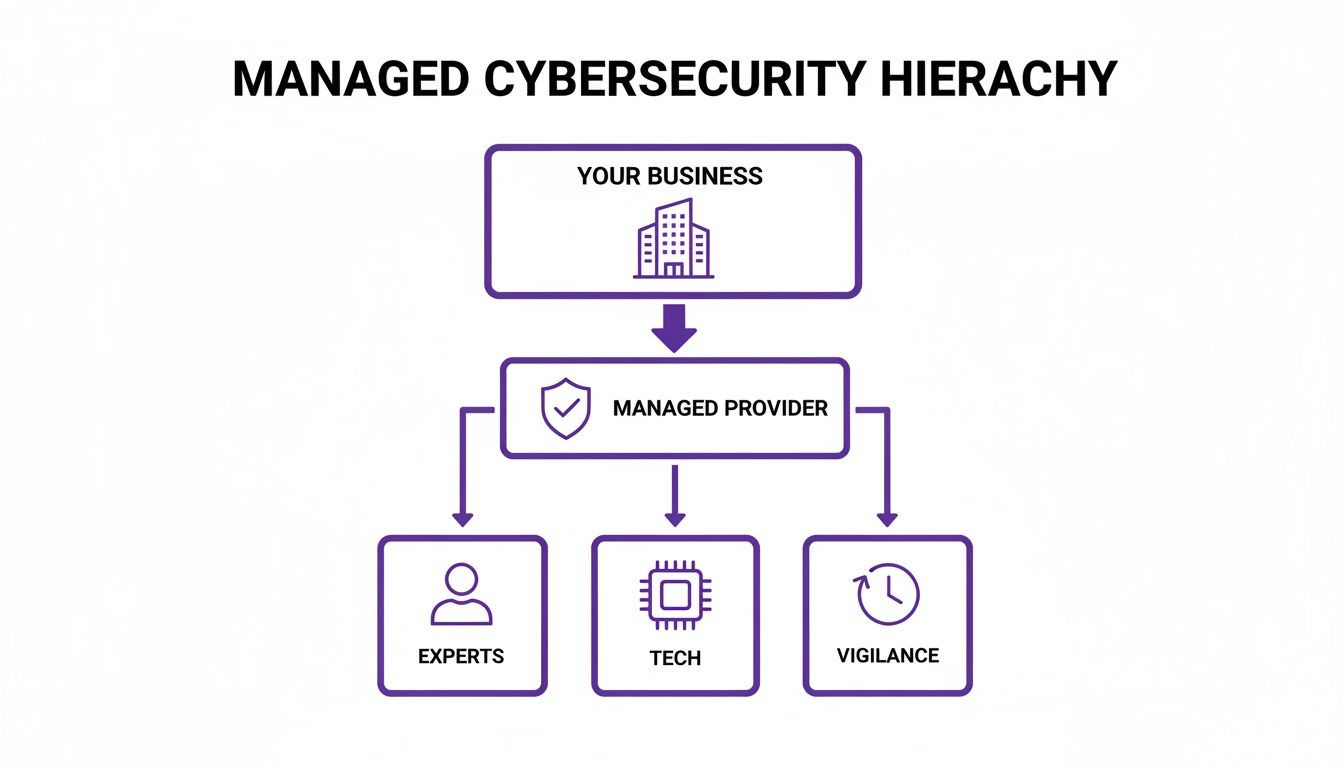
The crucial point is that your organisation sits under this protective umbrella, with an expert team orchestrating all these complex security elements for you.
Security Information and Event Management (SIEM): Your Central Intelligence Hub
Your IT systems—servers, laptops, firewalls, cloud apps—generate millions of little digital footprints, or 'logs', every single day. A Security Information and Event Management (SIEM) platform is the technology that pulls all this data together in one place. It’s like a central intelligence hub.
Its job is to sift through the noise, correlate events from different systems, and spot patterns that could signal a coordinated attack. Without a SIEM, trying to connect the dots would be like finding a needle in a continent-sized haystack. The intelligence it gathers also helps inform other security layers, such as controlling who can access your most sensitive data. To get a better handle on that, you can learn more about what is privileged access management and see how it fits into a strong security posture.
The Security Operations Centre (SOC): Your 24/7 Watchtower
The SIEM is the technology, but the Security Operations Centre (SOC) is the human brainpower behind it. This is the command centre, staffed 24/7/365 by expert security analysts whose entire job is to watch over your digital world. They are your constant guardians.
When the SIEM or another tool flags something suspicious, it’s the people in the SOC who jump on it. They investigate, figure out if it's a real threat or just a false alarm, and decide on the right course of action. This human expertise is what makes a managed service so much more than just a piece of software.
Managed Detection and Response (MDR): The Elite Threat Hunters
Your standard antivirus is great at stopping the known, common threats. But what about the sophisticated, brand-new attacks designed to slip past those initial defences? That’s where Managed Detection and Response (MDR) comes into play.
Think of an MDR team as digital detectives. They’re not waiting for an alarm to go off; they are proactively hunting for subtle clues and unusual behaviour within your network that could point to a hidden intruder. If they find something, they move fast to contain it, kick the attacker out, and stop them before they can do any real damage.
Proactive Patch and Vulnerability Management: Bolting the Doors
One of the simplest ways for a criminal to break into a network is by exploiting a known software vulnerability that someone just hasn't got around to patching yet. For any in-house team, keeping every application on every device up-to-date is a relentless, thankless task.
A managed service takes this entire headache away. Proactive patch management means critical security updates are tested and rolled out promptly across your systems, shutting down those security holes before attackers can find them.
This usually goes hand-in-hand with regular vulnerability scanning, a process that methodically checks your network for weak spots. The provider then gives you a clear, prioritised report on what needs fixing, helping you systematically harden your defences from the inside out.
Constant vigilance is key to all of this. It includes everything from high-level SIEM analysis down to granular network monitoring. For instance, understanding the raw data flow is crucial, and having tools for effective Linux network traffic monitoring is a good example of the deep visibility required to spot anomalies.
Together, these components create a cohesive and formidable shield, giving you a level of protection that most businesses would find impossible and prohibitively expensive to build and maintain on their own.
Why Smart SMEs Are Making the Switch
For small and medium-sized businesses across the East Midlands, the conversation around cybersecurity has changed. It’s no longer just about buying the right software; it's about making a smarter, more sustainable business decision. The truth is, relying on a small, in-house IT team to handle today's complex security threats just isn't cutting it anymore. The risks are too great, the required skills are too specialised, and the cost of getting it wrong is simply too high.
This isn't just a hunch; the market data tells the same story. The UK's cybersecurity sector has exploded, rocketing from £4 billion in 2015 and is on track to hit £14 billion by 2025. What's really telling is that managed services now account for 60% of that market value. Businesses are clearly voting with their budgets, choosing partnership over payroll. You can explore more data on this significant market shift to see how UK firms are focusing their security spending.
Moving to a managed cybersecurity service isn’t just an IT upgrade. It fundamentally changes the financial and operational reality of keeping your business safe, shifting security from a reactive, unpredictable cost to a proactive, fixed-cost investment in your future.
Immediate Access to Elite Expertise
One of the biggest wins for any SME is getting an entire team of certified security specialists on your side from day one. Trying to build a team with this level of skill in-house is a massive undertaking. You'd need to find and hire people who are experts in network defence, threat intelligence, incident response, and compliance regulations—a line-up that would cost a fortune in salaries alone.
With a managed service, you tap into that collective expertise for a fraction of the price. These are people who live and breathe this stuff. They see threats across dozens of different industries every single day and are constantly training to stay ahead of the curve. It’s how you get an enterprise-grade defence without the enterprise-level price tag, putting you on a much more even footing with your larger competitors.
Significant and Predictable Cost Savings
Let’s be blunt and talk numbers. The average salary for just one cybersecurity analyst in the UK can easily top £50,000-£60,000 a year. Need a more senior expert or a security manager? You’re looking at a lot more. And that's before you even start factoring in recruitment fees, ongoing training, benefits, and the eye-wateringly expensive security tools they need to do their job properly.
A managed service flips this on its head. It turns a messy pile of capital and operational costs into one, predictable monthly fee. This makes budgeting a whole lot simpler and gets rid of the nasty financial surprises, freeing up cash you can invest in actually growing the business.
When you do the maths, the return on investment is usually a no-brainer. The monthly fee for a comprehensive managed security service is almost always far less than the cost of hiring a single, full-time security professional.
Sharpening Your Business Focus
Think about your internal IT team. When they're constantly jumping from one security alert to the next, putting out fires, they aren't focused on what you hired them for: helping the business run better and innovate. They get stuck in a defensive crouch, reacting to problems instead of proactively building solutions that drive you forward.
Outsourcing your security frees them up. By handing over the 24/7 monitoring and threat management to a dedicated partner, you allow your own people to concentrate on the strategic projects that deliver real value. They can finally focus on improving systems, supporting your staff, and finding new efficiencies.
This approach achieves two vital goals at once:
- Your defences get stronger: Your security is now handled by dedicated experts whose sole job is to protect your business.
- Your internal team is unlocked: Your IT staff can stop being a cost centre and start being a catalyst for growth.
Ultimately, switching to managed cybersecurity services is a strategic move to operate more efficiently, more securely, and far more intelligently.
Ready to make a smarter security switch for your business? Phone 0845 855 0000 today or send us a message to discuss how we can help.
Securing Your Microsoft 365 and Azure Environments
Lots of businesses here in the East Midlands have put Microsoft’s ecosystem at the heart of their operations. But just having the tools doesn’t mean you’re secure. Microsoft 365 and Azure are packed with brilliant security features like Defender, Sentinel, and Entra ID, but there’s a catch: they’re complex, enterprise-level systems. Getting them right requires specialist know-how to configure, monitor, and manage them day-to-day.
It’s a bit like being handed the keys to a Formula 1 car. The potential is incredible, but without a skilled driver and a full pit crew, you’re not going to win any races—and you’re more likely to end up in the wall. A managed cybersecurity services partner is your expert pit crew, constantly tuning the engine and checking every dial to keep you safe and performing at your peak.
Their job is to get the most out of your Microsoft security investment, turning these powerful (but often underused) tools into a solid, unified defence for your business.
Going Beyond the Default Settings
Straight out of the box, Microsoft’s security settings are good, but they’re not tailored to your business and its unique risks. This is where a managed partner adds real value, providing the expert human oversight needed to turn good into great. This is where proper protection really starts.
Here’s what that expert management looks like in practice:
- 24/7 Alert Monitoring: Your internal IT team can’t be expected to watch security dashboards around the clock. A managed service provides constant monitoring, ensuring that a critical alert from a tool like Microsoft Sentinel gets investigated immediately, whether it’s at 2 PM or 2 AM.
- Expert Policy Tuning: Default security policies are one-size-fits-all. A provider will fine-tune these rules based on how your organisation actually works, cutting down on the noise from false alarms and letting you focus on genuine threats.
- Rapid Incident Response: When a real threat is spotted, every second counts. A managed team has the skills and the playbook ready to go. They can contain the threat, kick the attacker out, and get your systems back online fast, keeping disruption to a minimum.
Practical Security for Your Cloud Infrastructure
This hands-on approach delivers tangible benefits you’ll see every day. An overstretched in-house team, juggling a dozen other tasks, can easily miss a critical alert. A dedicated security partner ensures nothing falls through the cracks. It's a fundamental part of building a robust approach to security and risk management that protects your entire operation.
For example, a managed service can set up and enforce policies in Microsoft Entra ID (which you might know as Azure AD) to protect against compromised login details – one of the most common ways attackers get in. They’ll make sure multi-factor authentication is correctly rolled out and watch for any suspicious login attempts from unusual places.
In the same way, they can configure Microsoft Defender for Cloud to protect your Azure servers and services, spot misconfigurations in your cloud setup, and help you stay compliant with industry regulations. It's this proactive, continuous hardening of your cloud environment that most in-house teams simply don't have the time or the specialised knowledge to maintain.
Protecting Data and Remote Workers
In today's world of hybrid work, your data isn't just sitting on a server in the office. It's constantly flowing through Teams, getting stored in SharePoint, and being accessed from people's homes, coffee shops, and everywhere in between.
A managed cybersecurity partner extends that protection to where your team works now:
- Securing Collaboration Tools: They can implement data loss prevention (DLP) policies to stop sensitive information from being accidentally—or deliberately—shared outside the company through Teams chats or email.
- Protecting Endpoints: Using tools like Microsoft Defender for Endpoint, they secure the laptops and mobile devices your team relies on, no matter where they’re connecting from.
This ensures your remote and hybrid teams can be productive without creating new security holes, protecting what is ultimately your most valuable asset: your data.
To learn how we can fortify your Microsoft environment, Phone 0845 855 0000 today or Send us a message.
How to Choose the Right UK Cybersecurity Partner
Picking a provider to look after your company’s security is one of the most important decisions you'll make. It’s not about just hiring a supplier; it’s about finding a genuine partner who gets what you’re up against and has the credentials to back it up. Get this right, and you have a solid defence. Get it wrong, and the consequences can be severe.

The market for these services is booming in the UK, and for good reason. As businesses here have embraced digital tools, they've also opened themselves up to new risks. This isn’t just a niche service anymore; the wider UK managed services market, which includes managed cybersecurity services, is on track to hit a staggering £33 billion by 2030. You can explore more about the UK's expanding managed services market to see just what's behind this growth.
Look for Clear Service Level Agreements
First things first: get a look at their Service Level Agreement (SLA). This document is your rulebook. It's a binding contract that spells out exactly what you can expect. If it’s woolly or full of vague promises, walk away.
A solid SLA needs to nail down the specifics:
- Response Times: When a critical alert fires, how fast will they react? We're talking minutes, not hours.
- Resolution Times: What's their target for neutralising a threat and getting you back to business as usual?
- Responsibilities: In the heat of an incident, who is responsible for what? Clarity is everything when the pressure is on.
- Reporting: How will they keep you in the loop? Look for a commitment to regular, meaningful reports that give you a clear picture of your security.
Verify UK Operations and Certifications
When your business data is on the line, you need to know exactly where it's being handled. Always prioritise a partner with a UK-based Security Operations Centre (SOC). This gives you peace of mind that your data is governed by UK laws like GDPR and that the team on watch understands the threats targeting British businesses.
Beyond location, you need to see proof of their expertise. Look for industry-standard certifications. These aren’t just badges for their website; they're independent verification that the provider meets tough security and quality benchmarks. ISO 27001 (for information security) and Cyber Essentials Plus are the big ones to look for.
Ensure All Staff Are DBS Checked
Think about it: you're handing over the digital keys to your entire operation. It's not just reasonable, it’s essential to ask if their technical staff have passed Disclosure and Barring Service (DBS) checks.
This is a fundamental trust signal. It confirms the people with privileged access to your systems have been properly vetted. For any business, but especially those in sensitive sectors like finance, law, or education, this should be a non-negotiable part of your due diligence.
Evaluate Case Studies and Testimonials
Finally, you need to see proof they've done this before—for businesses like yours. Don't fall for slick marketing speak. Ask to see case studies that are relevant to your industry and company size, and read through detailed client testimonials.
A provider worth their salt will be proud to show you their track record. Pay close attention to how they describe the initial challenge, the solution they put in place, and the real-world results they delivered. This is the best indicator you'll get of their competence and whether they’re the right fit for you.
Ready to find a trustworthy cybersecurity partner? Phone 0845 855 0000 today or Send us a message.
It’s Time to Take Control of Your Business Security
The old ‘wait-and-see’ approach to cybersecurity is finished. In fact, it’s a recipe for disaster. Protecting your business means taking decisive action, moving beyond just knowing the risks to actively building a proper defence. The whole journey starts by getting a clear picture of where you’re vulnerable.
Let’s boil it all down. For a small or medium-sized business, managed cybersecurity services offer a realistic way to get enterprise-level protection without the eye-watering cost and headache of building your own security team from scratch.
What you're really buying is 24/7 vigilance from certified experts, all wrapped up in a predictable monthly cost. It turns security from a reactive, panic-driven expense into a sensible, strategic investment. Simply hoping you won't get hit by an attack isn't a strategy; it's a gamble you can't afford to lose.
Your Action Plan for a More Secure Future
Getting started is often the most daunting part, but we can break it down into a few straightforward steps. Use this checklist to get the ball rolling today.
-
Start with an Internal Review: First things first, figure out what your most critical digital assets are. Where do you keep sensitive client information? Which systems would bring your operations to a halt if they went down? You can't protect what you don't understand.
-
Get Your Questions Ready: Before you even think about talking to a provider, have a list of non-negotiable questions. You’ll want to ask about their UK-based team, their certifications (look for ISO 27001), whether their staff are DBS checked, and if they can show you case studies from businesses like yours.
-
Download Our In-Depth Guide: To give you a hand with your internal review, our free cyber security audit checklist provides a clear, structured way to assess where you stand. It’s the perfect tool to prepare you for a proper conversation with security professionals.
Don’t leave your business, your staff, and your customers exposed for a moment longer. It’s time to move from learning to doing.
Take the next step towards securing your future and gaining some much-needed peace of mind.
Give us a call on 0845 855 0000 today or Send us a message to arrange a no-obligation chat about your security.
Frequently Asked Questions
Stepping into the world of managed cybersecurity naturally brings up a few questions. As a business leader, you need to know you’re making the right call. We get it. To give you some clarity, here are our straight-talking answers to the questions we hear most often from businesses across the East Midlands.
Is My Business Too Small for These Services?
Not at all. In fact, it’s often the small and mid-sized businesses that are most at risk. Cybercriminals see them as prime targets, guessing (often correctly) that their defences aren't as robust as a large corporation's. They know you're the backbone of the economy, but likely don't have a dedicated security team on standby.
Managed services are built to scale. They bring the kind of enterprise-level protection you'd expect to see in a huge company and make it affordable and practical for a business of your size, budget, and risk level. It's how you level the playing field.
We Already Have an IT Team, Why Do We Need This?
Your in-house IT team is fantastic at what they do—keeping the daily operations running smoothly, helping users, and looking after your core systems. But cybersecurity isn’t just another IT task; it’s a completely different discipline that requires a unique set of skills, round-the-clock focus, and constant learning.
Think of a managed security provider as a specialist extension of your existing team. They bring dedicated 24/7 monitoring, cutting-edge threat intelligence, and certified expertise that’s simply unrealistic to expect from a general IT department.
This partnership frees up your IT staff to focus on what they do best: supporting your business goals and driving growth. It’s about complementing their work, not replacing it.
What Is the Typical Cost in the UK?
Pricing for managed cybersecurity services isn't a one-size-fits-all deal, as it’s shaped around what your business actually needs. The final cost will hinge on a few key things: the number of people and devices you need to protect, the specific services you choose (like 24/7 monitoring or regular vulnerability scans), and your company's overall risk profile.
Most UK providers work on a predictable monthly subscription, usually priced per person or per device. To give you a ballpark figure, a foundational plan might start from around £25-£40 per user per month. More comprehensive packages that include advanced threat hunting and incident response will naturally be more.
It’s an investment, for sure, but it’s almost always significantly less than the cost of hiring just one junior cybersecurity analyst in-house. That role alone could easily set you back over £50,000 a year in salary, and that’s before you even buy the expensive software they’d need. When you weigh it against the crippling cost of a data breach, the return on investment becomes crystal clear.
Protecting your business is too important to leave to chance. F1Group has been delivering dependable, expert IT support across the East Midlands since 1995, helping organisations like yours work more securely.
Phone 0845 855 0000 today to speak with one of our specialists, or Send us a message to arrange a no-obligation security consultation.