
When a business decides on outsourcing for IT, it’s about more than just handing over tech tasks. It means strategically shifting some, or even all, of your technology functions to a third-party expert. The goal? To free up your team to focus on what they do best—running your core business.
It's a practical move to bring in specialised skills, tighten up your security, and get a better handle on costs, all without the overhead of a full in-house IT department.
Why UK Businesses Are Outsourcing IT Now More Than Ever

For a growing number of UK businesses, particularly SMEs, IT outsourcing has evolved from a simple cost-cutting tactic into a core strategy for growth and resilience. The conversation is no longer about just fixing things when they break; it's about building a genuine competitive edge.
This change in mindset is fuelled by a few key pressures. The well-documented tech skills gap, especially in crucial areas like cybersecurity, makes finding and keeping qualified staff a constant, expensive battle. For many companies in regions like the East Midlands, simply getting access to that level of local expertise is a major hurdle.
Gaining a Strategic Advantage
This is where outsourcing really levels the playing field. It gives smaller companies access to the kind of high-end technology and expert knowledge that used to be reserved for large corporations with deep pockets. Instead of a huge capital outlay on servers and salaries, IT becomes a predictable, manageable operational cost.
The right partnership helps you shift from a reactive "break-fix" cycle to a proactive, strategic one. A good IT partner doesn’t just sit around waiting for a server to go down; they work tirelessly to prevent it from happening in the first place, ensuring your systems are actively supporting your business goals. They effectively become a seamless extension of your own team.
A modern IT partnership is a proactive alliance designed for growth. It’s about leveraging expert knowledge to not only solve today's problems but also to anticipate and prepare for tomorrow's challenges, turning technology into a business enabler rather than just a cost centre.
Responding to Market Demands
The sheer speed of technological change is another massive driver. Just keeping up with emerging threats, endless software updates, and evolving compliance rules is a full-time job in itself. An outsourced provider’s entire business is dedicated to staying ahead of these curves, so you don’t have to.
The market data backs this up. The UK IT outsourcing market is valued at approximately £19.6 billion, a figure that reflects the huge demand driven by skills shortages. Projections show this growth continuing, which just goes to show how many UK businesses are seeing the value in this model.
Ultimately, the reasons businesses choose to outsource are varied, but they all point to the same thing. You can read more about the specific advantages of outsourcing IT for companies like yours, but it really boils down to achieving better operational efficiency, strengthening security, and freeing up your people to focus on what your company does best. It's a strategic move that can unlock sustainable growth in an increasingly complex world.
Ready to explore how a strategic IT partnership could benefit your business? Phone 0845 855 0000 today or Send us a message.
Choosing the Right IT Outsourcing Model
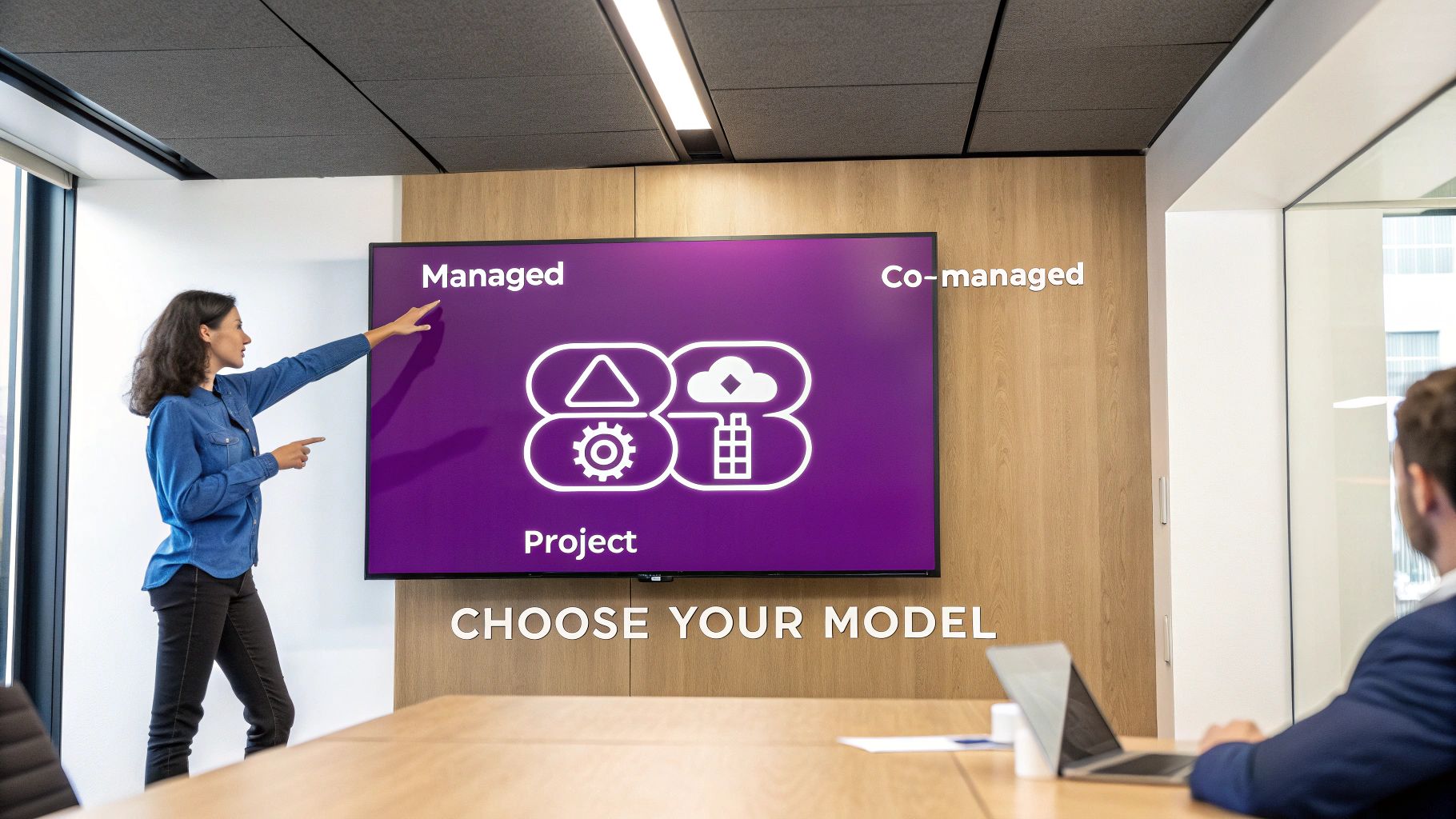
When it comes to IT outsourcing, there’s no such thing as a one-size-fits-all answer. The right approach for your business hinges entirely on your specific needs, the skills you already have in-house, and where you’re headed in the future. Picking the right model is often the difference between a partnership that actively fuels your growth and one that simply puts out fires.
Let's break down the three main ways you can structure an outsourcing partnership. Each one is built for a different kind of business scenario.
Fully Managed Services
Think of this as the most hands-off approach. With a fully managed service, you're essentially handing over the keys to your entire IT operation to a specialist provider. They become your IT department, handling everything from day-to-day helpdesk tickets and network security to bigger-picture strategic planning.
This model is a perfect fit for businesses that don't have a dedicated IT person or want to free up key staff from dealing with tech troubles. Imagine a busy manufacturing firm here in the East Midlands; they can't afford downtime. A fully managed service ensures their critical systems are always running smoothly, without the overhead of hiring a full-time IT manager.
Typically, you pay a predictable, fixed monthly fee per user or device. It turns a chunky capital expense into a manageable operational one, and you get access to a whole team of experts for a fraction of the cost of hiring them yourself. If you're looking for a complete outsourcing IT service that takes care of absolutely everything, this is it.
Co-Managed IT
The co-managed, or 'hybrid', model is all about collaboration. It’s designed for businesses that already have an IT manager or a small team on the ground but need to bolster their capabilities. Your chosen provider works right alongside your internal people, filling in any skills gaps and providing an extra pair of hands.
This partnership can look a few different ways:
- Specialist Expertise: Your partner could handle the complex stuff, like cybersecurity and cloud infrastructure, while your team looks after daily user support.
- Added Capacity: The provider can act as an escalation point for tricky problems or provide cover when your team is on holiday or off sick.
- Strategic Input: They can offer high-level advice and project management, letting your team concentrate on day-to-day operations.
A growing accountancy practice with its own IT manager could use a co-managed model to get access to advanced cybersecurity tools and 24/7 network monitoring—things that are often too expensive to build in-house. It’s a smart way to level up your existing team without adding to the payroll. For more on building these kinds of partnerships, it's worth reading a practical guide to IT outsourcing development.
Project-Based Outsourcing
Sometimes you don’t need round-the-clock support. You just need a specialist to come in and get a specific, one-off job done. That’s where project-based outsourcing comes in, perfect for tasks with a clear beginning and end.
Here are a few classic examples:
- Moving your servers and applications over to Microsoft Azure.
- Planning and managing an office move.
- Rolling out a new system like Microsoft Dynamics 365.
- Carrying out a deep-dive cybersecurity audit and fixing the issues.
With this model, you usually agree on a fixed price for the project upfront, so there are no surprises. It gives you direct access to high-level skills for a specific purpose, without locking you into a long-term contract.
Choosing the right model isn't just a technical decision; it's a strategic one. Aligning the service model with your business objectives ensures that your IT investment directly contributes to your company's success and growth.
Getting your head around these different models is the first real step toward finding a great partner. To make it a bit clearer, here’s a quick comparison.
Comparing IT Outsourcing Models
The table below breaks down the key differences between the models, helping you see which one might be the best fit for your business right now.
| Model | Best For | Typical Cost Structure (GBP) | Level of Control |
|---|---|---|---|
| Fully Managed | Businesses with no or limited in-house IT resources | Fixed monthly fee per user/device (£40-£100+) | Low (day-to-day), High (strategic) |
| Co-Managed | Companies with an existing IT team needing support or specialist skills | Retainer or monthly fee based on scope | Medium (collaborative with in-house team) |
| Project-Based | Specific, one-off initiatives like migrations or installations | Fixed price per project | High (client sets project goals and deliverables) |
Ultimately, the best choice really does come down to where your business is today and where you want it to be tomorrow. A frank assessment of your resources, your biggest headaches, and your goals will quickly point you toward the model that’s going to deliver real value.
Your Vendor Selection Checklist
Choosing an IT partner is one of the most important decisions you'll make for your business. Let's be honest, the right one can feel like a strategic part of your team, driving you forward. But the wrong one? They can become a source of constant frustration, security risks, and costly downtime.
To see past the slick sales pitches and find a partner you can genuinely count on, you need to know what to look for. This isn't about finding the cheapest quote; it's about identifying the best long-term value and the most reliable expertise.
Here’s a breakdown of the key areas you need to investigate before you even think about signing a contract.
Verify Their Cybersecurity Credentials
These days, cybersecurity isn't just an add-on; it has to be the bedrock of any IT service. A potential partner's own security measures are a direct reflection of how well they'll protect you. Don't just take their word for it—ask for proof.
The absolute bare minimum you should be looking for is the Cyber Essentials Plus certification. This isn't just a questionnaire; it's a hands-on technical audit that proves a company has the controls in place to guard against the most common cyber threats. It’s a clear, government-backed sign that they take this stuff seriously.
But go further. Ask about their internal security policies. Do their engineers get regular, up-to-date training? Do they hold advanced security certifications? A provider that invests heavily in its own protection is far more likely to do a good job protecting yours.
Confirm Deep Technical Expertise
Every IT provider will tell you they're an "expert," but you need to make sure their skills actually align with the systems your business depends on. For most UK businesses, that means having deep, demonstrable knowledge of the Microsoft ecosystem.
Look for specific, verifiable credentials that can’t be faked:
- Microsoft Solutions Partner Designations: These have replaced the old Gold and Silver tiers and are much tougher to earn. Look for titles like "Modern Work" or "Security," as they prove real proficiency in Microsoft 365 and its powerful security tools.
- Individual Certifications: Ask what qualifications their technical team holds. Are their engineers certified in Azure, Microsoft 365, or key security platforms? This demonstrates a real commitment to keeping their skills sharp.
This is especially important if you’re thinking about a cloud migration or want to get more from tools like Microsoft Teams and Power BI. You need a partner who knows the platform inside and out, not one who's learning on your time.
Prioritise Local and Responsive Support
When your systems go down, the last thing you want is to be stuck in a queue for a faceless, overseas call centre. For businesses here in the East Midlands, having fast access to local support is a game-changer. A local provider not only understands the regional business landscape but can also get an engineer on-site quickly when things go truly wrong.
During your evaluation, dig into their support structure:
- Who answers the phone? Is it a qualified engineer ready to help, or just someone taking a message?
- What are their guaranteed response times? This should be clearly spelled out in their Service Level Agreement (SLA).
- Where are their engineers based? Proximity really matters when you need hands-on help.
A great IT partner doesn't just offer a helpdesk; they offer peace of mind. Knowing an expert who understands your specific setup is just a local phone call away is invaluable for keeping your business running smoothly.
Assess Their Strategic Approach
Here’s the difference between a basic IT supplier and a true IT partner: a supplier fixes things when they break. A partner works with you to stop things from breaking in the first place and helps you use technology to hit your business goals. One is reactive, the other is proactive.
Ask them how they handle strategic planning. Do they offer regular business reviews? Will they sit down with you to build a technology roadmap that lines up with your growth plans? You want a partner who brings new ideas to the table and helps you budget for the future, not just one who sends an invoice every month.
When you're evaluating potential vendors, getting the procurement process right is key. For a more detailed look, this essential guide to RFQs and RFPs is a great resource for structuring your formal evaluation. You can also get a head start with our ready-to-use guide on building an RFP for your IT needs.
Scrutinise Their Track Record
Finally, check their references. Any provider can give you a couple of cherry-picked testimonials. You need to go deeper. Ask for case studies or references from businesses in your sector or of a similar size.
When you speak to their current clients, ask pointed questions about their responsiveness, technical skill, and the strategic value they bring to the table. A long list of happy, long-term clients is probably the most reliable indicator that you’ve found a partner worth trusting.
Choosing the right IT partner is about building a relationship for the long haul. Use this checklist to guide your decision, and you’ll find a provider who doesn’t just support your tech, but actively helps your business succeed.
Ready to find a partner who ticks all the right boxes? Phone 0845 855 0000 today or Send us a message.
Getting the Paperwork Right: Contracts and Service Level Agreements
You’ve done the hard work and found an IT partner that seems like a great fit. Now comes the part that can feel a bit intimidating: the contract and the Service Level Agreement (SLA). But don't let the legal language fool you. These documents are your best friends in an outsourcing relationship. They’re what turn a provider’s promises into solid, measurable commitments that protect your business.
Think of this stage less as a legal hurdle and more as a conversation to get everything down in black and white. It’s all about making sure the agreement truly reflects what your business needs and what you expect from your new partner.
Talking Money: Common Pricing Models
Before you get lost in the finer points of the contract, you need to understand how you’ll be paying for the service. Most IT providers in the UK use one of a few standard models, and the best one for you hinges on what you need in terms of budget predictability and flexibility.
- Per-User or Per-Device: This is the bread and butter of managed IT services. You pay a set monthly fee for each person or computer on your network. For a typical East Midlands SME, you can expect to see prices ranging from £40 to £100 per user per month. The lower end usually covers the basics like remote helpdesk support and security monitoring, while the top end will throw in on-site visits and more strategic, advisory work.
- Fixed-Price Project: As we touched on earlier, this is for one-off jobs. Moving your office, migrating to the cloud, or rolling out new software all fall under this umbrella. The provider gives you a single price for the entire project based on a very clearly defined scope. A simple server swap might be a few thousand pounds, but a full-blown infrastructure overhaul will be a much bigger investment.
- Retainer / Block Hours: Some businesses like the idea of pre-buying a block of support hours each month, usually at a better rate. It offers a degree of flexibility, but be warned – it can make your costs unpredictable if you have a couple of bad months and burn through your hours quickly.
The most important thing here is clarity. Your contract must spell out exactly what's included in your monthly fee and, crucially, what isn't. You don’t want any nasty surprises on your first invoice.
Key Contract Clauses You Need to Look For
Never just sign the provider's standard contract. It was written by their lawyers to protect them. Your job is to make sure it protects you, too. There are a few areas I always tell clients to focus on during negotiations.
A good contract is the foundation for a strong partnership, not a trap. Make sure you negotiate fair, clear terms for the contract length, your exit strategy, and who owns your data. It needs to work for your business today and tomorrow.
These are the absolute must-haves for any business that takes its operations seriously:
- Contract Length & Getting Out: How long are you committing for? Most contracts are for 12, 24, or 36 months. You need to know what happens when that term is up. More importantly, what’s the process if things go south and you need to leave early? A solid 'off-boarding' or exit clause is non-negotiable. It should detail how the provider will hand everything back and help you move to a new supplier without bringing your business to a halt.
- Data Ownership & Return: This must be crystal clear: you own your data. Not them. The contract should state this plainly and also outline the process for getting all of it back – in a usable format – when the contract ends.
- Confidentiality & Liability: This part details the provider's duty to keep your information secure and what happens if they fail. It defines their liability in the event of a security breach or a major service outage.
With the current economic climate in the UK, including persistent wage inflation and skills shortages, outsourcing has become a smart financial move for many. The UK outsourcing services market outlook shows significant growth, highlighting just how many businesses are seeing the value. This reality makes getting the contract terms right even more vital to lock in that value for the long term.
Decoding the Service Level Agreement (SLA)
If the contract is the skeleton, the SLA is the beating heart of your agreement. It goes way beyond vague promises like "99.9% uptime" and gets into the nitty-gritty of the service you’ll actually receive. A well-written SLA is how you hold your provider accountable.
A strong SLA must clearly define:
- Guaranteed Response Times: This isn’t how long it takes to fix a problem, but how quickly they promise to acknowledge it and start working. This should be tiered. For instance, a critical "server down" emergency might demand a 15-minute response, while a minor question about Microsoft Word could be four hours.
- Target Resolution Times: This is the goal for actually fixing the issue. Again, this needs to be tiered. A critical problem might have a four-hour resolution target, while a low-priority ticket could be 48 hours.
- Clear Severity Levels: What exactly is a "critical" issue? The SLA must define what constitutes a critical, high, medium, or low-priority incident in plain English. This stops any arguments later about how urgent a problem really is.
- Escalation Procedures: What’s the plan if your issue isn't fixed within the target time? A good SLA outlines the chain of command, detailing who the problem goes to next, all the way up to senior management if needed.
By taking the time to really scrutinise these documents, you’re setting the stage for a partnership built on a solid foundation of mutual understanding and clear expectations.
Ready to build a partnership based on clear, fair agreements? Phone 0845 855 0000 today or Send us a message.
Managing a Smooth Transition and Partnership
Getting the contract signed is a huge step, but it’s really just the starting line. I’ve seen time and again that the success of an IT outsourcing deal hinges entirely on what happens next. A well-thought-out transition is what separates a frustrating experience from a seamless one, laying the foundation for a partnership that genuinely delivers.
This isn’t about just handing over the keys to your server room. It’s about carefully integrating a new group of experts into the fabric of your business. The aim should be to move beyond a simple client-vendor dynamic to a true partnership, where your provider is proactively looking for ways to improve things for you.
The Critical Onboarding and Discovery Phase
Once the ink is dry, the first thing that should happen is a deep-dive discovery and onboarding process. This is where your new provider gets under the bonnet to learn how your business actually works, day-to-day. Rushing this stage is probably the single biggest mistake I see companies make, and it always causes headaches later on.
A methodical approach here is non-negotiable. It typically involves a few key activities:
- A full system and network audit: Your provider needs to map out everything. We're talking server configurations, software licence tracking, network layouts, user accounts—the lot.
- Understanding your workflows: They need to see how your team uses technology. Who needs access to what systems? Which apps are absolutely critical? This context is what allows them to provide support that actually helps, rather than hinders.
- Reviewing security and compliance: They'll assess your current security setup, pinpoint any weak spots, and make sure everything is aligned with any regulations you need to meet.
This meticulous documentation means that when one of your team calls for help, the engineer on the other end of the line has all the information they need right there. It’s the difference between a quick fix and a lengthy back-and-forth.
Communicating the Change to Your Team
Never underestimate the importance of internal communication. Your employees are on the front line of this change, and how you introduce it can make or break their buy-in.
Start by explaining why you've made this decision. Frame it as a positive step—a way to get them faster, more expert support so they can get on with their jobs without tech headaches. Introduce the new provider by name and be crystal clear on how to ask for help, whether that’s a phone number, an email address, or a support portal. Clarity from day one prevents confusion and builds trust.
Negotiating these partnerships always comes down to getting three things right: the pricing, the contract, and the all-important Service Level Agreement (SLA).
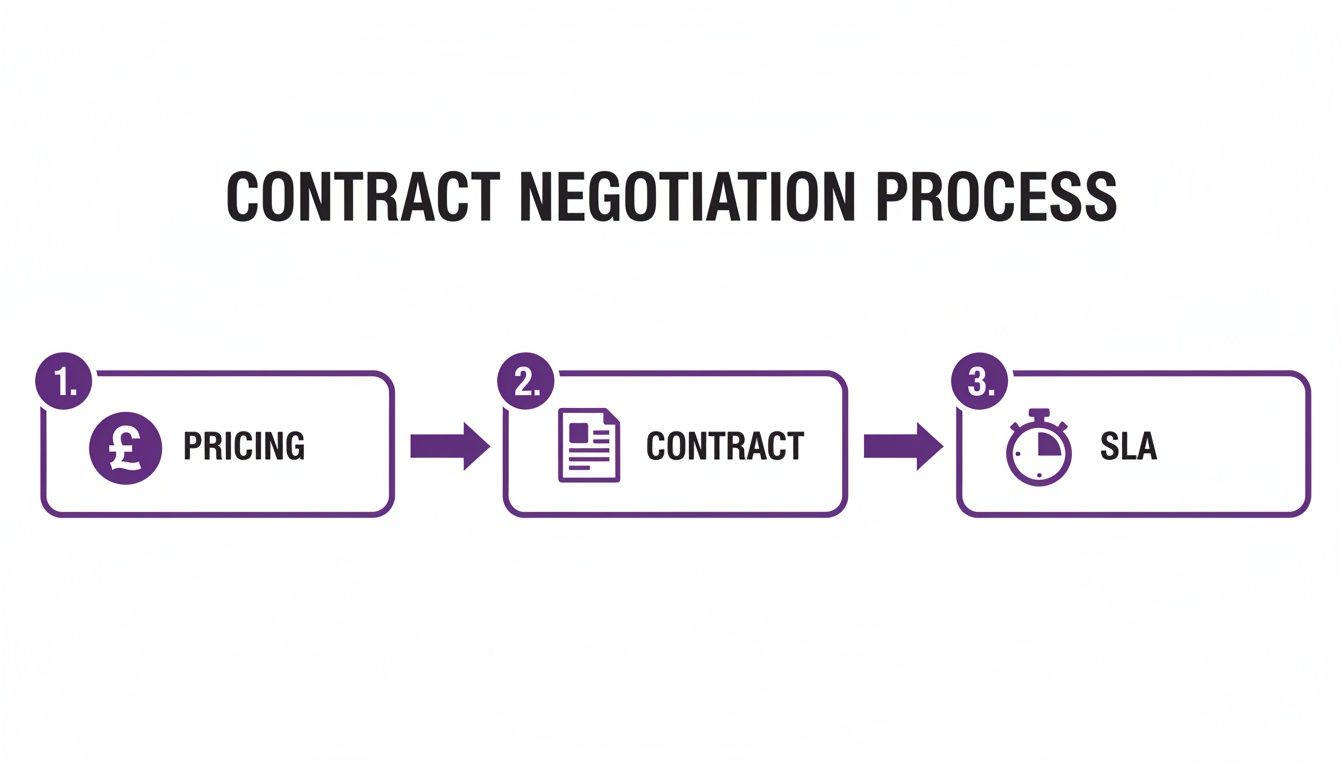
This process shows how the financial, legal, and service-level details are all connected, but need to be tackled in a logical order to finalise a strong agreement.
Building a Framework for Long-Term Success
A great IT partnership can't just be left to run on autopilot. It needs a clear governance framework to make sure the service keeps up with your business as it changes and grows. This structure is what turns a reactive "fix-it" service into a genuine strategic asset.
The real value of an IT partnership is realised through ongoing collaboration. It’s about more than just closing support tickets; it’s about regular strategic conversations that ensure your technology is actively fuelling your business growth, not just keeping the lights on.
To make this a reality, you need to establish a regular rhythm of communication. I always recommend:
- Quarterly Business Reviews (QBRs): Set these in stone. They are your chance to formally review performance against the SLA, discuss any big issues, and plan for the next few months. This is where you talk strategy and make sure your IT roadmap is aligned with your business goals.
- Key Performance Indicators (KPIs): Look beyond the basic SLA metrics. Agree on a handful of KPIs that really matter to your business. This could be anything from a reduction in critical incidents to better user satisfaction scores.
- A Clear Escalation Path: Make sure everyone knows who to contact if a problem isn't being resolved through the usual channels. A defined process prevents frustration and keeps everyone accountable.
By putting this structure in place from the start, you create a partnership built on transparency, trust, and shared goals. It ensures your provider is focused not just on today’s problems, but on helping you get where you want to go tomorrow.
To start building an IT partnership that drives your business forward, Phone 0845 855 0000 today or Send us a message.
Your Questions About IT Outsourcing Answered
Deciding to outsource your IT is a big step, and it’s only natural to have a long list of questions. Business leaders need to be confident they’re making the right call for their security, budget, and future growth. Let's tackle some of the most common queries we hear from businesses across the East Midlands.
How Much Does IT Outsourcing Cost for a UK Small Business?
This is usually the first question, and the honest answer is: it depends. The cost varies quite a bit based on the model you choose and the level of support you need.
That said, for a typical small business in the UK with between 10 and 50 employees, a comprehensive managed services plan will likely land somewhere between £40 and £100 per user, per month.
At the lower end of that scale, you're generally covering the essentials: remote helpdesk support, basic security monitoring, and keeping your software patched. As you move up the price bracket, the service becomes more proactive and strategic, adding things like on-site engineer visits, high-level consultancy, and advanced cybersecurity measures.
For specific, one-off jobs like an office move or a cloud migration, you’ll be looking at a fixed price. A simple server upgrade might be a few thousand pounds, whereas a complete infrastructure overhaul could be tens of thousands. The golden rule here is to always get a detailed, itemised quote. No one likes surprise costs later on.
Will I Lose Control of My IT If I Outsource?
This is a huge, and completely valid, concern. The fear is that you're handing over the keys to a critical part of your business. But a good IT partnership doesn't take away control—it gives you more strategic control.
Think about it. When you're not bogged down with day-to-day firefighting and technical upkeep, you and your team are free to focus on the bigger picture: how technology can actually help you grow the business.
You aren't losing control; you're delegating the execution to specialists. A quality provider works as an extension of your team, not as a replacement for your decision-making. You should always have full visibility through clear reports, regular meetings, and strategic reviews.
Models like co-managed IT are built specifically for this. You can keep your in-house staff focused on strategy while the provider handles the heavy lifting.
What Happens if Our Business Grows or Our Needs Change?
Any decent outsourced IT service is built for flexibility. Scalability is one of its core strengths. A well-structured agreement should be designed to grow right alongside you without any fuss.
Most managed service contracts are priced per user, so support scales up automatically as you bring new people on board. Simple.
But what if your needs change in other ways? Maybe you want to explore AI, or you need more sophisticated data analytics. A good partner can add these as specific projects or new service lines without you having to tear up the old contract and start again. A forward-thinking provider won't just react to your growth; they’ll anticipate it and suggest the right technology moves during your regular strategy sessions.
How Secure Is My Company Data With an External Provider?
In almost all cases, a reputable IT provider can offer a much higher level of security than a small business can manage on its own. Their entire reputation hinges on protecting client data, so they invest heavily in the best tools and expertise.
When you're checking out a potential partner, their security credentials must be a top priority.
- Check their certifications: Look for tangible proof of their commitment to security, like a Cyber Essentials Plus or ISO 27001 certification. These aren't just badges; they're proof of rigorous independent audits.
- Scrutinise the contract: It must clearly state who owns the data, detail confidentiality clauses, and outline their security responsibilities, including what happens if there’s a breach.
- Ask about their tools: They should be able to walk you through their security stack, which ought to include essentials like multi-factor authentication (MFA), endpoint detection and response (EDR), and secure data centre protocols.
The bottom line is your data is often far safer with a dedicated specialist than managed in-house without the same resources and singular focus.
If you have more questions about how outsourced IT could work for your business, we're here to provide clear, practical answers. Phone 0845 855 0000 today or send us a message.
Thinking About Your Next IT Move?
Choosing the right IT partner is a huge decision. Get it right, and you’ll see tangible improvements in efficiency, beef up your security, and ultimately, boost your bottom line. If you're wondering how a strategic partnership could work for your business, we're here to talk it through – no jargon, just practical advice.
We’ve spent years helping businesses across the East Midlands and the wider UK build IT strategies that actually deliver. We'd be happy to have a chat about the specific challenges you're facing and see if we can help you find a better way forward.
Phone 0845 855 0000 today or Send us a message.