
Your biggest security vulnerability isn’t a flaw in your software; it’s a well-crafted email landing in an employee's inbox. The right security awareness training can transform your staff from potential targets into your most vigilant defenders, building a powerful human firewall against these ever-present threats.
Why Your Team Is Your Best Cyber Defence
You can spend a fortune on firewalls, anti-virus software, and all the latest threat detection systems, but a single convincing email can slip past all of it. A clever phishing attempt doesn't hack your network in the traditional sense; it convinces a person to willingly open the door for the attacker.
This is the hard reality for UK businesses today, where simple human error remains the leading cause of security breaches.
It’s not about blaming employees. Cybercriminals are masters of manipulation. They use sophisticated tactics to create a sense of urgency or curiosity that’s difficult to ignore. A fraudulent invoice that looks identical to one from a real supplier, or a message that appears to come from a director, can easily fool even the most diligent team member on a busy day.
The True Cost of a Single Click
For a small or medium-sized business, the consequences of one misguided click can be absolutely catastrophic. The initial financial loss from a bogus invoice or a ransomware payment is often just the tip of the iceberg.
The real damage digs much deeper:
- Operational Disruption: Key systems can be knocked offline for days, sometimes weeks. This halts business, delays customer orders, and piles on an incredible amount of stress.
- Reputational Damage: Having to tell your customers their data may have been compromised shatters the trust you’ve worked so hard to build. Government surveys show that 32% of UK businesses suffered a breach or attack in the last 12 months alone.
- Regulatory Fines: A serious data breach can also bring hefty penalties under regulations like GDPR, adding a massive financial blow to an already painful situation.
It's a common mistake to think of cyber security as purely a tech problem. In reality, it's a people problem with a technical component. Your technology provides a baseline defence, but it's the awareness and actions of your people that ultimately determine how resilient you are.
Shifting from Liability to Asset
This is where effective security awareness training comes in. I'm not talking about ticking a compliance box or sitting everyone through a dull annual presentation. This is about fundamentally changing behaviour and nurturing a security-first culture throughout your entire organisation.
When your team is trained to spot the tell-tale signs of a threat, they become an active part of your defence strategy. Instead of being your biggest vulnerability, they become a network of human sensors, ready to identify and report suspicious activity before it can do any damage.
Think about it: an employee who pauses to verify an unusual payment request over the phone, or who forwards a dodgy-looking email to the IT team, is more valuable than any piece of software. That’s the goal here. A great training programme empowers your staff with the knowledge and confidence to become your first—and most effective—line of defence, turning your team from a potential risk into your strongest security asset.
For a personal assessment of how to strengthen your team’s security posture, Phone 0845 855 0000 today or Send us a message.
Designing a Training Programme That Actually Works
An impactful security awareness training programme is carefully designed, not just purchased off the shelf. A generic, one-size-fits-all approach rarely sticks because it fails to address the specific threats your business actually faces. The key is to build a plan that feels relevant and practical to your team.
This process starts with a clear-eyed assessment of your unique risks. Are you an accountancy firm handling sensitive client financial data, making invoice fraud a primary concern? Perhaps you're a manufacturer where operational uptime is everything, making ransomware the most significant threat. Pinpointing these specific vulnerabilities is the foundation of an effective programme.
Identifying Your Core Risks and Objectives
Before you can create content, you need to know what you’re defending against. Don't just guess; look at real-world data and common attack vectors in your industry.
Think about these key areas:
- Data Handling: Where is your most sensitive data stored and who has access? Mistakes here can lead to serious GDPR breaches.
- Financial Processes: How are payments authorised and invoices verified? Attackers often target these workflows with business email compromise (BEC) scams.
- Access Control: Who has administrative rights to key systems? The more people with high-level access, the wider your attack surface.
Once you’ve identified your top 2-3 risks, you can set clear, measurable objectives for your training. Instead of a vague goal like "make staff more secure," aim for something specific, such as "reduce clicks on simulated phishing emails by 40% within six months" or "increase employee reporting of suspicious emails by 50% in the next quarter."
This approach turns training from a fuzzy concept into a measurable business activity with a clear return on investment.
Tailoring Content to Different Roles
What your finance team needs to know about security is vastly different from the priorities for your sales or marketing teams. A generic presentation on password hygiene just won't resonate if it doesn’t connect to their daily tasks.
For example, your finance department should receive intensive training on spotting fraudulent invoices and verifying payment requests, complete with real-world examples of scams that have targeted similar businesses. Your sales team, on the other hand, might need more guidance on handling client data securely and identifying phishing attempts that mimic customer enquiries.
A common pitfall is treating all employees as a single, uniform group. Effective training acknowledges that different roles face different threats. By customising the message, you make the learning directly applicable to each person's job, which dramatically increases engagement and retention.
Effective security awareness begins the moment a new employee joins your team. For insights into foundational training, consider reviewing these employee onboarding best practices to build security habits from day one.
The infographic below shows the simple, common path a cyber threat takes, from a seemingly harmless email to a full-blown security breach.
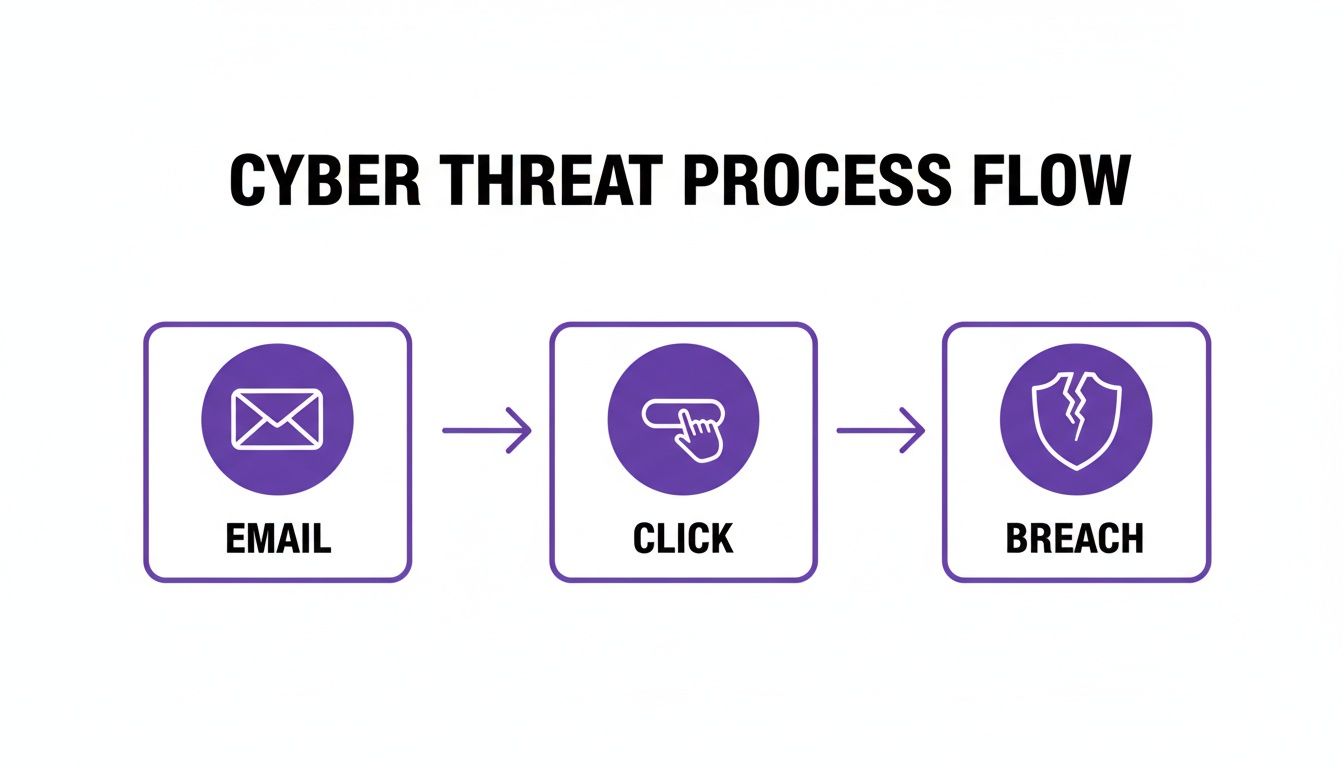
This process highlights how a single human action—the click—is the critical weak point that attackers exploit to bypass technical defences.
Mapping Out a Continuous Training Schedule
The annual, hour-long security presentation is a relic of the past. It’s ineffective because people simply forget what they’ve learned. The modern approach to security awareness training is built on continuous reinforcement.
Instead of a single yearly event, create a schedule of ongoing, bite-sized learning activities. This keeps security front-of-mind and builds a lasting culture of vigilance. A successful schedule might look something like this:
- Quarterly Core Modules: Introduce a new major topic each quarter, like phishing, password security, or safe remote working, using short e-learning videos or interactive modules.
- Monthly Phishing Simulations: Send realistic but harmless phishing emails to test how staff respond. Use the results to provide immediate, supportive feedback.
- Weekly Security Tips: Share a quick tip or a real-world scam alert via email or your company’s communication platform.
- On-Demand Resources: Maintain a central hub (like a SharePoint site) with guides, policies, and contact information for reporting incidents.
This continuous cycle transforms training from a dreaded annual chore into a regular, manageable part of the work week. It creates a rhythm of learning and testing that genuinely changes behaviour over time, making your team a far more resilient defence against cyber threats.
Choosing the Right Training Content and Delivery
Having a solid plan is a great start, but how you deliver your security training is just as important as the material itself. Let’s be honest, if the content is dry or feels irrelevant, your team will switch off, and the lessons simply won't stick.
The real goal is to weave security awareness into the fabric of the work week, making it an engaging and normal part of the job—not a chore to be dreaded and clicked through.
To do that, we need to move beyond static PowerPoint slides and embrace a mix of formats. Not everyone learns by reading dense documents. Some people absorb information best from a short video, while others need a hands-on, interactive session to really get it. A blended approach, mixing and matching different methods, is almost always the winning strategy.
Finding Your Content Mix
There’s no magic bullet for training content. A truly effective programme uses a variety of formats to keep things fresh and reinforce key messages over time. When someone sees the same concept presented in a few different ways, it’s far more likely to be remembered.
Here are a few formats I’ve seen work really well in practice:
- Interactive E-learning Modules: These are brilliant for laying the groundwork on core topics. They let people learn at their own speed and can include quick quizzes to check they've understood the main points.
- Short, Punchy Videos: A two-minute video showing exactly how to spot a phishing email will get watched and remembered. A ten-page document on the same topic? Probably not.
- Live Workshops (Virtual or In-Person): These are fantastic for role-playing scenarios—like how to handle a suspicious phone call—and for open Q&A sessions where people can ask specific questions.
- Gamified Learning: A bit of friendly competition goes a long way. Quizzes, leaderboards, and "spot the phish" challenges can seriously boost engagement.
If you’re thinking about creating your own visual content, it's worth checking out some expert advice on creating engaging training videos to make sure they hit the mark. The trick is always to match the format to the topic and your team.
Using Microsoft 365 for Seamless Delivery
For many UK businesses, the tools you need for brilliant security training are already part of your Microsoft 365 subscription. Using familiar platforms makes the whole process feel less like a separate task and more like part of the daily routine.
Instead of bringing in a whole new system that everyone has to learn, you can build a powerful training hub with the tools your team uses every single day.
The most effective training feels like a natural extension of the work environment. By embedding security content into platforms like Teams and SharePoint, you lower the barrier to entry and make continuous learning feel effortless for your employees.
Here’s how you can put this into practice:
- Microsoft Teams for Live Sessions: Host your virtual workshops and Q&A sessions here. You can even record them for anyone who couldn't make it.
- SharePoint for a Resource Hub: Set up a dedicated site to be your single source of truth for all training materials—videos, policy documents, quick-reference guides, you name it.
- Microsoft Forms for Quizzes: Quickly create and send out short quizzes after a training module to check understanding and track who’s completed it.
This approach not only saves you money but also dramatically increases the chances of your team actually engaging with the content on a regular basis.
Choosing the Best Way to Deliver Your Training
Deciding on the right delivery method depends on your team's size, location, and learning preferences. There's no single "best" option; the most successful programmes often mix and match.
Here’s a quick comparison to help you weigh your options:
Comparing Security Training Delivery Methods
| Method | Best For | Pros | Cons |
|---|---|---|---|
| E-learning Modules | Self-paced, foundational knowledge. Great for remote or hybrid teams. | Flexible, consistent messaging, easy to track completion. | Can feel impersonal, lower engagement if not interactive. |
| Live Virtual Workshops | Interactive discussions, role-playing, and Q&A sessions. | Highly engaging, allows for real-time feedback and questions. | Scheduling can be a challenge across different time zones. |
| In-Person Sessions | Building team cohesion and tackling complex, sensitive topics. | Highest level of engagement, great for hands-on practice. | More expensive, difficult to scale for larger or distributed teams. |
| Micro-learning (Videos/Tips) | Ongoing reinforcement and quick, timely reminders. | Easy to digest, fits into the daily workflow (e.g., via Teams). | Not suitable for in-depth topics on its own. |
Ultimately, a blended approach gives you the best of all worlds. You can use e-learning for the basics, run a virtual workshop for a deep dive, and then follow up with short videos to keep the lessons top-of-mind.
Accommodating Different Learning Styles
We all absorb information differently. Some of us are visual learners, others are auditory, and many of us learn best by doing. A training programme that only caters to one style is bound to leave people behind.
This is where a blended model really shines. It ensures everyone gets the chance to learn in the way that clicks for them. It’s all about combining the "why" with the "how."
For example, a module on password security could start with a short video explaining the principles of a strong password. This could be followed by a hands-on exercise where employees create and test their own passwords. The final piece might be a practical guide on setting up a password manager—a tool that reinforces the training with a concrete action.
This layered approach is absolutely essential, especially when explaining crucial concepts like multi-factor authentication. If you'd like a refresher, you can learn more about what is multi-factor authentication and see why it’s a non-negotiable layer of security today.
By offering a rich mix of videos, guides, quizzes, and practical simulations, you're not just delivering training. You're creating a learning experience that ensures the critical lessons of your security awareness training are understood, absorbed, and—most importantly—put into practice.
To discuss building a training programme that fits your team's needs, give us a call on 0845 855 0000 today or Send us a message.
Putting Your Team to the Test with Phishing Simulations
Knowing the theory of cyber security is one thing, but reacting correctly under pressure is what really counts. This is where simulated phishing attacks become the most powerful tool in your security awareness training. These controlled tests are essential for seeing how your team responds to realistic threats in real time, moving their knowledge from abstract to practical.
A well-run simulation isn't about catching people out; it's about building muscle memory. You're creating a safe environment for employees to make mistakes without causing any actual harm, which lets you turn a potential weakness into a proactive defence.
Setting Up a Realistic Phishing Programme
The success of a phishing simulation hinges entirely on how convincing it is. If the emails are obviously fake, they teach your team absolutely nothing. The goal is to mimic the genuine, sophisticated tactics that cybercriminals are using right now.
Get started by creating templates that reflect current trends:
- Urgent Invoice Payments: These are especially effective against finance teams, creating a sense of urgency that encourages them to bypass normal checks.
- Password Reset Alerts: A classic. An email claiming an account has been compromised prompts an immediate, panicked click from the recipient.
- Package Delivery Notifications: With so much online shopping, fake courier notifications are incredibly common and have a very high click-rate.
- Internal Company Memos: A message that looks like it's from HR about a new policy can easily trick staff into clicking a dodgy link or opening an attachment.
When scheduling these tests, avoid falling into a predictable pattern. Sending a simulation at 10 AM on the first Monday of every month will quickly be figured out. Instead, stagger the sends throughout the month and at different times of the day. This better reflects the random nature of real attacks.
Handling Clicks with a Supportive Approach
What you do after an employee clicks is the most critical part of the entire process. A punitive or shaming approach is completely counterproductive. It just creates fear and discourages people from reporting genuine threats in the future.
Your focus must be on immediate, supportive feedback.
When someone clicks a simulated phishing link, they should be instantly redirected to a landing page that explains what happened. This page should clearly point out the red flags they missed—perhaps a suspicious sender address, a generic greeting, or subtle spelling mistakes.
The moment someone clicks a simulated phish is a powerful teaching opportunity. Instead of blame, provide an immediate, private, and educational follow-up. This reinforces the learning when it's most relevant and helps build a culture where it's safe to report mistakes.
This "just-in-time" training is far more effective than a generic reminder sent out weeks later. It connects the action (the click) directly with the consequence (the learning moment), helping to truly solidify the lesson. For more in-depth strategies, our guide on how to protect against phishing attacks offers further practical advice.
Measuring the Impact of Your Training
Phishing simulations provide clear, quantifiable data on how well your security awareness training is working. The key metric to watch is your phish-prone percentage—the proportion of employees who click on a simulated phishing email. By tracking this over time, you can demonstrate a real return on your investment.
Phishing remains the single biggest threat to UK businesses, making this a critical area to measure. The UK Government’s Cyber Security Breaches Survey shows that roughly four in five UK businesses identify phishing as their main vector of attack.
Large-scale simulations show that an untrained workforce has a baseline "phish-prone" click rate of around 33.1%. Within just 90 days of quality training, that can drop by about 40%. For organisations that stick with an ongoing programme, that rate can decline by up to 86% after 12 months.
For a UK SME, a realistic goal is a 15–40% reduction in risky clicks in the first three months. With sustained training, you can see improvements of 70% or more within a year.
This data allows you to see which departments or individuals might need extra coaching and which types of phishing emails are most tempting, helping you continuously refine your training for maximum impact.
To start building a proactive defence with a custom phishing simulation programme, phone 0845 855 0000 today or send us a message.
Measuring Success and Building a Security Culture
So, how do you know if your security awareness training is actually working? It’s a fair question. Just seeing that everyone has ticked the box on a training module doesn’t tell you much. The real proof is in the results you can see and feel—a genuine shift in how your team thinks about and handles security every day.

This means we need to look past simple pass/fail rates and focus on real behavioural change. Are fewer people falling for phishing scams? Are more of them reporting suspicious emails? Answering these questions means tracking the right data and keeping an eye out for the tell-tale signs of a stronger security mindset across the business.
Key Metrics to Track
To show the value of your training programme, you need solid numbers. These metrics give you a clear view of how employee behaviour is changing over time and help you demonstrate a real return on your investment in security awareness training.
Here are the core indicators I always recommend focusing on:
- Phishing Simulation Click-Rates: This is your number one metric, without a doubt. Seeing the percentage of staff clicking on simulated phishing links drop over time is the clearest sign you’re on the right track.
- Suspicious Email Reporting Rates: A fantastic sign of success is an increase in employees using the 'report phish' button or forwarding dodgy emails to your IT team. It shows they're paying attention and getting involved.
- Quiz and Assessment Scores: While they don't tell the whole story, tracking better quiz scores after training modules confirms that people are absorbing the key lessons.
- Incident Reporting Times: How quickly does someone raise the alarm when they realise they've clicked a real malicious link? Getting this time down can make a massive difference in containing a breach.
Monitoring these figures creates a powerful feedback loop. The data tells you what’s hitting the mark and where you might need to adjust your approach. You can use a detailed cyber security audit checklist to establish a baseline for these metrics before you even begin.
The Real-World Signs of a Strong Security Culture
Numbers are great, but a successful programme also builds a culture where security becomes second nature. These shifts are just as important as your metrics, even if they’re harder to pin down on a spreadsheet.
You'll know you're getting it right when you start to see things like:
- Staff proactively asking security questions, like phoning to verify an unusual payment request before sending any money.
- Team members politely challenging unfamiliar faces in secure areas of the office (stopping "tailgating").
- Colleagues reminding each other about good habits, like locking their screens when they pop out for a coffee.
- A noticeable drop in those small but risky incidents, like finding passwords on sticky notes or company USB sticks left lying around.
A strong security culture is what happens when no one is looking. It’s the collection of individual habits and shared responsibilities that transforms your organisation from a group of potential targets into a unified human firewall.
This cultural change doesn't happen overnight, of course. It’s the result of consistent, engaging training and positive reinforcement over many months.
Training Isn't a Silver Bullet
It’s really important to remember that even the best security awareness training isn’t a magic fix. It has to be part of a bigger picture that includes solid technical defences and a well-rehearsed recovery plan. Recent government data from the education sector offers a sobering lesson here.
Ofqual reported that while the percentage of teachers receiving cyber security training rose from 61% to 72%, the proportion of schools able to recover immediately from an attack actually fell from 63% to 55%. This tells us that awareness alone didn't speed up their recovery. For UK business leaders, it’s a stark reminder that training must go hand-in-hand with rigorously tested backup and disaster recovery procedures.
This creates a cycle of continuous improvement. The data from your technical systems and security metrics helps shape your training, while your newly empowered team provides an essential layer of human vigilance that technology can’t replicate. It's this combined approach that builds true resilience against modern cyber threats.
What's Next? Putting Your Human Firewall Plan into Action
Building and running a solid security awareness programme isn't a one-and-done project. It takes consistent effort, time, and frankly, a level of expertise that most busy business owners just don't have on hand. While the steps in this guide give you a great roadmap, the reality of managing it all can feel overwhelming.
This is where bringing in a specialist can make all the difference. Think of it less as outsourcing and more as bringing a security training expert onto your team.
An experienced partner, like us here at F1 Group, can take the entire process off your plate. We've seen what works and what doesn't. We go beyond generic videos and quizzes to build a programme that actually reflects the real threats your business faces every day. From creating phishing emails that look just like the ones hitting your inbox to providing reports that make sense, we handle the nuts and bolts so you can see your team's security skills improve.
Why Work with a Managed Partner?
Handing over the reins to a dedicated team gives you a few significant advantages, especially when you're already stretched thin:
- You get expert-led strategy. We build your programme using up-to-the-minute threat data and proven training techniques, not guesswork.
- It actually gets done. We manage the entire schedule of training, reminders, and phishing tests, making sure it happens consistently without you having to chase anyone.
- You can see what's working. You get clear, straightforward reports that show exactly how your team is improving and where the gaps are, proving the value of your investment.
The bottom line: You get to focus on your business, knowing that your team is steadily becoming your best line of defence against cyber attacks. We handle the technology and the training, while your staff can focus on learning and making secure behaviours second nature.
Ready to see how this could work for your business?
Give us a call on 0845 855 0000 or send a quick message to start the conversation.
Got Questions? We've Got Answers
When you're rolling out a security awareness programme, it's natural for a few questions to pop up. Business owners and IT managers often ask us the same things, so let's tackle them head-on to help you build a programme that sticks.
How Can We Make This Affordable for a Smaller Business?
Let's be realistic—for most SMEs, the budget isn't endless. The good news is you can get great results without breaking the bank, often by using the tools you already pay for.
If your team lives in Microsoft 365, you're already halfway there. You can run live training sessions using Teams and build a fantastic resource library in SharePoint. This simple trick means you don't need to shell out for a separate, expensive learning platform.
Another smart move is to look at managed services that scale with you. Instead of a hefty one-off cost, you get access to top-tier phishing simulations and training content for a simple monthly fee. Working with a partner often delivers a professional-grade programme for a fraction of what it would cost to hire a dedicated security trainer in-house.
How Often Do We Really Need to Train Everyone?
The old-school, once-a-year PowerPoint presentation is dead. It just doesn't work. Think of security awareness like fitness; you need to keep at it consistently to see results. It’s all about regular, bite-sized engagement, not one long, mind-numbing session.
We've found the sweet spot is a rhythm of monthly phishing simulations, short quarterly training modules on topics like password hygiene, and instant 'just-in-time' coaching for anyone who happens to click a simulated phish. This keeps security at the front of everyone's mind without causing burnout.
What Do We Do About People Who Keep Failing the Phishing Tests?
First, don't panic, and definitely don't punish them. When an employee repeatedly clicks on simulated phishing links, it's not a disciplinary issue; it's a training opportunity. This is a clear signal that they need more personalised, one-to-one support.
Pulling them aside for a friendly chat often reveals the root cause. Maybe they feel rushed to clear their inbox, or they’re just not confident spotting the tell-tale signs. A bit of focused coaching tailored to their specific role and the kind of emails they handle every day can make all the difference. The aim here is to build up their skills and confidence, not create a culture of fear.
Ready to build a stronger, more cyber-aware team? Let's talk about a professionally managed security awareness programme that fits your business.
Give us a call on 0845 855 0000 or send us a message to get started.
Ready to build a stronger, more cyber-aware team? Let's talk about a professionally managed security awareness programme that fits your business.
Phone 0845 855 0000 today or Send us a message