
A digital transformation strategy isn’t just a fancy term for buying new software. Think of it as a detailed plan that fundamentally changes how your business works and how you deliver value to your customers. It’s a comprehensive blueprint for modernising your culture, processes, and customer experiences for today’s economy, making sure every technology investment pulls you closer to your core business goals.
What Is a Digital Transformation Strategy?
Imagine you’re building a new headquarters for your business. You wouldn’t just start laying bricks without a detailed architectural plan, would you? A digital transformation strategy is that blueprint for your business’s future. It’s what moves your organisation away from making reactive, isolated tech purchases and towards a proactive, unified vision.
This strategic approach is crucial because real transformation goes far deeper than the technology itself. It requires a fundamental shift in your company’s culture and daily operations. A clear strategy ensures every new tool, every updated process, and every team training session all work together towards the same big-picture goal. It answers the “why” behind the change, not just the “what.”

The Five Core Pillars of a Successful Strategy
A solid digital transformation strategy stands on five interconnected pillars. If one is weak, the whole structure can become unstable, leading to wasted money and projects that never get off the ground. These pillars provide a balanced framework, reminding us that success is just as much about people as it is about technology.
Below is a breakdown of these essential components, showing how they fit together to form a complete plan.
The Five Core Pillars of Digital Transformation
| Pillar | Focus Area | Example Objective |
|---|---|---|
| People & Culture | Cultivating a mindset that embraces change, learning, and collaboration. | Secure leadership buy-in and upskill teams to use new digital tools with confidence. |
| Process Optimisation | Redesigning and automating workflows to remove bottlenecks and improve customer experience. | Move from manual, paper-based invoicing to a streamlined, automated digital system. |
| Technology Integration | Selecting and implementing the right tools that align with business goals and work together seamlessly. | Adopt a cloud platform that unifies communication, data storage, and business applications. |
| Data & Analytics | Turning raw information into a strategic asset for making smarter, evidence-based decisions. | Implement a system to collect and analyse customer feedback to improve product development. |
| Governance & Security | Creating a framework to manage change, mitigate risks, and ensure security and compliance. | Establish clear policies for data handling and cybersecurity to protect company and customer information. |
By addressing each of these pillars, you ensure a holistic approach that considers every angle of your business.
Ultimately, your strategy is the roadmap guiding your organisation from where it is today to where it needs to be tomorrow. It provides clear direction, gets everyone on the same page, and ensures your efforts deliver real, measurable value. It’s how you turn technology from a necessary cost into your most powerful engine for growth.
Why a Strategy Is So Important for Mid-Sized Businesses
It’s a common misconception that having a formal digital transformation strategy is something only global corporations need to worry about. For a mid-sized business, it can feel like a luxury you can’t afford.
The truth is the exact opposite. A clear strategy is precisely what enables agile, mid-sized companies to punch well above their weight. It turns technology from a necessary evil on the balance sheet into your biggest competitive advantage.
Without a plan, tech adoption is usually chaotic and reactive. You buy a new piece of software to solve one team’s immediate problem or patch a security flaw you just discovered. These are just tactical fixes, not strategic moves. A proper plan shifts you from constantly fighting fires to proactively building a stronger, more efficient business.

digital transformation strategy
Unlocking Real Growth and Efficiency
Think of a digital strategy as a roadmap. It doesn’t just list technologies; it connects every decision back to your core business goals, helping you unlock tangible benefits across the entire organisation.
Here’s where the opportunities really lie:
- Boosted Operational Efficiency: Picture a logistics company right here in the East Midlands. Their strategy might focus on automating the entire invoicing process. Instead of someone manually keying in data for hours—a soul-destroying and error-prone task—an integrated system can generate, send, and track payments on its own. That frees up your people to focus on work that actually adds value.
- Stronger Customer Relationships: A local manufacturing firm could use its strategy to bring in a Customer Relationship Management (CRM) system. Suddenly, they can track every client interaction, anticipate what customers need next, and offer a level of personalised service that their larger, faceless competitors simply can’t match. That’s how you build real loyalty.
- Smarter, Data-Backed Decisions: Gut feeling has its place, but a good strategy puts data at the heart of your decisions. It could be as straightforward as analysing sales figures to see which products are your true winners, or using website analytics to finally understand what your customers are doing online and how to improve their experience.
“A strategy ensures that every pound spent on technology is an investment in a specific business outcome, not just another line item on the IT budget. It’s the difference between buying a new tool and building a better business.”
The Huge Risks of Doing Nothing
It’s just as crucial to understand the risks of standing still. Inaction is a choice, and it’s one that often leaves a business dangerously exposed. Without a proactive plan, you risk being completely outmanoeuvred by competitors who are already using tech to cut their costs and deliver better service.
Legacy systems become a serious bottleneck. They slow everything down, frustrating your employees and customers alike. These old platforms are often a nightmare to maintain, expensive to run, and completely incompatible with modern, secure cloud services. They create hidden inefficiencies that quietly eat away at your bottom line.
The numbers really highlight the urgency. The UK’s digital sector contributed a staggering £160 billion to the economy in 2023. While over 90% of large companies have a strategy, a massive capability gap exists for smaller firms. It’s estimated that while over 65% of UK SMEs will have started some form of digital journey by 2025, many will fail to see any real value because of outdated systems and a culture that resists change. You can explore more data on the UK’s digital economy at Statista.
Ultimately, a strategy is about survival and growth. It’s your plan for staying relevant, efficient, and competitive for years to come.
Ready to build a strategy that drives real growth for your business? Phone 0845 855 0000 today or Send us a message to get started.
Breaking Down the Core Components of Your Strategy
A winning digital transformation strategy isn’t just an IT project with a fancy name. It’s a complete business overhaul, a carefully balanced initiative that touches every single part of your organisation.
Think of it as being built on five essential pillars. If you neglect one, it’s like trying to build a house with a missing foundation wall—it might stand for a while, but eventually, the whole structure will become unstable. To build something that delivers real, lasting value, you need to give each of these core areas the attention they deserve.
Let’s dig into what each pillar really means for a mid-sized business in practice.
The Human Element: People and Culture
Let’s be honest: technology is only ever as good as the people using it. This is why the human element is arguably the most critical pillar, and often the trickiest. It’s all about mindsets, habits, and getting people comfortable with change.
It all starts at the top. You need genuine buy-in from your leadership team. If they see this as just another IT cost on a spreadsheet, the whole thing is likely to stall. They need to be the champions, constantly explaining the ‘why’ behind the changes and leading by example.
Just as important is bringing your team along for the journey. This means providing practical, role-specific training so they feel confident with the new tools, not intimidated. You need to foster a culture where learning is encouraged, where the occasional mistake is seen as a learning opportunity, and where teamwork is rewarded. That’s the fertile ground where real change takes root.
Streamlining Operations: Process and Workflows
This pillar is all about reimagining how work actually gets done. It means taking a step back, looking at your current workflows with fresh eyes, and asking a tough question: “Why do we do it this way?” So many businesses are still stuck with old-fashioned processes that were designed for a world of paper and filing cabinets.
Optimising your processes isn’t about making tiny tweaks here and there. It’s about a fundamental redesign focused on efficiency and delivering a better experience for your customers. A great example is automating a clunky, multi-step invoicing process that currently eats up days of an employee’s time. You can see plenty of practical business process automation examples to get a feel for what’s possible.
The goal here is simple: eliminate bottlenecks, cut down on human error, and free up your people to focus on work that actually requires their brainpower, not just repetitive admin. It’s about making your operations as smart as the technology you’re bringing in.
Choosing the Right Tools: Technology and Platforms
While your strategy isn’t just about the tech, picking the right tools is still a crucial decision. The secret is to choose technology that directly supports your business goals, not just whatever is new and shiny. A cutting-edge platform is completely useless if it doesn’t solve a real problem for your business or play nicely with your existing systems.
This requires a proper evaluation of your needs. Is it time to invest in a cloud platform like Microsoft Azure to give you more flexibility and room to grow? Do you need a proper CRM system like Dynamics 365 to finally get a single, clear view of every customer interaction? Exploring some of the best low-code platforms can also give you a massive advantage, letting you build custom solutions faster and more flexibly.
A successful technology strategy prioritises integration and alignment. Your tools should work together seamlessly to create a unified ecosystem, not a collection of disconnected software that causes more problems than it solves.
Fuelling Smarter Decisions: Data and Analytics
In today’s economy, data isn’t just important—it’s one of your most valuable assets. But data sitting in a spreadsheet is useless. This pillar is all about building systems to properly collect, analyse, and, most importantly, act on information from all corners of your business.
A solid data strategy lets you shift from guesswork to making decisions based on hard evidence. By using tools like Power BI, you can build simple, clear dashboards that show you what’s really happening with sales trends, customer behaviour, or operational snags. These insights allow you to see what’s working, fix what isn’t, and spot new opportunities you would have otherwise missed.
Managing Change: Governance and Security
Finally, governance is the framework that holds everything else together. It sets the rules of the road—the policies, standards, and controls for how your transformation is managed. This is what ensures your project stays secure, compliant, and on track to meet its goals.
This isn’t just one thing; it includes:
- Change Management: Having a clear, structured plan for how you’ll communicate changes and roll them out to cause as little disruption as possible.
- Cyber Security: Implementing robust policies to protect your business and customer data from ever-evolving threats, especially as you move more services to the cloud.
- Compliance: Making sure your new digital processes and systems meet all the necessary industry regulations and data protection laws, like GDPR.
Good governance isn’t about creating endless red tape. It’s about putting sensible guardrails in place. These guardrails give you the confidence to move forward, knowing you’re managing risks and keeping the entire initiative heading in the right direction.
The Right Tools for the Job: Your Strategy on the Microsoft Stack
A great digital transformation strategy is just a plan on paper until you have the right technology to make it real. For most mid-sized businesses, the Microsoft ecosystem is the perfect toolkit. It’s integrated, it scales as you grow, and it directly supports the five pillars of transformation: People, Process, Technology, Data, and Governance.
Mapping your strategy to these tools turns vague ideas into practical next steps. Instead of saying, “we need to be more efficient,” you can say, “we’ll use Microsoft Power Automate to digitise our invoicing process.” This gives you a clear roadmap, connecting your big-picture vision to the specific software that will get the job done.
Let’s look at how these platforms can become the engine room for your business’s modernisation.
Microsoft 365: Where Your People Come Together
At its core, any transformation is about helping your people work smarter, not harder. That’s exactly what Microsoft 365 is designed for. It’s so much more than the Word and Excel we all know; it’s a complete platform built for the way modern teams collaborate.
- Real Teamwork, No More Silos: Tools like Microsoft Teams become the central hub for everything—conversations, file sharing, and project updates. It brings everyone together, whether they’re across the office or working from home.
- Productivity from Anywhere: With familiar apps now powered by the cloud, your team can edit documents together in real-time and securely access their work on any device. This kind of flexibility is essential for building a more responsive business.
Microsoft Azure: A Scalable Foundation for Growth
As your business expands, your technology has to keep up. Microsoft Azure provides the secure and flexible cloud infrastructure you need, allowing you to finally move away from costly, high-maintenance servers in the office.
But Azure is more than just storage in the cloud; it’s a launchpad for new ideas. It offers a huge range of services, from simple virtual machines to sophisticated AI tools, giving you the power to scale your operations up or down at a moment’s notice. For businesses in the East Midlands, a planned approach is key. You can find out more about structuring your move in our guide to the Azure Cloud Adoption Framework.
Moving to Azure isn’t just an IT upgrade; it’s about future-proofing your entire operation. It gives you the agility to react to market changes and jump on new opportunities without being held back by old hardware.
Dynamics 365: Uniting Your Business Functions
You can’t deliver a seamless customer experience if your own internal departments don’t talk to each other. Microsoft Dynamics 365 solves this by breaking down the walls between your core business systems. It brings your Customer Relationship Management (CRM) and Enterprise Resource Planning (ERP) together under one roof.
This means your sales, marketing, service, and finance teams are all working from the same information. Imagine your salesperson seeing a customer’s recent support ticket before a call, or your finance team getting a real-time view of the sales pipeline. That’s the kind of integration that smooths out processes and gives you a true 360-degree view of your customers.
Power Platform: Unleashing Your Team’s Potential
One of the biggest changes in business today is empowering staff to solve their own problems with technology. The Microsoft Power Platform makes this possible, putting simple but powerful tools directly into the hands of the people who know the processes best.
- Power BI: Turns messy spreadsheets into clear, interactive reports. Suddenly, anyone can spot trends and make data-driven decisions.
- Power Apps: Lets your team build simple, custom apps to fix specific bottlenecks, all without needing to write a single line of code.
- Power Automate: Gets rid of those repetitive, manual jobs by automating workflows between different apps, freeing up your team for more important work.
Microsoft Copilot: Your AI Assistant for Work
Artificial intelligence is no longer science fiction; it’s a practical tool that can boost everyday productivity. Microsoft Copilot is an AI assistant that works alongside you in the Microsoft 365 apps you use every day.
It can help your team draft emails in Outlook, summarise lengthy reports in Word, generate presentation ideas in PowerPoint, and analyse data in Excel—all from simple, conversational prompts. By weaving AI into daily tasks, Copilot helps unlock creativity and efficiency for everyone in the organisation.
Aligning Microsoft Tools with Transformation Goals
To make this more concrete, here’s a quick look at how these different Microsoft platforms map directly to common strategic business goals.
| Strategic Goal | Relevant Microsoft Technology | Example Use Case |
|---|---|---|
| Improve Employee Collaboration | Microsoft 365 (Teams) | Creating a central project hub for a new product launch, with dedicated channels for marketing, sales, and development teams to share files and updates. |
| Increase Operational Agility | Microsoft Azure | Migrating an on-premises accounting server to a scalable cloud environment, allowing for easy expansion during peak financial reporting periods. |
| Create a Single Customer View | Dynamics 365 | Integrating sales and customer service data so that support agents can see a customer’s full purchase history when they call for help. |
| Automate Manual Processes | Power Platform (Power Automate) | Building an automated workflow that sends a notification to the finance team and updates a spreadsheet every time a new invoice is approved. |
| Boost Team Productivity | Microsoft Copilot | Using AI to summarise a long chain of project-related emails, instantly generating a list of action items and key decisions for a team member who was on leave. |
As you can see, the Microsoft ecosystem isn’t just a collection of separate products. It’s a powerful, interconnected platform that provides a tangible solution for each of your strategic objectives.
Your Practical Six-Step Digital Transformation Roadmap
Staring down the barrel of a full-scale digital transformation can feel like a mammoth undertaking. Where do you even begin? The key is to avoid getting overwhelmed by breaking the journey down into a clear, manageable process.
Think of it less as a giant leap and more as a series of well-planned steps. This roadmap turns a vague, intimidating vision into a sequence of concrete actions that any mid-sized business can follow, ensuring every effort is grounded in your real-world business goals from day one.
Step 1: Assess and Align
Before you can map out where you’re going, you need an honest, warts-and-all picture of where you are right now. This first step is all about a frank assessment of your current digital capabilities.
You need to look at your people, your day-to-day processes, and the technology you use. What works well? Where are the frustrating bottlenecks and hidden inefficiencies? Critically, you have to tie this audit directly to your main business objectives. If your goal is to boost customer retention, for example, then your focus should be squarely on the systems and workflows that shape that customer experience.
Step 2: Develop the Strategy
With a clear picture of your starting point, it’s time to build your digital transformation strategy. This is where you move from ideas to a concrete plan. You need to define exactly what success will look like by setting clear, measurable objectives and Key Performance Indicators (KPIs).
Your strategy should map out the specific projects you’ll run, the technologies you’ll adopt, and realistic timelines for getting it all done. This document is your North Star for the entire journey, guiding every decision and keeping the project from veering off course.
Step 3: Secure Buy-In and Communicate
A brilliant strategy is worthless if it just sits in a folder. This next phase is all about getting everyone on board, from the directors in the boardroom to the team on the shop floor.
Clear, consistent communication is everything here. You have to explain the ‘why’ behind the changes—how this will not only make the business stronger but also make people’s jobs easier and more rewarding. This isn’t a single all-hands meeting; it’s an ongoing conversation to manage expectations, answer questions, and build real momentum.
This diagram shows how Microsoft’s core technologies can work together to provide a solid foundation for your strategy.
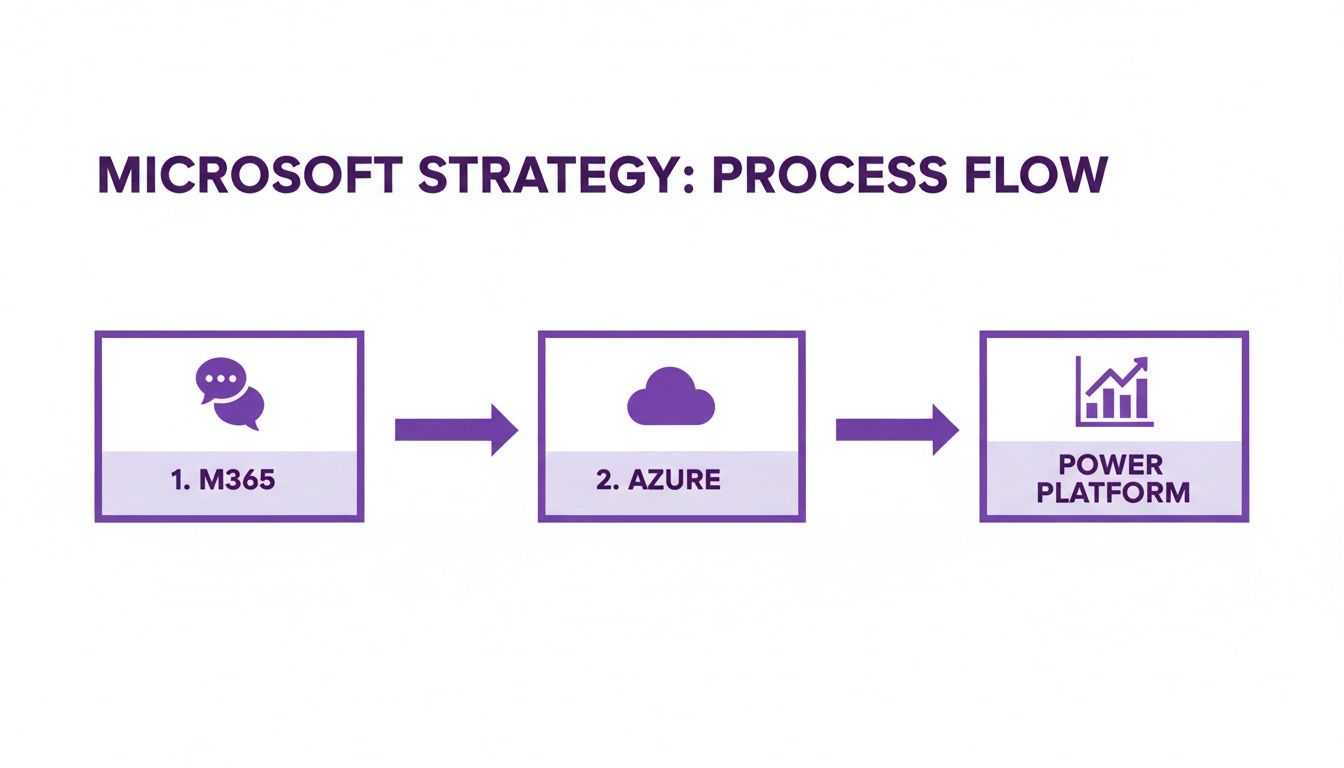
The flow demonstrates how foundational tools like M365 for collaboration are supported by the scalable power of Azure, and then supercharged with custom automation and insights from the Power Platform.
Step 4: Implement Pilot Projects
Don’t try to boil the ocean. Instead of attempting a massive, high-risk overhaul from the get-go, start small. Pick one or two specific areas where a change could have a big impact and run pilot projects.
These pilots are your testbed. They let you try out ideas on a manageable scale, gather real-world feedback, and—most importantly—prove the value of what you’re doing. A successful pilot, like automating a tedious manual report that everyone hates, creates a powerful success story. It builds confidence and makes it much easier to get backing for the bigger projects to come.
Step 5: Scale and Integrate
Once your pilot projects have proven their worth, it’s time to scale up. This step is about methodically rolling out the new processes and technologies across other parts of the business.
The crucial word here is integration. Your new tools must talk to your existing systems. The last thing you want is to create new digital silos where information gets trapped. The aim is a unified digital ecosystem where data flows smoothly between departments. This integrated approach is happening at the highest levels; the UK government, for example, committed £8 billion to its own digital roadmap, with a strong emphasis on joining up services. You can read more about the government’s digital future roadmap and see the same principles at play.
Step 6: Measure and Optimise
Digital transformation is not a “set it and forget it” project. It’s a continuous loop of improvement. This final, ongoing step is about constantly measuring your results against the KPIs you established back in step two.
Use the data and analytics from your new systems to see what’s working and what isn’t. This insight allows you to fine-tune your approach, react to changing market demands, and ensure your strategy keeps delivering real value, year after year. It’s a commitment to always getting better.
Ready to build a roadmap that delivers real results? Phone 0845 855 0000 today or Send us a message to start your transformation.
Common Pitfalls and How to Sidestep Them
Setting out on a digital transformation journey is a big move, but the path is often littered with predictable hurdles. Many projects stumble, not because the ideas are bad, but because they fall into the same old traps. Knowing what these are ahead of time is half the battle won.
One of the most common reasons things go off the rails is a fuzzy, poorly communicated vision from the top. If the leadership team can’t clearly and consistently explain why this change is happening and what success looks like, the whole thing loses steam before it even starts. Teams end up pulling in different directions, and the initial excitement fizzles out.
The fix? Leaders need to create a transformation charter. Think of it as your North Star for the project. It should spell out the exact business problems you’re solving, define what success actually looks like in numbers, and show how the changes will make life better for both the company and the people in it.
Focusing on Technology Over People
Another classic mistake is getting so wrapped up in the shiny new tech that you forget about the people who have to use it. It’s easy to get excited about features and platforms, but if you don’t manage the human side of the change, you’re heading for trouble. A staggering 70% of digital transformation efforts fail, and it’s rarely because the tech broke. It’s because of employee resistance.
A new system that nobody uses correctly is just an expensive database. Real value only comes when your team actually adopts the new tools and weaves them into how they work every day.
The best way to avoid this is to bring your team into the loop early on. Ask for their input right from the start to understand the daily frustrations they face. This doesn’t just help you pick better tools; it gives your people a sense of ownership, turning them from sceptics into champions for the project.
Underestimating Change Management and Training
Finally, so many businesses completely underestimate what it takes to manage change and provide proper training. A single training session on launch day just won’t cut it. People need ongoing support as they get to grips with new processes. Without it, they get frustrated, fall back into old habits, and those promised efficiency gains simply never happen.
You need to invest in a proper change management plan. This means clear communication before, during, and after you go live, plus easy-to-access training that’s relevant to different roles. To build a culture that truly embraces new ways of working, explore our in-depth guide to effective change management in digital transformation.
Getting this right is becoming more critical by the day. Market research predicts the UK digital transformation market will be worth £47.33 billion in 2025, and it’s set to grow at nearly 15% a year through to 2033. That kind of growth shows just how important it is for businesses to get their strategy right from the beginning. By planning for these common pitfalls, you can build a strategy that’s resilient, people-focused, and set up for real success.
Ready to build a strategy that avoids these common pitfalls? Phone 0845 855 0000 today or Send us a message.
Time to Take the First Step
Getting started with a big new initiative can feel like staring up at a mountain. But as we’ve walked through, a digital transformation strategy isn’t a single, impossible climb. It’s a journey made up of manageable steps, and the most crucial one is the first. You don’t need to flip a switch and change everything overnight; real, lasting change begins with a few smart, well-chosen moves.
The trick is to build some early momentum. Take a candid look at where your business stands today. Where are the real bottlenecks in your day-to-day work? Which clunky, manual tasks are eating up valuable time and causing headaches for your team or your customers?
Pinpointing just one or two areas where a small change could make a big impact is the perfect way to begin. That first win, however small, builds the confidence and buy-in you need to keep moving forward.
You Don’t Have to Go It Alone
Making sense of this journey takes more than just good intentions. It demands real-world experience, careful planning, and a clear understanding of how to connect technology to actual business problems. For mid-sized businesses here in the East Midlands, having a partner who gets both the local landscape and the tech possibilities is vital. You need someone who can cut through the jargon and focus on what will genuinely work for you.
At F1 Group, this is what we do. We’re specialists in designing and rolling out practical digital transformation strategies built on the Microsoft technology stack. Our job is to turn your high-level business goals into concrete, tech-powered solutions that deliver tangible results. We don’t just install software; we partner with you to create a clear roadmap that gets your people, processes, and technology all pointing in the same direction.
“The secret of getting ahead is getting started. The secret of getting started is breaking your complex overwhelming tasks into small manageable tasks, and then starting on the first one.” – Mark Twain
This rings true for any major business change. It’s not about one giant leap, but a series of deliberate, well-planned steps. Let’s figure out that first step together. Our team can help you assess where you are, identify some quick wins, and map out a phased plan that works with your budget and delivers value from day one.
Ready to modernise your business and set it up for the future? F1 Group is here to help you build a strategy that works.
Phone 0845 855 0000 today or Send us a message.