
So, what exactly is a Managed Service Provider, or MSP? In simple terms, it's a company that takes complete ownership of your business's IT, managing everything from your servers to your employee's laptops. But the key difference is their approach: they work proactively to prevent problems before they start, all for a predictable monthly fee.
This is a world away from the old way of doing things, where you'd only call an IT person when something was already broken.
Your Proactive IT Partner, Explained
If you're running a business, you've likely felt the frustration. You're trying to focus on growth, but you're constantly pulled away by computer glitches, worries about a potential cyber-attack, or the sheer panic of a server going down. Many UK business owners end up becoming reluctant, part-time IT managers, and it's a huge drain on their time and energy.
This is exactly where a Managed Service Provider comes in. Think of them less as an outside contractor and more as an extension of your own team—your dedicated technology department.
Their entire mission is to flip your IT strategy from reactive to proactive. Instead of the stressful "break-fix" cycle of waiting for disaster to strike, an MSP is always watching, maintaining, and improving your systems in the background.
This shift makes a massive difference. It dramatically reduces expensive downtime, bolsters your defences against ever-present security threats, and helps make sure your technology is actually helping you achieve your goals. Plus, the subscription model makes budgeting a breeze, getting rid of those nasty, unexpected bills for emergency repairs.
The Growing Demand for Managed Services in the UK
Partnering with an MSP isn't just a niche trend; it's become a standard, smart way for UK businesses to handle their technology. The market growth tells the story.
A recent government report really puts this into perspective. The UK managed service provider market now includes 12,867 active firms. That's a huge number, showing just how much businesses rely on outsourced IT to keep up. These providers employ over 343,000 people and generate a staggering £51 billion in annual revenue.
These figures aren't just statistics; they highlight the critical role MSPs now play in the UK economy. For any business looking to grow and stay secure, they've become an essential partner. You can dive deeper into the data by reading the full government research on the UK MSP market.
What Does an MSP Actually Do?
So, what does this proactive partnership look like on a day-to-day basis? An MSP essentially takes the entire weight of your technology off your shoulders. This almost always includes a core set of services:
- Continuous Monitoring: They keep a constant, watchful eye over your entire network, servers, and computers. This lets them spot warning signs and fix potential issues long before you or your team even notice a problem.
- Helpdesk Support: Your team gets a direct line to friendly, expert technicians for any and all IT queries. No more asking a colleague or trying to Google the answer—just fast, professional help when you need it.
- Cyber Security Management: From firewalls and antivirus software to advanced threat detection, they build and manage a robust security shield to protect your company's valuable data from attack.
- Backup and Recovery: They make sure your data is backed up safely and regularly. More importantly, they ensure it can be restored quickly in a worst-case scenario, getting you back up and running with minimal disruption.
The Core Services of a Modern MSP
When you partner with a Managed Service Provider, you're not just hiring someone to fix broken computers. You're getting a whole suite of strategic services designed to keep your business running smoothly, securely, and efficiently. While the exact menu can vary, any top-tier provider builds their offering on a solid foundation of core services that work together to create a powerful technology framework for your organisation.
Let's break down the essentials you should expect and see how each piece contributes to a more resilient and productive business.
Proactive IT Support and Helpdesk
The biggest change an MSP brings to the table is the shift from reactive repairs to proactive maintenance. Instead of waiting for a critical system to fail—and bringing your business to a halt—they work constantly behind the scenes to prevent problems from ever happening. That's the real magic of managed services.
This preventative approach means they're always running system health checks, applying software patches to close security gaps, and fine-tuning performance. You can learn more about how proactive IT support is a game-changer for preventing costly downtime and keeping your team productive.
Of course, when issues do pop up, you need fast, expert help. A dedicated helpdesk gives your team a direct line to technicians who can sort out everything from a forgotten password to a tricky software glitch, making sure small frustrations don't balloon into major roadblocks.
24/7 Network Monitoring and Management
Imagine having a guardian for your IT infrastructure that never sleeps. That's exactly what 24/7 network monitoring is. Using sophisticated tools, your MSP keeps a constant, vigilant watch over your servers, network devices, and all the critical systems your business relies on.
This round-the-clock oversight allows them to spot anomalies or warning signs—like a server running low on memory or unusual traffic patterns—long before they escalate into a full-blown crisis. By catching and fixing these potential issues early, they prevent the kind of significant downtime that can cripple a business.
Specialised Microsoft 365 and Azure Support
In any modern workplace, Microsoft's cloud platforms are the engine room for daily operations. But managing these powerful and complex ecosystems takes a very specific set of skills. That's why expert management of Microsoft 365, Azure, and Dynamics 365 is a key service offered by any forward-thinking MSP.
This goes way beyond a basic setup. It involves:
- Optimising Subscriptions: Making sure you’re on the most cost-effective licensing plan for your actual needs.
- Security Configuration: Applying best practices to lock down your data within the Microsoft cloud.
- User Management: Handling the day-to-day admin of user accounts, access, and permissions.
- Platform Integration: Helping you get the most out of your investment by making sure different applications play nicely together.
This shift is reflected across the industry. The UK MSP market is seeing 'IT Infrastructure Management' predicted to fall from a 74% market share in 2024 to 52% in 2025. At the same time, 'Application and Hosting' services are surging from 17% to 33%. This trend is all about cloud adoption and aligns perfectly with F1Group's deep expertise in Microsoft platforms.
Robust Cyber Security Services
In a world of constant digital threats, strong cyber security is simply non-negotiable. Your MSP acts as your first line of defence, putting a multi-layered security strategy in place to protect your sensitive data, your reputation, and your finances. Implementing essential cyber security risk management strategies is a core part of the proactive support a modern MSP delivers, safeguarding businesses from an ever-changing threat landscape.
Core security services should always include:
- Advanced Threat Detection: Using intelligent tools to identify and neutralise malware, ransomware, and phishing attacks.
- Firewall Management: Configuring and maintaining the primary digital barrier protecting your network from intruders.
- Endpoint Protection: Securing every single device connected to your network, from desktops and laptops to mobile phones.
- Security Awareness Training: Giving your staff the knowledge they need to spot and avoid common cyber threats.
A quality MSP doesn't just install some antivirus software and call it a day. They build a comprehensive security posture that evolves to counter new threats, ensuring your business stays protected.
Backup and Disaster Recovery
Here's a question that keeps business owners up at night: what would happen if your critical data vanished tomorrow? Whether it’s due to a hardware failure, a cyber-attack, or even a fire or flood, a solid Backup and Disaster Recovery (BDR) plan is your only real answer. It’s the absolute backbone of business continuity.
An MSP manages this entire process for you. They ensure your data is backed up regularly to a secure, off-site location. But more importantly, they test those backups to guarantee they can be restored quickly and reliably when you need them most. This service isn't just a technical task; it's peace of mind, knowing that even in a worst-case scenario, your business can get back on its feet with minimal disruption.
Understanding MSP Pricing Models and SLAs
Figuring out the cost of IT support shouldn't feel like a guessing game. One of the biggest reliefs of working with a managed service provider is swapping unpredictable, often painful, repair bills for a straightforward, consistent monthly cost. Getting to grips with how MSPs structure their fees is the first step to building an IT budget you can actually rely on.
Most providers in the UK have a few common ways of pricing their services, each designed to fit different kinds of businesses. It's all about providing clarity and letting you choose a plan that makes sense for how you work and where you're headed.
Common Pricing Structures Explained
The way an MSP charges is a direct reflection of how they deliver their support. There’s no single "best" model – the right choice really depends on the size of your company, how many people are on your team, and the level of support you need day-to-day.
Here are the main models you're likely to come across:
-
Per-User Model: This is easily the most popular approach today. You simply pay a flat monthly fee for each member of your team. It's perfect for modern businesses where staff use multiple devices – a laptop, a desktop at the office, and a mobile phone – because it covers the person, not just the machine. For a typical UK small business, you can expect this to be somewhere between £35 to £65 per user per month.
-
Per-Device Model: With this model, your monthly fee is based on the number of bits of kit the MSP is looking after. This includes servers, desktops, laptops, and networking gear. It’s a great fit for businesses with a fixed, predictable amount of hardware, like a manufacturing firm or an office where staff share workstations.
-
All-Inclusive (Tiered) Model: Many MSPs bundle their services into different packages, often labelled something like Bronze, Silver, and Gold. Each tier offers a different depth of service for one fixed monthly cost. This is a brilliant option if you want everything covered under one umbrella, as it usually bundles proactive monitoring, helpdesk support, security, and backups into one predictable payment.
This flexibility means that whether you’re a fast-growing team or have a stable set of equipment, there's a pricing structure out there that will give you both value and predictability.
To make things clearer, let's break down how these common pricing models stack up against each other. Each one has its place, and understanding the nuances will help you decide which is the best financial fit for your business.
Typical MSP Pricing Models Compared
| Pricing Model | How It Works | Best For | Typical UK Price Range (Per Month) |
|---|---|---|---|
| Per-User | A flat fee is charged for each employee, regardless of the number of devices they use. | Businesses with flexible working, BYOD policies, or where staff use multiple devices (laptop, phone, tablet). | £35 – £65 per user |
| Per-Device | A flat fee is charged for each managed device (server, desktop, laptop, firewall, etc.). | Companies with a fixed number of devices or shared workstations, like manufacturing or call centres. | £25 – £55 per desktop £100 – £300+ per server |
| All-Inclusive (Tiered) | Services are bundled into packages (e.g., Bronze, Silver, Gold) with increasing levels of support at fixed prices. | Businesses wanting comprehensive, all-in-one coverage with a predictable, fixed budget for all IT needs. | Varies widely based on tier, from basic packages around £500 to comprehensive plans at £2,000+ |
Ultimately, the goal is to find a model that feels fair and transparent, allowing you to budget effectively without worrying about hidden costs popping up when you least expect them.
The Importance of the Service Level Agreement
While the pricing model tells you how much you'll pay, the Service Level Agreement (SLA) is the document that tells you exactly what you get for your money. Think of it as the bedrock of your relationship with an MSP. It’s a formal contract that clearly defines the services being provided and, crucially, the standards the provider has to meet.
An SLA is more than just paperwork; it’s your guarantee of service quality. It sets clear, measurable expectations for both sides and removes any grey areas around response times, support availability, or performance. Without a solid SLA, you're essentially just hoping for the best.
A well-written SLA takes the guesswork out of the equation and creates a clear framework for accountability. It turns a vague promise of "good support" into a set of concrete, binding commitments.
Key Metrics to Look for in an SLA
When you're reading through an SLA, you need to zoom in on the specific, measurable details that will actually affect your business day-to-day. A vague or poorly defined SLA is a massive red flag.
A good SLA should spell out the following in plain English:
-
Response Time: This is the maximum time you should ever have to wait for the MSP to acknowledge your support ticket and start looking at the problem. This is almost always tiered by priority – a server outage should get an immediate response, whereas a minor printer issue can wait a bit longer.
-
Resolution Time: This takes it a step further. It defines the target for getting the issue fixed. Of course, not every problem can be solved in ten minutes, but the SLA should set realistic and acceptable targets for different types of incidents.
-
Uptime Guarantee: For the systems your business can't live without, like servers or key cloud services, the SLA should promise a specific percentage of uptime, such as 99.9%. This is your assurance that your most important tools will be there when you need them.
-
Support Availability: The agreement has to be crystal clear about the hours of support. Are they on hand 24/7/365, or do they only work standard UK business hours? This is absolutely vital if your team works flexibly or you have operations outside the traditional 9-to-5.
By carefully checking these metrics, you can be confident that the MSP’s promises line up with what your business actually needs, ensuring you get the reliable and responsive support you’re paying for.
Choosing Between MSP And Break-Fix IT Support
Sooner or later, every business hits a fork in the road with its technology. Do you stick with the familiar "call someone when it breaks" approach, or do you bring in a partner to make sure things don't break in the first place? This single decision can define how resilient your business is, how predictable your costs are, and ultimately, how much time you get to spend on what really matters—growth.
The choice really boils down to two very different philosophies: the traditional break-fix model versus a modern managed service provider (MSP).
The Traditional Break-Fix Approach
We’ve all been there. A server goes down, a laptop dies, or the Wi-Fi disappears right before a big meeting. You frantically call an IT technician, who comes out and charges you by the hour to get things working again. That’s the break-fix model in a nutshell.
Think of it like calling an emergency plumber. They’ll fix the burst pipe, but you’re left with the mess, the disruption, and a surprisingly large bill you weren't expecting. The technician's business literally depends on your technology failing, so there's no real incentive for them to prevent problems from happening again.
While it might seem cheaper on the surface because you only pay for repairs, the hidden costs quickly add up. Every hour of downtime is an hour of lost productivity and potential revenue. Add in the stress and the premium rates for "emergency" call-outs, and it's often the most expensive way to manage your critical IT systems.
The Proactive MSP Partnership
An MSP flips the script entirely. Instead of waiting for the pipe to burst, they're focused on maintaining the entire system to make sure it never does. It’s a fundamental move away from reactive firefighting towards proactive, preventative care.
For a predictable monthly fee, your MSP takes complete ownership of your IT. Their goals are perfectly aligned with yours: the fewer problems you have, the better it is for everyone. This dynamic creates a genuine partnership built on keeping your business stable, secure, and running at its best.
The value here goes far beyond just fixing things. To get a clearer picture of how this proactive model can drive your business forward, it's worth exploring the full benefits of managed IT services.
This shift isn't just a niche trend; it's where the market is heading. The UK managed services sector is set to rocket from roughly £10 billion in 2025 to over £21 billion by 2035. This explosive growth shows that businesses are overwhelmingly choosing proactive partnerships to build a stable foundation for modern operations. You can learn more about this impressive market growth in managed network services.
Managed Services vs Break-Fix A Head-to-Head Comparison
To make the distinction crystal clear, let's break down the fundamental differences between the proactive managed services model and the reactive break-fix approach. This will help you see which philosophy best aligns with your business goals.
| Feature | Managed Service Provider (MSP) | Break-Fix IT Support |
|---|---|---|
| Approach | Proactive & Preventative | Reactive & Problem-Focused |
| Cost Structure | Predictable monthly fee | Unpredictable hourly rates |
| Incentive | Aligned with your success; paid to prevent downtime | Paid only when things break |
| Budgeting | Simple, fixed operational expense (OpEx) | Unpredictable capital expense (CapEx) |
| Downtime | Minimised through constant monitoring | Frequent; business halts until fixed |
| Focus | Strategic IT improvement & long-term stability | One-off transactional repairs |
| Relationship | Strategic partner invested in your growth | On-demand vendor |
Ultimately, the choice comes down to whether you view IT as a cost centre to be managed reactively or as a strategic asset that can drive efficiency and growth when managed proactively.
Introducing Co-Managed IT: A Hybrid Solution
But what if you already have a great IT person or a small team in-house? Does that mean an MSP is off the table? Not at all. This is where a third option, Co-Managed IT, comes in. It’s a flexible, hybrid model that gives you the best of both worlds.
In a co-managed partnership, an MSP like F1Group works with your existing team, not to replace them, but to make them even better.
This collaborative approach allows your internal staff to focus on daily user support and strategic projects, while the MSP handles specialised tasks like 24/7 server monitoring, advanced cybersecurity defence, and complex infrastructure management.
It's the perfect way to plug skills gaps, access enterprise-grade tools, and give your IT department a powerful support system without the huge expense of hiring more specialists. Your team gets the backup they need, and your business gets an extra layer of protection.
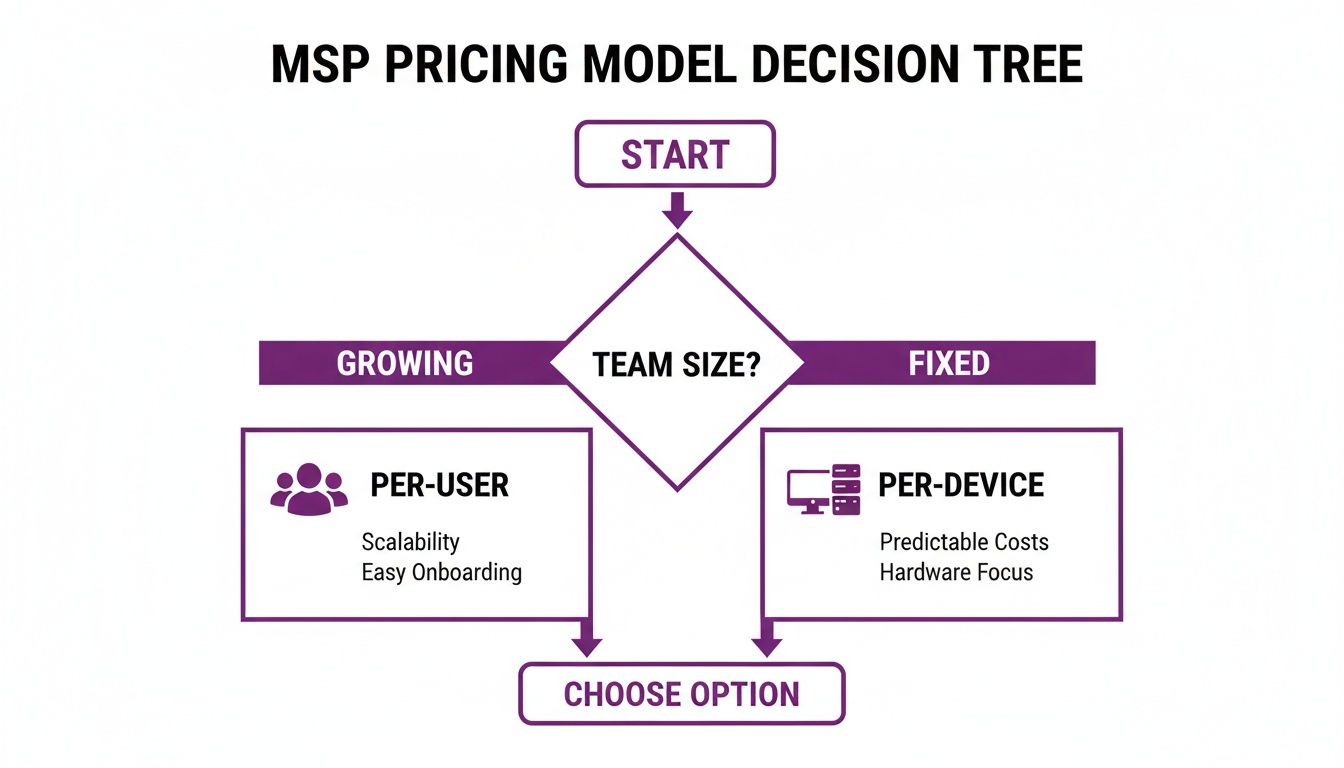
This diagram helps you think through whether a per-user or per-device model makes more sense for you. Generally, a per-user model scales beautifully with growing teams, while a per-device model can be more cost-effective if you have a fixed number of machines to manage.
How to Select the Right MSP for Your Business
Choosing a managed service provider isn't just another item on a procurement list; it’s a major strategic decision. You're not just buying a service—you're choosing a long-term partner who will be responsible for the very technology that keeps your business running.
Getting it right means finding a provider whose technical skills, company values, and vision for the future all click with your own. This is about much more than just finding someone to fix computers; it's about trusting them with your operational stability, your data, and your peace of mind.

Building Your Evaluation Checklist
To cut through the marketing noise, you need a clear checklist of what really matters. A structured approach helps you compare providers like-for-like and ensures you don’t miss any critical details before signing on the dotted line. Think of it as your roadmap to making a confident, informed choice.
Here are the non-negotiables to include in your assessment:
- Technical Expertise: Can they prove they know their way around the systems you actually use? For most UK businesses, that means demonstrating deep expertise in core platforms like Microsoft 365, Azure, and Dynamics 365.
- Security Credentials: What qualifications do they hold? Look for recognised certifications like Cyber Essentials or ISO 27001. These aren't just badges; they're proof of a serious commitment to security.
- On-Site and Remote Capabilities: Do they offer both? You need quick remote support for everyday glitches but also the assurance that an engineer can be on-site when something more serious happens.
- Client Testimonials and Case Studies: Ask for evidence of their work with businesses like yours. Real-world success stories are far more telling than any sales pitch.
Verifying Technical and Security Credentials
Any provider can talk a good game, but the best ones back it up with official certifications and a completely transparent approach to security. These credentials are your best guarantee of quality and competence.
A crucial but often-missed detail is the background of their engineering team. Asking if all engineers are DBS-checked is a vital step, especially if they will have access to sensitive company data. It shows a provider's commitment to security goes beyond the technology.
You should also look for established partnerships with major tech vendors. Being a certified Microsoft Partner, for instance, shows a deep understanding of the Microsoft ecosystem. These relationships often grant the MSP access to higher levels of support, which is a direct benefit to you when a tricky issue pops up.
To make this process easier, using a structured document can be a massive help. You can explore our Request for Proposal (RFP) IT template to get a sense of the key questions you should be asking.
The Strategic Advantage of a Local Partner
In a world of remote everything, it's easy to think geography doesn't matter. But when your entire business grinds to a halt, having an IT partner just down the road can make all the difference, particularly for us here in the East Midlands.
Choosing a local MSP gives you tangible advantages:
- Faster On-Site Response: When a server fails or your network goes down, you can't wait for an engineer to travel for hours. A local team in Lincoln, Nottingham, or Leicester can be on-site fast to get you back up and running.
- Understanding of the Regional Business Community: A local provider is part of your world. They understand the local market, its challenges, and its opportunities, which means their advice is far more relevant and practical.
- Building a Genuine Partnership: Nothing beats face-to-face meetings for building real trust. It’s simply easier to form a strong working relationship with a team you can actually meet.
A long-standing history in the region is also a powerful indicator of reliability. For example, F1Group was established in 1995 and has spent decades building a reputation for hands-on, dependable IT support across the East Midlands. That kind of longevity doesn’t happen by accident; it’s a testament to our focus on delivering real results for our local clients.
Your Questions About Managed Services, Answered
Deciding to bring in a managed services partner is a big move, and it's only natural to have questions before you dive in. We get it. To help clear things up, we’ve put together answers to some of the most common queries we hear from businesses across the UK. Our goal is to give you the clarity you need to make the right choice for your company's future.
Are We the Right Size for an MSP?
It’s a common myth that managed services are just for big corporations with massive budgets. The truth is, managed IT services are incredibly flexible and bring huge advantages to businesses of all shapes and sizes, from ambitious start-ups to well-established firms. The whole point is that the model scales right alongside your growth.
For small and medium-sized businesses (SMEs), working with an MSP is like unlocking an enterprise-level IT department overnight. You gain access to sophisticated tools, deep expertise, and robust security measures that would be prohibitively expensive to build from scratch. It’s a game-changer that allows smaller players to compete on a level playing field.
On the other hand, larger organisations with their own IT teams find an MSP can be the perfect partner. We can take on the essential but time-consuming tasks like 24/7 monitoring and system updates. This frees up your internal experts to stop firefighting and start focusing on strategic projects that genuinely push the business forward.
How Exactly Does an MSP Boost Cyber Security?
An MSP fundamentally shifts your security from a reactive, "hope for the best" approach to a proactive, round-the-clock defence. It's not just about installing some antivirus software and calling it a day. We manage a continuous, multi-layered strategy designed to keep you one step ahead of the bad guys.
This kind of comprehensive protection involves several pieces working together:
- Constant Vigilance: We actively monitor your network for any sign of trouble, ready to neutralise threats before they have a chance to do any real damage.
- Proactive Patching: We make sure all your software is kept up-to-date, closing the security gaps that cybercriminals are always looking to exploit.
- Powerful Security Tools: You get the benefit of advanced tools like next-generation firewalls and endpoint detection and response (EDR) systems, all managed by experts.
- The Human Element: Many MSPs, including us, provide security awareness training to turn your staff into your first line of defence against phishing and social engineering.
With this level of expert oversight, you drastically reduce the risk of a costly and reputation-shattering data breach.
Is This Going to Be Expensive?
While you'll have a predictable monthly cost, partnering with an MSP is almost always more cost-effective than relying on the old break-fix model. That predictable fee is a huge win for budgeting—it puts an end to those dreaded, out-of-the-blue repair invoices that can throw your finances into chaos.
But the real value isn't just in predictable costs; it's in preventing downtime. Think about it: every hour your systems are down is an hour of lost productivity, missed sales, and frustrated customers. An MSP's entire job is to keep that from happening.
When you add up the savings from preventing operational gridlock and avoiding the catastrophic costs of a data breach, the monthly investment in managed services delivers a return that speaks for itself.
Let's Build Your IT Future, Together
Choosing a managed service provider isn't just about outsourcing your IT support; it's about finding a genuine partner. A great MSP is someone who rolls up their sleeves and gets invested in your company’s security, efficiency, and future growth. Think of them as the specialists who turn your technology from a constant headache into one of your greatest business advantages.
Moving to a managed services model is a huge leap forward from the old way of just fixing things when they break. It’s a complete mindset shift. You’re trading unpredictable repair bills and the panic of downtime for a fixed, predictable IT spend and a team whose main job is to stop problems from happening in the first place.
Ready for Proactive IT? Here's Your Next Step
For businesses right here in the East Midlands, this proactive approach is what helps you get ahead and stay there. If you’re tired of worrying about what might go wrong with your systems and want to get back to focusing on what you do best, we should talk. We've got the expertise and the local, hands-on team to build a rock-solid technology foundation for your business.
When you work with a local provider, you get more than just technical skill. You get a team that understands the regional business climate because we're part of it. We're invested in your success. Let's start a conversation about how F1Group can help you build a more secure, efficient, and resilient business. We’re ready to show you what a real IT partnership feels like.
Take the first step. Phone 0845 855 0000 today or Send us a message to talk about what you need.