
In today's competitive business environment, managing an entire IT department in-house is becoming an unsustainable challenge for many small and mid-sized organisations (SMOs). The combination of escalating costs, the rapid pace of technological change, and the persistent threat of cyber-attacks places immense strain on internal resources. This is where strategic IT outsourcing offers a clear path forward.
Partnering with a dedicated managed service provider (MSP) is more than just a way to fix technical issues; it's a powerful business strategy designed to unlock efficiency, bolster security, and empower your team to concentrate on what truly matters: driving your business forward. Understanding the full scope of benefits is crucial for making an informed decision. For those looking to understand the different engagement models available, this strategic guide to IT outsourcing development offers valuable insights into structuring external partnerships effectively.
This article explores the top 10 advantages of outsourcing IT, providing a comprehensive guide for UK business leaders aiming to secure a competitive edge. We will examine each key benefit with practical, real-world examples, demonstrating how leveraging powerful platforms like Microsoft 365, Azure, and Dynamics 365 through an expert partner can fundamentally transform your operations. From significant cost reductions and access to specialised skills to enhanced business continuity and robust risk management, you will discover how a strategic approach to IT can fuel sustainable growth and innovation.
1. Drastic Cost Reduction and Predictable Financial Planning
One of the most compelling advantages of outsourcing IT is the immediate and significant impact on your bottom line. By shifting from an in-house model to a managed service, you convert unpredictable capital expenditures (CapEx) into a fixed, manageable operational expenditure (OpEx). This strategic financial move eliminates the hefty, often unexpected, costs associated with purchasing hardware, software licences, and managing the entire lifecycle of an internal IT team.
Instead of facing a sudden £40,000 bill for a new server or the ongoing £45,000+ salary of a single IT specialist, outsourcing provides access to a full team of experts and enterprise-grade infrastructure for a predictable monthly fee. This model typically saves organisations between 20-40% on their annual IT spend, allowing for more accurate budgeting and improved cash flow management. This is particularly effective in modern operational frameworks; for instance, many find that cost predictability can be achieved through models like DevOps as a Service (DaaS).
Practical Scenarios
- CapEx to OpEx Conversion: A UK-based logistics firm avoided a £50,000 capital outlay for on-premise servers by migrating to a managed Microsoft Azure environment. This was converted into a predictable £1,500 monthly operational cost, preserving capital for core business growth.
- Scaling without Headcount: A growing marketing agency needed more IT capacity but wanted to avoid hiring a second IT professional at £50,000 per year. They outsourced to a managed service provider for just £2,000 per month, gaining access to a diverse team of specialists in security, cloud, and support.
Actionable Tips for Cost Management
To maximise financial benefits, it is crucial to approach outsourcing strategically:
- Conduct a TCO Analysis: Before committing, perform a thorough Total Cost of Ownership (TCO) analysis. Compare the direct and indirect costs of your current in-house setup (salaries, training, hardware, software, downtime) against the proposed managed service fee.
- Scrutinise the SLA: Ensure your Service Level Agreement (SLA) clearly details every included service, response times, and any potential extra charges for out-of-scope work. This prevents 'scope creep' and unexpected bills.
- Request Cost Breakdowns: Ask potential partners for a detailed cost breakdown in their proposals. This transparency helps you understand precisely what you are paying for and compare offers effectively.
By making this shift, you're not just cutting costs; you're investing in financial stability and strategic foresight. For more information, explore the benefits of managed IT services.
2. Access to Specialized Expertise and Advanced Skills
Attempting to build an in-house team with expertise across every IT discipline, from cybersecurity to cloud architecture and AI integration, is a monumental challenge for any organisation. One of the key advantages of outsourcing IT is gaining immediate access to a deep pool of certified professionals and advanced skills that would be prohibitively expensive and difficult to recruit and retain internally. This allows you to leverage enterprise-level knowledge without the associated overheads.

A managed service provider (MSP) invests continuously in training and certifying its team in emerging technologies. Instead of relying on a single generalist, you gain a dedicated partner with specialists in areas like Microsoft Dynamics 365, Azure infrastructure, and modern security frameworks. This ensures your technology strategy is not just maintained but actively enhanced by experts at the forefront of the industry. This is the core benefit of what is often called specialist IT support.
Practical Scenarios
- Cybersecurity Enhancement: A mid-sized charity in the East Midlands needed to achieve Cyber Essentials certification but lacked in-house security expertise. By outsourcing, they accessed a certified security specialist who implemented the required controls within their Microsoft 365 environment, achieving certification in weeks.
- Complex Cloud Migration: A manufacturing firm wanted to modernise its legacy systems by moving to Microsoft Azure. Their MSP provided a certified cloud architect to design and execute a seamless migration, a role that would have cost over £80,000 to hire directly.
Actionable Tips for Leveraging Expertise
To ensure you gain the maximum value from your provider's skills, consider the following:
- Verify Vendor Certifications: Ask potential partners for evidence of their team’s certifications, especially in technologies critical to your business, such as Microsoft Azure Administrator or M365 Security Administrator credentials.
- Request Relevant Case Studies: Request case studies or references from clients in a similar sector or who have faced similar technological challenges. This demonstrates proven experience, not just theoretical knowledge.
- Ensure Knowledge Transfer: Your contract should include provisions for knowledge transfer. This ensures your internal team understands the new systems, empowering them to handle day-to-day issues and collaborate effectively with the outsourced experts.
3. Focus on Core Business Functions
One of the most profound advantages of outsourcing IT is the liberation of your internal teams to concentrate on what they do best: driving your business forward. Every moment your management team or non-IT staff spend wrestling with technical issues, system updates, or user support is a moment diverted from revenue-generating activities like product development, customer engagement, and strategic planning. By delegating the complexities of IT management to a specialist partner, you reclaim invaluable focus.
Outsourcing allows your organisation to channel its energy and resources into its core competencies, enhancing innovation and strengthening your competitive edge. Instead of being a necessary but distracting operational overhead, your technology becomes a seamless, reliable utility managed by experts. This strategic shift ensures that your most valuable assets, your people, are dedicated to activities that directly contribute to growth, rather than being bogged down by peripheral technical responsibilities.
Practical Scenarios
- Manufacturing Firm Innovation: A UK-based engineering firm outsourced its entire IT infrastructure management, including its Microsoft 365 environment, to an external provider. This freed its engineering director from daily IT troubleshooting, allowing him to focus on designing a new product line which increased company revenue by 15% within a year.
- Charity Mission Focus: A large charity with a small internal team was spending over 20% of its administrative time managing IT systems and donor databases. By outsourcing to a managed service provider, they refocused this time on fundraising campaigns and programme delivery, boosting donor engagement and operational efficiency.
Actionable Tips for Maintaining Focus
To ensure outsourcing successfully redirects focus to core activities, consider these strategies:
- Define Core Business Priorities: Before outsourcing, clearly articulate your primary business objectives. This ensures you align the IT provider’s services with your strategic goals and measure their contribution to your mission.
- Establish Clear Communication Channels: Set up regular, structured meetings (e.g., monthly or quarterly) with your IT partner to review performance and align on future needs. This prevents operational drift and keeps IT in sync with your business roadmap.
- Align Outsourced Services with Growth: As your business evolves, your IT needs will change. Work with a provider who can scale and adapt their services, from managing your Microsoft Azure environment to implementing new tools like Copilot AI, ensuring technology remains an enabler, not a bottleneck.
4. Scalability and Flexibility
One of the most powerful strategic advantages of outsourcing IT is the ability to achieve seamless scalability and operational flexibility. Business is never static; it ebbs and flows with seasonal demands, project cycles, and market shifts. An outsourced IT model allows your organisation to instantly scale resources up or down to meet these demands without the friction and cost associated with hiring, training, or managing internal staff and infrastructure.
Instead of being locked into a fixed capacity, you gain an elastic IT environment. Need to support a major new project or a seasonal peak in business? Your managed service provider can allocate more resources almost instantly. Conversely, if you need to streamline operations during a quieter period, you can scale back without the burden of redundant hardware or staff. This agility is a core benefit of moving away from rigid on-premise systems, allowing you to adapt to new opportunities with speed.
Practical Scenarios
- Seasonal E-commerce Demand: A UK-based online retailer uses a managed Microsoft Azure service to handle the holiday shopping surge. Their cloud resources automatically scale to manage the fivefold increase in website traffic from October to December, then scale back down in January, ensuring they only pay for the capacity they use.
- Project-Based Expansion: A construction firm needed to set up a temporary IT infrastructure for a new 18-month site project. Instead of a large capital investment, they partnered with an MSP to deploy a fully managed, secure network and cloud access for 30 temporary staff, which could be decommissioned easily upon project completion.
Actionable Tips for Scalability Management
To ensure you can leverage this flexibility effectively, consider the following:
- Define Scaling Triggers: Work with your provider to establish clear triggers and thresholds for scaling resources up or down. This could be based on user numbers, data volume, or specific business events.
- Build Flexibility into the SLA: Your Service Level Agreement (SLA) should explicitly detail the process, timeframe, and costs for scaling resources. Ensure it covers both temporary spikes and long-term changes to your business needs.
- Leverage Cloud-Based Services: Prioritise providers who utilise cloud platforms like Microsoft Azure. These services are inherently designed for dynamic scaling and offer a pay-as-you-go model that perfectly complements a flexible business strategy. You can explore the differences further in this comparison of on-premises vs cloud solutions.
5. 24/7 Business Continuity and Support
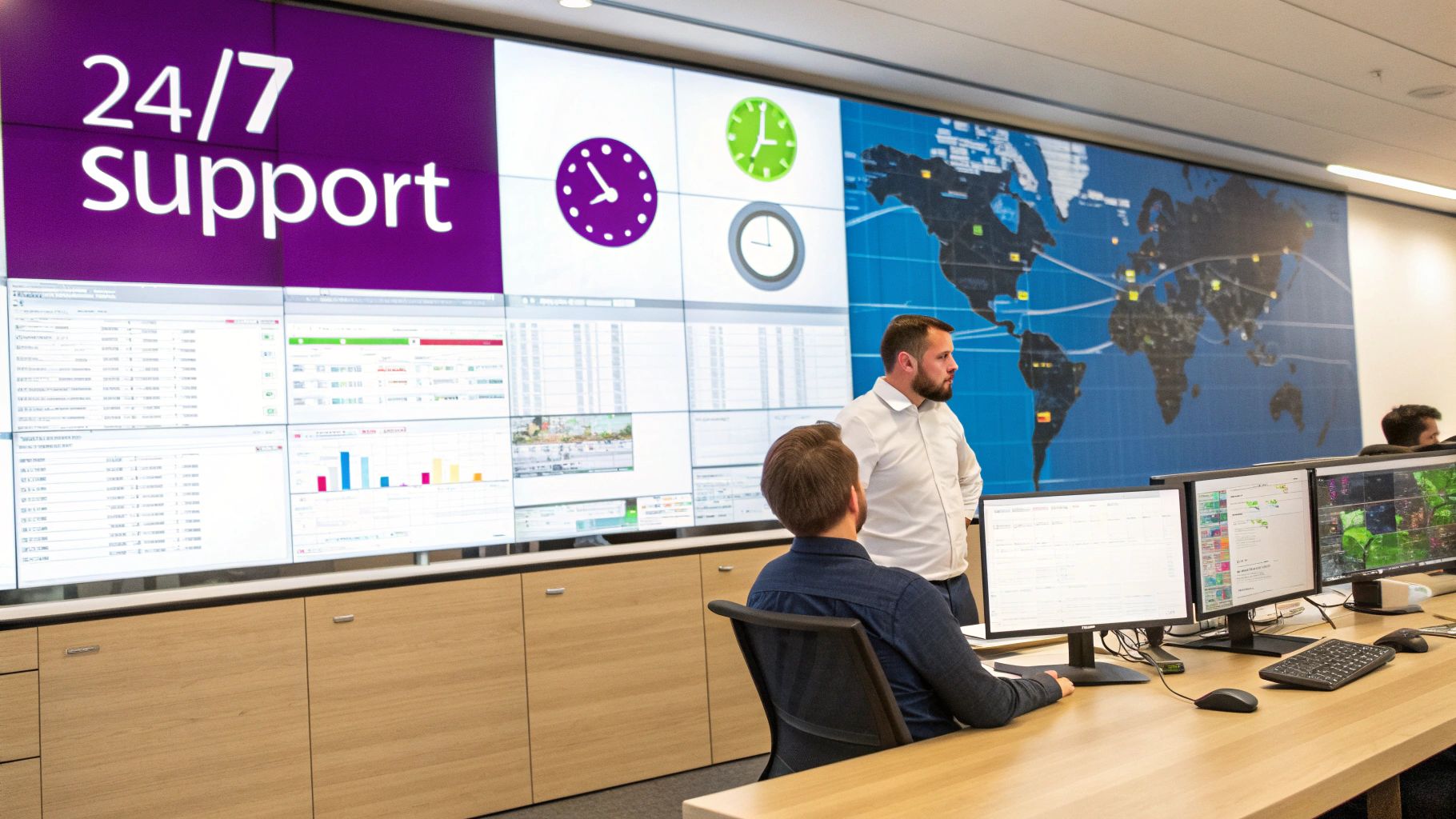
In today's global, always-on economy, downtime is no longer an option. One of the most critical advantages of outsourcing IT is achieving continuous business operations through round-the-clock support. An external partner provides 24/7 monitoring, maintenance, and helpdesk services, ensuring that critical systems are always available without the immense cost and logistical challenge of staffing an in-house, multi-shift team.
This constant vigilance protects your organisation from threats and resolves issues before they can impact productivity or revenue. For a small or mid-sized business, building this level of internal resilience is often financially and practically impossible. Outsourcing provides immediate access to a follow-the-sun support model, ensuring an expert is always on hand, regardless of the time or day. This is particularly vital for companies leveraging cloud platforms like Microsoft Azure, where uptime directly correlates with customer satisfaction and operational success.
Practical Scenarios
- Global Operations Continuity: An e-commerce business in the East Midlands uses an outsourced IT provider to monitor its Azure-hosted web servers. When a critical security patch needed to be applied at 2 AM GMT, the provider's overnight team handled it seamlessly, preventing any downtime during peak European and US shopping hours.
- Uninterrupted Patient Care: A private healthcare clinic maintains its patient management system, built on Microsoft Dynamics 365, with 24/7 outsourced support. This ensures clinicians have constant, HIPAA-compliant access to patient records, even for out-of-hours emergencies, without needing on-call IT staff.
Actionable Tips for Ensuring Continuity
To leverage 24/7 support effectively, proactive planning and clear communication are essential:
- Define Clear Escalation Procedures: Your Service Level Agreement (SLA) must precisely map out the escalation path for different incident severities. Know who is contacted and when, from the first-line support technician to senior engineers.
- Establish Communication Protocols: Agree on standard communication channels and protocols for out-of-hours incidents. This could include automated alerts, a dedicated hotline, or a shared communication platform to ensure rapid response.
- Test Disaster Recovery Regularly: Don't wait for a real disaster. Work with your provider to schedule and execute quarterly disaster recovery and business continuity tests to validate the agreed-upon procedures and ensure a swift recovery.
6. Risk Management and Compliance
Navigating the complex and ever-changing landscape of data protection and regulatory compliance is a significant challenge for modern businesses. Outsourcing IT to a specialist provider transfers this burden to experts whose core business is managing security risks and ensuring adherence to legal frameworks. This is a critical advantage of outsourcing IT, as it mitigates the substantial financial and reputational damage that can result from a security breach or compliance failure.
A professional managed service provider (MSP) invests heavily in the tools, processes, and expertise required to maintain robust security postures and meet standards like GDPR, Cyber Essentials, and industry-specific regulations. They implement best practices for data protection, threat detection, and disaster recovery, ensuring your systems are resilient and your data is secure. This proactive approach to risk management is often beyond the capacity of an in-house team, who may lack the specialised knowledge or resources.
Practical Scenarios
- Achieving Cyber Essentials Certification: A regional accountancy firm needed to achieve Cyber Essentials Plus certification to tender for government contracts. Their outsourced IT partner managed the entire process, implementing necessary controls within their Microsoft 365 environment, and ensuring a successful audit without disrupting daily operations.
- GDPR Compliance: Following a data subject access request, a retail business relied on its MSP to correctly identify, retrieve, and document the required personal information from its systems, ensuring they met the strict GDPR deadline and avoided potential fines.
Actionable Tips for Compliance and Security
To ensure your outsourced partner effectively manages risk, consider the following steps:
- Verify Vendor Certifications: Prioritise partners who hold recognised security and quality certifications, such as ISO 27001 (for information security management) and SOC 2. These credentials demonstrate a formal commitment to security best practices.
- Define Compliance in the SLA: Your Service Level Agreement (SLA) must explicitly state the provider's responsibilities regarding compliance with relevant regulations (e.g., GDPR). This includes data processing, breach notification, and support during audits.
- Establish Clear Data Privacy Agreements: Ensure a robust Data Processing Agreement (DPA) is in place. This legal document outlines how the provider will handle your sensitive data, providing you with essential legal protection and clarity.
7. Access to Latest Technologies and Infrastructure
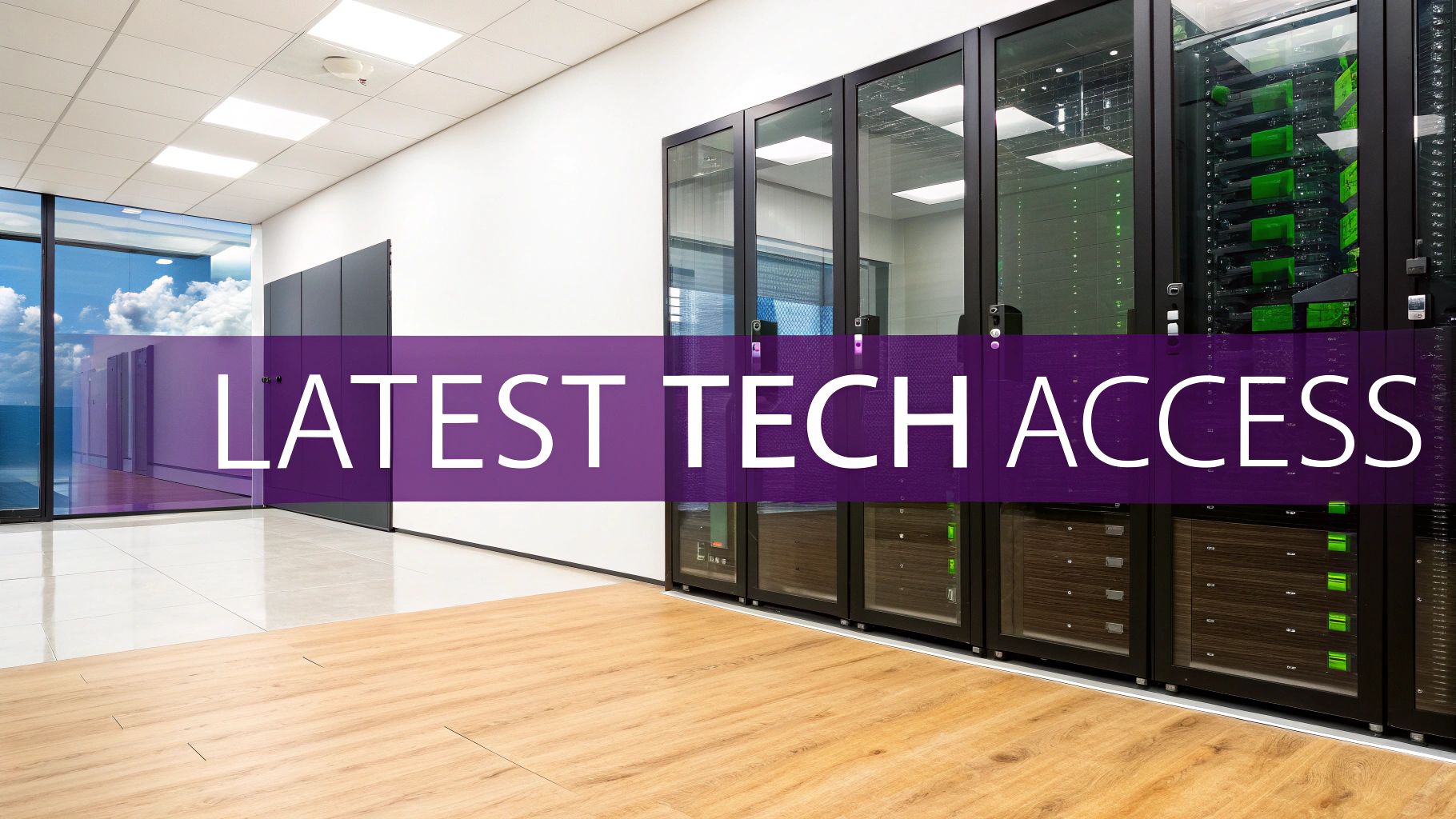
Keeping pace with the relentless evolution of technology is a significant challenge for any organisation. Outsourcing your IT function provides a direct gateway to the latest enterprise-grade hardware, software, and cloud platforms without the prohibitive capital investment. A key advantage of outsourcing IT is that managed service providers (MSPs) stake their business on maintaining cutting-edge infrastructure. They continuously invest in emerging technologies to deliver superior service, allowing your business to benefit from innovations you couldn't justify purchasing or managing in-house.
This means you can leverage advanced solutions built on platforms like Microsoft Azure, Amazon Web Services (AWS), or Google Cloud without needing to build and maintain the expertise yourself. Your MSP handles the complexity of infrastructure management, security patching, and system upgrades, ensuring your operations are always running on a modern, secure, and resilient technology stack. This access democratises technology, allowing smaller businesses to compete with larger enterprises on a more level playing field.
Practical Scenarios
- Cloud Innovation without CapEx: A manufacturing firm in the East Midlands wanted to implement an IoT solution for predictive maintenance but lacked the server capacity. By partnering with an MSP, they gained access to a scalable Microsoft Azure environment, enabling the project to proceed immediately on a pay-as-you-go model, avoiding a £60,000 upfront hardware cost.
- Leveraging Advanced AI: A legal practice sought to improve efficiency using AI tools like Microsoft Copilot. Instead of undertaking a complex internal deployment, they engaged their IT partner who already had the expertise and infrastructure to integrate Copilot securely within their existing Microsoft 365 tenancy, accelerating adoption and ROI.
Actionable Tips for Technology Access
To ensure you are truly benefiting from the latest innovations, take a proactive approach with your provider:
- Request Regular Technology Roadmaps: Ask your MSP to present their technology roadmap annually. This ensures their investment strategy aligns with your future business goals and that they are not letting their infrastructure become dated.
- Negotiate Technology Refresh Clauses: In your contract, include clauses that specify a technology refresh schedule. This contractually obligates the provider to upgrade the underlying hardware and software that supports your services.
- Evaluate Cloud-First Providers: Prioritise partners who have a 'cloud-first' mentality and strong partnerships with major vendors like Microsoft. This is a clear indicator that they are committed to providing modern, scalable, and secure solutions.
8. Improved Efficiency and Reduced Time to Market
In today's fast-paced digital landscape, speed is a critical competitive differentiator. One of the key advantages of outsourcing IT is the ability to significantly accelerate project delivery and shorten the time-to-market for new products, services, and internal systems. An expert managed service provider (MSP) arrives with established, optimised processes, experienced teams, and dedicated resources, eliminating the lengthy learning curve and ramp-up time associated with building these capabilities in-house.
Engaging an outsourced partner gives you immediate access to a mature operational framework, often built on Agile and DevOps principles. This means your projects, whether a Dynamics 365 implementation or a new software launch, are managed with a focus on rapid, iterative progress and continuous improvement. This structured approach avoids common internal bottlenecks, resource constraints, and skill gaps that often derail timelines, allowing your organisation to innovate and respond to market demands with greater agility.
Practical Scenarios
- Accelerated Cloud Migration: A retail business aimed to launch a new e-commerce platform on Microsoft Azure before the peak Christmas season. By outsourcing the project, they leveraged the provider's pre-existing migration templates and automation scripts, completing the deployment in six weeks instead of the projected four months, capturing crucial holiday revenue.
- Rapid Application Development: An East Midlands logistics firm needed a custom Power App to streamline warehouse inventory. Instead of hiring a specialist developer, they engaged an MSP. The provider's team used low-code development methodologies to deliver a functional prototype in under a month, allowing for quick feedback and a full rollout within a single quarter.
Actionable Tips for Boosting Efficiency
To leverage an outsourced partner for maximum speed and efficiency, focus on collaborative processes:
- Adopt Agile Methodologies: Work with your partner to implement Agile frameworks like Scrum or Kanban. This involves breaking large projects into smaller "sprints," enabling regular reviews and faster, more responsive development cycles.
- Define Clear Milestones: Establish a clear project roadmap with well-defined deliverables and deadlines from the outset. This ensures both teams are aligned on goals and progress can be tracked effectively against a shared timeline.
- Leverage Automation: Enquire about your provider’s use of automation tools for testing, deployment (CI/CD pipelines), and quality assurance. Automation drastically reduces manual effort, minimises human error, and accelerates the entire delivery process.
By entrusting your IT projects to a specialist team, you are not just delegating tasks; you are strategically buying speed and efficiency, which translates directly into a stronger competitive position.
9. Enhanced Performance and System Reliability
One of the core advantages of outsourcing IT is the immediate improvement in system performance and operational stability. Professional managed service providers (MSPs) leverage best-practice methodologies, advanced monitoring tools, and proactive maintenance routines to ensure your entire technology stack runs at peak efficiency. This moves your IT from a reactive, break-fix model to a proactive, optimised state, significantly reducing downtime and enhancing the user experience for your team.
An expert partner doesn't just fix problems; they prevent them. By continuously monitoring network health, server loads, and application performance, they can identify and resolve potential issues before they impact your operations. This constant optimisation means faster response times for critical applications like Microsoft Dynamics 365 and a more reliable digital workplace built on platforms such as Microsoft Azure, ensuring your business maintains momentum without technological interruptions.
Practical Scenarios
- Minimising Critical Downtime: A manufacturing firm in the East Midlands was suffering from frequent production line stoppages due to an unreliable on-premise server. By outsourcing to a managed Azure environment, they achieved 99.9% uptime, preventing costly operational delays and securing their production schedule.
- Optimising Application Speed: An e-commerce business found their website slowed down during peak traffic, leading to lost sales. Their MSP implemented a Content Delivery Network (CDN) and optimised database queries, resulting in a 40% improvement in page load times and a better customer experience.
Actionable Tips for Ensuring Reliability
To guarantee high performance from an outsourced partner, you must set clear expectations from the outset:
- Establish Stringent SLAs: Your Service Level Agreement (SLA) is critical. Insist on clear, measurable uptime guarantees, such as 99.9% availability for critical systems, and define penalties for non-compliance.
- Implement Comprehensive Monitoring: Ensure your provider uses advanced monitoring and alerting tools that cover your entire infrastructure. You should have visibility into key performance indicators (KPIs) through regular, transparent reporting.
- Schedule Regular Performance Reviews: Work with your partner to conduct quarterly performance tests and capacity planning reviews. This proactive approach ensures your systems can handle future growth and evolving demands.
10. Reduced Capital and Operating Expenditures
One of the most powerful financial advantages of outsourcing IT is the strategic shift from unpredictable capital expenditures (CapEx) to fixed, manageable operational expenditures (OpEx). This conversion significantly improves cash flow and enhances financial planning by eliminating the need for large, upfront investments in hardware, software licences, and the infrastructure needed to support an in-house IT department.
Instead of facing a sudden £100,000 bill for a server refresh or the ongoing £50,000+ salary of a specialised IT engineer, outsourcing provides access to enterprise-grade technology and a full team of experts for a predictable monthly fee. This model allows startups to avoid initial infrastructure investments that can exceed £400,000 and enables mid-market firms to convert potential multi-million-pound CapEx projects into flexible operational costs. This frees up vital capital that can be reinvested into core business activities like sales, marketing, and product development.
Practical Scenarios
- CapEx to OpEx Conversion: A mid-sized manufacturing firm in the East Midlands avoided a £150,000 capital outlay for on-premise servers and networking equipment by migrating to a managed Microsoft Azure environment. This was transformed into a predictable £4,000 monthly operational cost, preserving capital for new machinery.
- Avoiding Infrastructure Debt: A tech startup needed a robust development and testing environment but wanted to avoid the £40,000+ initial investment in servers and software. They outsourced this function, gaining immediate access to a scalable cloud platform for just £1,200 per month, allowing them to focus funds on hiring developers.
Actionable Tips for Financial Management
To maximise the financial benefits and ensure a strong return on investment, a strategic approach is essential:
- Conduct a 5-Year TCO Analysis: Before making a decision, perform a detailed Total Cost of Ownership (TCO) analysis. Compare the five-year costs of your current in-house model (including hardware refreshes, salaries, training, and downtime) against the proposed managed service fees to see the long-term financial impact.
- Negotiate Fixed Pricing: Where possible, negotiate a fixed monthly or quarterly fee for a defined scope of services. This provides maximum budget predictability and protects your business from unexpected cost fluctuations.
- Monitor Financial Ratios: Regularly evaluate how the shift from CapEx to OpEx impacts key financial metrics like your debt-to-equity ratio and return on assets. This helps demonstrate the strategic value of IT outsourcing to stakeholders and investors.
10-Point IT Outsourcing Benefits Comparison
| Item | Implementation complexity | Resource requirements | Expected outcomes | Ideal use cases | Key advantages |
|---|---|---|---|---|---|
| Cost Reduction and Financial Savings | Low–Medium (contracting & vendor management) | Minimal internal staff; vendor-provided labor & infra | Lower recurring costs, predictable billing, scalable spend | SMBs, cost-constrained projects, non-core IT | Significant cost savings, improved cash flow, reduced CapEx |
| Access to Specialized Expertise and Advanced Skills | Medium (vendor selection, knowledge transfer) | Certified specialists on-demand; limited hiring | Immediate access to niche skills, faster tech adoption | Projects needing AI, cloud, integrations, specialist skills | On‑demand expertise, no lengthy recruitment, flexible scaling |
| Focus on Core Business Functions | Low–Medium (redefining roles & SLAs) | Small internal oversight; vendor handles operations | Leadership freed for strategy, faster time to market | Companies prioritizing innovation and strategic growth | Better business alignment, focus on revenue-generating work |
| Scalability and Flexibility | Medium (scaling processes, SLA design) | Variable vendor resources, cloud-based capacity | Rapid scaling up/down, handle demand spikes | Seasonal businesses, high-growth startups, variable workloads | On‑demand capacity, pay‑as‑you‑grow pricing, rapid provisioning |
| 24/7 Business Continuity and Support | Medium–High (global ops, handoff procedures) | Continuous vendor staffing, monitoring & DR tools | Uninterrupted operations, faster incident resolution | Financial services, healthcare, e‑commerce, global ops | Round‑the‑clock monitoring, reduced downtime, quicker recovery |
| Risk Management and Compliance | High (security controls, audits, contracts) | Specialized compliance teams, audit processes | Improved regulatory adherence, lower breach risk | Regulated industries (finance, healthcare, payments) | Certified controls, regular audits, expert incident response |
| Access to Latest Technologies and Infrastructure | Medium (integration & compatibility) | Vendor-maintained modern infra, frequent updates | Use of cutting‑edge tools without heavy CapEx | Organizations needing rapid tech adoption or refresh | Automatic upgrades, faster innovation adoption, better reliability |
| Improved Efficiency and Reduced Time to Market | Medium (process alignment, CI/CD adoption) | Experienced delivery teams, DevOps/QA toolchains | Faster project completion, higher-quality deliverables | Product launches, fast-paced development initiatives | Accelerated delivery (30–50%), proven delivery processes |
| Enhanced Performance and System Reliability | Medium–High (tuning, HA architecture, SLAs) | Redundant infra, monitoring, performance engineers | Higher uptime (99.9%+), improved user experience | Customer‑facing platforms, mission‑critical systems | Optimized performance, proactive maintenance, higher availability |
| Reduced Capital and Operating Expenditures | Low–Medium (financial model changes) | Vendor bears infra CapEx; predictable OpEx | CapEx converted to OpEx, improved cash flow and ROI | Startups, SMBs, organizations avoiding upfront infra spend | Lower upfront costs, easier budgeting, improved financial metrics |
Ready to Transform Your IT from a Cost Centre to a Strategic Asset?
We have journeyed through the multifaceted landscape of IT outsourcing, exploring ten pivotal advantages that can fundamentally reshape your organisation’s trajectory. The conversation has moved far beyond a simple calculation of pounds and pence. It’s about a strategic realignment, turning what is often perceived as a necessary overhead into a powerful engine for growth, innovation, and competitive advantage. The advantages of outsourcing IT are not isolated benefits; they are interconnected pillars that support a more resilient, agile, and future-focused business.
You'veseen how partnering with a managed service provider (MSP) can drastically reduce both capital and operational expenditure, freeing up vital cash flow for core business initiatives. We’ve highlighted how it provides immediate access to a deep well of specialised expertise, from Microsoft 365 and Azure cloud architects to cybersecurity analysts, skills that are often prohibitively expensive to hire and retain in-house. This strategic move allows your internal teams to break free from the reactive cycle of troubleshooting and firefighting, empowering them to concentrate on high-value activities that directly drive revenue and customer satisfaction.
Ultimately, the decision to outsource is a commitment to operational excellence. It's about leveraging a partner's investment in cutting-edge technology and robust infrastructure to enhance your own performance and reliability. It’s about achieving unparalleled scalability, ensuring your IT can expand or contract in lockstep with your business needs without the friction of hardware procurement or lengthy recruitment processes. Moreover, it's a critical step in fortifying your organisation against an ever-evolving threat landscape, ensuring robust risk management, data protection, and regulatory compliance are woven into the fabric of your operations.
Your Path to a Strategic IT Future
To truly harness these benefits, the next step is to move from understanding to action. This involves a thoughtful evaluation of your current IT posture and a clear vision for where you want your technology to take you. Consider these actionable steps:
- Conduct an Internal IT Audit: Before you can effectively outsource, you must understand your current state. Assess your existing infrastructure, recurring IT issues, hidden costs (like downtime and lost productivity), and skills gaps within your team. This baseline will be invaluable when discussing your needs with potential partners.
- Define Your Strategic Objectives: What do you want to achieve? Are you aiming to accelerate your cloud migration with Microsoft Azure? Do you need to enhance cybersecurity to meet new compliance standards? Perhaps you want to empower your team with collaborative tools like Microsoft Teams or explore the potential of CoPilot AI. Clearly defined goals will help you find the right partner.
- Look for a True Partner, Not Just a Vendor: The most successful outsourcing relationships are collaborative. Seek a local provider, like F1 Group, that takes the time to understand your unique business challenges and long-term vision. A partner is invested in your success, offering proactive guidance and strategic insights, not just reactive support.
Embracing the advantages of outsourcing IT is not about relinquishing control; it's about gaining greater strategic command. It's about entrusting the complex, specialised, and rapidly changing world of technology to experts, so you can focus on what you do best: leading your business forward. By making this strategic shift, you transform your IT from a reactive cost centre into a proactive, strategic asset that actively contributes to your bottom line and secures your future success.
Phone 0845 855 0000 today. Send us a message