
Imagine your business hits a complete standstill. A cyberattack freezes your systems, a flood damages your servers, or a key supplier vanishes overnight. Business continuity and disaster recovery is the detailed playbook that ensures your organisation can weather these storms, protecting your operations, data, and hard-earned reputation from serious harm.
Why Every UK Business Needs a Resilience Strategy

Here’s a tough question: how long could your business actually survive a total operational halt? For most UK small to medium-sized businesses (SMBs), the honest answer is not very long at all. Without a plan, a small incident can quickly snowball into a full-blown financial and reputational crisis. This is exactly why a formal BCDR strategy is no longer a ‘nice-to-have’ for big corporations but a fundamental necessity for survival.
Think of it as the operational insurance policy for your entire company. It’s the framework that keeps the lights on and the doors open when the unexpected happens. Crucially, it’s not just about technology; it’s a whole-business strategy designed to build resilience against an ever-growing list of threats.
Distinguishing Continuity from Recovery
At its heart, a BCDR strategy is made up of two distinct but deeply connected parts. Getting your head around the difference is the first step to building a plan that works. The two pillars are:
- Business Continuity (BC): This is the proactive, big-picture plan. It answers the question, “How do we keep essential business functions running during a crisis?” This is all about your people, your processes, and ensuring you can still serve your customers.
- Disaster Recovery (DR): This is the more technical, reactive part of the plan. It tackles the specific question, “How do we get our IT systems and data back online after a major incident?” The focus here is on restoring servers, networks, applications, and files.
You can’t really have one without the other. A disaster recovery plan without a wider business continuity strategy is like having a fire extinguisher but no evacuation route. You might put out the fire, but your people are left in chaos, and your processes grind to a halt.
A robust BCDR plan is your strategic roadmap for navigating unforeseen events. It moves your organisation from a position of vulnerability to one of controlled, confident readiness, ensuring that an incident is merely a disruption, not a complete disaster.
Ultimately, this isn’t just an IT problem—it’s a core business function. A well-executed strategy protects your revenue, preserves the trust you’ve built with your customers, and secures the future of your business in an increasingly unpredictable world.
To get help building your resilience strategy, Phone 0845 855 0000 today or Send us a message.
Understanding Business Continuity and Disaster Recovery
It’s a common mistake to use the terms business continuity and disaster recovery as if they mean the same thing. In reality, while they’re two sides of the same coin, they tackle very different challenges when your business hits a crisis. Getting this distinction right is the first, most crucial step in building a plan that actually works.
Let’s paint a picture. Imagine your office has a major power cut, or worse, a flood, and your core IT systems are knocked offline. The frantic, immediate effort to get those servers back up and running, restore your data, and make your applications accessible again? That’s Disaster Recovery (DR). It’s the technical, reactive response focused squarely on fixing the IT problem.
But what happens in the meantime? How does your sales team take orders? How do your finance people run payroll? How does customer support keep customers from panicking? Answering these questions is the job of Business Continuity (BC). It’s the bigger, proactive strategy that keeps the wheels of your business turning, even when the technology underneath has failed.
The Big Picture vs. The Technical Fix
Think of Business Continuity as the master plan for the entire organisation. It’s a holistic strategy designed to answer one fundamental question: “How do we keep serving our customers and stakeholders when things go wrong?” This means looking far beyond just the server room.
A proper BC plan covers:
- People: Who does what? Where will they work from if the office is out of action? Is your remote working setup ready to handle the entire team at a moment’s notice?
- Processes: What are the manual workarounds for critical tasks like invoicing, logistics, or customer communication when your main systems are down?
- Suppliers: What’s your backup plan if a critical partner in your supply chain has their own disaster?
Disaster Recovery is a vital piece of this bigger plan, but its focus is much narrower. DR is all about the IT infrastructure. It asks, “How do we restore our data, servers, and networks as quickly as possible?” It’s the technical blueprint for your IT team to follow when the alarm bells ring.
A Disaster Recovery plan without a Business Continuity strategy is like having a spare tyre for your car but no jack to lift it. You have a solution for one part of the problem, but you’re still stranded on the side of the road.
Business Continuity vs Disaster Recovery At a Glance
To really hammer home the difference, let’s put them side-by-side. Seeing their distinct roles and objectives makes it clear why you can’t have one without the other.
| Aspect | Business Continuity (BC) | Disaster Recovery (DR) |
|---|---|---|
| Focus | Keeping the entire business operational and serving customers. | Restoring IT systems, applications, and data. |
| Scope | Business-wide, including people, processes, and locations. | Technology-centric, focusing on infrastructure and data. |
| Timing | Proactive planning to mitigate disruption before and during an event. | Reactive response to an incident that has already occurred. |
| Objective | Minimise overall business impact and maintain service levels. | Minimise IT downtime and data loss. |
At the end of the day, you absolutely need both. A robust business continuity and disaster recovery plan ensures that while your IT experts are in the trenches fixing the technical failure (DR), the rest of your organisation has a clear playbook to keep business moving (BC). This powerful combination is what turns a potential catastrophe into a manageable, albeit stressful, event.
Ready to build a truly resilient business? Phone 0845 855 0000 today or Send us a message to speak with one of our specialists.
The Core Components of an Effective BCDR Plan
A solid business continuity and disaster recovery plan isn’t just a document you file away; it’s a living strategy made up of several moving parts that all need to work together. Getting these elements right is what separates a plan that holds up under pressure from one that falls apart when you need it most. And it all begins with a deep-dive into how your business actually works.
First things first, you need to conduct a Business Impact Analysis (BIA) and a Risk Assessment. The BIA is all about identifying your mission-critical functions. It forces you to ask the hard questions: which operations would cause the most damage if they suddenly stopped? What are the real-world financial and reputational costs for every hour of downtime?
From there, the Risk Assessment zeroes in on the specific threats that could cause that disruption. We’re talking about everything from a simple power cut at your East Midlands office to a global, sophisticated ransomware attack. Together, these two analyses give you the ‘why’ and the ‘what’ that will shape your entire BCDR strategy.
Defining Your Recovery Objectives
Once you know what’s most important to protect, you need to decide how fast you need it back. This is where two of the most critical metrics in the BCDR world come into play: Recovery Time Objective (RTO) and Recovery Point Objective (RPO).
- Recovery Time Objective (RTO): Think of this as your downtime deadline. It’s the maximum acceptable amount of time a system can be offline before it causes serious harm to your business. If your e-commerce site has an RTO of one hour, it means you need it back up and running within 60 minutes of an incident.
- Recovery Point Objective (RPO): This metric is all about data loss tolerance. It defines the maximum age of the data you can afford to lose. An RPO of 15 minutes for your finance system means that if you have to restore from a backup, the data will be no more than 15 minutes out of date.
These aren’t just technical terms; they have a direct and significant impact on your technology choices and, ultimately, your budget. A near-zero RTO and RPO will require advanced, expensive solutions like real-time data replication. In contrast, a 24-hour RTO might be perfectly fine with simple nightly backups.
Building Your Technical and Human Toolkit
With clear objectives in place, you can start picking the right tools for the job. A cornerstone of any modern data protection strategy is the famous 3-2-1 backup rule: always keep three copies of your data, on two different types of media, with at least one copy stored safely off-site. This simple principle provides a surprisingly robust defence against almost any data loss scenario.
For businesses relying heavily on cloud services, understanding the nuances is crucial. You can learn more about the specifics of backing up Office 365 and why it’s a non-negotiable part of any resilience plan.
This diagram shows how everything fits together, with the broader goal of continuity driving the technical response and recovery efforts.
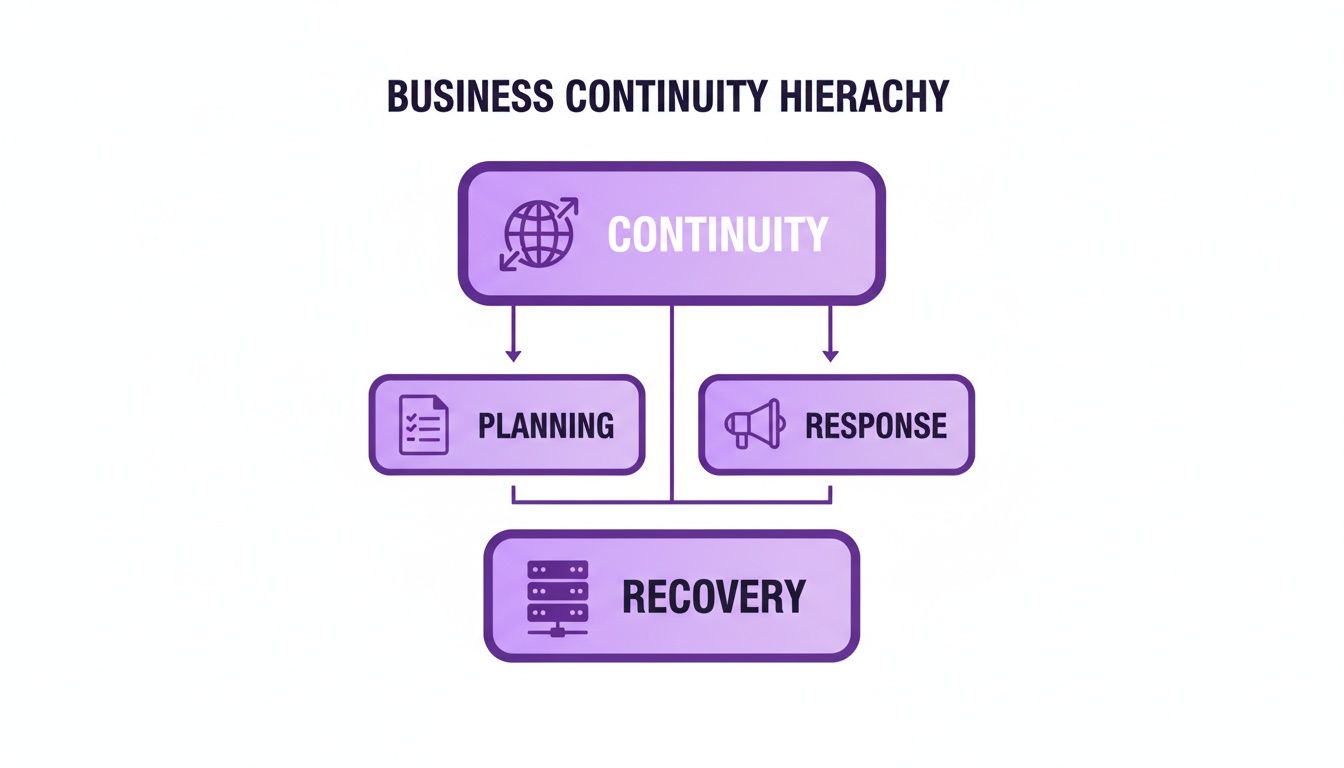
As you can see, recovery is just one piece of the wider business continuity puzzle. It’s a stark reminder that technology alone can’t solve everything.
A BCDR plan is a blend of technology and people. Failover systems and data backups are crucial, but they are useless without a clear communication plan and defined roles for your team during a crisis.
That human element is just as vital. A well-rehearsed Crisis Communications Plan ensures staff, customers, and key stakeholders are kept in the loop, which helps prevent panic and the spread of misinformation. You also need a crystal-clear chain of command that spells out who has the authority to declare a disaster and who can kickstart the recovery process. This clarity prevents hesitation when every second counts.
Finally, remember that managing the entire lifecycle of your IT assets is part of good governance. This includes securely disposing of old equipment, following established guidelines like the NIST SP 800-88 for Secure Data Sanitisation to protect sensitive data. By weaving together these components—analysis, objectives, technology, and people—you create a truly comprehensive plan that prepares you for whatever comes next.
Navigating the Modern UK Threat Landscape
The biggest threats to your business operations these days don’t come from a dodgy weather forecast or a leaky pipe. They’re digital. For businesses across the UK, the whole conversation around business continuity and disaster recovery has been turned on its head. We used to worry about physical disasters like fires or floods, but now, the number one cause of damaging downtime is overwhelmingly a cyber incident.
This changes everything.
That old-school approach of just copying your data every night simply won’t cut it anymore. Today’s cybercriminals are methodical. They don’t just lock down your live files; they actively hunt for and destroy your backups first. Their goal is to corner you, leaving you with no other option but to pay the ransom. It’s a nasty strategy that makes older backup methods dangerously obsolete.
This new reality demands a far smarter, more resilient approach to protecting your business.
Countering Sophisticated Cyber Threats
To stand a chance against these attacks, two concepts are now non-negotiable for any modern resilience plan: immutable backups and rigorous recovery testing.
An immutable backup is exactly what it sounds like—once it’s created, it cannot be changed or deleted for a set period. Think of it like writing a document in permanent ink. Even if a ransomware attacker gets into your network, they can’t touch these protected copies.
This gives you a clean, uninfected version of your data to restore from, pulling the rug out from under the attacker. But just having the backup isn’t enough. You have to know you can actually use it. Regular testing is the only way to be certain your plan works. An untested plan is just a hopeful theory; a tested one is a lifeline.
The rise of sophisticated ransomware means a backup is only valuable if it is both unchangeable and proven to be recoverable. Without these two qualities, your recovery plan is built on a foundation of hope, not certainty.
This proactive stance isn’t just a good idea; it’s critical. The latest data shows that cyber incidents are the leading cause of downtime for UK organisations, with an alarming 71% experiencing an attack in the past year. On the bright side, improved defences mean only 17% of affected UK organisations paid a ransom. However, 16% still suffered consequences, including a noticeable rise in being temporarily locked out of their own files. You can read the full research on UK cyber continuity trends to see the bigger picture.
The Preparedness Gap for UK SMBs
A dangerous gap has opened up between large corporations and small to medium-sized businesses (SMBs). Attackers see smaller companies as low-hanging fruit, assuming—often correctly—that they lack the resources for sophisticated security and recovery systems.
Many SMBs are working with tight budgets and small, overworked IT teams, making enterprise-grade resilience feel like an impossible goal. But the consequences of a successful attack are just as devastating, if not more so. A single major incident can cause catastrophic financial loss, shatter customer trust beyond repair, and sometimes, lead to a complete operational collapse.
For a deeper dive into defensive strategies, take a look at our guide on how to prevent ransomware attacks. The threats are very real, and they’re happening now. That’s why building a solid business continuity and disaster recovery plan has become an urgent priority, not something you can kick down the road.
Ready to build a truly resilient business? Phone 0845 855 0000 today or Send us a message to speak with one of our specialists.
The Critical Role of Testing and Maintaining Your Plan
A business continuity and disaster recovery plan sitting on a shelf gathering dust is worse than useless—it’s a liability. Real resilience isn’t about having a perfectly written document; it’s about having a living, breathing strategy that you regularly test, challenge, and improve. The plan gives you a roadmap, but it’s the rigorous testing that proves you can actually make the journey when it counts.
The simple act of having a plan isn’t the end goal. The real work begins with a constant cycle of testing, learning, and refining. This approach changes your company’s culture from just ‘having a plan’ to ‘being in a state of readiness’. Think of it this way: it’s the difference between owning a fire extinguisher and actually knowing how to use it when the room starts filling with smoke.
From Theory to Practice: Different Ways to Test
Testing isn’t a one-size-fits-all deal. There are several methods you can employ, from simple discussion-based exercises to full-blown disaster simulations. The trick is to pick the right kind of test based on your team’s experience and how complex your plan is.
Here are a few of the most common approaches:
- Tabletop Exercises: These are guided ‘what-if’ sessions. You get the key people in a room and talk through a potential disaster scenario, step-by-step. The focus is on roles, decisions, and communication, all without touching a single live system.
- Walkthroughs: A bit more hands-on than a tabletop, walkthroughs involve team members actually going through their documented procedures. This is a great way to find out if the steps are clear, accurate, and practical in the real world.
- Component Testing: This is where you test one specific piece of the recovery puzzle. It could be something like restoring a critical server from a backup or making sure a backup communication system works as intended.
- Full-Scale Simulations: The ultimate test. This is where you intentionally failover critical systems to your secondary site or cloud environment, mimicking a real disaster as closely as possible. It’s the only way to be completely sure that your technology, processes, and people all work together under pressure.
Keeping Your Plan Alive with Good Governance
To make testing truly effective, you need solid governance. This simply means having a formal process for who owns the plan, how often it’s reviewed, and ensuring all the documentation is kept up-to-date as your business and technology change. Good governance is what stops your BCDR plan from becoming obsolete.
A plan is only as good as its last test. Without a formal schedule for reviews and updates, your strategy will quickly become outdated, leaving you exposed to new threats and changes in your own infrastructure.
The good news is that UK organisations are taking this seriously. A recent survey found that 85% now have a business continuity plan, and an encouraging 89% tested parts of their recovery process within the last year. With 92% also maintaining an IT disaster recovery plan, the foundational pieces are clearly in place.
However, there’s a crucial catch. As one industry director put it, “plans give structure, testing gives certainty”—a point hammered home by the fact that 9 in 10 organisations hit by a cyberattack last year admitted their recovery could have been smoother. You can discover more insights about UK business resilience. This really drives home the point that having a plan is just the start; consistent, tough testing is what truly prepares you for a crisis.
Ready to build a plan that works under pressure? Phone 0845 855 0000 today or Send us a message.
How Managed IT Services Bridge the Resilience Gap for SMBs

For most small and medium-sized businesses, the idea of creating an enterprise-grade business continuity and disaster recovery plan can feel completely out of reach. The expertise is hard to find, and the technology costs seem daunting. This is exactly where a specialist Managed IT Partner changes the game, especially for businesses here in the East Midlands.
The truth is, there’s a worrying gap in business preparedness. While a whopping 97% of large UK organisations have business continuity plans, only 58% of smaller companies can say the same. It’s a huge vulnerability, made worse by the fact that half of these smaller firms admit they couldn’t survive an IT outage lasting just half a day. You can discover more insights about this UK resilience divide.
A managed provider closes this gap by giving you access to seasoned experts and powerful resilience tools, but without the eye-watering upfront investment.
Accessing Enterprise-Grade Expertise and Technology
Partnering with a managed services provider (MSP) is the fastest way to level the playing field. Instead of struggling to hire and keep expensive in-house specialists, you instantly get a dedicated team whose entire job is to think about IT resilience, security, and recovery.
But it’s about so much more than just technology; it’s about strategy. A great partner won’t just sell you a backup product and walk away. They become an extension of your own team, working alongside you to:
- Carry out a proper risk assessment and business impact analysis.
- Figure out realistic and achievable RTOs and RPOs for your most important systems.
- Design and build a BCDR strategy that actually fits your budget and goals.
- Provide the day-to-day management, monitoring, and support to make sure it all works.
They bring the kind of experience that can only come from managing countless recovery situations for other businesses—a depth of knowledge that’s almost impossible to build internally as a typical SMB.
A Managed IT Partner democratises business resilience. They make the strategies, tools, and expertise that were once exclusive to large corporations accessible and affordable for ambitious SMBs.
What to Look for in a BCDR Partner
Choosing the right partner is absolutely critical. Not all IT providers are the same, so it’s vital to find one that genuinely understands your business, especially if you’re an organisation in the East Midlands looking for that local, hands-on support.
When you’re weighing up potential partners, be sure to look for:
- Proven BCDR Experience: Don’t be afraid to ask for case studies or real-world examples of how they’ve helped businesses like yours prepare for and recover from a disaster.
- Expertise in Your Technology Stack: If your business relies on platforms like Microsoft 365 and Azure, make sure the partner has deep, certified expertise in those specific environments.
- Local Presence and Support: For businesses in places like Lincoln, Nottingham, or Leicester, having a partner who can be on-site when you really need them is invaluable.
- A Strategic, Not a Sales, Approach: The conversation should start with your business goals and risks, not a sales pitch for a particular bit of software or hardware.
This partnership is a cornerstone of your resilience. Working with a dedicated provider for managed IT support ensures your business continuity and disaster recovery plan isn’t just a document that gathers dust, but a living, breathing service that’s constantly managed and optimised. To further strengthen your defences, exploring specialised Cybersecurity Consulting Services can provide crucial expertise. This collaborative approach turns resilience from a costly headache into a real strategic advantage, freeing you up to run your business with confidence.
Ready to close your resilience gap? Phone 0845 855 0000 today or Send us a message.
So, What’s Next? Taking Your First Steps Towards Resilience
We’ve covered a lot of ground, and hopefully, it’s clear that business continuity and disaster recovery aren’t just IT buzzwords—they’re fundamental to your company’s survival. Building genuine resilience isn’t a single project you can tick off a list; it’s an ongoing commitment. It’s about shifting your mindset from reacting to a crisis to being proactively prepared for whatever comes your way.
The journey to becoming a truly resilient business starts with a few simple, deliberate actions. The worst time to find a hole in your plan is in the middle of a flood, a power cut, or a cyber-attack. By taking control now, you’re protecting your revenue, your reputation, and your entire operation for the long haul.
Your Immediate Action Plan
Feeling a bit overwhelmed? Don’t be. Here’s where you can start today, right now:
- Pinpoint Your Must-Haves: Grab a pen and paper (or a whiteboard) and list the absolute core functions that keep your business alive. What can you absolutely not do without, even for a day? That’s your starting point.
- Check Your Last Save Point: When did you last try to restore a file from your backup? Not just run the backup, but actually pull a file back. If you can’t remember, now’s the time to test it. Assumptions are dangerous here.
- Get People Talking: Book a short meeting with your team leaders or your IT partner. The agenda? An honest, no-blame chat about where you stand today. Ask the simple question: “If the office was inaccessible tomorrow, what would we do?”
Don’t let a crisis dictate your future. Take the first step today.
Ready to build a business that can weather any storm? The experts at F1Group are here to help.
Phone 0845 855 0000 today or Send us a message to have a chat with one of our specialists.