
Think of a Managed Service Provider (MSP) as your dedicated, outsourced IT department. For a simple, predictable monthly fee, they proactively manage your entire technology stack. This is a world away from the old ‘break-fix’ support model, where you’d only call an IT technician after something went wrong. An MSP’s entire purpose is to prevent those problems from happening in the first place, keeping your business running smoothly and securely.
What Is a Managed Service Provider in Simple Terms
Let’s use an analogy. Imagine your business’s IT is a high-performance car you rely on every single day. The traditional ‘break-fix’ model is like calling a mechanic only when you’re stranded on the side of the motorway with smoke pouring from the engine. It’s purely reactive. You’ve already suffered the breakdown, the frustration, and the costly downtime before you even start paying for the fix.
A Managed Service Provider, on the other hand, is your dedicated pit crew. They’re not just waiting for a crash. They are constantly monitoring every part of the car—checking the engine diagnostics, fine-tuning performance, and ensuring the tyres are perfectly inflated. Their job is to keep you on the track, running at peak performance without any unexpected stops.
This fundamental shift from reactive problem-solving to a proactive partnership is what an MSP is all about. They don’t just fix things; they take complete ownership of your technology. This turns your IT from a recurring source of headaches and surprise bills into a reliable, strategic asset that helps you grow.
To put it simply, here’s a look at how the two models stack up.
Traditional IT Support vs Managed Services
| Feature | Traditional IT Support (Break-Fix) | Managed Service Provider (MSP) |
|---|---|---|
| Approach | Reactive. Waits for systems to fail before acting. | Proactive. Aims to prevent issues before they occur. |
| Goal | Fix the immediate problem and move on. | Ensure long-term stability and business continuity. |
| Cost Model | Unpredictable. Billed per hour or per incident. Costs spike when things go wrong. | Predictable. A flat monthly fee covers all support and management. |
| Incentive | Profits from your technology problems and downtime. | Profits when your systems are stable and efficient. Our success is tied to yours. |
| Service Level | Response times can vary. No guarantee of uptime. | Agreed-upon service levels (SLAs) with a focus on maximising uptime. |
| Relationship | Transactional. You only call them when you have a problem. | Partnership. Acts as a strategic advisor and part of your team. |
As you can see, the difference is night and day. The break-fix model inherently benefits from your misfortune, whereas an MSP is financially motivated to keep your business productive and secure.
From Reactive Repairs to a Proactive Partnership
The business models couldn’t be more different. A break-fix technician makes money when your systems fail. An MSP, however, makes money when your systems run perfectly. Our success is directly linked to your operational stability, which creates a genuine partnership where we’re both working towards the same goal: minimal disruption and maximum productivity.
This proactive approach isn’t just a philosophy; it involves a whole host of activities happening behind the scenes to keep you safe and efficient:
- Continuous Monitoring: We use sophisticated tools to keep a 24/7 watch over your network, servers, and devices, allowing us to spot potential trouble long before it can impact your team.
- Preventative Maintenance: This means regularly applying critical security patches, updating software, and optimising system performance to head off slowdowns and vulnerabilities.
- Strategic Planning: We function as your virtual Chief Information Officer (vCIO), helping you make smart, forward-thinking technology decisions that align with your business ambitions.
Taking Ownership of Your Entire IT Environment
A modern MSP looks after much more than just your desktops and laptops. We manage the entire technological ecosystem your business depends on every day. This covers everything from cybersecurity defences and cloud services to data backups and day-to-day user support. For instance, some providers even handle incredibly complex systems; you can see a great example of this in guides to managed Kubernetes services, where the heavy lifting of container orchestration is completely outsourced.
When you partner with an MSP, you’re not just buying IT support; you’re investing in business continuity. For one predictable monthly cost, you get an entire team of certified experts dedicated to your success, freeing you up to focus on what you do best—running your business.
Phone 0845 855 0000 today or Send us a message to learn how a proactive IT partnership can benefit your organisation.
What Does a Modern MSP Actually Do?
Forget the old image of the IT helpdesk you only call when something breaks. A modern Managed Service Provider (MSP) offers a complete technology partnership, building a framework that actively supports your business’s security, day-to-day efficiency, and future growth. Getting your head around these core services is the first step to understanding what a true MSP partnership can bring to your business.
The range of services a good MSP provides is surprisingly broad, covering everything from fundamental support right up to strategic planning. At its core, it’s about shifting the heavy responsibility of managing complex, ever-changing technology from your shoulders to a dedicated team of experts. This frees you up to concentrate on what you do best, confident that your IT is in safe hands.
This image shows just how much IT support has evolved, moving from a reactive, firefighting model to a proactive partnership that actually helps a business grow.
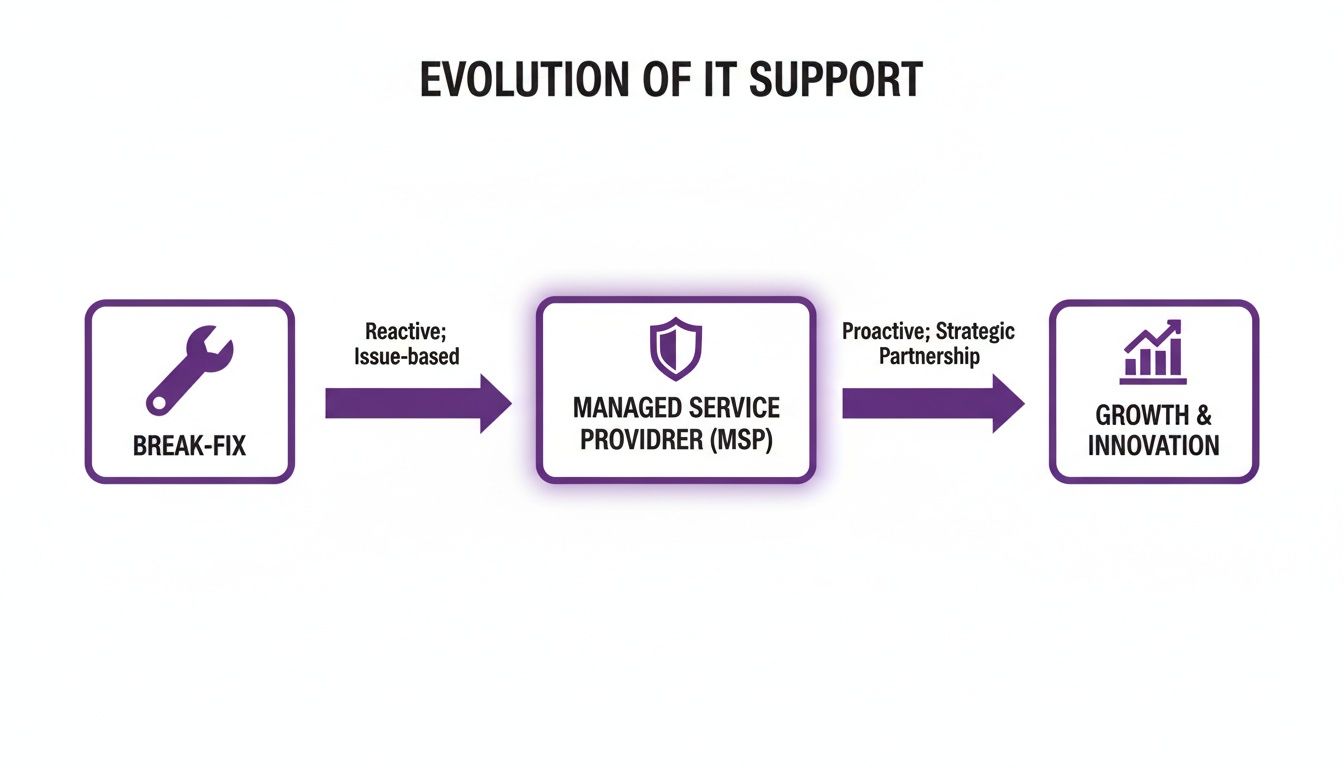
As you can see, the journey is all about leaving behind the costly downtime of the old ‘break-fix’ model and moving towards the stability and strategic advantage an MSP provides.
Proactive IT Management and Monitoring
The absolute bedrock of any quality managed service is proactive IT management. This isn’t about waiting for a problem to pop up; it’s about stopping it from ever happening in the first place. Modern MSPs use sophisticated monitoring tools that keep a constant, watchful eye over your entire network, servers, and devices, 24/7/365.
This round-the-clock oversight allows them to spot early warning signs—things like a server running low on memory or unusual network traffic—and sort them out long before they can cause disruptive downtime. It also includes strategic device management, making sure every company laptop, desktop, and mobile device is properly updated, patched, and running as it should.
A proactive approach turns your IT from a potential headache into a reliable business asset. Instead of lurching from one crisis to the next, you build a stable foundation where technology consistently works for you, not against you.
Secure Cloud and Collaboration Solutions
The way we all work has changed for good, with a massive shift towards flexible, cloud-based tools. A huge part of an MSP’s job today is to manage and secure these cloud environments. This is especially true within the Microsoft ecosystem, which has become a real powerhouse for UK businesses.
Recent government research highlights this perfectly. ‘Cloud Computing’ is now the most common service offered by UK MSPs, with Microsoft Azure leading the pack at 62% adoption, followed by AWS at 50%. This trend directly mirrors what we see with businesses here in the East Midlands moving to powerful platforms like Microsoft 365 and Azure.
An MSP’s core services in this area typically include:
- Microsoft 365 Management: Making sure your team can collaborate securely and effectively using tools like Teams, SharePoint, and Exchange Online.
- Microsoft Azure Expertise: Managing your cloud infrastructure on Azure to ensure it’s scalable, high-performing, and cost-effective.
- Robust Cybersecurity: Keeping your cloud data safe is non-negotiable. You can learn more about how we achieve this with our comprehensive IT managed security services.
This also extends to business continuity. A modern MSP ensures you’re protected against any eventuality with essential disaster recovery planning to keep your operations running, no matter what.
Advanced Business Applications and AI Integration
Looking beyond the infrastructure, a forward-thinking MSP helps you use technology to get real business results. This means implementing and supporting powerful business applications that can streamline your processes and reveal new insights.
Within the Microsoft stack, this translates to real-world expertise in:
- Dynamics 365: Customising and managing this suite of applications for sales, customer service, and finance to bring all your business data together and improve client relationships.
- Power Platform: Building custom solutions with tools like Power BI for data visualisation, Power Apps for low-code application development, and Power Automate to get rid of repetitive manual tasks.
- Copilot AI Integration: Helping your business adopt and use Microsoft’s AI tools responsibly and effectively, boosting productivity and innovation right across your teams.
By combining proactive management, secure cloud solutions, and advanced application support, an MSP creates a single, forward-thinking IT environment that truly empowers your business to succeed.
What an MSP Partnership Really Means for Your Business
Beyond the technical jargon and monitoring alerts, what does partnering with a Managed Service Provider actually do for your business day-to-day? It’s about more than just fixing computers; it’s about turning your IT from a cost centre into a real, tangible asset that helps you grow.
One of the first things you’ll notice is a complete change in how you budget for technology. The old ‘break-fix’ model is a financial rollercoaster – one minute everything is fine, the next a server dies and you’re hit with a massive, unexpected bill. That kind of unpredictability makes planning for the future almost impossible.
An MSP flips that script. By moving to a fixed monthly fee, you swap that volatile capital expenditure (CapEx) for a predictable operating expenditure (OpEx). This simple change makes budgeting a breeze and frees up cash you can put back into what really matters, like marketing or developing new products.
A Serious Step Up in Cybersecurity and Compliance
These days, a single security breach can be devastating. We’re talking serious financial loss, a damaged reputation, and potentially crippling regulatory fines. The truth is, most small and medium-sized businesses just don’t have the in-house firepower to keep up with the ever-changing world of cyber threats.
That’s where an MSP becomes your frontline defence. You instantly gain a team of security specialists and access to enterprise-level tools that would cost a fortune to buy yourself. This partnership wraps your business in a multi-layered security blanket.
- 24/7 Threat Monitoring: Someone is always watching your network, ready to shut down threats before they can do any harm.
- Advanced Endpoint Protection: Every single device, from laptops to company mobiles, is locked down against malware and ransomware.
- Regular Security Audits: We don’t wait for problems. We proactively hunt for weaknesses in your systems and patch them up.
- Compliance Management: Navigating the maze of regulations like GDPR is a headache. An MSP ensures your data handling is by the book, keeping you compliant and protected.
A Boost to Productivity You Can Actually Feel
Downtime is the silent killer of productivity. Every minute your systems are offline is a minute your team isn’t making sales, finishing projects, or helping customers. The whole point of managed services is to stop these disruptions from ever happening.
By getting ahead of problems, an MSP keeps your critical systems running smoothly, maximising uptime. But it’s not just about preventing major outages. It’s also about ironing out the daily frustrations—the slow computers, the patchy network, the software glitches. These issues are often fixed before your staff even know something is wrong, creating a seamless work environment where your team can actually get on with their jobs.
When you outsource the day-to-day IT grind, you free up your internal team. They’re no longer putting out fires and can finally focus their talents on strategic projects that genuinely push the business forward.
Access to Deep Expertise and Strategic Advice
The MSP market in the UK is a huge economic driver for a reason—businesses see the immense value. UK MSPs employ 343,762 people and generate £51 billion in revenue, fuelling the growth of companies from Grimsby right through to Newark. For businesses diving into powerful platforms like Azure and Dynamics 365, these numbers show just how vital it is to have an expert partner who can scale with you.
Partnering with an MSP gives you a whole team of certified experts in everything from Microsoft Azure cloud solutions to complex cybersecurity. It means you always have the right person for the job, without the immense cost and hassle of hiring them all yourself. This kind of relationship is one of the key benefits of managed IT services for any ambitious business. Ultimately, your technology stops being a problem to be managed and starts becoming your competitive edge.
To discuss how these benefits could apply to your business, phone 0845 855 0000 today or Send us a message.
How MSP Pricing Models and Contracts Work
Before we dive into the nuts and bolts, this video offers a great overview of how managed IT services are structured.
Getting to grips with the financial side of working with a managed service provider is one of the most important first steps. One of the biggest draws is moving away from those unpredictable, often painful, break-fix bills to a stable monthly fee. But how is that fee actually worked out?
MSP pricing isn’t a one-size-fits-all deal. The best providers offer a few different models because they know every business has unique needs, headcount, and growth plans. By understanding these structures, you’ll be in a much better position to compare quotes, spot genuine value, and find a plan that feels right for your budget. It’s all about finding a predictable cost that aligns with your goals, so you can avoid any nasty surprises down the line.
Common MSP Pricing Models Explained
When you start talking to potential IT partners, you’ll probably hear about a few standard pricing models. Each one calculates your monthly cost a bit differently, and the right choice really depends on the size of your team and how you operate.
Here’s a simple breakdown of the most common pricing structures you’ll come across in the UK.
- Per-User Pricing: This is easily the most popular and straightforward approach. You simply pay a flat fee every month for each person on your team who needs IT support. It’s perfect for businesses where staff use multiple devices—like a laptop, a desktop in the office, and a company mobile—because it keeps the billing clean and simple.
- Per-Device Pricing: As the name suggests, this model calculates your monthly fee based on the number of devices you want the MSP to look after. You’ll have a set price for each server, desktop, laptop, and even network hardware. This can be a really cost-effective option if you have staff sharing equipment, like in a manufacturing facility or a business that runs on shifts.
- All-Inclusive (Flat-Fee) Pricing: Think of this as the ‘all-you-can-eat’ model. It’s a single, fixed monthly price that covers a comprehensive list of services, from remote and on-site support to proactive monitoring and security. This offers the ultimate peace of mind when it comes to budgeting and is ideal for businesses that want to completely hand over the reins of their IT.
To give you a clearer picture, this table lays out how these models typically look, along with some average UK price points to keep in mind.
Common MSP Pricing Models Explained
Here’s a quick look at the typical pricing structures you’ll encounter, what’s usually covered, and the type of business each model is best suited for.
| Pricing Model | How It Works | Typical UK Price Range (per month) | Best For |
|---|---|---|---|
| Per-User | A flat fee is charged for each employee supported. | £30 – £70 per user | Businesses where employees use multiple devices. |
| Per-Device | A flat fee is charged for each managed device. | £20 – £60 per device | Businesses with shared workstations or many devices per user. |
| All-Inclusive | A single monthly fee covers all agreed-upon services. | Varies based on scope | Companies seeking total budget predictability and comprehensive support. |
Knowing these models will help you have more meaningful conversations with potential providers and ensure the quotes you receive are easy to compare apples-to-apples.
The Importance of the Service Level Agreement
No matter which pricing model you end up with, the real heart of the contract is the Service Level Agreement (SLA). This is, without a doubt, the most critical part of your agreement because it’s where your provider puts their promises in writing. It turns vague assurances into concrete, measurable commitments.
An SLA isn’t just a formality; it’s your guarantee of service quality. It defines key metrics like response times, issue resolution times, and system uptime, ensuring both you and your provider are perfectly aligned on expectations.
When you’re reviewing a potential contract, you need to find the SLA and read it carefully. A good one will clearly specify:
- Response Times: How quickly will they acknowledge your support ticket?
- Resolution Times: What’s the target for actually fixing different problems (e.g., critical server down vs. a minor printer issue)?
- Uptime Guarantees: What percentage of the time are your critical systems guaranteed to be online (look for 99.9% or higher)?
- Reporting: How often will you get reports showing that they’re meeting these targets?
A strong, transparent SLA is the sign of a truly professional managed service provider. It’s the foundation for a successful, long-term partnership built on trust and measurable results.
To understand which model would best suit your business, phone 0845 855 0000 today or Send us a message for a no-obligation chat.
How to Choose the Right MSP for Your Business
Picking an IT partner is one of the biggest decisions you’ll make for your company. This isn’t just about finding someone to fix a misbehaving printer; it’s about entrusting a team with your critical data, your team’s productivity, and your ability to grow. A great managed service provider doesn’t just work for you—they become an extension of you.
So, how do you see past the sales pitch and find a partner who is genuinely invested in your success? This guide cuts through the noise with a straightforward checklist to help you evaluate potential MSPs and make a choice you can be confident in for years to come.

Verify Technical Expertise and Certifications
First things first: you need to know they have the technical chops to handle your specific setup. In today’s business world, that almost always means having deep, proven expertise in the Microsoft ecosystem. Official certifications are the best way to separate the experts from the amateurs.
Here’s what to look for:
- Microsoft Partner Status: This is a clear indicator of a strong relationship with Microsoft and solid expertise across their core business tools, like Microsoft 365, Azure, and Dynamics 365.
- Security Accreditations: Credentials like Cyber Essentials Plus or ISO 27001 are non-negotiable. They show an MSP takes protecting your business from cyber threats seriously.
- Vendor Relationships: A well-connected MSP has strong partnerships with other leading tech vendors. This is crucial when you need priority support for a tricky hardware or software issue.
Don’t be shy about asking to see their credentials. Any provider worth their salt will be proud to show you what their team has achieved.
Look for a Proven Track Record and Client Testimonials
An MSP’s history tells a powerful story. You need a partner who has real-world experience supporting businesses like yours—similar in size, industry, and goals. Ask to see case studies or client testimonials that prove they can solve the kind of challenges you face.
When you read testimonials, look for more than just “they fixed our IT.” The best feedback will highlight how the MSP improved efficiency, tightened security, or directly contributed to the client’s growth. That’s the sign of a true partnership.
It’s also worth checking how long they’ve been around. An established provider brings a level of stability and hard-won knowledge that newer firms just can’t match. Many of the most reliable managed services companies have been operating since the 1990s, adapting and growing alongside their clients.
Assess Their Local Presence and Support Model
While a lot of IT support can happen remotely, you should never underestimate the value of having someone local. When a critical server goes down or you need hands-on help setting up a new office, having an engineer who can be on-site quickly is an absolute game-changer.
The UK is home to a huge number of active MSPs, which shows just how much businesses—including many in the East Midlands like Lincoln, Nottingham, and Leicester—rely on outsourced IT. This is especially true for organisations adopting Microsoft 365 and Azure who need local experts. In fact, government research shows that larger, more established MSPs handle the most revenue, making them an ideal choice for mid-sized PLCs and charities looking for scalable, dependable solutions. You can read the full government research on MSPs to see the data for yourself.
Ask any potential partner about how their support actually works:
- On-Site Capability: Do they have engineers based locally in the East Midlands who can get to you when you need them?
- Problem Ownership: Will they take complete ownership of a problem, even if it means chasing a third-party vendor like your internet provider?
- Team Structure: Is their support team in-house or outsourced? An in-house team almost always delivers a more consistent and accountable service.
Evaluate Cultural Fit and Strategic Alignment
Finally, remember that you’re choosing a team, not just a service. You’ll be communicating with these people regularly, so you need to feel comfortable with them. Do they listen to your concerns and explain things in plain English, or do they hide behind technical jargon?
A genuine IT partner is also a strategic advisor. They should be interested in your business goals and proactively suggest how technology can help you get there. This forward-thinking approach is what separates a basic IT supplier from a truly valuable managed service provider.
Ready to start the conversation with a trusted local expert? Phone 0845 855 0000 today or Send us a message for a no-obligation consultation.
Common Questions About Managed IT Services
Making the move to a managed service provider is a big decision, and it’s natural to have questions. We find business leaders often ask the same things, so we’ve put together some straight-talking answers to help you see the path forward clearly.
How Is an MSP Different from Our Current IT Guy?
The biggest difference comes down to one word: proactive. Your typical IT support works on a ‘break-fix’ model. Something breaks, you call them, they fix it. This approach is purely reactive, meaning you’re always dealing with problems after they’ve already caused frustrating downtime.
We do the opposite. An MSP is all about preventing those problems from happening in the first place. We use constant monitoring to spot potential trouble long before it affects your work, creating a partnership focused on keeping your business running smoothly. It shifts IT from a source of unexpected costs and headaches to a predictable, strategic asset.
Is My Business Too Small for This?
Absolutely not. In fact, we find that small and medium-sized businesses often get the most out of working with an MSP. It’s about gaining access to a level of expertise and technology that would be incredibly expensive to hire and manage on your own.
Think of it this way: an MSP gives you the power of a full-scale corporate IT department for a fraction of the cost. It levels the playing field, allowing smaller businesses to compete with the big players without the massive overhead. Our services are built to scale with you, making it a smart investment for any growing business in the UK.
What’s Involved in Switching Over to an MSP?
We know the idea of changing IT providers can be daunting, which is why we’ve refined our onboarding process to be as smooth and undisruptive as possible. Your day-to-day work won’t miss a beat.
It all starts with a deep dive into your current setup – we look at your infrastructure, security, and how your team actually works. Based on that, we map out a clear transition plan with a firm timeline, so you know exactly what’s happening and when. Our engineers then handle all the technical bits, from installing monitoring tools to migrating data, ensuring your team feels supported and confident from day one.
Ready to see how a more secure and efficient IT environment could help your business? The expert team at F1Group is here to help.
Phone 0845 855 0000 today or Send us a message for a no-obligation chat.