
Staring at a massive bill for new server hardware? Let’s talk about a smarter way. Infrastructure as a Service (IaaS) is like renting a professional, fully-equipped kitchen instead of building your own from scratch. You get all the high-end computing power, storage, and networking you need, delivered over the internet on a pay-as-you-go basis, letting you focus on cooking up great ideas for your business instead of managing physical hardware.
Your Practical Guide to Infrastructure as a Service
Picture a growing business in Nottingham. Their old on-site servers keep crashing during busy periods, costing them thousands in lost productivity and customer goodwill. This is exactly where IaaS becomes a game-changer for UK firms, especially those we support at F1Group across the East Midlands.
At its core, IaaS provides virtualised computing resources over the internet. It allows companies to rent servers, storage, and networking from massive providers like Microsoft Azure. This model completely removes the hefty upfront costs of buying and maintaining your own IT gear.
The market for these cloud services is booming in the UK. The IaaS segment is projected to see considerable growth through 2026 and beyond, driven by the relentless demand for digital services and scalable solutions. You can dive into the numbers in this Statista report on the UK IaaS market.
For businesses in Lincoln or Leicester already using Microsoft 365, embracing Azure for infrastructure is the logical next step. It means finally ditching those on-premise IT headaches for a flexible model that grows right alongside them.
Who Benefits from IaaS?
In short, any organisation that relies on server hardware stands to gain from this model. It’s a direct route to accessing enterprise-grade technology without the eye-watering capital expenditure. To dig a little deeper into the real-world uses, you can read how Infrastructure as a Service is ideal for any business with a need for a server.
This guide will break down exactly what IaaS is, using practical scenarios relevant to UK businesses. We’ll explore how companies are using this powerful model to become more agile, slash their spending, and finally stop worrying about physical hardware for good.
Ready to see how IaaS could transform your business operations? Phone 0845 855 0000 today or send us a message.
The Building Blocks of IaaS Explained
So, what exactly are you renting when you sign up for Infrastructure as a Service? Let’s break it down. Think of it as having your own virtual data centre, ready to go whenever you need it, built on three core pillars that replace the need for a physical server room.
First up, you have Compute. This is the engine room of your operation. We’re talking about virtual machines (VMs)—powerful computers that exist entirely in the cloud. You can fire them up, configure them, or shut them down in minutes. This is where your applications live and all the heavy lifting happens, giving you raw processing power without a single physical server taking up space in your office.
Next is Storage. Imagine a vast, secure, and endlessly expandable digital warehouse for every piece of information your company owns. From critical customer databases and financial records to everyday documents and emails, IaaS storage gives your data a safe and resilient home that you can access from anywhere.
The All-Important Connections
Finally, there’s Networking. This is the glue that holds everything together, connecting all your virtual resources to each other and linking them securely to the internet and your team. It’s more than just a simple connection, though. This includes vital services like:
- Virtual Networks: These let you create isolated, private environments for your applications to run in safely.
- Firewalls: Your digital security guards, protecting everything from unauthorised access and cyber threats.
- Load Balancers: These are like traffic police for your applications, intelligently distributing incoming requests to keep things running smoothly and prevent slowdowns during busy periods.
These three elements—compute, storage, and networking—are the foundation of any IaaS setup. They hand you the controls to build a resilient and scalable IT infrastructure that’s a perfect fit for what your business actually needs.
For an IT manager in Grimsby, this model is a lifeline. Faced with skyrocketing data demands from Copilot AI integrations but with a budget that can’t accommodate new data centres, IaaS provides the answer. It is the backbone of modern cloud infrastructure.
The growth in this area is staggering, especially for UK businesses. The European IaaS market, with the UK at the forefront, is booming thanks to hybrid cloud strategies. In fact, the UK is on track to claim 15.40% of Europe’s IT Infrastructure Services market in 2025, worth about $3.005 billion (£2.4 billion) here at home. Projections show that figure climbing to $4.552 billion (£3.64 billion) by 2033. For F1Group clients in Newark or Scunthorpe, this translates into seamless Azure migrations that cut downtime and seriously bolster cybersecurity. You can explore more of these IT infrastructure market trends for yourself.
Choosing Your Cloud Model: IaaS vs PaaS vs SaaS
The world of cloud computing can feel like a bit of an alphabet soup. When you hear terms like IaaS, PaaS, and SaaS, it’s easy to get lost. A great way to get your head around them is to think about something we all understand: pizza.
Let’s say you fancy a pizza for dinner. You have a few options, and each one lines up nicely with a cloud service model.
Understanding The Different Levels of Control
If you choose Infrastructure as a Service (IaaS), it’s like deciding to make the pizza from scratch. You head to the shop and buy the raw ingredients—the flour, yeast, tomatoes, and cheese. You bring it all home to your own kitchen, using your own oven. You have total control over every single detail, from the thickness of the crust to the exact blend of toppings and how long you cook it for. This is the essence of IaaS: you get the fundamental building blocks (servers, storage, networking), but you’re in charge of putting it all together.
Next up is Platform as a Service (PaaS). This is more like ordering a takeaway pizza. The pizza place provides the pre-made base and cooks it for you in their professional oven. Your job is simply to choose the toppings. You don’t have to worry about managing the oven, paying the electricity bill, or cleaning up afterwards. In the tech world, PaaS provides developers with a ready-made platform—including the operating system and development tools—so they can focus purely on building and running their applications.
Finally, we have Software as a Service (SaaS). This is the equivalent of dining out at a restaurant. You just walk in, sit down, and order a pizza from the menu. The restaurant staff take care of everything: making the pizza, cooking it, serving it to your table, and even washing the dishes. It’s the ultimate convenience. You simply enjoy the finished product. Familiar examples of SaaS include Microsoft 365, Salesforce, or even your online banking app.
The diagram below breaks down the core components you get with an IaaS model. It’s these foundational elements that you rent from a provider like Microsoft Azure.
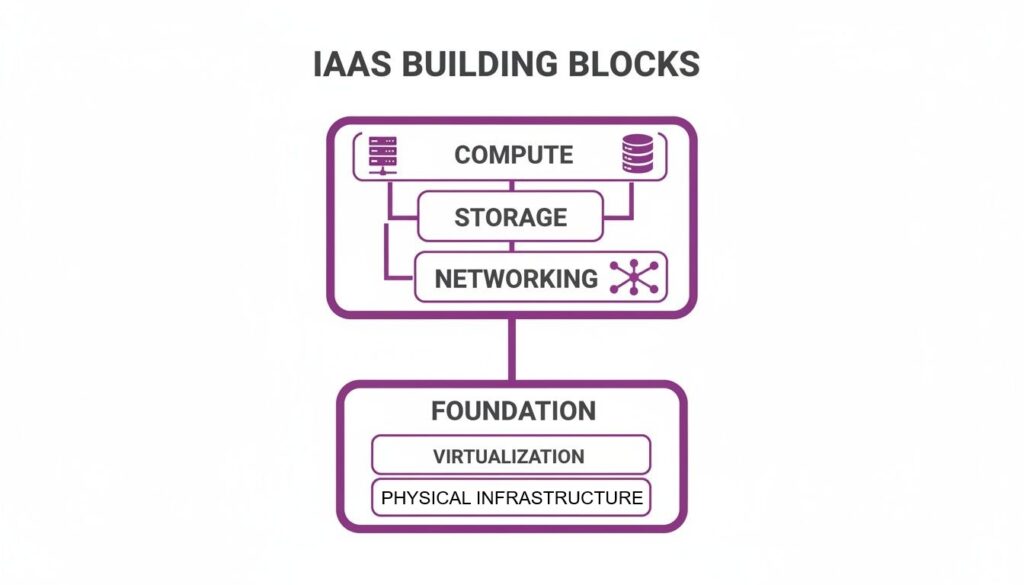
As you can see, you’re essentially renting access to the physical data centre, servers, and networking gear, giving you a blank canvas to build upon.
To put it all into perspective, here’s a table that clearly shows who manages what in each model.
Cloud Service Model Comparison IaaS vs PaaS vs SaaS
| Component | You Manage (IaaS) | You Manage (PaaS) | You Manage (SaaS) |
|---|---|---|---|
| Applications | ✔ | ✔ | ✖ |
| Data | ✔ | ✔ | ✖ |
| Middleware | ✔ | ✖ | ✖ |
| Operating System | ✔ | ✖ | ✖ |
| Virtualisation | ✖ | ✖ | ✖ |
| Servers | ✖ | ✖ | ✖ |
| Storage | ✖ | ✖ | ✖ |
| Networking | ✖ | ✖ | ✖ |
This breakdown makes it clear that the more you move from IaaS towards SaaS, the less you have to manage yourself.
Ultimately, the choice comes down to a simple trade-off between control and convenience. IaaS gives you maximum flexibility and control, which is fantastic for businesses with specific needs or complex custom projects. On the other end, SaaS offers maximum ease of use, perfect for standard business functions where you just need the software to work. PaaS offers a happy medium.
Deciding between them means carefully considering your team’s technical expertise, your budget, and what you want to achieve. For a deeper dive, our guide comparing cloud vs on-premises solutions is a great place to start. It’s also worth knowing about other models, such as Backend as a Service (BaaS), as you map out your cloud strategy.
The Real-World Business Benefits of IaaS

It’s easy to get lost in the technical jargon, but what does adopting Infrastructure as a Service actually do for your business? The truth is, the benefits are tangible, turning IT from a necessary expense into a powerful engine for growth.
One of the most immediate impacts you’ll see is a dramatic reduction in cost. Think about traditional IT. It’s all about huge upfront capital expenditure on physical hardware. With IaaS, you can forget about that £50,000 server upgrade; instead, you pay a predictable, manageable fee for what you actually use.
This pay-as-you-go model doesn’t just free up a huge amount of capital. It makes budgeting far simpler and eliminates the guesswork that often leads to overspending on equipment that sits idle.
Unlocking Agility and Unmatched Scalability
Another game-changer is the ability to scale your operations up or down almost instantly. Imagine you’re running an e-commerce site from Nottingham. During the Black Friday sales, your website traffic explodes. With old-school on-premise hardware, that surge could easily crash your site, resulting in lost sales and frustrated customers.
With IaaS, you can ramp up your computing power in minutes to handle the spike and then scale it right back down when things quieten. This kind of agility is invaluable for any business with fluctuating demand or big growth plans, making sure your infrastructure is always the right size for the job.
By letting a provider like Microsoft Azure handle the physical hardware, your internal IT team is freed from the daily grind of maintenance. Instead of patching servers and replacing failed hard drives, they can focus their skills on projects that genuinely move your business forward.
Enhancing Security and Ensuring Business Continuity
For many small and medium-sized businesses, achieving enterprise-level security on your own is a huge, often impossible, undertaking. IaaS changes that completely. Major cloud providers invest billions in securing their data centres, giving you a level of physical and digital protection that would be out of reach for most individual companies.
On top of that, IaaS makes disaster recovery robust and affordable. By replicating your critical systems in the cloud, you can be confident that your business will keep running, even if your main office is hit by a flood, fire, or cyber-attack. It’s a level of resilience that provides genuine peace of mind. These are just a few of the benefits of cloud computing for business that organisations are now waking up to.
Each advantage delivers a clear business outcome:
- Reduced Costs: Swap large capital outlays for predictable operational expenses, boosting cash flow.
- Improved Scalability: React instantly to market changes and customer demand.
- Enhanced Security: Get access to world-class security without the world-class price tag.
- Greater Reliability: Minimise downtime with built-in redundancy and effective disaster recovery.
Ready to see how these benefits could apply to your organisation? Phone 0845 855 0000 today or Send us a message to discuss your needs.
How Businesses Are Using IaaS Today
Infrastructure as a Service has moved well beyond a technical buzzword. It’s now a fundamental part of how smart organisations operate, solving everyday problems and unlocking new growth. The sheer adaptability of IaaS means it’s being used for a lot more than just storing files in the cloud.
Think about it: from powering e-commerce sites that need to stay online during a massive sale to running complex, data-intensive software, IaaS is the engine room. It gives a business the reliable foundation it needs for its most important applications, but without the headache and expense of owning and maintaining physical servers. This is what IaaS looks like in the real world.
Creating Flexible Development Environments
Software development is one area where IaaS has made a huge impact. In the past, getting a new environment ready for developers to code and test their work was a real bottleneck. It was slow, expensive, and usually meant buying more hardware.
Now, with IaaS, a development team can create multiple, separate testing environments in a matter of minutes. They can experiment, run tests, and then simply delete the environments when they’re done. They only pay for what they used, for the exact time they used it. This approach speeds up projects and slashes development costs.
A common and critical use for many organisations is building dependable and affordable data backup and disaster recovery plans. IaaS offers a secure, off-site location for crucial data that can be accessed instantly, keeping the business running no matter what.
A Practical Example in Leicester
Let’s look at a charity right here in Leicester that handles sensitive donor details and financial records. An old-school, on-site backup system would be costly to buy and run, demand constant attention, and be at risk from local incidents like a fire or break-in.
By turning to Microsoft Azure’s IaaS, the charity can set up a secure, automated backup system that just works.
- Cost-Effective: The charity skips the hefty upfront cost of buying backup servers. Instead, it pays a manageable monthly fee based purely on the storage space it uses.
- Secure & Compliant: All their vital data is encrypted and stored in UK-based data centres, which is a huge help for meeting data protection rules.
- Reliable Recovery: If something happened at their office and data was lost, they could quickly restore everything from the cloud. This ensures they can get back to their important work with minimal downtime.
This scenario is a perfect illustration of how IaaS brings top-tier, enterprise-level solutions within reach for any organisation, regardless of its size.
To explore how IaaS could work for your business, phone 0845 855 0000 today or send us a message.
Partner with F1Group for Your Cloud Transformation
Thinking about what Infrastructure as a Service could do for your business but don’t know where to start? That’s where we come in. Here at F1Group, we’re a dedicated local partner, guiding businesses right across the East Midlands through every stage of their move to the cloud.
Our approach always begins with a detailed chat to get to grips with your specific operational needs and what you want to achieve. From there, we design a custom IaaS strategy using the power and reliability of Microsoft Azure, making sure the solution is the perfect fit for your company.
From Strategy to Seamless Execution
Our expert team manages the entire migration process for you, from initial planning to the final switchover. We’re focused on making the transition to the cloud as smooth as possible, causing minimal disruption to your daily operations so your team can carry on with their work uninterrupted.
But our support doesn’t stop once you’re up and running. We offer comprehensive managed cloud computing services to ensure you get the most out of your investment. This ongoing partnership means we handle:
- Proactive Management: We constantly monitor your infrastructure to keep it running smoothly and at peak performance.
- Cost Optimisation: Our team continually analyses your cloud usage to find opportunities for savings and prevent wasted spend.
- Security Monitoring: We keep a vigilant watch over your environment to protect it from emerging threats.
We don’t just set it and forget it. Our goal is to build a long-term partnership, helping you adapt and grow by making sure your cloud infrastructure always aligns with your business objectives.
Let our local experts in Lincoln and Grimsby help you unlock the full potential of the cloud. We take the complexity out of IaaS, leaving you free to focus on what you do best—running your business.
Take the first step towards a more agile and cost-effective future. Phone 0845 855 0000 today or Send us a message to start the conversation.
Your IaaS Questions, Answered
If you’re weighing up what Infrastructure as a Service could mean for your business, you’ve probably got a few questions. That’s a good thing. To clear things up, here are some straightforward answers to the questions we hear most often from business leaders across the East Midlands.
Is My Data Actually Secure in the Cloud?
This is usually the first question on everyone’s mind, and rightly so. The short answer is yes. In fact, major IaaS platforms like Microsoft Azure offer enterprise-grade security that is almost always stronger and more resilient than what a typical SME can build and maintain on-site.
Cloud security isn’t a one-way street, though. It works on a shared responsibility model. Think of it this way: Microsoft takes care of securing the physical fortress—the data centres, the servers, the core network. Your responsibility is to secure everything you put inside that fortress—your operating systems, software, and data. With proper configuration and ongoing management from a partner like F1Group, an IaaS setup can dramatically improve your security.
How Does the Pricing Actually Work?
One of the biggest draws of IaaS is its flexible pay-as-you-go model. Gone are the days of shelling out huge sums for hardware you might not fully use for years. You simply pay for the specific resources you consume.
Pricing is broken down by usage, usually billed monthly or even hourly for each service you use. For instance:
- Virtual Machines (Compute): You’ll typically pay for the time your virtual servers are running, which can be just a few pence per hour.
- Storage: This is usually billed by the amount of data you store, often on a per-gigabyte-per-month basis.
- Data Transfer: There can be costs associated with data moving into and, more commonly, out of the cloud.
This approach transforms IT costs from a big, unpredictable capital expenditure into a manageable and predictable operational expense that grows and shrinks with your business.
Can I Use IaaS with My Current IT Setup?
Absolutely. Not only can you, but it’s often the smartest way to get started. This is what we call a ‘hybrid cloud’ strategy, and it allows you to blend cloud resources seamlessly with your existing on-premise equipment.
A hybrid approach lets you have the best of both worlds. You could use the cloud to add more capacity when you need it, run a new application without buying another server, or set up a fantastic off-site backup and disaster recovery solution. It’s all about maximising the value of your existing IT investments while tapping into the power and flexibility of the cloud.
What’s the First Step to Moving to IaaS?
The most important first step is a strategic assessment. A successful cloud migration is never just about lifting and shifting technology. It’s about aligning that technology with what you want to achieve as a business.
This means we first need to take a close look at your current setup, figure out which applications and workloads are a good fit for the cloud, and create a clear plan. A solid roadmap is the key to making the transition smooth, cost-effective, and successful.
Ready to explore how IaaS could specifically benefit your business? The team at F1Group is here to guide you through every stage of your cloud journey.
Give us a call on 0845 855 0000 or Send us a message to start the conversation today.