
Not so long ago, running a business meant having a server room. That humming, air-conditioned space was the heart of the operation, holding all your data, software, and applications. But today, for a growing number of UK businesses, that model is becoming a relic. Cloud solutions for business have moved from being a nice-to-have tech upgrade to a core part of modern strategy.
So, what exactly is the cloud? It's simply about accessing all those computing services—servers, storage, databases, software—over the internet, instead of from a physical box in your office. This single shift in approach is helping businesses across the UK become more agile, secure, and financially savvy.
Why Cloud Solutions Are Essential For Modern Business

Relying on old, on-premise IT is a bit like trying to run your business with a dial-up connection. It’s clunky, expensive to maintain, and ultimately, it holds you back from competing effectively. Cloud computing offers a completely different, and far more efficient, way of doing things.
A great way to think about it is to compare it to your electricity supply. You don’t build a private power station in your car park. Instead, you plug into the national grid and just pay for what you use. The cloud works on the very same principle: you tap into vast, powerful, and incredibly secure data centres run by experts like Microsoft, and you only pay for the resources you actually need.
From Capital Expense To Strategic Investment
This pay-as-you-go approach completely changes the conversation around IT spending. The days of making huge upfront capital investments in servers and hardware—which start depreciating the second you switch them on—are over. Instead, IT becomes a predictable, manageable operational expense.
For a small or medium-sized business, the benefits are immediate and tangible:
- Improved Cash Flow: You’re no longer tying up huge sums of cash in hardware. That money can be put to better use in growing the business, whether through marketing, sales, or R&D.
- Greater Scalability: Need more power for a busy sales period? Or need to scale back during a quiet patch? The cloud lets you adjust your IT resources almost instantly to match the rhythm of your business.
- Access to Enterprise-Grade Technology: It levels the playing field, giving smaller companies access to the kind of powerful and secure technology that was once the exclusive domain of large corporations.
The move to the cloud isn't just about saving a bit of money on hardware. It’s about building a business that is more resilient, flexible, and ready for whatever comes next. It lets your team work securely from anywhere and gives you the agility to pounce on new opportunities.
By embracing the cloud, you're not just getting new IT; you’re fundamentally future-proofing your business. To dig deeper, have a read of our detailed guide on the specific benefits of cloud computing for business. Understanding these fundamentals is the first step in making smart decisions that drive real growth.
Decoding The Core Cloud Service Models
To pick the right cloud solutions for your business, you first need to get your head around what you’re actually buying. Cloud services generally fall into three main categories, and each one offers a different level of control and management.
Think of it like getting a pizza. You could make the whole thing from scratch (buying the flour, yeast, and toppings), use a pre-made base and just add your own sauce and cheese, or simply order a finished pizza delivered hot to your door.
This distinction really matters because it dictates how much IT responsibility stays with your team and how much you hand over to the cloud provider. Let's break down the three core models.
SaaS: Software as a Service
This is the model you’re probably most familiar with, even if you don't realise it. Software as a Service (SaaS) is like subscribing to Netflix or Spotify. You pay a recurring fee, log in, and you get instant access to the finished product. You don't have to think about the servers, the software updates, or any of the tech behind the curtain—it just works.
- You Manage: User access and your company's data within the app.
- The Provider Manages: Absolutely everything else – the software itself, the servers, security, and all the maintenance.
- A Perfect Example: Microsoft 365. You get powerful tools like Outlook, Teams, and Word without ever needing to worry about installing or managing a server.
Diving a bit deeper, understanding these different models can open up new business avenues, like launching a SaaS business with white label software without building a product from the ground up.
PaaS: Platform as a Service
If SaaS is getting a pizza delivered, then Platform as a Service (PaaS) is like using a meal-kit box. You get the pre-portioned ingredients and a recipe card (the development platform), but you still assemble and cook the meal (your application) yourself.
PaaS is a dream for developers. It gives them a ready-made environment to build, test, and deploy their own unique applications without the headache of managing the underlying servers, storage, or networking.
PaaS offers a powerful middle ground, giving your technical team the freedom to create custom solutions without the heavy lifting of maintaining the core infrastructure.
IaaS: Infrastructure as a Service
Finally, we have Infrastructure as a Service (IaaS), which is the most fundamental of the three. Think of this as leasing a fully serviced plot of land. You get the essential utilities—gas, water, electricity—all hooked up and ready to go.
In tech terms, you're renting the basic building blocks like virtual servers, storage, and networking hardware from a provider like Microsoft. From there, you're responsible for building everything on top of it, from the operating system to your own applications. This approach gives you the ultimate flexibility and control.
- You Manage: The operating systems, your data, and all your applications.
- The Provider Manages: The physical data centres, the servers, and the storage hardware.
- A Leading Example: Microsoft Azure is a major IaaS player, offering businesses the raw computing resources to build pretty much anything they can imagine.
Cloud Service Models: SaaS vs PaaS vs IaaS At A Glance
To make it even clearer, here’s a quick comparison of what you manage versus what the provider manages in each model. It helps to visualise where the handover of responsibility occurs.
| Aspect | IaaS (Infrastructure) | PaaS (Platform) | SaaS (Software) |
|---|---|---|---|
| You Manage | Applications, Data, Runtime, Middleware, Operating System | Applications, Data | Just your data and user access |
| Provider Manages | Virtualisation, Servers, Storage, Networking | Everything in IaaS, plus Runtime, Middleware, OS | Everything from the application down to the physical server |
| Best For | IT teams needing total control, custom infrastructure, and high-performance computing. | Developers building and deploying custom web or mobile applications quickly. | Businesses wanting ready-to-use software without any IT overhead (e.g., email, CRM, collaboration). |
| UK Examples | Running a custom retail e-commerce platform on Azure Virtual Machines. | A fintech start-up building a new app using Azure App Service. | A Midlands-based law firm using Microsoft 365 for documents and communication. |
Getting a solid grasp of these models is the first real step towards matching a cloud strategy to what your business actually needs to achieve.
Ready to find the right cloud model for your business?
Phone 0845 855 0000 today or Send us a message to discuss your specific needs.
Choosing Your Ideal Cloud Environment
Once you’ve got your head around the different service models, the next big question is: where will your cloud services actually live? Getting this right is a balancing act between what you want to spend, how much control you need, and the compliance rules you have to follow. For UK businesses, this usually comes down to three main options: Public, Private, and Hybrid cloud.
A good way to think about it is like choosing a place to live. Each option gives you a different level of privacy, responsibility, and flexibility, so you can find the perfect match for your company.
This diagram shows how much control you keep versus how much you hand over to a provider with each service model.
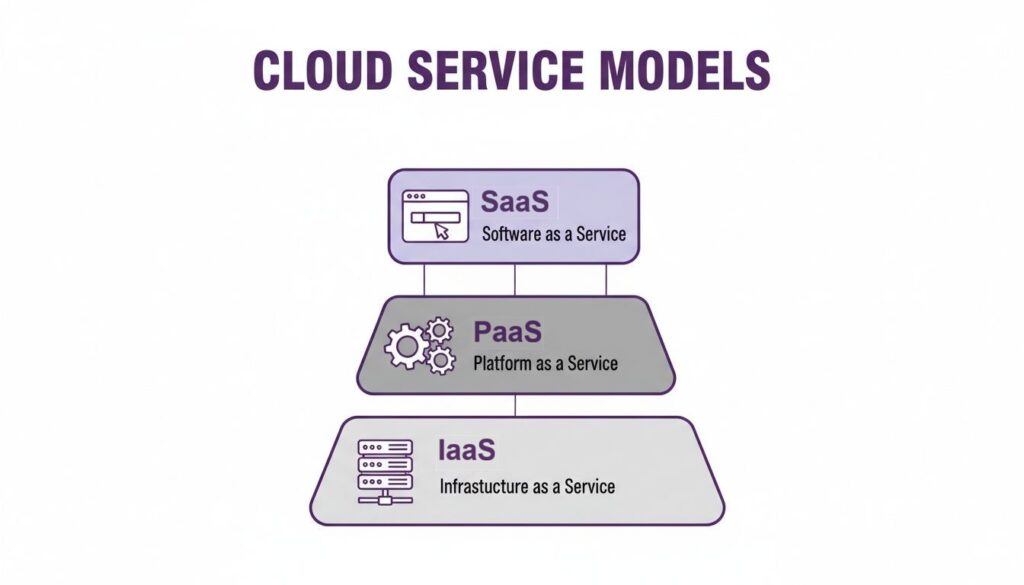
As you go from IaaS at the bottom to SaaS at the top, you’re basically trading direct control for convenience and simplicity.
Public Cloud: The Modern Apartment Building
The Public Cloud is a bit like renting a flat in a modern, secure apartment block. Big providers like Microsoft Azure own and manage the entire building (the infrastructure), and you simply rent the space and services you need. It’s incredibly cost-effective because you’re sharing the building’s maintenance, security, and utilities with other tenants.
This is by far the most popular model. It gives you amazing scalability and access to powerful tech without having to buy any of your own expensive hardware.
Private Cloud: Your Own Detached House
A Private Cloud, on the other hand, is like owning your own detached house. The entire environment is for your business and your business alone. This gives you the ultimate control over security and customisation because you’re not sharing anything with neighbours.
Of course, just like owning a house, you’re on the hook for all the costs and upkeep, from the initial build to ongoing maintenance. This is the go-to option for organisations with incredibly strict data security policies or specific regulatory demands. The debate over cloud vs on-premises infrastructure really comes down to these factors.
Hybrid Cloud: The Best of Both Worlds
The Hybrid Cloud cleverly mixes public and private clouds, aiming to give you the best of both. Think of it as owning your own secure house (the private cloud) but also having a flexible, pay-as-you-go storage unit down the road (the public cloud) for things that aren’t as sensitive or when you just need a bit of extra room.
This strategy lets UK businesses keep their most critical data—like customer or financial records—on a tightly controlled private server, while using the huge, scalable power of the public cloud for things like web applications or development work. It’s a popular way to get the right balance of security, cost, and performance.
How Microsoft Cloud Solutions Power UK Business Growth
Knowing the difference between cloud models is one thing, but seeing what they can actually do for a business is where it gets interesting. For businesses right here in the UK, the Microsoft ecosystem – that’s Microsoft Azure, Microsoft 365, and Dynamics 365 – offers a genuinely powerful and connected platform for growth. This isn’t just about swapping old tech for new; it’s about building a smarter, more resilient company from the ground up.
The momentum is hard to ignore. The UK cloud computing market is ballooning, hitting an estimated £37.4 billion in revenue this year alone. It’s on track to rocket past £107 billion by 2030. That’s not just a statistic; it’s a clear signal that UK businesses, especially those in the East Midlands, are using scalable cloud platforms to get ahead. You can read more about the UK’s cloud market projections on Grandview Research to see just how fast things are moving.
Building On a Foundation of Power with Azure
Think of Microsoft Azure as the engine room for your business. It’s the powerful, flexible infrastructure that lets your company expand without the eye-watering cost of buying and managing racks of physical servers in your office.
Instead of hitting a wall when your hardware runs out of puff, you can spin up more computing power or storage in minutes. When things quieten down, you can scale it right back down. That kind of agility is a game-changer for handling seasonal peaks, launching a new product, or simply growing without being shackled by your own IT.
Creating a Hub for Modern Collaboration
If Azure is the engine, then Microsoft 365 is the cockpit where your team works together. It’s so much more than the Word and Excel we all know. It’s an entire toolkit built for the way we work now.
- Microsoft Teams: This is your central hub for everything – chats, calls, file sharing, and project planning. It keeps everyone in sync, whether they’re at a desk in Derby or working from home in Leicester.
- SharePoint: Think of it as your secure, central library for company documents. No more hunting for the right version of a file; everyone works from the same source of truth, and your critical data stays protected.
- Built-in Security: These tools aren’t just convenient; they’re designed with serious, enterprise-level security baked in from day one, helping you fend off ever-present cyber threats.
Set up correctly, Microsoft 365 completely changes how your teams collaborate. It breaks down those frustrating information silos and creates one secure place where people can just get on with their work, all for a predictable monthly cost.
Unlocking Business Intelligence with Dynamics and AI
The final piece of this puzzle is turning all your business data into your biggest advantage. That’s where Dynamics 365 and integrated AI tools like Copilot come in. Dynamics 365 brings your customer relationship management (CRM) and enterprise resource planning (ERP) systems together, giving you a single, clear picture of your entire operation.
When you add Copilot into the mix, you start to see the magic. It can automate tedious tasks, pull out key insights from your sales figures, and help you make smarter decisions, faster. A good local IT partner can connect these dots for you, turning powerful cloud technology into real-world results like better efficiency and a healthier bottom line.
Ready to explore how Microsoft cloud solutions can fuel your growth?
Phone 0845 855 0000 today or Send us a message to book a consultation.
Your Practical Cloud Migration Checklist
Moving to the cloud successfully doesn’t happen by accident. It’s the result of sharp planning and careful execution. The key is to treat it as a strategic business project, not just another IT task. This is how you unlock its real potential and avoid the headaches of disruption. This practical checklist gives business leaders a clear roadmap to follow.
The shift towards the cloud here in the UK is impossible to ignore, supercharged by the rise of remote working and a workforce that’s more comfortable with technology than ever before. The UK’s public cloud market is already worth over £36.6 billion and is forecast to hit an eye-watering £477 billion by 2032. This incredible growth presents a huge opportunity for businesses to migrate smoothly and seriously upgrade their security. You can see the full scale of the UK cloud market on Statista for yourself.
Phase 1: Assess and Plan
Before you even think about moving a single file, you need to know exactly where you’re starting from. This first phase is all about auditing what you have and defining what a successful move will look like for your business.
- Audit Your Current Systems: Get a complete inventory of every application, piece of hardware, and dataset you use. Which systems are absolutely critical? Which are old, clunky, and could be retired? Be honest.
- Define Clear Business Goals: What, specifically, are you trying to achieve? Your goals need to be concrete. Think: “reduce IT running costs by 20%,” “improve our disaster recovery time,” or “let our team collaborate seamlessly from anywhere.”
Phase 2: Strategy and Selection
Once you know your destination, you can map out the journey. Now it’s time to make the big decisions about your approach, the technology you’ll use, and the partners who will help you get there.
- Choose the Right Cloud Model: Look back at the SaaS, PaaS, and IaaS models. Do you just need a ready-to-go application like Microsoft 365 (SaaS)? Or do you need the raw power and flexibility of a platform like Microsoft Azure (IaaS/PaaS)?
- Select a Migration Approach: A common starting point is the ‘lift-and-shift’ method, where you basically copy your applications to the cloud with minimal changes. On the other hand, you might choose to ‘re-platform’ or ‘re-factor’ your apps to really take advantage of what the cloud can do.
- Find an Expert Partner: Don’t try to go it alone. A local, certified partner who genuinely understands the East Midlands business scene can be your greatest asset. They bring the technical know-how for a smooth switch and the strategic advice for long-term wins.
A well-planned migration isn’t just about moving data from A to B. It’s a chance to modernise your operations, strengthen your security posture, and build a more resilient business for the future.
Phase 3: Execute and Optimise
This is where the plan becomes reality. It’s the hands-on stage of moving your data and applications, followed by the all-important job of managing it day-to-day.
- Execute the Migration: This is the practical work, often carried out in stages to keep disruption to your daily operations to an absolute minimum.
- Plan for Security and Compliance: Make certain your new cloud setup is configured to meet UK-specific regulations like GDPR. This is a non-negotiable step where an expert partner proves their worth.
- Manage and Optimise: The work isn’t over once you’re in the cloud. You need to constantly monitor your spending and performance to ensure you’re getting the best possible return on your investment. For a structured way to handle this, you can learn more about Microsoft’s Azure Cloud Adoption Framework which provides a proven guide.
Ready to start planning your migration?
Phone 0845 855 0000 today or Send us a message to speak with our experts.
Answering Your Key Questions About The Cloud
Deciding to move your business into the cloud is a big step, so it’s completely natural to have questions. For business owners here in the East Midlands and right across the UK, we find the same handful of concerns pop up time and again. Let’s tackle them head-on, so you can make your next move with confidence.
How Secure Is My Business Data In The Cloud?
This is usually the first question on everyone’s mind, and for good reason. The truth is, major cloud platforms like Microsoft Azure are built on a foundation of security that most small businesses could never afford on their own. We’re talking about multiple layers of protection, from physical data centres with biometric scanners and round-the-clock surveillance to sophisticated digital encryption that protects your data whether it’s being stored or sent.
But it’s crucial to understand that security is a partnership. The cloud providers operate on a ‘shared responsibility model’. This means Microsoft takes care of securing its global network, but you are responsible for securing your data and access within that environment. This is where things like setting up user permissions, access controls, and security policies come into play. Getting this right is absolutely vital, and it’s why having an expert IT partner is so important—they ensure no gaps are left in your defences.
What Are The Real Costs Of Moving To The Cloud?
One of the most appealing things about the cloud is how it changes your spending. You move away from huge, one-off capital expenses (CapEx) for servers and hardware to a predictable, monthly operational expense (OpEx). Instead of a massive upfront bill, you pay a manageable subscription.
To give you a rough idea, a UK business with around 50 employees could expect their monthly Microsoft 365 bill to be somewhere between £500 and £1500, depending on the plan. While that’s great value, it’s also wise to factor in the one-time cost of the migration project itself, plus the ongoing cost of having an expert manage the system to keep it running efficiently.
Will Cloud Solutions Work With Our Existing Software?
Yes, almost certainly. Modern cloud platforms are built to be flexible and connect with other systems. They use something called Application Programming Interfaces (APIs) to build secure bridges between the trusty software you already rely on and your new cloud applications. This integration is key to avoiding data getting trapped in separate systems and keeps your workflow smooth. We can even develop custom solutions to make sure every piece of your software, old and new, talks to each other perfectly.
The goal isn’t to rip and replace everything. It’s about creating a connected, efficient ecosystem where every part of your operation works together, whether it’s on-premise or in the cloud.
Why Do I Need A Local Partner For A Global Service?
The cloud might be global, but your support shouldn’t come from a faceless, international call centre. Having a local IT partner right here in the East Midlands offers real, practical advantages. It means getting rapid on-site support when a problem just can’t be fixed remotely. It means getting strategic advice from a team that actually understands the local business community.
Ultimately, it’s about building a relationship with certified, DBS-checked engineers you know and trust. It’s the difference between having an expert on the end of a phone and having an expert in your corner.
Ready to transform your business with secure, scalable cloud solutions?
Phone 0845 855 0000 today or Send us a message to schedule your initial consultation.
Time to Take the Next Step?
Moving to the cloud isn’t just a technical upgrade; it’s a strategic business decision that genuinely opens up new possibilities for efficiency, security, and growth. You’ve now got a solid understanding of the different models, the environments, and what a migration project looks like. The next part is moving from planning to action.
That’s where we come in. Think of us as your local guide for this journey, here to help you navigate every step using tried-and-tested Microsoft technologies.
We have years of experience helping organisations right here in the East Midlands make this transition a success. Working with a local partner means you get a team that’s on your doorstep, one that understands the specific challenges and opportunities your business faces. It’s about making sure your cloud strategy isn’t just a plan on paper, but something that delivers tangible results and a real return on your investment.
If you’re ready to see how secure, scalable cloud solutions could reshape your business, let’s have a proper conversation. Together, we can build your future in the cloud.
Phone 0845 855 0000 today or send us a message to arrange an initial chat.