
A growing UK business can have capable people, Microsoft 365 licences and plenty of hard work, yet still deliver unpredictable results. One project finishes smoothly, another depends on a single administrator, and a third stalls because nobody knows which process to follow. The organisation appears busy, but its performance isn't consistently repeatable.
A capability maturity model gives leaders a practical way to understand why that happens. It replaces vague confidence with observable evidence, then turns capability gaps into a prioritised improvement plan. For East Midlands SMEs, that means connecting Microsoft technology with the ownership, processes, skills and measurements needed to produce dependable business outcomes.
What Is the Capability Maturity Model and Why It Matters
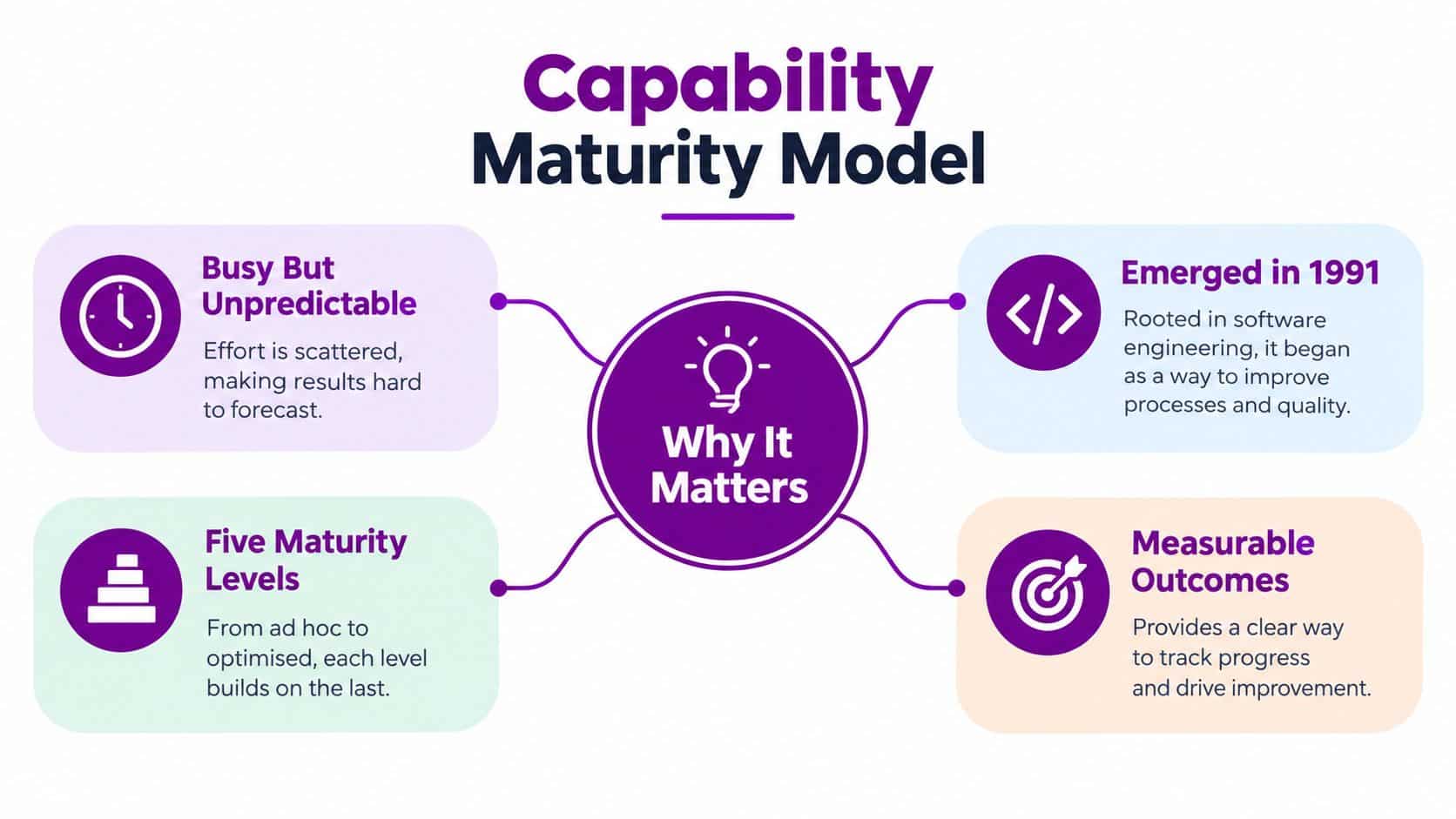
The Capability Maturity Model, or CMM, originated in software engineering and was released as the Software Capability Maturity Model in 1991. Its purpose was to assess whether an organisation's work was defined, managed, measured, controlled and effective. Rather than asking whether a team had talented individuals, it examined whether the organisation could deliver reliably without depending on heroics.
Consider an East Midlands manufacturer that has grown quickly. Sales records sit in Dynamics 365, project information is spread across Teams chats, and a small number of experienced employees know how customer issues are really resolved. When one of those people is absent, delivery slows and managers spend time reconstructing information. The problem isn't effort. It's the absence of repeatable capability.
A useful analogy is housebuilding. You can have quality materials and skilled workers, but without a shared blueprint, inspections and clear responsibilities, the finished building may be unsafe or inconsistent. The capability maturity model provides that blueprint for organisational work. It helps leaders see whether weaknesses come from inconsistent delivery practices or from wider management and organisational issues.
Practical rule: A maturity assessment should identify what the organisation can demonstrate, not what its leaders hope is happening.
The model matters because it turns broad ambitions such as “improve governance” or “strengthen security” into staged capability. A business can start with named ownership and basic controls, then introduce standard processes, measurement and continuous improvement. This makes maturity relevant beyond software development, including data management, cyber security, service delivery and cloud adoption.
For a related perspective on ownership, decision-making and controls, see this guide to IT governance frameworks. A maturity model isn't a compliance badge. It's a structured way to build predictable growth, so people, processes and technology support the same business priorities.
Understanding the Five Maturity Levels in Practice
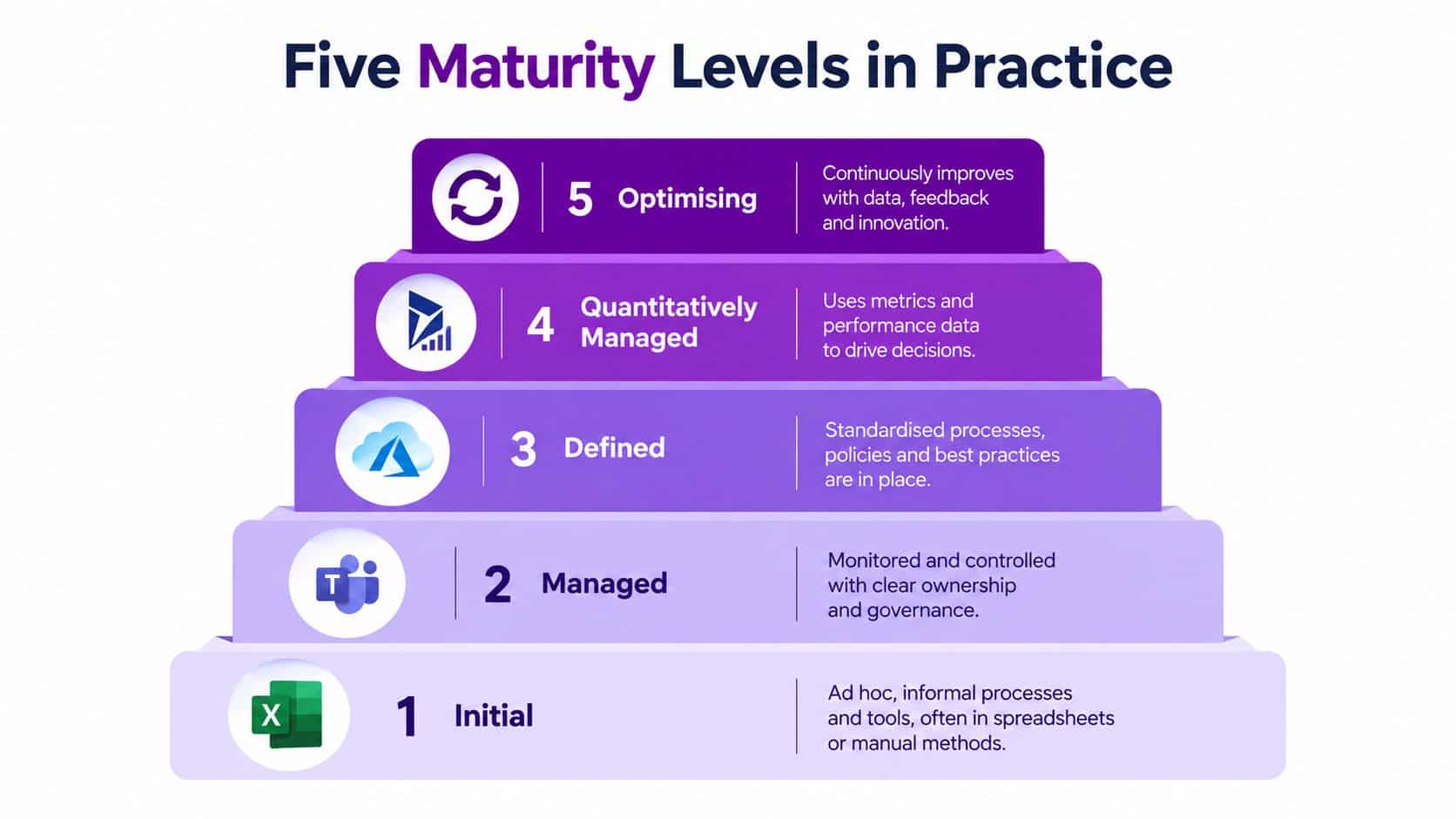
The five levels become clearer when you examine what people can consistently demonstrate. Learning to drive offers a useful parallel: you first learn basic controls, then follow rules in real traffic, then use feedback to improve how you travel. Organisations develop in a similar sequence, replacing individual memory with shared, measurable ways of working.
| Level | What it looks like in a UK SME |
|---|---|
| 1. Initial | Work is ad hoc, reactive and dependent on individual effort. |
| 2. Managed | Basic planning, ownership and repeatable project practices exist. |
| 3. Defined | Organisation-wide processes are documented and consistently applied. |
| 4. Quantitatively Managed | Measurements guide decisions and reveal variation. |
| 5. Optimising | Teams use evidence to improve processes continuously. |
At Level 1, a Microsoft 365 environment may function because one administrator remembers its configuration. Joiners, leavers, permissions and incidents receive attention when somebody notices a problem. The business may deliver good results, but performance depends heavily on individuals and remains difficult to predict.
Level 2 gives that effort a basic operating structure. A UK SME might introduce an onboarding checklist, project templates and agreed storage locations. Azure workloads and Dynamics 365 changes are recorded, although departments may still apply slightly different practices. Ownership becomes visible, even if consistency is still developing.
Level 3 establishes a common organisational method. Documented standards guide security reviews, data ownership, service requests and change management across teams. A new employee can understand how work should happen without relying on an informal explanation from one experienced colleague. The process itself carries the knowledge.
Measurement changes the conversation at Level 4. Managers examine unresolved service requests, access-review completion, backup-test results or adoption of a Dynamics 365 process. They can identify variation between teams and investigate its cause. Decisions are based on recorded evidence rather than confident impressions.
At Level 5, teams use that evidence to improve repeatedly. They identify recurring weaknesses, test a change, review the result and share successful practices across the organisation. For a Microsoft-based business, optimisation might involve refining a workflow in Power Platform or changing how service data is reviewed. Technology serves a business improvement, rather than becoming the objective.
Progress remains cumulative. An organisation cannot claim quantitative control while ownership is unclear, and optimisation is difficult before a defined process exists. The UK Government Maturity Modelling Guide describes maturity models as structured assessment frameworks with defined levels, including a possible Level 0 where no awareness or capability exists.
How to Assess Your Current Maturity Effectively
A credible assessment starts with evidence. Asking a leadership team whether security is “well managed” produces opinions. Asking for an access-review record, a named owner, a retention rule and proof of follow-up produces something a board, insurer or auditor can examine.
The UK Government's Data Maturity Assessment provides a useful reference. It uses five stages, Beginning, Emerging, Learning, Developing and Mastering, across ten data topics and six cross-cutting themes. The framework describes observable behaviours, from siloed working and unclear responsibility to stronger accountability, data skills, standardised tooling and decisions informed by data.
Use a simple assessment cycle:
- Define the capability. Separate governance, identity, security, architecture, data quality, analytics, skills and user adoption. Don't give the whole organisation one flattering score.
- Write evidence requirements. For identity, request an ownership matrix, access reviews and leaver records. For data, request retention rules, data-quality measures and examples of reporting used in decisions.
- Interview the people doing the work. Compare management expectations with what staff do in Microsoft 365, Azure, Dynamics 365 and Power Platform.
- Score demonstrated behaviour. If evidence is missing, record the gap rather than assuming the control exists.
- Create a prioritised backlog. Address the weaknesses that create the greatest operational, security or customer risk first.
Cloud adoption doesn't automatically indicate maturity. A business may own modern Microsoft services while lacking clear permissions, documented processes or user adoption. Similarly, a policy stored in SharePoint isn't evidence that employees follow it.
The UK Government Data Maturity Assessment framework emphasises that capability is demonstrated through reliable use of data for organisational priorities. For a broader way to think about control design and testing, CEFCore's guide to internal controls offers useful context.
Repeat the assessment after meaningful improvement work, rather than treating it as a one-off compliance exercise. A focused security risk assessment can help connect the maturity baseline to practical cyber priorities, especially where a small team owns both day-to-day support and strategic change.
Common Mistakes When Implementing Maturity Models
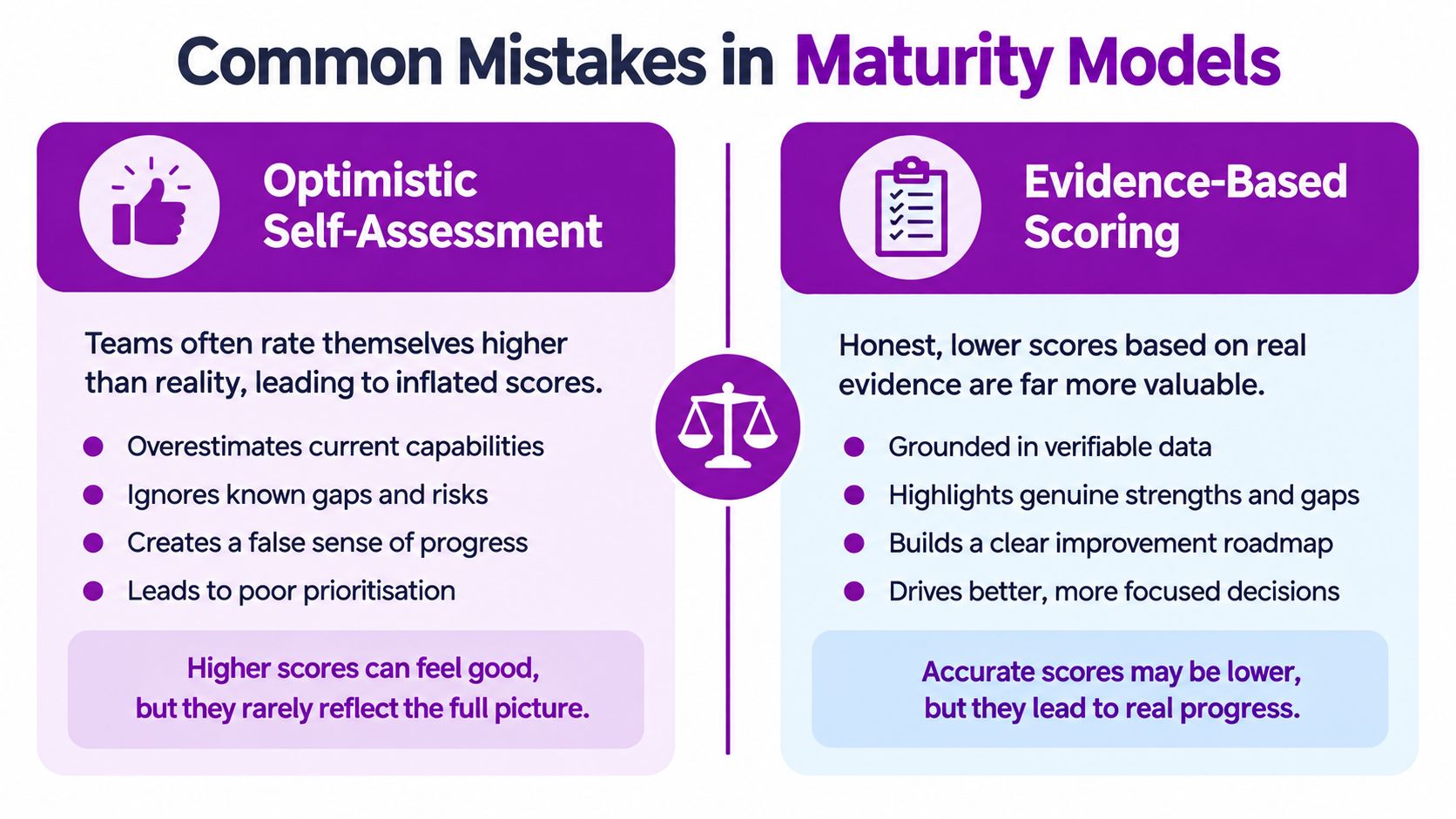
A director may rate the business highly because Microsoft 365, Azure or Power Platform is in place. A technician may describe a different reality: unclear ownership, inconsistent processes and controls that have never been tested. That gap is the first mistake. A maturity score should reflect demonstrated capability, not the presence of licences or confident opinions.
UK SMEs often have limited time, cash and specialist knowledge for transformation. The UK SME Digital Adoption Taskforce report noted that smaller businesses can overrate their digital readiness, so assessment should compare ambition with evidence. Useful evidence includes configuration records, completed reviews, staff interviews, service reports and examples of controls working in practice.
| Assessment approach | Strength | Risk |
|---|---|---|
| Self-assessment only | Quick and inexpensive | Confidence may replace evidence |
| Rigid external framework | Consistent terminology | The process may become disproportionate |
| Evidence-led review | Reveals practical capability | Requires ownership and honest discussion |
A second mistake is importing a framework without adapting it to the business. A 1997 UK study of companies that had actively considered adopting CMM found that all but one rejected it, citing barriers such as limited engineering culture, a lack of short-term business gains and external imposition. The finding is reported in the study of CMM adoption in UK companies. For a growing UK firm, the practical question is whether a proposed practice improves delivery reliability, quality, security or customer service.
Technology purchases create another distraction. More Microsoft licences will not resolve unclear ownership, weak training or undocumented work. A business using Teams, Azure and Power Platform still needs named people who know what should happen, when it should happen and how results will be checked.
A lower score with evidence is an improvement tool. A higher score without evidence is only reassurance.
A proportionate approach usually works better. A growing firm might begin with an accurate asset inventory, named data owners and tested recovery arrangements, then improve one weak capability at a time. It does not need to copy every practice used by a large enterprise. Guidance on change management in digital transformation can help leaders address the human side of those changes.
Business Benefits of Achieving Higher Maturity
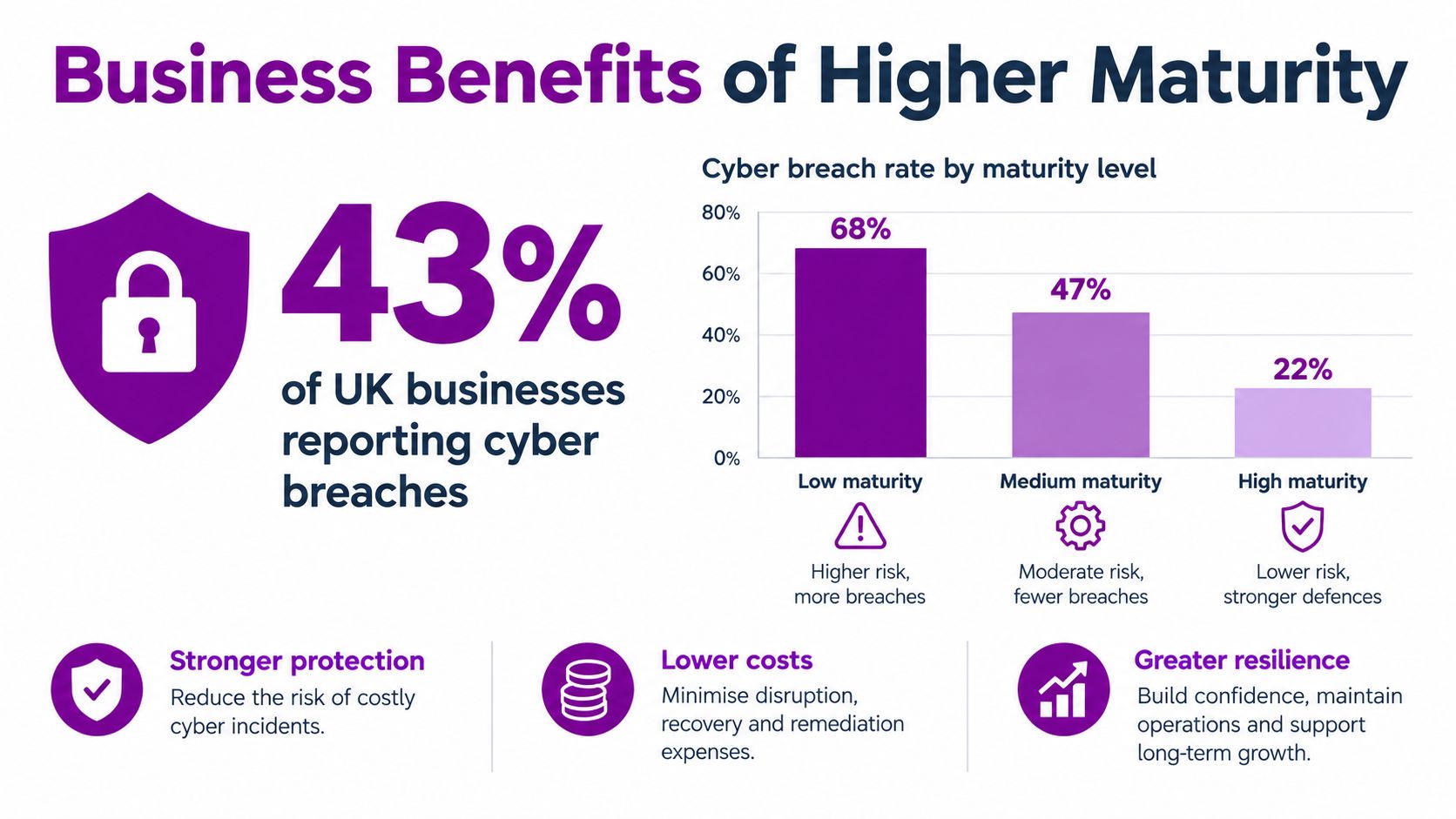
A ransomware incident can expose the difference between having security tools and being able to operate them under pressure. The 2025 UK Cyber Security Breaches Survey found that 43% of businesses, approximately 612,000 businesses, reported a breach or attack in the previous twelve months. Reported prevalence was 67% for medium-sized businesses and 74% for large businesses. These figures are published by the UK Government.
A maturity model links that exposure to practical controls. Early capability can establish an asset inventory, multi-factor authentication, supported software and named responsibility. Intermediate capability adds centralised logging, vulnerability management, tested backups, privileged-access governance and incident playbooks. Advanced capability introduces continuous assurance, recovery exercises, supplier-risk monitoring and performance measures that show whether controls work.
The business value is reduced dependence on one administrator. Documented ownership and repeatable procedures let another authorised person respond when the usual contact is unavailable. Testing controls and reviewing telemetry can expose failures before an incident. Recovery rehearsals give the business a tested response when prevention has failed.
Maturity works like insurance combined with operational discipline. Insurance may help after an event, but it does not tell staff which systems matter, who makes decisions or how services will be restored. A mature organisation prepares those answers in advance.
It also creates better evidence for Microsoft investment decisions. For example, a UK business could compare Dynamics 365 adoption records with the customer-service tasks the system is meant to support. If usage is low because staff are bypassing a workflow, the evidence may support targeted training or process changes rather than another licence purchase. If adoption is strong but response remains slow, the next investment may address workflow design or integration. The maturity benefit is a clearer connection between technology spending and operational results.
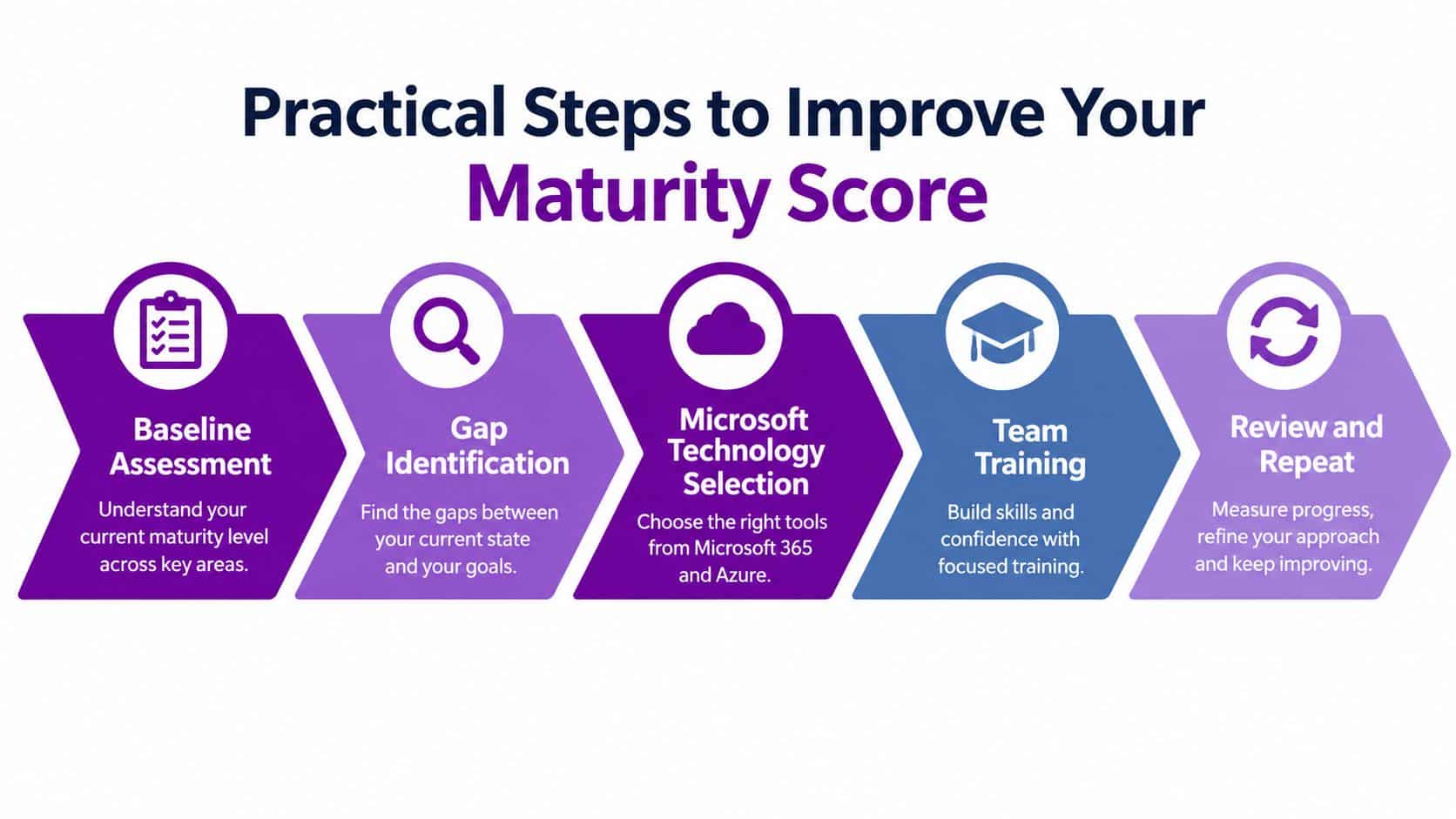
Practical Steps to Improve Your Maturity Score
Improvement should begin with a baseline, not a shopping list of new technology. An East Midlands SME can make useful progress by reviewing how governance, security, data management and adoption work across Microsoft 365, Azure, Dynamics 365 and Power Platform.
Start with a defensible baseline
Choose an accountable owner, then involve the people who operate the controls. Review configurations, process documents, access records, backup evidence, incident records and user adoption. Require documentary evidence for each claimed level. If nobody can produce it, record the capability as unproven rather than arguing about whether it probably exists.
Prioritise the weakest critical areas
Don't improve every capability at once. Rank gaps by business impact, exposure and effort. A missing owner for privileged access may deserve attention before a less important reporting enhancement. A weak recovery process may matter more than adding another dashboard.
Create an improvement backlog with:
- Capability: The area being improved, such as identity or data governance.
- Current evidence: What exists today and where the proof is stored.
- Target behaviour: What staff and systems should do consistently.
- Microsoft action: The relevant work in Entra ID, Intune, Defender, Microsoft 365, Azure or Power Platform.
- Business measure: The evidence that will show progress.
Assign ownership and build adoption
A technical administrator can configure a control, but business leaders must decide its purpose and risk tolerance. Department managers should validate access, data owners should confirm retention needs, and users should receive training that matches their daily work.
For cyber resilience, the roadmap can connect identity controls, supported devices, detection, backup testing and continuity evidence. For data maturity, it can connect ownership, quality checks, reporting and decisions. Keep each action small enough to complete alongside operational work.
Review and repeat
Schedule a reassessment after the improvement backlog has been addressed, then retain the evidence. The UK Office of Rail and Road capability framework illustrates a cumulative approach in which organisations establish a baseline, set targets and create an improvement plan. That principle works well for SMEs, provided the measures remain relevant to the business.
How F1Group Can Accelerate Your Maturity Journey
F1Group supports East Midlands organisations that need to turn a maturity assessment into practical change. Its services cover managed IT, Microsoft 365 and Azure, Dynamics 365, Copilot AI, Power Platform, custom application development and cyber security.
That support aligns with the core discipline of a capability maturity model. The work starts by establishing what exists, clarifying who owns each capability and documenting how processes operate. Improvement actions can then be connected to Microsoft technologies and business continuity evidence, rather than treated as isolated technical projects.
F1Group's team is vendor-certified and DBS-checked, and can work remotely or on site across Lincoln, Nottingham, Leicester, Scunthorpe, Grimsby and Newark. This matters for SMEs whose internal teams need practical assistance without losing ownership of their systems or decisions.
A useful engagement might examine Microsoft 365 configuration, Entra ID controls, Intune device management, Defender coverage, Azure workloads, Dynamics 365 processes or Power Platform governance. The outcome should be a risk-ranked roadmap with evidence requirements, accountable owners and review points.
F1Group has helped organisations work more efficiently and securely with Microsoft-focused technologies since 1995. Its role is not to award a maturity label and leave the business with a report. It can help connect the assessment to implementation, training, support and measurable operational improvement.
Your Next Steps Toward Mature Operations
A capability maturity model gives a growing business a shared language for predictable operations. It shows whether teams have repeatable processes, clear ownership, useful measurements and the ability to improve. It replaces optimistic assumptions with evidence that leaders can use.
Start with one business-critical capability. Gather the documents, configurations and records that prove how work happens today. Score what the organisation can demonstrate, identify the most important gap and create a proportionate improvement action with a named owner.
Review progress regularly, especially after significant changes to Microsoft 365, Azure, Dynamics 365, security controls or business processes. The aim isn't to reach a theoretical perfect state. It's to make the organisation more dependable, resilient and able to grow without increasing avoidable risk.
If you want help interpreting your current position, speak with F1Group on 0845 855 0000 or use the F1Group contact form.
F1Group can assess your current capabilities, identify evidence-based gaps and build a practical improvement roadmap across Microsoft 365, Azure, Dynamics 365 and cyber security. Visit F1Group to discuss how structured maturity improvement can strengthen your operations and business continuity.