
When a crisis hits, having a plan is the difference between weathering the storm and going under. That's what business disaster recovery is all about: a comprehensive strategy to get your company back on its feet after an unexpected, disruptive event. It’s far more than just an IT issue; it’s a complete plan designed to protect your people, your processes, and your technology, making sure your business can survive and keep serving customers when the worst happens.
What Is Business Disaster Recovery and Why Is It Crucial?

Think of your business as a ship at sea. You always hope for calm waters, but you know storms are inevitable. A business disaster recovery (BDR) plan is your emergency navigation chart. It details precisely what the crew needs to do to keep the ship afloat and get it back on course when a gale hits.
Without that chart, you're sailing blind straight into chaos.
The Modern Meaning of Disaster
Years ago, the word "disaster" probably brought to mind images of a fire or a flood. For UK businesses today, the definition is much broader and the threat far more immediate. A disaster is any event that grinds your critical operations to a halt. It could be a sophisticated cyber-attack that locks up your files, a primary server failing, a prolonged power cut, or even a key supplier going bust.
These events can strike without a flicker of warning, which makes having a plan in place essential for survival. The damage from being unprepared goes well beyond the initial financial hit.
A robust disaster recovery plan isn't a luxury reserved for big corporations anymore. It's a fundamental necessity for any business that depends on its data and technology to function. Downtime doesn't just stop sales; it erodes customer trust and can permanently damage your reputation.
Protecting Your Business Lifeline
A well-thought-out business disaster recovery strategy gives you a clear, actionable framework. It ensures everyone knows exactly what to do in a crisis, turning panic into a calm, measured process. This resilience is built on a few key pillars.
- Minimising Financial Impact: Every single minute of downtime costs money. A solid BDR plan gets you back up and running fast, slashing revenue loss and limiting the financial fallout.
- Maintaining Customer Trust: If your services go offline, customers quickly lose confidence. A swift, professional recovery shows you’re reliable and in control, preserving the trust you’ve worked so hard to earn.
- Ensuring Operational Continuity: The plan lays out how your most important functions will carry on, whether that’s by switching to backup systems, moving to an alternative location, or enabling remote work. It keeps the heart of your business beating.
- Safeguarding Critical Data: Your data is one of your most valuable assets. A recovery plan ensures it’s backed up, secure, and can be restored accurately after an incident.
Ultimately, business disaster recovery is about taking control. It’s the proactive step you take to ensure an unforeseen event doesn’t get to decide your company's future. It gives you the tools to navigate the storm and come out stronger on the other side.
Ready to build a resilient future for your business? Our experts can help you create a robust disaster recovery plan tailored to your specific needs.
Phone 0845 855 0000 today or Send us a message to get started.
RTO vs RPO: The Two Most Important Questions in Disaster Recovery
Before you can build a solid disaster recovery plan, you have to answer two surprisingly simple but absolutely critical questions:
- How quickly do we need to get back up and running?
- How much data can we realistically afford to lose?
The answers give you your Recovery Time Objective (RTO) and Recovery Point Objective (RPO). Think of them as the fundamental building blocks of your entire recovery strategy. Getting them right is non-negotiable, but it’s more straightforward than it sounds.
What is a Recovery Time Objective (RTO)?
Imagine your RTO is a stopwatch. The moment a disaster strikes, that stopwatch starts ticking. Your RTO is the maximum amount of time you’ve decided can pass before your business is back online and operational. It’s all about the speed of your recovery.
An RTO of one hour means you have just 60 minutes to get your critical systems restored after an incident. An RTO of 24 hours gives you a bit more breathing room. The right number depends entirely on the specific function.
For instance, a busy e-commerce site might have an RTO of just a few minutes, because every second of downtime means lost revenue and unhappy customers. On the other hand, an internal HR system might have an RTO of eight hours, as the immediate business impact of it being down is much lower.
What is a Recovery Point Objective (RPO)?
Now, think of your RPO as a rewind button. It determines the maximum amount of data, measured in time, that your business can tolerate losing. This metric is all about data loss and directly dictates how often you need to back up your information.
If you set an RPO of 15 minutes, it means your systems must be backed up at least every quarter of an hour. If the worst happens, you know you’ll only lose, at most, the last 15 minutes of work.
A law firm constantly drafting and amending client documents might need an RPO of mere minutes to avoid a major setback. In contrast, a team working on a long-term design project might find an RPO of 24 hours acceptable; losing a day’s work would be a pain, but it wouldn't bring the business to its knees.
Setting your RTO and RPO isn't just a technical task—it's a crucial business decision. These numbers dictate the technology you need and the cost of your disaster recovery solution, so they must be grounded in your real-world priorities and budget.
Despite how vital these metrics are, many businesses haven't nailed them down. A recent survey found that while 72% of UK organisations suffered a major IT disruption last year, only 56% had properly defined and tested their RTOs. Even more worrying, just 36% had done the same for their RPOs, exposing a serious vulnerability. You can read more about these IT resilience gaps.
By taking the time to properly define an RTO and RPO for each part of your business, you create a clear and practical blueprint. This blueprint will guide every decision you make, ensuring your disaster recovery plan is built to do exactly what you need it to: keep your business going, no matter what.
Ready to figure out the right RTO and RPO for your business? Our local experts can walk you through it and help build a disaster recovery plan that fits.
Call us on 0845 855 0000 today or send us a message to get started.
Identifying Critical Risks with a Business Impact Analysis
Before you can even think about building a recovery plan, you need to know exactly what you’re protecting and what you’re protecting it from. This is where a Business Impact Analysis (BIA) comes in. It’s the foundational audit that shifts your plan from hopeful guesswork to a solid, data-driven strategy.
Think of it as a diagnostic check-up for your entire organisation. A BIA helps you uncover vulnerabilities you never knew you had and pinpoints which parts of your business are absolutely essential for survival. It answers the big questions: which processes matter most, what’s the real-world consequence if they fail, and how fast do we really need them back?
Uncovering Your Most Critical Functions
The first step in any BIA is to map out your mission-critical business processes. This isn’t just an IT job; it’s about looking at every single department, from sales and customer service right through to finance and operations.
You need to work out your core activities and understand how each one contributes to keeping the lights on and money coming in.
- Sales and Client Management: How do you find new customers, manage existing relationships, and process orders? If your CRM system went offline, would all sales activity grind to a halt?
- Operational Delivery: What systems do you rely on to deliver your product or service? For a manufacturer, this could be the software running the production line; for a consultancy, it might be project management tools and shared files.
- Financial Operations: How do you run payroll, send invoices, and take payments? A failure here doesn't just stop you from earning; it can quickly snowball into a serious cash flow crisis.
By categorising these functions, you can start to build a clear picture of priorities. It’s not about deciding what’s unimportant, but rather understanding the logical order things must be restored in to keep the business alive.
Assessing the True Cost of Disruption
Once you know what’s critical, the next job is to put a number on what it would cost to lose those functions. The cost of downtime is rarely just about the immediate loss of sales. A proper BIA digs deeper, looking at the ripple effects over time.
A Business Impact Analysis forces you to look beyond the obvious. It reveals how a seemingly small disruption in one area can trigger significant financial, operational, and reputational damage across the entire business.
Think about these potential impacts:
- Financial Losses: This is more than just lost revenue. It includes penalties for failing to meet contractual SLAs and even potential regulatory fines.
- Reputational Damage: How would a major outage affect customer trust? A prolonged service failure can cause customers to leave, and winning them back is incredibly difficult.
- Operational Consequences: Consider the knock-on effects like lost productivity, supply chain chaos, and the inability to hit crucial project deadlines.
When you're mapping out these risks, don't forget the ever-present danger of cyber attacks, such as the rising threat of infostealer malware, which can have truly devastating consequences.
Mapping Dependencies and Single Points of Failure
Finally, a BIA involves tracing the resources that each critical process depends on. This is where you uncover your weakest links—the single points of failure that could bring everything crashing down.
These dependencies can be internal, like a specific server or a key person in your team, or they could be external, like a vital software provider or a supplier you can't easily replace. By identifying these connections, you can start building redundancy into your disaster recovery plan, making sure that one failure doesn't cause a total collapse.
Phone 0845 855 0000 today or Send us a message to get expert help with your Business Impact Analysis.
Building Your Business Disaster Recovery Plan Step-by-Step
A strategy is only as good as its execution. With your Business Impact Analysis complete, it's time to translate those insights into a practical, step-by-step business disaster recovery plan. This shouldn't be a document that gathers dust on a shelf; it needs to be a living guide that steers your response when things go wrong.
Creating this plan involves far more than just backing up data. It’s about building a coordinated, resilient response that protects your entire operation. This means getting the right people on board, defining crystal-clear procedures, and making sure everyone knows their role when a crisis hits. A well-structured plan is what turns chaos into a controlled, manageable process.
Step 1: Assemble Your Disaster Recovery Team
Your first move is to put together a dedicated disaster recovery team. This group needs to be cross-functional, with people from every key area of the business—not just the IT department.
- Team Lead: Someone with the authority to make critical decisions under pressure.
- IT and Technical Staff: The hands-on experts responsible for restoring systems, data, and network connectivity.
- Department Heads: They provide vital insight into what their teams need to get back up and running.
- Communications Lead: This person manages all internal and external messaging, keeping staff, customers, and stakeholders in the loop.
Each member must have their roles and responsibilities clearly documented within the plan. Knowing exactly who does what is fundamental to a swift and effective response.
Step 2: Define Goals and Procedures
Now you can use the insights from your BIA to set concrete recovery goals. Define the specific RTOs and RPOs for each critical system and create detailed, step-by-step procedures for different disaster scenarios.
These procedures can't be ambiguous. For instance, what is the exact process for failing over to a backup server? Who needs to approve it? What are the precise steps for restoring customer data from cloud backups? Documenting these actions removes the guesswork and prevents costly mistakes in a high-stress situation.
This process flow shows the foundational analysis needed to inform your recovery goals.
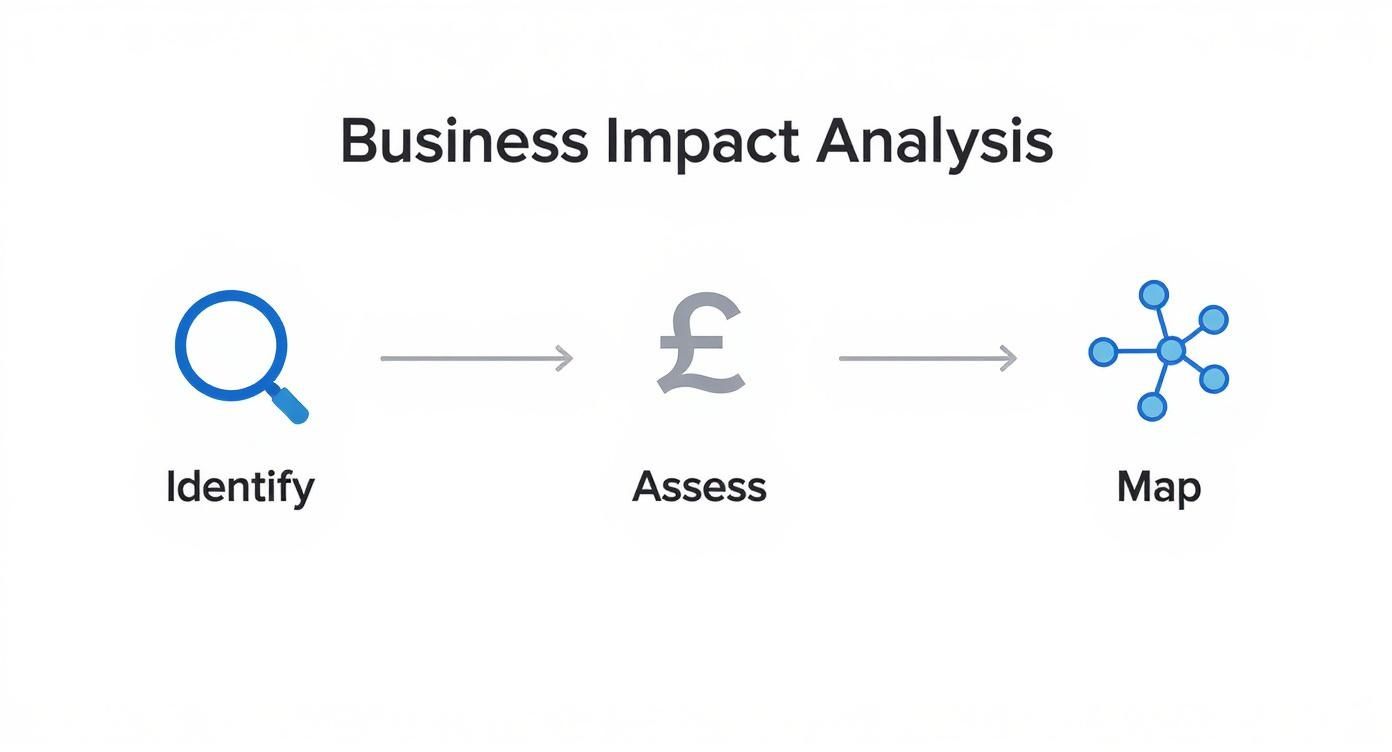
The graphic shows the three core stages—Identify, Assess, and Map—that provide the data needed to build an effective and prioritised recovery plan.
Step 3: Establish Crisis Communication Protocols
How you communicate during a disaster is just as important as how you recover your systems. A solid communication plan prevents misinformation from spreading and helps maintain confidence when it matters most.
Your plan should include:
- Pre-approved message templates for different scenarios (like a system outage or a cyber-attack).
- A complete contact list for all employees, key clients, and suppliers.
- Designated communication channels (such as email, text alerts, or social media updates).
This ensures your messaging is consistent, timely, and reassuring, which goes a long way in managing stakeholder expectations and protecting your brand's reputation. An essential part of a resilient business disaster recovery plan is ensuring your team is prepared for any physical risks, often achieved through a high-impact health safety course.
Step 4: Document and Test Your Plan
Finally, document everything in a clear, accessible format. Your plan must be stored in multiple locations, including off-site and in the cloud, so it’s available even if your primary site is down. To get started, you can use our comprehensive IT disaster recovery plan template as a solid framework.
The greatest mistake you can make is assuming your plan will work without testing it. A plan that hasn't been tested is not a plan; it's a theory.
Regular drills and simulations are the only way to find weaknesses and ensure your team is truly prepared. The good news is that UK businesses are taking this seriously. Recent findings show that 85% of UK organisations now have a formal continuity plan, and 89% have tested their recovery processes in the last year, demonstrating a strong commitment to practical readiness. Testing validates your procedures and builds the muscle memory your team needs to act decisively during a real incident.
Ready to build a plan that works? Call us on 0845 855 0000 or Send us a message.
Choosing Your Recovery Solution: On-Premises vs Cloud
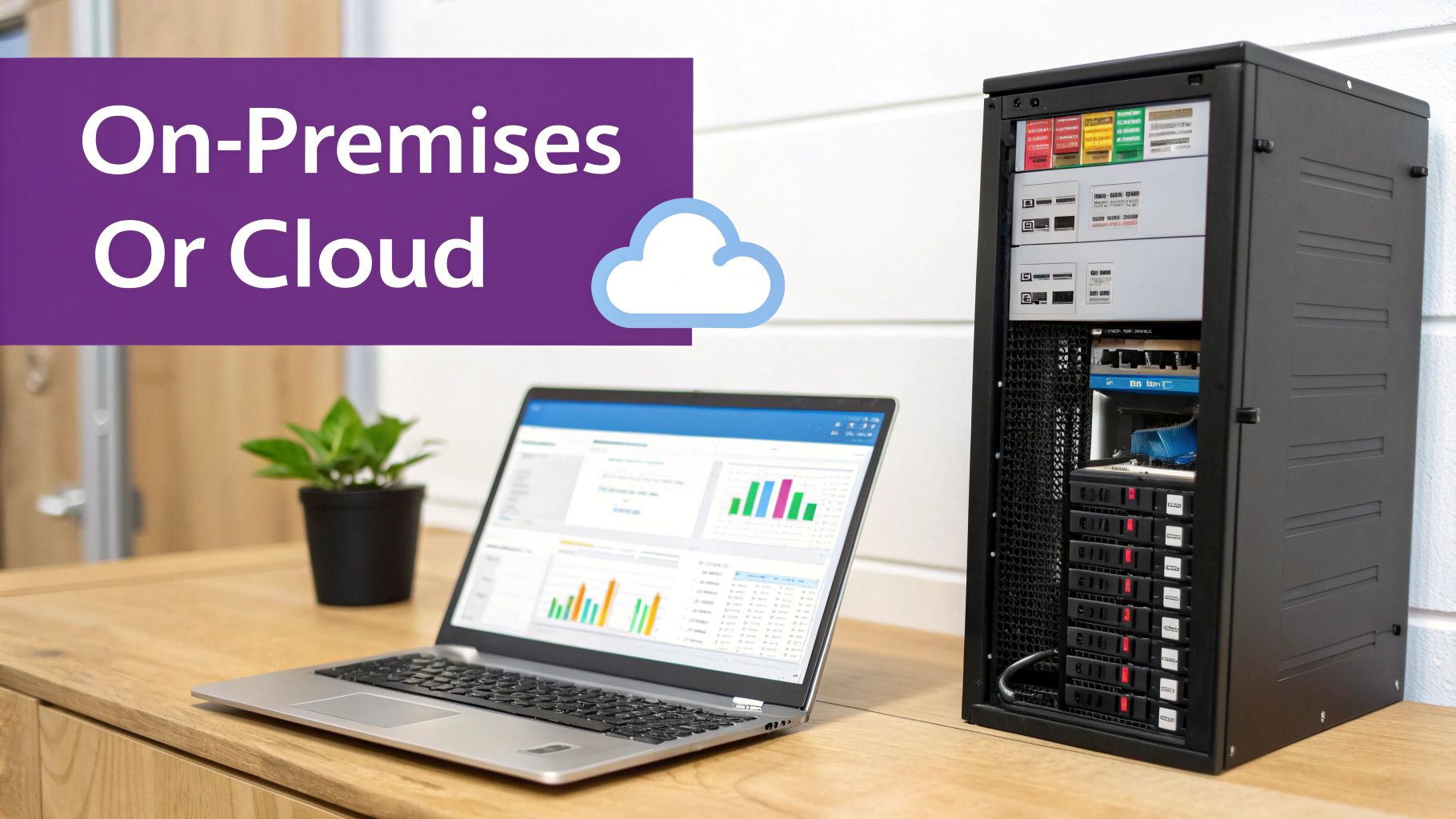
When it comes to the nuts and bolts of your disaster recovery plan, you're looking at a fundamental choice: do you stick with traditional on-premises hardware, or do you embrace modern cloud-based solutions? It's a big decision, as each path comes with its own set of pros and cons for cost, speed, and day-to-day management.
The right answer isn't as clear-cut as it used to be. If you want to really get into the weeds, our detailed guide on on-premises vs cloud solutions is a great starting point. For now, let’s break down the key differences right here.
The On-Premises Approach: Control and Capital
An on-premises disaster recovery setup is exactly what it sounds like—you own and manage all your own backup hardware. Typically, this means running a second physical site kitted out with servers, storage, and networking gear that mirrors your main office.
The biggest draw here is control. You have direct, physical oversight of your systems. When a crisis hits, you aren't waiting on a third party. But that control comes with some hefty responsibilities.
- High Initial Cost: You're buying all that hardware upfront. It's a major capital investment.
- Ongoing Management: Your IT team is on the hook for everything—maintenance, security, updates, and testing at the second site.
- Scalability Challenges: Need more capacity? That means buying more physical kit, a process that’s often slow and expensive.
This traditional model still has its place, especially for organisations with very strict data location rules or those who already have the in-house team and budget to run a second data centre effectively.
The Cloud Approach: Flexibility and Affordability
Cloud-based recovery, often known as Disaster Recovery as a Service (DRaaS), flips the script entirely. Instead of buying and managing your own duplicate hardware, you pay a provider to copy your systems to their secure, off-site data centres.
This model is a game-changer for budgeting, shifting the cost from a massive upfront purchase to a predictable monthly operational expense. Platforms like Microsoft Azure have put genuinely robust disaster recovery well within reach for SMEs.
Cloud-based DRaaS transforms resilience from a costly capital project into an affordable, scalable service. It allows SMEs to access enterprise-level protection without the enterprise-level price tag, paying only for the resources they need.
For most small and medium-sized businesses, the benefits are hard to ignore:
- Lower Upfront Costs: Forget the huge bill for new servers. Basic replication for a virtual machine in Azure can start from as little as £15-£50 per month.
- Rapid Scalability: You can increase or decrease your recovery resources almost instantly, only ever paying for what you actually use.
- Simplified Management: The cloud provider takes care of the physical infrastructure, freeing your team to focus on more important work.
This flexibility is crucial, especially when you consider how unprepared many businesses are. Alarming data shows that 42% of medium-sized companies in the UK don't have off-site backups, and nearly 83% of UK organisations admit they can only withstand 12 hours of downtime before things get ugly. As you can discover in these UK disaster recovery insights on PhoenixNap.com, cloud solutions tackle this problem head-on by making off-site recovery simple and affordable.
Why Partnering with an MSP Is a Smart Move for Your Business
Let's be honest, for most small and medium-sized businesses in the UK, the idea of creating and managing a complex disaster recovery plan is overwhelming. It demands specialist skills, non-stop vigilance, and a chunk of resources that are frankly better spent on running and growing your business.
This is exactly why bringing a specialist Managed Service Provider (MSP) on board isn't just a convenience; it's a game-changing strategic move. A good MSP provides far more than just tech. They bring the expertise, the proven processes, and the peace of mind you need to build real, tangible resilience.
Beyond Technology: The Expertise Advantage
A seasoned MSP brings years of hard-won experience to the table. They’ve designed, built, and tested recovery plans for countless businesses across all sorts of industries. That depth of experience means they know the subtle differences between threats and understand exactly what’s needed to get your operations running again, fast.
Think of them as a dedicated partner, guiding you through every single step, from the first Business Impact Analysis all the way through to keeping the plan sharp and relevant. This kind of partnership lets you draw from a well of knowledge that would be prohibitively expensive to build in-house.
Partnering with an MSP for disaster recovery is about offloading the risk and the operational burden. It allows you to focus on your core business, confident that a team of specialists is working 24/7 to protect it.
Hiring, training, and keeping a dedicated IT security and recovery team is a major financial commitment. When you work with an MSP, you get access to a shared team of certified professionals for a fraction of that cost. You can read more about the financial and operational upsides in our guide to the benefits of managed IT services. It’s a model that makes enterprise-level expertise affordable for any SME.
Proactive Management and Proven Processes
A disaster recovery plan isn't something you can just set up and then forget about. It needs constant attention, regular testing, and frequent updates to have any value as your business and the world around it changes. This is where an MSP really proves its worth.
- 24/7 Monitoring: They keep a watchful eye on your systems around the clock, often spotting and fixing potential problems long before they have a chance to cause any disruption.
- Regular Testing and Validation: A good MSP will schedule and run regular, controlled tests of your recovery plan. This is crucial for making sure it actually works, finding any gaps, and refining the whole process.
- Keeping Pace with Change: As you bring in new software or your infrastructure evolves, your MSP will update the recovery plan to make sure it’s always perfectly aligned with how you operate.
Ultimately, an MSP provides the structure and discipline required to maintain a constant state of readiness. They do the heavy lifting of managing your company's resilience, turning disaster recovery from a source of stress into a genuine source of confidence.
To explore how a managed partnership can secure your business's future, get in touch with our team of local experts.
Phone 0845 855 0000 today or Send us a message.
Your Disaster Recovery Questions Answered
Putting a disaster recovery plan into action always brings up practical questions. It’s one thing to understand the theory, but quite another to get it working on the ground. For UK business owners, getting these details right is what makes a plan truly effective. Let's tackle some of the most common queries we hear.
How Often Should We Be Testing Our DR Plan?
As a rule of thumb, you should test your disaster recovery plan at least once a year. Think of this as the absolute minimum.
But if your IT systems change frequently, you handle a lot of transactions, or you're in a high-risk industry, you really ought to be testing more often—perhaps quarterly or twice a year. The more that’s at stake, the more you need to be sure your plan actually works.
Testing doesn’t always mean a full-scale simulation. You have a few options:
- Tabletop Exercises: This is where you get the recovery team together and talk through a specific scenario, like a sudden power outage or a ransomware attack. It’s a great, low-impact way to spot logical holes in the plan and make sure everyone knows their role.
- Full Failover Tests: This is the real deal. You actually switch your live operations over to your backup systems. It’s definitely more involved, but it's the only way to be 100% certain everything will work as it should when a real crisis hits.
Consistent testing builds confidence and gives your team the muscle memory they need to act quickly and correctly under pressure.
What’s the Difference Between Business Continuity and Disaster Recovery?
This is a common question, and the distinction is crucial. The easiest way to think about it is in terms of scope.
Business Continuity Planning (BCP) is the big-picture strategy. It’s about keeping the entire business running, no matter what happens. It covers all the bases:
- People: How will your staff work if they can't get to the office?
- Processes: Are there manual workarounds if a key system is down?
- Places: Do you have alternative sites or a solid remote working setup?
A Disaster Recovery (DR) plan is a vital part of that bigger strategy. It’s focused specifically on the technical side of things—getting your IT infrastructure, data, and applications back up and running after a disaster.
In a nutshell, Business Continuity is about keeping the lights on by any means necessary. Disaster Recovery is the technical instruction manual for flicking the IT switch back on.
We’re a Small Business. Do We Really Need a Formal DR Plan?
Yes, without a doubt. In many ways, small businesses are more vulnerable. Lacking the cash reserves of a larger corporation, a serious disruption can easily become a company-ending event. One stark report revealed that a staggering 40% of small businesses never reopen after a major disaster.
But a formal plan doesn't have to be a monstrously complex or expensive document. Modern cloud technology has levelled the playing field, making robust disaster recovery affordable and achievable for businesses of any size. The days of needing a second, fully-equipped data centre are long gone.
For instance, with a cloud service like Azure Site Recovery, you can protect a server for as little as £15-£20 per month. This puts top-tier protection well within reach. The most important thing to remember is that having a simple, documented plan is infinitely better than having nothing at all when things go wrong.
If you need some expert guidance on putting together a DR plan that fits your business and your budget, we're here to help.
Give us a call on 0845 855 0000 today or send us a message.
Ready to Build Your Recovery Plan?
Don't let a disaster be the first real test of your business's resilience. The time to find the gaps in your defences is now, not when everything is on the line. Getting ahead of the problem is what separates a business that survives from one that doesn't.
We work with SMEs across the UK, helping them build disaster recovery plans that actually work in the real world. We'll guide you through a proper business impact analysis, help you nail down your recovery objectives, and put a solid strategy in place to protect your future. It’s about more than just backups; it's about building a business that can confidently face whatever comes next.
Let's build a plan that gives you genuine peace of mind.
Phone 0845 855 0000 today or Send us a message.