
Kicking off a Dynamics 365 project is a massive step for any business, and let’s be honest, its success rides on one crucial decision: who you choose as your implementation partner. This is far more than just a software purchase; it’s the beginning of a long-term strategic relationship. The right Dynamics 365 partner in the UK becomes a genuine extension of your team, helping to steer your digital growth for years.
Why Your Partner Choice Is So Critical

Choosing a partner for your Dynamics 365 implementation is, without a doubt, more important than the software itself. I’ve seen it time and again: the wrong choice can spiral into a nightmare of budget blowouts, missed deadlines, and a system that just doesn’t deliver what was promised. On the flip side, a great partner delivers results that genuinely move your business forward.
This decision goes way beyond a simple tech checklist. A truly effective partner brings a unique blend of skills and understanding that has to align perfectly with your organisation.
It’s About More Than Just Tech Skills
While technical know-how is the absolute minimum you should expect, the best partnerships are built on a much wider foundation. A partner who only knows the software inside-out but doesn’t take the time to understand your business is a recipe for a cookie-cutter solution that will inevitably fall short.
To really grasp this, it helps to understand the fundamental Customer Relationship Management (CRM) concepts that are the bedrock of systems like Dynamics 365. The whole point is to build better, smarter business processes—not just to install a new programme. This is where a strategic partner makes all the difference.
What should you be looking for?
- Deep Industry Knowledge: They need to get the specific challenges and opportunities in your sector, whether you’re in manufacturing, professional services, or retail. Generic advice won’t cut it.
- Cultural and Business Alignment: Does their way of working mesh with yours? They need to have a solid grasp of UK business practices and regulations to ensure a smooth, compliant project.
- A Long-Term Strategic Outlook: The best partners are invested in your future. They should be there to provide ongoing support and guidance as your business grows and changes. If you’re new to the platform, it’s worth exploring what Microsoft Dynamics 365 is to get a better handle on its capabilities.
A successful Dynamics 365 project isn’t measured by a smooth ‘go-live’ day. It’s about achieving tangible business outcomes like greater efficiency, better customer relationships, and sustainable growth—all of which are driven by your partner’s expertise.
Key Partner Evaluation Criteria at a Glance
To help you narrow down your options, it’s useful to have a clear framework. The table below summarises the core criteria you should be using to evaluate any potential partner.
| Criteria | Why It Matters | What to Look For |
|---|---|---|
| Industry Expertise | Ensures the solution is built around your specific business challenges, not generic templates. | Case studies, client testimonials in your sector, and pre-built industry solutions. |
| Technical Competency | Guarantees they have the skills to implement, customise, and support the system effectively. | Microsoft certifications, partner awards, and a strong, experienced technical team. |
| Support Model | Defines how you’ll get help after launch, which is absolutely critical for long-term success. | Clear Service Level Agreements (SLAs), UK-based support teams, and flexible plans. |
| Cultural Fit | A good cultural fit makes for better communication, smoother collaboration, and a more positive project. | A partner who listens, understands your company values, and communicates openly. |
Ultimately, finding the right Dynamics 365 partner in the UK is about finding an ally who is genuinely committed to helping your business thrive.
Ready to discuss your project with an experienced UK-based partner? Phone 0845 855 0000 today or Send us a message.
Decoding Microsoft Partner Competencies and Awards
Trying to make sense of Microsoft partner designations can feel like deciphering a secret code. You’re hit with a barrage of badges, awards, and acronyms, all meant to signal expertise. But what do they actually tell you when you’re on the hunt for the right Dynamics 365 partner in the UK? Knowing how to read these signs is key to telling the real experts apart from those who just talk a good game.
Make no mistake, these aren’t just shiny logos for a website. They’re hard-won credentials. To get them, a partner has to prove they’ve not only passed demanding technical exams but have also successfully delivered projects that make a real difference for their clients. Microsoft doesn’t give these away – they represent a serious investment in training and a solid track record.
The One Designation That Matters Most: Solutions Partner for Business Applications
When you’re looking at partners for a Dynamics 365 project, there’s one title that should be at the top of your checklist: Solutions Partner for Business Applications. This is Microsoft’s new-and-improved way of flagging its best-in-class partners. It replaced the old Gold and Silver system with a much tougher, more rounded scoring method.
To earn this status, a partner is judged on three critical fronts:
- Performance: This is all about net customer additions. It’s simple, really – are they consistently bringing new businesses onto the Dynamics 365 platform?
- Skilling: This measures the number of certified professionals on the team. It’s direct proof of their technical know-how and their commitment to keeping skills sharp.
- Customer Success: This is the big one. It looks at how successfully their projects are deployed and how much their clients are actually using the system. It proves they don’t just sell you software and disappear; they deliver results that stick.
Any partner holding this designation has shown Microsoft they can manage complex projects and help businesses like yours get genuine value from their investment. Frankly, it should be a non-negotiable for anyone on your shortlist.
Think of the “Solutions Partner for Business Applications” designation as your first quality check. It’s Microsoft’s official stamp of approval, confirming a partner can not only get the technology working but also drive the business outcomes you’re actually paying for.
Going Deeper with Specialisations and Advanced Certifications
Beyond the main Solutions Partner designation, you’ll find specialisations. These are a whole other level of expertise. They’re much more specific and harder to get, demanding a deep, proven understanding of a particular part of Dynamics 365.
For example, a partner might hold a specialisation in “Small and Medium Business Management.” If you’re looking at Dynamics 365 Business Central, that’s exactly what you want to see. These advanced certifications tell you a partner has gone above and beyond to master their niche.
When you spot one of these, you know they have:
- Passed advanced, highly focused exams.
- Met even stricter performance and customer success targets.
- Been through a third-party audit to verify their processes and results.
This level of detail is incredibly important. If you’re a manufacturing firm with complex supply chain needs, a partner with a specific Supply Chain Management specialisation will grasp your challenges far better than a generalist ever could.
What Top Awards and Recognitions Really Mean
On top of the core designations, Microsoft hands out annual awards to celebrate the absolute best of the best. These are fiercely competitive and recognise partners who are truly innovating and delivering incredible solutions for customers. Two of the most prestigious to keep an eye out for are:
- Partner of the Year Awards: These global awards are given to partners who have shown true excellence. Winning in a category like Business Applications is a massive deal.
- Inner Circle for Microsoft Business Applications: This is the elite of the elite. It’s a group that represents the top 1% of Microsoft’s Business Applications partners across the globe. Being in the Inner Circle means a partner is at the very top of their game.
For a great UK example, HSO has cemented itself as a powerhouse, winning the 2025 Microsoft Dynamics 365 Sales and Customer Insights Partner of the Year Award. This wasn’t a one-off; it was their third year in a row winning a global award in the Business Applications category, demonstrating their deep expertise and consistent leadership right here in the UK. You can read more about their consistent success here.
Seeing a partner consistently win these kinds of awards shows a long-term commitment to excellence. It shows they aren’t just meeting the standards – they’re setting them. As you choose your Dynamics 365 partner in the UK, their history of recognition can give you real confidence that they’re building solutions for the long haul.
Phone 0845 855 0000 today or Send us a message.
The Importance of Industry Experience and Local Insight
Technical skill, proven by Microsoft certifications, is your baseline. It’s the price of entry. But the real difference between a good Dynamics 365 partner and a great one often boils down to two things: deep-seated experience in your industry and a genuine understanding of the local UK business scene.
You can have the most technically gifted team on the planet, but if they don’t speak your industry’s language, they’re going to miss the nuances that make your business tick. That’s why finding a Dynamics 365 partner in the UK with a proven track record in your sector—whether it’s manufacturing, professional services, or retail—is non-negotiable. They don’t just install software; they solve the real-world problems you face day in, day out.

Why Generic Solutions Fall Short
An industry-savvy partner walks in on day one already understanding your workflows, your common pain points, and the metrics that matter. They’ve seen the challenges you’re up against because they’ve solved them for businesses just like yours.
This kind of specialisation means they can:
- Offer best practices that actually apply to your sector, not just vague business advice.
- Spot potential problems early on, saving you a world of headaches and cost overruns.
- Speak your language. Using terminology your team already knows makes training and user adoption infinitely smoother.
What’s more, these partners often bring pre-built industry accelerators to the table. Think of these as specialised templates or add-ons designed to tackle common sector-specific needs, giving your project a massive head start and delivering value much, much faster.
Don’t just ask a potential partner if they’ve worked in your industry. Ask them to prove it. Request case studies from UK businesses of a similar size and scope. That’s the only real evidence they can turn their experience into your success.
The Undeniable Value of Local UK Knowledge
Beyond industry expertise, local knowledge is a massive advantage. A partner who gets the subtleties of the UK’s economic landscape, business culture, and regulatory web can offer guidance that a firm based overseas simply can’t. This is where a UK-based team truly shines.
Their local know-how is vital. For starters, they have a solid grip on UK-specific compliance—and that isn’t a small detail. It’s fundamental. A partner who is fuzzy on the rules could leave your business exposed.
Navigating UK-Specific Regulations
A good local partner will ensure your Dynamics 365 system is configured correctly from the get-go to handle crucial UK regulations.
Key compliance areas they should have mastered include:
- Making Tax Digital (MTD): They need to know HMRC’s requirements inside and out to ensure your finance module is fully compliant for digital record-keeping and VAT submissions.
- GDPR: Your partner must be able to help configure security roles, data retention policies, and customer consent features in line with UK data protection laws.
- UK Financial Reporting Standards: They should be adept at setting up your chart of accounts and reporting structures to meet FRS 102 or other relevant UK accounting standards.
This local expertise isn’t just about red tape. A partner with a strong presence in your region, like the East Midlands, understands the local business community, the supply chains, and what makes the area’s economy tick. This familiarity often leads to more practical, grounded solutions. To see the impact of local insight, you only need to look at various successful software launches in the UK, which frequently point to a deep understanding of the domestic market as a key factor.
Ultimately, a partner with both deep industry experience and sharp local insight is the winning combination. It ensures your Dynamics 365 partner in the UK isn’t just another software vendor, but a strategic advisor who truly gets your world.
Phone 0845 855 0000 today or Send us a message.
Getting the Delivery Method and Support Right
How a partner builds your solution and what happens after it goes live are just as critical as the technology itself. A clunky, ill-fitting implementation can derail a project from the get-go. Worse yet, a non-existent or slow-to-respond support team will leave you high and dry precisely when you need them most. This is where you need to roll up your sleeves and really understand how a potential Dynamics 365 partner in the UK works day-to-day.
The methodology a partner favours tells you a lot about how they manage projects, communicate progress, and handle the unexpected. Getting this piece right is about finding a process that gels with your own company culture.
Finding an Implementation Approach That Fits
You’ll almost always hear two terms thrown around: Waterfall and Agile. Neither is inherently superior, but one will absolutely be a better match for your business and your project.
- The Waterfall Method: Think of this as the traditional, A-to-B-to-C approach. It’s a linear journey where the whole project is mapped out in sequential phases—discovery, design, building, testing, and finally, deployment. Each stage has to be signed off before the next one can kick off. It’s highly structured and predictable, making it a solid choice for projects where the requirements are set in stone from day one.
- The Agile Method: This is a much more flexible, iterative way of working. Instead of one giant project, it’s broken down into smaller, manageable cycles called “sprints.” In each sprint, a specific piece of functionality is built, tested, and delivered. This constant loop of feedback and adjustment is perfect for complex projects where you expect requirements to evolve as you go.
Don’t think of the Agile vs. Waterfall choice as just a technical tick-box. It’s a fundamental business decision. A highly structured, process-driven organisation might find the fluidity of Agile chaotic. On the other hand, a fast-paced, adaptable business could feel completely bogged down by Waterfall’s rigid pace. You need to have an open conversation about this with any partner you’re considering.
Thinking Beyond Go-Live: What Does Support Actually Look Like?
The real test of a partnership starts the day your new system is switched on. This is when you’ll lean on your partner to fix glitches, answer user questions, and help you get the absolute most out of your investment. Support models here in the UK can vary wildly, from a simple ‘call us when it breaks’ arrangement to a fully managed, proactive service.
It’s crucial to understand the different options so you can find a plan that works for your budget and your team’s needs. You need to know exactly what you’re paying for and what kind of response times you can realistically expect.
Comparing UK Support Contracts and Pricing
When you’re evaluating a Dynamics 365 partner in the UK, their support packages will usually fall into one of these buckets, with pricing to match.
| Support Model | Description | Typical UK Pricing (GBP) | Best For |
|---|---|---|---|
| Pay-As-You-Go (PAYG) | Ad-hoc support billed by the hour. You only pay for what you use. | £100 – £150 per hour | Businesses with a capable in-house IT team that just needs occasional expert backup. |
| Retainer / Block Hours | You pre-pay for a block of support hours each month, usually at a discounted rate. | £2,000 – £5,000+ per month | Companies that need regular, predictable support but don’t require a fully outsourced service. |
| Managed Services | A proactive, all-in approach covering system monitoring, maintenance, and user support. | Custom quote based on scope | Organisations that want a partner to take full responsibility for the health of their Dynamics 365 environment. |
A truly proactive support model goes way beyond just fixing things. A great partner will act as a strategic advisor, constantly looking for ways to improve your system. They might suggest how to use new features from a recent update or show you what the Power Platform is and how its apps could automate more of your manual processes. This kind of forward-thinking guidance is where a partner proves their long-term value.
Solid project delivery and dependable support are the hallmarks of a top-tier partner. For instance, in the UK, Dynamics Square stands out among Microsoft Dynamics 365 Finance partners with an impressive 85% project delivery success rate. That figure is miles ahead of the typical 50% success rate for projects attempted without expert guidance, highlighting their skill in everything from fresh implementations to complex ERP rescue projects for UK businesses. You can discover more insights about top UK finance partners.
At the end of the day, you’re looking for a partner whose approach to implementation and support gives you the right mix of structure, flexibility, and cost. It’s about securing the expert backing you need to succeed for years to come.
Ready to find a partner with a proven implementation methodology and dependable UK-based support? Phone 0845 855 0000 today or Send us a message.
Your Final Partner Evaluation Checklist
You’ve got a shortlist. The brochures have been read, the initial pitches heard, and now the real work begins. This is where you move past the polished sales talk and get down to the nitty-gritty of finding the right Dynamics 365 partner in the UK.
This isn’t just about technical skills; it’s about finding a genuine extension of your team. You need a structured, objective way to compare your contenders, ensuring your final decision is built on hard evidence, not just a gut feeling.
Diving Deep with Discovery and Reference Checks
Before anyone even thinks about a final presentation, you need to dig deeper. It’s time to verify the claims and get a real sense of what it’s like to work with these potential partners day-to-day.
Start by setting up discovery calls, but don’t just speak to the sales team again. Insist on talking to the project managers and consultants who would actually be assigned to your account. You’re looking for someone who listens intently and asks sharp, insightful questions about your business processes. It’s a massive green flag when they’re more interested in your challenges than in listing their own accomplishments.
Next up, reference checks. Don’t settle for a hand-picked list of their star clients. Ask specifically for references from UK businesses in your sector, ideally ones that are a similar size to you. When you get them on the phone, ask the tough questions:
- How did the partner react when things didn’t go to plan?
- Was the project delivered on schedule and, crucially, within the agreed budget?
- What has the support been like since the system went live?
This kind of unfiltered feedback is gold. It will tell you more about a partner’s character and capability than any slide deck ever could. A confident partner won’t hesitate for a second to connect you with their clients.
The Tough Questions for the Final Presentation
The final presentation is your chance to see the team in action. This isn’t about a flashy, generic demo; it’s about understanding their methodology, their people, and their commitment to your long-term success.
Using a formal Request for Proposal (RFP) is a great way to structure this stage. If you need a starting point, our guide to creating an effective RFP IT template can help you lay the groundwork.
Go into that final meeting armed with questions that get to the heart of the partnership:
- Who is our team? We don’t want to see a revolving door of consultants. We want to meet the specific project manager and lead consultant and hear about their direct experience.
- How do you handle innovation? What’s your real-world strategy for helping clients get value from new Microsoft features like Copilot, not just talking about them?
- Are you in this for the long haul? Can you provide evidence of your company’s financial stability? We’re looking for a partner who will be here in five years.
- What about our people? What’s your plan for managing the human side of this change? How will you train our staff and drive user adoption?
The honesty and detail in their answers will be incredibly telling.
How to Spot the Red Flags
Knowing what to look for is only half the battle; you also need to know what to avoid. Certain behaviours should set alarm bells ringing immediately.
A partner using high-pressure sales tactics is a huge red flag. A true partner focuses on finding the right fit, not on closing a deal before their quarter ends. If you feel rushed, walk away. Their priorities are clearly not aligned with yours.
Keep an eye out for these other warning signs:
- Vague Proposals: Your Statement of Work should be crystal clear. If costs, timelines, or deliverables are fuzzy, you’re leaving the door open for unexpected and expensive “surprises” down the line.
- The “One-Size-Fits-All” Demo: If they show up with a generic demo that hasn’t been tailored to your specific business needs, it signals a lack of preparation and genuine interest.
- Hesitation Over References: Any partner who is reluctant to let you speak to their existing UK clients probably has a good reason for it.
The kind of support you’ll need post-launch is another key decision point. This decision tree can help you think through the different models available.
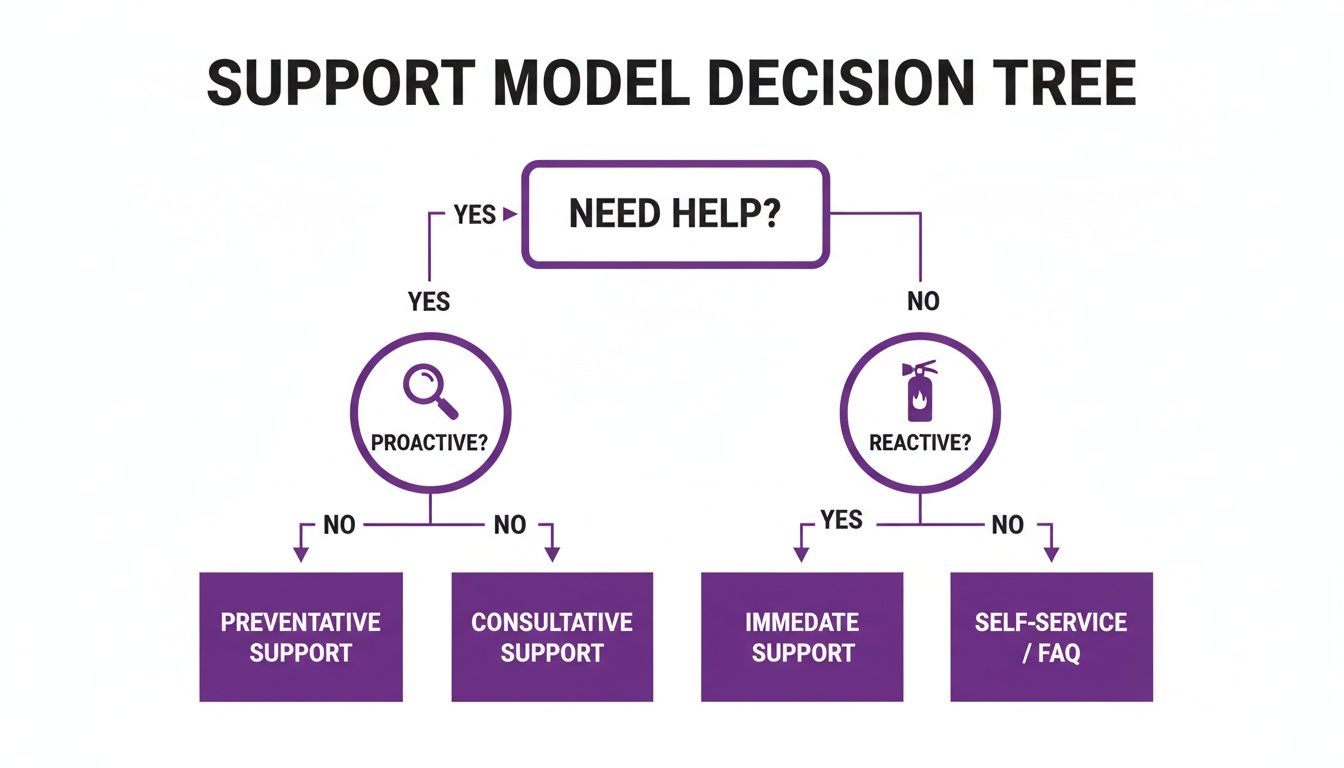
As the graphic shows, a core consideration is whether you need a proactive partner who helps you stay ahead of issues, or a more reactive one who is there to fix problems as they pop up.
Ultimately, this whole process is about finding a Dynamics 365 partner in the UK that embodies excellence. For instance, ANS has firmly established its leadership in the UK by winning the Microsoft UK Partner of the Year 2025 award, hot on the heels of their UK Services Partner of the Year 2024 win. This kind of consistent recognition highlights their critical role in guiding UK businesses through digital projects, especially now that over 70% of enterprises are prioritising cloud solutions for greater resilience. By using a structured checklist and knowing the signs of a quality partner, you can make your choice with total confidence.
Ready to take the next step with a trusted, local expert? Call us on 0845 855 0000 or Send us a message to start the conversation.
Ready to Find Your Perfect Dynamics 365 Partner?
Choosing the right Dynamics 365 partner isn’t just a project decision; it’s a long-term investment in your company’s future. Getting it right sets the stage for growth and efficiency for years to come. Hopefully, this guide has given you a solid framework for navigating the UK market, asking the tough questions, and evaluating potential partners with real confidence.
Remember, this is about finding a genuine partner, not just a supplier. The goal is a collaborative relationship built on trust and shared success.
Now it’s time to put what you’ve learned into practice. Start those conversations, use the evaluation tools, and take that crucial first step. If you’d like to see what a dedicated, experienced UK-based team can bring to the table, we’re here to help.
Give us a call on 0845 855 0000 or Send us a message to get started.
Got Questions? We’ve Got Answers
Stepping into the world of Dynamics 365 is a big move, and it’s only natural to have a lot of questions. We get it. Choosing a long-term partner is a major decision, so here are some straight answers to the most common queries we hear from UK businesses just like yours.
What’s the Real Cost of a Dynamics 365 Implementation in the UK?
There’s no one-size-fits-all price tag, and anyone who tells you otherwise isn’t being straight with you. The cost really boils down to your specific needs – the project’s scope, its complexity, and how many people will be using the system.
A smaller business getting started with Dynamics 365 Business Central might see initial project costs starting from £15,000 to £30,000. For a mid-sized company needing more complex modules like Finance or Sales, you’re more likely looking at a range of £50,000 to over £250,000. That investment typically covers everything from initial discovery and setup to migrating your data, training your team, and providing support right after you go live.
Our advice? Always ask for a detailed, itemised quote. Real transparency is non-negotiable. If a potential partner gives you a single, vague number, it’s often a red flag for hidden costs down the line.
How Long Does a Dynamics 365 Project Actually Take?
The timeline is tied directly to how much work is involved. A clean, straightforward Business Central rollout for a smaller team can be up and running in as little as 3 to 6 months.
However, if you’re undertaking a major ERP implementation or a project involving multiple CRM modules, you need to be realistic. These more complex jobs can take anywhere from 9 to 18 months to get right. A good partner will lay out a clear project plan with sensible phases and milestones you can track. It’s also worth remembering that things on your end, like the state of your existing data and how much time your key people can commit, will have a big impact on the final timeline.
Should We Go with a Big National Partner or a Smaller Local One?
This is the classic debate, and honestly, both have their merits. The big national players usually have a huge team of consultants and a lot of experience with massive, multi-site projects.
On the other hand, a smaller, local partner often delivers a much more personal and agile service. They tend to have a better feel for the local business landscape – here in the East Midlands, that kind of insight can be a real advantage. The right choice isn’t about size; it’s about fit. Look for a partner who genuinely understands your industry and can provide responsive, hands-on support when you need it.
What Happens If the Project Goes Over Budget or Off Schedule?
This is a critical question to ask any potential partner right at the start. Any partner worth their salt will have a rock-solid change control process clearly written into their statement of work.
This process should spell out exactly how any changes to the project scope are handled: how they’re requested, how their impact on cost and timing is assessed, and how they’re formally signed off before any work starts. You want a partner who prioritises open communication and regular progress meetings. That’s how you manage risk and avoid nasty surprises.
Ready to get clear, straightforward answers about your own Dynamics 365 project? Talk to the experts at F1Group.
Phone 0845 855 0000 today or Send us a message.