
Boosting productivity isn’t about getting people to work harder. That’s an old-school mindset that just leads to burnout. The real secret is helping your team work smarter. To do that, you need a strategy that brings together your people, your processes, and your technology. This guide is all about giving UK businesses a practical, no-nonsense framework to get the balance right when it comes to workplace productivity and how you can apply it to your workplace.
Why True Productivity is More Than Just Hustle
For years, productivity was measured by the number of hours someone sat at their desk. We all know now that’s a flawed model. Real productivity is about creating an environment where efficiency feels natural, not forced.
It’s about getting rid of the daily frustrations that slow people down, giving them the right tools for the job, and designing workflows that actually help them succeed.
For small and mid-sized businesses, this is absolutely crucial. You can’t afford to invest in fancy software that no one uses properly, nor can you let a great team be held back by clunky, outdated processes. The goal is to see productivity as the result of a healthy, well-oiled operational machine.
The 3 Pillars of a High-Performing Workplace
If you want sustainable growth, you have to focus on three things at once. When they work together, they create a powerful engine for your business. But if you neglect one, it will drag the other two down with it, leading to wasted money and frustrated staff.
A truly productive workplace is one where people feel empowered by their tools and supported by clear processes. It’s the synergy between your team, your methods, and your technology that unlocks genuine efficiency.
The three pillars are People, Processes, and Technology. Think of it as a natural flow.
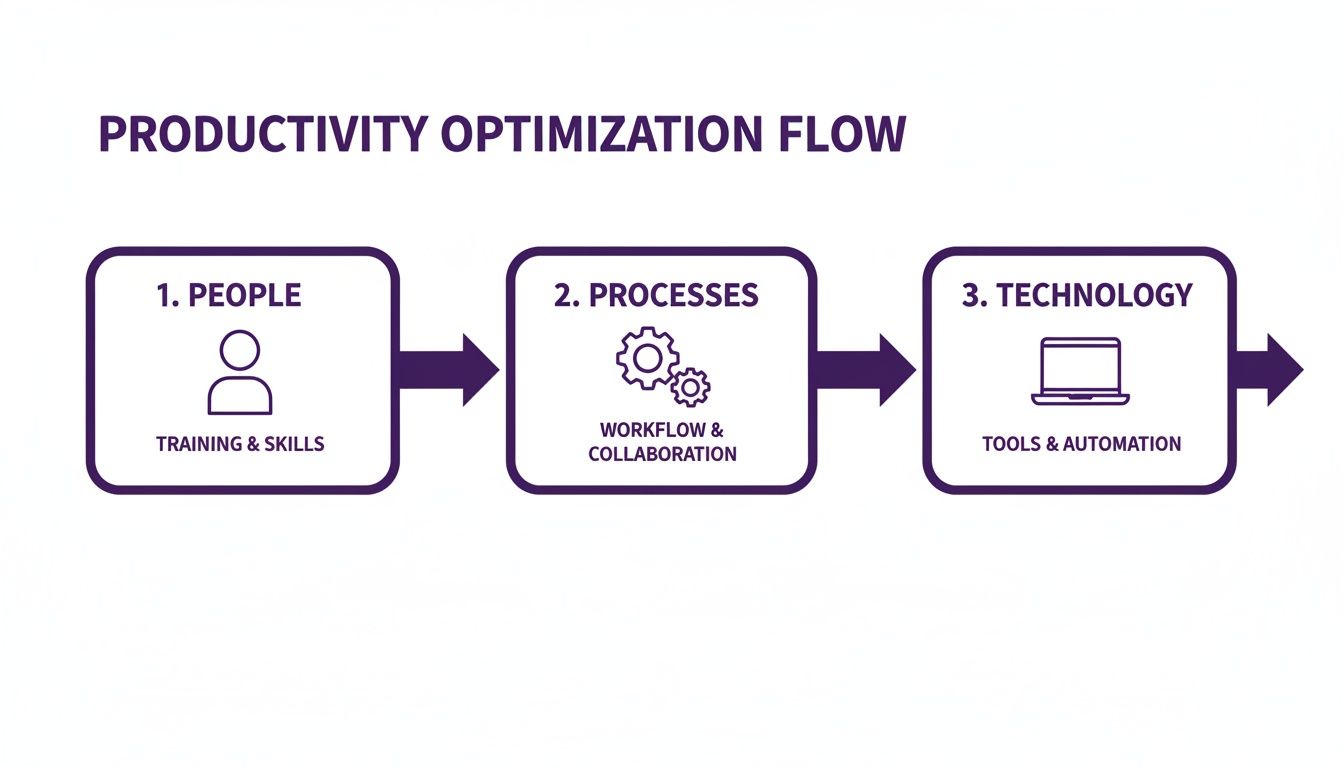
It all starts with your people. When they’re supported, you can refine your processes. And with solid processes in place, you can bring in the right technology to supercharge everything.
What This Guide Will Show You
We’re going to get straight into practical, real-world strategies you can use to lift performance across your entire organisation. This isn’t about high-level theory; it’s about actionable steps for UK businesses.
Here’s a glimpse of what you’ll learn:
- How to build a culture of well-being and trust that has a direct impact on output.
- Ways to streamline your core operations by finding and fixing the hidden bottlenecks that drain time and energy.
- How to make smart tech investments in platforms like Microsoft 365, Copilot AI, and Azure to solve actual business problems.
By the end, you’ll have a clear plan for how to improve workplace productivity from every angle, giving you a serious competitive edge.
Ready to get started? To talk about IT solutions that fit your business goals, give us a call on 0845 855 0000 today or send us a message.
Building a Culture That Champions Productivity
You can have the slickest processes and the latest tech, but they’ll fall flat without the right culture. At the end of the day, your team is your biggest asset, and their well-being is directly tied to their output. A culture built on support, trust, and clear communication isn’t a “nice-to-have”—it’s the foundation of a truly productive organisation.
When people feel valued and psychologically safe, they’re more engaged, more innovative, and more committed. This isn’t about beanbags and free fruit; it’s about fundamentally reshaping how your business supports its people. The aim is to create an environment where productivity happens naturally, not because it’s demanded, but because everyone is empowered to do their best work.

Embrace Flexible Working That Actually Works
Let’s be honest, the rigid 9-to-5, five-day week is an outdated model for many businesses. Offering genuine flexibility is one of the most powerful levers you can pull to boost both morale and efficiency. When you give employees more control over their schedules, they can strike a healthier work-life balance, which we all know is a proven antidote to stress and burnout.
It’s not just a theory. A high-profile UK trial of the four-day week found that 71% of employees reported lower levels of burnout and 39% felt less stressed. The best part? Productivity held firm, and in some cases, even improved. This led to around nine in ten participating employers sticking with the new model.
This isn’t a risk; it’s a strategic advantage. It proves you value your team’s well-being and trust them to get the job done.
Fight Burnout and Prioritise Well-being
Burnout is the silent killer of productivity. An overwhelmed, stressed, and exhausted team simply cannot perform at its best. Creating a supportive environment means being proactive, not reactive, about mental and emotional well-being.
You don’t need a huge budget to make a real difference. It starts with simple, consistent actions:
- Encourage Proper Breaks: Actually champion taking a full lunch break away from the desk. Lead by example and discourage that “always-on” culture where emails are flying at 10 pm.
- Set Realistic Workloads: Keep a pulse on your team’s capacity. Regular check-ins can stop workloads from spiralling into something unmanageable, which is a fast track to burnout.
- Provide Mental Health Resources: Make it clear that it’s okay not to be okay. Whether it’s access to support services or just fostering a culture where mental health can be discussed openly, it matters.
A healthy team is a productive team. Investing in your employees’ well-being isn’t just a compassionate choice; it’s one of the smartest business decisions you can make. It fosters loyalty, reduces absenteeism, and directly fuels higher-quality work.
Build Strong Feedback and Recognition Loops
People need to know where they stand. More importantly, they need to feel that their hard work is actually seen and valued. This is where continuous feedback and meaningful recognition come in.
Forget the stuffy annual performance review. Think instead about creating systems for ongoing dialogue and appreciation.
- Regular Check-ins: I’m talking about frequent, informal one-to-ones. These should be two-way conversations focused on progress, roadblocks, and career development, not just a list of tasks.
- Peer-to-Peer Recognition: Encourage colleagues to celebrate each other’s wins. It builds brilliant camaraderie and makes sure that great work is acknowledged, no matter who did it.
- Clear Communication Channels: Ensure everyone understands the company’s goals and how their role fits into the bigger picture. Tools within Microsoft 365 can be great for this, keeping everyone connected. Platforms like Microsoft Viva are even designed specifically to improve the employee experience and foster that sense of connection.
When you create a culture where feedback is a gift and recognition is a regular habit, you start a powerful positive cycle. People feel more engaged, they know how to improve, and they’re genuinely motivated to help the business succeed.
Streamlining Operations to Eliminate Bottlenecks
Inefficient processes are the invisible friction slowing your business down. They’re the real culprits behind missed deadlines, frustrated teams, and wasted money. To really boost workplace productivity, you have to look beyond how individuals are performing and start questioning the very systems your team relies on every day.
By rooting out and fixing these operational bottlenecks, you free up your people to focus on what actually matters: high-value, strategic work.
Often, the hardest part is just admitting a process is broken. So many businesses get stuck in a rut, using clunky, manual workflows simply because “that’s how we’ve always done it.” This kind of inertia is a massive drain on efficiency. A simple, regular process audit can uncover some surprising sticking points.

Mapping Your Workflows to Find the Friction
You can’t fix a problem until you can see it clearly. This is where workflow mapping comes in. It’s simply the act of visually charting a process from its start to its finish. The exercise is brilliant for getting everyone in a room to understand how work actually gets done, not just how it’s supposed to get done.
Pick a common process that you know causes headaches—client onboarding or invoice approvals are classic examples. Get your team to walk through every single step, decision point, and handover. The redundancies and delays will quickly become obvious.
Keep an eye out for these common culprits:
- Too many handoffs: Does a simple request really need to be approved by four different people? Every handover is a potential delay.
- Manual data entry: Is your team still spending hours copying and pasting information between spreadsheets and other systems? This is a huge red flag and a prime candidate for automation.
- Information silos: Do people have to dig through countless folders, email chains, and apps just to find what they need? Getting your data into one central place is crucial.
Once you’ve pinpointed these friction points, you can start designing smarter, more direct ways of working that save time and cut down on mistakes.
Automating the Repetitive to Unleash Potential
Some of the biggest wins in productivity come from automating the repetitive, low-value admin tasks that eat up the day. Think about all the time spent chasing approvals, sending reminder emails, or pulling together standard reports. This grind consumes a shocking amount of time and mental energy that your team could be using for creative problem-solving or looking after clients.
This is where tools like the Microsoft Power Platform can be a game-changer. It gives you the ability to build simple, automated workflows without needing to be a coding expert. For instance, you could set up a flow that automatically saves email attachments to a specific SharePoint folder or pings someone in Teams when a new lead is added to your CRM.
By automating routine admin, you’re not just saving time—you’re elevating your team’s entire role. You’re shifting their focus from tedious box-ticking to tasks that demand human insight, creativity, and strategy. That’s what drives real business growth.
Taking the time to understand what business process automation is can reveal a whole new world of efficiency for every single department, from finance to marketing.
The Compounding Power of Small Changes
Streamlining your operations doesn’t have to mean a massive, disruptive overhaul. More often, it’s a series of small, smart changes that create a powerful compounding effect on your team’s efficiency. These little tweaks reduce the daily friction and add up to huge time savings over weeks and months.
Think about these practical examples:
- Standardised Project Management: Instead of each team using their own method, get everyone onto a single platform like Microsoft Planner. It creates one source of truth, making it clear who’s doing what and by when. The number of follow-up emails will plummet.
- Shared Document Templates: Create a set of official templates in SharePoint for things like proposals, reports, and presentations. This saves everyone from reinventing the wheel, ensures consistency, and makes your brand look more professional.
- Centralised Communication Channels: For each project, set up a dedicated channel in Microsoft Teams. This stops vital information from getting buried in endless email threads and keeps all project-related chat in one easy-to-find place.
On its own, each of these changes might only save an employee a few minutes a day. But roll them out across the whole organisation, and you’re suddenly reclaiming hundreds of hours for more important work.
Making Smart Technology Investments for Growth
Your technology should be a growth engine, not a handbrake. Once you’ve focused on your people and fine-tuned your processes, the final piece of the productivity puzzle is making smart IT investments that will genuinely support your business for the long haul. This isn’t about jumping on every new tech trend; it’s about strategically choosing tools that solve real problems and deliver a clear return.
The best technology should feel almost invisible, seamlessly connecting your team and making their day-to-day work simpler. For most small and mid-sized organisations I work with, the Microsoft 365 ecosystem is a powerful, integrated solution that does exactly that. It pulls essential functions into one place, breaking down the frustrating information silos that kill momentum.
Take a look at how the Microsoft 365 suite brings everything together under one roof.

It’s this kind of integrated platform that shows how everything from communication to document management can operate from a single, unified environment.
Centralising Work with the Microsoft 365 Ecosystem
Having your work scattered across dozens of different apps is a recipe for chaos. When conversations are happening in one tool, files are stored in another, and project plans live somewhere else entirely, your team wastes precious time just trying to connect the dots. The real magic of Microsoft 365 is how it brings all of this together.
Think about how these tools work in harmony:
- Microsoft Teams: This becomes the central hub for team communication. Instead of getting buried in email chains, project discussions happen in dedicated channels where every relevant file and note is right there.
- SharePoint: This is your intelligent company library. It provides a secure, shared space for all company documents, making sure everyone is always working from the latest version. No more “final_v2_final”.
- Planner: Built right into Teams, Planner offers a simple, visual way to organise teamwork. You can assign tasks, set deadlines, and see progress at a glance without ever having to switch apps.
This unified approach removes so much friction from daily workflows. A team member can join a video call in Teams, co-author a report stored in SharePoint, and update their to-do list in Planner—all from one connected experience. You can even take it a step further; learning what is Power Platform can open your eyes to building custom apps and automating repetitive tasks right inside these tools.
Putting AI to Work with Microsoft Copilot
Artificial intelligence isn’t some far-off concept anymore; it’s a practical tool that can give your team back its most valuable asset: time. Microsoft Copilot is a fantastic example of AI embedded directly into the apps your team already uses every single day, acting as an intelligent assistant to handle the grunt work.
So much of the working week is spent on ‘work about work’—summarising meetings, drafting emails, and hunting for information. Research actually shows that employees using generative AI at work save an average of 5.4% of their work hours. For someone on a 40-hour week, that’s over two hours back in their pocket for more meaningful, strategic activities.
Copilot isn’t about replacing people; it’s about augmenting their abilities. It frees them from the repetitive, administrative grind, allowing them to focus on the creative, high-impact work that truly drives the business forward.
Imagine what your team could do if Copilot handled tasks like these:
- Summarising long meetings and email threads to get someone up to speed in minutes.
- Accelerating content creation by drafting first-pass proposals, reports, or marketing copy from a few simple prompts.
- Assisting with data analysis in Excel by spotting trends and creating charts automatically.
Ensuring Security and Scalability with the Cloud
As your business grows, your technology must be able to keep up. On-premise servers and old-school systems are often expensive to maintain, a nightmare to scale, and a huge security risk. This is where moving to cloud solutions like Microsoft Azure gives you a massive advantage.
Shifting your infrastructure to Azure delivers immediate benefits for both productivity and peace of mind. First, you get enterprise-grade security, protecting your sensitive data from constantly evolving cyber threats. Second, it offers incredible scalability. You can easily dial your computing resources up or down as your needs change, paying only for what you actually use. This kind of flexibility ensures your technology never becomes a bottleneck to growth.
By investing in a secure, scalable cloud foundation, you’re not just improving today’s productivity—you’re future-proofing your business for whatever comes next.
To discuss how the right technology investments can transform your business, Phone 0845 855 0000 today or Send us a message.
How to Measure Success and Drive Improvement
You’ve put new strategies in place to boost productivity, which is a fantastic start. But how can you be sure they’re actually moving the needle? It comes down to a simple truth: you can’t improve what you don’t measure. To make your efforts stick and create a cycle of real growth, you need to get smart about tracking your progress.
This isn’t about micromanaging or timing every single task. It’s about zeroing in on the Key Performance Indicators (KPIs) that truly reflect efficiency. These metrics give you the hard data needed to make informed decisions, rather than just guessing what’s working.
Moving Beyond Superficial Metrics
It’s all too easy to get caught up in vanity metrics, like the number of hours someone has logged. But real productivity is about output and results, not just looking busy. The best KPIs are the ones tied directly to your core business goals, giving you a clear, honest picture of performance.
A huge part of this is mastering operational efficiency metrics, which helps you track what matters and confirm your strategies are paying off.
Here are a few meaningful metrics I’ve seen work wonders for small and mid-sized businesses:
- Project Completion Rates: Are you hitting deadlines and staying within budget? A steady increase here is a brilliant sign that your process improvements are taking hold.
- Task Turnaround Times: How long does a typical task take from start to finish? If you can shorten this, you’ve likely found and fixed a bottleneck.
- Employee Satisfaction & Engagement Scores: Let’s be honest, happy and engaged teams get more done. Simple pulse surveys are great for this. A dip in morale can be an early warning sign of process friction or impending burnout.
- Client Satisfaction Scores (CSAT): For any client-facing team, this is non-negotiable. Your internal efficiencies should ultimately translate into a better, faster, and more reliable service for your customers.
Creating Dashboards for Clear Visibility
Collecting data is one thing, but it’s useless if it’s just sitting in a forgotten spreadsheet. You need to make it visible and easy for everyone to digest. This is where simple, visual dashboards come into play, and you probably already have the tools to build them.
With something like Microsoft Power BI, you can pull data from all your different systems—your project management tool, CRM, finance software—and display it all in one place. Suddenly, you have a live, at-a-glance overview of your most important productivity metrics.
A good dashboard tells a story. It should clearly show where you are, where you’ve been, and where you’re heading. This visibility empowers your team leaders to spot trends, celebrate wins, and address issues before they become major problems.
By making this information accessible, you build a culture of transparency and shared ownership. When your teams can see the direct impact of their work on the company’s bigger picture, it becomes a powerful motivator.
The UK Productivity Picture and Continuous Investment
Looking at the national picture really drives home why this matters. The Office for National Statistics pegs the UK’s output per hour worked at around £46.92. But this average hides a lot of variation, and many experts point to a real fiscal cost linked to these productivity gaps.
One of the most telling statistics is that UK investment in employee training is roughly half the EU average. This points to a clear conclusion: sustained investment in both skills and the right tools is absolutely essential for lifting performance. You can dig deeper into these UK productivity statistics yourself.
This data really reinforces a critical point: improving workplace productivity isn’t a one-and-done project. It’s an ongoing business cycle. The insights you get from your KPIs should directly feed into your next set of actions.
For example:
- If task turnaround times are still lagging despite a new process, maybe more training is needed on a specific software tool.
- If engagement scores drop after a change, it’s a clear signal to gather feedback and perhaps tweak your approach.
By letting data guide your decisions, you shift from guesswork to a strategic, iterative process of improvement. You end up investing your time and money in the areas that will have the biggest impact, ensuring your efforts across people, process, and technology deliver a real, measurable return. This data-informed loop is the engine that drives sustainable growth.
Ready to transform your productivity with data-driven IT solutions? Phone 0845 855 0000 today or Send us a message.
So, What’s Your Next Move?
Rethinking how your business approaches productivity isn’t a project you tick off a list; it’s an ongoing journey. The real magic happens when you start weaving your people, processes, and technology into a single, cohesive strategy.
This means building a culture where your team feels supported and empowered. It means smoothing out those clunky workflows that cause daily friction. And yes, it means investing in the right tech to help you get ahead. Even small, practical tweaks to your physical space can make a surprising difference, as this handy guide on 5 things to change about your office for better productivity points out.
Let’s be honest, figuring out the technical side of things can feel like a huge task. That’s where a good managed IT partner comes in. We can take the complexity out of implementing tools like Microsoft 365 and give your team the expert back-up they need to thrive.
When you look at the bigger picture and connect all the dots, you create a powerful engine for efficiency and growth that keeps on running. This is how you unlock what your team is truly capable of and build a more resilient, successful business for the long haul.
Ready to make it happen? Give us a call on 0845 855 0000 or Send us a message to chat about the right IT solutions for your business.
Frequently Asked Questions
As you start thinking about how to improve productivity, a few common questions always seem to pop up. Here are some straightforward answers to help you focus your efforts where they’ll make the biggest difference.
What Is the Fastest Way to Improve Productivity?
Look for the biggest bottleneck. The quickest wins always come from zeroing in on a single, frustrating part of your daily operations and fixing it. You don’t need a massive project; small, targeted changes often pack the biggest punch.
For instance, think about that one repetitive admin task everyone hates doing. Could you automate it? That’s an instant win. Another simple but effective move is to clarify how your team communicates. Setting up a project board in Microsoft Planner immediately centralises tasks, cuts down on confusing email chains, and saves everyone a ton of time.
The fastest route to better productivity is often hidden in your team’s biggest frustrations. Just ask them, “What one thing slows you down every day?” Their answer will likely point you to a simple process or communication gap you can fix right away.
How Does Technology Help with Productivity?
Technology is a brilliant accelerator, but only if you use it with a clear purpose. It works best when it automates tedious manual work, makes it easier for people to collaborate, and gives you real data to make smarter decisions.
Think about it this way: creating a shared workspace in Microsoft Teams puts an end to the frustrating hunt for the latest version of a file. All the conversations, documents, and plans are right there in one place. Or consider an AI tool like Copilot, which can draft an email or summarise a long report in seconds, freeing your team up for the kind of strategic thinking that actually adds value.
Can Flexible Working Actually Increase Productivity?
Yes, for many roles, it absolutely can. The old-fashioned idea that everyone needs to be in the same room from 9-to-5 to be productive is well and truly outdated. Major UK pilot schemes have shown that giving people more control over where and when they work significantly reduces burnout.
When your team feels trusted and has a healthier work-life balance, they’re naturally more engaged and motivated during their working hours. It turns out that giving people autonomy is a powerful driver of performance, often leading to the same—or even better—results.
How Do I Measure If Productivity Is Actually Improving?
You need to shift your focus from tracking hours to measuring outcomes. Real productivity is about the results you achieve, not just the activity you can see.
The best way to do this is by tracking Key Performance Indicators (KPIs) that are directly tied to your business goals. Look at metrics like:
- Project completion rates: Are we finishing more projects on time and on budget?
- Client satisfaction scores: Are our internal improvements making customers happier?
- Revenue per employee: Is our newfound efficiency translating into real business growth?
- Time to complete key tasks: Are those process refinements actually making routine work faster?
By comparing these numbers before and after you introduce a change, you’ll get a clear, data-backed verdict on whether it’s working.
Ready to build a more efficient and resilient workplace? The expert team at F1Group is here to help you implement the right IT solutions to drive your business forward.
Phone 0845 855 0000 today or send us a message to start the conversation.