
Think of managed cloud computing services as having an expert crew on hand to run your company's digital engine room. Instead of your own team being stretched thin trying to handle server updates, security patches, and performance checks, you hand the keys over to a Managed Service Provider (MSP). They take on the full responsibility, making sure your cloud environment is secure, running smoothly, and always up to the task.
Understanding Managed Cloud Computing Services
Let’s use an analogy. Your digital infrastructure is like a commercial property. You could manage the security, maintenance, and utilities yourself, but that requires a lot of time, specialised knowledge, and constant attention. Or, you could hire a professional management company to handle it all. That frees you up to actually run your business. Managed cloud services work exactly like that, but for your digital world.
This is a strategic partnership, a world away from the DIY approach. When you manage your own cloud, your IT team is on the hook for everything—configuration, 24/7 monitoring, security updates, compliance, and every little hiccup. While that gives you absolute control, it can easily overwhelm a small or medium-sized business (SMB) team, pulling them away from projects that actually make money.
The Role of a Managed Service Provider
A good MSP isn't just a supplier; they become a true extension of your own team. They bring deep, specialised expertise and sophisticated tools to the table, taking care of the complex, day-to-day grind of managing cloud infrastructure. This gives you access to enterprise-level IT management without the hefty price tag of building a large in-house team.
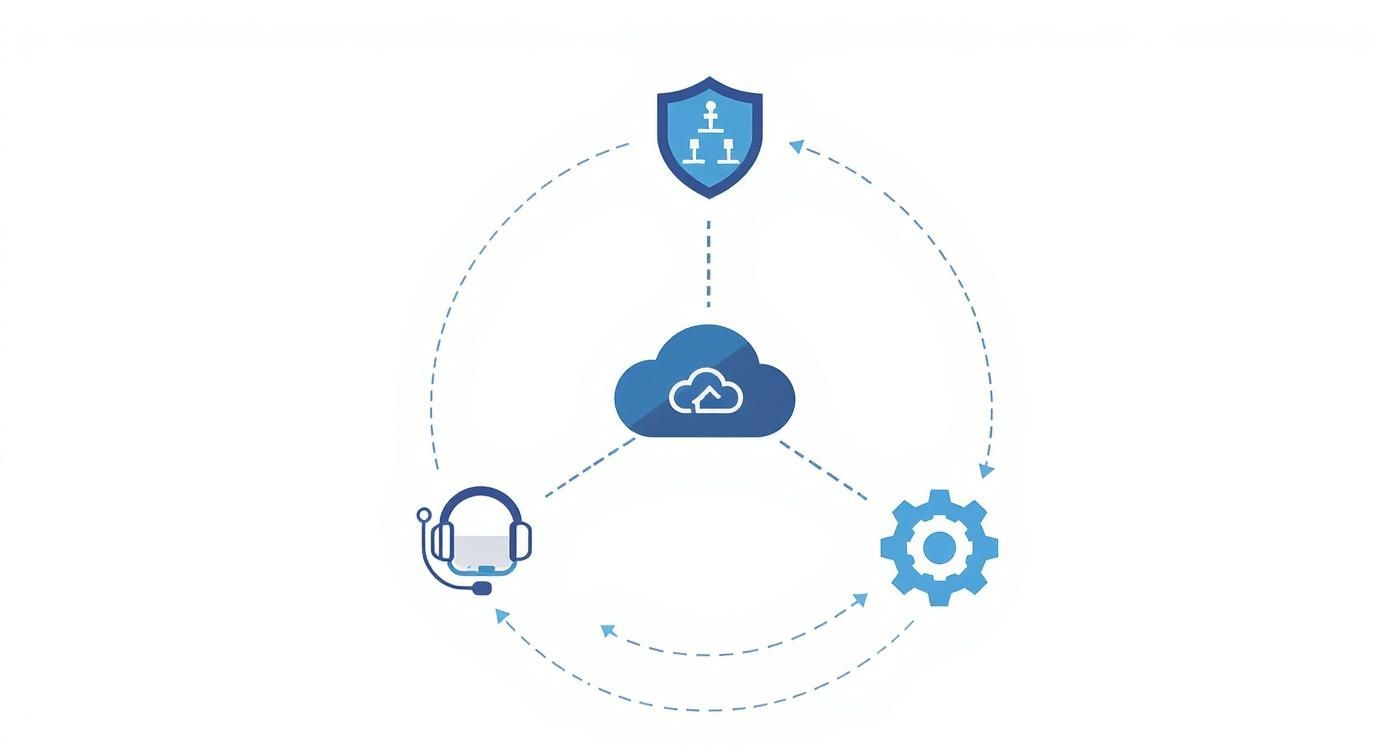
As you can see, a managed service isn't about one single task. It's a holistic approach designed to keep your digital operations safe, efficient, and well-supported from every angle.
Self-Managed Cloud vs Managed Cloud Services At a Glance
To make the distinction clearer, let's break down who does what in each scenario. This table gives you a side-by-side look at the responsibilities and realities of both approaches.
| Responsibility | Self-Managed Cloud (DIY) | Managed Cloud Services |
|---|---|---|
| Initial Setup & Configuration | Your in-house team plans and executes everything. | The MSP handles deployment, configuration, and optimisation for you. |
| 24/7 Monitoring & Alerts | Your team must set up and respond to alerts, even after hours. | The MSP provides round-the-clock monitoring and proactive response. |
| Security & Patching | You are solely responsible for identifying and applying all patches. | The MSP manages security updates, threat detection, and compliance. |
| Performance Optimisation | Requires constant internal analysis and adjustment. | The MSP continuously optimises for performance and cost-efficiency. |
| Disaster Recovery | Your team designs, tests, and executes the recovery plan. | The MSP provides managed backup and a robust disaster recovery plan. |
| Expertise & Skills | Relies entirely on the existing skills within your team. | You get immediate access to a team of certified cloud specialists. |
| Cost | High upfront and ongoing costs for staff, training, and tools. | Predictable monthly fee, converting capital expenses to operational ones. |
Ultimately, the choice comes down to where you want your team to focus their energy: on maintaining infrastructure or on driving business innovation.
Why UK Businesses Are Making the Switch
The move towards managed services is gathering serious momentum across the UK. In a competitive market, businesses need to be agile and secure, and this is a proven way to achieve both. If you want to dig deeper into the underlying technology, you can explore the various general cloud services that form the foundation of these solutions.
The numbers tell the story. The UK's cloud computing market hit a value of roughly £21.7 billion in 2024. Forecasts suggest it could soar to nearly £76.8 billion by 2033, a surge driven by digital transformation and the need for more flexible IT. This growth shows just how much UK organisations, from local SMBs to large enterprises, are relying on managed services to stay ahead.
A partnership with a managed service provider allows businesses to offload the technical burden of cloud management, transforming IT from a cost centre into a strategic enabler for business growth and innovation.
In the end, choosing managed cloud services is about making a smart decision to focus on what your business does best. Let the experts handle the complexities of cloud technology.
The Business Case for Managed Cloud Services
Let's move past the tech jargon for a moment. The real reason to consider managed cloud computing isn't about servers and software—it's about solid business outcomes. For small and medium-sized businesses here in the East Midlands, this is more than just an IT upgrade. It's a strategic shift that has a direct, positive impact on your financial health, your security, and your ability to grow.
The true value is found in how these services solve the real-world challenges your business faces every day.

Perhaps the most powerful argument is how it changes the way you budget for IT. Imagine moving away from massive, unpredictable hardware bills to a simple, predictable monthly cost. This fundamentally improves how you manage your money and plan for the future.
From Unpredictable CapEx to Predictable OpEx
Traditionally, running your own IT meant huge upfront investments. You'd shell out thousands for servers, storage, and networking gear—a major capital expenditure (CapEx). Then came the endless cycle of costly maintenance and eventual replacement. This old model creates financial headaches and makes budgeting a frustrating, reactive guessing game.
Managed cloud services completely flip that script. Instead of buying expensive equipment that loses value every year, you pay a consistent monthly fee for the exact computing power and expert support you need. This operational expenditure (OpEx) model gives you some serious advantages:
- Better Cash Flow: It frees up a significant amount of capital. That's money you can put back into what really matters—developing new products, ramping up your marketing, or hiring key people.
- Simpler Budgeting: A predictable monthly cost means no more nasty surprises. Financial planning becomes far more accurate, and you can say goodbye to emergency spends when a server inevitably fails.
- Scale at a Moment's Notice: Need more power for a busy period? Or need to scale back? You can adjust your resources almost instantly, ensuring you only ever pay for what you actually use. No more overspending on hardware "just in case".
This kind of financial agility is a game-changer. It allows your business to jump on new opportunities without being held back by a rigid and outdated IT budget.
Enhancing Security and Compliance
With cyber threats becoming more sophisticated by the day, robust security is no longer an optional extra—it's essential for survival. A single data breach can cause devastating financial losses, ruin your reputation, and lead to heavy regulatory fines. For most SMBs, trying to build and maintain an enterprise-grade security defence in-house is simply too expensive and complex.
Working with a managed service provider gives you immediate access to a team of security specialists. These are people who live and breathe threat detection and prevention. They put multi-layered security protocols in place, provide 24/7 monitoring, and make sure your systems are constantly updated to protect against the latest threats. This expert oversight is crucial for meeting tough compliance standards like GDPR, safeguarding your data and earning your customers' trust.
Liberating Your Internal IT Talent
Think about your in-house IT team. They have invaluable knowledge of your business operations and strategic goals. Too often, though, their days are consumed by routine maintenance and putting out fires—tasks that keep the lights on but do little to move the business forward.
When you outsource the day-to-day management of your cloud infrastructure, you empower your internal team. They can finally shift from a reactive, break-fix role to a proactive, strategic one. This frees them up to focus on innovation, improving processes, and using technology to give you a genuine competitive edge.
This trend is playing out across the UK's cloud market. While Software as a Service (SaaS) accounted for about 65.75% of the £37.3 billion UK market in 2024, the fastest-growing area is Infrastructure as a Service (IaaS)—the very foundation of managed services. Forecasts predict an 18.4% compound annual growth rate from 2025 to 2030, driven by businesses wanting to bolster security and get their costs under control. You can dig into the numbers in the UK cloud computing market report.
Ultimately, when you partner with a managed cloud provider, you're not just buying technology. You're investing in financial predictability, stronger security, and the untapped potential of your own team.
Ready to explore how a managed cloud strategy could benefit your business? Phone 0845 855 0000 today or Send us a message to schedule a consultation with our team.
Your Guide to Microsoft Azure, with a Managed Partner in the Driving Seat
For many UK businesses, Microsoft Azure feels like a huge landscape of untapped potential. It's so much more than just a place to store files in the cloud; it's a platform with enough power to run your entire operation. But having access to Azure is a bit like being handed the keys to a high-performance race car without any driving lessons. To really get the most out of it, you need a skilled co-pilot.
This is precisely where a managed partner comes in, transforming your Azure investment from a simple utility bill into a genuine strategic asset for your business.
https://www.youtube.com/embed/7W58YbE1B-o
For most companies, the real magic of Azure lies in how beautifully it works with the rest of the Microsoft ecosystem. Think about it – your team is already using Microsoft 365, Teams, and maybe even Dynamics 365 every single day. A good managed partner knows exactly how to weave these familiar tools together with Azure's powerful services, creating a single, seamless digital workplace. They don't just fix things when they break; they design solutions built specifically around your business goals.
Turning Cloud Concepts into Concrete Solutions
A managed partner’s job is to translate all of Azure's impressive capabilities into practical, real-world solutions that solve your day-to-day business headaches. They move beyond basic IT support to actively design and implement services that deliver real, measurable value.
Here are a few ways a partner brings Azure to life for a business like yours:
- Azure Virtual Desktop (AVD): If your team embraces flexible or remote working, AVD is a total game-changer. A partner can set up a secure and scalable virtual desktop environment, allowing your staff to access their work computer from any device, anywhere in the world. All this happens without ever compromising on security or performance, making life easier for IT and ensuring you can keep operating no matter what.
- Azure Backup and Site Recovery: Let's be honest, downtime is a disaster you can't afford. A partner will use Azure to build a rock-solid backup and disaster recovery plan. They’ll make sure your critical data is securely backed up and can be restored in a flash if the worst happens. It’s about airtight business continuity and, frankly, a lot more peace of mind.
- Modernising Your Infrastructure: Are you still relying on ageing servers tucked away in a cupboard? Many businesses are. A partner can map out a smooth migration to Azure, shifting your applications and data onto a more reliable, scalable, and cost-effective cloud infrastructure. This isn't a rushed 'lift-and-shift'; it's a carefully planned project designed to cause minimal disruption.
Building a Foundation for Growth and Efficiency
Perhaps the greatest value a managed partner brings to the table is strategic oversight. They don’t just get you set up and then disappear. Instead, they continually monitor, manage, and fine-tune your Azure environment to make sure you're always getting the best possible performance and value for money.
For any business looking to bring structure to this journey, understanding the migration process is key. You can get a deeper insight into this with our guide to the Azure Cloud Adoption Framework.
This strategic management covers everything from cost optimisation—where your partner analyses usage to cut out waste—to performance tuning and applying the latest security best practices. It's about keeping your environment running like a well-oiled machine.
Think of a managed partner as your expert guide, navigating the complexities of Azure to build a cloud environment that not only supports where you are today but also scales to meet your ambitions for tomorrow.
This kind of expert guidance is incredibly relevant right now. Hybrid cloud adoption is a major focus for UK businesses, with the market projected to grow at a compound rate of 20.0% annually. While the public cloud still accounts for a massive 70.20% share in 2024, many companies—especially those in regulated sectors like finance or healthcare—need to keep sensitive data on-premises.
A managed partner is perfectly placed to design a hybrid Azure solution that gives you the best of both worlds, balancing security, compliance, and scalability. It’s a trend we're seeing right across the country, from the financial hubs in London to the growing tech centres here in the East Midlands. To get the full picture, you can discover more about the UK's hybrid cloud landscape.
Ultimately, working with a managed service provider for Azure is about unlocking your true potential. It’s about taking a powerful but complex platform and turning it into a finely tuned engine for your business's success.
Ready to unlock the full potential of Microsoft Azure for your business? Phone 0845 855 0000 today or Send us a message to speak with one of our cloud experts.
Solving Cloud Security and Compliance Challenges
Let's be honest: for many businesses, the biggest thing holding them back from the cloud is a nagging fear about security. Handing over your critical data can feel like a huge leap of faith. But this worry often stems from a misunderstanding of how modern cloud security actually works. With the right managed cloud partner, your data isn't just as safe as it is on your own servers—it's often far more secure.
The key to getting your head around this is something called the 'shared responsibility model'. Think of it this way: the cloud provider (like Microsoft Azure) is responsible for the security of the cloud itself. That means the physical data centres, the core network, all the heavy-duty infrastructure. You, however, are responsible for security in the cloud—how you set up access, protect your files, and manage who can do what.
This is where things can go wrong if you're not careful, and it's where many businesses accidentally leave a door unlocked. A managed service provider (MSP) steps in to take ownership of your side of that bargain. They become your dedicated security expert, closing any gaps and building a proper digital fortress around your operations.
Building a Multi-Layered Defence
A good managed partner doesn't just install one piece of software and call it a day. Instead, they build layers of protection that work together to keep threats out. It’s a level of security that would be incredibly expensive and complicated for most SMBs to build and maintain themselves. This is where you see the real value of bringing in specialists.
So, what does this actually look like? Key security services usually include:
- 24/7 Threat Monitoring and Response: Your partner uses sophisticated tools to constantly watch for anything suspicious. If a potential threat pops up, their team jumps on it immediately—day or night—to shut it down before it can cause any real damage.
- Proactive Vulnerability Management: Hackers love to exploit known weaknesses in software. An MSP makes sure your systems are always patched and updated, systematically scanning for vulnerabilities and closing them off before they can be used against you.
- Robust Data Encryption: This is a big one. Your data is encrypted both when it’s just sitting there (at rest) and when it’s moving between systems (in transit). This means even if a cybercriminal somehow got their hands on it, the information would be completely unreadable and useless.
These services create the foundation of a genuinely strong security posture. To learn more about what goes into it, take a look at our detailed guide on cybersecurity managed services.
A partnership with a managed service provider transforms cloud security from a source of anxiety into a source of confidence. It provides access to enterprise-grade security tools and specialist expertise, giving you peace of mind that your most valuable asset—your data—is protected around the clock.
Navigating Complex Compliance Requirements
Security is only half the battle; compliance is the other. For any UK business, navigating regulations like the General Data Protection Regulation (GDPR) simply isn't optional. Getting it wrong can lead to eye-watering fines and serious damage to your reputation. The cloud, with its complexities, can make this challenge even trickier.
This is where a UK-based managed service provider becomes invaluable. They have a deep, practical understanding of local data sovereignty laws and precisely what's needed to meet GDPR standards. They’ll configure your cloud environment to ensure your data is stored and processed in a way that is fully compliant from day one.
This involves implementing strict access controls, maintaining clear audit trails, and making sure your data handling policies are correctly enforced within the cloud infrastructure. This expert guidance is crucial for proving due diligence to regulators and, just as importantly, for showing your customers you take their privacy seriously.
Ultimately, a managed partnership delivers a secure and compliant cloud environment without you having to become an expert in either. It frees you up to focus on what you do best, confident that all the technical complexities are being handled by people who live and breathe this stuff.
Ready to strengthen your cloud security and ensure compliance? Phone 0845 855 0000 today or Send us a message to speak with our specialists.
How Managed Cloud Pricing Models Work
Getting your head around cloud costs is one of the most important steps in making a smart investment. You need to know exactly what you’re paying for and why. Let's break down the common pricing models you'll come across, ditching the jargon for real-world examples in Pounds (£).
The aim here is simple: financial clarity. A good partner ensures there are no nasty surprises on your invoice, just predictable costs that match up with your business plan.

Pay-As-You-Go: The Flexible Option
The pay-as-you-go (PAYG) model is the most common starting point in the cloud. It works just like your electricity bill – you only pay for what you use. That usage could be measured by gigabytes of storage, the number of hours a server is running, or how much data you transfer.
This approach offers fantastic flexibility. It’s perfect for businesses whose needs change throughout the year or for those just dipping their toes into the cloud. For example, a retailer can automatically scale up server power for the Black Friday rush and then dial it right back down in January, only paying for that extra horsepower when it was actually needed.
Reserved Instances: The Commitment Model
If you have parts of your business that are always running, like a core database or a critical application server, reserved instances can save you a serious amount of money. With this model, you commit to using specific computing resources for a one or three-year term.
In exchange for that commitment, the cloud provider gives you a hefty discount on the standard PAYG rate. A business running its main server 24/7 could reserve that capacity for a year and potentially cut its computing costs by up to 40%. It’s a savvy move for the predictable, 'always-on' bits of your IT infrastructure.
Fixed-Fee Contracts: The All-Inclusive Approach
The "managed" part of the service is often covered by a fixed-fee or tiered pricing model from your Managed Service Provider (MSP). This single monthly fee bundles in all the expert support, proactive security monitoring, system maintenance, and strategic advice they provide.
This gives you a predictable, all-in cost for the day-to-day management of your cloud environment. No guesswork required.
A transparent managed service provider will blend these models to give you the best of both worlds. Your underlying cloud resources from Microsoft might be on a PAYG or reserved plan, while all the expert management and support you need is wrapped up in one simple, predictable fixed fee.
Watching for Hidden Costs
While cloud pricing is far more transparent than old-school IT, there are a few things to keep an eye on that can trip up the unwary. A good MSP will always highlight these and help you keep them under control.
Common areas to watch for include:
- Data Egress Fees: This is a charge for moving data out of the cloud. Uploading data is usually free, but downloading huge files or transferring data to another platform can come with a cost.
- API Requests: Some services charge based on how many times your applications 'talk' to each other via an API. For highly connected systems, this can add up.
- Premium Support: Your MSP contract covers their expert support, but if you need to escalate an issue directly to the vendor (like Microsoft), that can be an extra charge.
To illustrate how these costs might look for a typical small business in the UK, here’s a sample monthly breakdown.
Example Monthly Cloud Costs for a UK SMB
This table shows a sample monthly cost breakdown in GBP (£) for a small business using managed Azure services, highlighting how different components contribute to the total cost.
| Service Component | Example Specification | Estimated Monthly Cost (GBP) |
|---|---|---|
| Virtual Machines (Servers) | 2 x General Purpose VMs (Reserved Instance) | £150 |
| Cloud Storage | 1TB of SSD Storage for databases & files | £80 |
| Networking | VPN Gateway, 500GB Data Egress | £45 |
| Backup & Disaster Recovery | Daily backups with 30-day retention | £50 |
| Managed Service Fee | Proactive monitoring, support, security | £450 |
| Total Estimated Cost | Your Complete Managed Cloud Service | £775 |
A trustworthy partner won’t just send you a bill; they’ll provide detailed, itemised reports and actively work with you to optimise your spend. They should be analysing your usage and suggesting ways to save money—like shifting a PAYG server to a reserved instance—to ensure you’re always getting the best possible value.
Ready to gain clarity on your cloud costs? Phone 0845 855 0000 today or Send us a message to get a transparent quote tailored to your business needs.
Choosing the Right UK Managed Cloud Partner
Picking a partner for your managed cloud services isn't just another supplier decision—it's about forging a long-term strategic relationship. The right partner acts like an extension of your own team, genuinely invested in seeing your business thrive. To find that partner, you need to look past the glossy brochures and get down to the details that really make a difference.
This isn't a decision to rush. It's about taking a measured approach, asking the tough questions, and knowing what great looks like. A bit of structured thinking now will help you find a company that has the technical chops and, just as importantly, fits with your business culture and goals.
Verifying Technical Expertise and Certifications
First things first: you have to be confident they know what they're doing. Certifications are the easiest way to see if a provider has put in the hard work and had their skills validated by the people who make the technology.
When you're sizing up a potential partner, keep an eye out for credentials like these:
- Microsoft Partner Status: Look for official designations like Solutions Partner for Infrastructure (Azure) or Modern Work. This is your proof that they have a deep, Microsoft-verified grasp of the ecosystem.
- Individual Certifications: Don't be afraid to ask about the team's qualifications. Certs like Azure Administrator Associate or Azure Solutions Architect Expert show that the engineers have proven, hands-on skills.
- Vendor Relationships: A strong partnership with Microsoft means they get the inside track on updates and can escalate issues to a higher level of support when needed.
Think of these credentials as your insurance policy. They give you peace of mind that the people managing your most critical systems are genuinely up to the job.
Scrutinising Service Level Agreements
The Service Level Agreement, or SLA, is arguably the most critical document you'll sign. This is the contract that spells out exactly what level of service you can expect, and a vague or flimsy one should set off alarm bells.
A strong SLA provides concrete, measurable commitments. It moves beyond vague promises and gives you a clear framework for accountability, ensuring that your business operations are protected by guaranteed standards of service.
A solid SLA must clearly define:
- Guaranteed Uptime: You should be looking for a commitment of 99.9% or higher for anything critical. This number directly translates into how much potential downtime you can expect per year.
- Response and Resolution Times: How quickly will they jump on a problem, and how fast do they promise to fix it? These times should be clearly laid out and based on how severe the issue is.
- Support Availability: Make sure their support hours line up with your business needs. For critical systems, 24/7 support is non-negotiable.
For some more background, it can be useful to review general advice on choosing a Managed Service Provider to get a sense of industry standards. It helps ensure you're not missing any crucial details.
The Importance of Local Presence and Proven Success
Finally, never underestimate the power of a local partner, especially for businesses here in the East Midlands. A provider who understands the regional business climate and can be on-site when you really need them offers a level of reassurance you just can't get from a remote, faceless firm.
Ask to see UK-based case studies and testimonials, ideally from businesses like yours. A provider worth their salt will be proud to show off their track record. Hearing directly from other local companies gives you an unfiltered look at how they operate and whether they deliver on their promises. Exploring the different types of local managed services companies can also help you understand the options available right on your doorstep.
Choosing the right partner is the cornerstone of a successful cloud strategy. By taking the time to properly evaluate their technical skills, SLAs, and local reputation, you can build a partnership that delivers real, tangible value to your business.
Ready to find a trusted local partner for your managed cloud needs? Phone 0845 855 0000 today or Send us a message to speak with our team of certified experts.
So, What's Next on Your Cloud Journey?
We’ve covered a lot of ground in this guide, from how managed cloud services work to the real-world benefits for businesses right here in the East Midlands. The main point to take away is this: you don’t have to be a cloud expert to get the most out of it.
By partnering with the right team, you can lift the burden of day-to-day IT management from your shoulders. This frees up your own people to focus on what they do best—driving your business forward, innovating, and looking after your customers. It's less of an IT decision and more of a strategic business move.
Time to Put Your Plan into Action
Now’s the time to stop thinking and start doing. The first step is to take a good, honest look at your current IT setup. What are the persistent headaches? Maybe it’s the constant worry about cyber threats, the frustration of systems that can’t keep up, or the unpredictable IT bills that throw your budget off course.
Think about how handing those problems over to a specialist partner could solve them for good. You'd get the stability you need today and a clear, scalable path for whatever tomorrow brings.
When you switch to managed cloud services, your IT stops being a reactive cost and starts becoming a strategic asset. It’s what gives you the edge, makes your operations more resilient, and lets your team focus on high-impact work.
This is about more than just outsourcing. It’s about gaining a partner who’s genuinely invested in your success. You get a whole team of specialists on your side, bringing top-tier skills and tools that were once only available to the big players. It all starts with a simple conversation about where you are now and where you want to be.
The road to a more secure, efficient, and predictable IT environment is much clearer than you might imagine. Don’t let the technical details get in the way of your business goals.
Ready to see what a managed cloud strategy could look like for your business?
Give us a call on 0845 855 0000 or send us a message to arrange a chat with one of our team. No pressure, no obligation.
Frequently Asked Questions
When it comes to managed cloud services, a lot of questions come up. It's a big step for any business, so let's tackle some of the most common ones we hear from UK organisations to help you get a clearer picture.
Is My Business Too Small for Managed Cloud Services?
Absolutely not. In fact, you could argue that small and medium-sized businesses (SMBs) stand to gain the most. Managed cloud services level the playing field, giving you access to the kind of high-end IT infrastructure and expertise that was once only available to large enterprises.
Think of it this way: instead of a massive upfront cost for servers and hiring specialist staff, you get a tailored solution that fits your budget. A good Managed Service Provider (MSP) ensures you only pay for what you actually use, all while benefiting from top-tier security and support that would be incredibly difficult to manage on your own.
Will I Lose Control Over My IT Systems?
This is a common worry, but it's really a myth. A strong managed cloud partnership is just that—a partnership. It’s not about handing over the keys and walking away; it’s about collaboration. You always own your data and your applications.
Your MSP acts as an extension of your team, taking care of the day-to-day grind of management, security, and maintenance. You set the direction and the business goals, and they handle the technical execution. They'll keep you in the loop with clear reports, so you’re free to focus on your business, not firefighting IT issues.
What Does the Migration Process Look Like?
A professional managed cloud partner won’t just flip a switch. They'll walk you through a clear, structured migration process. It always starts with a discovery phase, where they get to know your current setup, your apps, and what your business really needs to function.
From there, they'll create a detailed migration plan designed to cause as little disruption as possible. The actual move is usually done in stages, often starting with less critical systems to ensure everything goes smoothly. Your provider manages all the technical heavy lifting, keeping you informed every step of the way and making sure your team is ready for the change.
How Do Managed Cloud Services Improve Security?
This is one of the biggest wins. Most SMBs can't afford a dedicated team of security specialists and the sophisticated tools they use. An MSP brings that expertise to the table. They build a defence-in-depth security strategy with things like 24/7 monitoring, proactive threat hunting, and regular security check-ups.
A key benefit is the implementation of robust identity and access management. MSPs also ensure your systems are consistently patched and updated against the latest threats. By leveraging their expertise and economies of scale, you gain a far more resilient and secure environment than is typically possible with an internal IT team alone.
Ready to take the next step towards a more secure and efficient IT strategy for your business? The expert team at F1Group is here to help.
Phone 0845 855 0000 today or Send us a message to schedule a no-obligation consultation.