
Picture your business's IT setup like a high-performance car. The old-school 'break-fix' way of doing things is like waiting for the engine to seize up on the M1 before you even think about calling a mechanic. In stark contrast, proactive IT support is the regular, scheduled maintenance that keeps the engine perfectly tuned, the oil topped up, and the tyres rotated. It’s all about preventing that motorway breakdown in the first place.
Moving From IT Firefighting To Future-Proofing
For far too long, many businesses across the UK have treated their IT support as an emergency service—something you only call when a critical system has already failed. This reactive model, often called 'break-fix', traps you in a stressful cycle of downtime, lost productivity, and sudden, hefty repair bills. It’s a strategy based entirely on waiting for disaster to strike, making your technology a source of anxiety instead of a tool for growth.
Thankfully, there's a major shift underway. Business owners are realising that constantly putting out IT fires isn't just inefficient; it’s a genuine risk to their stability and ability to compete. The alternative is a forward-thinking approach that changes IT management from a reactive headache into a strategic business asset. This is the core of proactive IT support.
The Core Pillars of Proactive IT
Rather than just fixing what's broken, a proactive strategy is all about stopping issues before they can ever affect your operations. This philosophy is built on three key pillars that work in tandem to create a robust and reliable technology foundation for your business.
- Continuous Monitoring: Think of this as your digital early-warning system. Specialised tools keep a constant, 24/7 watch over your servers, network, and devices. They're designed to spot the subtle signs of trouble—like a server running low on memory or unusual network activity—long before they snowball into a full-blown crisis.
- Preventative Maintenance: Just like servicing your car, this involves the regular, scheduled tasks of applying software updates, security patches, and system tune-ups. This digital housekeeping closes security gaps and keeps your systems running at their best, drastically reducing the risk of slowdowns or, worse, a security breach.
- Strategic Planning: A true proactive partner does more than just maintain what you already have; they help you plan for what's next. By getting to know your business goals, they can offer expert advice on technology investments, helping you choose the right tools to boost efficiency and stay ahead of the competition.
By building on these pillars, you step away from the chaotic and unpredictable nature of IT emergencies. Instead of just reacting to expensive disasters, you invest in the kind of stability and security that lets your business truly flourish, turning technology into a dependable engine for growth.
This strategic shift is about regaining control, building resilience, and making sure your technology is perfectly aligned with your business ambitions for the long haul.
Ready to move beyond reactive IT? Phone 0845 855 0000 today or send us a message to learn how we can help.
The Real Cost Of IT Downtime Vs Proactive Investment
When your systems go down, the clock starts ticking, and every second costs money. It's not just about the bill to fix the immediate problem; it's about lost sales, stalled projects, and staff who are being paid but can't work. Moving to proactive IT support isn't just another business expense. It's about swapping those unpredictable, often crippling emergency costs for a flat, manageable investment that actually protects your bottom line.
Many business owners get caught out by underestimating the true financial fallout from an IT failure. The focus tends to be on the repair bill, but the real damage is often hidden in lost productivity. That’s where the numbers tell a powerful story.
Recent industry analysis for 2024–2025 paints a very clear picture. The average UK employee loses 14.5 hours of productivity per year due to IT issues. For a business, this adds up to a staggering £1,075 in lost output per employee. The good news? Businesses that switched to a proactive, managed IT service slashed their downtime by 35% to 60%. This simple change led to direct annual savings of between £376 and £645 per employee.
Calculating The Hidden Costs
The cost of downtime is like an iceberg—what you see on the surface is only a fraction of the real danger. The true financial and reputational damage comes from a chain reaction that ripples through your entire business.
Think about these knock-on effects:
- Missed Opportunities: Your sales team can't access their CRM. Your website is offline. Every minute this happens, you are actively losing potential new business.
- Reputational Damage: Frequent outages or security breaches quickly erode the trust you've worked so hard to build with your customers.
- Data Recovery Expenses: A critical server failure or a ransomware attack can lead to eye-watering data recovery costs, often running into thousands of pounds.
- Supply Chain Disruption: If your systems fail, you can't place orders, track deliveries, or manage inventory, bringing your operations to a grinding halt.
These hidden costs are volatile and can strike without warning. That's why having a solid strategy in place is non-negotiable, something we cover in our guide to effective business disaster recovery.
This image really highlights the difference between the reactive "firefighting" approach and the protective shield that proactive management provides.
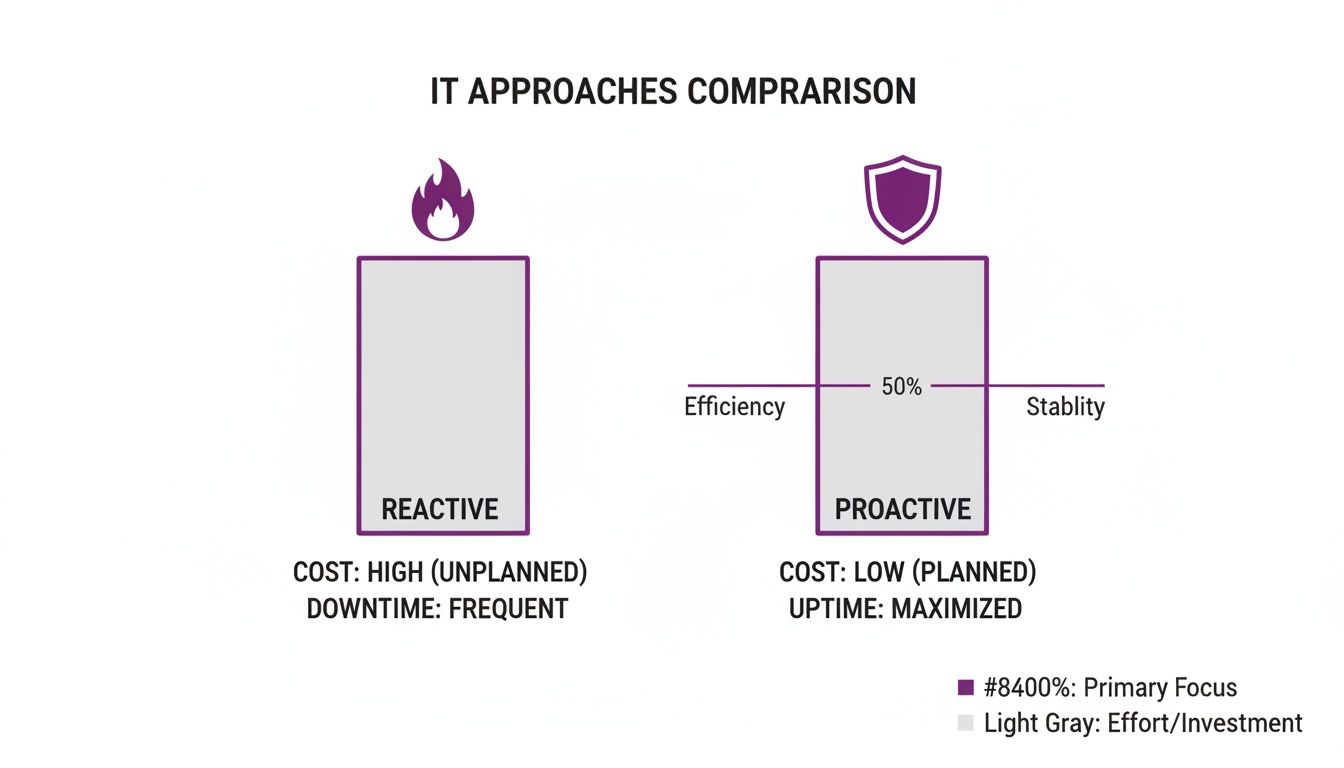
As you can see, proactive support transforms unpredictable costs and high downtime into stable, predictable outcomes with maximum uptime.
A Clear Financial Comparison
To bring this all to life, let’s crunch the numbers for a typical UK business with 30 employees. The table below lays out the predictable investment of a proactive plan against the volatile, and often much higher, costs of a reactive break-fix model.
Cost Comparison Proactive IT Support vs Reactive Break-Fix Model
| Cost Factor | Proactive Managed Support (Annual Estimate) | Reactive Break-Fix Support (Annual Estimate) |
|---|---|---|
| Managed Service Fee | £21,600 (based on £60/user/month) | £0 (no upfront fee) |
| Downtime Productivity Loss | £12,870 (assuming 40% reduction) | £32,250 (based on avg. 14.5 hrs) |
| Emergency Call-Out Fees | Included | £4,500 (est. 3 major incidents) |
| Data Recovery/Security Remediation | Minimal (largely prevented) | £7,500 (est. 1 significant event) |
| Total Estimated Annual Cost | £34,470 | £44,250 |
At first glance, the reactive model might look cheaper because there's no upfront fee. But look closer. The reactive total represents a best-case scenario with just a few major problems. A single severe cyberattack or server failure could easily double those emergency costs, making the reactive approach a huge financial gamble.
With proactive support, your costs are fixed and predictable. More importantly, they work to prevent these expensive disasters from happening in the first place. It turns your IT from a source of financial anxiety into a strategic asset that delivers a clear, measurable return.
So, What Does A Proactive IT Strategy Actually Involve?
Let's move past the theory. A proper proactive IT strategy isn’t a single product you buy off the shelf; it's a complete operational framework. It’s a set of specific, interconnected services all working together to keep your business running smoothly, securely, and efficiently.
Think of it as a protective shield. Each part has its own job, but the real strength comes from how they combine to turn your technology from a potential headache into a genuine asset. To get this right, many businesses look to managed IT services that bundle these core functions into one seamless package.

Let's pull back the curtain on the three essential pillars that make this strategy work so well in the real world.
24/7 Monitoring and Alerts: Your Digital Sentry
At the very core of being proactive is constant vigilance. This comes from sophisticated monitoring software installed across your entire IT setup – from servers and laptops to network switches and firewalls. This isn't about spying on your team; it’s about keeping a constant eye on the health and performance of the tech they depend on every day.
This system is your digital sentry, always on the lookout for the early signs of trouble. It spots anomalies like a server getting too hot, a hard drive running out of space, or unusual network traffic that could hint at a security breach. When it detects a potential problem, an alert is automatically fired off to the IT support team. Often, they can fix the issue before you or your staff even realise anything was amiss. This is what preventing downtime truly looks like.
Automated Patch Management: Your Digital Locksmith
Software vulnerabilities are the bread and butter of cybercriminals. Every day, vendors like Microsoft and Adobe release 'patches' – small updates designed to plug security holes. For any business with more than a handful of devices, trying to keep every single application up-to-date manually is a losing battle.
This is where automated patch management steps in. It's like having a digital locksmith who methodically checks and strengthens every digital door and window in your business. The system ensures all your software is updated with the latest security patches the moment they’re available.
This systematic approach closes security gaps before hackers can find them. It's a simple but incredibly powerful layer of defence that neutralises a huge number of common cyber threats without anyone on your team having to lift a finger.
Managed Backups and Disaster Recovery: Your Business Insurance Policy
Even with the best defences in place, the unexpected can still happen. A major power surge, a flood, or a sophisticated ransomware attack could lead to catastrophic data loss. That's why a robust backup and disaster recovery plan isn't a 'nice-to-have'—it's a non-negotiable part of any proactive strategy.
This is much more than just copying files to a USB stick once a week. A professionally managed backup solution includes:
- Automated, regular backups of all your critical business data, often happening several times a day.
- Secure, off-site storage in multiple locations to protect your data from physical disasters like fire or theft.
- Regular testing to prove that your backups can be restored quickly and reliably when it matters most.
This comprehensive approach is your business's insurance policy against disaster. It's the guarantee that, if the worst happens, you can get your operations back on track with minimal disruption and data loss, protecting your bottom line and your reputation.
Building Business Resilience and Cybersecurity Defences
In today's economy, a single system outage or data breach can be catastrophic, hitting your finances and your reputation hard. Building resilience isn't just a good idea anymore—it's essential for survival. This is where proactive IT support truly shines, evolving from simple maintenance into a core part of your business's defensive strategy. It's all about building an operational framework that can actually stand up to modern threats.
This goes way beyond just installing antivirus software and calling it a day. A proactive model is built to tackle the two biggest fears keeping UK business leaders awake at night: unexpected downtime and a full-blown cyber attack. It uses a multi-layered approach to security and stability, turning your IT infrastructure from a potential weakness into a hardened, reliable asset.

From Vulnerability to Fortification
A proactive approach to cybersecurity is all about spotting and shutting down threats before they can cause any damage. Think of it as locking all the doors and windows before the burglar even gets to your street. This involves a few critical, ongoing activities that work in concert to create a formidable defence.
Key defensive measures include:
- Continuous Vulnerability Scanning: This is like having a security patrol constantly checking your digital perimeter. It methodically scans your network and devices for known weaknesses that hackers love to exploit, allowing your IT partner to patch them up before they become a problem.
- Regular Security Audits: An audit goes much deeper than an automated scan. It’s a proper, top-to-bottom review of your security policies, who has access to what, and how you handle data. To get a feel for what’s involved, a comprehensive cyber security audit checklist can help you understand where you currently stand.
- Vital Employee Training: Let's be honest, many breaches start with a simple human error—someone clicking a dodgy link in a phishing email. Proactive support includes training your team to spot these scams, turning your staff from a potential weak link into your first line of defence.
When you bring these elements together, security stops being an afterthought and becomes woven into the very fabric of your daily operations.
Meeting Compliance and Protecting Trust
Here in the UK, data protection isn't just good practice; it's the law. Regulations like the General Data Protection Regulation (GDPR) have strict rules on handling personal data, and getting it wrong can lead to eye-watering fines and a serious blow to your reputation.
A proactive IT partner is invaluable here. They help you meet your obligations by putting robust security controls in place, managing data backups securely, and keeping detailed logs of all system activity. It’s this technical framework that provides the proof you need for compliance. More importantly, it shows your customers you take their privacy seriously, building the kind of trust that keeps them coming back.
The shift towards this proactive model is being driven by some very real fears. Recent UK surveys revealed that 93% of business leaders were worried about the financial fallout from outages, and nearly all had lost money from downtime in the last year. These are high-stakes risks, and they are precisely why, as explained in this report on the role of proactive IT support, the demand for these services is climbing so quickly.
Ultimately, in our interconnected world, a purely reactive IT strategy is a gamble you can't afford to take. Adopting a proactive, defensive stance is the only reliable way to protect your critical data, maintain customer trust, and secure your company's future.
This strategic shift isn’t just about preparing for today's threats. It’s about building a business resilient enough to handle whatever comes next. Think of it as an investment in continuity, security, and your own peace of mind.
How To Bring Proactive IT Support Into Your Business
Making the move to proactive IT support isn’t like flipping a switch overnight. It’s a carefully planned process. But with the right IT partner guiding you, it can be a surprisingly smooth transition that minimises disruption and starts adding value from day one.
Think of it as a journey. It begins with a thorough health check of your current IT setup—and this is far more than just counting computers. We're talking about a deep dive to understand what’s working, what’s broken, and where the hidden risks are lurking.
This initial audit gives us a clear baseline. It uncovers everything from outdated software and security gaps to those pesky network bottlenecks that are quietly slowing your team down. It’s the essential first step to building a strategy that actually fits your business, not some generic, one-size-fits-all solution.
Stage 1: The Initial IT Health Audit
The first real step is a comprehensive audit of your existing technology. A good IT partner will work alongside you to map out your entire infrastructure. This includes all your hardware, software, security protocols, and data backup procedures.
This process is designed to find risks you might not even know you have. It provides the hard data needed to create a plan that’s built specifically for your business.
Stage 2: Aligning Technology With Your Business Goals
Once we have a clear picture of where you are now, the next phase gets strategic. This is where your IT partner sits down with you to properly understand your business objectives. Are you planning to expand into a new office? Do you want your team to have the freedom to work more flexibly? Are you worried about staying compliant with things like GDPR?
The answers to these questions are what shape the technology strategy. Proactive IT support is at its best when it directly supports your commercial goals, making sure every technology decision helps you get where you want to go. This is how IT stops being a cost centre and starts becoming a powerful tool for growth.
Stage 3: Choosing The Right IT Partner
Picking the right partner is probably the most important decision you'll make in this entire process. You need more than just a technical helpdesk; you need a strategic ally who takes the time to understand your business.
When you're evaluating potential providers, don't be afraid to ask some direct questions:
- How do you handle the onboarding process? A good partner should have a detailed, transparent plan to manage the transition with as little disruption to your team as possible.
- What do your reports look like? You should expect clear, regular reports that show you the health of your systems and the value they're delivering.
- Can you provide references from other local businesses? Hearing from other companies in your area gives you real insight and builds a lot of confidence.
A partner truly focused on providing excellent managed IT support will be able to answer these questions without hesitation. The onboarding process they describe should feel seamless, giving you peace of mind that your team will be looked after throughout the switch.
The final, crucial piece of the puzzle is ongoing strategic review. Your business isn't static, and your technology shouldn't be either. Regular meetings with your IT partner ensure your strategy stays relevant, adapting to new challenges and opportunities as your company grows.
This structured approach takes what could be a daunting technical project and turns it into a manageable and genuinely rewarding business improvement initiative.
Partner With F1 Group for Proactive IT Management
Knowing what proactive IT support is all about is one thing. Actually making it work for your business is another challenge entirely. Here at F1 Group, we take those powerful ideas—monitoring, maintenance, and strategic planning—and turn them into dependable, hands-on support for businesses right across the East Midlands.
We don't do one-size-fits-all. Our whole approach is built on getting to know your business, how you operate, and where you want to go. This lets us build a proactive strategy that genuinely works for you, transforming your technology from a constant source of headaches into a reliable tool for growth.
Your Local Team of Proactive Experts
Our entire service is designed to give you peace of mind. Think of us as your dedicated IT department, using the best tools and our local expertise to keep your systems running smoothly, securely, and in line with your goals. For any business ready to leave the reactive cycle behind, working with an experienced provider is the most effective way forward, a point explored in a technical guide to managed IT services for small business.
Here’s a look at how our proactive model works for our clients in practice:
- Round-the-Clock Monitoring: Our systems are like a digital watchtower, constantly scanning your network for the very first signs of trouble. This means our engineers can often step in and fix an issue before you or your team even notice something is wrong.
- A Dedicated Engineering Team: You get direct access to our team of Microsoft-certified and DBS-checked engineers. We’re not a faceless call centre; we’re local experts who are invested in your success, ready to help both remotely and on-site.
- Strategic IT Guidance: We look beyond the day-to-day fixes. Through regular reviews, we make sure your technology roadmap is perfectly aligned with your long-term ambitions, offering clear advice on everything from cybersecurity to cloud strategy.
Real-World Success in the East Midlands
Let me give you an example. A logistics company in Nottingham was completely stuck in a reactive loop. They were constantly battling server outages and a painfully slow network, which was crippling their ability to manage deliveries and stay in touch with their drivers. Their small in-house team was swamped, just putting out fires all day instead of working on projects that could actually grow the business.
After they brought F1 Group on board, we implemented our full proactive management framework. Within three months, their critical system downtime had plummeted by over 90%. Our monitoring tools caught a failing server drive weeks before it could have caused a catastrophic failure, and our automated patching kept their systems secure from emerging threats.
What was the result? Their team was finally free to focus on their actual jobs. They now have a stable, secure, and efficient IT foundation that actively supports their growth instead of holding it back. That’s the real-world difference a proactive partnership makes.
This story isn't a one-off. It’s the kind of outcome we deliver for businesses every day, from Lincoln and Leicester to Scunthorpe and Newark.
Ready to stop worrying about IT and start using it to drive your business forward?
Call us on 0845 855 0000 today or send us a message to arrange a chat. We’ll help you build a proactive strategy that fits your business perfectly.
Still Have Questions About Proactive IT Support?
It's completely normal to have a few questions before changing how you manage your company's technology. Moving from a reactive "break-fix" model to a proactive one is a big decision, so let's tackle some of the most common things business owners in the East Midlands ask us.
Isn't Proactive IT Support Just More Expensive?
It’s a fair question. You're moving from paying for IT only when it breaks to a predictable monthly cost. But here’s the thing: in the long run, proactive support almost always works out cheaper. It completely gets rid of the financial shock that comes with a sudden server failure or a major data breach – those huge, unexpected bills for emergency repairs and after-hours call-outs simply disappear.
What’s even more important are the hidden costs you stop paying. Think about the lost revenue and staff wages wasted every minute your system is down. When you factor that in, the investment in prevention pays for itself many times over. It turns a chaotic, unpredictable cost into a controlled, value-adding one.
We're Just a Small Business. Do We Really Need This?
Absolutely. In many ways, small businesses need this more than anyone. You're often the most vulnerable to IT disasters and cyberattacks because you don't have a large internal IT team or a massive budget to recover from a crisis. Proactive support gives you access to enterprise-level tools and expertise at a price that scales with your business.
It’s about peace of mind. It frees you and your team from worrying about technology so you can focus on what you do best – running and growing your business.
A professional provider makes the switch seamless. We always start with a deep dive into your current setup to create a migration plan that fits you perfectly. Our team handles everything, from installing monitoring agents to setting up secure backups, and we do it all around your schedule to make sure the changeover is smooth and stress-free.
What Sort of Reports and Updates Will I Actually See?
A good IT partner should never be a black box. Transparency is key. You should expect to receive regular, easy-to-understand reports that show you exactly what’s going on behind the scenes. This includes the health of your systems, what security patches have been applied, any cyber threats that were blocked, and the status of your backups.
At F1 Group, we go a step further by scheduling regular strategic reviews. These meetings are a chance for us to discuss the reports, look at what’s coming down the line, and make sure your IT strategy is still perfectly aligned with your business goals.
Ready to get your questions answered in person?
Phone 0845 855 0000 today or Send us a message to discuss how proactive support can benefit your business.
Ready to Get Ahead of Your IT?
Waiting for an IT crisis to strike is a gamble most businesses can't afford to take. The disruption, the damage to your reputation, and the financial hit are all avoidable. A proactive IT strategy is about more than just defence; it's about empowering your team and driving your business forward.
If you're tired of constantly putting out fires and want to build a more resilient, future-ready business, we're here to help. Our local experts across the East Midlands can make the switch from reactive to proactive IT a smooth and straightforward process. Think of it as an investment in your company's stability and growth – a way to finally take control of your technology, instead of letting it control you.
The F1Group team is ready to get started.
Phone 0845 855 0000 today or Send us a message.