
You’re seeing the same pattern in board meetings now.
The finance papers are clear. The operational update is routine. Then the agenda turns to Microsoft 365 security, a proposed Azure migration, a Copilot pilot, or a Dynamics 365 implementation. The room goes quieter. A few directors know the potential consequences are significant, but they don’t want to ask what sounds like a basic question. Others jump into detail and end up debating products, settings, and suppliers instead of governance.
Boards encounter difficulties when they deviate from governance discussions.
The role of the board hasn’t become more technical. It has become more exposed. Directors still aren’t there to run systems, select software, or manage incidents minute by minute. They are there to set direction, challenge assumptions, allocate resources, and make sure management is controlling the risks that could damage the organisation.
That matters significantly beyond listed companies. In small and mid-sized UK businesses, charities, and owner-managed groups, technology decisions now affect revenue, compliance, customer trust, staff productivity, and resilience. If the board treats IT as a back-office utility, it will miss the underlying issue. Most strategic risk now runs through data, systems, suppliers, and cyber exposure.
A good board doesn’t pretend to be a technology team. It asks better questions than the technology team expects. It insists on plain English. It demands evidence. And it knows where oversight ends and management begins.
Beyond the Balance Sheet The Modern Board's Mandate
A board meeting used to revolve around cash, margins, debt, sales, and people. Those topics still matter. But they no longer tell you enough.
A company can look healthy on paper while sitting on weak cyber controls, poor data discipline, and a badly governed software rollout. A charity can have a strong mission and decent reserves, yet still expose beneficiary data because nobody at board level challenged access controls, supplier risk, or the use of AI tools.
That’s the shift. The modern board has to govern the organisation you run, not the one described in last decade’s board pack.
What directors are facing now
Non-technical directors face three problems at once:
- The language problem: Management papers use jargon, acronyms, and vendor terms that hide the underlying issue.
- The confidence problem: Directors know they’re accountable, but they don’t feel equipped to challenge technical proposals.
- The boundary problem: Some boards say too little and miss obvious risks. Others interfere in execution and slow everything down.
The practical answer isn’t more noise. It’s sharper governance.
A board doesn’t need to know how to configure Microsoft 365. It does need to know who is accountable for security, what the risk appetite is, and what happens if controls fail.
The boards that cope well with digital change do something simple. They pull every proposal back to first principles.
- What problem are we solving?
- What risks are we taking?
- What controls are in place?
- How will we know if this worked?
- Who is accountable if it doesn’t?
If you keep board discussion at that level, you stay in governance. If you drift into product comparison, implementation sequencing, or configuration detail, you’re in management’s lane.
The Board's Foundational Responsibilities in the UK
A board meeting approves a major Microsoft 365 rollout. The paper says productivity will improve, security is covered, and the supplier is experienced. Six months later, costs have risen, permissions are poorly controlled, staff adoption is weak, and nobody can say who signed off the risk trade-offs.
That is a board failure.
In the UK, board responsibility starts with statute. Under the Companies Act 2006, directors must promote the success of the company for the benefit of its members while taking proper account of employees, suppliers, customers, the community, and other long-term consequences of board decisions. The Institute of Directors sets out the core role clearly in its guidance on the role of the board.

For UK SMBs, this matters more than many directors realise. The legal duty is broad, but the practical test is simple. Can the board show that it set direction, weighed the consequences, challenged assumptions, and monitored delivery properly?
That requires discipline in five areas.
-
Set direction
The board decides where the business is going and what matters enough to fund. Strategy is not a slogan. It is a set of choices about priorities, trade-offs, timing, and acceptable risk. -
Oversee performance
The board tracks whether management is delivering what was approved. That includes financial performance, project delivery, customer outcomes, operational resilience, and adoption of major change programmes. -
Control risk
Risk oversight is not limited to finance or regulation. It includes supplier dependency, cyber exposure, weak data controls, failed change programmes, and overconfident assumptions about AI tools. -
Ensure proper governance
Good governance means clear delegations, named accountabilities, useful reporting, and decisions that are recorded well enough to stand up to scrutiny later. -
Hold executives to account
A board should test management's judgement. If papers are vague, if ownership is blurred, or if benefits are asserted without a way to measure them, directors should send the paper back.
At this juncture, many non-technical board members hesitate. They assume they need technical knowledge to challenge a cloud migration, a data platform decision, or a Copilot deployment. They do not. They need plain-English questions that expose whether management is in control.
Ask questions such as:
- Purpose: What business problem are we solving, and why now?
- Ownership: Which executive is accountable for delivery, security, adoption, and benefits realisation?
- Risk: What are the three main failure points, and what controls are in place for each?
- Capacity: Do we have the internal capability to manage the supplier and make decisions at the right speed?
- Measurement: What will the board see each month to confirm this is on track?
- Data: What information will this system or AI tool access, and who has approved those access rules?
Those questions keep the board at the right level. They also close the knowledge gap that leaves many UK boards too dependent on confident presenters and glossy vendor slides.
One practical standard helps. If a director cannot explain the proposal, the key risks, the decision required, and the reporting plan in plain English after reading the paper, it is not ready for board approval.
Information quality sits at the centre of this. Weak reporting leads to weak challenge. Weak challenge leads to poor decisions. For organisations trying to tighten ownership, retention, access control, and accountability, proper data governance best practices belong in the boardroom, because bad data handling quickly becomes a legal, operational, and reputational problem.
Boards also need a governance framework that is specific enough to guide real decisions. Corporate Governance Framework: A UK Board's Practical Guide to Roles, Risk, and Reporting is a useful reference point for directors who want clearer lines between board oversight and executive execution.
Collective responsibility still applies. A director with IT experience can help the board ask better questions, but that does not transfer accountability away from the rest of the board. Authority sits with the board as a whole. So does responsibility when oversight is weak.
Good boards are not passive. They are clear, concise, and hard to mislead.
Mastering Governance Risk and Compliance
Monday morning. The board has approved a Microsoft 365 clean-up, a Copilot pilot, and a CRM upgrade. By Thursday, the same directors are being told the data is inconsistent, responsibilities are unclear, and nobody can give a straight answer on risk ownership. That is not a technology problem. It is a governance failure.
Governance, Risk, and Compliance only sounds dry until a board has to explain a failed programme, a data breach, or a regulator’s question. Then it becomes obvious. GRC is how the board keeps control of decisions that carry operational, financial, and legal consequences.
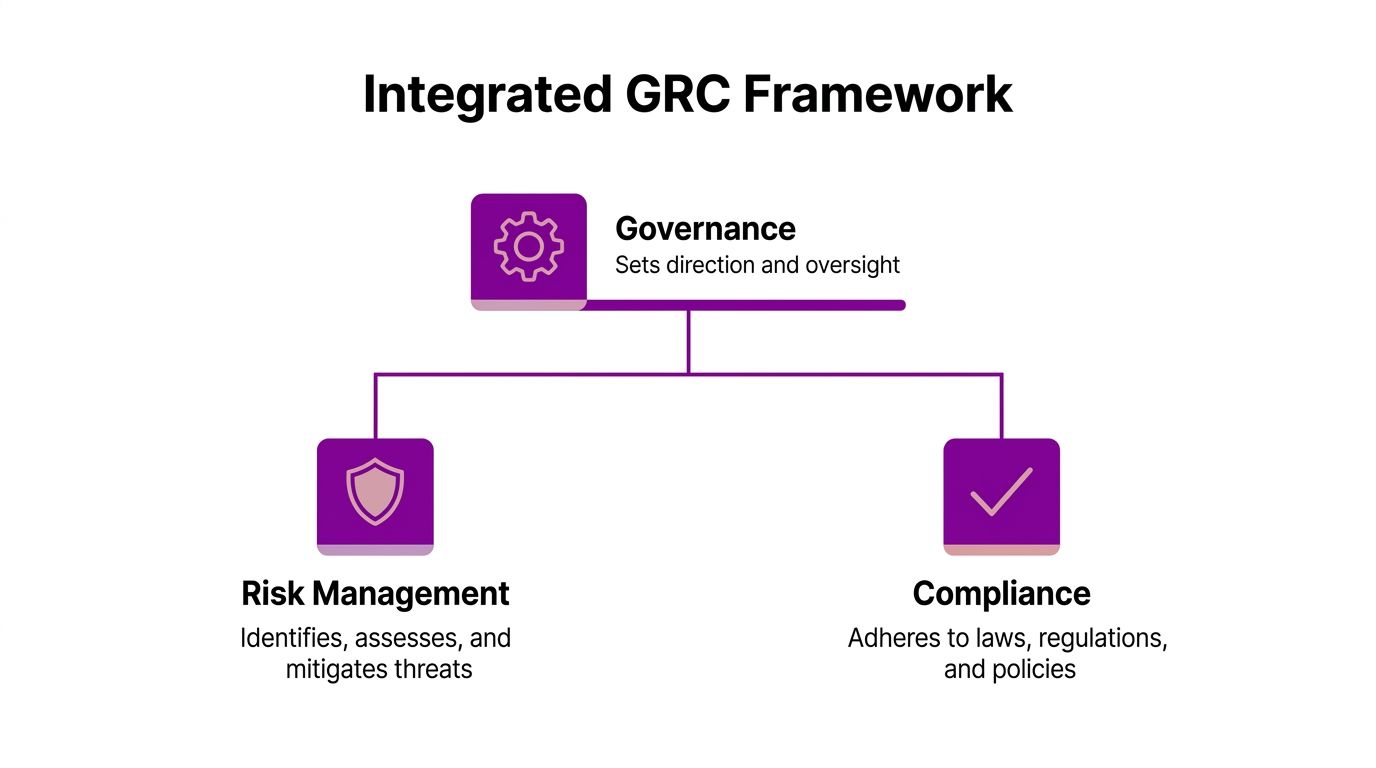
One board decision, three tests
Use a plain-English test on every material technology decision.
Take a Dynamics 365 rollout. Governance asks who has authority to approve scope changes, sign off spend, and escalate failure. Risk asks what could derail value, such as bad migration, weak adoption, supplier slippage, or poor integration with Microsoft 365 reporting and workflows. Compliance asks whether the organisation can justify how it handles personal data, permissions, retention, and audit history.
Non-technical directors do not need product knowledge to oversee this properly. They need clear decision rights, named owners, and reports that explain the position without jargon.
That is where many UK SMB boards fall short.
They approve the spend, but not the control model around the spend. They receive milestone updates, but not decision-quality reporting on ownership, data quality, user adoption, or unresolved risk. Then they are surprised when an AI tool exposes messy permissions or pulls from records nobody trusts.
Data governance belongs in the boardroom
Boards should treat data governance as a standing oversight issue whenever data affects strategy, reporting, compliance, customer service, or AI use.
A formal Data Governance Council is the right move. It gives management a place to settle ownership, standards, definitions, access rules, and escalation. It also gives the board a clear line of sight into whether the organisation is relying on controlled data or wishful thinking.
Without that discipline, the same failures keep turning up:
- Unclear ownership: no one can say who decides, who approves exceptions, or who carries the risk
- Inconsistent definitions: finance, operations, and sales report different answers to the same question
- Weak controls: sensitive data sits in the wrong location with the wrong access
- Poor AI readiness: Copilot or analytics tools are introduced before the underlying data is fit for purpose
Boards do not need to manage the council. They do need to insist it exists where the business depends on data.
For directors who want a clearer line between board oversight and management execution, this Corporate Governance Framework: A UK Board's Practical Guide to Roles, Risk, and Reporting is a useful reference.
What a workable GRC model looks like
Keep the model simple enough to use.
| Element | Board focus | Management output |
|---|---|---|
| Governance | Decision rights, delegation, reporting, accountability | Charters, approval records, policy ownership, escalation routes |
| Risk | Risk appetite, principal risks, tolerances, intervention points | Risk registers, treatment plans, incident logs, action owners |
| Compliance | Legal duties, regulatory exposure, policy adherence, assurance | Control testing, audit findings, remediation plans, evidence packs |
The point is integration. A compliant process with no meaningful risk reporting does not protect the business. A risk register with no owner does not change outcomes. A governance chart that nobody follows is decoration.
The questions directors should ask
If the board is reviewing a major IT or AI proposal, ask questions that cut through jargon fast:
- Who is accountable for business value after go-live, not just delivery?
- Which three risks could force a pause or reset?
- What data problems would make reporting unreliable?
- What decision is reserved for the board, and what is delegated?
- What will we measure monthly to know whether this is working?
Those questions work because they are hard to dodge. They also help non-technical board members challenge management without pretending to be architects or security specialists.
Where cyber, resilience, or control maturity are part of the picture, a structured cyber assessment framework for board oversight and assurance helps translate technical controls into evidence the board can use.
One rule is worth keeping. If management cannot explain ownership, reporting, risk triggers, and compliance obligations in plain English, the proposal is not ready for approval.
Navigating Digital Oversight IT and Cyber Security
It is 8:15 on a Monday morning. The managing director says Microsoft 365 Copilot is ready to roll out, the finance lead wants savings inside two quarters, and the operations team still cannot tell you who owns the data permissions behind it. That is a board issue, not an IT detail.
Boards in UK SMBs know digital risk matters but still struggle to challenge it properly. The answer is not technical theatre. The answer is disciplined oversight in plain English.

Boards need clear sightlines, not technical detail
A weak board either accepts bland assurance from management or lets one technically confident director run the subject alone. Both fail the same test. The rest of the board cannot judge whether the business is exposed.
The board should insist on a view of technology that is tied to business outcomes, control, and accountability. For most SMBs, that means asking management to show five things:
- A business-led IT plan: priorities, dependencies, costs, and what gets stopped if this gets funded
- Named accountability: who owns cyber risk, operational resilience, data governance, and supplier performance
- Service resilience: what happens if key systems fail, how long recovery takes, and what customer impact looks like
- Supplier control: where the business depends on Microsoft, SaaS vendors, outsourced IT, or specialist developers
- AI guardrails: what tools are approved, what data they can access, and who signs off new use cases
If management cannot explain those points without jargon, they are not ready for board approval.
Decide whether a technology committee would improve challenge
Some boards need a dedicated technology committee. Some do not. The test is simple. If digital risk, cyber exposure, operational dependence, or AI adoption now affect strategy every quarter, the board needs more structured scrutiny than a rushed slot at the end of the agenda.
A committee helps where the business is dealing with repeated technology decisions that need informed challenge before they reach the full board. Financial services firms have adopted this model to deal with digital complexity, AI, and resilience, as discussed in this discussion of board technology committees.
For a UK SMB, the committee’s role is practical. It should test whether:
- Cloud moves are controlled: especially Azure migrations, identity changes, and legacy system retirement
- Third-party risk is understood: concentration risk, weak contracts, poor assurance, and unclear exit plans
- AI use is governed: especially Copilot access, prompt handling, data exposure, and record retention
- Resilience plans work: backups, recovery testing, incident roles, and communication paths
- Technology spend is disciplined: replacing weak systems on purpose rather than extending them by habit
This is not another talking shop. It is a way to improve the quality of challenge and shorten the distance between technical reality and board judgement.
Cyber security is a board matter because interruption is a board matter
Cyber security belongs on the board agenda for one reason. A serious incident can stop revenue, disrupt service, trigger legal duties, and damage trust faster than almost any other operational failure.
UK GDPR and the Data Protection Act 2018 already give boards enough reason to take this seriously. The Information Commissioner's Office publishes its regulatory action and monetary penalties, which makes the consequences of poor data governance and weak control clear on its ICO enforcement action pages.
Non-technical directors do not need to master security tooling. They do need to ask questions that expose whether management is in control.
Questions every board should ask on cyber
- What are the few systems, services, or data sets that would hurt us most if they were unavailable, changed, or exposed?
- Who has privileged access today, who approved it, and how often is it reviewed?
- How would management know an incident had started, and who decides it is material?
- What is the current recovery time for our most important services, based on tested evidence rather than assumption?
- Which third parties could shut us down, delay us badly, or expose our data?
- What has not been fixed yet, and why has management accepted that risk?
A practical explainer on cybersecurity risk management can help non-specialists frame these questions in business terms rather than technical ones.
Green-only cyber reporting should make directors suspicious. Real control reports show open issues, overdue actions, failed tests, and management trade-offs.
AI oversight starts with literacy, not hype
Boards do not need to become AI specialists. They do need enough understanding to approve, limit, or stop an AI proposal with confidence.
That matters most in SMBs adopting Microsoft 365 Copilot or similar tools. The board is not usually deciding whether the tool is clever. It is deciding whether the business is ready. If your data permissions are weak, document retention is inconsistent, and staff training is patchy, AI will spread those weaknesses at speed.
Drop the broad discussion about "innovation" and force management to answer practical questions:
- What job are we asking AI to do, and what business problem does that solve?
- What data can the tool reach on day one?
- What could it expose that staff cannot currently see easily?
- What human review is required before output is used externally or for regulated decisions?
- Who owns the benefits case after rollout?
- What would make us pause or restrict deployment?
Those questions help non-technical directors challenge properly without pretending to be engineers.
Set the ground rules before rollout
Boards should approve a short AI policy before broad deployment. Keep it practical. Cover approved tools, prohibited uses, sensitive data handling, output review, records management, and escalation points.
Then insist on a basic readiness check. For Copilot or any Microsoft-based AI tool, management should confirm identity controls, access permissions, data classification, retention settings, and user training before licences are expanded. A plain-English explanation of what zero trust security means is useful here because it gives directors a clear way to think about access, verification, and least privilege.
One blunt recommendation. Do not approve large-scale AI rollout based on vendor demonstrations and internal enthusiasm. Approve it when management can show controlled access, a defined business owner, measurable value, and a credible process for exceptions and incidents.
To ground the discussion further, this short video gives a useful prompt for board-level thinking about cyber oversight and accountability.
Keep the board in its proper role
Directors should approve direction, set risk appetite, test resilience, and challenge whether management is being candid. They should not choose tools, argue over configurations, or give instructions straight to specialists.
Good digital oversight is calm, sceptical, and evidence-based. That is how a non-technical board stays useful when the subject is complex.
Board-Level Questions and Key Performance Indicators
Most boards don’t need more dashboards. They need better questions.
A weak board pack gives directors pages of updates and little judgement. A strong board pack lets the board test whether management is delivering strategy, controlling risk, and using resources sensibly. That applies just as much to Microsoft 365 rollouts and Power BI reporting as it does to finance or operations.
Essential Board-Level Questions for Effective Oversight
| Oversight Area | Key Question for the Board |
|---|---|
| Strategy | Does this initiative clearly support our agreed business strategy, or is it an isolated project with no strategic case? |
| Strategy | What problem are we solving, and what happens if we do nothing for the next year? |
| Finance | What is the full cost of ownership, including licences, support, training, integration, and internal time? |
| Finance | What benefits are expected, and when should the board expect evidence rather than optimism? |
| People | Do we have the internal capability to adopt this change, or are we relying on a few overstretched individuals? |
| People | How are staff being trained, supported, and held accountable for secure and effective use? |
| Risk | What are the top failure points in this initiative, and who owns each mitigation? |
| Risk | What would trigger escalation to the board between scheduled meetings? |
| Technology | What are our critical dependencies across Microsoft 365, Azure, Dynamics 365, Power BI, or connected suppliers? |
| Technology | Where is our single point of failure, and what is the fallback plan? |
| Data | What data is involved, who owns it, and how is access controlled and reviewed? |
| Data | Are we relying on reports or dashboards built on data that hasn’t been properly governed? |
| Cyber security | How would we detect compromise, contain damage, and recover core services? |
| AI | What data can Copilot or other AI tools access, and what safeguards stop inappropriate use? |
| Suppliers | How are we measuring the performance and risk of key IT or cloud partners? |
KPIs the board can use
Boards ask for “technology KPIs” and receive meaningless activity measures. Ticket counts alone don’t tell you whether the organisation is safer, more resilient, or getting value.
Ask management to report a small set of indicators that support decisions.
For strategic delivery
- Adoption: Are staff using the new system as intended?
- Benefit realisation: What business outcomes are now visible?
- Milestone confidence: Are major phases on track, delayed, or at risk?
For cyber oversight
- Control gaps: What key weaknesses remain open?
- Incident readiness: Have response plans been tested and updated?
- Privileged access review: Are high-risk accounts reviewed on schedule?
For data and AI
- Data ownership clarity: Are key datasets assigned to named owners?
- Access review discipline: Are permissions being reviewed and corrected?
- AI use case control: Which AI use cases are approved, paused, or prohibited?
Ask for KPIs that show decision quality, control maturity, and business value. Avoid vanity reporting.
What to reject in board papers
If you want to improve oversight quickly, stop accepting papers that contain:
- Unclear decisions: “For noting” when what’s really needed is a decision.
- No risk statement: Every major proposal carries risk. If none is stated, the paper is incomplete.
- No owner: Committees don’t own actions. Named executives do.
- No downside case: Benefits are described in detail, but failure scenarios are skipped.
- Jargon-heavy reporting: If language obscures meaning, challenge it.
A simple board discipline
At the end of any discussion on technology, cyber, data, or AI, the chair should be able to summarise five things:
- the decision taken
- the executive owner
- the principal risk
- the next report-back point
- the trigger for escalation
If those five things aren’t clear, the board hasn’t governed the issue properly.
Engaging an IT Partner as a Strategic Asset
Monday morning. The board pack says the Microsoft 365 rollout is on track, Copilot licensing has been approved, and cyber risk is rated amber. By Thursday, users are locked out after a conditional access error, sensitive files have been overshared in Teams, and the finance director is asking why the business approved extra spend without a clear owner for delivery.
That is what poor supplier oversight looks like. The board did not fail because it lacked technical knowledge. It failed because it treated the IT partner as a contractor to manage, rather than a strategic supplier to govern.

Why this matters for UK SMBs
In UK SMBs, technology teams are capable but stretched. They are supporting users, handling suppliers, patching cyber issues, maintaining cloud services, and trying to deliver change at the same time. That is when boards need outside capability for projects such as Microsoft 365 hardening, Azure migration, Dynamics 365 integration, or Copilot rollout.
Use external support. Do it deliberately.
An IT partner should give the business specialist delivery capacity, stronger operational discipline, and clearer reporting. It should also reduce key-person dependency inside the organisation. What it must not do is blur accountability. The board still holds management to account for outcomes, spend, risk, and delivery.
What the board should expect from a strategic IT partner
A strategic partner is different from a helpdesk supplier. The difference shows up in how they plan, report, and escalate.
Look for five things.
1. Plain-English communication
If the provider cannot explain a cyber control, migration risk, or Copilot data issue in language a non-technical director can test, they are not ready for board-facing work.
2. Delivery discipline
Ask how they run projects, manage changes, and report slippage. A provider that only talks about tickets and service levels is built for support, not transformation.
3. Microsoft and security competence
If your business runs on Microsoft 365, Azure, Power Platform, Dynamics 365, or is considering Copilot, the provider must understand configuration risk, identity, permissions, retention, backup, and adoption. Licensing knowledge on its own is not enough.
4. Named accountability
You need a named service lead, a named delivery lead, and a clear route for escalation. Shared inboxes and vague team ownership are warning signs.
5. Commercial honesty
A good partner will tell management when a project is under-scoped, when internal ownership is missing, or when the business is trying to rush change without controls. Boards should value that candour.
Questions non-technical board members should ask before appointment
You do not need technical depth to test whether a provider is fit for purpose. You need direct questions.
Ask management and the proposed partner:
- Who in our executive team owns the result of this relationship?
- Which business outcomes are we buying, beyond system uptime?
- What will this partner take responsibility for, and what stays with management?
- How will they report cyber risk, project risk, and user impact in plain English?
- What happens if a Microsoft 365 or Copilot deployment creates a data exposure issue?
- How quickly will serious incidents be escalated, and to whom?
- What dependencies on our own staff could cause delay or failure?
- Where are we exposed to over-reliance on this supplier?
Those questions close the knowledge gap without dragging the board into execution.
Contract for decisions, reporting, and outcomes
Boards approve technology contracts that describe activity but say little about governance. That is weak practice.
The contract and operating model should define:
- decision rights
- risk ownership
- escalation triggers
- reporting frequency
- service expectations tied to business impact
- change control for projects and major configuration changes
- exit support and handover obligations
For UK SMBs, this often marks where many Microsoft 365 and cloud relationships go wrong. The supplier is told to "sort the tech", while no one defines approval points for security changes, data migration decisions, or AI tool rollout. Problems then surface late, after users are affected or controls have been weakened.
KPIs the board can use
Do not accept a dashboard built around ticket counts and generic satisfaction scores. Ask for measures that help the board judge control, delivery, and value.
Useful KPIs include:
- percentage of critical incidents escalated within the agreed timeframe
- number of unresolved high-risk security actions past target date
- percentage of major IT changes delivered on time and within approved scope
- recovery performance against agreed recovery targets for key systems
- percentage of privileged accounts reviewed and approved on schedule
- user adoption rates for major tools such as Microsoft 365 or Copilot, alongside exception or misuse issues
- variance between approved project budget and forecast out-turn
- number of recurring incidents caused by unresolved root causes
These are board-level measures. They show whether management is in control and whether the partner is helping or adding risk.
Keep the relationship under review
Appointment is the start of governance, not the end of it.
The board should expect a regular review of supplier performance, delivery quality, security issues, concentration risk, and whether the relationship still fits the business. For smaller organisations, this matters even more. One poor supplier relationship can shape your cyber posture, operational resilience, and pace of change for years.
Treat the IT partner as a strategic supplier. Set the terms clearly. Keep ownership inside the business. Demand reporting a non-technical board can challenge. That is how a board gets the benefit of outside expertise without outsourcing judgement.
Conclusion The Hallmarks of a Future-Ready Board
A future-ready board isn’t defined by how many technical terms it can repeat back to management. It’s defined by judgement.
It knows the legal duties. It understands that promoting the success of the organisation now includes serious oversight of data, cyber security, digital change, and AI use. It keeps strategy, risk, compliance, and delivery connected. It doesn’t confuse curiosity with interference.
The strongest boards do a few things consistently well.
- They insist on plain English.
- They separate governance from execution.
- They demand evidence, not reassurance.
- They appoint the right expertise where they don’t have it.
- They treat technology as part of business performance, not a side topic for specialists.
That is the fundamental evolution in the role of the board.
You don’t need every director to be technical. You do need every director to be capable of challenge. If the board can ask sharp questions about money, it can ask sharp questions about Microsoft 365 controls, Azure resilience, Dynamics 365 delivery, or Copilot risk. The standard is the same. Clear purpose, clear ownership, clear reporting, clear consequences.
Boards across the East Midlands and beyond don’t need more jargon. They need better governance habits. That’s what makes an organisation more resilient, more credible, and easier to lead.
If your board needs stronger oversight of cyber security, Microsoft 365, Azure, Dynamics 365, Power Platform, or Copilot AI, speak to F1Group. We help organisations across the East Midlands build the technical foundations and reporting discipline boards need. Phone 0845 855 0000 today or Send us a message at https://www.f1group.com/contact/