
When we talk about managing supply chain risk, it’s not just an abstract concept. It’s about getting ahead of the game—actively finding, checking, and neutralising threats across your entire network of suppliers, software, and partners. The goal is to shift from firefighting to strategic planning, making sure that a weakness in one of your vendors doesn't bring your own business to a grinding halt.
The Hidden Dangers Lurking in Your Supply Chain

The modern supply chain isn't just about physical goods anymore. For IT Directors, it’s a complex web of partners, contractors, and third-party software, with each connection acting as a potential entry point for cyber attacks. Frankly, understanding and managing this risk has become a matter of organisational survival.
The dependencies run deeper than most people realise. While tools like Microsoft 365 and Azure have given us incredible efficiencies, they've also introduced new kinds of risk. Every third-party app with access to your systems, every contractor with network credentials, and every SaaS platform you use extends your security perimeter far beyond the office walls. A single weak link can compromise the entire chain.
The Real-World Consequences of a Breach
The fallout from a supply chain attack isn't just theoretical. For many UK businesses, it's a harsh reality with consequences that ripple out far beyond the initial financial hit.
Take the 2025 Jaguar Land Rover (JLR) cyberattack. A ransomware incident at just one key supplier caused a catastrophic domino effect, putting an estimated 104,000 UK supply chain jobs at immediate risk. Smaller suppliers, especially in the East Midlands, were pushed to the brink. Production losses topped £50 million per week, forcing a £1.5 billion government loan guarantee to steady the automotive sector. This single breach created regional economic shockwaves, a story you can read more about in the full report on UK's escalating cyber risks.
A single compromised supplier can trigger a chain reaction, leading to operational shutdowns, significant financial penalties, and long-term reputational damage that can be incredibly difficult to repair.
Understanding the Full Spectrum of Risk
It’s easy to get fixated on data theft, but that’s a dangerously narrow view of supply chain risk. As an IT leader, you need to think bigger to build a truly resilient defence. The threats you face come in many forms:
- Operational Disruption: Imagine an attack on a critical software provider that halts your production lines or locks you out of core business systems.
- Financial Loss: This isn’t just about paying a ransom. Think remediation costs, regulatory fines, and lost revenue during downtime.
- Reputational Damage: Losing customer trust after a breach often causes more lasting harm than any direct financial cost.
- Intellectual Property Theft: Attackers frequently target suppliers as a backdoor to steal valuable IP, trade secrets, or sensitive research data.
This guide will give you a clear, repeatable framework to navigate these dangers. We’ve established the "why"—now let’s get into the practical "how" of securing your digital supply chain.
How to Scope and Map Your Digital Supply Chain

Before you can even think about managing risk, you have to know where it lives. The reality is you can't protect what you don't know exists. So, the very first, non-negotiable step is to get a crystal-clear picture of your entire digital supply chain. That means identifying and cataloguing every single vendor, contractor, and third-party app that touches your network and data.
This goes far beyond just having a list of suppliers in a spreadsheet. A proper mapping exercise means tracing how data flows through your organisation. Who has access to what? Where does that data go? And how critical is that vendor to your day-to-day operations? Without this map, you’re flying blind in a very real minefield.
From Supplier Lists to a True Asset Inventory
A basic supplier list is a start, but frankly, it’s not enough. You need to build this out into a dynamic, comprehensive inventory of every third-party relationship you have. This includes everyone from your primary software providers right down to the freelance developer you hired for a small, one-off project. Each one is a potential door into your network.
The goal here is to get past the names and services and truly understand the function and access level of each partner. Think about it: your cloud hosting provider has a completely different risk profile from your digital marketing agency, which in turn is different from the HR SaaS tool your team uses. Mapping this ecosystem is the only way you can start to prioritise your risk management efforts intelligently.
It's also worth remembering that physical logistics can have a surprising knock-on effect on your digital world. For instance, it pays to understand the role of sea freight if your hardware suppliers rely on it, as disruptions there can create unexpected delays and security challenges that ripple through your tech stack.
Uncovering Shadow IT in Your Microsoft 365 Environment
For any organisation running on Microsoft 365 and Azure, one of the biggest headaches is shadow IT. These are the unsanctioned apps and services that staff start using without getting the green light from IT. A user granting a new app access to their Microsoft account might seem trivial, but it can quietly punch a significant hole in your security.
Fortunately, Microsoft gives you some powerful tools to drag these hidden connections out into the open.
- Microsoft Defender for Cloud Apps: This should be your go-to for discovery. It can identify thousands of cloud apps being used across the business, give you a risk score for each, and let you formally sanction or block them.
- Azure Active Directory (Azure AD): Diving into the 'Enterprise Applications' section of Azure AD is essential. It gives you a direct view of which third-party applications have been granted permissions to access your company data and, crucially, the scope of those permissions.
Making time to regularly audit these tools helps you spot which apps have been given OAuth consent—often by individual users clicking "accept"—and allows you to revoke access for anything that looks risky or non-compliant.
By proactively discovering and managing third-party app integrations, you shift from a reactive, firefighting security posture to a strategic one. You're closing backdoors before an attacker even knows they're there. This needs to be a recurring task, not a one-and-done project.
Classifying Vendors by Criticality
Once you've got your full inventory, the next job is to classify each vendor. This is all about focusing your limited time and resources on the relationships that pose the biggest risk. A simple triage system is almost always the most effective way to do this.
You can use the template below to categorise vendors based on their level of access and the sensitivity of the data they touch. This helps you separate your suppliers into distinct tiers, from 'low-risk/non-critical' to 'high-risk/strategic'. This ensures you’re not wasting time on the small fry and are instead focusing intense scrutiny where it’s needed most.
Here is a simple checklist to get you started on triaging your vendors.
Vendor Criticality Triage Checklist
| Vendor Name | Service Provided | Data Accessed (e.g., PII, Financial, IP) | System Access Level (Admin, User, None) | Criticality Tier (1-High, 2-Medium, 3-Low) |
|---|---|---|---|---|
| Example Cloud Ltd | Cloud Infrastructure Hosting | All customer & company data | Admin | 1 – High |
| Example CRM Inc | Sales CRM Software | Customer PII, Financials | User | 1 – High |
| Example Design Co | Marketing Graphic Design | Marketing assets only | None | 3 – Low |
This organised inventory is the foundation of your entire supply chain risk management programme. With this clear map in hand, you’re finally ready to move on to the next critical phase: conducting proper due diligence.
Conducting Rigorous Vendor Due Diligence
So, you’ve mapped out your digital supply chain and figured out who your critical vendors are. Great. Now comes the real work: proper due diligence. This isn’t about firing off a generic questionnaire and just hoping for the best. It’s about rolling up your sleeves and properly investigating a supplier’s security posture to be certain you can trust them with your data.
Let’s be honest, you can’t just take their marketing at face value. You have to ask the right questions, know what to look for in the answers, and have a solid process for verifying their claims. Without that rigour, you’re operating on blind trust, and trust is not a security control. Think of this vetting process as the firewall that stops a supplier’s weakness from becoming your next business-ending disaster.
Looking Beyond the Surface Level Questionnaire
Most due diligence processes kick off with a questionnaire, and that’s a perfectly fine start. The real value, however, comes from what you do next. You have to dig into the answers and demand evidence. A simple “yes” to a question like “Do you have an incident response plan?” is completely meaningless until you’ve seen the plan itself.
Here’s where you need to focus your attention:
-
Security Certifications: Look for recognised, verifiable accreditations. In the UK, Cyber Essentials Plus is an excellent baseline as it involves hands-on technical verification. For your more critical vendors, ISO 27001 is the gold standard, proving they have a comprehensive Information Security Management System (ISMS). Always ask for the certificate and check its validity.
-
Incident Response and Data Breach Policies: Any credible vendor should have a well-documented incident response plan. Vague statements are a huge red flag. You’re looking for specifics: clear communication protocols, who is responsible for what, and—most importantly—contractually defined timelines for notifying you of a breach that impacts your data.
-
Their Own Supply Chain Management: How does the vendor vet their suppliers? A truly secure partner will have their own robust due diligence process. If they can’t clearly explain how they manage their fourth-party risks, you’ve just found a major weak link in your own chain.
The sheer urgency of this can’t be overstated. A 2025 survey of over 500 UK cybersecurity and risk management professionals was pretty damning: 85% had experienced at least one supply chain cyber incident in the last year, and 90% ranked it as their top concern. With attackers actively targeting suppliers to get around your defences, this level of diligence is non-negotiable. You can learn more about the findings in this supply chain risk report.
How to Spot the Red Flags
Knowing what good looks like is only half the story; you also need a nose for trouble. Over time, you learn to spot the warning signs that a potential partner might not take security as seriously as their website claims. These red flags should make you pause, dig deeper, or simply walk away.
A disorganised, chaotic approach to security is often the first giveaway. If a vendor struggles to produce basic documentation or can’t even name a dedicated contact for security matters, it tells you that security is an afterthought, not a core value. For a more structured approach to your questioning, our cyber security audit checklist provides a really useful framework to build from.
Don’t just ask if a vendor has a security policy; ask to see it. Don’t just ask if they train their staff; ask for details on the training content and how often it’s run. The difference between a genuine security culture and a paper-based one is always in the proof.
Another major red flag is a history of security incidents. A quick search for the company’s name along with terms like “data breach,” “cyber attack,” or “security incident” can be incredibly revealing. While a single past incident isn’t an automatic disqualifier—how they responded is the key—a pattern of repeated issues or a total lack of transparency about past events certainly is. Your goal is to build a network of trusted partners, and that trust has to be earned with hard evidence.
Putting Practical Controls and Safeguards in Place

Once your due diligence is complete, it’s time to turn those findings into real, tangible protections. Let’s be clear: good faith is not a security strategy. You need to weave your security requirements into legally-binding contracts and then use your technology stack to enforce those rules. This moves you from simply hoping your suppliers do the right thing to having enforceable standards with genuine consequences.
It all starts with the supplier agreement. Using a generic, off-the-shelf contract is a recipe for disaster. You have to insist on specific security clauses that make your expectations crystal clear, making security a non-negotiable part of doing business from day one.
Building Your Contractual Guardrails
Think of your contracts as your first line of defence. They establish the rules of engagement and, crucially, define what happens when things go wrong. Without specific security terms, you have very little recourse if a supplier’s weak security posture leads to a breach of your data.
From our experience, these clauses should be non-negotiable for any vendor handling your critical data or systems:
- Right-to-Audit: This is your contractual power to assess a supplier’s security controls, either directly or via a third-party auditor. It’s a powerful way to verify that the security measures they promised on paper are actually working in practice.
- Specific Breach Notification Timelines: Don’t settle for vague promises like “promptly” or “in a timely manner.” Your agreement must demand an exact notification window, such as within 24 hours of discovery, for any incident impacting your data. Every hour counts during a breach.
- Liability for Security Failures: The contract must spell out the supplier’s financial responsibility for costs if their negligence causes a breach. This should cover regulatory fines, customer notification costs, and credit monitoring services. A £50,000 incident can easily spiral to £250,000 in total costs if you’re not prepared.
A strong contract is a powerful deterrent. When suppliers know they are legally and financially on the hook for security, they’re far more likely to invest in protecting your data as if it were their own.
To make sure these safeguards are truly effective, they need to be part of a robust risk management process. This helps you integrate your contractual and technical controls into a single, cohesive strategy that stops nasty surprises before they happen.
Enforcing Controls with Microsoft Technology
A contract is just paper, though. To give it teeth, you need to back it up with technical enforcement. For organisations running on the Microsoft ecosystem, Azure and Microsoft 365 offer a fantastic toolkit for translating those legal protections into real-world security configurations. This is especially true when managing how third parties access your environment.
The goal here is always to enforce the principle of least privilege—give vendors access only to what they absolutely need to do their job, and nothing more.
Azure Policy is your go-to for enforcing security standards at scale. You can create policies that automatically audit or even block the deployment of resources that don’t meet your security baseline. For example, you could set a policy that prevents anyone from assigning public IP addresses to virtual machines inside a resource group dedicated to a specific vendor.
For managing exactly who can access what, Azure AD Conditional Access is absolutely indispensable. It allows you to build incredibly granular rules that govern how, when, and from where third parties can get into your systems.
You could, for instance, quickly create a policy that:
- Requires multi-factor authentication (MFA) for every single third-party guest account. No exceptions.
- Restricts their access to a specific set of applications or data.
- Blocks any sign-in attempts from unapproved countries.
Finally, you need to protect the data itself, and that’s where Microsoft Purview comes in. By using its data classification and labelling features, you can identify your most sensitive information. From there, you can apply policies that prevent that data from being shared externally or downloaded to a personal, unmanaged device. This ensures that even if a vendor has access, your crown jewels remain locked down, shrinking your attack surface significantly.
Setting Up Continuous Monitoring and Incident Response
Let’s be blunt: managing supply chain risk isn’t a task you can just tick off a to-do list and forget about. A supplier who is a fortress today could have a gaping hole in their defences tomorrow. That’s why moving from occasional spot-checks to a state of constant vigilance is non-negotiable for protecting your business.
This means you need your finger on the pulse, actively looking for signs of trouble across your entire supplier network. The good news is that modern tools can do a lot of the heavy lifting. By putting a system in place to watch for suspicious activity, you can catch threats early and deal with them before they spiral into a full-blown crisis.
Building Your Technical Watchtower
For organisations already invested in the Microsoft ecosystem, Microsoft Sentinel is a fantastic tool for this job. As a cloud-native SIEM (Security Information and Event Management) solution, it can pull in logs and alerts not just from your own systems but from a huge number of third-party applications. This gives you a single screen to monitor what’s happening across your digital supply chain.
You can get quite specific, configuring Sentinel to flag things that just don’t look right, such as:
- A sudden spike in failed login attempts from a supplier’s account.
- A third-party app trying to access data it has never needed before.
- Data being siphoned out to an unknown or suspicious location from a vendor-managed system.
When you set up custom alerts for these kinds of scenarios, your IT team gets an immediate heads-up the moment something is amiss. This allows for a swift investigation, turning your security from a passive wall into an active alarm system.
On top of this, you need to be watching for credentials or sensitive company data that might have been leaked online. This is where a dedicated service like our dark web monitoring can give you that critical early warning.
The Importance of Regular Reviews and Re-assessments
Technical monitoring is vital, but it’s only half the picture. You absolutely must pair it with regular, human-led supplier reviews. Businesses change. Your supplier might get acquired, or they could switch to a new, less secure subcontractor of their own. These kinds of shifts can dramatically alter their risk profile, so you can’t rely on your initial due diligence forever.
We’ve found a tiered approach works best. For your most critical, high-risk suppliers, an in-depth review should happen annually. For those in the medium-risk category, every 18-24 months is probably sufficient. This process isn’t just a box-ticking exercise; it’s a chance to revisit their security certifications, check their incident response plans are still relevant, and discuss any significant changes in their business.
A vendor’s security posture is not static. Regular re-assessment ensures that your understanding of their risk profile remains current and that your security controls are still effective against emerging threats.
This thinking aligns with national strategy. The UK government’s June 2025 Supply Chain Resilience Framework from the Department for Business and Trade guides businesses on this very topic. With software supply chain attacks predicted to have tripled in 2025, the government’s new Supply Chains Centre is designed to deliver data-led early warnings, turning policy into a practical defence that IT departments can implement. You can read more about how UK supply chain policy is reshaping risk.
Plan Your Response Before the Fire Starts
The absolute worst time to figure out your response to a supplier breach is while it’s happening. You need a pre-defined supply chain incident response plan. This is your playbook for when things go wrong, ensuring your reaction is calm, fast, and effective.
At a bare minimum, your plan needs to cover:
- Emergency Access Revocation: Have a crystal-clear, step-by-step process for immediately killing all credentials and system access for the compromised supplier. This includes everything from API keys and network access to application permissions.
- Communication Templates: Pre-drafted messages for notifying internal teams, other suppliers, and potentially your customers or regulators. This saves precious time and ensures your messaging is controlled and consistent from the outset.
- Impact Assessment: A defined method for figuring out what data or systems were touched and what the potential fallout for your business is. This will dictate everything that comes next, from legal obligations to technical fixes.
Having this plan ready to go replaces panic with a clear, rehearsed process. This preparation is what will minimise the damage and get you back on your feet quickly after a third-party security failure.
Building Your Supply Chain Resilience Action Plan
Getting a handle on supply chain risk isn’t a one-and-done project. It’s about building a robust, repeatable process that shields your business from the vulnerabilities of your partners. This summary is your starting point—an immediate action plan for IT Directors and business owners ready to build that resilience.
Your Immediate Action Checklist
The entire framework really boils down to a few core, repeatable actions. Each one builds on the last, creating a solid defensive posture around your entire digital ecosystem.
- Map and Classify Your Assets: First things first, you need to know who has the keys. List every single vendor, app, and contractor with access to your systems. Then, use a simple triage system to classify them by how critical they are to your operations. This lets you focus your energy where the risk is greatest.
- Conduct Rigorous Due Diligence: Don’t just take their word for it. Go beyond the basic questionnaires and ask for proof. Verify their security certifications like Cyber Essentials Plus and ISO 27001. You need to scrutinise their incident response plans and understand how they vet their own suppliers—after all, their risks can quickly become yours.
- Enforce Security in Contracts: Your supplier agreements are a powerful security tool. Embed specific security requirements directly into your contracts. Insist on clauses that give you the right to audit, demand strict breach notification timelines (we recommend within 24 hours), and establish clear liability for security failures.
- Implement Technical Controls: The principle of least privilege is your best friend here. Use the tools you already have, like Azure Conditional Access and Microsoft Purview, to enforce it. The goal is simple: ensure vendors can only access what they absolutely need to do their job, and nothing more.
This flowchart shows the simple, continuous cycle that effective risk management follows.
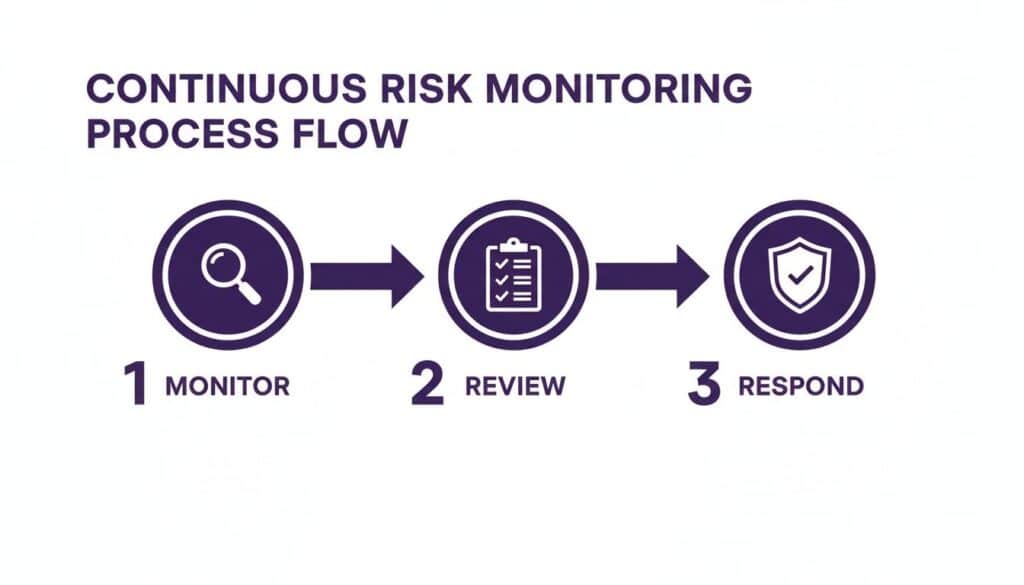
It’s a constant loop of monitoring, reviewing, and responding—not a linear project with a finish line. This cyclical approach is the absolute foundation for a strong business continuity plan and disaster recovery plan.
Accelerate Your Progress with an Expert Partner
Putting this framework into place can feel like a mammoth task, especially for busy IT teams. The good news is, you don’t have to go it alone.
Partnering with a certified expert like F1 Group can fast-track your progress and give you real peace of mind. Our vendor-certified, DBS-checked team has been translating these principles into action for years. We can help you properly secure your Microsoft 365 and Azure environments through our managed IT support services.
Ready to Strengthen Your Supply Chain?
Building a truly resilient supply chain isn’t a one-off project; it’s an ongoing commitment. We’ve walked you through the framework, but putting it all into practice can feel like a heavy lift, especially when you’re already juggling day-to-day IT demands.
If you’re based in the East Midlands, you don’t have to go it alone. Our team of vendor-certified, DBS-checked engineers has been helping local businesses get this right for years. We offer practical, hands-on support to help you map your risks and put the right controls in place.
Leaving your business exposed to vendor vulnerabilities simply isn’t an option anymore. It’s time to take control of your third-party risk to protect your operations, your data, and the reputation you’ve worked so hard to build.
Phone 0845 855 0000 today or Send us a message.