
You’re probably dealing with one of two problems right now. Either your shared drive has turned into a maze of folders called “Final”, “Final v2”, and “Use This One”, or you’ve already got Microsoft 365 and know SharePoint should solve it, but you’re not sure how to set it up without creating a newer, shinier mess.
That’s the point where most UK businesses need practical direction, not another generic Microsoft overview. If you want to understand how to use SharePoint for document management, the answer isn’t “upload your files and hope search sorts it out”. A reliable SharePoint document management system starts with structure, permissions, metadata, and governance that match how your business works.
For firms across Lincoln, Nottingham, Leicester, Newark, Scunthorpe and Grimsby, the same pattern crops up repeatedly. Teams want something simple. Compliance needs control. Management wants visibility. SharePoint can deliver all three, but only if you build it as a proper document management system rather than a cloud version of a file server.
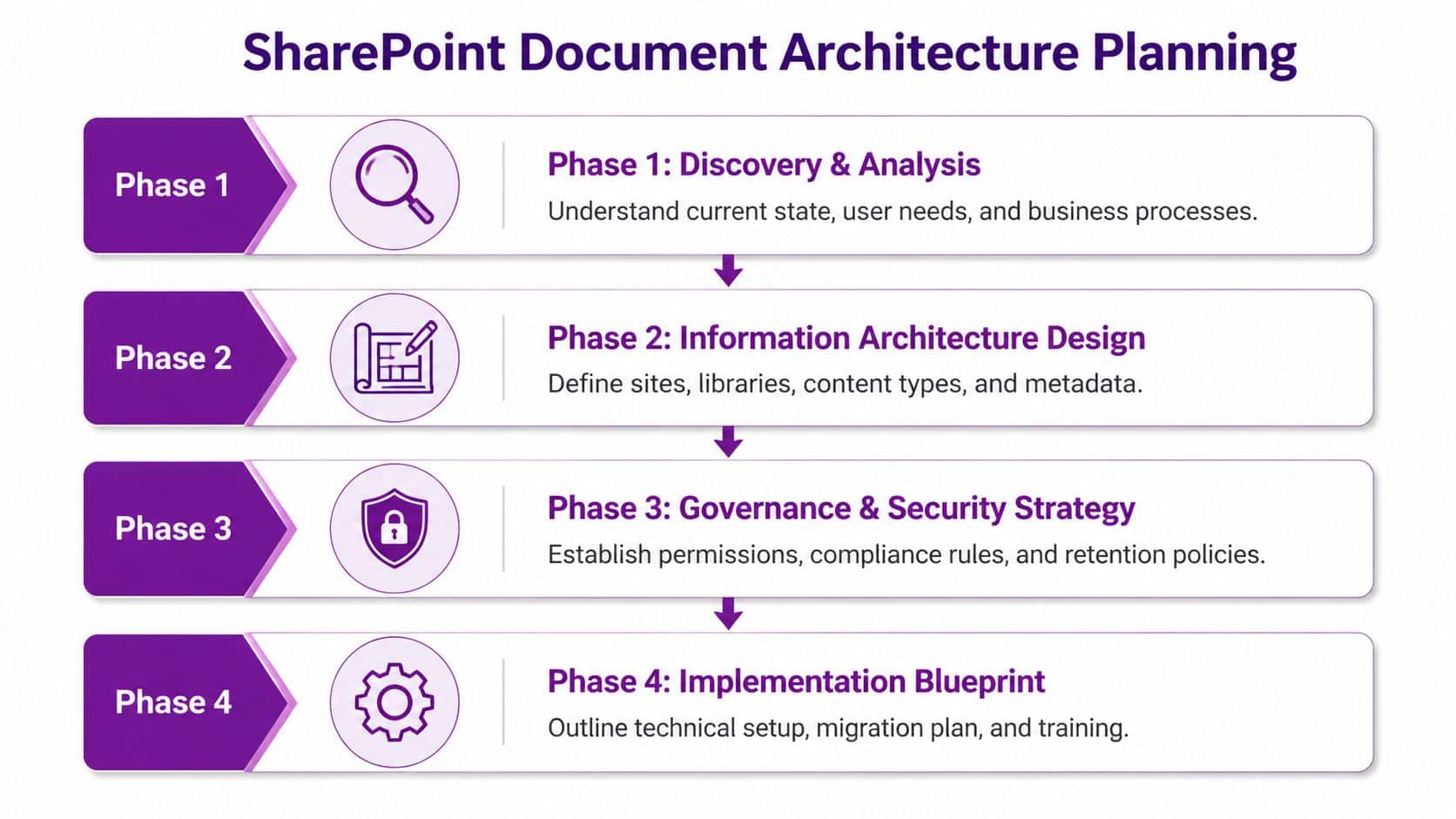
Planning Your SharePoint Document Architecture
The biggest mistake I see is businesses opening SharePoint and starting with folders. That feels familiar, so it feels safe. It usually ends with users recreating the same clutter they had on the old server, only now it’s online.
Start with the business, not the technology. Think about who creates documents, who reviews them, who approves them, who needs read-only access, and what has to be retained for compliance. If your head office is in Lincoln and you’ve got operational teams in Nottingham and Leicester, your structure needs to reflect how those people work together, not just your org chart on paper.
Choose the right site type first
SharePoint gives you different building blocks. Picking the wrong one at the start causes confusion later.
- Team Sites work well for active collaboration. Use them where staff create, edit, and review documents together.
- Communication Sites suit information that’s mainly published outward to the business, such as policies, announcements, or board updates.
- Hub Sites help tie related sites together under one navigation and search experience when your environment starts to grow.
A straightforward model for a mid-sized business might look like this:
| Need | Best fit in SharePoint | Typical use |
|---|---|---|
| Department collaboration | Team Site | HR, Finance, Operations |
| Company-wide publishing | Communication Site | Policies, news, intranet |
| Grouped business area | Hub Site | All people-related or project-related sites |
That structure gives you room to grow without forcing everything into one giant site.
Define your content buckets
Before you create a single library, list the main categories of business content. Most organisations have some version of these:
- Policies and procedures
- Contracts and supplier documents
- HR records
- Project documents
- Finance and compliance files
- Sales and customer-facing material
These are your content buckets. In SharePoint, that usually means separate document libraries, and sometimes separate sites as well.
Because metadata applies at the library level, mixing contracts, HR files and SOPs in one place leads to either too many irrelevant columns or not enough control. For a practical SharePoint DMS, separate libraries for distinct document types are cleaner and easier to govern.
Practical rule: if two document types have different owners, review cycles, or retention needs, they usually shouldn’t live in the same library.
Map business needs to structure
A good architecture answers simple operational questions quickly.
- Where do draft procedures live?
- Where do approved policies live?
- Who can edit supplier contracts?
- Who can read audit evidence but not change it?
- Which documents must be reviewed on a schedule?
For UK firms, that last point matters more than many guides admit. If you’ve got quality, HR, finance, or regulated charity processes, you need a structure that supports retention, approvals, and audit trails from day one.
One practical way to frame it is to split content into three states:
- Working documents
- Controlled documents
- Records
Working documents need collaboration. Controlled documents need approval and version control. Records need retention and restricted change. SharePoint can support all three, but they shouldn’t all be treated the same way.
Don’t confuse SharePoint with OneDrive
This catches out a lot of businesses during first rollout. OneDrive is for an individual’s work files. SharePoint is for team and organisational content. If you let staff keep departmental documents in personal OneDrive libraries, ownership and continuity become a problem the moment someone leaves or changes role.
If your team needs help understanding where each tool fits, this guide on SharePoint vs OneDrive for business use is worth reading before rollout.
Keep the architecture flat
Deep folder trees look organised until nobody can find anything. SharePoint search and filtering work far better when the structure is flatter and the metadata is stronger.
A simple architecture usually works best:
- Site for department or function
- Library for document class
- Metadata for sorting, filtering, ownership and status
That gives users fewer places to browse and more ways to find what they need.
A tidy SharePoint environment isn’t the one with the most folders. It’s the one where staff can find the right document without asking a colleague where it lives.
Building Your Document Libraries and Metadata
A good SharePoint library answers a simple question fast. What is this document, who owns it, and what needs to happen to it next?
That is why library design matters so much in a first rollout. For many UK SMBs, especially firms managing policies, supplier paperwork, HR files, and client contracts across more than one office, the primary benefit is not extra storage. It is getting documents classified properly so staff can find them, filter them, and trigger the right process without digging through old folder trees.

Build libraries around document purpose
Libraries should reflect how the business uses documents, not how the old file server looked.
For a UK mid-sized business, separate libraries for SOPs, policies, and contracts usually make sense because each one has different owners, review rules, and compliance needs. A contracts library often needs renewal dates and approval status. A policies library usually needs review cycles and effective dates. Putting all of that into one catch-all library makes search noisy and governance harder later.
A practical setup for controlled documents often includes columns such as:
- Owner using a Person field
- Author using a Person field
- Status using a Choice field like Draft, Approved, Archived
- Expiration Date using a Date field
- Department using a Choice field such as Lincoln, Nottingham, Leicester
- Review Cycle using a Number field
- Compliance Tag using a Yes/No field
Keep the choices controlled. If users can type anything they like into key fields, reporting and automation become unreliable very quickly.
A worked example for a Contracts library
A Contracts library is a good example because it has commercial value and clear operational deadlines.
Create the library first. Then add metadata that helps the business answer day-to-day questions without opening every file.
| Column | Type | Why it matters |
|---|---|---|
| Contract Type | Choice | Distinguishes client, supplier, partner |
| Owner | Person | Makes accountability obvious |
| Status | Choice | Shows Draft, Under Review, Approved, Archived |
| Expiration Date | Date | Supports renewal and review |
| Department | Choice | Helps route by business unit |
| Compliance Tag | Yes/No | Flags contracts with added controls |
Once that is in place, create views such as:
- Expiring soon
- Awaiting approval
- Approved contracts
- Contracts by department
That structure works well for businesses with finance in one office, sales in another, and directors who want a quick answer on renewal exposure. It also gives you a clean base for Power Automate later, such as reminders 90 days before expiry or approval requests when status changes to Under Review.
Use content types where consistency matters
Content types help standardise how specific document types are created and tagged. They are worth using where consistency matters and where missing metadata causes real problems.
For example, an HR Policy content type could require:
- owner
- policy status
- review cycle
- effective date
- department
- compliance tag
A Supplier Contract content type might need a different set of required fields. That stops staff uploading important files with no expiry date, no owner, and no status. Once that happens, search becomes weaker, reminders get missed, and retention decisions become harder to defend.
For businesses still getting used to the platform, this overview of what SharePoint Online does in Microsoft 365 explains the building blocks behind libraries, metadata, permissions, and document control.
Why metadata beats folder sprawl
Metadata works better because staff rarely search for documents by remembering the exact path. They search by context. Contract owned by Sarah. Policy due for review in June. Approved supplier agreement for the Nottingham office.
That is the practical reason F1Group usually keeps folder use light in SMB deployments. A few folders for broad separation can be fine. Heavy nesting usually creates two problems. Users file documents inconsistently, and important attributes stay hidden in the folder path instead of being available for filtering, search, retention labels, or workflow conditions.
For UK businesses dealing with GDPR, ISO-aligned processes, or customer audit requests, that matters. If review date, owner, approval status, and department are stored as metadata, they can be surfaced in views, used in Power Automate, and checked during governance reviews. If the same information only exists in a folder name, SharePoint cannot do much with it.
Set up views that users will actually use
A library can be designed well and still fail if the default view is cluttered.
Build views around real tasks:
- Documents due for review this month
- Approved policies only
- Drafts owned by me
- Contracts expiring soon
- Leicester department documents
Pin the columns people check first. Hide the ones they do not need every day. A policy owner might care about status and next review date. A director may only want approved documents and effective dates. Good views cut friction and reduce the temptation to export everything back into Excel.
A useful demonstration of the wider approach is below.
What usually goes wrong
Most problems come from making the setup too clever too early.
- Too many columns. Staff skip metadata if every upload feels like admin.
- Wrong column types. Free-text fields create messy values where Choice fields would keep data consistent.
- Libraries that mix unrelated content. Search results become noisy and views stop being useful.
- Fields nobody maintains. If no one owns the data quality, reports and workflows drift out of date.
- Folder-first thinking. Documents get buried instead of classified.
Start with a small number of fields that support a real business outcome. Finding documents faster, flagging reviews, identifying approved versions, or separating controlled content from general working files. That is usually enough for a first phase, and it is far more cost-effective than building an elaborate taxonomy that staff never adopt.
Mastering Versioning Permissions and Security
A finance manager updates a supplier contract. Someone else edits the same file later that afternoon. By Friday, nobody is certain which version was approved, who changed the payment terms, or whether the external accountant can still open the folder.
That is the point where a SharePoint DMS stops being helpful and starts creating risk.

Versioning, permissions and security need setting properly at the start. For UK SMBs, that is not only about tidy administration. It affects audit trails, data protection, staff accountability and the amount of time wasted fixing avoidable access problems.
Why versioning should be switched on early
Version history gives you a record of what changed, who changed it and when. For policies, procedures, contracts and controlled documents, that record matters.
A practical setup is to enable versioning from day one and set retention limits that fit the document type. Controlled documents usually need a clearer approval history than general working files. Draft-heavy collaboration libraries may need more versions kept for a period, while routine team content can be lighter.
Minor versions also have a place, but only where the business will use them. If nobody understands draft versus published status, keep the setup simpler. I usually advise clients across Nottingham, Leicester and Derby to reserve the more controlled version settings for documents that carry operational, legal or compliance weight.
When check-in and check-out still make sense
Check-out is useful in the right library. It is irritating in the wrong one.
Use it for content that needs deliberate control before changes are published, such as:
- controlled policies
- approved SOPs
- sensitive finance documents
- board papers
- records under formal review
Leave it off for live collaboration files where teams need to co-author in Word or work inside Teams without friction.
A good rule is simple. If a document needs sign-off, scheduled review or a clear approval trail, treat it as controlled content. If it is a working draft for day-to-day collaboration, avoid adding barriers people will work around.
Build permissions around groups, not people
One-off permissions feel convenient when somebody needs access quickly. Six months later, nobody remembers why they were added, who approved it, or what else they can now see.
Group-based access is easier to run and easier to explain during an audit.
| Group | Permission level | Typical use |
|---|---|---|
| Auditors | Read | Evidence review without edits |
| Department managers | Edit | Day-to-day updates |
| Site owners | Full control | Administration only |
| External reviewers | Limited access where needed | Specific controlled collaboration |
This model suits most smaller businesses because it keeps the structure readable. It also reduces the support burden. When a member of staff changes role, you update group membership instead of hunting through folders and files.
Least privilege scales better
Least privilege means giving people access to the content they need for their job, and no more.
That matters in practice. HR files should not sit in the same permission structure as marketing collateral. Board papers should not inherit access from a general team site. Temporary staff and contractors should not keep access after the project ends because nobody reviewed the membership.
Use these rules:
- grant access to groups, not individual users
- break inheritance sparingly
- keep sensitive content in separate libraries or separate sites
- review permissions on a schedule
- avoid file-level permissions unless there is a clear short-term reason
- remove access as part of offboarding and role changes
For many F1Group clients, substantial improvement originates here. The technology is already there. The gain comes from cutting exceptions and agreeing who owns access decisions.
A practical security model for UK SMBs
For most East Midlands businesses, a sensible first model looks like this:
- Use the default SharePoint groups for owners, members and visitors
- Create separate libraries for sensitive functions such as HR, finance and leadership documents
- Allow library-level permission breaks only where the business case is clear
- Avoid ad hoc file sharing for internal records
- Review membership quarterly, especially for leavers, contractors and cross-department projects
This approach is usually enough for a first-phase DMS. It supports GDPR-minded access control without turning SharePoint administration into a part-time job.
Security also needs process, not only settings. If approvals, document reviews or access requests are still handled by scattered emails, control weakens quickly. A simple Power Automate workflow for document approvals and access tasks helps keep the audit trail in one place and reduces the usual chasing.
Restraint matters here. Fewer permission exceptions. Fewer inherited mistakes. Fewer situations where staff can see or edit documents they were never meant to touch.
Automating and Integrating Your Document Workflows
A good SharePoint DMS should do more than hold files. It should move documents through the right review, approval and handover steps without staff relying on memory, inbox chasing or side conversations in Teams.
For many UK SMBs, this is the stage where SharePoint starts affecting day-to-day operations. A policy gets reviewed on time. A contract owner receives a reminder before renewal. A manager approves a document from Teams, and the final version stays controlled in SharePoint rather than disappearing into email attachments.
Know what each Microsoft 365 tool is for
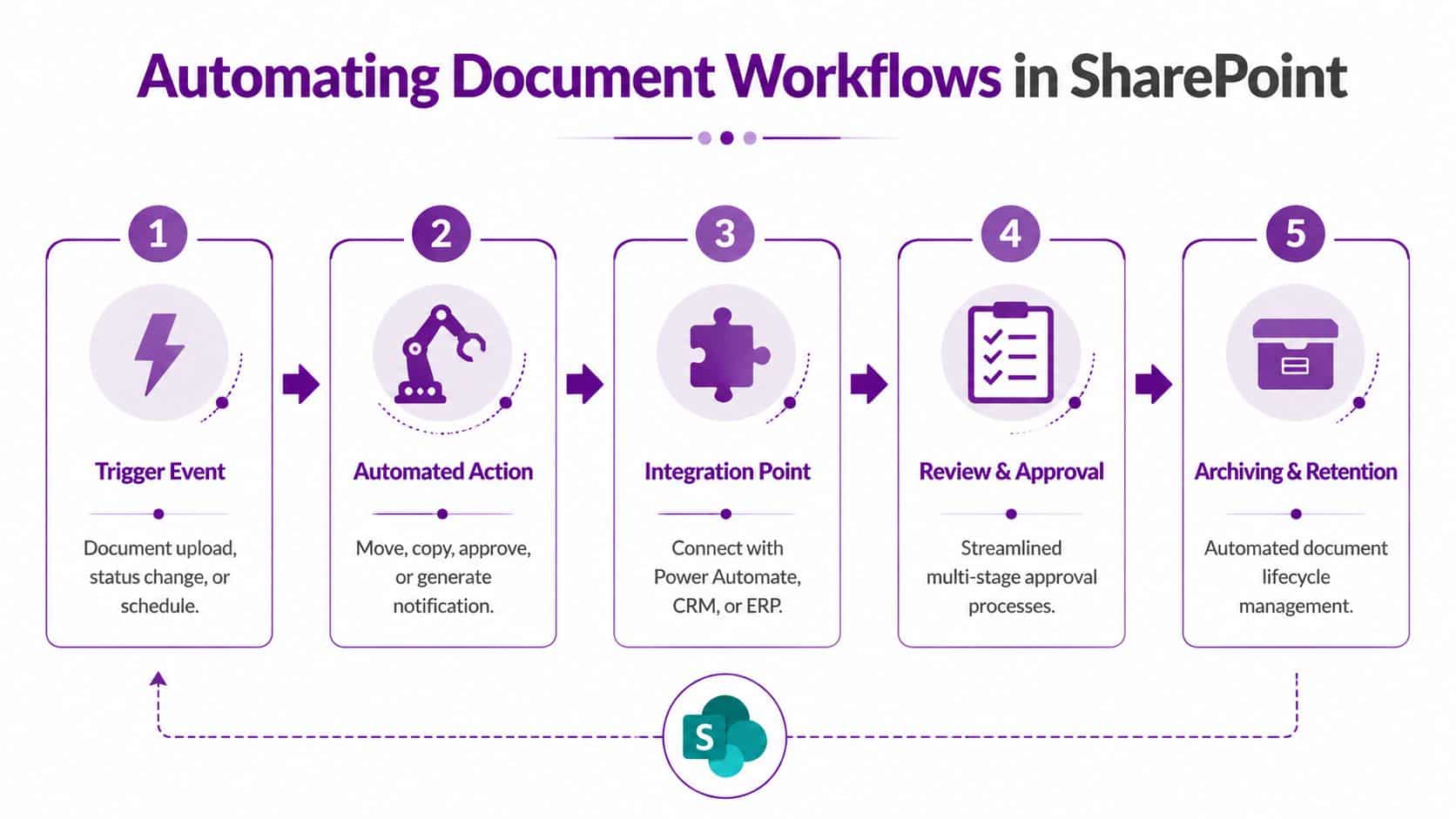
Automation works best when each Microsoft 365 tool has a clear job.
- SharePoint stores controlled business documents, along with metadata, version history and approval status.
- OneDrive is for personal working files and early drafts that do not yet belong in a shared process.
- Teams gives staff a practical front end for conversations, meetings and document collaboration.
- Power Automate handles the repeatable actions, such as alerts, approvals, routing and record updates.
That distinction matters. If staff treat every tool as a general file dump, workflows become harder to manage and harder to trust.
Start with one process that causes regular friction
The best first automation is usually not the most ambitious one. It is the process that already wastes time every week.
For many East Midlands firms, that means a policy approval, contract review, supplier sign-off or controlled document update. A simple example is a policy library where a user marks a document as ready for review, the relevant manager receives an approval request, and SharePoint updates the status based on the decision. If the document is rejected, comments go back to the owner and the file stays in draft.
That gives the business a clear trail of who approved what, and when. It also cuts down the usual problem of three slightly different versions being circulated by email.
If you want a practical starting point, our guide to Power Automate workflow examples for approvals and document processes shows the sort of flows that fit a first-phase SharePoint rollout.
Integration matters because staff work across more than one system
Documents rarely sit in isolation. Sales teams work in Dynamics 365. Managers live in Teams. Individual staff still use OneDrive during drafting. SharePoint needs to fit around that reality.
When the setup is done well, staff can collaborate in Teams, store the approved document in SharePoint, and keep the official version tied to the right customer, project or department record. That joined-up approach is usually more important than adding complex automation for its own sake.
I normally advise clients to avoid building flows just because Power Automate makes it possible. Build around a business event instead. Contract due for review. Policy submitted for approval. Project closed. Staff member leaves. Those triggers are easier to explain, test and maintain.
Where automation usually gives the quickest return
Most SMBs do not need dozens of workflows. They need a handful that run reliably and solve recurring admin problems.
The first candidates are usually:
- Approval routing for policies, contracts and controlled documents
- Review and expiry reminders for agreements, certifications and scheduled document checks
- Metadata-based notifications when status, owner or review date changes
- Archive actions when a document reaches the end of its active life
- Planner task creation when a review or follow-up action is assigned
These are practical wins. They save admin time, reduce missed actions and make audits less painful.
Consistency matters more than complexity
A key benefit of workflow automation is consistency. Every document of a given type follows the same path, uses the same status values and leaves the same audit trail.
That is particularly useful for UK businesses with compliance obligations but limited internal IT capacity. A small finance team, HR function or operations manager can keep control without checking every step manually. GDPR does not require fancy workflow diagrams. It requires the business to know who handled information, where it sits, and what process was followed.
A simple flow that staff understand is usually better than a highly customised process that breaks after six months.
Be selective with customisation
Some businesses do need more than standard approvals. Mobile forms, multi-stage reviews, Dynamics 365 integration or reporting into Power BI can all be valid requirements. F1Group implements those patterns as part of wider Microsoft 365 and Power Platform projects where the process justifies the extra design work.
But restraint still pays off.
Automate the stable, repeatable steps first. Leave edge cases to people unless the volume is high enough to justify building and maintaining something more involved. That keeps costs sensible, reduces support overhead and gives UK SMBs a document management setup they can live with after go-live.
Ensuring Governance Compliance and Searchability
A document system usually starts to slip after the go-live project ends.
Six months later, one member of staff has left, another has inherited three libraries, permissions no longer match job roles, and nobody is quite sure which policy file is the approved one. That is the point where governance stops being an IT tidy-up task and becomes a business risk. For UK SMBs, especially firms handling HR records, client files, contracts or finance documents, the answer is a governance model people can run without a full-time records manager.

Retention needs to match the document type
Finance records, HR files, policies, project documents and supplier agreements should not all be kept on the same basis. Some need formal retention periods. Some need review dates. Some should be archived quickly because they create more risk than value once the work is done.
SharePoint and Microsoft 365 handle this well if the content is classified properly from the start. Retention labels, sensitivity labels and basic metadata such as document type, department, or review date give the business a way to apply rules consistently instead of leaving decisions to individual users.
That matters for GDPR and for day-to-day control. If a business cannot explain what it holds, why it holds it, who can access it, and when it should be deleted, the system is not under control.
For most East Midlands businesses we work with, a sensible approach is to keep the rules simple. Set retention by document category, assign an owner for each library, and review exceptions instead of trying to build a perfect records policy on day one.
Search quality comes from structure and habits
Search problems in SharePoint are usually caused by weak filing discipline, not weak search technology.
If staff upload documents with no metadata, save six versions with slightly different names, or bury files in deep folder trees, search results become noisy and unreliable. If the library has clear fields and people use them properly, users can find documents by client, status, owner, department, or review date without relying on memory.
A practical setup usually includes:
- A small set of standard metadata fields such as owner, document type, department, status and review date
- Content types for records with different requirements, for example policies, contracts and HR forms
- Shallow folder structures where folders help users, but do not replace metadata
- Saved views for common tasks such as expired documents, pending review items or department-specific records
- Basic user training so staff understand what to tag and why it matters
Search is partly a system design issue. It is also a staff behaviour issue.
That is why we usually recommend governance checks after launch. If one team ignores metadata, the whole business feels it in search.
Keep governance small enough to maintain
A 30-page governance pack rarely changes behaviour. A short operating model usually does.
The businesses that manage SharePoint well tend to answer a few straightforward questions. Who owns each library? Who approves permission changes? Who checks retention settings? Who reviews old content? Who decides whether a new document type needs new metadata?
Here is the level of governance most SMBs can sustain:
| Area | Owner | Frequency |
|---|---|---|
| Library ownership | Department lead | Ongoing |
| Permission reviews | IT or system owner | Quarterly |
| Retention review | Compliance or data owner | Scheduled |
| Metadata standards | System owner with business input | Reviewed when libraries change |
| Archive and disposal checks | Records or compliance lead | Scheduled |
This does not need to be heavy. It does need to be clear.
For smaller firms without an internal compliance lead, these checks can sit with operations, finance, HR, or an external Microsoft 365 partner. The important part is that somebody is accountable.
Compliance should show up in normal work
Good compliance in SharePoint is visible in the way staff file, approve, review and remove documents. It should not live only in a policy folder that nobody opens.
In practice, that usually means:
- approved documents are clearly identified
- confidential records are stored separately and access is limited
- version history is available where it needs to be
- permissions are reviewed on a schedule
- out-of-date content is archived or deleted in line with policy
- audit history can be checked if there is a complaint, subject access request or internal review
For UK SMBs, the best setup is rarely the most complicated one. It is the one people follow every week. A modest governance model, backed by sensible metadata and a few well-chosen Microsoft 365 controls, gives businesses a document system that stays searchable, stays compliant, and does not become another admin burden a year later.
Frequently Asked Questions About SharePoint DMS
What’s the best way to migrate files from an old server?
A file migration is usually the first moment a business sees how much duplicate, outdated and badly named content it has been carrying for years.
Start with a triage. Separate live business documents from records that only need to be kept for reference or retention purposes. Then move current content into the right SharePoint sites and libraries with agreed naming rules and metadata applied during migration. If everything lands in one place without context, staff will still struggle to find the right version six months later.
For many East Midlands SMBs, a phased move works better than a weekend cutover. Finance, HR and operations often need different levels of control, and migrating them in stages gives you time to fix issues before they spread.
Why can’t users find documents in search?
Search problems usually start before anyone uses the search box. Documents have been uploaded with vague names, no metadata, inconsistent titles, or buried several folders deep.
Good SharePoint search depends on structure people follow. That means clear library design, predictable document names, and metadata that reflects how the business works, such as department, document type, client, status or review date. Staff should be able to filter results instead of relying on memory and hoping the file name appears exactly as they remember it.
Permissions can also affect search results. If a user cannot access a document, SharePoint will not show it to them in the same way as openly shared content.
Should we use folders at all?
Yes, in some cases.
The strict “folders are bad” advice rarely survives contact with a real business. A project team may want a project folder. A legal or case-based team may need a matter structure. A construction, engineering or professional services firm may work more naturally with a client or job container. That is fine, as long as folders are limited and supported by metadata.
The practical rule is simple. Use metadata for reporting, filtering and search. Use folders where they match a genuine business process and help staff file documents consistently. In client work, we usually find the strongest SharePoint DMS setups use both, but with clear limits so the structure does not sprawl.
What should we do with external contractors or temporary project staff?
Give them their own access group and only the permissions they need for the work in front of them.
Do not drop contractors into broad internal groups to save time. That shortcut creates avoidable risk, especially where commercial data, HR records or customer information is involved. Set an end date for access, record who approved it, and review it when the project closes. In smaller firms, that step is often missed because nobody owns it.
Guest access can work well in SharePoint. It just needs handling with the same care as any other supplier relationship.
Can SharePoint handle approvals on its own?
For many SMBs, yes.
SharePoint and Power Automate are usually enough for document approvals, review reminders, status updates, notifications and simple audit trails. That covers a large share of day-to-day needs without buying a separate document system. It is also a sensible fit for businesses trying to keep Microsoft 365 costs under control.
Some processes need more than that. If approvals involve complex forms, external sign-off, integration with line-of-business systems, or management reporting across several teams, the design may need to extend into the wider Power Platform. SharePoint still holds the documents, but it does not have to do every job on its own.
What if our process doesn’t fit a pure metadata model?
That is common, especially in firms that work by case, client, contract or project.
A pure metadata design can look tidy on paper and still frustrate staff if it ignores how they work. A hybrid model is often more practical. Keep a light folder structure where it helps users orient themselves, then apply metadata for document type, owner, approval status, review dates or retention category inside that structure. That gives the business better search and control without forcing people into an artificial filing method.
The best test is simple. If staff can file and retrieve documents without asking IT for help, the model is probably sound.
How often should permissions be reviewed?
Quarterly is a sensible starting point for many businesses. Review sooner if you have regular staff changes, external project teams, or sensitive information in HR, finance or commercial libraries.
Permission reviews should also happen after role changes, leavers, restructures and major process changes. In practice, many UK SMBs do not need a complicated review regime. They need a named person, a calendar reminder, and a short checklist that gets completed properly.
Is SharePoint enough for a full DMS?
For many SMEs, yes. SharePoint can handle document storage, version history, permissions, approvals, search and retention within Microsoft 365 if the setup is planned properly.
Where businesses run into trouble is usually not a missing feature. It is poor structure, weak ownership, or too much complexity introduced too early. A good SharePoint DMS for a 20 to 200-person business should be controlled, searchable and realistic to maintain with the team you have. That is usually a better outcome than copying an enterprise design that no one has time to manage.
Transform Your Document Management with Expert Help
A well-built SharePoint document management system gives your business far more than cloud storage. It gives you structure, accountability, stronger search, clearer approvals and better control over sensitive content. That’s what turns scattered files into a system people can trust.
The hard part isn’t getting SharePoint switched on. It’s shaping it around how your teams work, what your compliance obligations require, and how much administration your business can realistically maintain. Get that balance right and SharePoint becomes one of the most useful parts of your Microsoft 365 estate.
For organisations across the East Midlands, that often means starting with a sensible architecture, a handful of well-designed libraries, practical metadata, controlled permissions and a few automations that remove manual effort without overcomplicating things.
If your current setup feels more like a dumping ground than a document management system, it’s usually fixable. The best improvements often come from simplifying the design rather than adding more layers to it.
If you want help designing or improving a SharePoint document management system that fits your business, speak to F1Group. Phone 0845 855 0000 today or send us a message to discuss your requirements.