
Think of a managed IT services firm as your on-call technology department. But instead of just fixing things when they break, they work in the background to stop problems from happening in the first place, all for a straightforward monthly fee.
It’s a complete shift away from the old, stressful "break-fix" model, where every phone call to IT support is an emergency. This is about having a dedicated team focused on keeping your systems secure, efficient, and aligned with where your business is headed.
The Shift from Reactive Fixes to Proactive Strategy
Let’s use an analogy. Imagine you only called a mechanic after your delivery van’s engine seized up on the M1. The cost, the disruption, the stress—it’s a business nightmare. A managed IT service is like having that same mechanic regularly service the van, check the engine, and replace worn parts before they fail. You avoid the breakdown entirely.
That’s exactly what this approach does for your technology. Waiting for a server to crash or a cyber-attack to hit is incredibly disruptive and expensive. Moving to a proactive partnership changes the game completely.
From Unpredictable Costs to a Stable Budget
The old break-fix way of doing things means your IT costs are a rollercoaster of sudden, large bills. A managed service agreement smooths all that out. You pay a predictable monthly fee, converting volatile capital expenses into a steady, manageable operational cost. This covers everything from day-to-day support to long-term security planning, making it far easier to budget.
It’s no surprise that this model is taking off. The UK's managed services market is projected to grow from around £18.5 billion in 2025 to over £38.5 billion by 2033. Businesses are clearly voting with their budgets, prioritising the efficiency and security that a managed approach brings.
Your Expert Team on Demand
For most businesses, especially in a competitive area like the East Midlands, hiring a full-time team of specialists in networking, cloud systems, and cybersecurity just isn’t practical. The cost is prohibitive. A managed IT services firm gives you immediate access to a whole bench of certified experts for a fraction of that cost.
What does that partnership look like in practice?
- Proactive Monitoring: We keep a constant eye on your systems to spot and fix trouble before it can affect your team's work.
- Enhanced Security: We build and manage a robust security shield to protect your valuable data from constantly changing digital threats.
- Strategic Guidance: You get expert advice on using technology to find efficiencies, fuel growth, and hit your business goals.
- Full-Spectrum Support: You have one friendly, expert team to call for everything, from a simple password reset to a complex cloud migration project.
Ultimately, working with a local managed IT services firm turns your IT from a headache and a cost centre into one of your most powerful business assets. To explore this further, check out our guide on what a managed service provider does.
What Does a Modern IT Partner Actually Do?
To get a real handle on what a modern managed IT services firm offers, it helps to look past the technical jargon and focus on what each service means for your business. These aren't just isolated bits of tech; they’re designed to work together, supporting your entire operation from the ground up. Think of it less like a random collection of tools and more like a complete workshop, equipped to build a stronger, more resilient company.
At its heart, this kind of partnership is about proactive digital caretaking. It’s about having someone constantly monitoring and maintaining your systems to catch problems before they can derail your day. This is a massive shift from the old "break-fix" model, where you’d only call for help after a server had crashed or a laptop had died.
That proactive approach is what makes all the difference. The UK's managed IT services sector is a serious business, and the government’s own research paints a clear picture of its scale.
A March 2024 report identified 12,867 active managed service providers in the UK. Together, they employ over 343,000 people and generate a staggering £51 billion in annual revenue. The research also highlighted a major shift: 'Cloud Computing' has now overtaken 'IT Infrastructure Management' as the most common service offered.
This diagram perfectly illustrates that move away from firefighting towards a more strategic partnership.
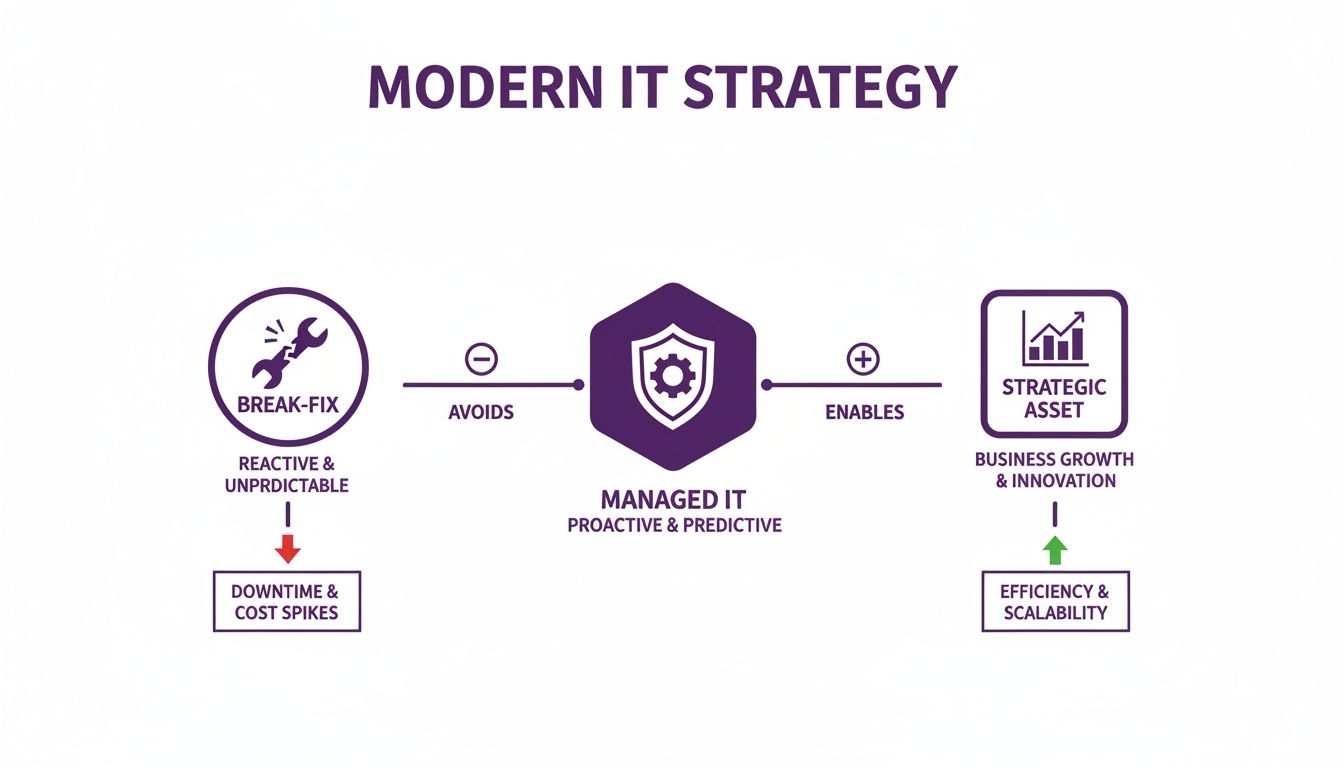
As you can see, the old way was a reactive loop of problems and quick fixes. A managed IT approach acts as a buffer, preventing those system failures and turning your technology into an asset that actively helps you grow. This involves proactive maintenance, cyber security, and smart IT Asset Management (ITAM). Getting your head around IT Asset Management best practices is fundamental to controlling costs and staying compliant.
So, what are the core services you should expect? Let's break them down into the key pillars that support a modern business.
A Quick Look at Key Services
A good managed IT partner provides a comprehensive suite of services. The table below gives you a quick overview of the most common pillars, what they do, and why they matter to your bottom line.
| Service Pillar | Primary Function | Key Business Benefit |
|---|---|---|
| Microsoft 365 & Cloud | Centralises productivity, communication, and data in the cloud. | Enables secure, flexible working from anywhere and scales with your business needs. |
| Copilot AI & Power Platform | Automates tasks and extracts insights using AI and low-code tools. | Frees up your team from repetitive work and unlocks the value hidden in your data. |
| Cyber Security | Provides multi-layered protection against digital threats. | Safeguards your data, reputation, and finances from costly breaches and downtime. |
| Custom Development | Builds bespoke software and integrations for unique business needs. | Ensures your technology perfectly aligns with your specific operational workflows. |
Each of these pillars plays a vital role in creating a robust, efficient, and secure technology environment for your company. Now, let's explore them in a bit more detail.
Microsoft 365, Azure, and Dynamics 365
These Microsoft cloud platforms have become the backbone of modern business. They aren’t just pieces of software; they’re powerful engines for collaboration, efficiency, and growth.
- Microsoft 365: This is your everyday productivity toolkit. It gives you the familiar apps like Word and Excel, but supercharges them with cloud-based collaboration tools like Teams and Outlook, all wrapped in enterprise-grade security.
- Microsoft Azure: Think of Azure as your business's flexible, powerful back-end. It’s a cloud platform that can handle everything from simple data backups to running complex custom applications, letting you scale your computing power up or down instantly.
- Dynamics 365: This is the glue that connects your customer data (CRM) with your operational data (ERP). It breaks down internal silos, giving you a single, clear view across your sales, customer service, and finance departments.
Copilot AI and The Power Platform
This is where things get really interesting. These tools are all about working smarter, not harder, by automating manual processes and tapping into the data you already have.
Copilot AI is like having a clever assistant built right into the Microsoft apps you use every day. It can help you draft emails, summarise long documents, or even analyse spreadsheet data, all from a simple text prompt.
Meanwhile, the Power Platform gives your own team the power to build custom apps and automations without needing to be expert coders. For instance, you could create a simple Power App for staff to log expenses from their phones or use Power Automate to kick off an approval workflow the moment a new invoice lands in your inbox. It’s about clawing back time for what really matters.
Robust Cyber Security
In today's world, strong cyber security isn’t just an IT issue; it’s a core business requirement. A top-tier managed IT services firm acts as your digital bodyguard, protecting your data, finances, and reputation from a constant barrage of threats.
This is much more than just installing antivirus software and hoping for the best. It's a comprehensive, layered strategy that includes:
- 24/7 Threat Monitoring: Keeping a constant watch over your network to spot and stop suspicious activity before it can cause damage.
- Employee Training: Your people are your first line of defence. Good training helps them spot phishing emails and other social engineering tactics.
- Compliance Management: Making sure your data security and handling processes meet all the necessary regulations, like GDPR.
Custom Development and Infrastructure
Sometimes, an off-the-shelf solution just won't cut it. Your business has unique processes, and your technology should support them, not hinder them. This is where custom development comes in.
Whether it’s building an integration to make two of your core systems talk to each other or creating a brand-new application from the ground up, custom work ensures your tech works for you. This is all underpinned by solid infrastructure management services that make sure the digital foundations of your business are stable, secure, and always on.
What's the Real Business Value and ROI?
Beyond just fixing tech problems, how does partnering with a managed IT services firm actually move the needle for your business? The real value isn't about mending broken computers; it’s about generating tangible results that fuel your growth. It’s a strategic shift that stabilises your budget, fortifies your security, and gives you a genuine competitive edge.

When it comes down to it, bringing on a managed IT partner is all about getting a solid return on investment (ROI). That return shows up in hard financial numbers, but also in operational benefits that are just as crucial.
Move from Unpredictable Bills to a Stable Budget
One of the first things you'll notice is a complete change in how you handle IT spending. Most businesses are stuck in a "break-fix" cycle, where you’re hit with surprise costs every time a server fails or a laptop dies. A managed service model flips that on its head.
Instead, you move to a predictable operational expense. It's a fixed monthly fee that covers everything from proactive maintenance and user support to long-term strategic planning. This stability makes budgeting a whole lot simpler and puts an end to those nasty, unplanned IT bills.
For a typical mid-sized business, a managed services contract might fall between £25,000 to £50,000 per year. That gives you comprehensive support for a fraction of what it would cost to build and maintain an equivalent in-house team, allowing for much smarter financial planning.
Gain an Entire Team of Experts
Let's be realistic: hiring individual specialists for cybersecurity, cloud infrastructure, and network engineering simply isn't feasible for most small and mid-sized businesses. A managed IT services firm instantly gives you access to a deep bench of certified professionals, all for one inclusive price.
Think of it as gaining an entire IT department overnight. You get a dedicated team that’s constantly on top of the latest technologies and security threats, ensuring your business runs efficiently and stays protected—all without the huge overheads of recruitment, training, and salaries.
This collective expertise is a huge part of the ROI. You're getting enterprise-grade skills focused on your specific business challenges, a point we explore further in our guide to the advantages of managed IT services.
A Practical Look at the Financial Returns
The numbers really start to make sense when you compare the costs side-by-side. Building your own IT department isn’t just about salaries; you have to factor in National Insurance, pensions, ongoing training, and expensive diagnostic tools.
A managed partnership rolls all of that into one straightforward agreement. The market certainly reflects this. In the UK, the IT services sector was valued at £15,349.99 million in 2023 and is projected to surge towards £28,291.12 million by 2032. While big corporations still hold the largest share, small and medium-sized enterprises (SMEs) are the fastest-growing segment, proving the model delivers clear ROI for growth-focused businesses.
The key drivers behind this return are clear:
- Reduced Downtime: Proactive monitoring catches problems before they happen, keeping your team productive. Every hour of downtime you avoid is money back in your pocket.
- Increased Productivity: When systems just work and your staff have instant support, they can focus on what they do best. The result is a more effective and efficient workforce.
- Enhanced Security: A single security breach can cost a business thousands, if not millions, in fines, recovery costs, and reputational damage. The ROI on expert protection is immense.
The Powerful Intangible Benefits
Of course, not all returns show up on a balance sheet. The intangible benefits are just as powerful. Think about the peace of mind that comes from knowing your critical data is secure and your systems are resilient.
This frees up your leadership team to stop putting out IT fires and start focusing on what really matters: expanding into new markets, developing innovative products, and looking after your customers. When technology is expertly managed, it stops being a source of stress and becomes the engine that helps you achieve your biggest goals.
How to Select the Right Managed IT Partner
Choosing a managed IT services firm is one of the most important decisions your business will make. This isn’t just about outsourcing your helpdesk; it’s about entrusting a core part of your operations to a new partner. Get it right, and you’ll boost efficiency and sleep soundly at night. Get it wrong, and you’re in for a world of frustration, downtime, and risk.
Let's cut through the sales pitches. This is about properly vetting a potential partner's real-world capabilities. You need to dig into their technical skills, understand how they handle support, and put their security standards under a microscope. Asking the tough questions now saves you from major headaches later.
Verify Technical Credentials and Specialisms
First things first: does the firm actually have the expertise you need? Accreditations aren't just fancy logos for a website; they are hard-won proof of competence and a real commitment to industry standards. This is non-negotiable, especially if your business runs on Microsoft technologies.
You're looking for proof that they have a deep understanding of the tools you rely on every day.
- Microsoft Partner Status: Are they a certified Microsoft Solutions Partner? This designation is earned, not given, and shows they’ve proven their skills in key areas like Modern Work, Security, or Business Applications.
- Engineer Qualifications: Are their engineers individually certified in platforms like Azure, Microsoft 365, or specific security frameworks? You want the people working on your systems to be genuine experts.
- Industry Specialisation: Do they have a track record with businesses in your sector? A partner who understands the unique pressures of manufacturing, professional services, or charities brings a massive advantage to the table.
For companies in the East Midlands, finding a partner who genuinely gets the local business environment adds another layer of confidence. They’ll be tuned into the regional economy and can offer advice that feels grounded and relevant, not generic.
Scrutinise the Support Model and Security Standards
How a firm delivers support is every bit as important as their technical knowledge. When a critical system fails, you need to know exactly what will happen and when. Vague promises of "fast support" simply won't cut it.
A crucial—and often missed—part of vetting security is checking the people who provide the support. You must ask if their engineers are DBS-checked. This simple check provides a vital layer of assurance, confirming that the individuals with privileged access to your company's data have passed a thorough background check.
When comparing providers, demand total transparency on how they deliver their service. A trustworthy managed IT services firm will be open and clear about its processes.
Checklist for Vetting a Potential IT Partner
To make this easier, we’ve put together a checklist. Use it to methodically compare different firms, helping you focus on what really matters for building a successful, long-term partnership.
| Evaluation Criteria | What to Look For | Why It Matters |
|---|---|---|
| Response Times (SLAs) | Clearly defined and guaranteed response times in a formal Service Level Agreement (SLA). | This guarantees your critical issues will be addressed within a set timeframe, minimising disruption to your business. |
| Proactive Monitoring | Evidence of 24/7 monitoring tools and a documented process for catching issues before they cause downtime. | It’s the difference between a reactive “break-fix” service and a truly proactive partner who prevents problems. |
| Security Protocols | Details on their multi-layered security stack, from threat detection and data encryption to their own internal staff training. | This ensures your business is properly defended against a huge range of cyber threats, from phishing to ransomware. |
| Local Presence & On-Site Support | A physical office in your region (like the East Midlands) and a clear policy for providing on-site support. | This gives you peace of mind that an engineer can physically be there to fix complex hardware or network problems quickly. |
This checklist helps you standardise your evaluation so you can make a true like-for-like comparison and choose with confidence.
Critical Questions to Ask Potential Firms
Armed with this framework, you're ready to have some very telling conversations. Here are a few essential questions that will reveal a lot about a firm's approach, culture, and capabilities.
- How do you proactively find and fix problems before we even know they exist? (This sorts the true managed service providers from the glorified helpdesks).
- Can you share case studies or references from businesses our size and in our industry? (This is the ultimate proof of relevant, real-world experience).
- What does your onboarding process for a new client like us look like? (A good firm will have a structured, reassuring plan to make the transition seamless).
- How do you measure customer satisfaction, and can you share your latest scores? (This demonstrates accountability and a genuine focus on service quality).
Making a smart, informed choice now will pay dividends for years. You’ll gain more than just a supplier; you'll get a technology partner that actively contributes to your security, efficiency, and growth.
Real-World Success Stories from the East Midlands
It’s one thing to talk about the benefits of a managed IT services firm in theory, but it’s another thing entirely to see the results in action. The true impact really hits home when you look at how local businesses have solved their biggest headaches and achieved real growth.
These aren't just abstract case studies. They're real stories of transformation happening right on our doorstep, from organisations here in the East Midlands.
Let’s start with a growing charity we worked with in Lincoln. They were stuck with an ageing, on-premise IT setup that was making teamwork a struggle. More alarmingly, it was putting their sensitive donor data at serious risk. Like most charities, their budget was incredibly tight, so they needed a modern solution that wouldn't cost the earth.

The path forward was a carefully managed migration to Microsoft 365. This move immediately gave their team secure, flexible access to their files and communication tools, no matter where they were working. We also layered in robust security controls to properly protect supporter information. By taking advantage of Microsoft's non-profit pricing, they gained top-tier tools while staying well within their budget, completely changing how they operate.
From Manual Paperwork to Automated Insight
Next, picture a manufacturing PLC based in Leicester that was practically drowning in paperwork. Their entire production reporting system relied on clipboards and manual data entry into spreadsheets. This meant management had zero real-time visibility of the factory floor, making it nearly impossible to spot production bottlenecks or react quickly when things went wrong.
They had to find a way to digitise this entire process and start using the data they were collecting every day. We found the perfect answer in the Microsoft Power Platform, a suite of tools built for exactly this kind of challenge.
We used Power Apps and Power Automate to build a simple, tablet-based system for operators to log production data right from their workstations. That information was then instantly funnelled into a Power BI dashboard, giving managers a live, visual overview of factory performance for the first time.
The results were immediate. The new system is estimated to have saved hundreds of administrative hours annually. But the real win was the instant visibility, which allowed them to make data-driven decisions that directly improved output and cut down on waste. Finding a partner with deep platform expertise is key; whether it's for Microsoft's suite or if you need to find the best ServiceNow partners, a specialist makes all the difference.
The Impact of a Local Partnership
These examples from Lincoln and Leicester show the tangible value you get from partnering with a local managed IT services firm. This isn’t just about installing new technology. It’s about understanding a specific business problem and applying the right tools to fix it.
Whether it’s securing a charity’s critical data or boosting a factory’s productivity, the right IT partner has a direct and positive impact on your security, efficiency, and ultimately, your bottom line.
Is your business ready to write its own success story? Let’s have a conversation about the challenges you’re facing and how we can help you solve them.
Your Questions About Managed IT Services, Answered
Choosing a managed IT partner is a big step, and it’s completely normal to have a few questions before you commit. This isn't just about buying a service; it’s about entrusting a critical part of your business to an external team. Getting straight answers is the only way to make the right call.
We get asked these questions all the time. So, let’s cut through the jargon and tackle the things business leaders really want to know.
How Much Do Managed IT Services Cost in the UK?
It’s the first question on everyone's mind, and the honest answer is that it varies. Most providers structure their pricing on a per-person, per-month basis. A basic plan covering just the essentials like helpdesk support will be at the lower end, while a full-service package that includes advanced security and strategic advice will naturally cost more.
As a realistic guide, you can expect to budget between £50 and £150 per user per month for a quality managed service in the UK.
So, what pushes the price up or down?
- Service Level Agreement (SLA): If you need guaranteed, rapid response times for business-critical problems, that will be reflected in the price.
- The Scope of Support: Are we just keeping the lights on, or do you need 24/7 security monitoring, cloud management, and a partner who helps shape your IT strategy? The more comprehensive the service, the higher the investment.
- Your Business Setup: The number of people on your team, how many offices you have, and the complexity of your current technology all factor into the final cost.
The best way to think of it isn't as an expense, but as a predictable, flat-rate investment in keeping your business running smoothly and securely.
What Is the Difference Between Managed Services and Traditional IT Support?
This is a crucial distinction, as the two approaches are fundamentally different. It's all about being reactive versus being proactive.
Traditional IT support is a reactive, 'break-fix' service. Something breaks, your team gets frustrated, you call for help, and then you get a bill for the emergency fix. This model almost guarantees downtime and unpredictable costs.
A managed IT services firm, on the other hand, is proactive. Our goal is to stop problems from ever happening. We do this through constant monitoring, regular maintenance, and managing your security behind the scenes. It's about ensuring your systems are always stable and secure, not just scrambling to fix them when they fail. This approach transforms your IT from a headache into a reliable engine for your business.
How Long Does It Take to Onboard with a New IT Provider?
The thought of switching IT providers can feel like a huge upheaval, but any good firm will have a tried-and-tested onboarding plan to make the transition seamless. For most small to medium-sized businesses, the entire process typically takes between two and six weeks.
A well-managed migration looks something like this:
- Discovery & Audit: We get under the bonnet of your current setup, auditing everything from security gaps to software licences.
- Strategic Planning: We map out a detailed migration plan, designed to cause minimal disruption to your daily operations.
- Implementation: This is where we roll out monitoring agents, security tools, and any new systems agreed upon.
- Handover & Training: We make sure your team feels confident, knows how to request support, and can get the most out of any new technology.
Can a Managed IT Firm Work with Our Existing IT Team?
Yes, absolutely. This setup is incredibly common and is often called 'co-managed IT'. The goal isn't to replace your in-house staff but to supercharge them.
In a co-managed partnership, the managed services provider acts as an extension of your internal team. We can take on the day-to-day grind of user support tickets, server patching, and system monitoring. This frees up your IT manager or internal team to focus on the big-picture projects that actually move the business forward, while we provide specialist expertise in complex areas like cybersecurity or cloud infrastructure.
Ready to Talk Strategy?
You’ve seen what a genuine IT partnership can look like. Now it’s time to see what it could do for you. For businesses across the East Midlands, F1Group has been that trusted partner for over 25 years. We’re not just another IT provider; we live and breathe the Microsoft ecosystem.
From our home base in Lincoln, we’ve helped countless companies in the region turn their technology from a source of frustration into a real competitive advantage. We believe in getting ahead of problems, not just reacting to them, with a security-first approach baked into everything we do.
Whether you’re an IT Director needing an expert pair of hands to support your team, or a CEO wanting to finally get your technology and business goals pulling in the same direction, a simple conversation is the best place to start. Let's talk about the specific issues you're facing and map out a sensible way forward.
Our team is made up of DBS-checked, vendor-certified engineers who take real pride in their work. When you partner with us, we take responsibility for your IT challenges, freeing you and your team to concentrate on what matters most: running and growing your business.
Phone 0845 855 0000 today or Send us a message.