
For a lot of UK businesses, small business IT support is the behind-the-scenes hero that keeps everything running. It’s not just about calling someone when a laptop dies. It’s about having a dedicated team that manages, secures, and looks after your entire technology setup, so you don't have to.
What Is Small Business IT Support and Why Does It Matter Now?
Think of your company’s IT as the plumbing and electrics in your office. When it all works, you don't even think about it—the lights are on, the water flows, and everyone can get on with their jobs. But if a pipe bursts or the power cuts out, everything grinds to a halt. Suddenly, you're not focused on your customers; you're in full-on crisis mode.
For years, many businesses have treated their IT support like an emergency plumber—someone you only call when things have already gone wrong. This old-school "break-fix" approach is not just outdated; it's a massive risk. In a world where a server crashing can stop you from taking orders or a data breach can destroy your reputation overnight, waiting for a disaster is a strategy you can no longer afford.
The Shift to a Proactive Partnership
This is why modern IT support looks completely different. It’s less about frantic emergency calls and more about having a team of engineers making sure the pipes never burst in the first place. That’s where a Managed Service Provider (MSP) comes into the picture. An MSP is a partner who takes full responsibility for your IT, all for a predictable monthly fee.
This proactive approach means your systems are always being monitored, kept up-to-date, and secured against threats. Instead of just putting out fires, an MSP prevents them from starting. It turns your technology from a potential headache into an asset that helps you grow. For any business trying to compete, especially in a busy region like the East Midlands, this isn't a nice-to-have; it's fundamental.
This move from reactive to proactive IT isn't just a theory; it's happening right now across the UK. A recent analysis found that by 2026, 62% of UK SMEs will be using an MSP for at least some of their IT needs. That number is set to climb to 70% by 2028. Even more telling, 31% of SMEs have already handed over their entire IT operation to an MSP. It’s clear that outsourced IT has become a mainstream route to success. You can get the full picture of this trend in the complete UK IT support guide.
A Managed Service Provider (MSP) is an outsourced third-party company that manages and assumes responsibility for a defined set of IT services for its customers. It's a strategic partnership focused on proactive maintenance and long-term stability rather than reactive problem-solving.
So, what do you actually get from this shift?
- Cost Predictability: You can wave goodbye to surprise invoices for emergency fixes. A fixed monthly fee makes budgeting simple and predictable.
- Access to Expertise: You get a whole team of certified specialists in security, cloud systems, and infrastructure—the kind of team most small businesses could never afford to hire directly.
- Enhanced Security: MSPs bring top-tier security tools and knowledge, giving you proper protection against the constant threat of cyber attacks.
- Focus on Growth: With your technology sorted, you and your staff can get back to what you do best: looking after customers and growing the business.
The Core Services Your IT Partner Should Provide
When we talk about proper small business IT support, we're not just talking about a helpdesk you phone when your printer stops working. A genuine IT partner becomes an extension of your own team, moving beyond simple fixes to help your business run more efficiently, stay secure, and ultimately, grow. It’s about turning your technology from a frustrating cost into a real competitive edge.
So, what does that partnership actually look like day-to-day? The services go much deeper than just troubleshooting. You should expect robust cybersecurity, proactive network management, cloud solutions, and a plan for when things go wrong, including access to things like professional data recovery services to protect your most vital information. A good partner brings a complete toolkit to the table.
This diagram really highlights the journey IT support has been on—from the old "break-fix" model to a much more sensible, proactive approach.
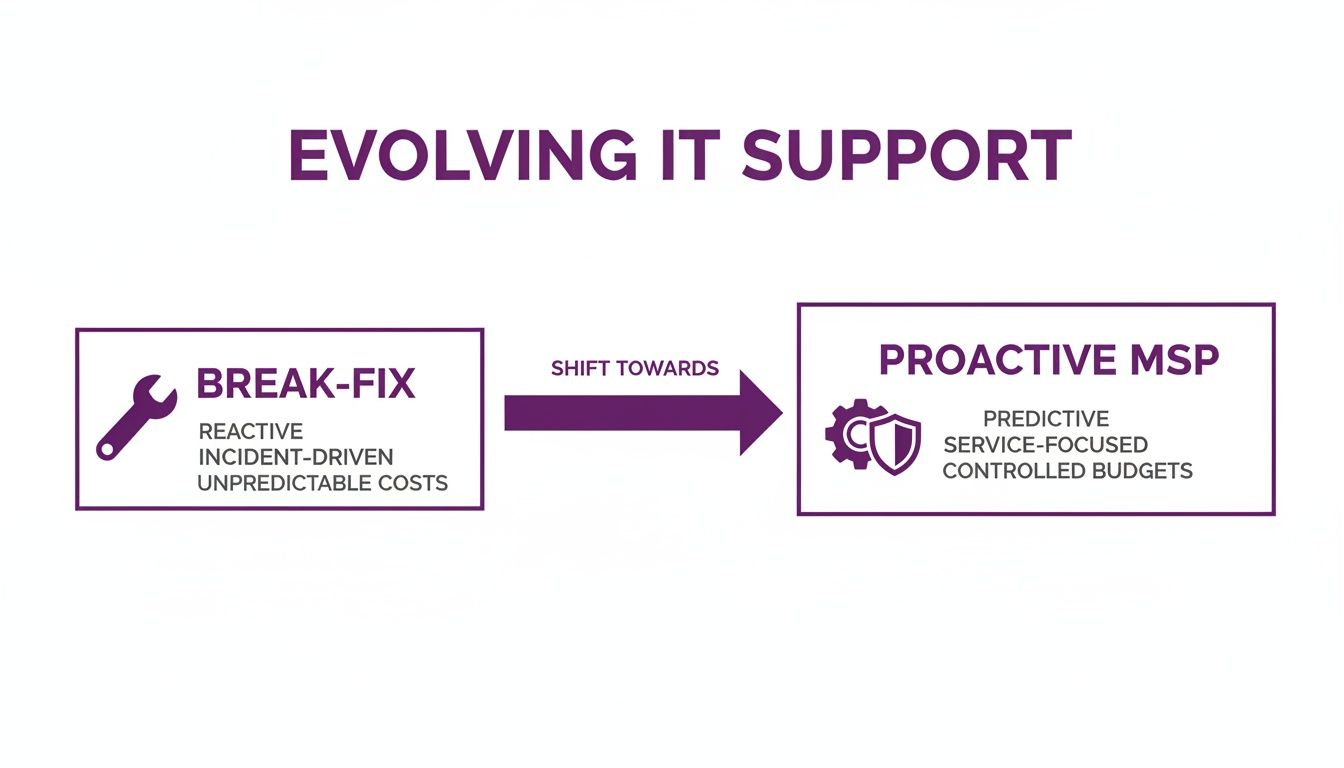
It’s a fundamental shift in thinking. Instead of technology being a source of unexpected headaches and bills, it becomes a stable, predictable platform you can build your business on.
Proactive Managed IT Services
Imagine having a dedicated team keeping a constant eye on your entire technology setup, 24/7. That's the essence of managed IT services. Rather than waiting for a server to go down or a laptop to freeze, your partner is always working behind the scenes—monitoring, maintaining, and optimising.
This proactive approach is the heart of modern IT support. It means potential problems are often spotted and sorted before you or your staff even notice them. This includes everything from routine software updates and security patching to making sure your network is running at full speed. For a fixed monthly fee, which in the UK typically falls between £35 to over £90 per user, you get consistency and peace of mind.
Microsoft 365 and Azure Management
Most UK businesses rely on Microsoft 365 every single day. But just having the licence isn't the same as getting the most out of it. Expert management is what turns these powerful tools into a true engine for collaboration and productivity. A good partner will ensure your Teams, SharePoint, and Exchange are configured correctly, securely, and for the way you work.
The same goes for Microsoft Azure. It offers fantastic power and flexibility, but it's a complex beast. Your IT partner should act as your cloud guide, managing your infrastructure to keep it cost-effective, secure, and perfectly matched to your business goals. They sweat the technical details so you can just enjoy the benefits.
Dynamics 365 and Power Platform Support
As you grow, keeping track of customer details, sales activity, and internal processes gets tougher. Microsoft Dynamics 365 support helps you bring all that information together, giving you one clear view of everything from your sales pipeline to customer service tickets. It provides that single source of truth you need to make better decisions based on real data.
The Microsoft Power Platform takes this idea even further. It gives you the ability to build your own custom apps and automate tedious workflows without needing a huge development team. With an expert on your side, you could build tools that:
- Automatically chase overdue invoices using Power Automate.
- Create a simple Power App for engineers to complete job sheets on-site.
- Build Power BI dashboards to see live sales figures at a glance.
AI Integration with Microsoft Copilot
Artificial intelligence isn't just for global corporations anymore. Microsoft Copilot is like giving every member of your team a smart assistant that lives inside the Microsoft 365 apps they already use. A savvy IT partner can help you roll out and manage Copilot to give productivity a serious boost.
Think about it: your team could summarise long email chains in an instant, ask Word to draft a proposal, or get Excel to analyse sales data just by typing a question. Copilot gives your people back their time, freeing them from repetitive admin to focus on the work that really matters.
By covering these core areas, a small business IT support partner does so much more than just keep the lights on. They give your business the tools and expertise to work smarter, grow with confidence, and stay safe.
Ready to see what a proactive IT partnership could do for your business? Phone 0845 855 0000 today or Send us a message to discuss your needs.
Why Modern IT Support Is Inseparable From Cybersecurity
It wasn't long ago that you could talk about IT support and cybersecurity as two different things. Today, for any business in the UK, those conversations have merged. Treating cybersecurity as an optional extra is like building a fantastic new office but deciding you'll add the locks later; it completely misses the point of creating a secure, functional space from day one.

The reality is that cyber threats are now one of the biggest challenges for UK SMEs. The government's own Cyber Security Breaches Survey found that while 43% of all businesses faced a breach or attack in the last year, that figure jumps to a staggering 70% for medium-sized businesses. These aren't just numbers; they represent a real vulnerability for companies that often lack the dedicated security teams of their larger counterparts.
This is why any credible small business IT support package must have robust security at its core. It’s not about scaremongering; it’s about business continuity.
Building a Multi-Layered Defence
Proper cybersecurity isn't a single product you buy off the shelf. It's a strategy built in layers. Think of it like defending a castle. You don’t rely solely on a strong front gate. You have a moat, high walls, watchtowers, and guards on patrol. If an attacker gets past one layer, another is waiting to stop them.
In IT, this means weaving together different technologies and best practices to shield your data from all angles. A good IT partner handles this complexity for you, creating a defence that feels seamless.
A proactive IT partner doesn't just sell you antivirus software. They design a complete security posture that protects your network, your cloud applications, your data, and most importantly, your people.
To keep that defence strong, it's vital for companies to follow essential cybersecurity tips for small businesses. This kind of proactive thinking is the cornerstone of modern digital safety.
Understanding Modern Security Concepts
Your IT partner should be able to explain modern security ideas in plain English. Two concepts you'll likely hear about are Zero Trust and CASB, and they're simpler than they sound.
-
Zero Trust Network Access (ZTNA): The old approach was "trust but verify." Once you were on the network, you had relatively open access. The new, much safer model is "never trust, always verify." ZTNA works on the assumption that no user or device can be trusted by default, even if they're inside your office network. Every single request to access data or an app has to be checked and approved, which drastically limits an attacker's ability to move around if they do get in.
-
Cloud Access Security Broker (CASB): Think of a CASB as a security guard standing between your team and your cloud services like Microsoft 365. This "guard" checks everyone's ID (authenticates them), makes sure they're allowed in, and monitors what they're doing. It's there to enforce your security rules, flag unusual behaviour, and stop sensitive information from being accidentally or maliciously shared.
Proactive Protection Beyond Technology
Of course, technology is only one part of the puzzle. The most advanced security system can be defeated by one person clicking a bad link in an email. That's why true cybersecurity support focuses just as much on people and processes. For a deeper dive, check out our guide on cyber security for small businesses.
This people-first approach includes:
- Robust Employee Training: Regularly teaching your staff how to spot phishing attempts and other common scams.
- Incident Response Planning: Having a clear, tested plan for the moment a breach happens. This minimises damage, downtime, and panic.
- Proactive Threat Hunting: Instead of waiting for an alarm, this involves actively searching your systems for hidden threats that might have slipped through.
Working with an expert partner makes this enterprise-level security accessible. At the end of the day, preventing a disaster is always smarter, safer, and far cheaper than cleaning one up.
Phone 0845 855 0000 today or Send us a message to secure your business.
How to Choose the Right IT Support Partner
Choosing someone to manage your company’s technology is a huge decision. It’s not just about finding someone to fix a broken laptop; it's about handing over the keys to the systems that run your entire business. You're trusting them with your operations, your data, and your ability to grow. To get it right, you have to look beyond the slick sales pitch and ask the questions that really matter.
This is all about finding a partner who is more than just technically brilliant. You need a team that's transparent, reliable, and genuinely cares about seeing your business succeed. Let’s walk through what to look for, so you can find a provider that truly fits your needs for robust small business IT support.
Local Presence and On-Site Capability
Don't let anyone tell you that 100% remote support is enough. While many problems can be sorted out over the phone, what happens when a critical server dies or your entire network goes down? When you need new equipment installed properly? Waiting hours for an engineer to travel across the country is a recipe for expensive downtime.
Having a provider with a solid base here in the East Midlands is a massive advantage. It means that when you desperately need hands-on help in Nottingham, Lincoln, or Grimsby, an engineer can be there—fast. This mix of efficient remote support and a local, physical presence is the safety net every business should have.
When you're talking to potential partners, ask them straight up: "Where are your engineers based, and what's your guaranteed on-site response time for our office?" A vague answer is a big red flag.
Certifications and Proven Expertise
Technical certifications aren't just fancy wallpaper for a website. They're hard-earned proof that a provider is committed to staying sharp and maintaining high standards. For any business that relies on Microsoft products, seeing that a partner holds current Microsoft certifications is non-negotiable. It proves their team has been properly trained and tested on the exact technology you use every day.
Dig a little deeper for specialisations that match what you actually need. If you’re moving your business into the cloud, a partner with certifications in Azure or Microsoft 365 security is vital. It shows they have the proven know-how to not only set up these powerful tools but also to manage and secure them correctly. On a related note, always confirm their engineers are DBS-checked. You need to know that the people with access to your systems are trustworthy.
Understanding Service Level Agreements
The Service Level Agreement (SLA) is probably the most important part of your IT support contract, but it's often buried in confusing jargon. Simply put, an SLA is their written promise to you. It outlines exactly what level of service you can expect, setting firm deadlines for how quickly they'll respond and how long they'll take to fix things.
You need to know what this means in the real world. A good SLA will be crystal clear about response and resolution times, usually based on how badly the problem is affecting your business.
- Critical Issues (e.g., the whole office is offline): Response within 15-30 minutes.
- High-Priority Issues (e.g., one person’s computer has failed): Response within 1-2 hours.
- Low-Priority Issues (e.g., a non-urgent question about software): Response within 4-8 business hours.
Read the SLA carefully. This is the document that holds your provider accountable and ensures your business gets the timely support it needs to keep running smoothly.
Pricing Models and Budgeting in the UK
Getting your head around IT support pricing is key to avoiding nasty surprises. While you can still find old-school 'pay-as-you-go' models, most modern providers use predictable monthly plans that make budgeting much easier. If you're new to this, it's worth taking a moment to learn more about what managed service providers do and how they operate.
To help you compare proposals, here's a look at the most common pricing structures you'll see in the UK.
Comparing IT Support Pricing Models in the UK
This table breaks down the common pricing structures for managed IT support, helping you understand your options and budget effectively.
| Pricing Model | How It Works | Best For | Example UK Pricing (GBP) |
|---|---|---|---|
| Per User | A fixed monthly fee for each employee being supported. It’s simple and scales up or down with your team. | Most small businesses with a predictable number of staff. | £35 – £90+ per user/month |
| Per Device | A fixed monthly fee for each device (server, laptop, etc.) being looked after. | Businesses with more devices than people, like in manufacturing. | Varies widely based on the type of device. |
| Co-Managed | A collaborative model where the provider supports your in-house IT team with specialist tools and expertise. | Businesses that have an IT person or small department already. | Custom pricing based on the specific services required. |
No matter the model, always ask for a detailed list of what’s included. Does the monthly fee cover on-site visits, cybersecurity software, and cloud backups? Getting absolute clarity on pricing is the only way to make a true like-for-like comparison and budget with confidence.
Ready to find a partner who ticks all these boxes? Phone 0845 855 0000 today or Send us a message for a transparent, no-obligation discussion about your IT needs.
IT Support in Action Across the East Midlands
It’s one thing to talk about what good small business IT support can do, but it’s another thing entirely to see it in action. For businesses right here in the East Midlands, having the right technology partner isn’t just a ‘nice-to-have’—it’s what separates growth from stagnation, efficiency from chaos, and security from vulnerability.
Let’s step away from the theory and look at a few real-world snapshots of how we help local businesses solve their biggest headaches. These aren’t just case studies; they’re stories about turning technology into a genuine competitive advantage.
The Nottingham E-commerce Retailer
We worked with a fast-growing e-commerce shop in Nottingham that had a great problem to have, but a problem nonetheless. Their marketing was working a little too well, and a huge sales event was on the horizon. Their old, on-site servers were already creaking under the strain and a crash during the sale would have been disastrous.
The answer was to move their online shop to Microsoft Azure. This gave them the power to scale up automatically, handling the massive spike in website traffic without missing a beat. To keep the flood of orders and customer information organised, they also brought in Microsoft Dynamics 365.
The result? They smashed their sales records with 100% uptime, and the new system made fulfilling orders a breeze. It wasn’t just about dodging a bullet; it was about building a foundation for even bigger things to come.
The Lincoln Accountancy Firm
For an accountancy firm based in Lincoln, protecting client data isn’t just important, it’s everything. They needed to give their team the flexibility of remote working but couldn’t afford even the slightest compromise on security or regulatory compliance.
Our solution was a robust, multi-layered security setup built around Microsoft 365. We implemented strict access controls based on Zero Trust principles, meaning staff could only see the specific client files they were assigned to. A Cloud Access Security Broker (CASB) was also put in place to act as a digital watchdog, flagging any unusual activity.
The firm moved to a hybrid work model smoothly and without a single security breach. Not only did this boost staff morale, but it also widened their recruitment pool, all while giving clients complete peace of mind.
The Grimsby Manufacturer
A well-established manufacturer in Grimsby was stuck in the past. Their factory floor ran on clipboards and paper, which meant job tracking, quality checks, and stock management were slow and riddled with errors. Lost paperwork and reporting delays were constant frustrations.
We helped them digitise the entire process using the Microsoft Power Platform. Our team built a set of simple, custom Power Apps that ran on tough, workshop-ready tablets. Now, workers can log job progress, snap photos for quality control, and update stock levels instantly.
This one change had a massive knock-on effect. It eliminated paperwork entirely, cut data entry mistakes by over 90%, and gave managers a live view of the factory floor on their Power BI dashboards. They boosted efficiency, cut down on waste, and could finally make decisions based on real-time data.
These stories from across the East Midlands show a simple truth: smart IT support is about solving real business problems and opening up new opportunities. If you want to see what a dedicated partnership could do for you, you can find out more about our IT support services.
Ready to write your own success story? Phone 0845 855 0000 today or Send us a message to get started.
Your Next Steps Toward Smarter IT
We’ve covered a lot of ground, from what small business IT support actually is to the nuts and bolts of choosing the right partner. It all boils down to one simple idea: strategic, forward-thinking IT is one of the best investments you can make in your company’s future. It’s the engine for growth, not just another expense.
For businesses across the East Midlands—whether you’re in Lincoln, Nottingham, Scunthorpe, or Leicester—the next move is simply a conversation. Let’s talk about the specific challenges you’re facing and what you want to achieve. From there, we can build a technology plan that truly works for you, giving you the security and efficiency needed to get on with what you do best.
Good IT support isn’t about just fixing things when they break. It’s about building a solid foundation to stop them from breaking in the first place. That change in thinking is what helps small businesses really punch above their weight.
Taking the first step towards a more secure and efficient business is easier than you think. Let us show you how the right IT partnership can take technology headaches off your plate and open up new possibilities.
Give us a call on 0845 855 0000 or send us a message to arrange a no-obligation chat.
Frequently Asked Questions About IT Support
Choosing the right IT partner is a big step, and it’s completely normal to have a few final questions before you commit. We find that once business owners have the right information, they can move forward with real confidence.
Let’s tackle some of the most common queries we hear to help clear things up.
How Much Should I Expect to Pay for IT Support in the UK?
This is often the first question on everyone’s mind. Thankfully, budgeting for IT support isn’t the black box it used to be. Most good providers now use a straightforward per-user, per-month pricing model, which makes it incredibly easy to forecast your costs as your team changes.
As a general rule, for fully managed, proactive support that covers your helpdesk, monitoring, and security, you should plan to invest between £35 to £90+ per user per month. The final figure really depends on the level of service you need, how complex your IT setup is, and any advanced cybersecurity measures you want to include.
Can I Keep My In-House IT Staff?
Absolutely. In fact, some of the most successful arrangements we have are when we work alongside a company’s existing IT team. This is often called a co-managed IT model, and it’s a fantastic way to blend internal knowledge with external expertise.
A co-managed partnership frees up your internal staff to focus on day-to-day fixes and strategic business projects. We then fill the gaps with specialist skills, advanced tools, and extra hands to cover holidays or tackle complex issues.
Think of us as specialist backup for your team. We bring the kind of high-level tools and deep experience in areas like cybersecurity or Microsoft Azure that might be impractical for an in-house team to maintain. It boosts their capabilities and gives your business a rock-solid defence against any IT challenge.
How Quickly Will You Respond When Something Goes Wrong?
A crucial question. Your provider’s answer to this should be written in black and white in your Service Level Agreement (SLA). The SLA is our promise to you, setting out guaranteed response times based on how severely an issue is impacting your business.
Here’s what you should expect as a minimum:
- Critical Issues: If something brings your business to a standstill, like a server failure or a site-wide outage, you should expect a response within 15 to 60 minutes.
- High-Priority Issues: For problems stopping a key person or a small team from working, a response within a couple of hours is typical.
- Standard Requests: For everyday queries or minor tweaks, a response within a few business hours is the standard.
Our first job is always to acknowledge the problem and let you know we’re on it. From there, it’s all about getting you back to work with as little disruption as possible.
Ready to get clear, reliable answers for your business? The team at F1Group is here to help.
Phone 0845 855 0000 today or Send us a message to discuss how we can support your specific needs.