
You're probably already feeling the pressure from both sides.
On one side, local need is obvious. A charity sees the same people returning with the same barriers around housing, transport, loneliness, debt, access to care, or digital exclusion. A supplier working with NHS or local government sees fragmented services and duplicated effort. A mid-sized business with a social value commitment wants to contribute meaningfully, not just sponsor a one-off event.
On the other side, the practical questions arrive fast. Who owns the data? Which system becomes the system of record? Can staff in different organisations collaborate without exposing sensitive information? Who signs off decisions when NHS teams, councils, charities and private partners all sit at the same table?
That's where community health partnerships either become productive or painful. The policy language makes them sound straightforward. The delivery work is not. Successful partnerships depend on governance, disciplined data handling, secure collaboration tools, and realistic operating models that people can maintain after the launch meeting is over.
For implementers, the job isn't to admire the strategy. It's to make the partnership usable, secure and measurable.
What Are Community Health Partnerships
A typical starting point looks like this. A local organisation knows a problem can't be solved by one service alone. A social prescribing provider can identify need but can't fix poor housing. A charity can reach residents that statutory services struggle to engage, but it can't commission clinical support. A business may have technical capability, but it needs a route into local delivery structures.
Community health partnerships are the formal way those organisations work together. In practice, they bring together NHS bodies, local authorities, voluntary, community and social enterprise organisations, and sometimes private sector partners around a shared local outcome. That outcome might involve access, prevention, mental wellbeing, long-term condition management, or joined-up support around wider determinants of health.
Why they matter now
Within the UK's Integrated Care System environment, partnership working isn't a nice extra. It's part of how local service planning is expected to happen. That matters for any charity, supplier or mid-sized organisation hoping to contribute to community outcomes in a credible way. If you want a seat at the table, you need to understand how local decisions are shaped and how evidence is used.
The strongest argument for this model isn't theoretical. One early English example came from Health Action Zones. Between 1997 and 2008, coronary heart disease mortality for people aged 15 to 64 fell by 22% in HAZ areas, compared with 18.3% in similarly deprived non-HAZ areas, a 3.7% absolute reduction linked to the partnership model according to the Journal of Public Health review of Health Action Zones.
Practical rule: If a partnership can't connect local need, shared delivery and shared evidence, it's still a loose network, not an operating model.
What this means for smaller organisations
For charities and regional businesses, that changes the question from “should we collaborate?” to “how do we join in without creating operational risk?”
A good first pass is simple:
- Check mission fit: Does the partnership address a problem your organisation already works on?
- Check delivery value: Are you bringing delivery reach, trusted relationships, facilities, technology, data capability, or specialist expertise?
- Check operational maturity: Can your team handle secure communication, controlled access, reporting discipline and formal decision-making?
If the answer is yes to all three, community health partnerships can move your organisation from peripheral support to core delivery.
Exploring Partnership Models and Their Benefits
Not every partnership looks the same, and that's where many organisations get caught out. They assume there's one standard NHS-facing structure. There isn't. The right model depends on geography, decision authority, funding route and whether the work is strategic or targeted.
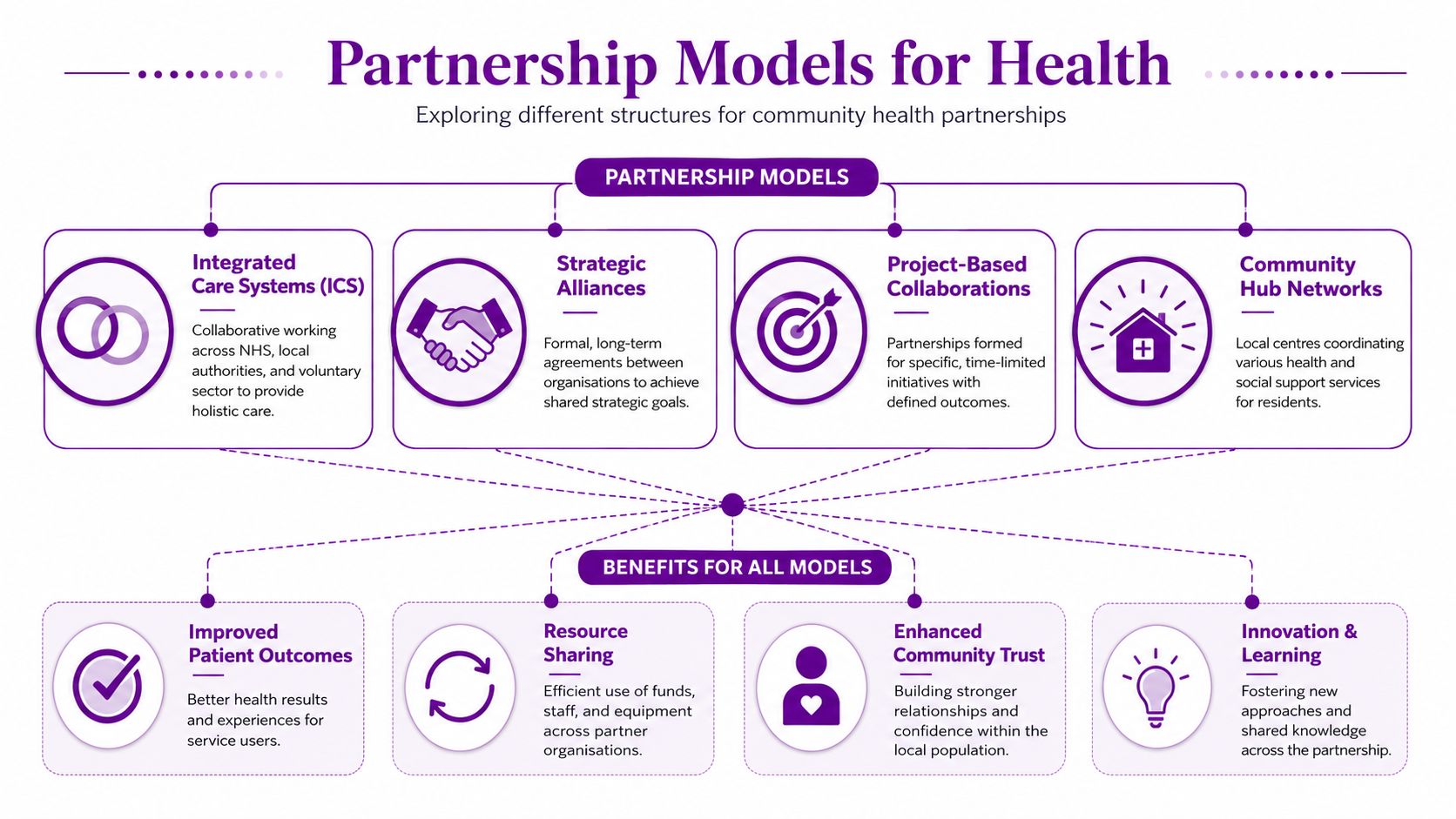
Four models you're likely to encounter
Integrated Care Systems sit at the broadest level. They align NHS organisations, councils and wider partners around population health, service integration and local inequalities. If your organisation works across several towns or supports multiple providers, this is often where strategic alignment starts.
Strategic alliances are more formal long-term arrangements between named organisations. These work well where partners already know they need each other over several years, such as combining community outreach, digital triage, estates use and clinical referral pathways.
Project-based collaborations are narrower and often the most realistic entry point for smaller charities and suppliers. They focus on a defined problem, a clear community, and a tighter delivery period. They're easier to launch, but they fail quickly if nobody plans for what happens after the pilot.
Community hub networks are the most visible to residents. They coordinate support through a physical or locally recognised front door. For implementers, these models are often the most IT-heavy because multiple services need shared booking, referrals, reporting and case visibility.
The infrastructure model worth knowing
There's also a more formal UK example that matters, especially if your work touches estates, facilities or integrated service locations. Community Health Partnerships, originally established as Partnerships for Health in 2001, operate as a Department of Health-owned company tasked with facilitating public-private partnerships for new healthcare facilities through the NHS Local Improvement Finance Trust programme, as outlined in the Community Health Partnerships overview.
That history matters because many partnerships aren't just about meetings and referrals. They also depend on where services are physically delivered, how co-location works, and who manages shared environments.
What works and what doesn't
A useful way to assess partnership models is to ask where they break.
| Model | Best use | Common weakness |
|---|---|---|
| ICS-level collaboration | Strategy, population planning, cross-agency alignment | Too broad for daily delivery without local operating groups |
| Strategic alliance | Long-term service integration | Can become slow if governance is over-engineered |
| Project collaboration | Testing a focused intervention | Often underestimates data and security setup |
| Community hub network | Local access and visible joined-up services | Needs strong operational ownership and shared systems |
Partnerships usually fail at the joins. Not because people disagree on purpose, but because nobody settled workflow, data ownership, escalation routes or access control.
The benefit of choosing the right model is straightforward. You reduce duplication, make better use of scarce staff and facilities, and improve the resident experience by making services easier to find and use.
Understanding Stakeholder Roles and Governance
A partnership becomes unstable when everyone is committed but nobody is clear on authority. Goodwill won't solve that. Governance does.
Who usually does what
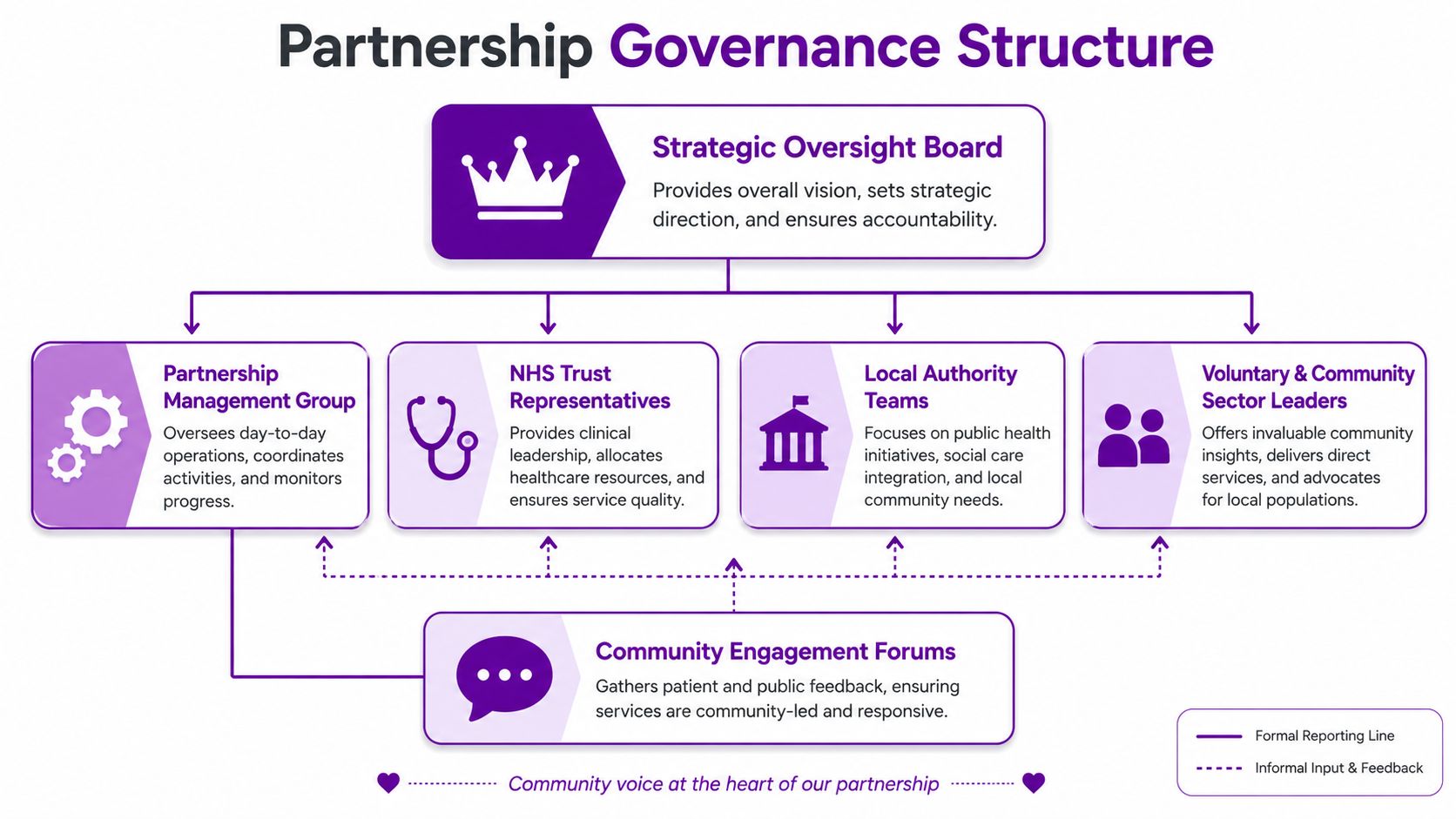
The NHS usually brings clinical leadership, statutory responsibilities, commissioning influence, pathway design and access to health intelligence. It often anchors the risk conversation because regulated care, patient safety and information governance can't be left vague.
Local authorities tend to lead on public health, social care links, housing context, safeguarding frameworks and broader local determinants. They also understand place in a way that larger systems often don't.
VCSE organisations bring something the statutory sector often can't manufacture quickly. Trust. They know which communities are under-served, which outreach methods work, and where formal services feel remote or inaccessible.
Private sector partners and suppliers should be precise about their role. The strongest contribution is usually operational rather than rhetorical. That means secure platforms, systems integration, reporting capability, cyber security, service desk support, automation, or facilities and logistics. It does not mean trying to dominate service design just because you own a technology component.
Governance that keeps the partnership usable
A workable governance structure usually has three levels:
- Strategic oversight board: Sets direction, agrees outcomes, resolves major disputes.
- Operational management group: Runs delivery, monitors risks, tracks actions, manages dependencies.
- Community engagement mechanism: Captures resident and service-user input in a form that can actually influence decisions.
This doesn't need to be bureaucratic. It does need to be written down.
Operational advice: If decision rights live only in meeting culture, the loudest organisation wins.
Shared governance isn't just a procedural preference. UK evidence on community-centred approaches found that when local services and communities collaborate across all planning cycle stages, health outcomes improve by 12% to 18% compared with top-down service models, and that improvement is linked to governance structures that clarify authority and accountability, according to the government guide to community-centred approaches.
The documents many partnerships skip too long
Before live delivery begins, most organisations should insist on a short governance pack. Not a huge policy bundle. Just the documents people will use.
- Terms of reference for each group.
- Decision matrix showing who recommends, who approves, and who delivers.
- Data sharing agreement or equivalent legal basis.
- Risk register with named owners.
- Escalation route for incidents, delays and safeguarding concerns.
A partnership gets stronger when roles are specific enough that people can act without waiting for permission on every small issue.
Warning signs
If you see these early, fix them early:
- Meetings without owners: Actions are discussed, not assigned.
- Shared objectives without shared measures: Each organisation reports success differently.
- One partner holding all admin rights: That creates avoidable dependency and trust problems.
- Community voice limited to consultation after decisions are drafted: Residents spot that immediately.
Governance isn't there to slow progress. It's what lets multiple organisations move without colliding.
Building the IT Foundation for Your Partnership
The technology problem in community health partnerships isn't usually a lack of software. It's a lack of coherence.
Most partners already have tools. The charity may use Microsoft 365 Business Premium, a case management platform and spreadsheets. An NHS organisation may use separate clinical, referral and reporting systems. A council team may rely on its own document management environment and strict endpoint controls. The partnership then tries to work across all three without agreeing where collaboration should happen.
Start with a data map, not a platform demo
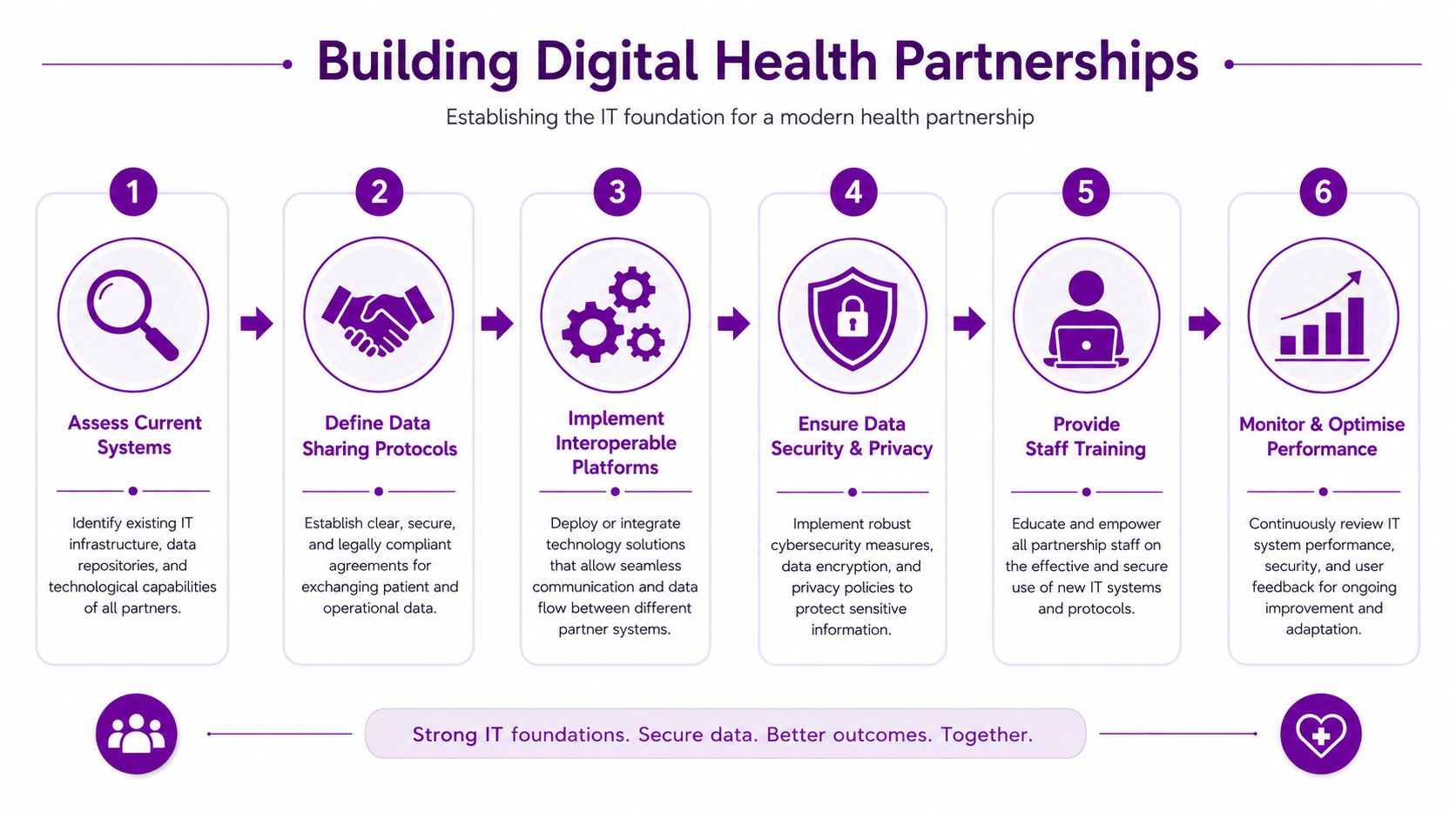
Before anyone talks about dashboards or shared portals, map four things:
- What data exists
- Who owns it
- What legal basis supports sharing
- Which team needs what level of access
That exercise exposes most future problems. It shows where the same resident appears in multiple systems, where manual rekeying is happening, and where people are relying on email attachments because no shared workspace exists.
Within the Integrated Care System framework, partnerships must integrate evidence from Local Health Profiles, Director of Public Health annual reports and Joint Strategic Needs Assessments so planning reflects local determinants rather than assumptions, according to NHS England guidance on working in partnership with people and communities. From an IT perspective, that means your reporting model needs to handle structured local intelligence, not just service activity counts.
A practical Microsoft-focused stack
For many charities, suppliers and mid-sized organisations, a Microsoft stack is the least disruptive route because it can support communication, access control, reporting and automation in one environment.
Microsoft Teams works well for controlled collaboration across partner groups, provided guest access is governed properly and channel structure reflects real workstreams rather than vague committees.
SharePoint is often the right place for controlled document management, versioning, policies, meeting packs and operational templates. It's better than attachments bouncing around mailboxes with no audit trail.
Power BI is useful when the partnership needs a shared view of referrals, activity, waiting lists, outreach coverage or operational bottlenecks. Its value isn't the chart itself. It's the agreed definition behind the chart.
Power Automate can reduce repetitive admin around approvals, notifications, document routing and task reminders. Used carefully, it cuts coordination friction. Used badly, it automates confusion.
Azure is typically the right foundation when partners need a more controlled data environment, secure integration, identity controls, logging and scalable services beyond everyday collaboration tooling.
The best partnership platform is the one that staff can use safely on a busy Tuesday, not the one that impressed everyone in procurement.
Security controls that matter in real life
Security design should reflect the fact that multiple organisations are involved and staff turnover is normal. Focus on controls that reduce avoidable exposure:
- Identity first: Use role-based access, named accounts and strong sign-in controls.
- Separate collaboration spaces: Don't mix operational case discussions, board papers and general project chat in one unrestricted area.
- Limit file sprawl: Store sensitive working documents in managed repositories, not local desktops and inboxes.
- Plan offboarding from day one: Remove access quickly when staff leave a partner organisation or change role.
- Log and review: If nobody reviews access and activity, the control only exists on paper.
The human factor
Most partnership failures blamed on technology are really failures in adoption. Staff need to know which tool to use for which task. If Teams is for active collaboration, say so. If SharePoint is the record store, enforce it. If Power BI contains the agreed performance view, stop circulating conflicting spreadsheet versions.
Training also needs to be role-based. Executives need dashboards and decision packs. Delivery teams need workflow clarity. Administrators need permission rules and retention procedures. One generic induction session won't cover that.
When the IT foundation is right, the partnership feels simpler than the number of organisations involved. When it's wrong, every shared task takes twice as long and nobody trusts the data.
Securing Funding and Evaluating Your Impact
Most partnerships don't fail because the need disappears. They fail because the operating model was built on temporary enthusiasm and short-term money.

The funding reality
A partnership may draw support from local commissioning, public health budgets, charitable grant funding, philanthropy, social value programmes, or supplier-backed delivery contributions. That mix can get a pilot started, but it often creates fragility if nobody decides which costs are one-off and which are recurring.
Recurring costs are the ones that matter most operationally. Think licence management, cyber security monitoring, integration support, reporting maintenance, user onboarding, governance administration and staff time for coordination. These rarely disappear after launch.
The broader context is tight. The British Medical Association analysis of health funding states that the DHSC day-to-day budget has fallen in real terms for three consecutive years from 2021/22 through 2024/25. That doesn't mean partnerships stop. It means every unsupported overhead becomes harder to carry.
There is current central support worth noting. The UK government has established the £11.5 million Local Covenant Partnerships fund, with applications accepted until 23:59pm on Monday 23rd February 2026, as set out in the government announcement on Local Covenant Partnerships.
Sustainability after the first funding round
One of the biggest gaps in UK practice is long-term sustainability beyond initial grant funding. Existing guidance supports partnership working strongly, but there's limited UK-specific detail on durable financial models for keeping community partnerships running over time. For charities and mid-sized organisations, that means you should treat sustainability design as a workstream from the outset, not as a discussion for year two.
Useful questions include:
- Which functions are core and must continue regardless of grant status?
- Which tools are shared costs and which sit with individual partners?
- Can any reporting, triage or admin process be standardised to reduce overhead?
- Who pays for security, compliance and support once pilot funding ends?
Here's a short explainer worth watching before building your funding case:
Evaluation that decision-makers will trust
Impact reporting should be useful enough to influence decisions, not just persuasive enough to satisfy a funding form.
Build your evaluation around three layers:
| Layer | What to measure | Why it matters |
|---|---|---|
| Service delivery | Referrals, response times, attendance, completion | Shows whether the partnership operates reliably |
| User experience | Feedback themes, barriers removed, ease of access | Shows whether residents can actually use the service |
| Strategic impact | Progress against local needs and agreed outcomes | Shows whether the partnership justifies continued backing |
Funders and boards rarely lose confidence because a partnership reports problems. They lose confidence when reporting is vague, inconsistent or delayed.
If you can't measure everything, measure a small set consistently. That's better than producing an impressive dashboard nobody believes.
Your Pre-Partnership Readiness Checklist
Some organisations are ready to join a partnership now. Others need a short preparation phase first. It's better to know that before signing data agreements or promising delivery dates.
A practical readiness review should look at strategy, capacity, technology and legal control together. If one is missing, the others won't compensate for it.
Organisational readiness checklist for partnership work
| Readiness Area | Key Question to Ask | Suggested Action |
|---|---|---|
| Strategic Alignment | Does this partnership support our mission and existing service priorities? | Write a one-page position statement linking the partnership to your current objectives and target communities. |
| Strategic Alignment | Do we know what value we bring that others do not? | Define your contribution in concrete terms such as outreach reach, technical capability, facilities, specialist staff, or data insight. |
| Leadership Commitment | Is there a named senior owner inside our organisation? | Appoint an executive sponsor with enough authority to make decisions and remove blockers. |
| Resource Capacity | Do we have staff time for meetings, delivery, reporting and follow-up? | Estimate staff commitment by role and protect that time in work plans before launch. |
| Resource Capacity | Can we absorb extra administrative load during setup? | Identify who will handle document control, onboarding, action tracking and coordination. |
| Technical Readiness | Are our collaboration tools suitable for multi-organisation working? | Review Microsoft 365 tenancy settings, guest access, document sharing rules and device security controls. |
| Technical Readiness | Do we know where sensitive data sits today? | Create a data inventory covering systems, file stores, owners and retention responsibilities. |
| Technical Readiness | Can we report consistently across partner activity? | Agree common definitions for key fields, outcomes and reporting periods before building dashboards. |
| Security and Privacy | Do we have an appropriate basis for sharing data? | Obtain legal and information governance review for data sharing, permissions and confidentiality obligations. |
| Security and Privacy | Are access rights controlled by role rather than convenience? | Set up role-based access and a joiner, mover and leaver process for every partner account. |
| Governance and Legal | Do we understand who decides what? | Create a decision matrix covering strategy, operations, incidents, finance and communications. |
| Governance and Legal | Is there a clear route for disputes or urgent escalation? | Document escalation contacts and thresholds for clinical, safeguarding, cyber and operational issues. |
| Delivery Model | Have we agreed the workflow from referral to closure? | Map the end-to-end process and test it with real scenarios before going live. |
| Community Involvement | Are residents shaping the service or only reacting to it? | Build regular feedback into design, delivery and review, not just consultation at the beginning. |
Readiness signals to take seriously
If your organisation can't answer basic questions about data ownership, approval routes or staff capacity, pause and fix those first. Joining too early creates more reputational risk than saying “not yet”.
A short internal workshop often helps. Put operational leads, IT, data protection, service delivery and senior management in the same room. Work through this checklist line by line. The gaps become obvious quickly.
Building Healthier Communities Together
Community health partnerships can achieve far more than isolated projects, but only when the operating detail is treated with the same seriousness as the public mission.
That means choosing the right model, writing down governance, controlling access properly, sharing data on purpose, and building reporting that helps partners act rather than argue. It also means being honest about trade-offs. Shared work creates shared complexity. More collaboration means more dependency on process, tools and trust.
The good news is that modern IT removes many of the old barriers. Microsoft 365, Power BI, Azure and related tools can give charities, suppliers and public bodies a practical way to collaborate securely without forcing everyone into one monolithic system. Used well, technology becomes the layer that supports coordination, visibility and accountability.
The organisations that do this best don't chase novelty. They build dependable foundations. They know where information lives, who can access it, how decisions are made, and how impact will be measured when budgets tighten and scrutiny increases.
That's what turns partnership working from aspiration into delivery.
If your organisation is preparing to join or strengthen a community health partnership, F1Group can help you design the secure Microsoft 365, Azure, data and cyber security foundations that make collaboration work in practice. For expert guidance across the East Midlands, Phone 0845 855 0000 today or Send us a message.