
Growth rarely arrives in a tidy, controlled way. It often shows up as a sudden spike in enquiries, a sales team pushing harder in Dynamics 365, more staff relying on Microsoft 365, and a finance director asking why systems feel slower just when the business needs them most.
That's usually when business owners ask the practical version of what is scalability. They're not asking for a textbook definition. They want to know whether their website, customer systems, reporting, and internal processes can cope without forcing a disruptive rebuild or a sharp increase in running costs.
Scalability is the ability to handle more demand, more users, more transactions, or more data without losing performance or quality, and without costs rising in direct proportion every time the business grows. In practice, it sits across technology, operations, and finance. If one of those three falls behind, growth starts creating friction instead of momentum.
Your Business Is Growing, But Can Your IT Keep Up?
A mid-sized firm can look perfectly healthy on paper and still hit a hard operational ceiling. Sales are up, the marketing campaign works, staff numbers rise, and customers are arriving faster than expected. Then the phone starts ringing for the wrong reasons. Orders stall. The CRM lags. Reports take too long to load. Staff begin creating manual workarounds because the systems can't keep pace.

That situation isn't unusual. It's what unmanaged success looks like. A business doesn't fail because demand increases. It struggles because the underlying systems were built for a smaller version of the company and never redesigned for what came next.
Where growth usually starts to hurt
The first warning sign is rarely a dramatic outage. More often, it's a series of small failures:
- Customer-facing slowdown means people abandon forms, delay orders, or lose confidence in the service.
- Internal bottlenecks appear when teams in finance, operations, and customer service all depend on the same overloaded systems.
- Manual fixes creep in because staff export spreadsheets, rekey information, or work around broken integrations.
- Leadership loses visibility when reports are late or inconsistent, which makes decisions slower.
A lot of leaders first meet the idea of scalability through cloud adoption. That's why it helps to understand how modern cloud IT infrastructure supports growth planning. The underlying question is simple. Can the business add demand without adding chaos?
The best time to think about scalability is before a successful campaign, product launch, acquisition, or hiring push exposes the weak points.
Continuity matters here as well. If systems are under strain, resilience and recovery become part of the same conversation, which is why resources explaining how resellers offer continuity solutions are useful alongside scalability planning. A business that can't maintain service during pressure isn't scalable in any meaningful sense.
What good looks like
A scalable business doesn't rely on luck. It uses systems that can absorb higher demand, support new users, and keep service levels steady while management stays in control of cost and risk. That's the difference between growth that strengthens the business and growth that exposes every weak decision made in the last few years.
Why Scalability Is a Boardroom Concern Not Just an IT Issue
Scalability often gets parked in the IT column, as if it only concerns servers, storage, and application performance. That's a narrow view. Its full impact shows up in customer retention, margin protection, working capital, hiring plans, and the pace at which the business can enter a new market or launch a new service.
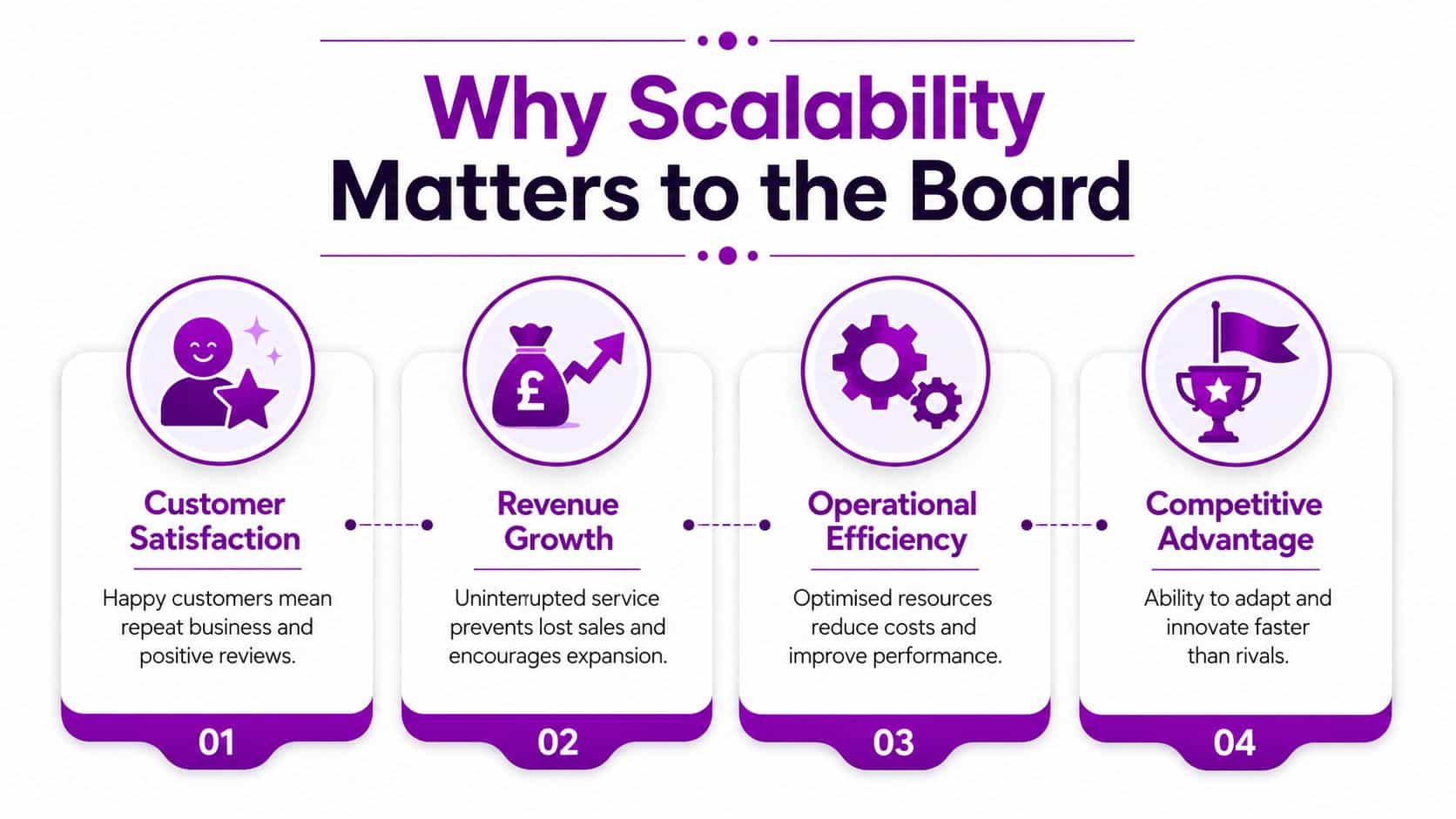
If systems buckle under pressure, the board feels it quickly. Revenue is interrupted. Service teams spend more time apologising than resolving. Managers approve emergency spending that wasn't in the plan. None of that is a technical footnote. It's a business problem.
The financial side of scaling
One of the biggest mistakes I see is assuming that if the technology works, the business is scaling well. That isn't enough. A company can move workloads to Azure, add Microsoft 365 licences, expand Dynamics 365 usage, and still create financial strain if spending gets ahead of operational return.
Recent UK SME data shows that 68% of scaling failures stem from misaligned cash flow management rather than technical limits, and highlights cash runway, operating cash flow ratio, and free cash flow as the critical metrics to watch, according to this UK SME finance analysis.
That matters in the boardroom because growth often increases spend before it improves cash generation. New tools, implementation support, training, licensing, and process redesign all land before the benefits are fully realised.
Why directors need to stay involved
A scalable organisation makes deliberate choices about where it wants flexibility and where it wants control. That isn't something IT should decide alone.
- Customer experience: If systems fail at peak demand, the brand takes the hit.
- Operating model: If every increase in volume needs more manual administration, margins shrink.
- Risk management: If a business depends on one legacy platform or one overloaded database, resilience is weak.
- Investment timing: If leaders don't prioritise properly, they either overspend too early or wait until failure forces a rushed response.
For boards that want stronger governance over this, it helps to look at the wider role of the board in technology and risk decisions, because scalability sits squarely inside that remit.
A short explainer can help frame the conversation internally:
Board-level rule: if growth requires disproportionate cost, rising operational friction, or declining customer experience, the business isn't scaling well, even if the infrastructure is still online.
The Core Types of Scalability Vertical vs Horizontal Scaling
Most discussions of what is scalability become abstract far too quickly. The simplest way to explain it is to think about a delivery fleet.
Vertical scaling is replacing one van with a larger, more powerful lorry. You keep one vehicle, but give it more capacity. Horizontal scaling is adding more vans to the fleet so the work is shared across multiple vehicles.
Both approaches have a place. The right choice depends on the application, the architecture, and how much resilience the business expects.
Vertical scaling
Vertical scaling, often called scale-up, means increasing the power of a single system. That could mean more memory, more processing capacity, or more storage allocated to one server or one database instance.
This is often the fastest route when a system is still fairly simple. It can also suit line-of-business applications that weren't designed to run across multiple nodes.
The trade-off is straightforward:
- It's simpler to implement in many legacy environments.
- It has a ceiling because one machine can only grow so far.
- It concentrates risk because one large system can become a single point of failure.
Horizontal scaling
Horizontal scaling, or scale-out, spreads the load across multiple systems. Instead of relying on one very large machine, the business uses several smaller components working together.
That's the pattern behind most modern cloud platforms. In UK cloud architecture, true scalability is achieved through “elastic by design” principles that mandate microservices, containers, and stateless design to ensure each component scales independently, as explained in this TechUK discussion of cloud scalability.
If your team is working in containerised environments, guidance on scaling Kubernetes pods efficiently helps make this principle practical rather than theoretical.
Horizontal vs. Vertical Scaling Compared
| Attribute | Vertical Scaling (Scale-Up) | Horizontal Scaling (Scale-Out) |
|---|---|---|
| Core idea | Add more power to one machine | Add more machines or instances |
| Implementation | Usually simpler at first | Usually needs more planning |
| Limit | Hard upper ceiling | More flexible for continued growth |
| Resilience | Lower if one system fails | Better fault tolerance when designed well |
| Legacy compatibility | Often easier for older applications | Better suited to cloud-native services |
| Cost pattern | Can become expensive at higher tiers | Can be more efficient if workloads vary |
Where elasticity fits
Elasticity is what makes cloud scaling commercially useful. Instead of keeping spare capacity switched on all the time, cloud services can add resources when demand rises and remove them when it falls.
That changes the economics. You're not only planning for bigger demand. You're planning for fluctuating demand without paying constantly for idle headroom.
For businesses exploring cloud operating models, infrastructure as a service in practical terms is often where this starts making sense. The move isn't just from servers to cloud. It's from fixed capacity to adjustable capacity.
How to Measure Scalability in Your Business
If scalability stays as a vague ambition, it won't survive contact with budget reviews. It needs measurement. That means technical indicators for operational teams and commercial indicators that make sense to directors, investors, and finance leads.
The technical measures that matter
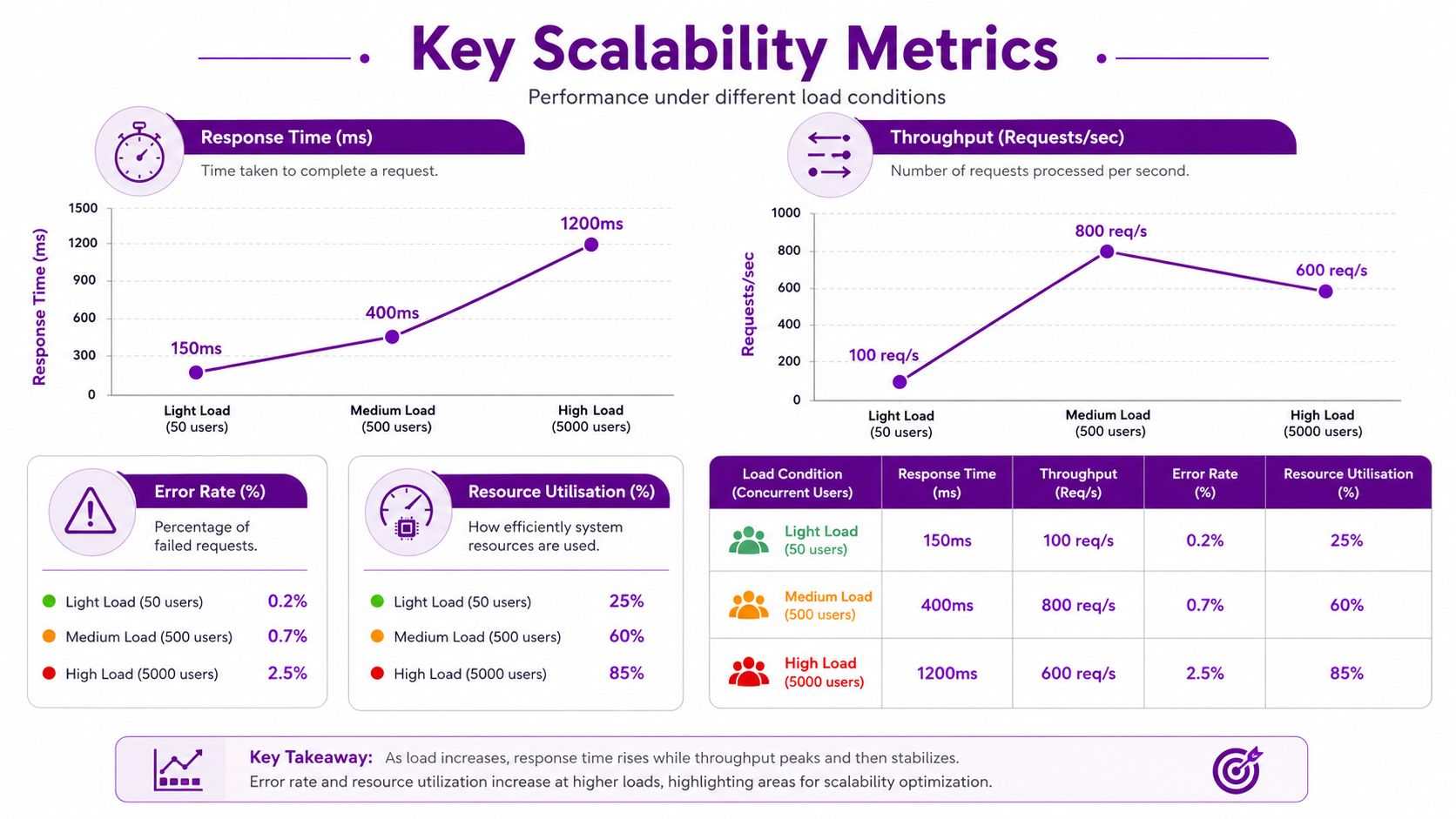
A system under load should be assessed by what happens as demand increases, not by how it behaves on a quiet Tuesday morning.
Key operational measures include:
- Response time for how quickly the system completes a request.
- Throughput for how much work it can process in a given period.
- Error rate for whether failures rise as demand increases.
- Resource utilisation for whether compute, memory, or storage are being used efficiently.
UK government service design guidance takes a disciplined approach here. It requires four mandatory KPIs, continuous performance monitoring, baseline performance across channels before load increases, and analysis of where response times degrade, error rates rise, or throughput plateaus, as set out in the UK government service metrics guidance.
The commercial proof of scalability
Boards and investors also want evidence that growth is economically sound. For UK-based SaaS and cloud-service firms, a healthy LTV:CAC ratio of at least 3:1 is the benchmark for economic scalability, and the Magic Number typically ranges between 0.7x and 0.8x for UK SaaS companies, according to this investor-focused scalability metrics guide.
Those metrics matter because they test whether customer growth creates value or creates activity.
If customer acquisition gets more expensive every quarter and lifetime value doesn't keep up, the business may be expanding, but it isn't scaling efficiently.
What leaders should ask for
A useful scalability dashboard should combine technical and financial views. Not dozens of measures. Just the ones that expose whether growth is healthy.
- Service performance under load: Are customer-facing systems still responsive when demand rises?
- Unit economics: Does each new customer or workload contribute profitably?
- Operational efficiency: Do teams need more manual effort every time volume increases?
- Capacity trend: Can leadership see pressure building before users feel it?
When those answers are visible, scalability becomes something the business can manage rather than something it hopes for.
Real-World Scalability with the Microsoft Cloud
Theory matters, but most mid-sized businesses don't buy theory. They buy tools that need to work on Monday morning with the teams they already have. That's where the Microsoft stack is useful. It gives businesses a path from basic cloud adoption to more mature scaling without forcing a complete platform change.

Azure for variable demand
Azure is often the first place a growing business sees practical scalability. Web apps, APIs, data workloads, and line-of-business systems can be hosted in ways that allow resources to rise or fall with demand.
For UK businesses, scalability is technically defined by the ability of cloud infrastructure to scale resources up or down via virtualisation, and UK industry analysis identifies auto-scaling policies matched to workloads as the primary route to a “flexible, resilient, and cost-effective infrastructure”, according to this cloud scalability overview.
In plain terms, that means a firm doesn't need to buy permanent capacity for its busiest possible day. It can use cloud services that respond to actual workload patterns.
Dynamics 365 as the business grows
Dynamics 365 changes the scalability conversation because growth is rarely only about websites or infrastructure. It's also about whether sales, customer service, finance, and operations can continue working in a joined-up way.
A small sales team can manage with lightweight processes for a while. A larger team usually can't. More leads, more customer interactions, and more hand-offs expose inconsistent data and weak workflows quickly. A well-configured Dynamics 365 environment gives the business room to grow processes as demand grows, rather than rebuilding the operating model every time another team joins.
Power Platform for controlled expansion
Power Platform is where many firms either scale intelligently or create a mess. Power Apps, Power Automate, and Power BI can solve genuine business problems quickly. They can also multiply badly if departments build disconnected tools with no standards.
Used properly, the platform helps businesses extend core Microsoft services without starting from scratch. A departmental app can become a wider operational service if security, governance, data design, and ownership are considered early.
The strongest Microsoft environments aren't the ones with the most tools. They're the ones where Azure, Dynamics 365, Microsoft 365, and Power Platform are connected by clear governance and a sensible operating model.
A Practical Framework for Improving Your Organisation's Scalability
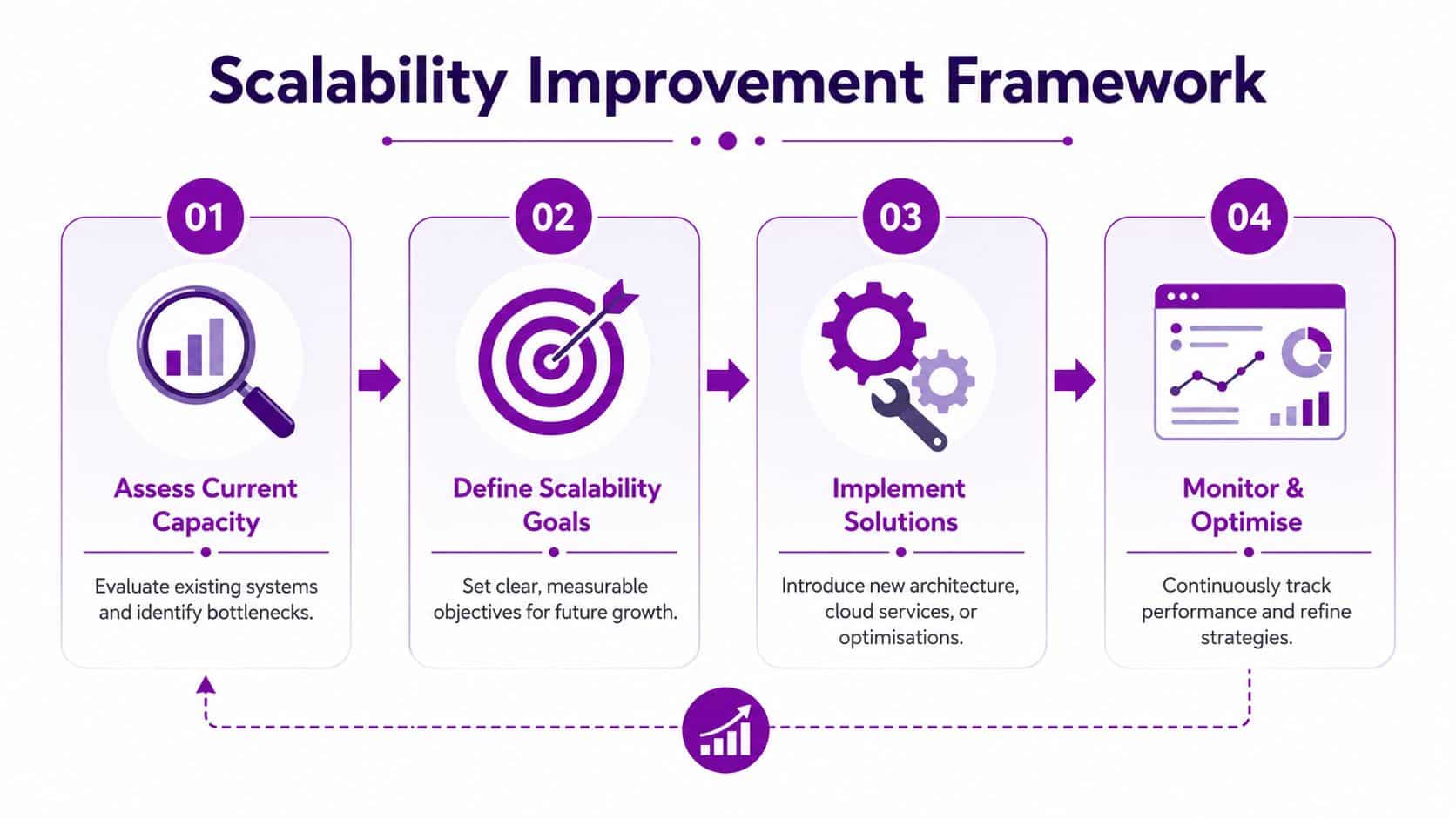
Scalability doesn't improve because a business adopts cloud services and hopes for the best. It improves when teams identify constraints, redesign weak points, and measure whether each change produces better output per unit of cost.
Assess current capacity
Start with evidence, not assumptions. Review where systems slow down, where users complain, and where staff have created manual workarounds. Load testing, transaction tracing, user interviews, and support ticket reviews often reveal the bottleneck faster than broad architecture debates.
Look across the estate, not only at the obvious application. The issue may sit in a database, an integration, a reporting layer, a licensing model, or even a manual approval step that technology can't compensate for.
Define what growth needs to look like
Scalability goals need business language. “Faster” isn't enough. The organisation should decide which services must remain responsive during seasonal peaks, how quickly new users should be onboarded, and which processes need to stay reliable as transaction volume rises.
Practical rule: tie every scalability target to a business outcome. Better service, faster fulfilment, lower overhead, stronger margin, or cleaner management reporting.
Implement changes in the right order
Not every improvement needs a major rebuild. Start with the fixes that remove friction fastest.
- Optimise obvious hot spots such as poor queries, duplicated workflows, or unnecessary data movement.
- Introduce buffering and caching where repeated requests are slowing customer-facing services.
- Break dependency chains so one overloaded component doesn't hold up the rest of the process.
- Automate scale decisions where cloud services can respond faster than manual intervention.
Monitor cost against output
Many projects lose discipline when dealing with scalability. More resource doesn't automatically mean better scalability. Resource costs for scalability must track hardware, software, licensing, labour, and energy expenses per additional unit of output, with scaling efficiency calculated as (Throughput_after / Throughput_before) ÷ (Resources_after / Resources_before), and values near 1 indicating near-linear scaling, according to this guide to scaling and governance.
That formula matters because it stops teams claiming success merely because they added spend. If throughput improves, but resource use rises faster, the system may be growing in size without growing in efficiency.
Build Your Scalable Future with F1Group
A growing business feels healthy until the systems underneath it start slowing sales, billing, service, and reporting. At that point, scalability affects cash flow as much as IT performance.
For many mid-sized UK firms, the answer is not more software. It is a better fit between business goals and the Microsoft stack already in use. Azure can scale infrastructure around real demand, so you are not paying for permanent capacity you only need at peak periods. Dynamics 365 helps sales, operations, and finance work from the same commercial picture, which improves forecasting and reduces the lag between winning work and invoicing it. Power Platform can remove manual steps quickly, but only if governance, security, and support are built in from the start.
That mix matters because weak scalability shows up in commercial metrics before it shows up in a server report. Delayed order processing slows cash collection. Poor CRM adoption weakens pipeline visibility and makes LTV:CAC harder to track with confidence. Manual rekeying adds cost per transaction and limits how far the business can grow without adding headcount.
F1Group has been supporting organisations across Lincoln, Nottingham, Leicester, Scunthorpe, Grimsby, and Newark since 1995. The team covers managed IT services, Microsoft 365 and Azure, Dynamics 365, Copilot AI, Power Platform, custom app development, and cyber security. In practice, that means we can look at scalability as an operating issue, not just a technical one. The constraint is rarely in one system alone.
If your business is growing and your current setup is starting to create delays, workarounds, or rising support overhead, speak to F1Group. Phone 0845 855 0000 or send us a message.