
A parish boundary can look like a line on a map, but for a local charity or small business it can determine who receives support, which councillors represent residents and where local partnerships are built. You may have spent years working with one parish, only to receive a consultation proposing new warding, a merger with a neighbouring parish or the abolition of the existing parish council.
That change isn't merely administrative. A community governance review can alter representation, community identity and the practical routes through which organisations influence local decisions. The organisations that engage early can provide evidence. Those that wait for the final recommendation may find that important local knowledge is missing from the record.
Why Community Governance Reviews Matter to Local Organisations
A community café in an East Midlands village might rely on parish funding, local volunteers and referrals from nearby community groups. If a proposed boundary separates the café from the settlement it serves, its existing partnerships may no longer align neatly with the new governance structure. A small employer could face a similar problem if a growing housing area is assigned to a different parish, changing which local representatives understand its transport, planning or workforce concerns.
The organisation hasn't changed. The administrative context around it has.
A community governance review, often shortened to CGR, can recommend changes to parish boundaries, parish names, council size, warding and election arrangements. It can also create, merge or abolish parishes. For charities, SMEs and community associations, those recommendations may affect:
- Representation: Which parish councillors hear concerns about local facilities, access and development?
- Relationships: Which council, parish meeting or community body becomes the organisation's main local contact?
- Funding and assets: Which local authority structure may discuss grants, facilities or community assets?
- Service reach: Does the proposed boundary reflect the residents and settlements the organisation serves?
- Influence: Can the organisation provide evidence before recommendations become difficult to change?
Why East Midlands organisations need a practical view
The East Midlands includes market towns, villages, expanding settlements and rural communities with different transport links and service patterns. An existing parish boundary may not match how residents travel, use facilities or identify with a place. A line that appears tidy on a council map can split a recognised community or combine settlements with limited day-to-day connection.
For a local organisation, the strongest response isn't just that a proposal feels inconvenient. It explains who is affected, how the community functions and what governance arrangement would work better.
Practical rule: Treat a CGR as a decision about representation and community capacity, not as a technical mapping exercise.
That approach helps trustees and directors move from anxiety to evidence. It also creates a clearer basis for discussions with residents, councillors and council officers.
What Is a Community Governance Review and Where Does It Come From
A community governance review is a formal review of all or part of a principal council's area. Its legal foundation is Part 4 of the Local Government and Public Involvement in Health Act 2007, which gives the process a defined purpose and scope. The review concerns local governance arrangements, including the establishment, abolition or alteration of parishes and parish electoral arrangements, rather than general local services. The Local Government Boundary Commission for England's guidance explains this statutory framework.
Responsibility moved to principal councils on 13 February 2008. Principal councils include district councils, unitary authorities and London borough councils. Before that transfer, decisions of this kind were more closely associated with central government and the Electoral Commission. The change made local authorities and communities the main participants in decisions about parish arrangements.
A principal council can review, create, merge, alter or abolish parish arrangements. It may also consider parish names and styles, council size, parish warding, election arrangements, grouped or de-grouped parishes and parish meetings.
The legal mechanics in plain English
The process normally begins with published terms of reference. These identify the area under review and the matters the council will consider. The council must then consult local government electors and other interested people or bodies, and it must take account of the responses before making recommendations.
The national procedural framework was strengthened by guidance published by the Department for Communities and Local Government and the Local Government Boundary Commission for England on 31 March 2010. The guidance makes clear that consultation isn't a courtesy. It forms part of a democratic process connected to legal authority and electoral consequences.
A council may start a review independently. Residents can also use a valid petition to require one, subject to statutory thresholds and exceptions. Once the review is under way, the council must examine whether arrangements provide effective and convenient local governance while reflecting community identity.
The process therefore has three linked dimensions:
- Legal authority: The council must act within the 2007 Act and relevant guidance.
- Local evidence: Residents, charities, businesses and other interested bodies can submit views.
- Electoral consequence: Recommendations may change wards, council size, election arrangements or the existence of a parish.
For organisations managing consultation records, stakeholder evidence or local decision workflows, software for local government can support document control and transparent reporting, although no system replaces the council's statutory judgement.
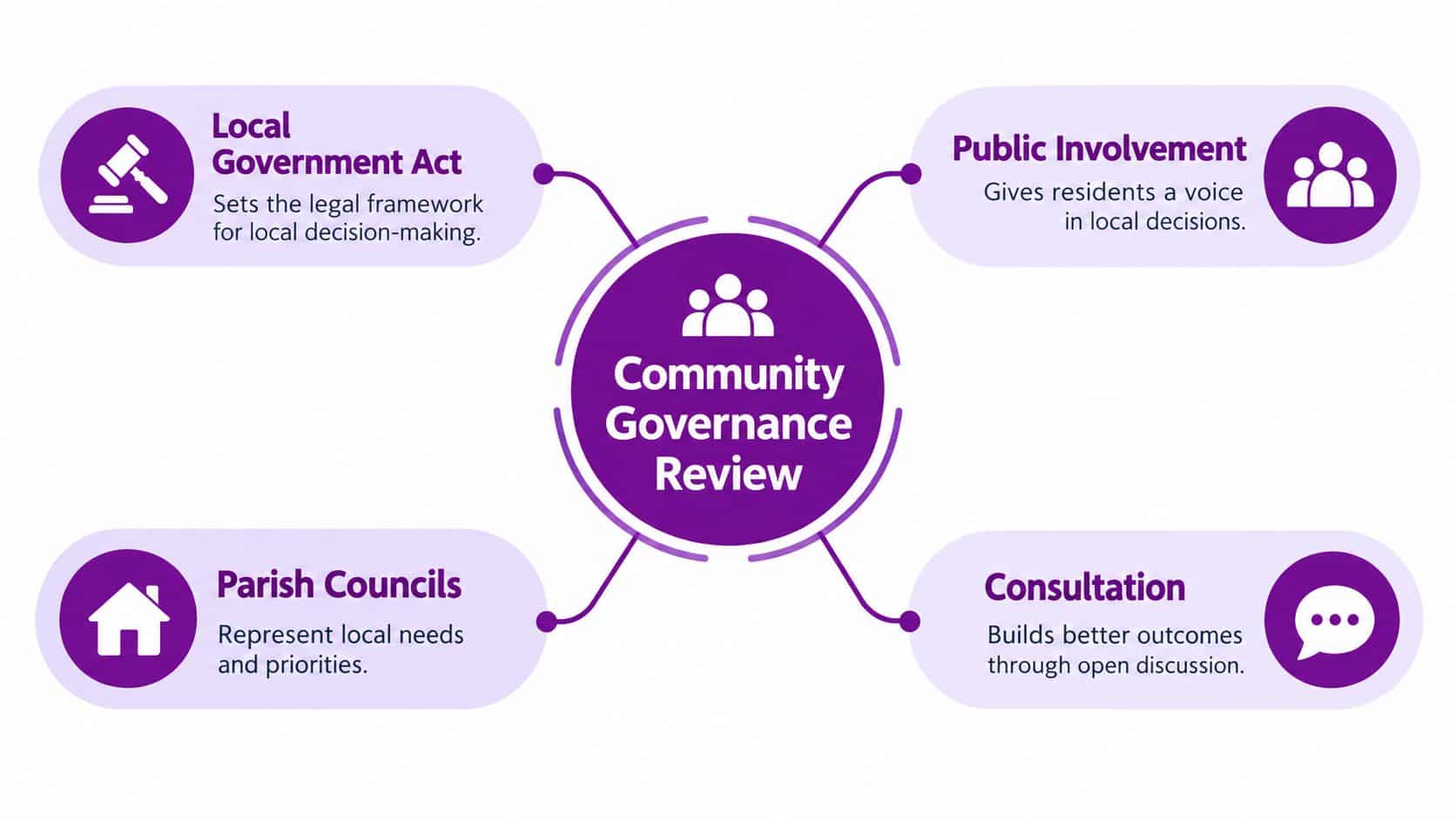
The following video provides additional visual context on the relationship between law, parish governance and consultation.
How to Trigger a Review Through a Valid Petition
A petition can do more than demonstrate public concern. If it satisfies the statutory requirements, it can create a duty for the principal council to conduct a community governance review. That duty remains subject to limited exceptions, including circumstances where a substantially covering review concluded within the previous two years or is already under way.
The threshold depends on the number of electors in the neighbourhood area:
| Elector position | Required petition support |
|---|---|
| Fewer than 500 electors | At least 50% of electors |
| Between 500 and 2,500 electors | 250 electors |
| More than 2,500 electors | 10% of electors |
These thresholds arise under section 80(3) of the 2007 Act, as explained in the Parliamentary explanatory document on community governance reviews. The figures determine whether campaigners can formally trigger the process rather than merely ask the council to consider one.
Build the petition around a clear area
A campaign should define the neighbourhood area precisely before collecting signatures. The proposed area needs to correspond to the governance question. A petition about a new parish, for example, should identify the settlements, streets or communities it would cover and explain why they form a coherent unit.
Organisations should also check the council's validation requirements. Signatures may need to come from eligible local electors, and the petition should make the requested review clear. A charity or business can't substitute its own support for the required elector signatures, but it can help residents understand the proposal, host an accessible meeting or provide neutral information.
Explain the purpose, not just the remedy
A credible petition sets out the underlying problem. Is the current parish split between settlements that share services? Has development changed the pattern of local activity? Does the existing arrangement make representation difficult? Clear evidence gives residents a reason to sign and gives the council a usable starting point for its terms of reference.
Keep a record of how signatures were gathered and ensure that residents understand what signing will do. A petition triggers consideration through the statutory process. It doesn't guarantee the final boundary, council structure or recommendation sought by campaigners.
Key Assessment Criteria and Practical Governance Tests
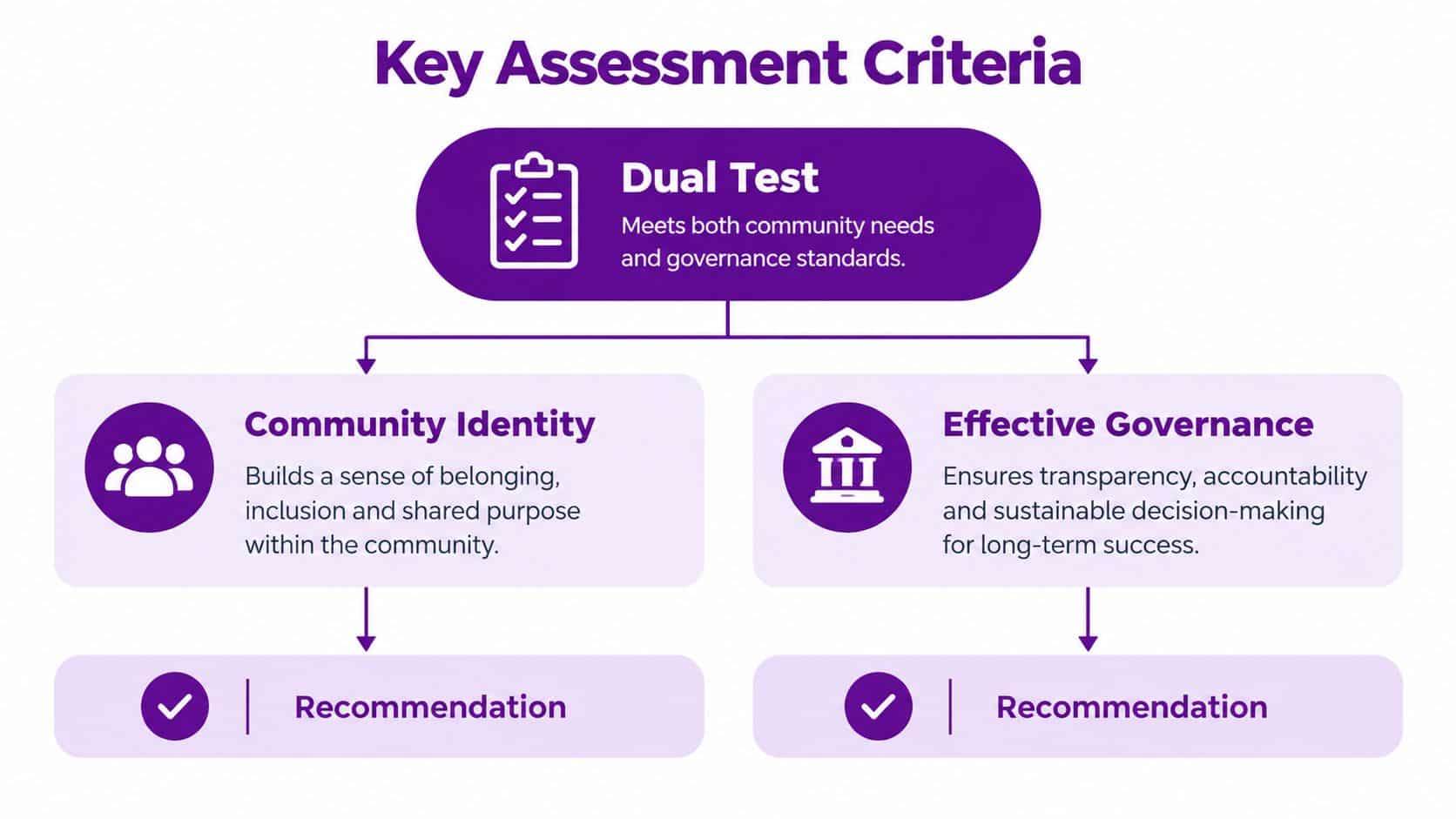
A council can't properly assess a proposal by looking at population figures alone. The statutory test requires attention to community identity and effective and convenient governance. Those ideas overlap, but they aren't identical. Residents may feel connected to one settlement while a different arrangement might provide more workable representation.
The community governance review guidance identifies the practical evidence councils should consider, including population, settlement form, transport links, service catchments, community cohesion and the boundaries used by other democratic or statistical systems.
Community identity
Identity can be evidenced through more than local sentiment. Organisations should map:
- Where residents use shops, schools, halls, health services and community facilities.
- Which settlements share clubs, volunteering networks and public transport routes.
- Whether proposed boundaries divide a recognisable neighbourhood or bring together disconnected places.
- How infrastructure, development and physical geography shape everyday relationships.
A parish boundary that follows an existing ward may be administratively convenient but still divide a community with a strong shared identity. Conversely, a proposal that residents support may need practical safeguards if it creates a parish that can't sustain effective representation.
Effective governance
Councils also consider whether the proposed unit can function. Commonly applied guidance distinguishes three elector thresholds. Where an area has 1,000 or more electors, a parish council must be created. Between 151 and 999 electors, a parish council may be created, with a parish meeting available as the alternative form of governance. Where there are 150 or fewer electors, a parish council is generally not created. A parish council should normally have at least five councillors, according to Bassetlaw's community governance review guidance.
These are practical tests, not a substitute for judgement. A proposal should still explain how the structure would support representation, meetings, elections and local accountability.
Charity trustees and SME directors may also benefit from understanding the difference between organisational purpose, legal structure and governance responsibility. A plain-language resource on nonprofit versus LLC tax and governance can help clarify those distinctions when an organisation is preparing evidence about its own role.
Evidence beats assertion: A map showing service links, settlement patterns and affected facilities usually carries more weight than a general statement that a boundary is “wrong”.
A strong submission connects the two tests. It shows how the proposed arrangement reflects community identity while giving councillors and residents a workable basis for local governance. Trustees should also review the role of the board so that the organisation's evidence has clear approval, ownership and accountability.
The Participation and Accountability Gaps in Modern Reviews
A parish boundary can be redrawn after a consultation that looked busy on paper, yet still leave the people most affected feeling they were never in the room. That happens when a review counts replies but pays less attention to who replied, who was missed, and whose evidence shaped the final recommendation. For charities and SMEs, this gap matters. If they wait for a formal decision notice, they are often reacting too late.
Participation rates already vary sharply across places. The 2024/25 Community Life Survey recorded civic participation in the East Midlands at 38%, below the England average of 41%. It also reported a 36-percentage-point gap between the highest and lowest local-authority rates of civic consultation, from 45% in the Isles of Scilly to 9% in Ipswich. A council running a lawful process therefore cannot assume that an open invitation will produce a balanced picture of local opinion.
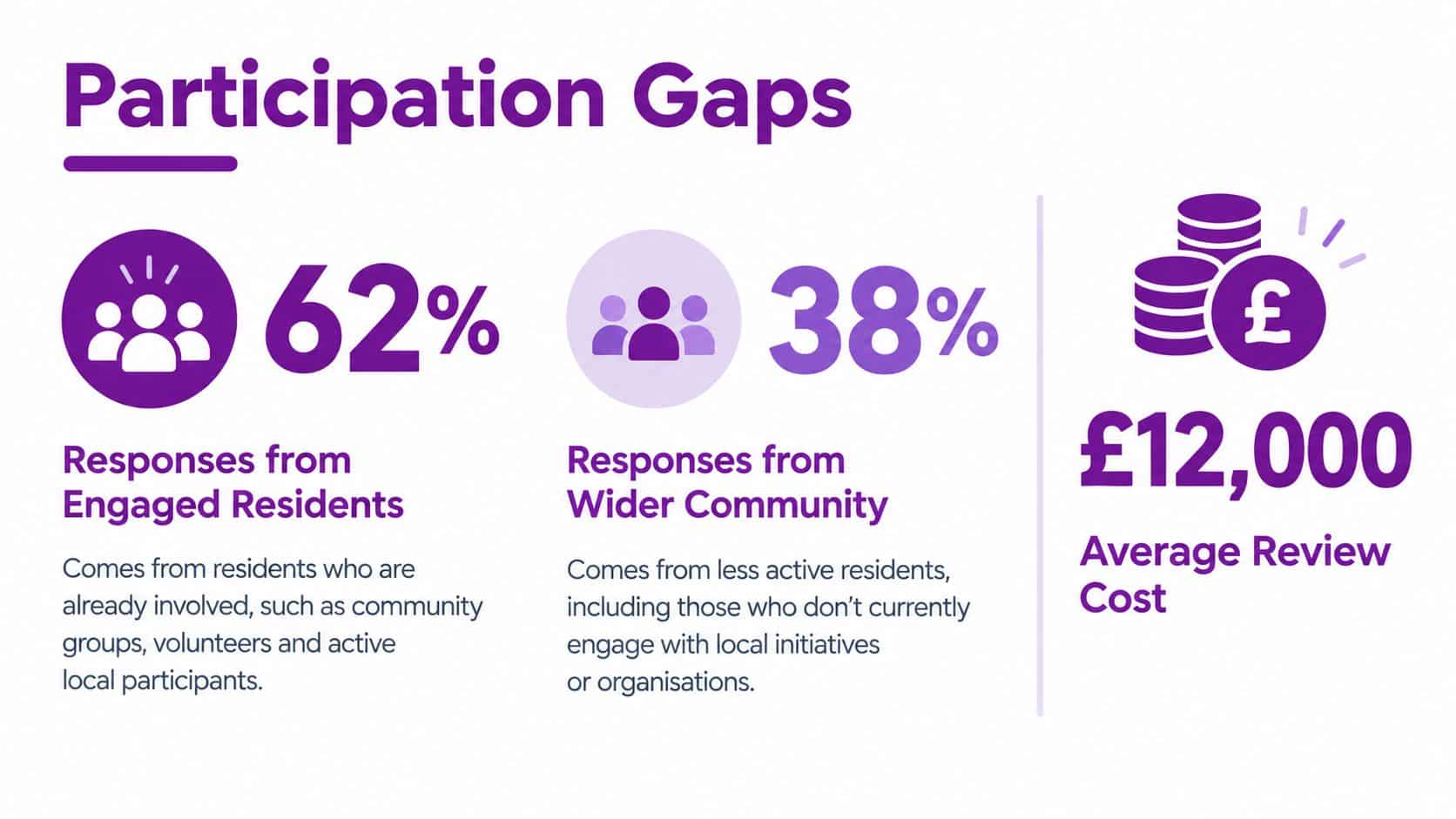
The image is an illustration, An infographic showing that 62% of responses come from engaged residents and 38% from the wider community. rather than a universal measurement for every review. The practical lesson is straightforward. A high response volume can signal activity without proving legitimacy, so councils should test who participated instead of treating raw numbers as consent.
A simple inclusion audit helps. It should check geographic coverage, so one village or estate does not drown out another. It should look at resident profile, including age, disability, deprivation and language accessibility where lawful and appropriate. It should record the access route, such as online forms, paper copies, telephone input, meetings and assisted responses. It should also examine organisational influence and unheard views, especially where established groups speak confidently while shift workers, tenants, younger residents or small traders stay silent.
Accountability has a second weak point. People may be invited to comment yet still have little idea what happened afterwards. In LGIU's State of the Locals 2025, a 2025 survey of 1,805 adults in England found that 3% said they were already actively involved in local-council decision-making, while 23% wanted greater influence and 36% wanted to understand more about how decisions were made.
Councils can close that gap with a you-said-we-did matrix. The format is plain but effective: issue raised, evidence received, council response, and any change made. Where a suggestion is rejected, the reason should be stated clearly. That gives charities and SMEs something concrete to challenge, support, or refine, instead of leaving them to guess whether participation changed anything at all.
How Local Organisations Can Effectively Engage with a Review
Effective engagement starts before an organisation writes its formal response. Charities, SMEs and community bodies should treat the review as a managed evidence project, with a named lead, a timetable and a record of decisions.
Start with the terms of reference
Read the council's terms of reference first. Identify the area under review, the questions being asked, the evidence the council wants and the dates for each consultation stage. A response that addresses issues outside the defined scope may be sincere but less useful.
Create a simple evidence register with four columns:
| Question | Evidence | People affected | Requested outcome |
|---|---|---|---|
| Does the boundary reflect local identity? | Service maps, user records and community links | Residents and users across affected settlements | Retain or amend the proposed boundary |
| Would the structure govern effectively? | Meeting access, travel routes and representation evidence | Electors and local groups | Recommend an appropriate arrangement |
| Who may be missing from consultation? | Outreach records and response coverage | Under-represented residents | Extend engagement through accessible routes |
Submit evidence that can be tested
Describe the organisation's role, but don't rely on organisational status alone. A charity should explain where its beneficiaries live, how its services operate across the proposed boundary and which practical consequences would follow. An SME can contribute evidence about local employment, transport, customer access or relationships with community facilities, while respecting confidential information.
Use maps, anonymised service data, meeting notes and short resident testimonies where appropriate. Separate observed facts from opinion. If your organisation supports a proposal, explain the alternative you considered and why the preferred option performs better against identity and governance criteria.
Keep inclusion and accountability visible
Run targeted outreach through paper forms, accessible meetings, trusted community intermediaries and translated or easy-read material where needed. Record which routes reached which settlements and whether minority or under-represented groups shaped the final position.
A network such as the leaders collective on ForumSpace) may help local leaders exchange practical ideas, but any external network should complement direct engagement with the principal council.
After submitting evidence, ask for a response matrix, publication of the final recommendation and a post-implementation review point. Community health partnerships offer a useful reminder that durable local outcomes often depend on organisations coordinating across institutional boundaries, not working in isolation.

Conclusion and Next Steps for Your Organisation
A community governance review can reshape local representation, community identity and the routes organisations use to influence decisions. The legal framework matters, but legal awareness alone won't protect a charity, SME or community group from an unsuitable outcome.
Start by identifying the review area and reading the terms of reference. Then build evidence around community identity, effective governance, service links and participation quality. If a petition is appropriate, check the relevant elector threshold carefully. If consultation has already started, submit a structured response and ask how the council will show which contributions changed its recommendation.
The strongest organisations don't just attend a meeting or complete a survey. They document who is affected, reach people who are less likely to participate and request a clear account of what happened to the evidence. A you-said-we-did matrix, inclusion audit and post-implementation review can turn consultation from a one-off exercise into accountable local governance.
F1Group can help organisations manage the digital records, collaboration systems and reporting processes that support structured engagement with local governance reviews. Visit F1Group, or phone 0845 855 0000 today, and send us a message about the practical support your organisation needs.