
When we talk about supply chain risk, it’s easy to picture the physical world: container ships stuck in a canal, lorries delayed by motorway closures, or a warehouse struggling to dispatch orders. That’s certainly part of the picture. But for a modern business, the biggest threats are often invisible.
Supply chain risk is anything that could disrupt the flow of goods, services, and data from your suppliers right through to your customers. And these days, it’s the data and services part that can bring a company to its knees.
What Supply Chain Risk Means for a Modern Business
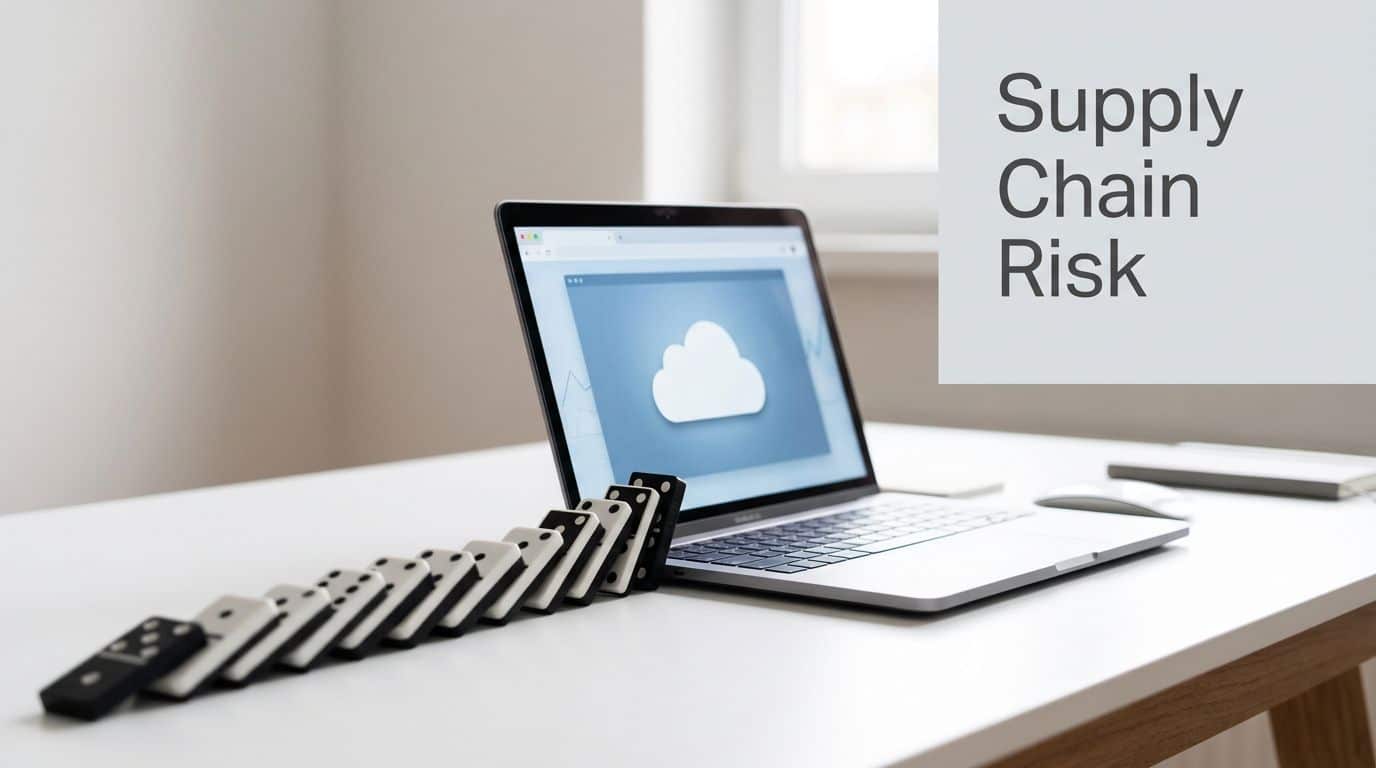
Think of your business as a line of dominoes. Each one represents a critical function—sales, finance, operations, customer support. In a traditional supply chain, a delay in physical parts might cause a few dominoes to wobble.
But what happens when the dominoes are digital? A security breach at your CRM provider, an outage from your cloud host, or a ransomware attack on your accounting software can knock over the entire line in an instant. Your business grinds to a halt.
The New Digital Front Line
This isn't just a theoretical problem. The reality is that these disruptions are happening more frequently than ever. Recent survey data from McKinsey revealed that over 70% of companies suffered at least one major supply chain disruption in the last year. That’s a staggering number. You can discover more about these supply chain findings on mckinsey.com.
For small and medium-sized businesses (SMBs) here in the UK, the exposure is significant. Your operations are built on a complex web of digital services, including:
- Software-as-a-Service (SaaS): Your everyday tools like Microsoft 365, your finance package, or your sales CRM.
- Infrastructure-as-a-Service (IaaS): The cloud platforms, like Microsoft Azure, that run your applications and store your data.
- Managed Service Providers (MSPs): The external IT experts you trust to manage your technology and security.
Each of these is a critical link. A failure in any one of them is a failure in your business.
To get a clearer picture, here’s a quick summary of the main risks that can affect your business through its supply chain.
Key Supply Chain Risk Categories for UK SMBs
| Risk Type | Description | Example for a UK SMB |
|---|---|---|
| Cybersecurity | A breach originating from a connected supplier or partner. | Your marketing agency gets hacked, exposing shared customer data. |
| Third-Party/Vendor | A key supplier suddenly goes out of business or fails to deliver. | The developer of your bespoke e-commerce plugin ceases trading. |
| Operational | Internal process failures or dependencies that create vulnerabilities. | All your critical business data is stored with one cloud provider with no backup. |
| Compliance | A supplier fails to meet regulatory standards (like GDPR), putting you at risk. | Your payment processor is found to be non-compliant with new data laws. |
| Geopolitical/Logistics | Global events, trade disputes, or shipping problems affecting services. | A key software provider’s data centre is located in a politically unstable region. |
Understanding these categories helps you see where the dangers lie beyond just physical goods.
The single most important shift in mindset is to start viewing your digital partners as a direct extension of your supply chain. It forces you to ask the right questions about dependency, resilience, and security.
Of course, ensuring you have reliable transportation solutions is still fundamental for any business dealing with physical products. But in 2026, protecting your digital connections is just as vital for building a resilient operation that’s ready for anything.
Ready to secure your digital supply chain and protect your business from disruption? Phone 0845 855 0000 today or Send us a message.
Finding the Hidden Risks in Your IT and Cloud Services
When most business owners think about supply chain risk, they picture a delayed shipment or a fire in a warehouse. But in reality, some of the most damaging threats are hiding in plain sight, right inside your IT systems. This creates a huge risk in the supply chain that too many businesses simply don't see.
These digital weak points are tied directly to the services you use every single day. Think about your Microsoft 365 subscription, the servers you run on Azure, or the dozens of other third-party apps your team relies on. Every one of them is a potential link in the chain that could break.
Unpacking the Digital Dangers
It’s easy to underestimate these hidden dangers, but the disruption they can cause is immense. What happens if a catastrophic data breach hits one of your key software vendors, instantly exposing your confidential client data? Or imagine the chaos when a major cloud outage grinds your team's productivity to a complete halt for hours, or even days.
These aren't just abstract worries; they are very real threats to your business. The first step towards building genuine resilience is realising that your 'supply chain' now includes every digital partner you trust with your data and operations. This shift in thinking is gaining traction. A recent report from WTW shows that companies are now far more focused on mapping these digital vulnerabilities to protect themselves from escalating global risks. You can discover the full findings on wtwco.com.
To get a handle on this, it helps to put these risks into clear categories. Once you break them down, you can start to see exactly where your own weaknesses might be.
The Four Core Digital Supply Chain Risks
Your digital supply chain is vulnerable to a few key types of risk, and each one carries different consequences. Recognising them is the foundation of effective security risk management.
-
Cybersecurity Failures: This is the one that gets the most headlines. A weakness in a supplier's software gets exploited by attackers, giving them a backdoor into your systems. The result? Data theft, ransomware, or financial fraud.
-
Vendor Instability: What if a critical software provider suddenly goes out of business or gets bought by a competitor? This can trigger a frantic scramble to find a replacement, leading to service loss, forced migrations, and unexpected costs.
-
Operational Downtime: Your business runs on the assumption that your suppliers' services are always on. An outage at your cloud provider or CRM vendor isn't their problem—it translates directly into downtime for your own operations, hitting sales and customer service hard.
-
Compliance Gaps: You are ultimately responsible for the data you hold, even when a third party is processing it for you. If one of your suppliers fails to meet its regulatory duties (like GDPR), your business could face hefty fines and serious reputational damage.
Thinking in these categories changes how you view your suppliers. They aren't just vendors; they're partners whose security, stability, and compliance directly impact your own. A weakness in their business becomes a direct risk in the supply chain for yours.
By identifying and categorising these digital dependencies, you can start building a much stronger and more secure foundation for your business.
Ready to secure your digital supply chain and protect your business from disruption? Phone 0845 855 0000 today or Send us a message.
A Practical Framework for Assessing Your Vendor Risk
Feeling swamped by the sheer number of digital partners you rely on? It’s a common problem. The good news is you don’t need some massive corporate process to get a handle on it. A simple, step-by-step approach can cut through the noise and show you exactly where to focus.
First things first: map out your critical suppliers. We're not just talking about the companies that send you physical goods. This is about every single digital partner whose services are vital to your day-to-day operations. Think about your cloud provider (like Microsoft Azure), your CRM software, your accounting platform, and of course, your IT support partner.
Creating a Simple Risk-Rating System
Once you have a clear list of who your key vendors are, the next move is to create a simple but effective risk-rating system. You don't need a complex algorithm; a basic impact matrix is the perfect tool for any SMB to start with.
This system helps you weigh how important a supplier is against their potential weak spots. For instance, a "High" impact supplier is one whose failure would bring your business to a screeching halt—your main cloud provider is a classic example. A "Medium" impact supplier might cause serious disruption but not a complete shutdown, like your marketing automation tool going down. A "Low" impact supplier might be an inconvenience, but your core business won't stop.
This flow chart breaks down how hidden risks can travel from vendors, through the cloud, and right into your compliance obligations.
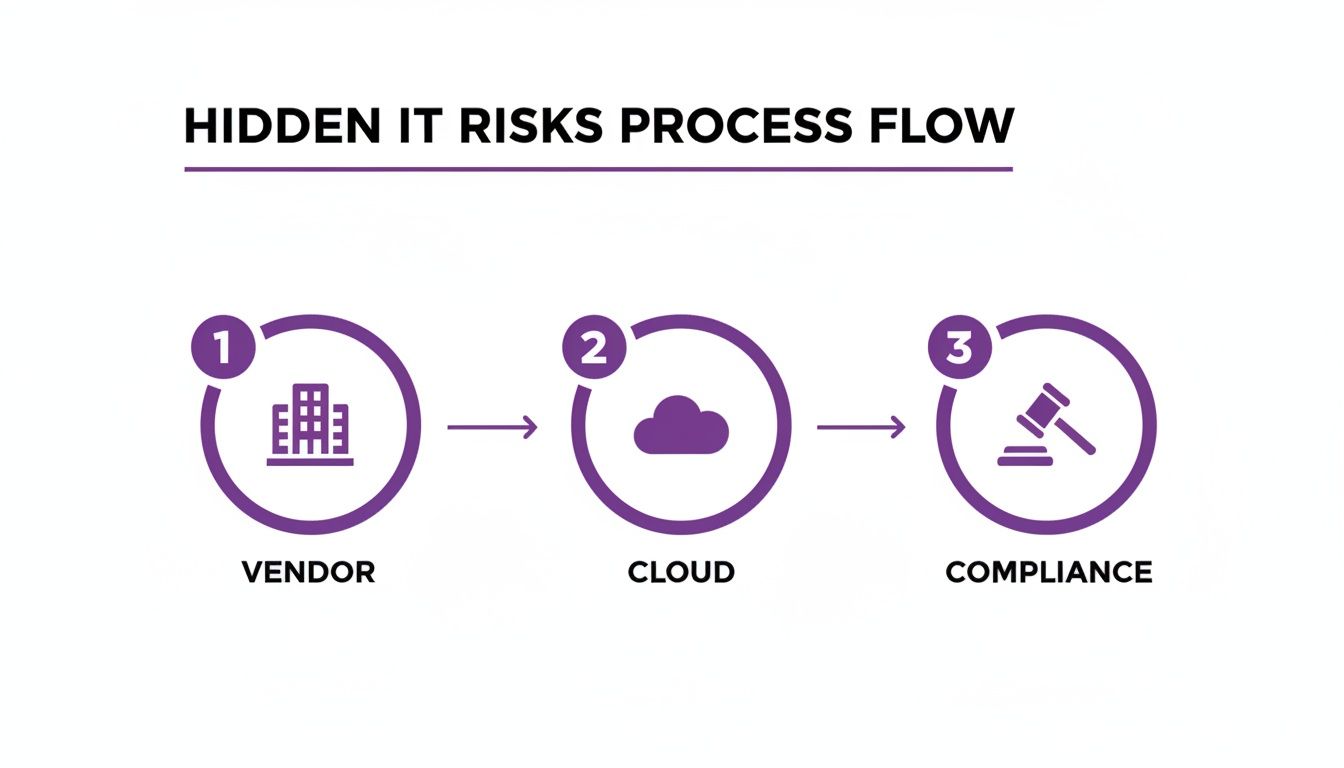
As you can see, a single vulnerability can have a domino effect across your entire digital supply chain, which is precisely why it’s so important to check every link in that chain.
Key Questions to Ask Your IT Vendors
With your suppliers mapped out and rated, it’s time to start asking some tough but fair questions. This is all about due diligence. Never feel hesitant to ask a vendor for proof of their security measures or to see their business continuity plans.
Here’s a straightforward checklist to get you started:
- Security Posture: Can you show us your security certifications? Think ISO 27001 or Cyber Essentials.
- Business Continuity: What's your game plan if a major disaster or outage hits? Crucially, what are your recovery time objectives (RTOs)?
- Data Protection: How do you handle GDPR and other data regulations? Where, geographically, will our data be stored?
- Incident Response: If you have a security breach, what’s your process for letting us know? How quickly will we be informed?
When assessing vendor risk, it's not just about their tech; it's also about your contracts. Implementing robust contractual safeguards is a must. Clauses that clarify ownership, like Retention of Title clauses, can offer vital protection by defining who owns what until payment is complete.
Gathering this information is a critical part of building a more resilient business. For a deeper look at vetting potential partners, our guide on creating a Request for Proposal (RFP) gives you a structured way to ask these questions. By taking these practical steps, you shift from being a passive user of services to an active manager of your digital risk in the supply chain.
Here are some real-world strategies for securing your digital supply chain, explained in plain English.
Real-World Strategies to Secure Your Digital Supply Chain
Knowing your risks is a great first step, but it’s what you do next that counts. For UK businesses running on Microsoft’s cloud, turning that knowledge into action is the only way to stay safe.
The good news is you don't need to reinvent your entire business to protect yourself. We can break down the process into three core pillars. Think of these as a straightforward framework for building digital resilience, one that stops a minor tech hiccup from spiralling into a full-blown crisis.
Pillar 1: Get Serious About Vendor Management
Your relationship with a new supplier has only just begun when the contract is signed. From that point on, strong vendor management is all about making sure they're holding up their end of the bargain and keeping your data safe. It all starts with the paperwork.
Specifically, we're talking about Service Level Agreements (SLAs). An SLA isn’t just another document; it’s your best line of defence. It must spell out, in no uncertain terms, uptime guarantees, support response times, and the financial penalties for failing to deliver. Never just accept a boilerplate template. If a critical piece of software goes down, what are the agreed recovery times? Will you get service credits? Get it in writing.
This kind of contractual rigour is becoming non-negotiable. Leading analysts like Moody's have flagged rising geopolitical tensions and increased regulatory scrutiny as key trends for 2026. Watertight supplier agreements have moved from being good practice to an absolute necessity. You can discover more about these supply chain trends on moodys.com.
Pillar 2: Fortify Your Technical Defences
The second pillar focuses on practical, hands-on security measures you can implement within your own Microsoft environment. These are powerful tools that shrink your attack surface and contain the damage if one of your suppliers is compromised.
If you do nothing else, start with these two high-impact actions in Microsoft 365 and Azure:
- Enforce Multi-Factor Authentication (MFA): This is the single most effective step you can take, period. Requiring a second form of verification makes it monumentally harder for an attacker to get in, even if they’ve stolen a password from a breach at another company.
- Configure Conditional Access Policies: This brilliant Azure AD feature lets you create automated security rules. For example, you can automatically block logins from high-risk countries or demand MFA whenever someone tries to access sensitive files. It’s like having a digital bouncer working for you 24/7.
A small investment in proactive mitigation can save you a fortune. A project to harden your Microsoft 365 security might cost a few thousand pounds, but that pales in comparison to the tens of thousands in potential losses from a data breach or operational shutdown.
Pillar 3: Build Resilience With an Incident Response Plan
Our final pillar is built on a simple truth: no defence is unbreakable. Sooner or later, something will go wrong. Your survival and recovery will be defined by how you react in that moment, not by hoping it never happens.
An incident response (IR) plan is your playbook for a crisis.
Imagine a key cloud service suffers a major outage. Without a plan, you have chaos. Phones ring off the hook, people don't know what to do, and panic sets in. With a plan, your team has clarity and purpose:
- Activate Communication Channels: The first step is to let your staff and key customers know what's happening and what to expect.
- Invoke Backup Procedures: You might switch to offline work or activate secondary systems you've prepared for this very scenario.
- Liaise with the Vendor: Your designated IT lead is already on a direct line to the supplier, getting real-time updates.
- Document Everything: A clear log of events is kept, which is invaluable for the post-mortem and any insurance claims.
These three pillars—stronger vendor management, technical hardening, and a clear response plan—completely change the game. They shift you from a position of vulnerability to one of control, ready to handle risk in the supply chain.
Ready to secure your digital supply chain and protect your business from disruption? Phone 0845 855 0000 today or Send us a message.
How to Build a Culture of Continuous Monitoring

Securing your digital supply chain isn't something you can just set up, tick off a list, and forget about. Think of it more like keeping your car serviced. It’s a continuous process of watching, checking, and fine-tuning to keep things running smoothly and safely.
The aim is to build a culture of constant awareness that becomes a natural part of your business rhythm, without bogging everyone down in red tape. This moves you from firefighting mode—only acting when something breaks—to a proactive position where you can spot trouble brewing and head it off at the pass.
Simple Governance for Lasting Resilience
For a small or medium-sized business, good governance doesn't require a whole department of risk managers. It really just comes down to simple, clear practices that make sure someone is always keeping an eye on things. This means giving people direct ownership and scheduling regular check-ins so nothing gets missed.
Here are a few straightforward steps to get started:
- Assign Clear Ownership: Make one person responsible for vendor management. This could be an operations manager or a director whose job is to track contracts, manage relationships, and spearhead risk reviews.
- Schedule Regular Risk Reviews: Put quarterly or bi-annual risk reviews in the diary. These are dedicated times to look over your critical suppliers, check for new security alerts, and adjust your risk ratings accordingly.
- Maintain a Centralised Vendor List: A simple spreadsheet can work wonders. Keep an up-to-date list of all your key digital suppliers, noting contract renewal dates, main contacts, and their current risk score.
These actions create a solid framework for vigilance. You can also look into services that give you continuous visibility, like dark web monitoring services, which can alert you if credentials from your company or one of your suppliers are found for sale online.
The most crucial cultural shift is moving from "set and forget" to "always be watching." A single unpatched device or an overlooked vulnerability in a supplier's network can create a significant risk in the supply chain, and ongoing vigilance is the only way to catch it.
Partnering for Expert Monitoring
Let’s be realistic. For many business owners, finding the time and developing the expertise for continuous security monitoring is a huge ask. This is where leaning on a trusted IT partner makes all the sense in the world. Rather than trying to become a cybersecurity expert overnight, you can hand that responsibility to a team that lives and breathes this stuff.
An expert IT partner takes this weight off your shoulders. They can handle the technical monitoring, have the security-focused conversations with your vendors, and provide the governance structure needed to keep your digital supply chain secure. This frees you up to focus on what you’re best at: running and growing your business.
To discuss how expert monitoring can protect your business from emerging threats, phone 0845 855 0000 today or Send us a message.
Your Partner in Building a Resilient UK Business
We’ve covered a lot of ground. You should now have a much clearer picture of how supply chain risk is no longer just about physical goods, but deeply embedded in your digital operations. We've seen that assessing these risks is the first step, and that practical, proactive mitigation is well within your grasp.
But knowing is one thing; doing is another. Tackling these intricate digital risks shouldn’t mean pulling you away from what you do best. This is where leaning on a trusted, local IT partner becomes one of the smartest investments you can make in your business's future.
Taking a structured approach to risk management fundamentally changes your posture. You move from constantly firefighting to being genuinely prepared. This shift doesn’t just protect your bottom line—it builds customer trust and carves out a real competitive advantage.
Ultimately, you have the power to transform how your business anticipates and responds to threats. The final, most important step is turning this awareness into action. A secure digital supply chain isn't a luxury; it's the bedrock of any modern, resilient company.
Ready to secure your digital supply chain and protect your business from disruption?
Phone 0845 855 0000 today or Send us a message to discuss how we can help build your resilience.
Got Questions? We’ve Got Answers
We hear these questions all the time from UK business owners trying to get to grips with supply chain risk. Here are some straightforward answers to help you figure out your next steps.
As a small business, do we really need to worry about this?
In a word, yes. It's a common misconception that size offers protection. In reality, smaller businesses are often more exposed because a single disruption can have a devastating ripple effect across the entire operation.
Think about your digital supply chain – the software and cloud services you rely on daily, like Microsoft 365. A security breach at one of those vendors is a direct threat to your data, your finances, and the reputation you've worked so hard to build.
Being proactive about risk in the supply chain isn't about paranoia; it's about building a resilient business that can weather the unexpected.
What's the cost of implementing these risk strategies?
It’s not as much as you might think. Many of the most effective first steps are low-cost or even free, already included in the services you use. For instance, switching on Multi-Factor Authentication (MFA) in Microsoft 365 is a massive security boost that costs nothing extra.
The real question isn't what it costs to act, but what it costs not to. A managed service to handle this might be a few hundred pounds a month, but that pales in comparison to the tens of thousands you could lose from a single supply chain incident.
We can provide a proper assessment tailored to your specific setup and budget.
Isn't my cloud provider responsible for security?
This is a crucial point that trips up many businesses. Cloud giants like Microsoft use a ‘Shared Responsibility Model’. It’s a bit like a landlord-tenant relationship. They are responsible for securing their global infrastructure – the physical data centres, the servers, the network. That's 'the cloud'.
However, you are responsible for securing everything you put inside it. That means your data, your user accounts, and how you configure your services. It's on you to manage who has access and to defend your team from threats like phishing emails. An expert partner can help you manage your side of the bargain effectively.
Where should we start with assessing our vendors?
Don't try to boil the ocean. Start with what matters most.
- First, identify the three to five suppliers whose failure would cause the most chaos for your business.
- This list will almost certainly include your core software (like your accounting or CRM platform), your primary cloud provider (Microsoft 365, for example), and your IT support company.
Once you have your list, simply start by asking for their security policies or any compliance certificates they hold. The key is to begin, not to do everything at once. A phased, focused approach is far more manageable and effective.
Of course, if that sounds like too much, you can always have a team like ours manage the entire process for you.
Ready to secure your digital supply chain and build a more resilient business?
Phone 0845 855 0000 today or Send us a message.