
Having a documented strategy for IT is what separates businesses that are constantly fighting fires from those that are actively building for the future. It's the difference between IT being a drain on resources and it becoming a genuine competitive advantage. This plan ensures every technology investment you make directly pushes your core business goals forward.
Why Your Business Needs a Modern IT Strategy
In most small and mid-sized organisations, the IT setup tends to grow organically, almost by accident. A new server gets bought when the old one gives up the ghost. Different departments adopt their own favourite software. Security measures get bolted on after a near-miss. This piecemeal approach might feel like it's saving money day-to-day, but it’s quietly building up hidden risks and inefficiencies that will eventually stifle your growth.
Trying to run a business without a cohesive strategy for it is like trying to navigate a new city without a map. Decisions get made in isolation, creating a tangled mess of systems that don't talk to each other. This inevitably leads to money being wasted on redundant tools and software licences, not to mention the countless hours your team loses to clunky manual workarounds.

The Real-World Consequences of a Missing Strategy
Let's be clear: operating without a formal IT plan isn't just inefficient, it's dangerous. The fallout can range from daily operational headaches to genuine, business-threatening events.
I’ve seen it happen time and again. The key risks usually fall into a few categories:
- Wasted Spend: You end up buying technology that doesn't fit your long-term goals. A classic example is a company spending £10,000 on a new on-premise server, only to realise six months later that a cloud migration is essential for their remote working ambitions.
- Security Vulnerabilities: A patchwork of systems is a hacker's dream. It creates gaps in your defences. Without a unified plan, it's frighteningly easy to miss critical security updates or fail to enforce basics like multi-factor authentication across every single platform.
- Operational Drag: When your software doesn't play nicely together, it slows everyone down. This isn't just a minor annoyance; it directly hits productivity and can start to damage the customer experience when staff are scrambling to find the right information.
- Missed Opportunities: Make no mistake, your competitors are using technology to get ahead. Without a strategic view, you’ll be left in their dust, unable to adopt the tools that could improve your service or open up entirely new revenue streams.
A well-crafted strategy transforms IT from a necessary expense into a powerful engine for growth. It ensures every pound spent on technology is an investment in achieving your specific business objectives, from improving customer retention to increasing market share.
Shifting from Reactive to Proactive Planning
A modern strategy for IT is all about making deliberate, informed choices. It forces you and your leadership team to ask the big, important questions. Where are we taking the business in the next three years? What technology and skills will we need to get there? How do we protect our data and systems as we expand?
Adopting this proactive mindset allows you to anticipate needs instead of just reacting to problems. It means you can plan for system upgrades before they fail, budget for new software that will support a new product launch, and build a security framework that can actually scale with your business.
When you align your technology roadmap with your commercial ambitions, IT stops being a barrier and starts becoming one of your most powerful tools for success.
Ready to build a strategy that drives real business results? Phone 0845 855 0000 today or Send us a message to discuss how we can help.
Connecting Technology with Your Business Objectives
A solid IT strategy never starts with chasing the latest shiny tech. It begins with a much simpler, more powerful question: "What does our business actually need to achieve?"
The goal is to make sure every pound you spend on technology directly pushes your business forward. Whether you're trying to boost customer satisfaction, make your sales team more efficient, or break into a new market, your tech should be your biggest ally, not just a cost centre.
Too often, tech decisions happen in a silo. Sales is crying out for a new CRM. Finance wants to upgrade its accounting software. Operations is eyeing a new project management tool. Without a central strategy, you end up with a patchwork of disconnected systems that solve one-off problems but do little to move the whole organisation in the right direction.
Uncovering What Really Matters
First things first: get your key stakeholders in a room for a proper, candid conversation. This isn't just an IT meeting. It's a business strategy session where technology is a core part of the discussion. The aim is to get past vague wishes and dig into the specific goals and real-world pain points of each department.
Your job is to act as the translator, turning those business goals into clear technology requirements.
Here’s how that looks in practice:
- The Business Goal: "We need to give our customers a much better experience."
- The Technology Translation: That could point to implementing Dynamics 365 to get a single, unified view of every customer interaction, from their first enquiry to after-sales support.
- The Business Goal: "Our sales team is drowning in admin instead of selling."
- The Technology Translation: This is a clear signal for automation. You could use Power Automate within Microsoft 365 to handle repetitive tasks or bring in Copilot AI to summarise meeting notes and draft follow-up emails.
Framing the conversation this way ensures every potential tech solution is tied directly to a measurable business outcome. It's the only way to build a business case for investment that will get a "yes".
Conducting an Honest IT Maturity Assessment
Once you know where you want to go, you need an equally clear picture of where you are right now. This is where an IT maturity assessment comes in. It's a structured, brutally honest look at your current technology, capabilities, and processes.
An IT maturity assessment isn’t about pointing fingers. It’s about establishing a realistic baseline so you can plan the journey ahead and spot the critical gaps that could trip you up.
This assessment needs to cover a few key areas:
- Infrastructure: Are you still relying on creaking on-premise servers when your business model desperately needs the flexibility of the cloud?
- Applications: Are you paying for three different tools that all do the same thing, creating wasted spend and siloed data?
- Security: Are your security basics, like multi-factor authentication and staff training, actually being used consistently across the board?
- Skills: Does your team have the know-how to manage the tech you have today, let alone the tech you'll need tomorrow?
The insights you get from this process are gold. You might discover that your big goal of "data-driven decision-making" is a non-starter because your customer data is trapped in three different systems that don't talk to each other. Suddenly, a data integration project shoots to the top of your priority list.
An assessment gives you the hard evidence to make informed decisions, turning your digital transformation strategy from guesswork into a structured plan.
This detailed understanding of your starting point and your destination is what allows you to build a realistic, prioritised roadmap—and that's the next crucial step.
Crafting Your Prioritised Technology Roadmap
Right, you’ve done the groundwork. You understand what the business wants to achieve and you’ve taken a good, hard look at your current tech setup. Now for the exciting part: building the roadmap that will actually get you there. This isn’t a list of gadgets and software you fancy; it's a carefully sequenced plan for the next one to three years, mixing quick, impactful changes with bigger, more strategic projects.
For most UK businesses, the Microsoft ecosystem is the natural place to build. It’s integrated, powerful, and familiar. A smart roadmap usually layers its components, starting with the nuts and bolts and building up to the really clever stuff.
Think of it like this: your business goals and your current reality are the inputs. The roadmap is the direct output.
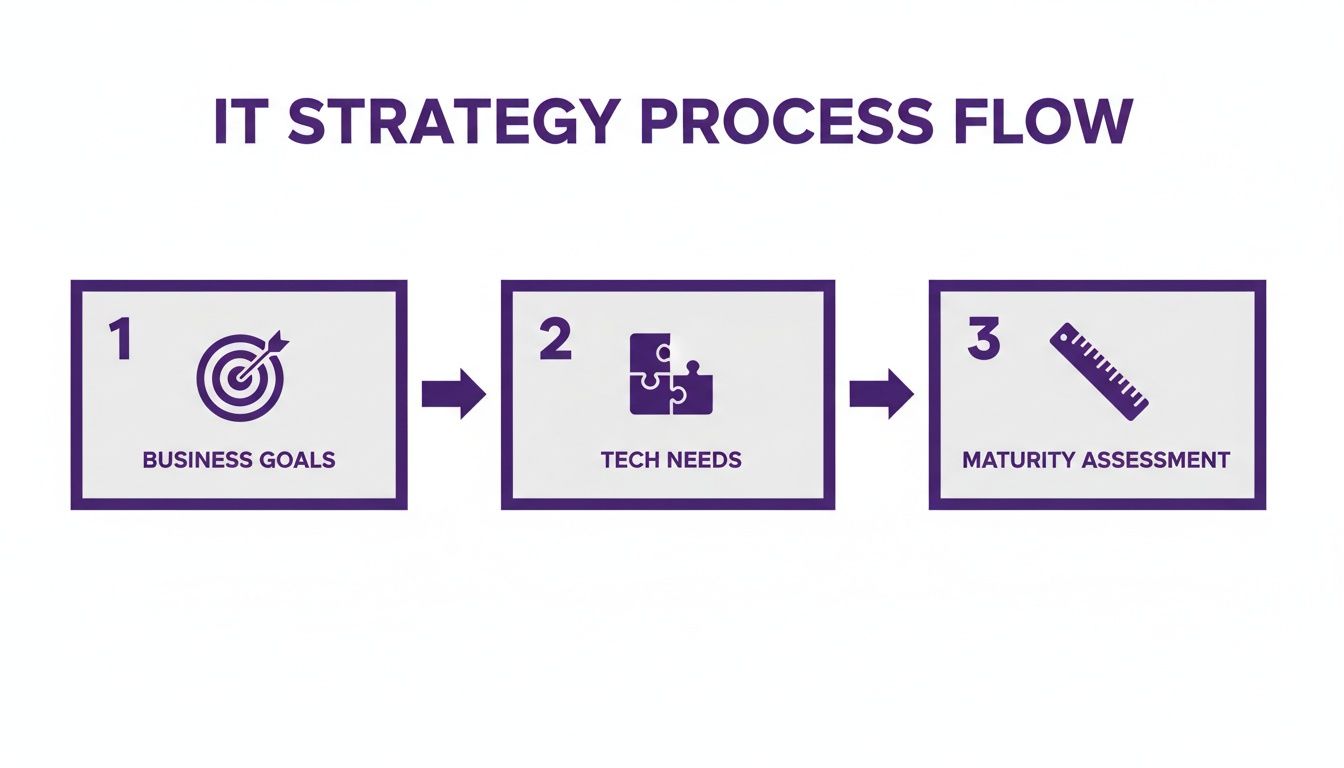
This process shows that a great roadmap doesn't come out of thin air. It’s born from aligning what the business needs with an honest assessment of what your tech can (and can't) do today.
Building Your Foundational Cloud Layer
First things first: your infrastructure. If your on-premise servers are creaking under the strain or holding you back, a move to the cloud is almost always the top priority.
- Microsoft Azure: Shifting your servers and key applications to Azure gives you a level of scalability and security that’s incredibly difficult and expensive to replicate yourself. You stop buying chunky, expensive hardware and instead move to a more predictable operational cost, paying only for what you use. It's the modern foundation you need.
For a detailed guide on making this move, our article on the Azure Cloud Adoption Framework is the perfect place to start. A well-executed Azure migration is the bedrock for everything that follows.
Enhancing Productivity and Collaboration
With a solid foundation in place, you can turn your attention to how your people actually get their work done. This is where you can make changes that your teams will notice and appreciate almost immediately.
- Microsoft 365: This is so much more than just Word and Outlook. When you properly set up Microsoft 365—using SharePoint for central document management and Teams for communication—you start to break down those frustrating information silos. Suddenly, everyone is working from the same live document, collaborating in real-time, whether they’re at the next desk or working from home.
Streamlining Core Business Processes
Now that your infrastructure is stable and your teams are collaborating effectively, it’s time to look at the core engines of your business: sales, customer service, and operations.
- Dynamics 365: This is where you start standardising and automating your most important workflows. For example, implementing Dynamics 365 for Sales creates a single source of truth for all your customer information, ending the chaos of scattered spreadsheets. It’s at this stage you begin to see a serious return on your investment through better efficiency and happier customers.
A prioritised roadmap is all about the right sequence. It makes no sense to roll out a brilliant new CRM system if your network is flaky or your staff are still saving mission-critical files to their own desktops. Get the foundation right first.
Thoughtfully Incorporating Emerging Technology
The final layer is about looking ahead. Technologies like AI are no longer just buzzwords, but the key is to be strategic, not just jump on the bandwagon. Pinpoint specific problems that need solving.
- Microsoft Copilot: Instead of a big-bang rollout, find a precise, high-value use case. Could your sales team use it to automatically summarise client meetings? Could your marketing team get it to generate first drafts for an email campaign? Start with a small pilot group, measure the impact, and build a solid business case based on real-world results before going wider.
To help visualise this process, here’s a simple framework for deciding what to tackle and when.
Microsoft Ecosystem Technology Prioritisation Framework
| Priority Level | Technology Focus (Example) | Business Goal Supported | Estimated Impact | Implementation Complexity |
|---|---|---|---|---|
| P1 – Foundational | Migrate on-premise servers to Microsoft Azure | Improve system reliability & scalability; reduce hardware costs. | High | High |
| P2 – Productivity | Fully deploy Microsoft 365 (Teams, SharePoint) | Enhance remote collaboration & secure data sharing. | High | Medium |
| P3 – Process | Implement Dynamics 365 for Sales | Create a single customer view; improve sales forecasting. | High | High |
| P4 – Innovation | Pilot Microsoft Copilot for Marketing Team | Increase content creation speed & efficiency. | Medium | Low |
This table is just a starting point, but it shows how you can map technology directly to business goals, while being realistic about the effort involved. By layering your roadmap—from infrastructure to productivity, processes, and innovation—you create a logical plan that delivers real, continuous value.
Embedding Security and Compliance from Day One
In any IT strategy worth its salt, security isn't just another box to tick. It’s the bedrock. A security breach or a compliance failure can obliterate years of hard work in a heartbeat, costing you a fortune and, more importantly, the trust you’ve earned from your customers. The most dangerous assumption you can make is that you'll "get around to security later."
You have to weave security and compliance into the very fabric of your technology plan from the get-go. This means every decision—from choosing a cloud platform to rolling out a new app—is viewed through a security-first lens. It’s a fundamental shift from reactive fire-fighting to proactive, deliberate design.
Building a Secure-by-Design Foundation
For businesses in the UK, compliance with regulations like UK GDPR is simply non-negotiable. The fines for getting it wrong are eye-watering, but the damage to your reputation can be terminal. A secure-by-design approach means intentionally choosing technology with powerful, built-in safeguards that make meeting these obligations far simpler.
This is where platforms like Microsoft 365 and Azure truly shine. They aren’t just productivity tools; they are comprehensive security ecosystems built to protect your data from the ground up.
- Data Protection: Think about features like data loss prevention (DLP) policies. These can automatically spot and block sensitive information, like credit card or National Insurance numbers, from being accidentally shared in an email or Teams chat.
- Identity Management: Azure Active Directory is the heart of it all, giving you one central place to control who can access what. It's the cornerstone of a modern zero-trust security model.
- Threat Intelligence: Microsoft ploughs over £800 million into cybersecurity research every single year. That incredible threat intelligence is fed directly into their platforms to protect you from the latest threats.
By building your strategy on this kind of foundation, you're not just buying software; you're effectively inheriting a world-class security operation.
Your security is only as strong as its weakest link. In almost every case, that weak link is human. A truly robust security strategy must combine powerful technology with continuous team education.
From Technology to People: The Human Firewall
Let’s be honest: technology alone can’t save you. The vast majority of successful cyberattacks start with a person making a mistake, usually falling for a phishing email. Turning your team into your first line of defence is one of the smartest security investments you can possibly make.
But this can't be a one-and-done training session. It has to be an ongoing programme.
- Regular Phishing Simulations: Test your team with safe, simulated phishing emails to see who takes the bait. This isn't about naming and shaming; it's about creating powerful, real-world teaching moments and gauging your organisation's vulnerability.
- Mandatory Multi-Factor Authentication (MFA): This is non-negotiable. It's the single most effective step you can take to secure your accounts. Enforcing MFA makes it exponentially harder for an attacker to get in, even if they’ve stolen a password.
- A Clear Incident Response Plan: Everyone in the business needs to know exactly what to do and who to call the second they spot something suspicious. Hesitation can turn a minor issue into a major disaster.
Regular security audits are crucial to make sure these measures are actually working. Our cyber security audit checklist is a great place to start assessing where you stand. To truly stay ahead, you need to think like the attackers. Services like Penetration Testing as a Service (PTaaS) do just that, simulating real-world attacks to find your weak spots before criminals do. A comprehensive IT strategy must also include a resilient disaster recovery and business continuity plan, ensuring you can get back on your feet quickly if the worst does happen.
For expert help embedding security into your IT strategy, Phone 0845 855 0000 today or Send us a message.
Governing Your Strategy and Measuring What Matters
Having a sharp IT strategy is a great starting point, but let's be honest—it’s the execution that really counts. Without a solid way to govern the plan and measure what’s actually working, even the best roadmap will gather dust and fail to deliver. A strategy is only worth the paper it's written on if it drives real, tangible business results.
Governance isn't about creating more red tape. It’s about accountability and making smart decisions along the way. Think of it as the framework that keeps your strategy on track, lets you adapt when business needs shift, and ensures your tech spend actually improves how you operate. This structure is what keeps your IT investments laser-focused on the business goals you set out to achieve in the first place.
Establishing a Clear Governance Structure
For most small and mid-sized businesses, the best way to keep a handle on this is to create a dedicated IT steering committee. This isn't just a huddle for the tech team; it’s a cross-functional group that absolutely must include heads from other departments like sales, finance, and operations, sitting alongside your IT lead.
This committee has a few critical jobs:
- Reviewing Progress: They should meet regularly—quarterly is a good rhythm—to see how things are progressing against the roadmap. Are we on time and on budget?
- Prioritising Initiatives: Business priorities can change in a heartbeat. The committee’s job is to make the tough calls, reshuffling projects when new opportunities or challenges pop up.
- Approving Major Spend: They provide the oversight for any significant technology investment, making sure there’s a solid business case behind every pound spent.
- Championing Change: This is a big one. They need to be advocates for new tech within their own teams, helping to drive adoption and smooth over any resistance.
When you do it this way, IT decisions stop happening in a silo. They become business-led conversations, creating a sense of shared ownership that is vital for success. To keep everything aligned with regulations, it's also crucial to have a good grasp of understanding compliance management.
From Technical Metrics to Business Outcomes
One of the biggest traps I see companies fall into is measuring their IT strategy with purely technical stats. Sure, things like server uptime and network speed are important for the IT team, but they don’t tell the board what it really wants to know: "Is this investment actually making our business better?"
To prove the real value of your strategy, you have to define Key Performance Indicators (KPIs) tied directly to business outcomes.
The most powerful KPIs translate technology performance into the language of the business—pounds, percentages, and productivity. This is how you prove the return on investment and build the case for future strategic projects.
Let’s look at a few practical examples of this shift in thinking:
| Old IT Metric | New Business-Focused KPI |
|---|---|
| Server Uptime is 99.9% | Customer response times reduced by 20% following CRM implementation. |
| Network bandwidth increased | Sales team productivity increased by 15% due to faster access to cloud files. |
| New software deployed to 100 users | Employee satisfaction with IT tools improved by 30% in annual survey. |
Focusing on these kinds of metrics completely changes the conversation. IT stops being a cost centre and starts being recognised as a strategic enabler of growth.
Demonstrating a Clear Return on Investment
Every strategy needs a budget, and every budget needs a justification. The key is to think in terms of investment, not just cost.
For example, a project to implement Power Automate might have an upfront cost of £15,000 for licenses and setup. But if that project saves 20 members of staff two hours per week each on mind-numbing admin, you can easily calculate the return in recovered productivity and show that to leadership in black and white.
This investment mindset isn't just for the private sector. Public sector organisations are also catching on. The UK government's 2022 to 2025 digital roadmap, for instance, saw an extra £8 billion invested to modernise technology, directly tackling how legacy IT was holding back public services. That initiative is all about building internal capability, showing a clear link between spending money and getting better outcomes. You can read more on their official publications page.
By governing your strategy properly and measuring what truly matters, you create a powerful cycle. You deliver clear results, which builds trust with leadership and secures the investment you need for the next phase of your roadmap.
Ready to build a strategy that delivers measurable results? Phone 0845 855 0000 today or Send us a message.
Bringing It All Together: Your Path to IT Success
We've walked through the entire process, from big-picture thinking right down to the practical details of building a robust IT strategy. This isn't just about a one-time project; it's about creating a living plan that continually aligns your technology with where your business is heading.
The real starting point is always the same: tying your tech decisions directly to your business goals. It's only then that you can build a sensible, prioritised roadmap. Think of it like building a house – you lay the strong foundations with something like an Azure cloud migration first, then you can start adding the powerful tools your team will use every day, like Microsoft 365.
Throughout this process, security and governance can't be an afterthought. They need to be baked in from the very beginning. By adopting a security-first mindset and setting up clear governance, you’re not just protecting your organisation; you're ensuring every pound spent on technology is a smart, accountable investment.
Your IT strategy should never just sit on a shelf gathering dust. It's a dynamic guide that needs to evolve as your business grows, adapts to new challenges, and spots new opportunities. It's what keeps your tech investments delivering real, measurable value, year after year.
Whether you decide to build out your own internal team or bring in a managed service provider, the core principles we've discussed will set you up for success. The ultimate aim is to shift from a reactive, fire-fighting mode to one of proactive, strategic planning.
Ready to put this plan into action? For expert guidance on implementing your IT strategy, give us a call on 0845 855 0000 today or send us a message to talk through your specific goals.
Your Questions Answered
When you start digging into your IT strategy, a few common questions always seem to pop up. Let's tackle some of the most frequent ones we hear from UK business leaders, giving you the clarity you need to move forward.
How Often Should We Revisit Our IT Strategy?
Think of your IT strategy less like a stone tablet and more like a living document. It has to breathe and adapt along with your business.
As a rule of thumb, we always advise clients to do a full, deep-dive review at least once a year. This is your chance to make sure your technology roadmap is still pointing in the same direction as your main business goals.
But don't just leave it for a year. Lighter, quarterly check-ins are essential. These are perfect for tracking how you're doing against your plan, seeing what's working (and what's not), and making quick adjustments. New tech might have appeared, or market conditions could have shifted – these meetings keep you agile.
And of course, any major business event – think a merger, a big product launch, or expanding into a new market – should immediately trigger a full strategy review.
What’s the Biggest Pitfall to Avoid?
Without a doubt, the single most damaging mistake we see is when an IT strategy is built in an echo chamber, completely cut off from what the rest of the business is trying to achieve. It’s a recipe for disaster that leads to money being poured into tech that doesn't solve any real problems or help the company grow.
A great IT strategy always starts with one simple question: 'How will this technology actually help us hit our commercial targets?' It means getting people from finance, sales, and operations in the room from the very beginning.
When IT decisions are made in isolation, you just end up with expensive systems that don’t talk to each other and teams who view technology as a roadblock, not a tool. Genuine alignment is the one thing you can't compromise on.
Can a Small Business Really Afford a Proper IT Strategy?
Let's flip that question around: can you afford not to have one? The hidden costs of being purely reactive with your IT are staggering. Think about the fallout from a security breach, the lost revenue from unexpected downtime, or the wasted cash on software that wasn't the right fit. These almost always cost far more than proactive planning.
A solid strategy means every pound spent on technology is an investment, not just an expense. It stops you from making those costly missteps and focuses your budget where it will deliver a real return.
For many small businesses, bringing in a managed service partner is a brilliant, cost-effective way to get that high-level strategic thinking without the salary of a full-time IT director.
Ready to build a strategy that delivers real business results? The team at F1Group is here to help. Phone 0845 855 0000 today or Send us a message.