
The UK government's digital and data spend was estimated at £26 billion in 2023, yet funding remained roughly 30% below peer benchmarks, making policy adherence both a compliance necessity and a competitive differentiator for supply chain partners. For East Midlands SMEs, the practical answer is to treat government IT policy as a route into public-sector work, then align contracts, people, devices, identities and Microsoft 365 controls before procurement demands evidence.
You may be running a logistics firm in Nottingham, a software business in Leicester, or a specialist charity supporting councils across Lincolnshire. A tender lands, and the technical work looks familiar until the security schedule appears. The buyer wants Cyber Essentials Plus, a data processing agreement aligned with GDPR, documented access controls and evidence that your cloud environment is managed securely.
That request can feel disproportionate, particularly if your team is small. It isn't arbitrary, though. Public-sector contracts expose government organisations to operational, privacy and supply-chain risks, so buyers increasingly expect suppliers to prove that their controls work in daily practice.
What Government IT Policy Actually Means for Your Business
From procurement wording to operating rules
A regional logistics company in Nottingham might already use Microsoft 365 for email, Teams and document storage. Its owner may reasonably believe the environment is secure because Microsoft operates the underlying platform. During a local council bid, however, the buyer may ask a different question: how has the supplier configured and governed the tenant?
The answer could require evidence of multi-factor authentication, device management, administrator review, data retention, incident handling and supplier oversight. Cyber Essentials Plus may be required rather than the basic certification. The council may also ask how personal information is processed, where business data is stored, who can access it and what happens when an employee leaves.
Government IT policy is therefore less like a single rulebook and more like the operating system for public-sector technology. It influences how departments design services, purchase technology, manage data and hold suppliers accountable. The official GovS 005 Digital functional standard sets expectations for managing digital, data and technology so that government organisations can achieve policy outcomes, improve usability and operate effectively.
The government's digital and data spend was estimated at £26 billion in 2023, equal to roughly 5.9% of total resource departmental expenditure limit, according to the State of Digital Government Review. The review said this funding level was around 30% below peer benchmarks, while spending per full-time equivalent was 78% lower than peer-set benchmarks, with the shortfall especially pronounced in local government.

Why the budget context affects suppliers
Limited public-sector technology capacity increases pressure to deliver secure services efficiently. A council may not want to inspect every technical setting itself, so procurement requirements transfer part of that assurance burden to suppliers.
That changes compliance from paperwork into market access. A business that can produce clear evidence, explain its controls and respond confidently to security questions is easier to assess than one that promises to improve later.
Practical rule: Treat every security requirement in a public-sector tender as an operating requirement, not a document-writing exercise.
For an East Midlands supplier, this means turning broad policy into repeatable actions:
- Assign ownership: Name the person responsible for cyber security, data protection and contract evidence.
- Record decisions: Keep a current register of systems, suppliers, risks and policy approvals.
- Control access: Link user permissions to job responsibilities and review them when roles change.
- Test resilience: Demonstrate how the business detects, contains and recovers from disruption.
- Prepare evidence: Keep policies, training records, audit results and remediation notes together.
The distinction matters because a policy that exists only in a folder won't protect a council's data or help your bid. A working control, supported by evidence, gives buyers confidence that your organisation can operate responsibly after the contract is signed.
The Seven Core Components of Modern UK Government IT Policy
A council's policy may be written in London, but its effect is felt in an East Midlands supplier's Microsoft 365 tenant. The seven components below connect policy ambition with the settings, decisions and evidence that staff use every day. Treat them like parts of a building: governance provides the frame, while classification, security, cloud services, suppliers, incident response and auditing keep the structure safe.
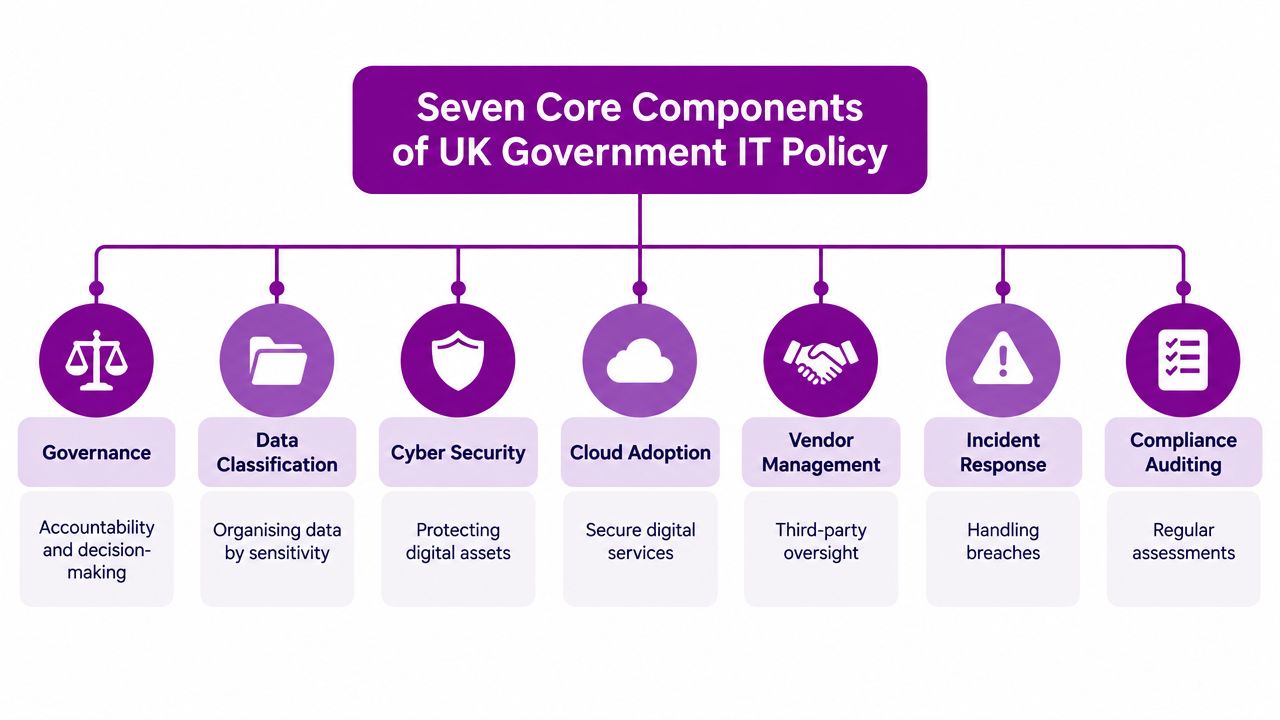
Governance
Governance assigns ownership. Your organisation needs named responsibility for approving policies, accepting risks, reviewing suppliers and escalating incidents. A small business does not need a large committee. It does need a decision-maker, recorded approvals and a clear route for unresolved risks.
An IT governance framework can organise accountability, risk and decision-making. In Microsoft 365, that may mean deciding who can create Teams, approve external sharing, manage privileged roles and authorise applications.
Data classification
Classification gives information a handling rule. Government categories commonly include OFFICIAL, SECRET and TOP SECRET, but suppliers must follow the contract's specific requirements rather than assume a government label applies automatically.
For an SME, ask whether a file contains personal data, commercial information, credentials, operational details or material that could harm a public body if disclosed. Microsoft Purview labels can connect those decisions to access, encryption, retention and sharing controls.
Cyber security
Cyber security covers identities, devices, applications and information. Multi-factor authentication, patching, secure configuration, malware protection, firewalls and restricted privileges address common attack routes and provide controls that buyers may expect to see.
Cloud adoption
Cloud services can improve collaboration and centralise administration. They do not secure themselves. Microsoft 365 and Azure require decisions about identity, logging, device compliance, backup, data location and administrator access. A supplier should document those choices instead of treating migration as the end of implementation.
Vendor management
Your suppliers extend your risk boundary. Record which providers handle contract data, define responsibilities in agreements, and confirm how each provider reports incidents, protects information and supports continuity.
Incident response
A response plan should name the person who receives an alert, the people allowed to isolate an account or device, the method for preserving evidence and the process for notifying the customer. A short procedure tested with staff is easier to use than an extensive document stored out of sight.
Compliance auditing
Auditing checks whether controls operate as intended. Reviews can examine administrator roles, dormant accounts, device encryption, conditional access, external sharing, supplier records and staff training. Findings should identify completed controls, gaps, owners and remediation actions.
These components depend on one another. Restricting external sharing in a policy has little effect if the tenant remains open. A security setting is difficult to defend without an owner, and an audit has limited value unless the business records what changed after a failed check.
Navigating Key Standards and Legal Requirements
Compliance becomes manageable when you separate the purpose of each framework. Cyber Essentials addresses common technical weaknesses. ISO 27001 provides a broader information security management system. GDPR governs personal data. Government standards guide how public bodies design and buy digital services.
Match the framework to the contract
Cyber Essentials is often the starting point for smaller suppliers. In the year to 30 June 2026, 61,430 certificates were awarded, including 46,245 basic Cyber Essentials certificates and 15,185 Cyber Essentials Plus certificates, according to the DCMS cyber security newsletter. The figures show that most adoption remains at the self-assessed baseline rather than third-party audited assurance.
Cyber Essentials focuses on five baseline areas: patching, access control, malware protection, secure configuration and firewalls. Cyber Essentials Plus adds independent testing, which can make it more demanding but provides stronger assurance for a buyer.
Government guidance says Cyber Essentials is mandatory for new central government contracts involving personal information and certain information and communications technology products or services. The requirement can therefore become a procurement gate.
ISO 27001 is different. It requires an information security management system with risk assessment, documented controls, management involvement and continual improvement. It may suit a supplier handling complex, sensitive or multi-client environments, but it requires sustained organisational effort rather than a one-off technical exercise.
Connect privacy and digital standards
GDPR sits alongside these security frameworks. It requires a lawful basis for processing, data minimisation, appropriate security and respect for individual rights. A data processing agreement should clarify responsibilities between the public body and the supplier, including instructions, sub-processors, breach handling and deletion or return of information.
The Technology Code of Practice gives departments criteria for designing, building and buying technology, alongside the Digital Service Standard. Suppliers don't automatically become government departments, but tender requirements may reflect these expectations around usability, security, interoperability and value.
The 2026 Digital Standards Strategy points towards stronger standards for AI, cyber security, quantum technologies, advanced connectivity and semiconductors. For a mid-sized supplier, that direction means procurement teams may ask more questions about AI governance, model risk, data lineage and secure integration.
For accessible background on organisational resilience and continuity planning, the Scottish Business Resilience Centre overview offers a useful complementary resource. It can help business owners think beyond certification towards the ability to keep operating during disruption.
The useful test is not “Which certificate should we buy?” It is “What risk does this contract create, and which framework gives the buyer credible assurance?”
A Practical Implementation Roadmap for Small Organisations
Small organisations can align with government IT policy without copying a large department's bureaucracy. A team of ten still needs identity controls, documented decisions and tested recovery, but it can combine responsibilities and keep procedures concise.
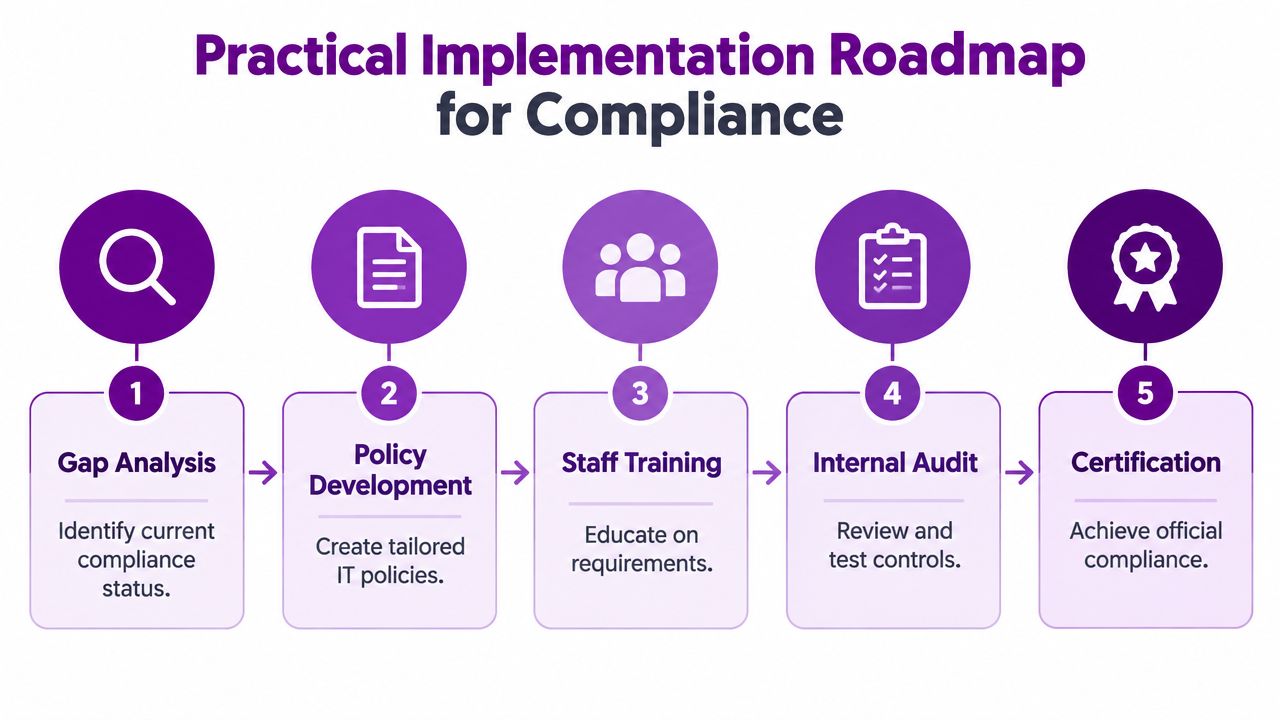
Start with a gap analysis
List every service, device, administrator, supplier and data flow that supports the contract. Compare the current position with the relevant Cyber Essentials requirements and tender schedule.
Look for practical gaps:
- Identity: Check whether every user has MFA and whether privileged access is limited.
- Devices: Confirm that supported devices receive updates and use protective controls.
- Configuration: Review Microsoft 365 security settings, sharing permissions and administrator roles.
- Information: Identify where personal and contract data is stored, copied and deleted.
- Response: Confirm that staff know how to report suspicious messages or lost equipment.
Rank each gap by contract urgency and risk exposure. A missing control demanded by a tender deadline needs immediate attention. A lower-risk documentation improvement can follow, provided someone owns it and the decision is recorded.
Write policies people can use
Create short policies for acceptable use, access management, incident response, supplier management, data handling and business continuity. Each policy should state who it applies to, what staff must do, who approves exceptions and how compliance is checked.
The IT policy template resource can provide a starting structure, but don't adopt wording without testing it against your systems. A policy that bans external sharing while Teams workflows depend on it creates confusion. Rewrite the rule so staff understand when sharing is allowed, who approves it and how the organisation records the decision.
Train, remediate and test
Explain the reason behind each control. Staff are more likely to report a suspicious sign-in when they understand the effect on a council contract and the people whose information the contract contains.
Remediate technical issues in a controlled sequence. Enable MFA, remove unnecessary privileged roles, enrol devices into management, review external sharing and test account recovery. Then run an internal audit using the evidence a buyer is likely to request.
A practical checklist might include:
- Name owners: Assign policy, security, data protection and supplier responsibilities.
- Build evidence: Store approvals, training records, access reviews and remediation notes.
- Test scenarios: Rehearse a compromised account, lost device and unavailable service.
- Review exceptions: Record why a control can't yet be met and set a follow-up action.
- Book certification: Choose the appropriate assessment route only after technical gaps are closed.
The sequence gives a small business visible progress. It also prevents a common mistake, paying for certification before fixing the underlying environment.
Building an In-House Team Versus Using a Managed Partner
The right operating model depends on workload, contract complexity and the skills already available. An internal administrator may understand your users and processes better than anyone else, while a managed partner can provide specialist capability without requiring one employee to cover security, cloud engineering, compliance and support alone.
| Decision factor | In-house capability | Managed partner |
|---|---|---|
| Control | Direct ownership of priorities and decisions | Shared operating model with agreed responsibilities |
| Speed | Depends on existing skills and staff availability | Can add specialist capacity quickly |
| Continuity | Vulnerable to absence, turnover and competing duties | Uses documented processes and a wider support team |
| Knowledge | Deep understanding of internal workflows | Broader exposure to Microsoft, security and compliance patterns |
| Evidence | Must be created and maintained internally | Can support policy records, reviews and audit preparation |
| Strategic focus | Technical staff may be pulled into routine support | Internal leaders can focus on contracts and business outcomes |
When an internal model works
An in-house approach suits a business with a capable IT lead, stable systems and enough time to maintain controls. The organisation must still provide training, cover absences and keep knowledge current. It should also avoid giving one administrator unchecked control over every identity, device and recovery process.
Internal ownership doesn't remove the need for independent challenge. A periodic external review can expose assumptions that daily administrators no longer notice.
When a managed model helps
A managed partner can combine service desk support, Microsoft 365 administration, Azure expertise, device protection, policy documentation and security monitoring. Ask potential providers how they handle privileged access, staff vetting, incident escalation, evidence retention and changes to your tenant.
For East Midlands businesses, location can matter when you need on-site support, clear accountability or familiarity with local public-sector supply chains. F1Group provides managed IT services and Microsoft-focused support, including Microsoft 365, Azure, cyber security and policy implementation for organisations that need practical assistance connecting controls to daily operations.
A hybrid arrangement is often sensible
Many SMEs keep strategic ownership internally and outsource specialist execution. The business owner or IT manager approves risk appetite and contract commitments. The partner helps configure controls, document procedures, monitor the environment and prepare evidence.
Choose the model that keeps controls working after certification, not merely the model that gets you through assessment fastest.
Cloud Adoption Strategies with Microsoft 365 and Azure
Cloud adoption is now a central part of government IT policy, but moving a workload into Microsoft 365 or Azure doesn't automatically modernise it. The January 2025 State of Digital Government review reported that about 55% of central government organisations had more than 60% of their estate on cloud, while also noting that many migrations involved replication with minimal reengineering. The review linked the shift to around £1.3 billion in dedicated cloud transformation budgets, Cloud First policy and NCSC guidance, as recorded in the State of Digital Government review PDF.
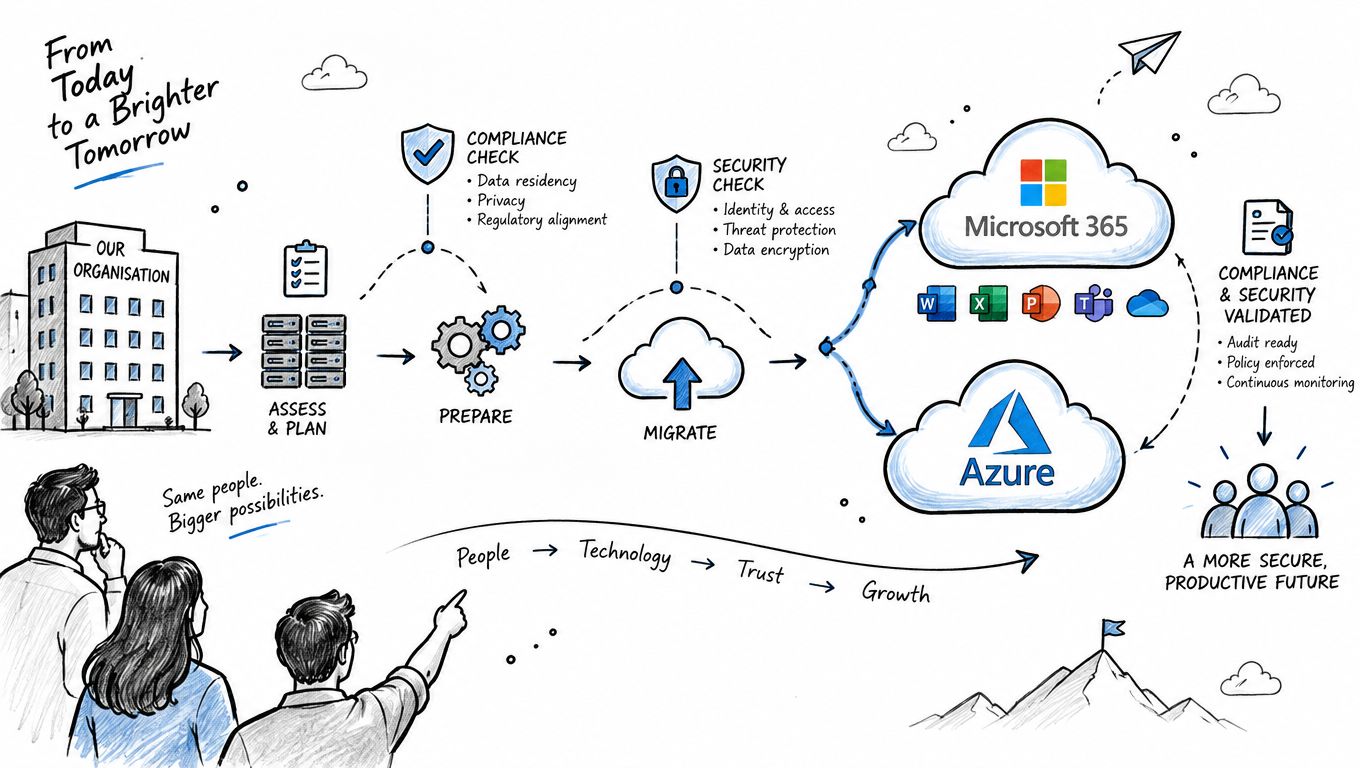
Secure the identity layer first
Microsoft Entra ID should become the control point for users, administrators and applications. Begin with MFA for all users, stronger controls for privileged roles and a process for removing access promptly when someone changes role or leaves.
Conditional Access can require compliant devices, restrict risky sign-ins and apply different rules to administrators. Keep emergency access accounts protected and monitored, and review sign-in and audit logs so unusual activity receives attention.
Microsoft 365 Government API settings can support environments that need government-oriented configuration and integration patterns. They should be assessed against the actual tenant, contract classification, data location and service requirements rather than treated as a substitute for governance.
The Azure Cloud Adoption Framework provides a useful structure for planning strategy, readiness, migration, governance and management. Use that structure to decide whether a workload should be retired, replaced, rehosted or redesigned.
Replace lift and shift with deliberate modernisation
A replicated server can still carry old identity assumptions, weak backup arrangements and inefficient application architecture. Review dependencies, recovery objectives, network access, secrets, monitoring and data flows before deciding that migration is complete.
Microsoft Purview can support information classification, retention and data loss prevention. Intune can enforce device configuration and compliance. Defender services can help protect endpoints and identities. The exact configuration depends on licensing, risk and contract terms, so document each decision and test it with representative users.
Govern Copilot and other AI tools
Copilot AI should operate within clear acceptable-use rules. Decide which information staff may use, how prompts and generated content are reviewed, when human approval is mandatory and how confidential data is protected.
Before enabling new AI features, identify the business purpose, data sources, permissions and accountability. A user who already has broad access may expose more information through an AI assistant unless the organisation first cleans up permissions and applies information controls.
A short pilot with named owners is safer than uncontrolled adoption. Record the use case, test outputs for accuracy and bias, define prohibited data and establish a route for reporting unexpected results.
Your Next Steps Toward Compliance and Growth
Government IT policy becomes less intimidating when you translate it into ownership, configuration and evidence. Start by checking the contract, map the data, review Microsoft 365 identities and devices, close the highest-risk gaps, train staff and test the response process.
Use certification to validate working controls, not to replace them. Keep procurement requirements, GDPR duties, cyber standards and cloud governance in one practical operating plan.
If your organisation operates across Nottingham, Leicester, Lincoln, Newark or the wider East Midlands, set a review date before the next tender arrives. Early preparation gives you time to fix weaknesses, explain your approach and compete on trust as well as price.
F1Group helps East Midlands organisations implement practical IT policies, secure Microsoft 365 and Azure environments, manage identities and devices, and prepare evidence for cyber and procurement requirements. Phone 0845 855 0000 today or send us a message to discuss your route towards compliance and resilient growth. Visit F1Group to explore managed IT support, cloud transformation and cyber security services.