
The finance director wants predictable costs. The operations team wants systems that don't freeze when someone works from home. The managing director wants growth without another expensive server refresh. Meanwhile, an East Midlands business may still be relying on ageing applications, shared drives, manual approvals and an IT provider that treats Microsoft 365 as little more than email hosting.
That's the situation many UK SMEs face. Cloud adoption is already mainstream, with 69% of UK firms using cloud-based computing systems and applications in 2023, while 68% planned adoption in 2024, according to the Office for National Statistics dataset. The question isn't whether your organisation should use the cloud. It's whether your current cloud estate is secure, governed, cost-controlled and useful to the business.
Redefining Cloud Transformation for Modern Business
A manufacturer in Nottingham might move its file server into Azure, keep the same folder structure, preserve the same manual approvals and call the project complete. The server is now in the cloud, but the business hasn't transformed. Staff still struggle to find information, managers still wait for reports and the IT team still spends time maintaining workarounds.
That's migration, not transformation.
Cloud transformation services should connect infrastructure, applications, data, security and working practices around a clear business result. For one organisation, that might mean replacing a fragile on-premises line-of-business system with a properly supported Azure platform. For another, it could mean using Microsoft 365, Teams and SharePoint to create controlled collaboration rather than allowing sensitive documents to circulate through email attachments.
Practical rule: If the project only moves technology without improving ownership, control or business performance, it hasn't gone far enough.
The public sector offers a useful warning. Around 55% of central government organisations reported that more than 60% of their estate was on the cloud, yet many migrations largely replicated existing systems instead of reengineering them, according to the State of Digital Government Review. An SME can make the same mistake on a smaller budget, carrying unnecessary complexity into Azure and then paying to operate it.
Transformation means changing the operating model
A sound programme combines three areas:
- Resilient platforms: Azure infrastructure, identity controls, backup, monitoring and disaster recovery replace fragile dependencies with a designed operating environment.
- Modern workplace tools: Microsoft 365, Teams, SharePoint and endpoint management give people secure access to the information and applications they need.
- Business improvement: Dynamics 365, Power BI, Power Apps and Power Automate turn operational data into decisions, workflows and customer service improvements.
This approach also changes the role of IT. Instead of reacting to outages and access requests, the IT function can manage risk, improve data quality and help departments automate repetitive work. The business gets more than flexible infrastructure. It gets a technology platform that can support new services, remote collaboration and controlled experimentation.
For East Midlands firms, that distinction matters. A cloud programme should be judged by resilience, security, user adoption, reporting quality and total cost of ownership, not by the number of servers moved.
Core Service Offerings and Microsoft Delivery Models
There isn't one correct cloud delivery model. The right choice depends on the age of the application, its dependencies, regulatory requirements and the business outcome it supports.
| Delivery Model | Best Use Case | Microsoft Example |
|---|---|---|
| Lift and shift | A stable workload needs a faster move with limited application change | Moving a virtual machine to Azure |
| Replatform | The application needs better resilience or manageability without a complete rewrite | Moving a database to an Azure managed service |
| Refactor | The application is strategically important and needs modern scalability | Rebuilding services using Azure App Service and managed databases |
| SaaS adoption | A specialist system is better consumed as a managed service | Microsoft 365 or Dynamics 365 |
| Platform integration | Separate systems need joined-up data and automated processes | Power Platform connected to Dynamics 365 and Microsoft 365 |
Azure provides the foundation
Azure is the infrastructure and platform layer. It can host virtual machines, applications, databases, identity services, security controls and data platforms. That doesn't mean every workload belongs there. A good provider will challenge unnecessary migration, identify applications that should be retired and separate systems that need redesign from those that can move with limited change.
Microsoft 365 modernises how people work. Exchange Online supports hosted email, SharePoint provides controlled document collaboration and Teams brings meetings, chat and shared work into one environment. The value comes from governance, not switching licences on. Access policies, retention, information protection and device management need to be designed alongside adoption.
Dynamics 365 addresses customer and operational processes. Dynamics 365 Sales can structure pipeline management, Customer Service can organise case handling and Human Resources can support people processes. Integrating those systems with finance, documents and reporting prevents staff from maintaining disconnected spreadsheets.
Automation and Copilot need foundations
Power BI can consolidate reporting, Power Apps can provide targeted business applications and Power Automate can remove repetitive hand-offs. Copilot AI can then help users search, summarise and act on information, but only when permissions, data quality and governance are under control.
For buyers comparing technical delivery partners, it can help to review broader professional services by Faberwork LLC, particularly where programme design, integration and delivery capability need to be assessed alongside product expertise. For Microsoft licensing, support and transition considerations, the Microsoft Cloud Solution Provider guide is also a useful reference.
The recommendation is straightforward. Use lift and shift only where it reduces risk or buys time. Use replatforming and SaaS where they simplify ownership. Reserve refactoring for applications that create competitive or operational value.
Navigating the Transformation Roadmap and Timelines
A big-bang cutover is attractive because it appears decisive. It's also how organisations discover, all at once, that their finance system depends on an undocumented service, a remote user can't authenticate or a backup has never been restored successfully.
A disciplined roadmap exposes those problems before they become incidents.
Start with evidence, not assumptions
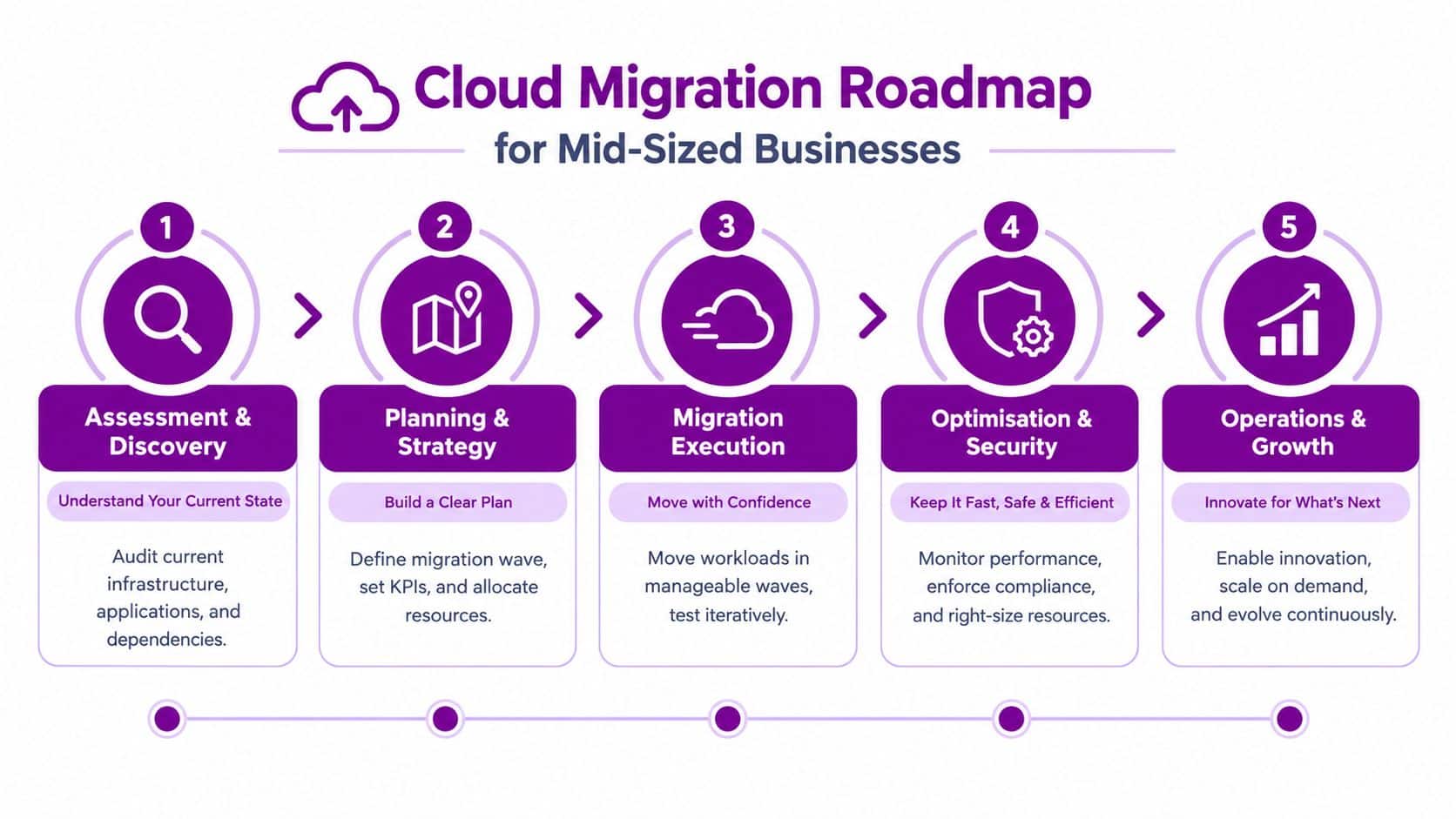
Assessment and discovery should catalogue infrastructure, applications, data stores, identities, integrations, users and contractual constraints. Dependency mapping is essential. An application that looks isolated may rely on a file share, a scheduled task or an old authentication service.
Planning and strategy turns the inventory into decisions. Classify each workload as retire, retain, replace, rehost, replatform or refactor. Define migration waves, owners, success measures, communications and rollback conditions. The Azure cloud migration services guidance can help leaders frame the technical and operational questions before procurement begins.
Build controls before moving workloads
The landing zone should establish subscriptions, resource policies, network design, logging, monitoring and identity management. Multifactor authentication, privileged access controls and least-privilege permissions belong here, not after the first workload has gone live.
Then migrate in manageable waves. Start with a workload that is important enough to test the operating model but contained enough to recover safely. Test application behaviour, integrations, permissions, performance, backup restoration and user access before each cutover.
Treat optimisation as a delivery stage
Go-live is not the finish line. The team should remove unused resources, right-size capacity, review licences, tune monitoring, close security findings and confirm that users are working in the intended systems. Complex environments can take several months to plan and migrate, particularly when legacy applications are tightly coupled or governance decisions remain unresolved.
The pacing items are usually application rationalisation and security governance, not the ability to create cloud resources. Rushed preparation creates operational disruption. Thorough preparation gives the business options.
Weighing the Benefits Against Hidden Migration Risks
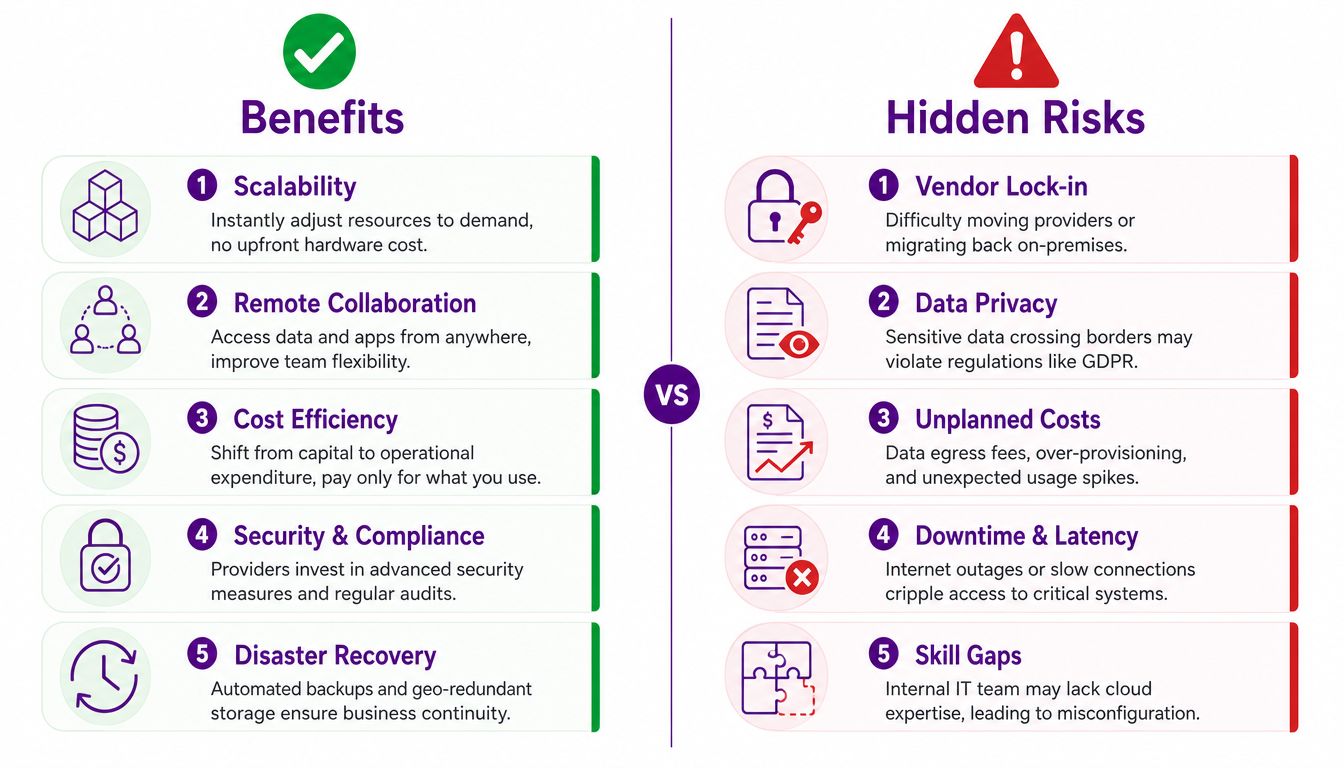
Cloud can improve resilience, remote access, scalability and operational visibility. It can also expose weak identity controls, poor backup practices and unclear data ownership. The provider's platform doesn't remove those responsibilities. It changes where and how they must be managed.
The business case is real
A well-designed cloud environment can give an SME access to scalable computing without owning physical infrastructure. Teams can collaborate from different locations, restore services through tested recovery arrangements and use managed security capabilities that would be difficult to build internally.
The UK market context supports this shift. The UK cloud market is valued at over £10.5 billion and is growing by around 30% each year, according to the Cloud Challenge Book 2026. That scale creates choice, but it also creates complexity. Buyers need a service design, not a shopping list of products.
The transition creates exposure
UK-facing reporting says 73% of cloud migration projects took longer than planned, 83% experienced security issues during or after migration and 90% said regulations were a major source of complexity, with the average cost of underestimating security requirements reported at more than £625,000 per organisation in the cloud migration risk analysis.
Those figures point to practical controls:
- Identity: Enforce multifactor authentication, separate administrative accounts and review privileged access.
- Data: Identify sensitive information, define residency requirements and apply retention and access rules.
- Resilience: Test restoration rather than assuming a backup is usable.
- Cutover: Move workloads in waves with documented rollback decisions.
- Ownership: Assign named people to security, costs, applications and supplier management.
Small businesses face a particularly direct cyber risk. UK government guidance states that 38% of small businesses suffered a cyber breach or attack in the past 12 months, while the average cost for those that lost data or assets was £8,170, according to Cyber security guidance for small businesses.
The message is clear. Cloud transformation is a risk-management exercise supported by technology. Treat it as a server relocation and you'll underfund the controls that protect the result.
Controlling Costs and Maximising Long-Term ROI
The migration invoice is only the beginning. Monthly consumption, Microsoft licensing, support, data movement, integration and staff adoption determine whether the programme produces lasting value.
UK-focused reporting says up to 80% of SMEs face unexpected cloud costs, while services represented 52.70% of the UK digital transformation market in 2025, according to the SME cloud adoption analysis. That combination matters. Businesses aren't only buying infrastructure. They're paying for integration, change management, skills transfer and ongoing optimisation.
Build a cost model before procurement
Separate one-off and recurring costs. The model should include discovery, migration, testing, training, support, licence changes, storage, data transfer, monitoring and security tooling. It should also identify who approves new resources and who reviews consumption.
For Microsoft estates, licensing needs a service review rather than an annual renewal exercise. Match Microsoft 365 licences to actual roles, remove unused assignments and establish a process for joiners, movers and leavers. Azure resources need tagging, budgets, alerts and regular rightsizing. Power Platform environments need capacity and connector decisions before departmental applications proliferate.
Data sovereignty affects design
Data residency isn't just a legal question. It can influence region selection, backup architecture, integration patterns and supplier contracts. Egress and API charges can also change the economics of a design that looked inexpensive during the initial proposal.
The right response isn't to avoid cloud. It's to make cost and location visible before deployment, then monitor both after go-live. A practical cloud cost optimisation approach should connect technical consumption with business ownership.
Commercial discipline: Every recurring cloud charge should have an owner, a purpose and a review date.
Managed support can improve ROI when it takes responsibility for monitoring, security updates, licence administration, incident response and optimisation. It should not become an excuse for unclear reporting. Ask for regular service reviews that show what changed, what risk remains and where the next saving or improvement sits.
Vetting Providers and Securing Local East Midlands Support
The cheapest migration proposal is rarely the cheapest transformation. A provider that excludes discovery, testing, governance or post-migration optimisation may move those costs into disruption and emergency support.
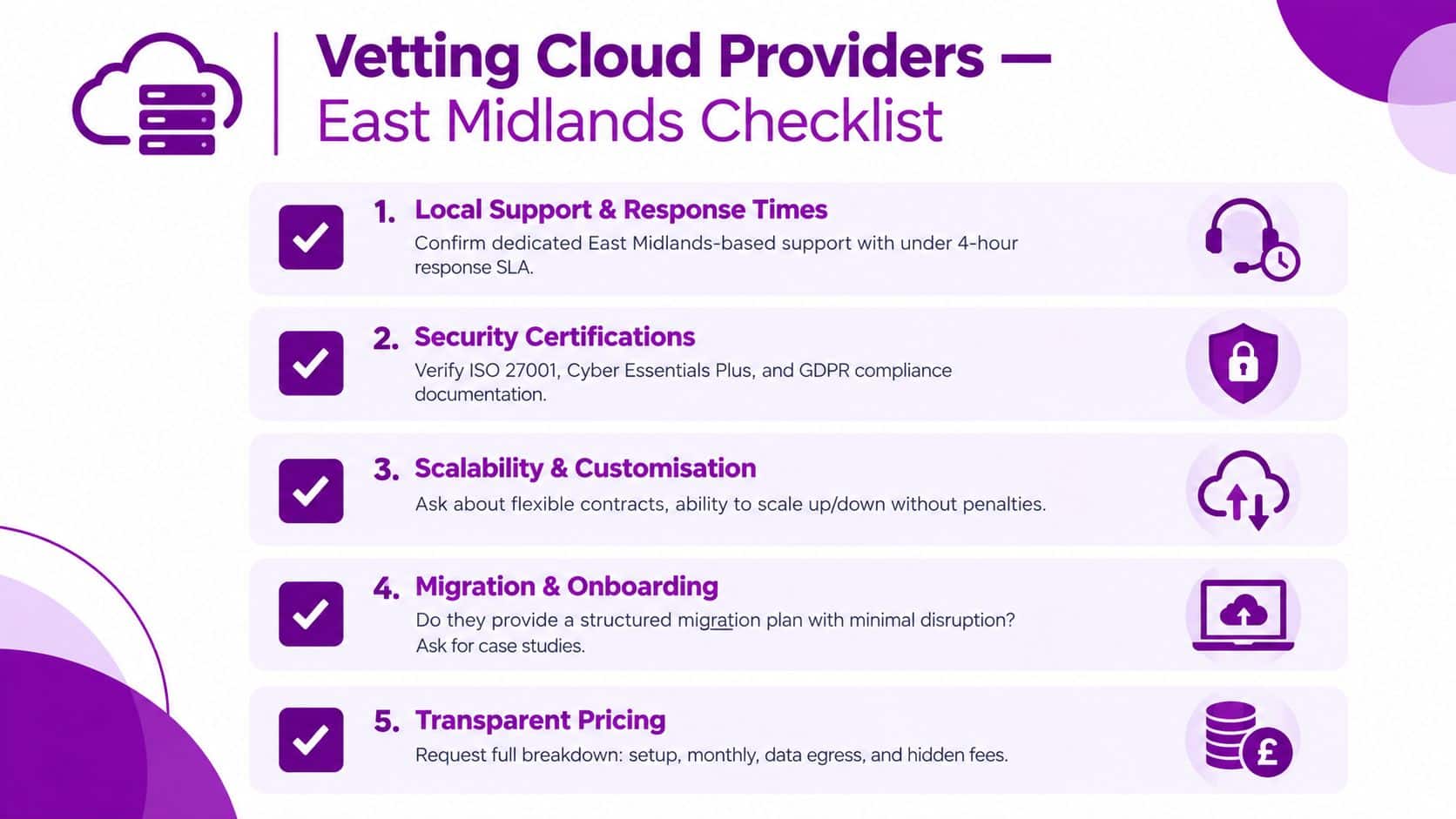
Start with the provider's method. Ask who will own architecture, security, data protection, user adoption and rollback decisions. Ask how they'll document dependencies and what happens when an application can't move as planned.
Questions that expose weak proposals
- Migration detail: What will you discover before designing the target environment, and which workloads would you recommend retiring rather than moving?
- Security ownership: Who reviews identity, privileged access, backup restoration, vulnerability management and incident response?
- Commercial transparency: Which costs sit outside the quoted project, including licences, support, data transfer, training and post-go-live improvements?
- Operational support: Who responds during a failed cutover, and can the provider provide on-site assistance when remote troubleshooting isn't enough?
- Technology fit: How will Azure, Microsoft 365, Dynamics 365, Copilot and Power Platform work together rather than become separate projects?
- Exit and continuity: How are documentation, administrative access, data export and supplier transition handled if the relationship ends?
Local support has practical value
An East Midlands business may need engineers who understand its sites, users and operational pressures. F1Group delivers IT support across Lincoln, Nottingham, Leicester, Scunthorpe, Grimsby and Newark, and has supported organisations since 1995, according to the publisher information. Its service scope includes Microsoft 365, Azure, Dynamics 365, Copilot AI, Power Platform, custom application development and cyber security.
Local presence doesn't replace sound remote monitoring or cloud engineering. It complements them when a network issue, device failure, meeting-room problem or site dependency needs hands-on attention. Vendor certification, DBS-checked engineers, clear escalation and documented response arrangements should be treated as evidence to verify, not marketing language to accept.
Check the contract as carefully as the architecture
Your agreement should define service boundaries, response targets, security responsibilities, reporting, backup testing, change control and termination assistance. It should also state who owns configuration, documentation and administrative credentials.
Choose a provider that can stay involved after migration. The hard work often begins when users adopt new tools, departments request automation and cloud consumption starts to drift.
Taking the Next Step Towards Cloud Maturity
Cloud maturity isn't measured by how much infrastructure sits in Azure. It's measured by whether the organisation can operate securely, control spend, recover from incidents, improve processes and introduce new capability without starting from scratch each time.
For East Midlands SMEs, the sensible route is clear. Begin with discovery and dependency mapping. Establish identity, security and governance before moving workloads. Choose the right Microsoft delivery model for each application, then budget for optimisation, user adoption and managed support after go-live.
The UK's cloud adoption figures show that cloud is already part of mainstream business planning, while public-sector experience shows that broad adoption doesn't automatically produce deep transformation. Organisations that replicate legacy systems may gain a new hosting location without gaining a better business.
The next step should be a candid assessment, not a rushed migration quotation. Ask which systems should move, which should be replaced, what controls are missing and how the investment will produce measurable operational value.
F1Group provides Microsoft-focused cloud transformation services across the East Midlands, covering Azure, Microsoft 365, Dynamics 365, Copilot AI, Power Platform, cyber security and ongoing managed support. Call 0845 855 0000 today to discuss your risks and priorities, or visit F1Group and send us a message to arrange a practical conversation.