
An IT Director opens another renewal quote before the first coffee has cooled. Microsoft 365 pricing has moved, Azure consumption is hard to reconcile, and nobody can produce a reliable record of which licences the business actually owns, uses or has already paid for. The supplier wants a signature. Finance wants certainty. Your team wants to get back to the project that matters.
That is where IT procurement services earn their keep. This isn't just about finding a cheaper reseller. It's about controlling demand, testing the market, negotiating terms and managing the full commercial life of technology, from the first requirement through renewal and exit. The strongest approach is grounded in whole-life cost, framework choice and the practical realities of Microsoft licensing.
When an IT Director Knows It Is Time to Buy Better
The warning signs rarely arrive as one dramatic failure. They accumulate in ordinary work. A Microsoft 365 renewal sits beside an Azure invoice that nobody can explain, a SaaS tool renews because its cancellation window was missed, and an old managed-service contract still includes users who left the organisation. Meanwhile, separate departments buy overlapping applications because no one owns the complete technology demand picture.
The internal IT team usually sees the problem first, but it doesn't always have the time or commercial weight to fix it. Engineers understand the technical estate. Service desk managers understand operational impact. Neither should be expected to benchmark every supplier, interpret every licensing clause and run every competitive event while keeping the business running.
The practical test: if your team can describe what technology does but can't quickly explain what the business owns, what it uses and what it can exit, procurement needs attention.
Professional support should begin with an honest current-state review. That means reconciling contracts, invoices, user counts, consumption, renewal dates and service commitments. It also means challenging requirements that have become habitual. A department asking for another licence may need a different permission model, a better configuration or a licence already available elsewhere in the tenant.
The commercial case is broader than an initial discount. Government guidance states that whole-life cost, rather than the lowest purchase price, is the key consideration in sourcing decisions, as set out in the UK Sourcing Playbook. That principle applies equally to a private-sector Microsoft agreement. A lower entry price can still produce a poor result if implementation, integration, support, price protection, data extraction and renewal terms are weak.
Buy better when renewals are reactive, ownership is unclear, requirements are duplicated or suppliers dictate the timetable. Procurement services provide the structure, but the value appears only when the engagement examines the entire commercial lifecycle rather than chasing a quick saving.
What IT Procurement Services Actually Cover
IT procurement services are the disciplined activity of sourcing, evaluating, contracting and managing technology purchases for an organisation. The scope can include hardware, software, cloud, telecoms, cyber security, professional services and managed IT. It can be a focused engagement for one strategic purchase or an ongoing service covering a defined category.
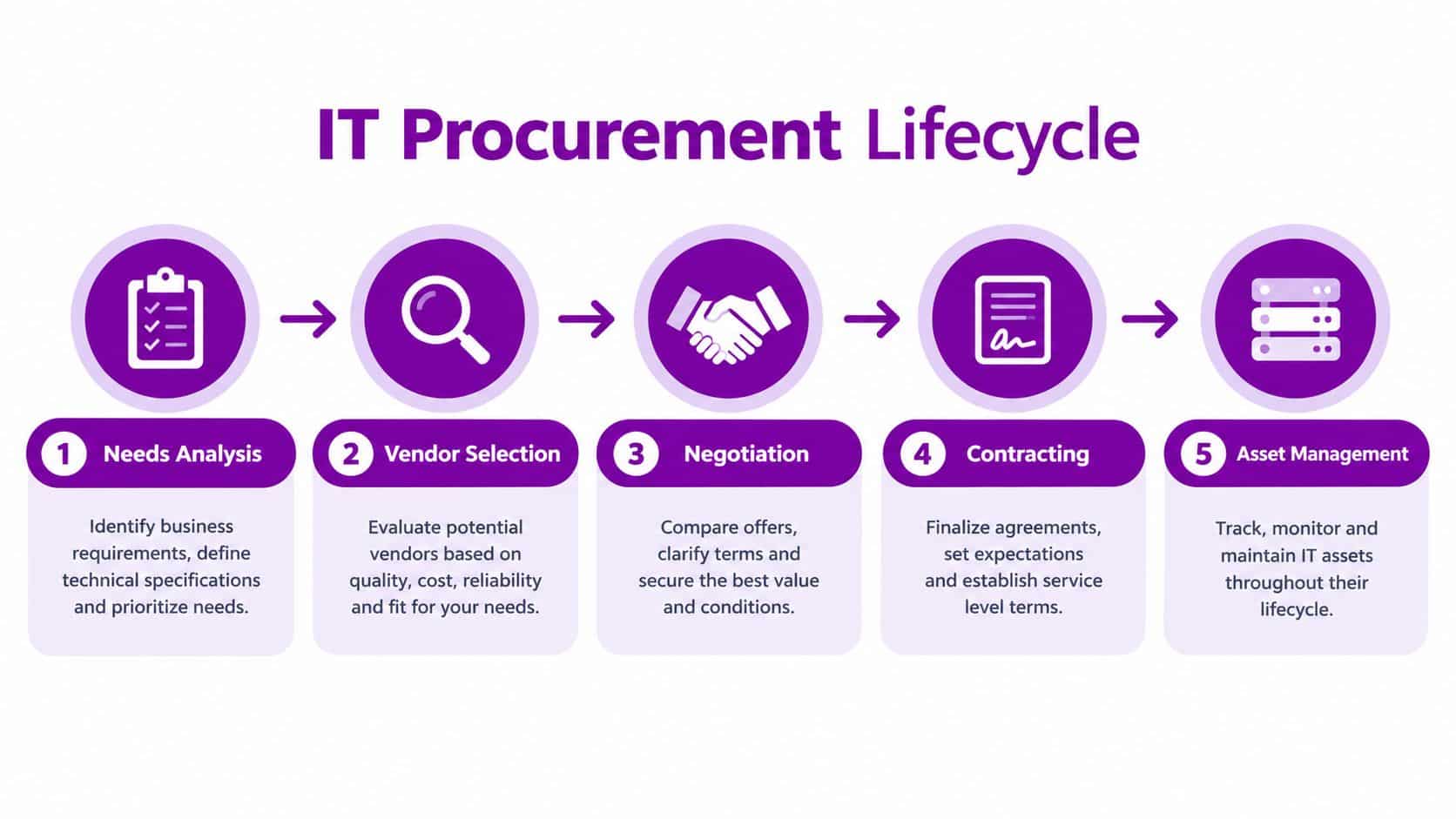
A useful lifecycle looks like this:
-
Needs assessment and demand consolidation. The adviser gathers requirements, then challenges and rationalises them. For Microsoft licensing, that means reconciling user roles, active usage, add-ons, dormant accounts and upcoming changes, not merely adding departmental wish lists together.
-
Market analysis and supplier identification. The team maps suitable suppliers, commercial routes and relevant capabilities. A direct reseller, a managed service provider and an independent adviser each bring a different incentive structure, so the route needs to match the decision.
-
RFx design and issuance. The procurement partner writes a requirement that suppliers can price consistently. It defines outcomes, assumptions, service boundaries, security controls, data responsibilities, transition expectations and evaluation rules before the tender reaches the market.
-
Evaluation and shortlisting. Responses are scored against an agreed model. Demonstrations, clarification questions, reference checks and technical validation should test whether a supplier can deliver, not whether its presentation is polished.
-
Negotiation, contracting and onboarding. The buyer negotiates price, indexation, service levels, liability, audit rights, renewal, exit and transition support. Ordering and onboarding then turn the commercial decision into an operational service.
-
Contract lifecycle management. A mature service tracks consumption, performance, changes, invoices, renewals, risks and exit planning. Supplier performance reviews shouldn't be an afterthought that starts only when service quality has already declined.
Strategic sourcing is not transactional purchasing
Transactional purchasing places an order against an approved catalogue. Strategic sourcing decides what should be bought, from whom, under what commercial protections and with what alternatives if the arrangement fails. Confusing the two is why organisations often have tidy purchase orders but poor control over technology cost and risk.
An external development requirement may also need a separate sourcing lens. For example, a buyer assessing an overseas engineering capability could use this overview of brazil developers as a starting point for understanding the supplier market, while still applying its own security, delivery and contracting tests.
The partner should leave behind more than an awarded contract. It should create a usable record of obligations, owners, renewal dates, consumption assumptions, service measures and exit options. If it can't explain how the arrangement will be managed after signature, it has only completed the visible half of procurement.
The Real Benefits and the Cost Drivers Behind Them
Procurement creates value by improving decisions, not by making every supplier offer the same percentage reduction. The strongest benefits usually come from better demand information, credible competition and contract terms that prevent avoidable cost later.
Where the commercial benefit comes from
Licence true-ups and tier optimisation can remove shelfware. Negotiation can improve price protection, audit wording, payment terms, service credits and termination rights. A repeatable RFP method can shorten the time spent reinventing documents, while structured due diligence can expose delivery, financial and security risks before they become operational problems.
The internal capacity released matters too. An IT team that isn't chasing quotes and reconciling invoices can spend more time on architecture, adoption, resilience and business change. That doesn't mean procurement should disappear from the organisation. It means technical leaders can contribute where their expertise is essential, while a commercial specialist manages the sourcing mechanics.
The public-sector market demonstrates why this discipline matters. UK local government spent £2.9 billion on IT procurement in FY24/25, based on transparency invoice data from more than 1,000 public-sector bodies. The same dataset records an average IT contract value of £344,881.41 and a median of £71,575.16, showing how a market can contain many relatively small deals alongside a smaller number of larger contracts. These figures are reported in the Stotles analysis of the digital government market.
The costs that defeat a headline saving
A discount is only one line in the business case. The following issues regularly erode it:
- Shelfware and over-licensing: accounts, modules and add-ons remain active after the underlying need has changed.
- Automatic renewal: the business loses negotiating power because the renewal date wasn't treated as a commercial event.
- Cloud commitment mismatch: Azure reservations or committed spend don't reflect actual usage, leaving the buyer paying for a forecast that never materialised.
- Managed-service scope creep: informal requests become recurring work without a clear change process or price boundary.
- Vendor consolidation premiums: a supplier presents a broader bundle that looks efficient but makes the organisation dependent on one commercial route.
- Poorly run RFPs: vague requirements attract incomparable bids, consume internal time and create disputes during implementation.
The right calculation includes implementation, migration, integration, support, training, governance, consumption, renewal exposure and exit. A large first-year discount can be a poor deal if the contract permits aggressive increases later or makes data and configuration difficult to recover.
Whole-life cost is a decision method, not a finance department phrase. If the model doesn't show what happens after implementation and at renewal, it isn't finished.
Vendor Evaluation Criteria and an RFP Checklist That Works
Supplier selection should resemble a controlled scoring exercise, not a beauty parade. Ask the same substantive questions, require evidence and separate technical confidence from commercial enthusiasm.
| Criterion | Weight | Sample RFP Question | Red Flag |
|---|---|---|---|
| Whole-life cost transparency | High | Which assumptions drive implementation, subscription, consumption, support and renewal cost? | The supplier provides a single bundled price with no assumptions. |
| Technical fit | High | How does the proposed design meet each written requirement, and where are the exceptions? | The response relies on product marketing rather than a traceable specification. |
| Financial stability | Medium | Who carries delivery responsibility, and what evidence supports the proposed operating model? | The bidder cannot explain subcontracting, continuity or financial resilience. |
| Security posture | High | Which controls, certifications and contractual commitments apply to the service and data? | Security is described as a future option or an unpriced add-on. |
| Support model | High | Who responds to incidents, at what priority, through which escalation path? | Service boundaries and out-of-hours responsibilities are unclear. |
| Cultural alignment | Medium | How will the supplier work with our change programme, stakeholders and internal IT team? | The supplier proposes a fixed delivery model without listening to operating constraints. |
An RFP checklist that forces useful answers
Require every bidder to answer these points in a consistent response schedule:
- State all pricing assumptions and exclusions.
- Separate one-off, recurring and consumption-based charges.
- Explain licence metrics and true-up rules.
- Describe price review and indexation provisions.
- Identify minimum commitments and unused-capacity treatment.
- Confirm contract term, renewal dates and notice periods.
- Set out termination rights and exit assistance.
- Define data extraction, portability and deletion.
- Confirm data-residency commitments where relevant.
- Describe subcontractors and their responsibilities.
- Provide the proposed implementation plan.
- Identify dependencies on the buyer and other suppliers.
- State service levels, credits and reporting.
- Give named escalation routes.
- Explain incident response and security notification.
- Provide relevant Microsoft accreditations or designations.
- Identify support coverage and service desk ownership.
- Supply customer references for comparable complexity.
- Explain change control and out-of-scope charging.
- Confirm transition, handover and knowledge-transfer obligations.
Use the checklist alongside a commercial route decision. A direct reseller can suit a straightforward purchase where the buyer already owns licensing expertise. A managed service provider fits when procurement must connect with implementation, support and ongoing operations. An independent procurement consultancy is more suitable when the buyer needs an impartial specification, market test or negotiation separate from the supplier that will deliver the service.
The same discipline applies when buying advisory work. This guidance on procurement of consultancy services is relevant where Microsoft 365, Azure, Dynamics 365, Power Platform, cyber security or Copilot projects depend on external expertise.
Microsoft Licensing, Azure and Managed Services Considerations
Microsoft procurement needs its own workstream. The catalogue is broad, licensing metrics vary by product and the most expensive mistakes often come from buying capability before confirming adoption, role design and operational ownership.
Start with the user and workload model. A move from Microsoft 365 E3 to E5 may be justified for particular security, compliance, communications or analytics requirements, but it shouldn't become a default upgrade for every user. Unused Power BI Pro seats need the same scrutiny as any other dormant licence. Dynamics 365 modules need a clear process owner and adoption plan, because paying for functionality that the business hasn't embedded creates recurring cost without corresponding value.
Give renewals a proper runway
An Enterprise Agreement renewal shouldn't begin when the supplier sends its first quote. Build a long planning window around usage analysis, business changes, product roadmaps, procurement route, negotiation strategy and approval. Compare the current estate with the future operating model, then test whether the proposed licensing construct still reflects user roles and workloads.
Don't accept a renewal proposal without examining:
- Licence assignment: who has access, who uses the capability and who needs the tier?
- Product dependencies: which security, identity, compliance or collaboration functions rely on the chosen bundle?
- Price protection: what can change during the term, and what happens at renewal?
- Audit exposure: what records must the organisation maintain to demonstrate compliance?
- Exit and transition: what data, configurations and services need to remain available if the agreement changes?
Azure requires a separate consumption view. Validate the landing zone, tagging, ownership, budgets, alerts, resource lifecycle and architecture before choosing between reservations and pay-as-you-go consumption. A reservation can be commercially sensible when usage is stable and well governed. It can also lock in waste when workloads are being redesigned or demand is uncertain.
Microsoft Customer Agreement and Enterprise Agreement routes create different commercial and governance considerations. Don't choose between them from habit. Match the agreement to purchasing authority, billing control, commitment appetite, licensing needs and the capability available to manage it.
Managed services then raise a practical choice: co-managed support, fully managed operations or advisory hours. A co-managed model can work when internal IT retains architecture and decision-making. Fully managed support needs explicit service boundaries and transition ownership. Advisory hours are useful for targeted expertise, but they don't replace operational accountability.
Microsoft Solutions Partner designations and Advanced Specialisations can provide useful evidence of capability. They aren't a substitute for testing the proposed people, delivery method, escalation path and experience with an organisation of similar complexity. The software licensing best-practice guidance provides a useful prompt for turning licensing activity into an ongoing control process.
Risk Mitigation, Compliance and Procurement KPIs
Procurement value is measured in incidents prevented, commitments understood and services delivered as agreed, not just invoices cut. A supplier can offer an attractive price and still create unacceptable exposure through weak access controls, unclear data processing, fragile subcontracting or an exit plan that exists only in the contract.
For UK public contracts, the government's Cyber Essentials procurement policy says suppliers bidding for certain contracts have needed Cyber Essentials or Cyber Essentials Plus, or equivalent controls, with evidence provided before award since 2014. The requirements are set out in the Cyber Essentials procurement policy note. Private-sector buyers should apply the same risk-based thinking, especially where a supplier touches production systems or sensitive data.
Build a dashboard that changes behaviour
A useful KPI connects a measure to a risk:
- Validated saving against the agreed baseline: prevents claimed savings that disappear when scope, usage or implementation cost is considered.
- Supplier SLA adherence: identifies service degradation before users treat it as normal.
- Renewal visibility: shows whether owners have enough time to review terms and alternatives before a commitment rolls over.
- Mean time to provision: reveals whether the commercial process is slowing delivery.
- Open risk and action closure: shows whether due-diligence findings are being managed rather than filed.
- Post-contract review cadence: confirms that supplier governance continues after signature.
The final measure is the one buyers most often omit. Put supplier performance reviews in the contract operating model, with a named owner, a defined agenda, evidence requirements and escalation rules.
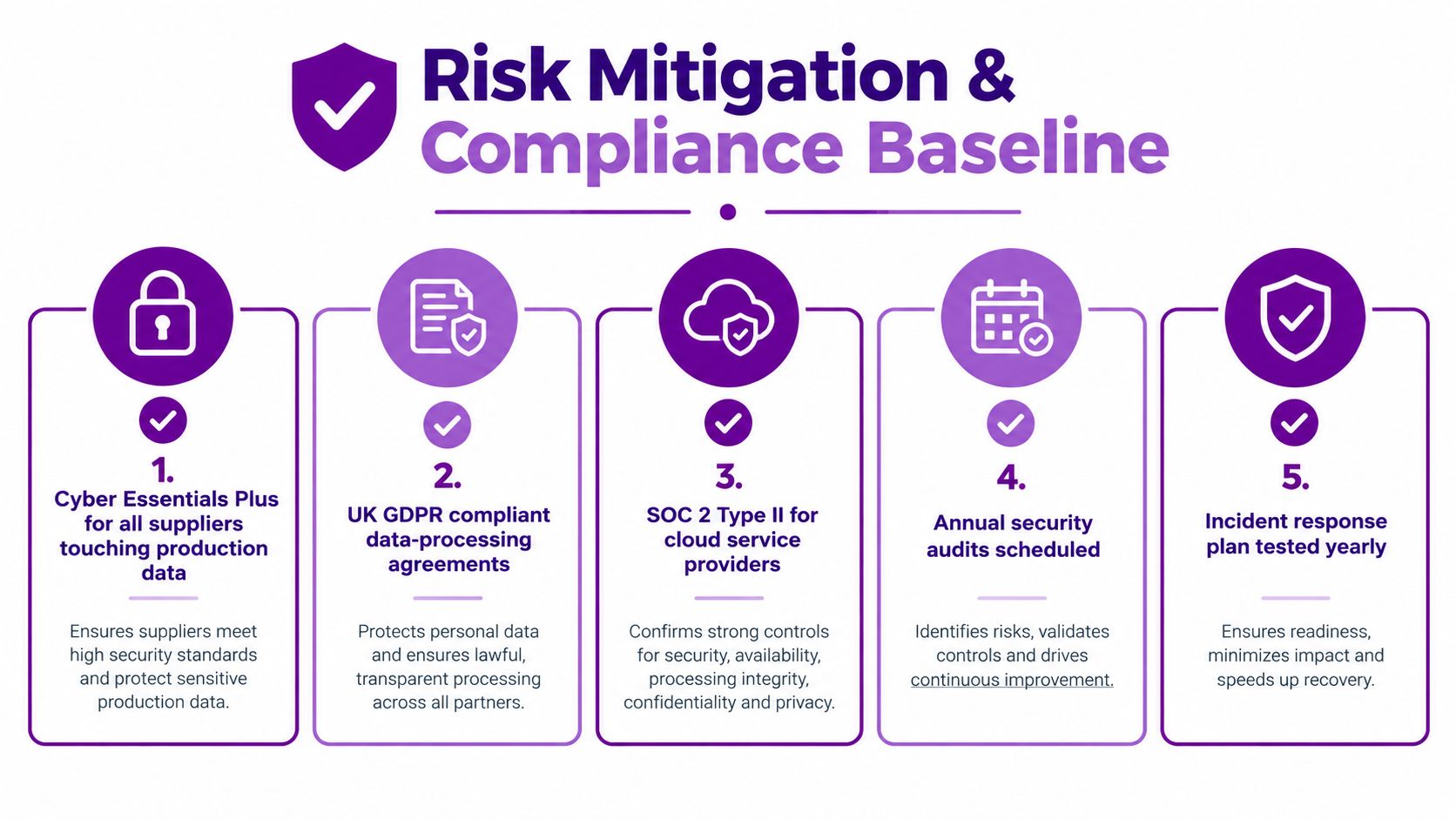
The visual baseline should be adapted to the service risk. A cloud provider, a consultancy with privileged access and a hardware supplier shouldn't automatically face identical controls. Assess data access, connectivity, subcontracting, resilience and recoverability, then write proportionate requirements into the RFP and contract.
A supplier code of conduct can reinforce those expectations when it is connected to onboarding, review and remediation. See this supplier code of conduct guidance for a practical reference point.
Threshold checking also belongs at the start, not the end. For procurements commencing on or after 1 January 2026, the goods and services threshold is £135,018 for central government authorities and £207,720 for sub-central government authorities, according to the 2026 public procurement threshold table. The applicable route depends on the buyer, procurement and legal context, so confirm the position before issuing documents.
Regional Lessons From East Midlands Procurement Activity
The East Midlands deserves more attention than it receives in national procurement commentary. Regional buyers face the same Microsoft, cloud and managed-service decisions as larger organisations, but locality affects support, supplier access, stakeholder relationships and the practicality of transition.
The available transparency data shows that the East Midlands accounted for £181 million of UK local IT procurement spend in FY24/25, equal to 5.9% of local IT spend, within the wider £2.9 billion local-government total. The figures come from the Stotles dataset cited earlier. They show that procurement is substantial and regionally concentrated, not an abstract national exercise.
Frameworks are also central to route-to-market decisions. Across UK public-sector IT and digital procurement, more than £7.4 billion of contracts were awarded through framework agreements in FY24/25. The top five IT frameworks accounted for more than £360 million, while G-Cloud 13 handled £117 million and had the largest supplier count, according to techUK's procurement index.
| Regional Procurement Pattern | Observed in East Midlands Tenders | Lesson for Private-Sector Buyers |
|---|---|---|
| Regional concentration of spend | East Midlands activity forms a significant local-government share within the published dataset. | Ask whether a partner understands local delivery realities, not just national catalogue pricing. |
| Framework-led access | Public buyers use established frameworks to reach compliant suppliers and accelerate award. | Check the lot, scope, supplier availability and call-off terms before assuming a framework is the cheapest route. |
| Mixed contract sizes | The dataset records many smaller deals alongside larger contracts. | Don’t let a large supplier bundle obscure a smaller, more suitable specialist option. |
| Aggregated buying | Frameworks can simplify route-to-market and create purchasing leverage. | Test whether aggregation matches your actual requirements, service boundaries and exit needs. |
| Local support considerations | Regional organisations often need practical on-site and remote collaboration. | Include response location, escalation, handover and continuity in the evaluation model. |
National government IT spending reinforces the importance of renewal discipline. Parliamentary and audit sources estimate at least £14 billion annually in government digital procurement, while the Institute for Government reported £19.7 billion spent on IT in 2023. The same parliamentary material refers to more than 8,800 IT contracts worth £23.4 billion ending across the parliament, as set out in the Public Accounts Committee report.
The private-sector lesson is straightforward. Use frameworks when they improve compliance and access, but don't outsource the commercial decision to the framework. Confirm the lot, compare the actual service, negotiate where permitted and retain a credible exit route.
Choosing a Procurement Partner and Your Next Steps
Choose a procurement partner by testing what it does before signature. A polished proposal isn't evidence of licensing competence, negotiation ability or post-award discipline. Ask to see the working method, the decision records, the evaluation model and the contract-management rhythm.
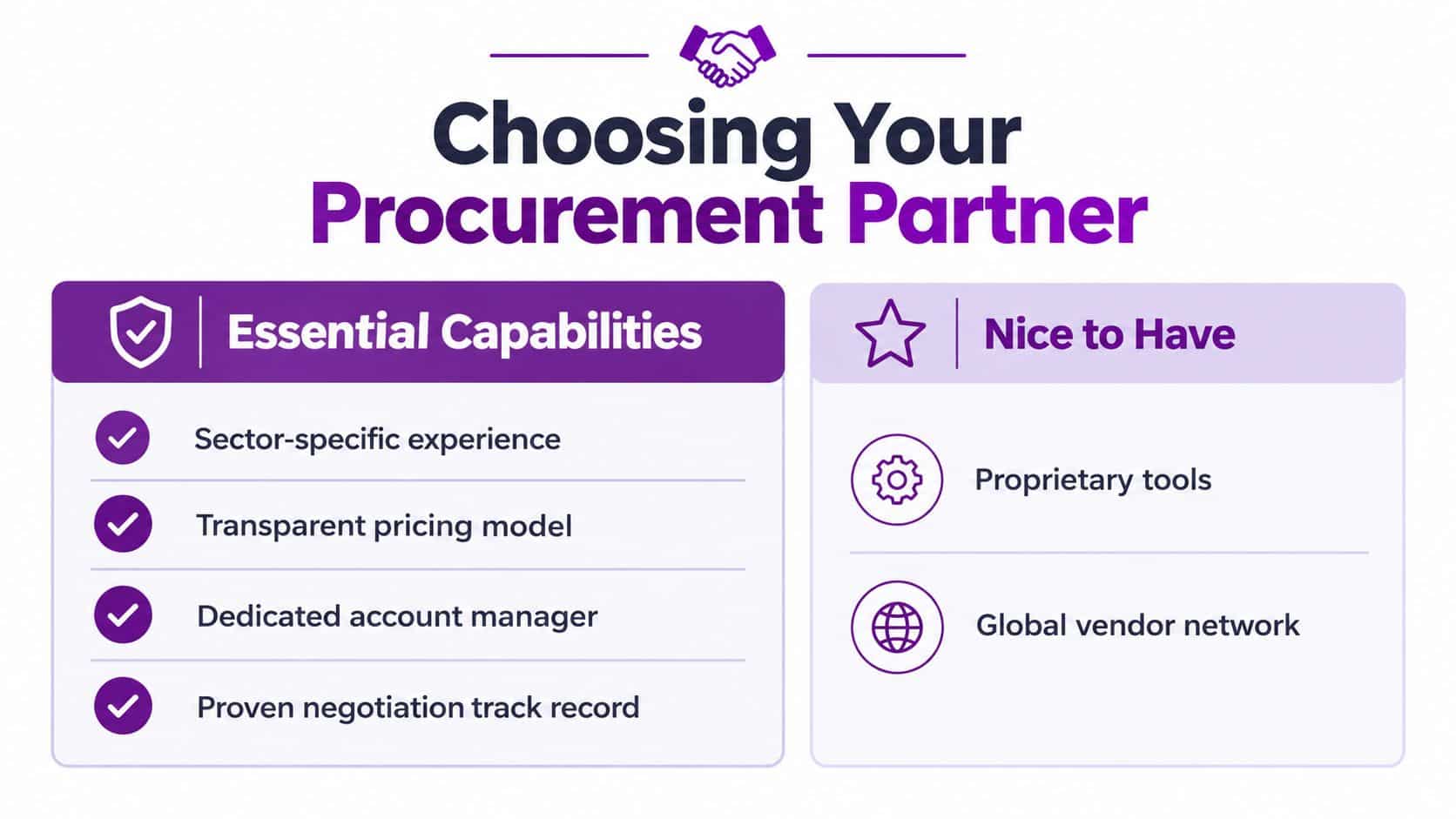
The essential capabilities are:
- Microsoft licensing competence: the partner can reconcile users, products, consumption and agreement structures rather than merely resell licences.
- Whole-life-cost modelling: the business case includes implementation, support, renewal, change, consumption and exit.
- RFP authoring discipline: requirements are measurable, proportionate and capable of producing comparable responses.
- Supplier risk scoring: security, financial, delivery and dependency risks receive an owner and treatment.
- Post-award contract management: the partner remains useful after the purchase order, with reviews, reporting and renewal control.
- Commercial independence: recommendations aren't shaped solely by a supplier margin or preferred catalogue.
The market is also moving towards outcome-based and AI-adjacent buying. Government guidance identifies vague requirements, short bidding timescales, high financial thresholds and poorly allocated risk as barriers for smaller suppliers, while encouraging challenge-led and demonstration-based procurement in suitable circumstances. The DSIT SME Action Plan provides the relevant policy context.
For Copilot, automation or AI-enabled services, write measurable outcomes without pretending the solution is already fully defined. Specify the business problem, data boundaries, user responsibilities, adoption evidence, security controls and pilot decision points. Keep the criteria proportionate so capable smaller suppliers can respond.
A practical route from uncertainty to control
-
Run a current-state audit. The IT Director owns the exercise with finance and procurement support. Reconcile contracts, licences, cloud usage, renewals and supplier obligations. The commercial question is, “What are we paying for, and what must change?”
-
Choose framework or direct sourcing. The procurement lead tests the available route against competition, compliance, supplier fit and timing. The question is, “Which route gives us the right market access without hiding cost or risk?”
-
Run a scoped RFP pilot. Start with a defined Microsoft, managed-service, cloud or cyber requirement. The project owner uses a written specification and evaluation matrix. The question is, “Can suppliers demonstrate a deliverable outcome at a whole-life cost we can defend?”
-
Onboard the partner with governance in place. Assign owners for invoices, usage, risk, service reviews, changes and renewal. The question is, “Who will prevent the next avoidable renewal problem?”
A transactional reseller appears when the conversation starts and ends with a product code and a price. A strategic partner asks what the organisation is trying to achieve, challenges the requirement, models the full term, protects the contract and stays accountable after award. That's the difference to test before you sign.
F1Group offers Microsoft-focused support across Microsoft 365, Azure, Dynamics 365, Power Platform, Copilot, cyber security and managed IT, with procurement input for supplier risk, requirements and rollout. If your technology estate needs a commercial reset, visit F1Group, phone 0845 855 0000 today or send us a message to discuss the next procurement decision.