
20% of UK businesses storing data away from their premises experienced a server or cloud outage or downtime, so proper Azure managed IT services must define who detects an outage, who communicates with users, and how recovery is tested. Cloud adoption alone doesn't provide business continuity. Ownership and rehearsal do.
A typical East Midlands business discovers this at the worst possible moment. A Nottingham charity is in the middle of a critical fundraising period when staff lose access to Microsoft 365. The migration to cloud services went smoothly, but nobody agreed who would identify the incident, update employees, contact suppliers, or decide whether to fail over. The provider's contract mentions monitoring, yet nobody can explain what happens after the alert.
That gap matters from Lincoln to Leicester, and from Newark to Grimsby. Azure can provide a strong technical foundation, but resilience depends on architecture, identity recovery, backups, connectivity, communications and tested decisions. A managed service should make those responsibilities visible before an outage, not debate them during one.
Why Azure Managed Services Matter for East Midlands Businesses
The UK government's Business Data Survey 2026 reports that 31% of businesses used a public-cloud provider such as Microsoft Azure, while 20% of businesses storing data away from their premises said they had been affected by a server or cloud outage or downtime. Those figures describe a practical reality for local firms: cloud use is established, but downtime still reaches organisations that have moved their systems off-site.

The question isn't whether Azure is worthwhile. The question is whether your business has designed for failure. A single-region workload, an untested backup, a dependency on one identity service or an unreliable office connection can still stop operations. Hosting a workload in a public cloud doesn't automatically create a second copy, a recovery plan or a person with the authority to make decisions.
Practical rule: If your provider can't name the person who owns outage communications, your continuity plan isn't finished.
For an East Midlands SME, a capable managed service should cover more than routine ticket handling. It should establish:
- Detection ownership: Which team monitors Azure, Microsoft 365, identity services, backups and connectivity?
- Communication ownership: Who tells directors, employees, customers and key suppliers what has happened?
- Recovery ownership: Who decides whether to restore, fail over, rebuild or wait for the affected service?
- Testing ownership: Who schedules recovery exercises and records what failed during the test?
The National Cyber Security Centre's cloud security principles provide the right starting point. The NCSC treats cloud adoption as an ongoing governance and security responsibility, not a one-off migration. It also makes clear that a provider and its supply chain become part of your supply chain, so outsourcing operations doesn't remove your accountability.
That is why Azure managed IT services matter. They turn cloud infrastructure into an operating model with named responsibilities, monitored controls and rehearsed recovery. The provider should support the technology, while your leadership team retains visibility over business priorities, risk tolerance and acceptable disruption.
What Azure Managed IT Services Actually Include
Azure managed services should describe the work performed every day, not just the products appearing in a proposal. Basic monitoring tells someone that a resource has changed state. A mature service explains who investigates the alert, what action is authorised, how the incident is recorded and when the customer is contacted.
For East Midlands SMEs, the core service normally combines Azure infrastructure management with Microsoft 365 and identity operations. That may include virtual machines, storage, networking, Azure Backup, Microsoft Entra ID, endpoint controls and Microsoft Sentinel, alongside on-premises systems that still support the business.
The operational layer
A useful service includes continuous monitoring of performance, availability, capacity, security alerts and backup jobs. Automated patching can reduce avoidable exposure, but it needs maintenance windows, exception handling and a record of systems that couldn't be updated. Otherwise, automation just hides the gap.
Backup and disaster recovery need particular scrutiny. The provider should define protected workloads, retention, recovery regions, recovery-time objectives and recovery-point objectives. It should also conduct restore tests and report the outcome. A successful backup job doesn't prove that the business can restore an application and its data.
Identity is the control plane. Microsoft Entra ID should support single sign-on, multifactor authentication, Conditional Access and Privileged Identity Management. A provider should review privileged roles, remove unnecessary standing access, maintain emergency-access accounts and investigate unusual sign-ins. Microsoft Sentinel, or an equivalent monitoring platform, can centralise relevant security and authentication events for investigation.
Service tiers and commercial clarity
Not every organisation needs full operational outsourcing. The important point is to identify what each tier leaves with the customer.
| Service Tier | Monitoring | Security Management | Backup & Recovery | Support Level |
|---|---|---|---|---|
| Essential support | Business-hours alert review and basic health checks | Advice and escalation | Job monitoring, customer-led recovery | Ticket-based assistance |
| Managed operations | Proactive Azure, identity and connectivity monitoring | MFA, Conditional Access and access reviews | Managed policies and scheduled restore testing | Agreed response and escalation |
| Fully managed resilience | Continuous operational oversight | Security operations, incident coordination and governance reporting | Recovery planning, exercises and failover coordination | Provider-led incident ownership |
A managed Azure services overview should be judged against this level of detail. Ask which actions are included, which generate additional charges and which decisions still require your approval.
The Government Digital Marketplace illustrates why support and consumption must be separated. One UK public-sector listing states that managed services start at £2,000 plus VAT per month, with additional charges depending on resources and support level, while implementation and professional services are listed at £700 to £1,200 per user per day. Treat those figures as catalogue pricing, not a universal private-sector tariff. Your quotation should separate Azure consumption, licensing, management, projects and emergency work.
The Shared Responsibility Model in Practice
Microsoft secures the underlying cloud, but your organisation remains responsible for how its Azure estate is configured and used. The NCSC's guidance makes this shared-responsibility model explicit, and its guidance on using a cloud platform securely recommends controls such as modern authentication, multifactor authentication, granular permissions and monitoring of privilege escalation.
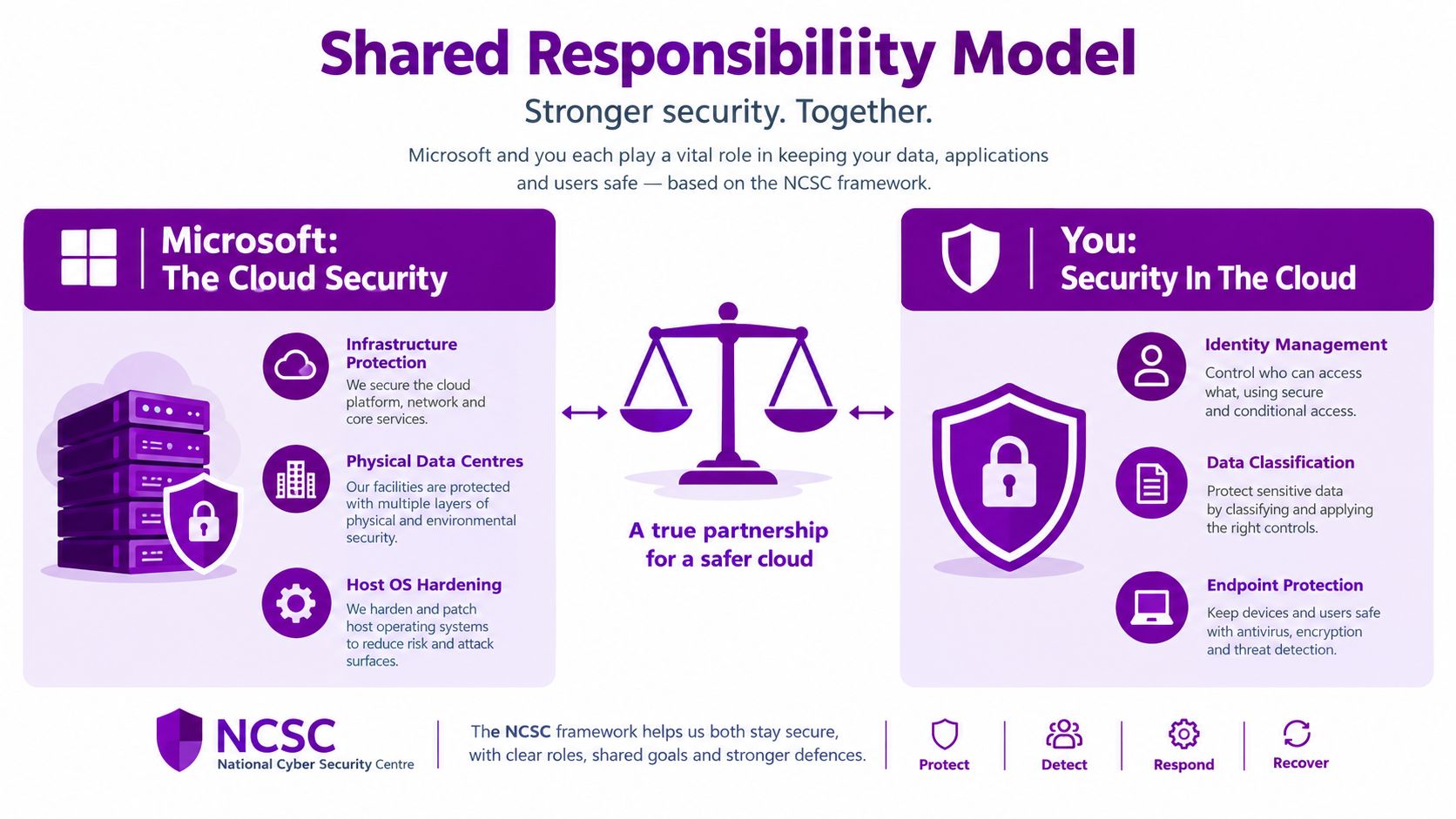
The division becomes clearer when you compare self-managed and provider-managed estates.
Self-managed Azure
Your internal team designs the landing zone, configures subscriptions, applies policies, monitors alerts, reviews privileged access and tests recovery. This can work well where the organisation has the skills and capacity to maintain those controls consistently. It becomes fragile when Azure ownership is added to an already stretched IT role.
The customer must still decide which data may be stored in which regions, which identities can administer resources and how the business will operate during an outage. Microsoft won't make those business decisions for you.
Provider-managed Azure
A managed provider can operate the monitoring, configuration, identity controls, patching, backup and incident processes. It can also maintain runbooks and coordinate recovery with application owners. That improves consistency only when the contract defines authority clearly.
The provider doesn't become the owner of every risk. Your organisation still approves business requirements, classifies information, confirms acceptable recovery outcomes and governs access to sensitive systems. A good partnership gives directors dashboards and reports rather than asking them to trust an invisible service.
Ownership must be written down: identity management, configuration, monitoring, data protection, vulnerability remediation and incident response each need a named owner, an escalation route and an evidence trail.
Build a responsibility matrix for every critical workload. Record who detects an outage, who can change production configuration, who contacts Microsoft, who authorises a restore and who informs users. Include Microsoft 365 dependencies, DNS, line-of-business applications, backups, identity services and on-premises equipment. That document should be reviewed when systems or suppliers change.
The difference between self-managed and provider-managed Azure isn't control versus no control. It's whether operational control is deliberate, visible and tested.
Security and Compliance Using NCSC Guidance
The NCSC framework contains 14 Cloud Security Principles, giving UK organisations a practical benchmark for assessing Azure arrangements. Microsoft's UK reference architecture for a three-tier web application was published on 8 February 2018 and maps responsibilities across those principles for workloads classified as UK OFFICIAL. It also uses infrastructure-as-code templates for a secure hybrid environment and references the UK government's G-Cloud framework and the Center for Internet Security Critical Security Controls.
For an East Midlands business, the value is practical. Don't accept a supplier's claim that Azure is secure. Ask how the service implements secure administration, separation, operational security, personnel security, supply-chain security and secure user management. The NCSC specifically recommends multifactor authentication for management, maintenance and administration access, alongside privileged-access-management controls.
Start with identity and privilege
Microsoft Entra ID should sit at the centre of your security design. Require multifactor authentication for administrators, apply Conditional Access using user, device, risk and location signals, and use Privileged Identity Management for just-in-time roles. Maintain separate emergency-access accounts and review exceptions rather than allowing them to become permanent shortcuts.
The cyber assessment framework can help structure a broader review of governance and control maturity. For teams dealing with artificial intelligence or sensitive operational data, guidance on securing models and data in production is also useful because security decisions must extend beyond the Azure subscription into applications, data flows and model access.
UK data location needs evidence
A UK data centre doesn't automatically guarantee UK compliance. The NCSC says organisations need to understand where data is stored, processed and managed, which jurisdictions apply, who can access it and whether overseas processing creates a restricted transfer under UK data-protection law.
Your provider should maintain an authoritative inventory covering subscriptions, regions, backup locations, support-access routes and third-party integrations. Azure Policy can enforce approved-region rules, but the provider must also assess support telemetry, remote administration, replication and SaaS-connected data flows.
For each important workload, document:
- Data classification: What information does the system hold?
- Permitted jurisdictions: Where may production data and backups reside?
- Access routes: Which Microsoft, partner and customer personnel can administer it?
- Encryption ownership: Who controls keys, policies and recovery access?
- Recovery region: Where will the workload recover, and does that design fit UK legal requirements?
- Exit process: How will you retrieve data and operate if the supplier relationship ends?
Security operations should produce evidence. Ask for MFA coverage, privileged-role activation reviews, Conditional Access exceptions, unresolved high-severity alerts and backup-restore test results. Ticket volume and uptime alone don't demonstrate secure management.
How to Evaluate Azure Managed Service Providers
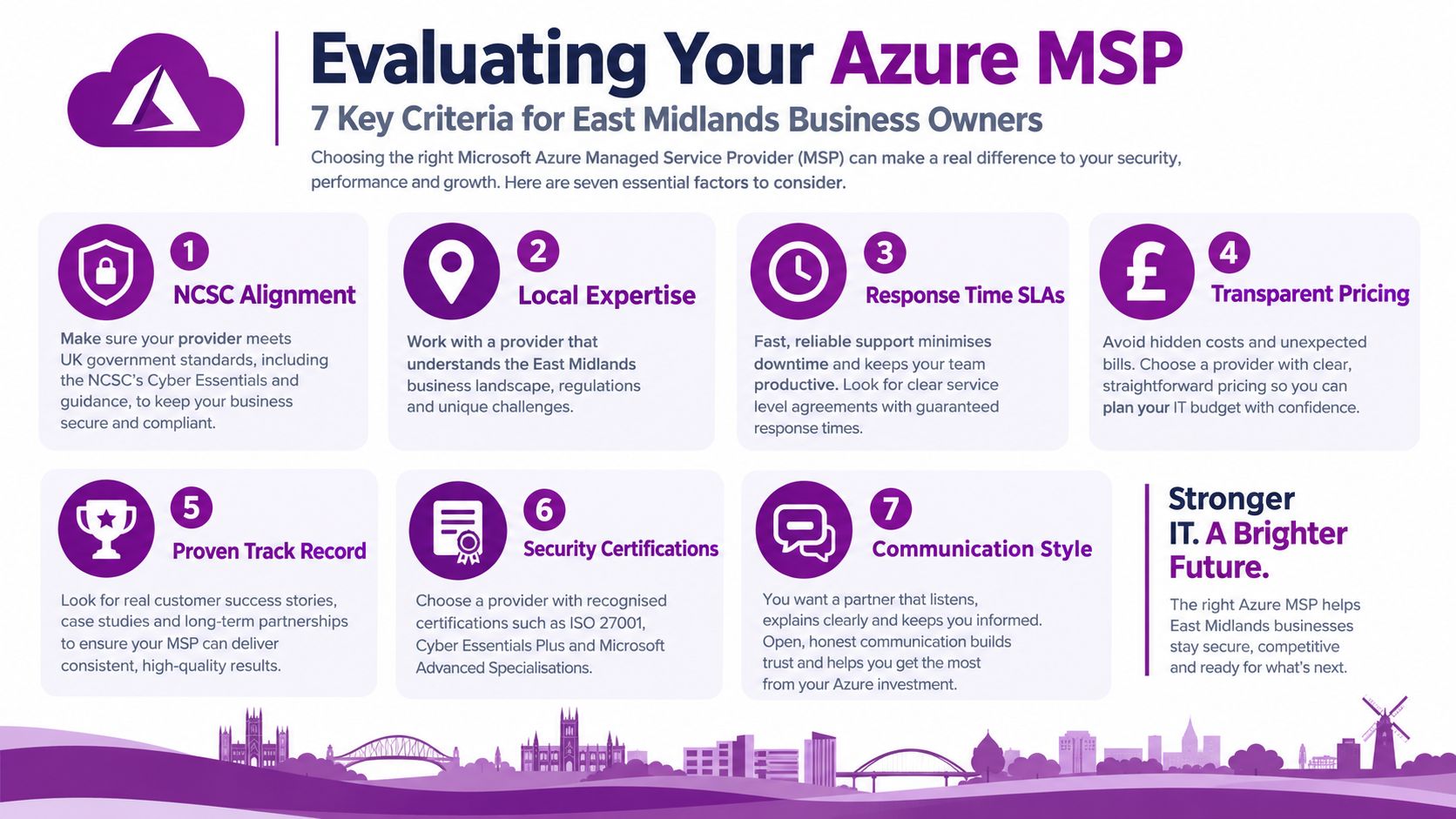
Choose an Azure managed service provider by testing its operating discipline, not by counting Microsoft badges. A provider serving a manufacturer in Leicester may need a different recovery model from one supporting a charity in Nottingham, but both should answer the same ownership questions.
Seven tests for your shortlist
-
NCSC alignment: Ask the provider to map its controls to the 14 NCSC Cloud Security Principles. A vague statement about compliance isn't enough. Request examples of secure administration, supply-chain assurance and access governance.
-
Incident response: Ask who receives the first alert, who can declare a major incident and when your leadership team is contacted. Check whether Microsoft, the provider and your organisation each have a defined role.
-
Recovery testing: Ask to see the restore-test process and the resulting report. A supplier that monitors backup jobs but never demonstrates recovery is selling storage protection, not resilience.
-
Identity governance: Require details on Entra ID, MFA, Conditional Access, Privileged Identity Management, leaver processing and emergency access. Excessive permissions should trigger a correction plan, not become a permanent exception.
-
Regional support: Businesses in Lincoln, Nottingham, Leicester, Scunthorpe, Grimsby and Newark should establish how remote and on-site support will work. Local presence can help, but clear remote procedures, escalation routes and communication matter more than a postcode alone.
-
Transparent pricing: Separate Azure consumption from management fees, licences, project work and out-of-hours response. Microsoft Partner Centre guidance confirms that Azure offers use regional price lists, with UK prices available in GBP. It shows a UK GBP annual term at £3,393.90 when billed annually and £3,393.96 when billed monthly, demonstrating why quotations should state market, currency, contract term and billing frequency. See the Microsoft Partner Centre pricing guidance for the pricing structure.
-
Comparable experience: Ask for relevant references or anonymised examples from organisations with similar operational pressure, regulatory needs and hybrid infrastructure. You need evidence that the provider can manage your type of business, not just a generic Azure environment.
Red flag: A provider that promises 24/7 monitoring but can't explain its escalation workflow is describing a feature, not a service.
Review the Azure managed service provider guidance alongside your tender questions. F1Group, for example, provides Azure architecture, migration, integration, management, optimisation, identity controls, Conditional Access, multifactor authentication, monitoring, backup and cybersecurity support. Compare those capabilities with the exact outcomes your business needs, rather than assuming every listed service is included in a standard package.
Finish the evaluation by requesting a sample monthly report. It should show security findings, access reviews, backup status, recovery tests, major incidents, unresolved risks and agreed actions. If the report only lists tickets closed, it won't give directors enough information to govern resilience.
Building Your Azure Managed Services Roadmap
Start with an honest current-state assessment. Catalogue subscriptions, regions, workloads, identities, backups, Microsoft 365 dependencies, connectivity and on-premises equipment. Record data classifications, recovery objectives, permitted jurisdictions and the person accountable for each service.
Next, choose a provider against the evaluation criteria above and negotiate the operating model before migration begins. The contract should define monitoring coverage, response priorities, incident communications, change approval, backup testing, recovery exercises, reporting and exit assistance. Don't leave those points inside an informal service-desk conversation.
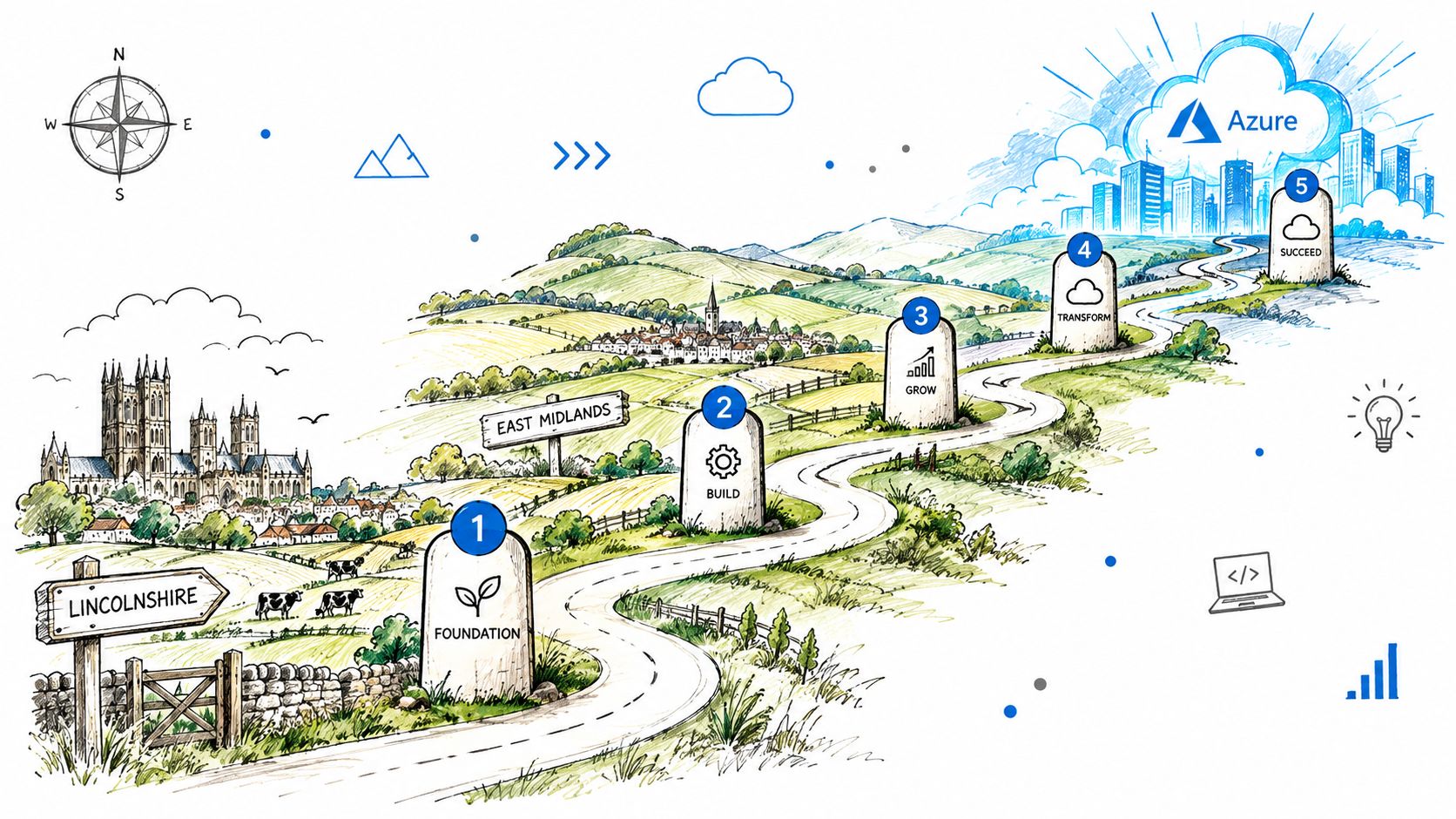
Move workloads in controlled stages. Begin with identity governance and policy guardrails, then address monitoring, backup and recovery before placing critical applications under managed support. Test a restore, run an outage exercise and make sure staff know where updates will appear.
The strongest arrangements I see across Lincolnshire and Nottinghamshire share the same habit. They treat Azure as an operating service, not a completed migration project. Leadership reviews the evidence, the provider owns agreed actions, and both sides rehearse what happens when a dependency fails.
F1Group can help East Midlands organisations assess Azure estates, establish identity and security controls, manage hybrid workloads, test recovery and define clear outage ownership. Visit F1Group to discuss a practical Azure managed service plan, call 0845 855 0000 today, or send us a message with your current resilience concerns.