
A lot of business owners only start thinking about cyber security compliance when a customer, insurer, or auditor asks for proof. It often arrives as a spreadsheet or supplier questionnaire with blunt questions about multi-factor authentication, access control, breach response, data handling, and standards you may not have had to think about before.
That moment catches plenty of otherwise well-run SMEs off guard. The issue usually isn't that the business has done nothing. It's that the business can't yet prove what it does, show that controls are applied consistently, or demonstrate that someone is checking those controls over time. That's where cyber security compliance services become useful. They turn scattered good intentions into a managed, documented, defensible process.
What Are Cyber Security Compliance Services
A common scenario looks like this. A growing firm wins interest from a larger customer, then receives a procurement pack asking for security policies, evidence of staff training, access controls, incident processes, and sometimes Cyber Essentials or ISO 27001 alignment. The business has Microsoft 365 in place, antivirus on devices, and sensible people running operations, but little of it is documented in a way an external party can rely on.
Cyber security compliance services bridge that gap. In practical terms, they help you understand which rules or frameworks apply, assess what you already have, fix the weak points, document the important controls, and keep evidence ready for the next questionnaire, audit, or renewal.
They also matter because cyber risk is no longer hypothetical. The UK Government's Cyber Security Breaches Survey 2024 found that 50% of UK businesses had experienced some kind of cyber security breach or attack in the previous 12 months, which is why many firms now treat compliance as part of protecting against cyber threats rather than a separate admin task.
For many SMEs, the first real compliance pain point is identity. Who has access to what, how that access is approved, and how former staff are removed quickly often becomes the make-or-break issue in reviews. That's why it helps to understand the basics of identity and access management early, especially if you rely on Microsoft 365, SharePoint, Teams, and cloud applications.
A business doesn't usually fail compliance because it has no security at all. It fails because security is inconsistent, undocumented, or impossible to evidence.
Good compliance services don't just hand you a policy template. They connect legal duties, customer expectations, and day-to-day controls so your business can answer questions confidently and keep trading without last-minute panic.
Why Compliance Is More Than A Tick-box Exercise
Treating compliance as paperwork is expensive thinking. It pushes attention towards passing an audit on a given day, instead of making sure your systems, people, and processes hold up when something goes wrong.
Legal and board-level risk
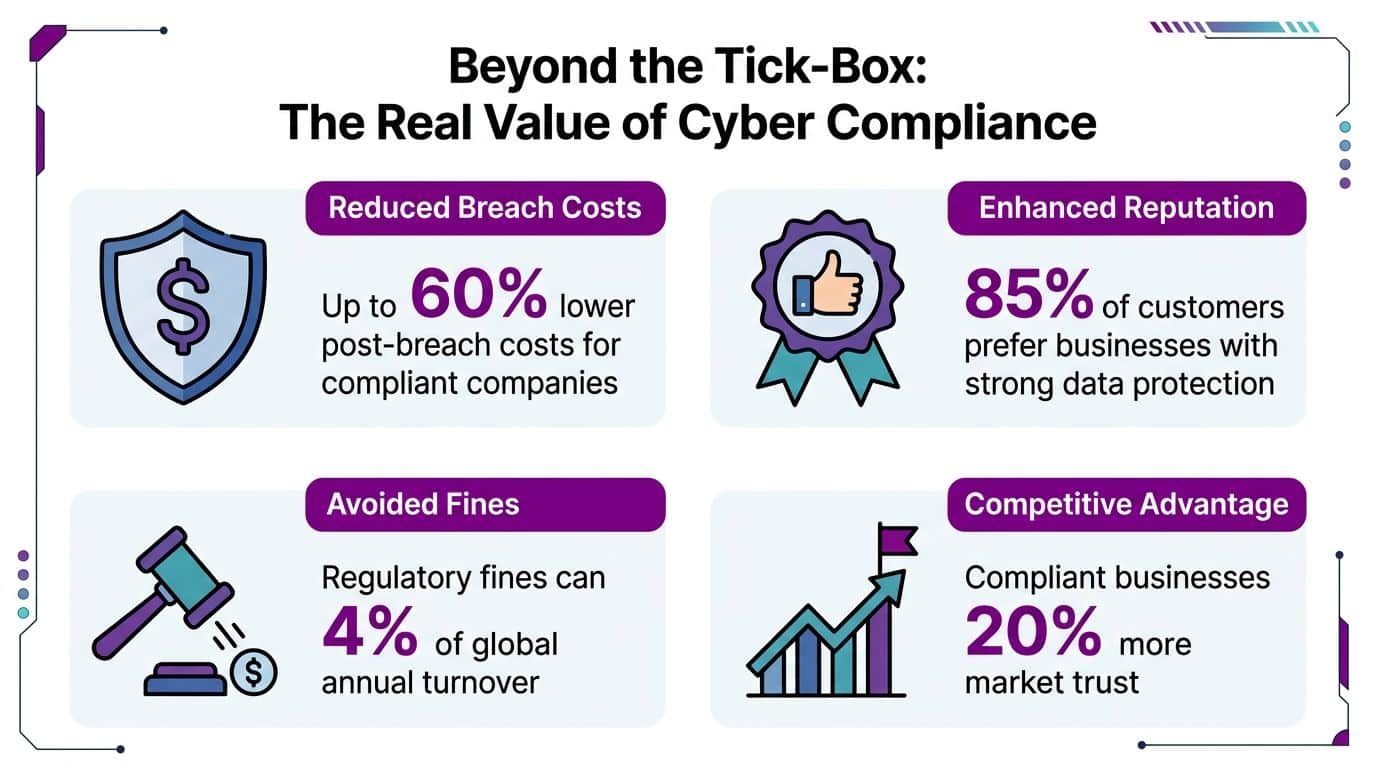
The legal side is straightforward. Under the UK Data Protection Act 2018, the Information Commissioner's Office can impose fines of up to £17.5 million or 4% of annual global turnover for serious infringements, which makes compliance a board-level issue rather than a purely technical one, as noted in this UK compliance overview.
That doesn't mean every business is heading for a major fine. It does mean directors should stop seeing compliance as an IT department side task. If your organisation handles personal data, then decisions about access, retention, encryption, supplier risk, and incident response have legal consequences.
Commercial pressure is rising
The second driver is commercial. Bigger customers increasingly expect suppliers to answer detailed security questions before contracts are signed or renewed. Insurers do the same. So do public sector buyers and regulated sectors.
A business that can produce current policies, show how access is managed, explain how incidents are handled, and demonstrate a sensible improvement plan is easier to buy from. A business that responds with uncertainty, outdated documents, or generic statements creates friction.
That's one reason senior security staff study broad governance topics rather than only technical tools. If you want a feel for the kind of domains experienced practitioners work across, Mindmesh Academy's CISSP prep is a useful example of how compliance, risk, operations, and architecture fit together.
Resilience is the real outcome
The third driver is operational resilience. A useful compliance programme improves how your business works under pressure. It forces clarity around ownership, approvals, exceptions, backups, supplier responsibilities, and breach handling.
Practical rule: If a control only exists in a policy and not in your Microsoft 365 settings, device management, logs, or service desk process, it probably won't survive real scrutiny.
What works is measurable control. What doesn't work is a folder full of policies nobody follows.
Decoding Common UK Compliance Standards
Once a business accepts that compliance matters, the next problem is choice. There are too many acronyms, and they're often discussed as if every company needs all of them. Most SMEs don't. They need the right level of assurance for their size, sector, customer base, and risk profile.
The standards most UK SMEs meet first
Cyber Essentials is usually the starting point. It's practical, recognisable, and often requested in supply chains and public sector work. It focuses on baseline controls such as secure configuration, access control, malware protection, patching, and boundary protection. For smaller businesses, it's often the quickest route to showing that the basics are taken seriously.
ISO 27001 is broader and more demanding. It isn't just a technical checklist. It requires a management system, defined scope, documented controls, risk treatment, internal review, and ongoing governance. Enterprise customers often like it because it shows discipline and repeatability, not just tool deployment.
Some organisations also need sector-specific requirements, contractual security schedules, or framework alignment rather than formal certification. In the UK, firms involved in essential services may also need to understand the Cyber Assessment Framework, especially where resilience, monitoring, recovery, and governance need to be evidenced more formally.
UK Cyber Security Standards Compared
| Standard | Best For | Typical SME Cost (GBP) | Key Focus |
|---|---|---|---|
| Cyber Essentials | SMEs needing a recognised baseline, customer assurance, or tender support | Often from £1,500 to £5,000 depending on scope and remediation support | Foundational technical controls |
| Cyber Essentials Plus | Firms that want independent technical verification of the baseline controls | Higher than Cyber Essentials because of testing and verification effort | Validated implementation of baseline controls |
| ISO 27001 | Businesses handling sensitive data, serving larger clients, or needing a mature governance model | Often starting from £10,000 for preparation, with certification costs varying by scope and audit body | Information security management system |
| UK GDPR and Data Protection Act alignment | Any organisation handling personal data | Varies widely because it depends on data use, systems, and process maturity | Accountability, lawful handling, and evidence of control |
| Customer or supplier security questionnaires | Firms in active procurement chains | Variable. Often bundled into advisory or managed compliance support | Contractual assurance and evidence gathering |
How to choose sensibly
If you're an SME with limited internal IT capacity, start with the requirement that affects revenue first. That might be a customer insisting on Cyber Essentials, an insurer asking for stronger controls, or a board concern about personal data handling.
Then check whether your current tools can support the standard. Microsoft 365 Business Premium, Microsoft Entra ID features, Intune, Defender, audit logging, and conditional access can do a lot of the heavy lifting when they're configured properly. Without that alignment, companies often pay twice. Once for the advisory work, then again to replace or bolt on tooling they already partly own.
A good standard is one your business can maintain. The wrong one is the one you chase for the badge, then quietly fail to operate six months later.
What to Expect From a Compliance Service Provider
A business owner usually asks the right question early. What are we buying?
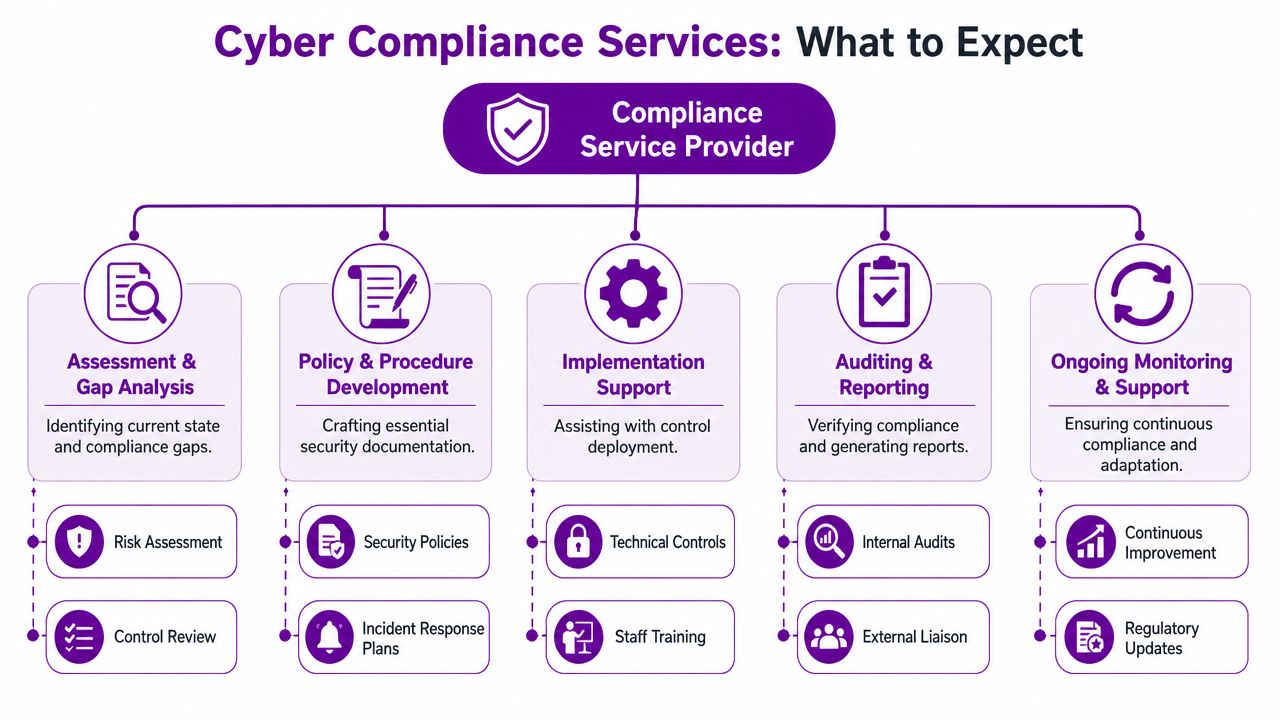
The answer should be practical support that gets you from uncertain to audit-ready, then keeps the work manageable after the first push. A good provider does more than review documents. They help define scope, fix control gaps, organise evidence, and set up a way of working your team can maintain without turning compliance into a second full-time job.
Gap analysis and scoping
The first job is usually a gap analysis, but the useful part is not the spreadsheet. It is the judgement behind it.
Your provider should review your systems, policies, responsibilities, and existing evidence against the requirement in scope, then separate findings into three groups. What creates real business risk. What blocks certification, contract approval, or insurer acceptance. What can be fixed quickly with the tools you already have.
For a UK SME using Microsoft 365, that often means checking:
- Identity controls such as MFA, joiner-mover-leaver processes, privileged access, and sign-in review
- Device security including patching, encryption, configuration baselines, and remote management through Intune
- Data handling across SharePoint, OneDrive, Teams, email, and any remaining local storage
- Logging and evidence so security activity can be reviewed without a scramble before an audit
- Incident handling including who makes decisions, who records actions, and when customers or regulators may need notifying
This stage should also stop wasted spend. I often see firms paying for extra products before anyone has checked what is already included in Business Premium, Defender, Entra ID, or Purview.
Remediation and control design
Once the gaps are clear, the provider should help you close them in a sensible order. That means dealing with the controls that reduce exposure and support evidence collection first, rather than producing polished policies around weak operational practice.
For UK GDPR work, the aim is to show that personal data is handled with appropriate controls and that the business can demonstrate accountability. In practice, that usually comes down to access control, encryption, vulnerability management, retention, and clear decision-making.
Experience matters. If MFA is only enabled for some users, rollout planning matters as much as the setting itself. If administrators share accounts, that needs redesigning. If laptops are encrypted but recovery keys are unmanaged, the control exists on paper but is weak in practice.
Policies, evidence, and staff behaviour
Policies still matter, but only if they reflect how the business operates. A provider should write or refine them around your real systems, approval paths, suppliers, and working patterns. Otherwise staff ignore them, and auditors spot the mismatch quickly.
Evidence handling is just as important. Audits, customer questionnaires, and renewal reviews usually ask for proof. That can include screenshots, configuration exports, training records, risk decisions, access reviews, incident logs, and change records. If those items are gathered in an organised way from the start, renewals become far less painful.
A solid service often includes:
- Policy drafting and review for acceptable use, access control, incident response, backup, retention, and supplier management
- Awareness support so staff know how to handle phishing, personal data, and escalation
- Control testing and internal review to check whether the stated process is followed
- Audit or questionnaire support for certification bodies, larger customers, and due diligence requests
F1Group also offers cyber security consultancy, incident response support, and awareness services that businesses often need when turning compliance requirements into day-to-day operating controls.
Ongoing service matters more than the initial project
The first assessment is only the start. Staff join and leave. Devices drift out of policy. New suppliers appear. Microsoft settings change. Business processes change too.
A provider should offer a way to review the controls and evidence that matter at regular intervals, so your team is maintaining compliance as part of normal operations instead of rebuilding everything from scratch at each renewal. For most SMEs, that ongoing discipline is where the true value sits.
Your Compliance Journey A Step-by-Step Process
Most successful compliance projects follow a clear path. The difference between a manageable project and a painful one usually comes down to scoping, ownership, and staying realistic about what can be fixed quickly.
A visual overview helps before the detail:
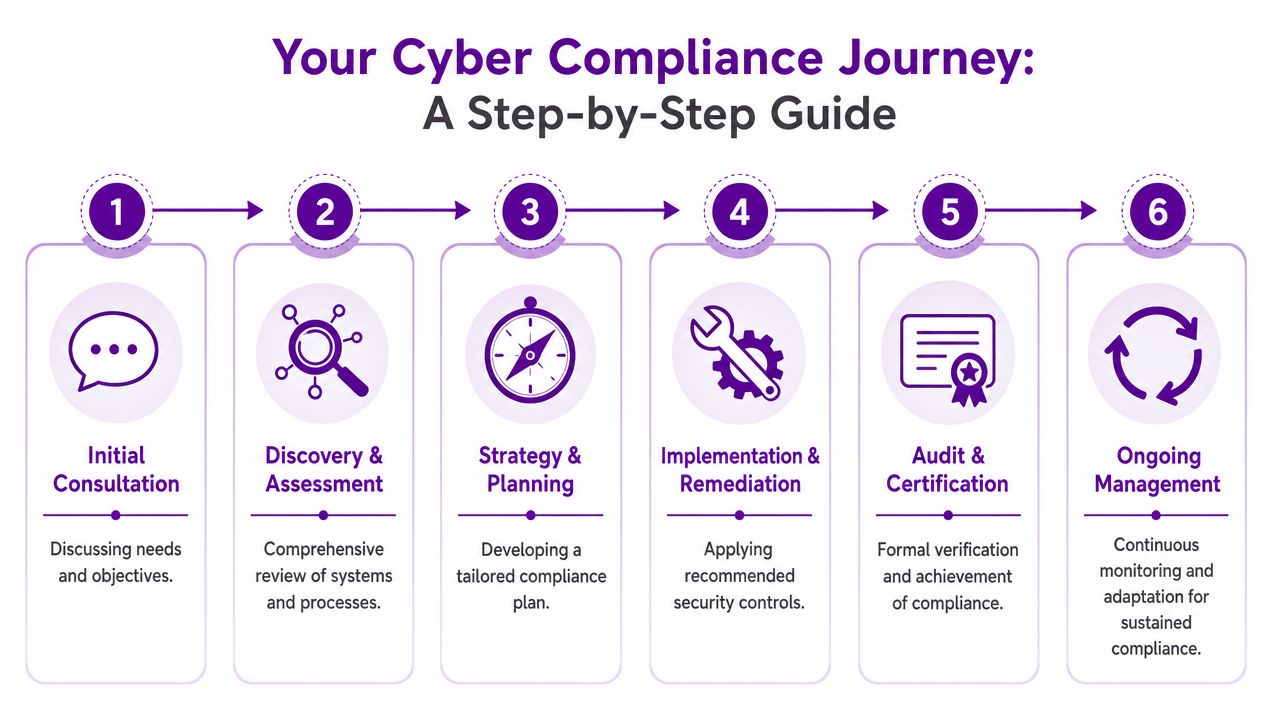
The six stages that work in practice
Initial consultation
During the initial consultation, the business goal becomes clear. Are you trying to win a contract, satisfy a customer, address a board concern, improve insurer responses, or prepare for certification? The answer affects scope, timing, and budget.Discovery and assessment
Your provider reviews systems, documentation, responsibilities, and controls. They should speak to both leadership and operational staff, because compliance failures often happen in the gaps between policy and daily work.Strategy and planning
A sensible roadmap follows. Not every issue needs solving at once. Some items are foundational, such as identity security and device management. Others can be phased.
The operational side is easier to understand when you can see it discussed plainly:
Implementation and remediation
Controls are configured, policies updated, staff guidance improved, and evidence collection organised. For Microsoft environments, that often means tightening Entra ID, conditional access, Intune policies, audit logging, and endpoint security settings.Audit or certification support
If a formal audit is involved, your provider should help you prepare evidence, answer assessor questions, and tidy obvious weaknesses before the audit day.Ongoing management
This is the stage many firms underestimate. The NCSC promotes continuous assurance models, meaning a good compliance service must evidence ongoing activities like monitoring and testing, not just a one-time policy review, to manage risk effectively.
Who needs to be involved
A compliance project doesn't belong to IT alone. The best results usually involve:
- Directors or owners who can approve priorities and accept risk where needed
- IT or operations leads who understand systems, suppliers, and current constraints
- HR or people managers where onboarding, leavers, and staff policies affect control quality
- Department managers if sensitive data sits in finance, sales, service, or project teams
Compliance moves faster when one person owns decisions, one person owns evidence, and nobody pretends the business has controls it doesn't really operate.
What slows projects down
Three things cause most delays. Undefined scope, over-complicated documentation, and trying to pursue a certification before the basics are stable. Businesses do better when they fix identity, endpoint management, access review, backup assurance, and incident handling first, then build formal assurance around those controls.
Choosing Your Compliance Partner in the East Midlands
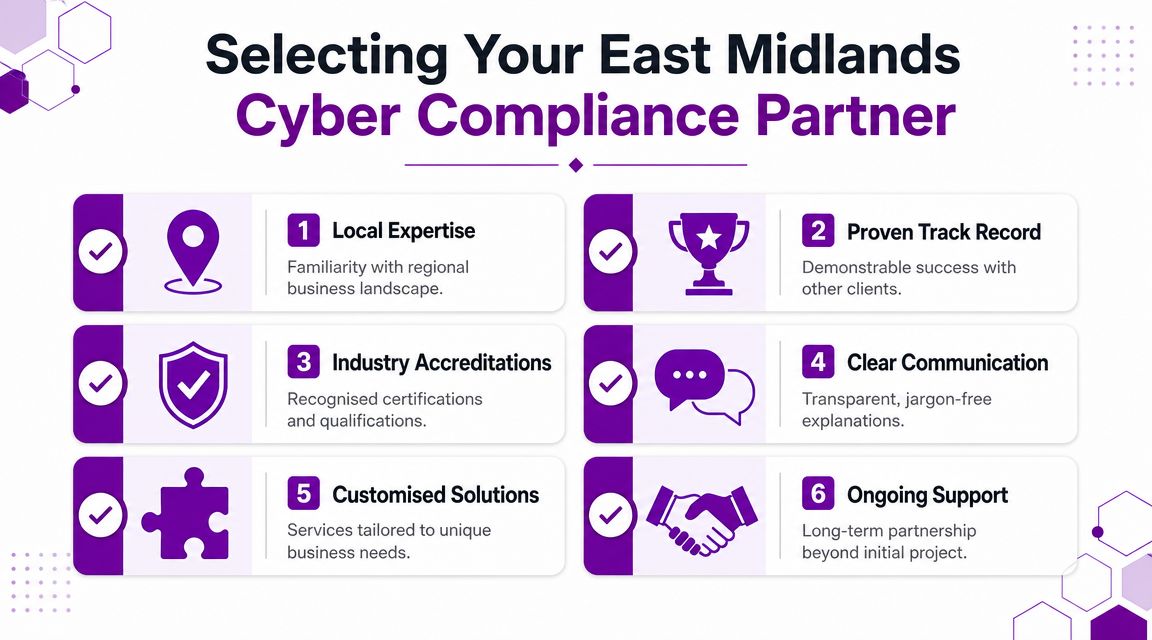
The provider you choose will shape whether compliance becomes a useful operating discipline or an expensive stack of documents. For East Midlands SMEs, local support can matter more than people realise, especially when leadership teams want a straight conversation rather than generic audit language.
Questions worth asking before you sign
A good buying process is simple. Ask direct questions and look for direct answers.
What standards do you work with regularly
You want a provider who can explain the difference between a baseline scheme, a management-system standard, and customer-specific assurance work without hiding behind jargon.How much of the work is advisory versus hands-on
Some firms will identify gaps but won't help implement fixes. Others will support both the documentation and the technical remediation.How do you work with Microsoft 365 and Azure
This matters for many UK SMEs. If your provider doesn't understand Entra ID, Intune, Defender, audit logging, and conditional access, they may recommend unnecessary tooling or miss simpler ways to evidence controls.Can you support us after the initial project
Ongoing governance is where value compounds. If support ends on certification day, expect the next renewal to be harder than it should be.How do you communicate findings
Business owners need priorities, consequences, and options. They don't need a report that reads like a detached academic exercise.
What affects cost
Quotes vary for good reasons. Scope, number of users, number of locations, the maturity of existing controls, and whether you need formal certification all change the amount of work involved.
For planning purposes, many SMEs find that a basic Cyber Essentials project might cost £1,500 to £5,000, while preparing for ISO 27001 is often a more significant investment starting from £10,000. Those figures can move up if remediation is extensive, multiple sites are involved, or policy and technical work both need attention.
What a sensible partner looks like
A practical provider should be willing to challenge weak assumptions. If your team says leavers are always removed promptly, they should ask how that's evidenced. If encryption is said to be enabled, they should verify where and how. If policies exist, they should check whether staff can follow them.
For businesses comparing providers, it also helps to review broader cybersecurity consultancy services so you can judge whether a firm can support risk, remediation, and operational follow-through, not just compliance administration.
The right partner reduces uncertainty. The wrong one increases documentation while leaving the real control gaps untouched.
From Compliant to Resilient Your Next Step
You pass the audit, file the evidence, and get back to running the business. Three months later, a member of staff still has access they no longer need, a new supplier has been onboarded without proper checks, and nobody is sure whether the incident process still matches how the team works. That is where many SMEs slip from compliant on paper to exposed in practice.
True value comes when compliance improves how your business controls access, protects data, responds to incidents, and keeps evidence up to date as part of day-to-day operations. For many UK firms, especially those already using Microsoft 365, that means turning policy requirements into managed settings, repeatable reviews, and clear ownership. Compliance should reduce operational risk and audit stress at the same time.
A one-off project rarely holds up for long. Staff join and leave. Devices change. Microsoft tenants evolve. Customer requirements tighten. Good compliance work accounts for that reality and treats governance as an ongoing managed process, not a once-a-year document exercise.
Looking ahead, it is reasonable to expect future breach surveys to keep showing that many businesses are still being caught out by basic control failures. That is why ongoing reviews, evidence collection, and control testing matter more than a certificate on its own.
If you want practical help turning requirements into workable controls, F1Group supports East Midlands organisations with Microsoft-focused IT and cyber security expertise. Phone 0845 855 0000 today or Send us a message.