
TL;DR: A D-U-N-S Number is a unique nine-digit business identifier issued by Dun & Bradstreet and used globally to establish a company’s business identity and credit file. In the UK, most registered companies are assigned one automatically when they register with Companies House, so the first job is usually to look it up rather than apply from scratch.
A lot of UK businesses only discover their D-U-N-S Number when a form blocks progress.
You’re setting up a supplier account, joining a vendor programme, or trying to register for a public sector opportunity. Everything is moving normally until one field appears: D-U-N-S Number. Finance may not know it. Operations may assume it’s the same as the company number. IT may only care because Microsoft, a procurement portal, or a due diligence process is asking for it.
That’s usually when the confusion starts.
For many East Midlands firms, the issue isn’t whether they have a D-U-N-S Number. It’s whether they know where to find it, what it does, and why it suddenly matters to a commercial process that seemed unrelated to credit reporting. That’s especially common in businesses adopting Microsoft 365, Azure, Dynamics 365, or bidding for framework work with councils, NHS bodies, trusts, and other large organisations.
The practical answer is simple. A D-U-N-S Number is one of those back-office business identifiers that becomes important the moment you want to trade with larger buyers, pass supplier checks, or speed up onboarding.
Introduction
A familiar example goes like this.
A growing business in Nottingham, Lincoln, Leicester, or Newark decides it’s time to formalise its cloud offering. The team wants to tighten up Microsoft relationships, apply for a supplier framework, or move into larger managed service contracts. The commercial side is ready. The technical side is ready. Then procurement asks for a D-U-N-S Number, and nobody is quite sure whether the company already has one.
That pause can be surprisingly expensive in time.
People start checking old emails, searching Companies House records, asking the accountant, or assuming the VAT number will do. It won’t. The tender deadline doesn’t move, the supplier portal doesn’t care, and the application sits there unfinished.
That’s why understanding that a D-U-N-S number matters beyond a textbook definition. It’s not only a finance admin detail. It affects whether your business can be verified quickly, whether buyers can match your organisation correctly, and whether procurement teams can move you through their process without manual back-and-forth.
For non-financial managers, the key thing to know is this. The D-U-N-S Number sits in the overlap between business identity, credit checking, and supplier verification. If you work with larger organisations, global vendors, or government procurement systems, it often becomes part of the route to “approved supplier” status.
Practical rule: Treat your D-U-N-S Number the same way you treat your company number, VAT registration details, and cyber security certifications. You might not use it every week, but when a buyer asks for it, you need the right answer straight away.
Used properly, it helps remove friction. Ignored, it tends to appear at exactly the wrong moment.
What Is a D-U-N-S Number A Digital Fingerprint for Your Business
A D-U-N-S Number is a unique nine-digit identifier issued by Dun & Bradstreet. The term stands for Data Universal Numbering System, and it works as a recognised business identity marker in commercial and credit systems.

Why people call it a business fingerprint
The easiest way to think about it is as a digital fingerprint for your business.
Your company name can be written in different ways. Trading names can vary. Addresses can be formatted differently. Group structures can be messy. A D-U-N-S Number gives other organisations a standard way to identify the right entity without guessing.
That matters because procurement teams, lenders, suppliers, and large vendor ecosystems don’t want ambiguity. They want to know they’re dealing with the correct business at the correct location.
According to ANNA’s guide to D-U-N-S numbers in the UK, the D-U-N-S Number was conceived in 1963, is a nine-digit identifier, and underpins a Dun & Bradstreet database containing over 285 million commercial entries worldwide.
What it is not
It isn’t your:
- Companies House number
- VAT number
- UTR
- bank account reference
Those all do different jobs.
A D-U-N-S Number is about commercial identity and recognition in systems that need a consistent way to identify your business. That’s why it often appears in onboarding, supplier validation, contract due diligence, and credit-related checks.
Why it exists in practice
Businesses don’t operate in one closed UK registry. They deal with software vendors, distributors, framework operators, finance providers, and multinational customers. Each one needs a way to verify who you are.
That’s where D-U-N-S becomes useful. It gives buyers and systems a shared reference point.
A company can be legally registered and still create friction in procurement if the buyer can’t match the business cleanly across its commercial verification tools.
For UK firms, this is often simpler than people expect because most registered companies already have a number allocated through the Companies House connection. The challenge is usually awareness, not eligibility.
If you’ve ever wondered why a Microsoft-related process, a supplier registration form, or a procurement portal asks for something that sounds financial, this is the answer. It isn’t asking for an accounting code. It’s asking for a trusted business identifier.
Why Your UK Business Absolutely Needs a D-U-N-S Number
Not every business thinks about D-U-N-S until a buyer demands it. By then, it’s already part of a live commercial process.
That’s why it helps to treat it as a readiness item rather than an afterthought.
It supports credibility when buyers check you
Larger organisations don’t only buy on price and technical fit. They also check that the supplier is real, established, and identifiable in the systems they use for onboarding.
According to Company Wizard’s explanation of the D-U-N-S Number, UK company registration automatically triggers issuance through the Companies House integration, D&B’s system supports over 300 million business entries worldwide, and the identifier is recognised by over 50 global trade associations and UK public procurement frameworks.
That gives a small or mid-sized business something useful. It creates a standard identity record that buyers already understand.
It matters when tenders become formal
A lot of firms are perfectly capable of delivering a contract but get slowed down by the mechanics of tendering.
The D-U-N-S Number comes into play when a procurement team wants a consistent business identifier that fits its supplier checks. If your organisation is aiming to pass a PQQ first time, getting the basics of business identity right matters just as much as writing a strong response.
Missing or confused identifiers create avoidable questions. Procurement teams then pause the application, ask for clarification, or move on to suppliers whose records line up cleanly.
It helps in the tech vendor world
In practice, this is especially relevant for businesses that sell, implement, or support major platforms.
If your firm works around Microsoft 365, Azure, Dynamics 365, software procurement, cloud migration, or managed services, you will keep encountering supplier verification steps. A D-U-N-S Number won’t win the contract by itself, but not having it ready can slow or derail the process.
That becomes even more important when the wider commercial picture includes supplier assurance. If you’re already reviewing exposure across third parties, contracts, and onboarding controls, it makes sense to include a verified business identity in the same thinking. That’s part of the wider challenge of risk in the supply chain.
It saves time when others need to validate your business
There’s a practical distinction here.
A company can be genuine, solvent, and technically strong, but still frustrate a buyer because the admin trail is unclear. D-U-N-S helps reduce that friction. It gives someone outside your business a cleaner way to confirm who they are dealing with.
For UK SMEs, that’s one of the strongest reasons to care. You’re making it easier for a customer, lender, distributor, or platform to say yes.
How to Get Your D-U-N-S Number in the UK Step by Step
A common problem shows up a day or two before a tender deadline. The bid is nearly ready, Microsoft registration is underway, or a supplier portal asks for business verification, and nobody can find the D-U-N-S number. At that point, speed matters less than accuracy. If the record is wrong or duplicated, procurement checks slow down.
For UK firms, especially in the East Midlands bidding for public sector work or dealing with larger technology vendors, the practical approach is simple. Check whether the number already exists first. Then request or retrieve it properly and store it where sales, finance, and operations can all find it.
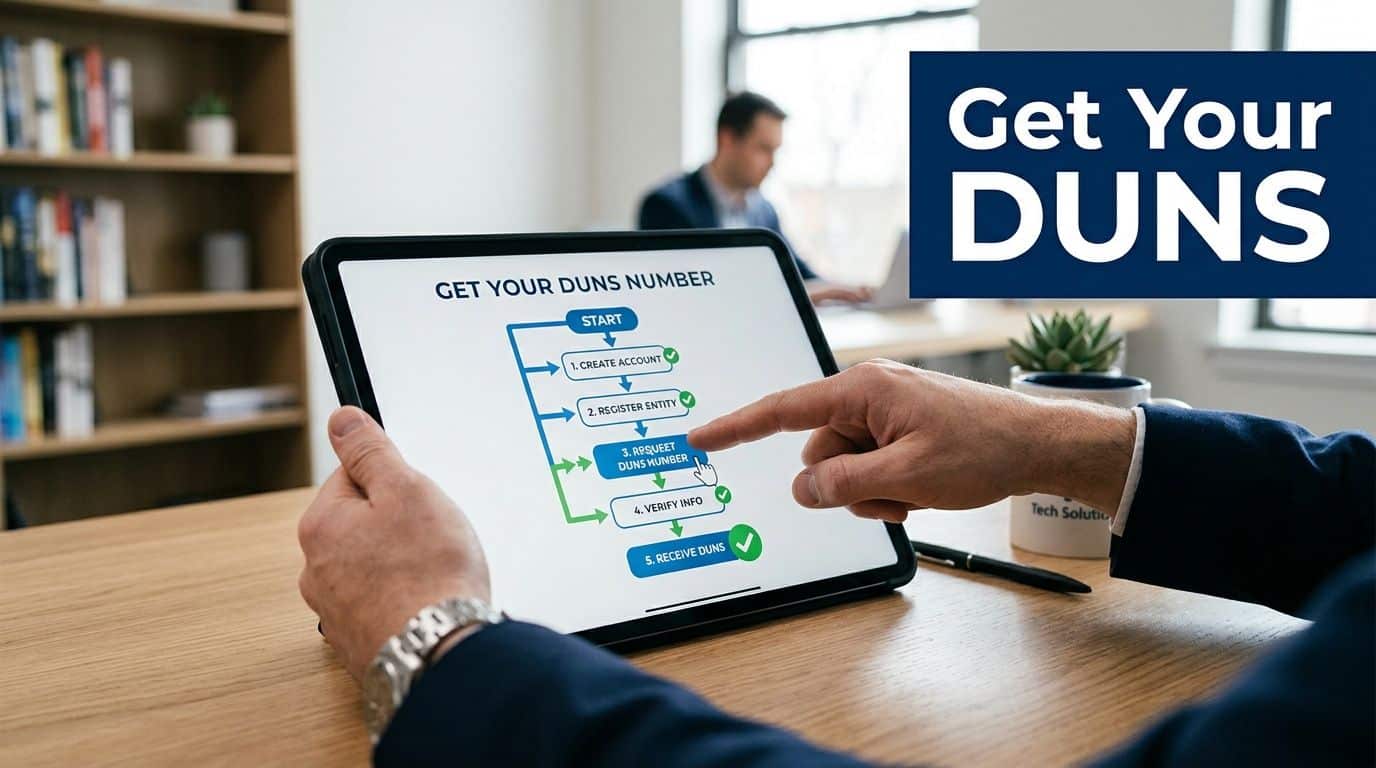
Step 1 Check whether your business already has one
Start with the D&B UK lookup tool rather than a fresh application.
Use your:
- company name
- Companies House Registration Number (CRN)
- registered address
The CRN is usually the best starting point because it reduces the risk of pulling up the wrong business, especially if your trading name differs from your legal entity name.
This matters more than many teams expect. If your legal identity is inconsistent across vendor systems, onboarding can drag. The same principle applies in other control areas too, including identity and access management for business systems. Clean records save time.
Step 2 Request email delivery if the business is found
If the company appears in the results, complete the retrieval step and request the number by email.
Teams often stop after finding the listing on screen. The safer process is to get the email confirmation, save it, and log it in the same place you keep supplier or bid documents. That avoids repeated lookups and reduces the chance that one person becomes the only holder of the information.
For businesses working with Microsoft distributors, cloud procurement frameworks, or council buying portals, that small admin step prevents a surprising amount of last-minute chasing.
Step 3 If it is not listed, submit a new request
If the lookup does not return a match, submit a request for a new D-U-N-S number.
Have these details ready:
- legal business name and any trading name
- registered business address
- telephone number
- website
- registration details
- industry information
- employee details
- start date
- ownership and contact details
Match the submission to your official records as closely as possible. Differences between your Companies House record, website, Microsoft partner profile, and D&B entry can create duplicate files or manual review.
I have seen this catch businesses that have grown quickly, changed premises, or operate under a better-known trading name than their registered company name. The business is real. The paperwork just does not line up cleanly enough for automated checks.
Step 4 Understand the timing and cost
The standard route in the UK is generally free. D&B also provides options for faster handling through its service pages, which is useful if you are working to a live procurement deadline or partner onboarding timetable.
Do not leave the request until the final week of a tender, a Microsoft programme application, or a supplier setup exercise. Free processes can take time, and any mismatch in your records adds delay. If the opportunity is commercially important, treat the D-U-N-S number like any other pre-qualification item and get it sorted early.
A short explainer may help if you’re guiding someone else through it:
Step 5 Store it where the right people can find it
Once you have the number, make it part of your standard business records.
Keep it in places such as:
- your supplier onboarding records
- bid and tender templates
- finance and compliance documentation
- vendor account administration notes
For East Midlands SMEs, I would add one more rule. Put it somewhere accessible to whoever handles council tenders, framework applications, Microsoft licensing relationships, and new supplier forms. Those tasks often sit across different people.
Useful habit: Store the D-U-N-S Number alongside your company number, VAT number, insurance details, certification references, and key vendor account information. That turns repeat procurement questions into a quick admin task instead of a scramble.
What works in practice
Use the CRN first. Check for an existing record. Request a new number only when the lookup confirms you need one.
Problems usually come from rushed submissions, inconsistent addresses, or assuming somebody else in finance or admin already has the number saved. Procurement systems do not make generous assumptions. If the identifier is missing or mismatched, the review queue gets longer.
D-U-N-S Versus Other UK Business Identifiers
Here, most confusion sits.
People often ask what a D-U-N-S is because they already have several business numbers and can’t see why another one exists. The answer is that each identifier serves a different audience and purpose.
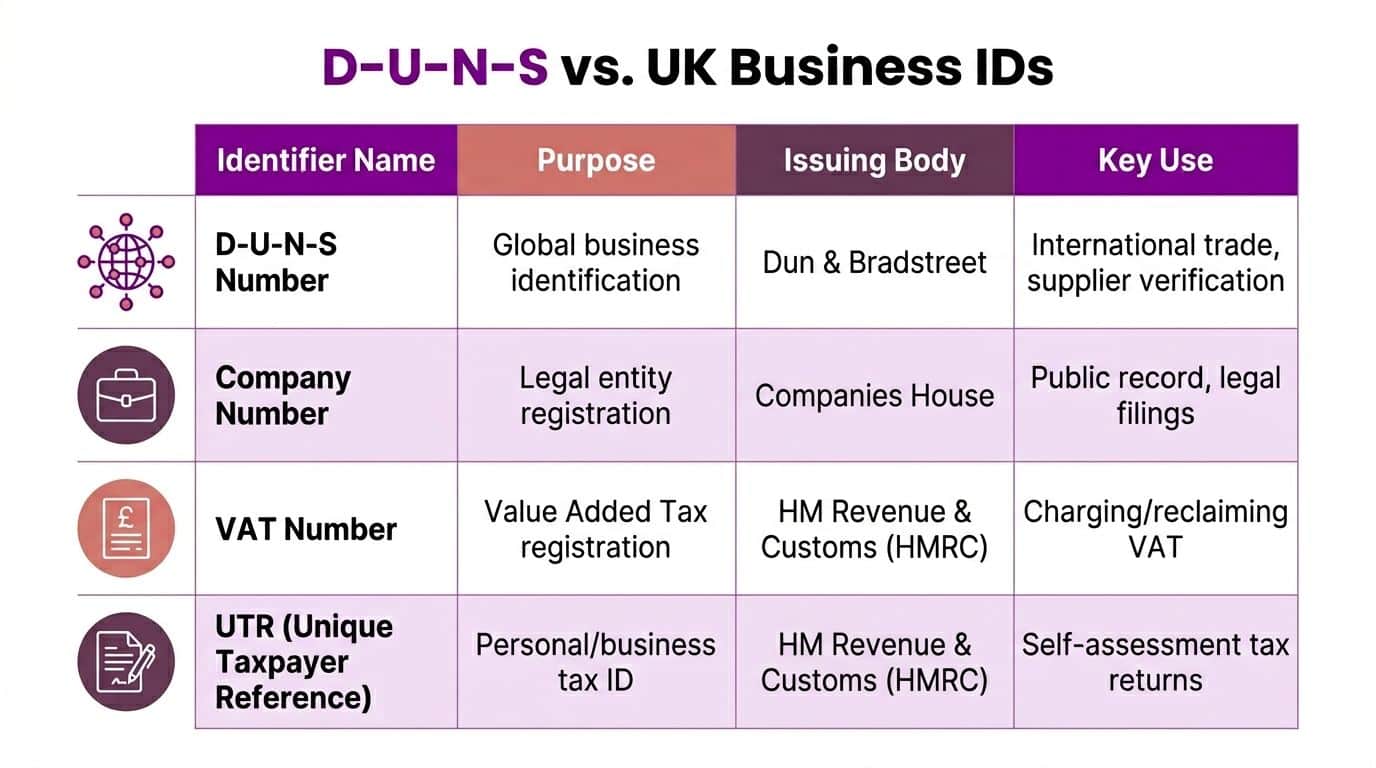
UK Business Numbers at a Glance
| Identifier | Issued By | Primary Purpose | Where It’s Used |
|---|---|---|---|
| D-U-N-S Number | Dun & Bradstreet | Global business identification | Supplier verification, commercial checks, international trade |
| Company Number | Companies House | Legal entity registration | Public record, statutory filings, incorporation records |
| VAT Number | HMRC | VAT administration | Charging and reclaiming VAT |
| UTR | HMRC | Tax identification | Self-assessment and tax administration |
The key difference
Your CRN proves your legal registration in the UK. Your UTR helps with tax. Your VAT number handles VAT obligations.
Your D-U-N-S Number sits in a different lane. It helps external organisations recognise and assess your business in commercial systems.
According to Quality Company Formations’ explanation of D-U-N-S and CRN linkage, all legally registered UK companies are automatically assigned a unique nine-digit D-U-N-S Number, and the CRN triggers the D&B database entry that creates a Live Business Identity profile used for real-time credit assessment.
Why this matters operationally
If a customer asks for your company number, don’t send the D-U-N-S Number.
If a procurement portal asks for your D-U-N-S Number, don’t send the VAT number.
It sounds obvious, but this mix-up happens often, especially when one person is handling company admin, tax, supplier forms, software accounts, and security reviews all at once.
There’s also a wider identity lesson here. Businesses already manage multiple layers of identity for users, devices, systems, and organisations. If that topic is relevant in your environment, this guide to what is identity and access management helps frame the broader discipline.
Different identifiers answer different questions. Legal existence, tax status, and commercial identity are related, but they are not the same thing.
Once that distinction is clear, D-U-N-S stops feeling redundant and starts making sense.
Key Use Cases for East Midlands Businesses
The most practical way to understand D-U-N-S is to look at where it appears in real business activity.
For East Midlands firms, that usually isn’t abstract credit theory. It’s supplier onboarding, tech partnerships, public sector opportunities, and commercial due diligence.
Microsoft and tech vendor onboarding
A business that sells or supports Microsoft platforms often runs into formal verification requirements earlier than expected.
The sales team may be discussing Microsoft 365 licensing, an Azure migration, or a Dynamics 365 project. The technical scope is clear. The customer is interested. Then a vendor or procurement process asks for the company’s D-U-N-S Number as part of verifying the supplier identity.
At that point, the issue is speed.
If the business can provide the correct identifier quickly, the process moves. If not, the whole conversation can stall while someone works out whether the company already has one, whether the details match, and who owns the record internally.
Government and framework opportunities
This is even more direct in public sector procurement.
According to the Digital Marketplace supplier guidance on D-U-N-S requirements, UK government digital procurement platforms such as G-Cloud and Digital Marketplace use D-U-N-S to pre-check supplier accounts. The same source states that UK public sector IT spend reached £28.5 billion in 2025, making awareness of the requirement important for firms pursuing Microsoft Azure and Dynamics 365 opportunities.
For a business in Lincoln, Nottingham, Leicester, Scunthorpe, Grimsby, or Newark, that matters because frameworks can open doors to larger buyers that would otherwise be hard to reach.
Being vetted, and vetting others
D-U-N-S also matters when businesses assess each other.
A supplier may want to confirm they’re dealing with the correct legal entity before extending terms, signing a contract, or sharing sensitive project information. A customer may want reassurance that the organisation they’re appointing is visible and verifiable in standard commercial systems.
That’s especially relevant in IT, where service providers often handle:
- licensing and renewals
- managed services contracts
- cloud migration projects
- cyber security work
- business-critical support
In those relationships, trust isn’t just technical. It’s administrative too.
For firms building their position in the region, strong operational basics can make the difference between staying in the SME bracket and being treated as a supplier that larger organisations are comfortable appointing. That’s one reason many growing organisations also review their wider operational readiness, including IT support services, service ownership, and supplier assurance.
If your business wants bigger contracts, it needs fewer avoidable blockers. D-U-N-S is one of those blockers you can remove in advance.
Troubleshooting Common D-U-N-S Number Issues
Most D-U-N-S problems are administrative rather than technical.
They’re frustrating, but they’re usually fixable if you deal with them early.
The lookup tool can’t find your business
Check the basics first.
Use the CRN rather than relying only on the trading name. Search against the registered address if needed. If the business still doesn’t appear, move to a manual request rather than repeating the same search in different formats.
The details are wrong
If the business appears but the address, name, or other record details are outdated, treat that as more than a cosmetic issue.
Supplier onboarding teams notice mismatches. So do procurement portals. Keep your business record aligned with your current official details, especially after a move, rebrand, or structural change.
You’re being shown paid services
This catches some businesses out.
The D-U-N-S Number itself and standard UK retrieval are one thing. Wider D&B products, monitoring, or credit services are another. Read each screen carefully so you know whether you’re retrieving an identifier, updating a record, or considering a paid add-on.
Your business structure has changed
A sole trader becoming a limited company, or a company reorganising sites or group relationships, may need to review how its business identity is represented.
The practical point is simple. Don’t assume old details still map neatly to the new legal structure. Check the record and update it where needed.
Keep one owner for this internally. When nobody owns business identity data, errors stay in place until a live tender exposes them.
Conclusion Your Next Step to Business Credibility
A D-U-N-S Number isn’t glamorous, but it is useful.
For UK businesses, especially those working with larger customers, public sector buyers, or Microsoft-related supply chains, it helps prove who you are in a format procurement and verification systems already understand. It’s a business identity tool, not just a finance admin detail.
The practical takeaway is straightforward. Check whether your organisation already has a D-U-N-S Number, retrieve it properly, store it somewhere central, and make sure the underlying record is accurate. That small bit of housekeeping can remove friction when you’re bidding, onboarding, or formalising a commercial relationship.
For many East Midlands organisations, that’s part of a wider challenge. Winning contracts and meeting vendor requirements usually depends on more than one identifier. It also depends on solid IT processes, clear commercial data, dependable systems, and a partner who understands how the technical and procurement worlds overlap.
If you need help aligning your systems, supplier readiness, Microsoft estate, or wider IT operations, speak to F1Group. Phone 0845 855 0000 today or Send us a message.