
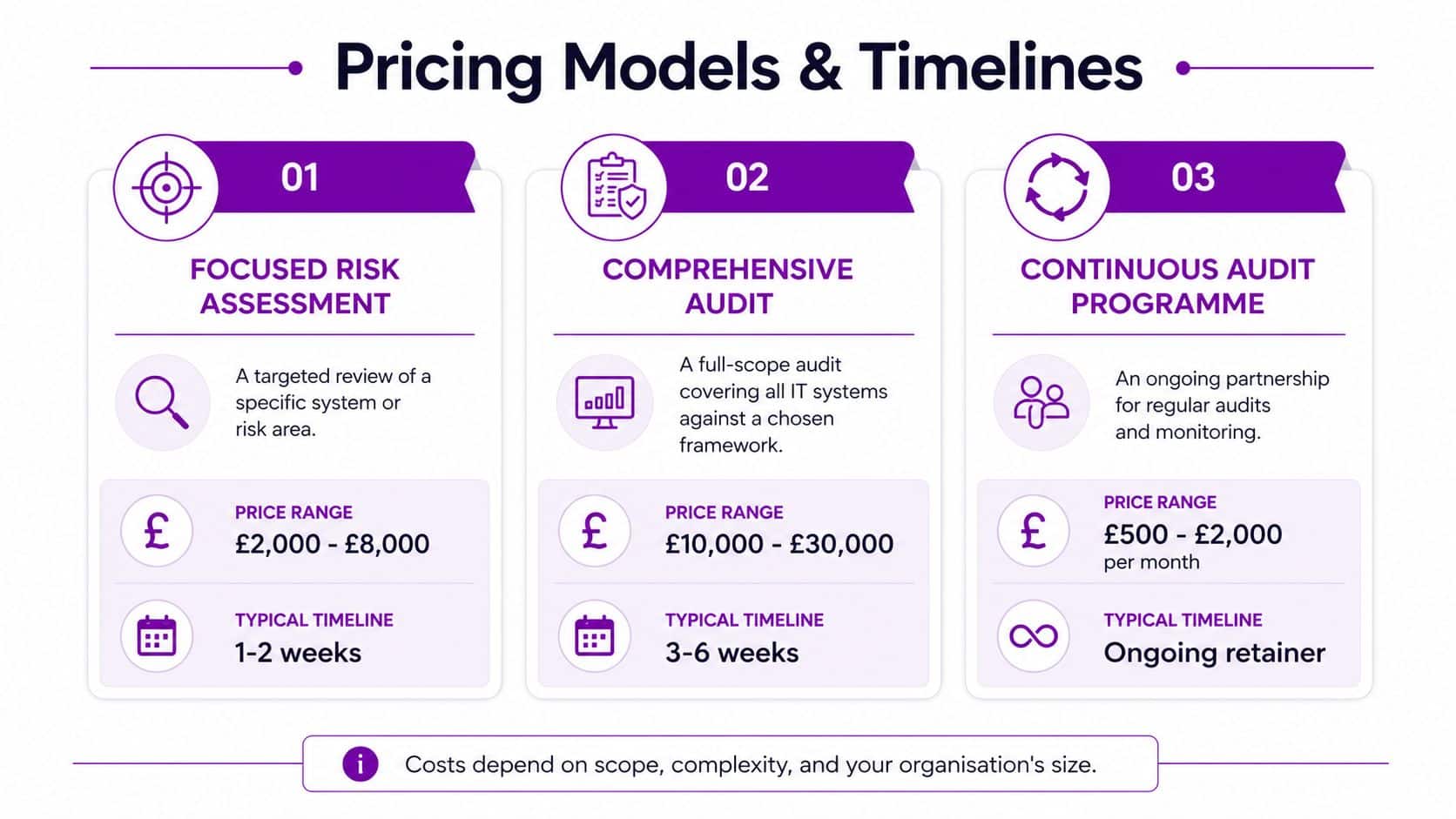
A focused IT audit in 2026 usually sits in the £10,000 to £30,000 band for a UK SME when it has to cover Microsoft 365, Azure, identity, logging, backups, vendor risk and a proper report with retesting. A narrower risk review can come in lower, but if you want real evidence on how controls work, that wider band is the one to budget for.
That is the reality many East Midlands directors are dealing with right now. The board wants reassurance before renewal, the IT manager is chasing evidence, and the finance team wants one clean answer on what the audit will deliver, not another compliance theatre exercise.
What IT Audit Services Provide in 2026
A typical East Midlands finance director does not ask for an “audit” because they enjoy paperwork. They ask because a board pack is due, a supplier questionnaire has landed, or a renewal depends on proving that access, patching and backups are not just documented, but working. IT audit services give them evidence, not vibes.
The threat context is not theoretical. The UK's National Cyber Security Centre reported 2,005 cyber incidents in the 12 months to the end of August 2025, including 89 nationally significant incidents, which is exactly why audit work now sits in governance, not just compliance NCSC incident context. UK businesses and charities are also living with breach exposure across ordinary operations, not only in large enterprises. The Government's Cyber Security Breaches Survey shows 50% of businesses and 32% of charities experienced some kind of cyber breach or attack in the previous 12 months, which is why directors keep asking for evidence that controls work in practice.
What you should expect in the deliverable
A proper audit report is not a rubber stamp. It should usually contain an executive summary, detailed findings, control ratings, a corrective action plan, and clear follow-up expectations. ISACA's guidance is blunt on one useful point, the executive summary is often the only part senior executives read, so it has to carry the overall conclusion, the main message, the key objectives and the headline results ISACA on audit report components.
Practical rule: if the report doesn't tell a director what failed, why it matters, who owns the fix and when it will be retested, it isn't an audit report, it's a document dump.
A strong 2026 deliverable also shows how the environment was tested. For East Midlands SMEs and charities using Microsoft 365, Azure and Dynamics 365, that means the report should spell out whether the auditor checked shared-responsibility boundaries, privileged access, logging, backup restore evidence and the controls behind admin activity. If those areas are missing, the report may look tidy and still miss the risks that matter most.
Why the 2026 budget sits where it does
For a focused SME engagement, the price reflects the work, not the slide deck. You are paying for scoping, discovery, control testing, evidence review, meetings with your team, a board-ready report and, in many cases, a follow-up check on the highest-risk issues. That is why a real budget has to assume Microsoft 365 or Azure estate review, privileged access testing, change-control sampling, backup validation and incident-response evidence.
Budget conversations also need a reality check. A narrower review can be cheaper if you only want one control area tested, but once you want evidence on cloud governance, supplier risk, identity, and recovery, the scope expands fast. East Midlands buyers should ask suppliers exactly which controls they test, which platforms they cover, and whether retesting is included, because that is where weak quotes hide the gaps.
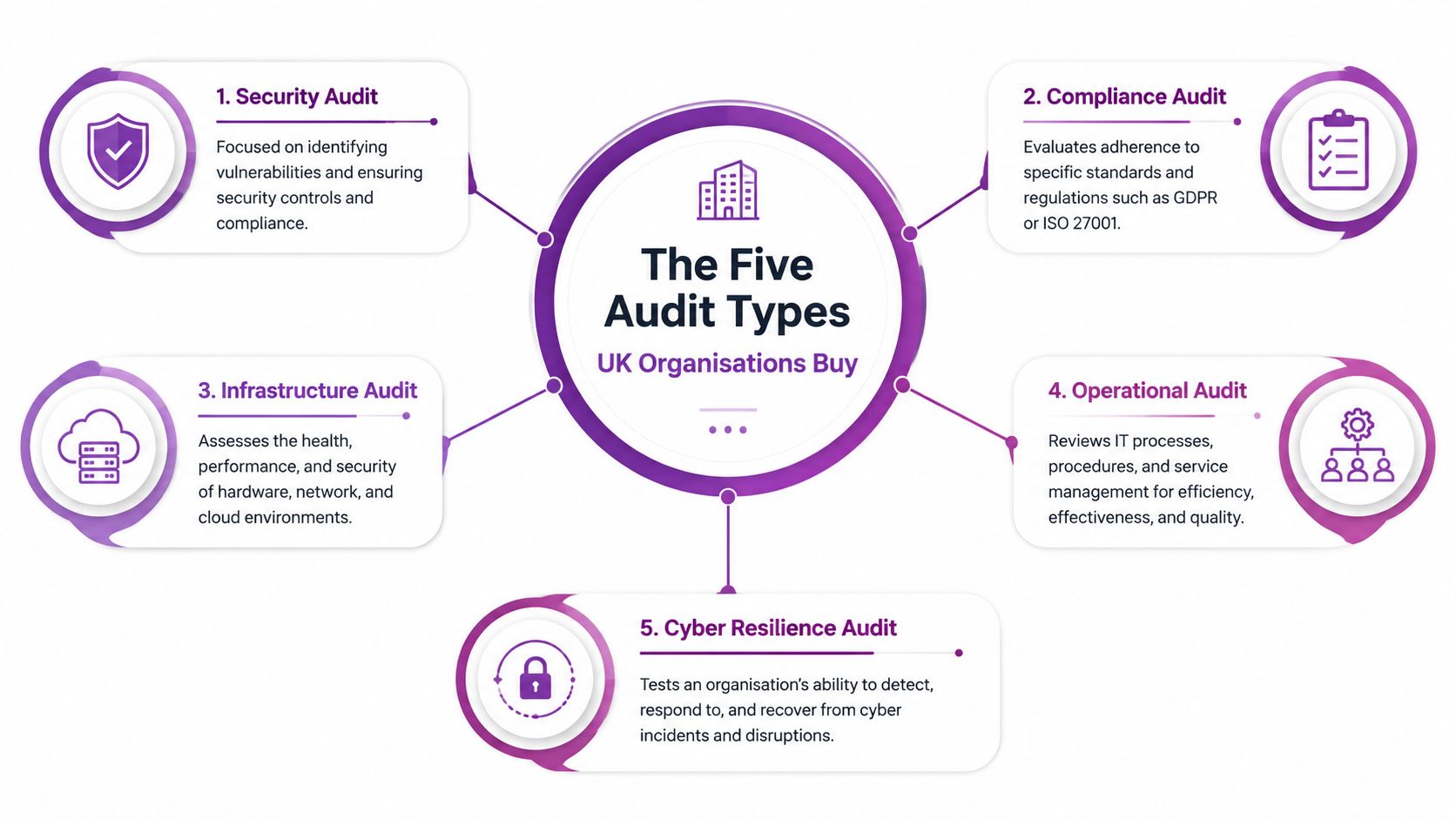
The Five Audit Types UK Organisations Actually Buy
Most buyers start with one problem and end up needing a different audit type than they first imagined. A Nottingham manufacturer worried about admin sprawl does not need the same engagement as a Leicester charity chasing supplier assurance on payroll, and a Lincoln professional services firm moving into cloud tools needs a different scope again.
Security, compliance and infrastructure audits
A security audit focuses on identity, patching and logging. If a Nottingham manufacturer has too many global admin rights in Microsoft 365, this is the engagement that tests who has access, whether MFA is enforced, and whether logs are usable when something goes wrong.
A compliance audit maps controls to a specific requirement set, such as GDPR, ISO 27001 or Cyber Essentials. A Leicester charity that keeps getting asked for evidence by funders usually starts here, because the deliverable is designed to show whether controls meet an external expectation.
An infrastructure audit checks the health of hardware, network and cloud configuration. That is the right fit when the business suspects technical drift, unsupported software, or fragmented device management across office and remote users.
Operational, cloud and third-party audits
An operational audit looks at process discipline, service management and repeatability. A Grantham firm with recurring ticket backlogs and ad hoc change approval should start here, because the failure is often process, not tooling.
A cyber resilience audit tests incident response and recovery. That matters when the board wants to know whether backup restore, disaster recovery and decision-making can survive a real outage, not just a policy document.
If your environment is mostly Microsoft 365, Azure and SaaS, start with a cloud and security audit. If your biggest concern is supplier dependence, add a third-party review. If you are unsure, begin with the control area most likely to fail in the next board meeting, not the one that sounds most impressive on a proposal.
How an IT Audit Actually Runs From Kick-Off to Report
A good audit runs in phases because that is the only way to avoid vague findings and circular evidence requests. The process should feel disciplined to the board and practical to the people pulling the logs, screenshots and policy files together.
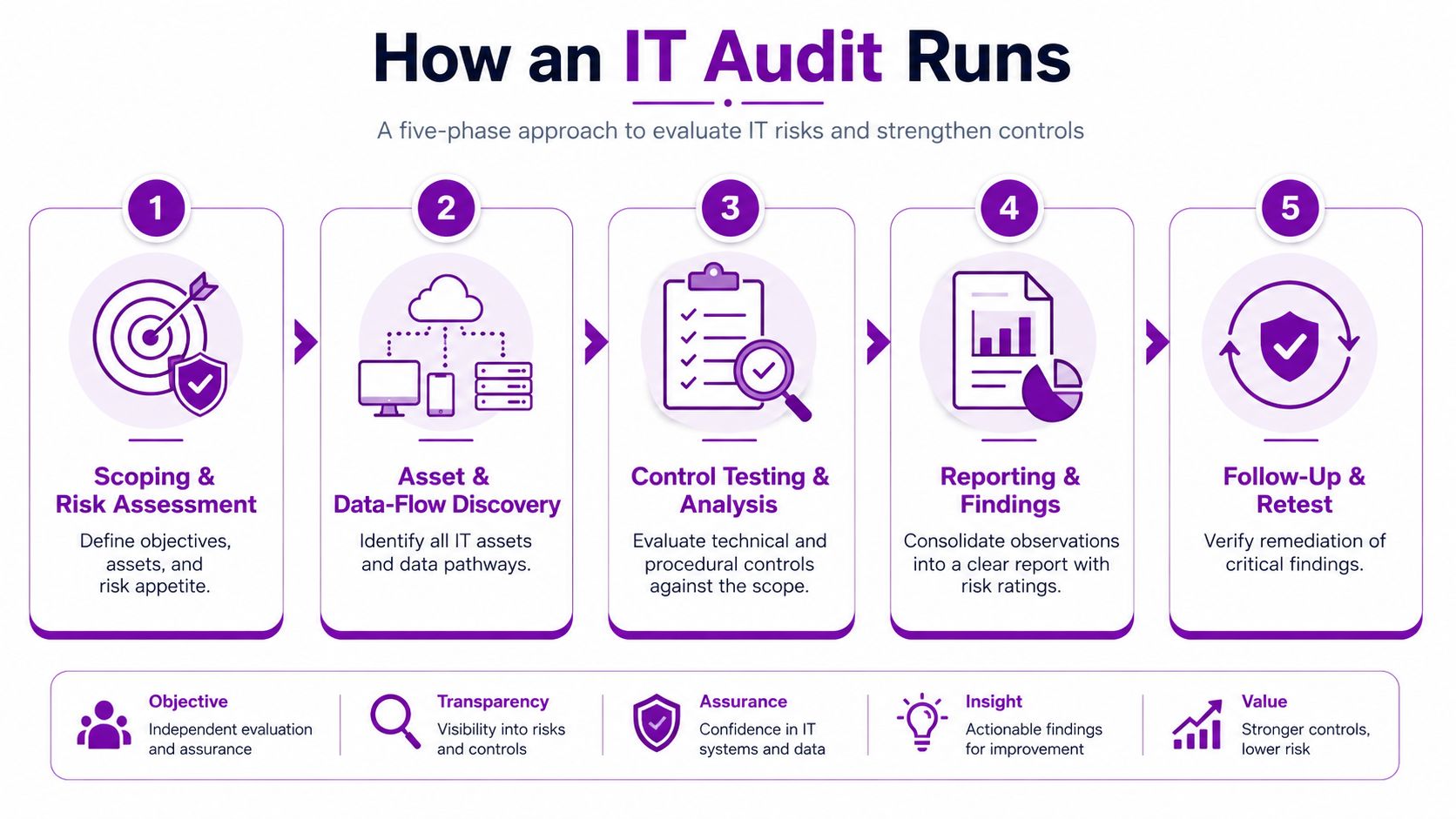
The first phase is scoping and risk assessment. The auditor defines the systems in scope, the business risks being tested and the expected evidence. That is where current network diagrams, system inventories and incident records matter, because without them the audit starts on guesswork.
The second phase is asset and data-flow discovery. A credible audit needs a baseline of every device, application, cloud workload and database before control testing begins audit readiness guidance. That baseline is what lets the auditor test access control, patch status, backup coverage and change-management drift instead of just sampling whatever the internal team remembered to mention.
The third phase is control evaluation and technical testing. This phase involves comparing policies, configuration exports, change histories, logs, vulnerability evidence and backup records with the agreed control set. A technically strong review should also test GDPR-linked obligations, security benchmarks and third-party risk evidence, then tie failures to severity and impact so the remediation plan is not vague audit cycle and remediation guidance.
Good evidence is collected across the year, not crammed into the final week. Monthly or quarterly exports, a central repository and timestamps showing when controls were checked make the difference between a clean audit trail and a messy scramble evidence documentation guidance.
The fourth phase is reporting. The report should not just list exceptions, it should show what failed, why it matters and what the business should do next. The fifth phase is follow-up and retest, because if the supplier never checks the fixes, the audit has not reduced risk.
Typical timelines depend on how organised the evidence is and how much of the estate sits in Microsoft 365 or Azure. A tidy SME with a small footprint can move quickly, while a multi-site business with shadow IT, old change records and half-finished backup testing will take longer, even if the audit scope looks simple on paper. If you want a practical read on related testing, this computer security audit guide is a useful companion.
UK Compliance Standards That Shape Audit Scope
UK standards shape what an auditor tests, but they do not all do the same job. The mistake I see most often is buyers asking for a certification outcome when they really need an assurance review of their current controls.
GDPR sets the data-protection baseline, so it drives lawful-basis checks, data-flow mapping, breach-readiness evidence and retention discipline. If a business cannot show where personal data lives, who touches it, and how it is secured in transit and at rest, that is where the audit should press hardest. The point is not to quote regulation, the point is to prove control design and operating effectiveness.
Cyber Essentials and Cyber Essentials Plus matter because they turn ordinary security hygiene into contract-ready evidence, especially where public-sector customers are involved. Organisations that touch NHS, MOD or local authority supply chains often need to show they can handle endpoints, patching and access control properly, not just promise good intentions. For a broader strategy view, exploring Trust Services Criteria is a useful comparison point, but UK buyers should still keep their focus on the tests their own contracts and regulators require.
ISO 27001 and sector overlays
ISO 27001 changes the conversation from one-off checks to an ISMS, because the auditor is looking for documented policies, risk treatment decisions, management review and continual improvement. If your organisation is building an ISMS, this internal primer on what an information security management system is is the right place to anchor the governance side.
Sector overlays add another layer. Financial services buyers need to think about operational resilience, and organisations handling NHS data need to align with the DSP Toolkit. Neither of those should be treated as a generic compliance badge.
An IT audit is not the same thing as a certification audit. A certification audit tries to confirm conformity against a defined scheme. An IT audit is broader, more practical and often more useful to a board because it tells you where the actual control weakness sits, even when there is no badge attached.
KPIs, Deliverables and a Practical Procurement Checklist
If you do not define “done” before the audit starts, you will get a report that looks busy and changes nothing. Good providers finish with a set of deliverables the board can act on and a remediation structure the IT team can manage.
What the report should contain
A solid audit pack should include an executive summary, detailed findings with severity and impact scoring, a prioritised corrective action plan and follow-up testing arrangements. That is not luxury output. It is the minimum needed to move from findings to accountability.
The four-week readiness rhythm is a sensible way to prepare. Week 1 is documentation inventory, Week 2 is control validation, Week 3 is gap remediation, and Week 4 is audit readiness review. That works because it forces the evidence forward before the auditor starts asking for it.
| Deliverable | Primary Audience | What It Includes |
|---|---|---|
| Executive summary | Board, Finance Director | Overall conclusion, headline risks, key actions |
| Detailed findings report | IT Manager, security lead | Severity, impact, evidence and root cause |
| Corrective action plan | Control owners | Owners, deadlines and remediation steps |
| Follow-up testing note | Board, auditor, IT team | What was fixed and whether it actually held |
The KPIs that matter after remediation
Track mean time to remediate critical findings so the board can see whether risk is coming down. Track the percentage of privileged accounts reviewed, patch latency and whether recovery time objectives were validated by test restore. If those measures do not move, the audit has only created paperwork.
A practical procurement checklist is just as important. Ask each supplier whether they carry relevant certifications, whether they use DBS-checked staff where sensitive data is involved, whether they know Microsoft and Cyber Essentials well, how they handle evidence, what their sample report looks like and what exit terms are written into the engagement. If the supplier cannot answer those questions clearly, they are not ready for a serious East Midlands audit.
Decision rule: pick the provider who can explain the control failure in plain English and tie it to a fix the business will actually own.
Pricing Models, Timelines and How to Choose the Right Engagement
The pricing conversation gets clearer when you stop asking for a single “audit price” and start asking what shape of engagement you need. A focused risk assessment is different from a full-scope audit, and both are different again from a continuous audit programme.
The three buying models
A fixed-scope engagement works best when you need a clear deliverable for a known deadline, such as a certification request or a board paper. It gives price certainty and keeps the scope tight.
Time and materials fits advisory work and remediation-heavy audits where the estate is messy, the evidence is incomplete or the client needs the supplier to follow the findings into implementation. It costs more to manage, but it avoids pretending the work can be boxed in before discovery.
A retainer makes sense when the business wants continuous assurance rather than a once-a-year event. That model is best for organisations with active cloud change, recurring board pressure or a need to keep evidence fresh between audit cycles.
What timelines really look like
A 30-person Lincolnshire manufacturer with a modest Microsoft 365 setup and tidy records can usually move quicker than a 120-user Leicester professional services firm with mixed cloud apps and several approval paths. A 250-user Nottingham multi-site operation with separate offices, more vendors and more than one helpdesk process will need longer because there is more evidence to test and more people to chase.
Choose the model based on your deadline, the state of your evidence and how much remediation you expect. If the board wants certainty, go fixed scope. If the environment is messy but the risk is high, accept time and materials. If you keep getting asked for proof all year, a retainer will save you more pain than another annual fire drill.
How F1Group Delivers IT Audit Services Across the East Midlands

For organisations in Lincoln, Nottingham, Leicester, Scunthorpe, Grimsby and Newark, the practical value comes from an auditor who understands Microsoft-first estates and the way East Midlands SMEs run. That means looking at Microsoft 365, Azure, Dynamics 365 and the Power Platform through a shared-responsibility lens before any technical testing starts.
That governance step matters because cloud and outsourced support models split control ownership across the client, the vendor and the MSP. F1Group's wider IT support services align with that reality, which is why the strongest audit outcome is a corrective action plan with owners, deadlines and board-ready evidence rather than a generic recommendations list.
Vendor-certified, DBS-checked teams matter when sensitive data is involved. So does a follow-up retest, because the true value is measured in reduced risk over the next quarter, not in a polished slide deck that gets filed away.
If you need IT audit services for a Microsoft 365, Azure or Dynamics 365 environment in the East Midlands, F1Group can help you turn unclear control risk into a board-ready plan. Visit F1Group to start a conversation about a focused audit, remediation support and follow-up testing that your team can action. Then Phone 0845 855 0000 today and Send us a message https://www.f1group.com/contact/