
You're probably closer to needing an ISMS than you think.
A client asks for your security policies before signing a contract. Your insurer wants clearer evidence of controls. A member of staff shares the wrong file in Microsoft Teams, or an old account still has access in Microsoft 365 after someone leaves. Nothing has gone catastrophically wrong, but there's a persistent sense that security is being managed through separate fixes rather than one joined-up system.
That's the point where many SMEs in the East Midlands find themselves. They've bought sensible tools. Antivirus is in place. Multifactor authentication might be switched on. There's a firewall, some password rules, maybe a backup platform. But the business still can't confidently answer basic questions. What information matters most? Who owns each risk? How often are controls reviewed? What happens when Microsoft changes a feature, a supplier changes a process, or a team starts using a new cloud app?
An Information Security Management System gives structure to that mess. It doesn't replace your tools. It tells you how to choose them, govern them, review them, and prove they're appropriate for your business.
Moving Beyond Patchwork Security
Patchwork security usually grows by accident.
A business adds controls in response to events. A customer questionnaire prompts a policy. A phishing scare prompts awareness training. A cyber insurance renewal prompts tighter password settings. Someone in IT enables a Microsoft 365 control because it looks sensible. All of those decisions may be reasonable on their own. The problem is that they don't automatically form a coherent security model.
That leaves gaps in awkward places. Finance data may be locked down properly, while shared folders are still overexposed. Backups may exist, but nobody has linked them to recovery priorities. Azure resources may be deployed with sensible defaults, but there's no formal review to check whether those defaults still match business risk.
What patchwork security looks like in practice
The signs are usually obvious once you look for them:
- Policies exist but nobody uses them because they were written for a tender or audit, then left untouched.
- Technical controls are switched on unevenly across laptops, mobile devices, Microsoft 365, servers, and cloud services.
- Responsibilities are blurred so security becomes “an IT thing” rather than a management responsibility.
- Supplier and client demands drive action instead of a consistent internal security plan.
- Changes happen faster than governance so the business adopts new tools without updating access rules, training, or documentation.
Security gets expensive when every improvement starts from scratch.
An ISMS is the answer because it's a management framework, not another product to buy. It gives leadership a way to decide what matters, define acceptable risk, allocate responsibility, and keep improving over time.
That matters more now because security isn't just about stopping technical attacks. It's tied to compliance, client trust, staff behaviour, supplier relationships, and day-to-day business continuity. If your data sits across Exchange Online, SharePoint, Teams, OneDrive, Dynamics 365, Azure, laptops, phones, and third-party platforms, a loose collection of controls won't hold together for long.
For a director, the key shift is this. Instead of asking, “Have we got enough security tools?”, you start asking, “Do we have a managed system for protecting information across people, process, and technology?”
What Is an Information Security Management System
The simplest practical answer to what is an information security management system is this. It's the business system you use to protect information in a controlled, repeatable way.
It functions similarly to health and safety for data. You don't manage workplace safety only by buying signs, gloves, and fire extinguishers. You set responsibilities, assess risks, document procedures, train people, check performance, and improve where needed. An ISMS does the same job for information security.
An Information Security Management System is a systematic, risk-based framework designed to protect the confidentiality, integrity, and availability of sensitive data, using a mandatory Plan-Do-Check-Act cycle for continuous improvement according to this overview of ISMS fundamentals.
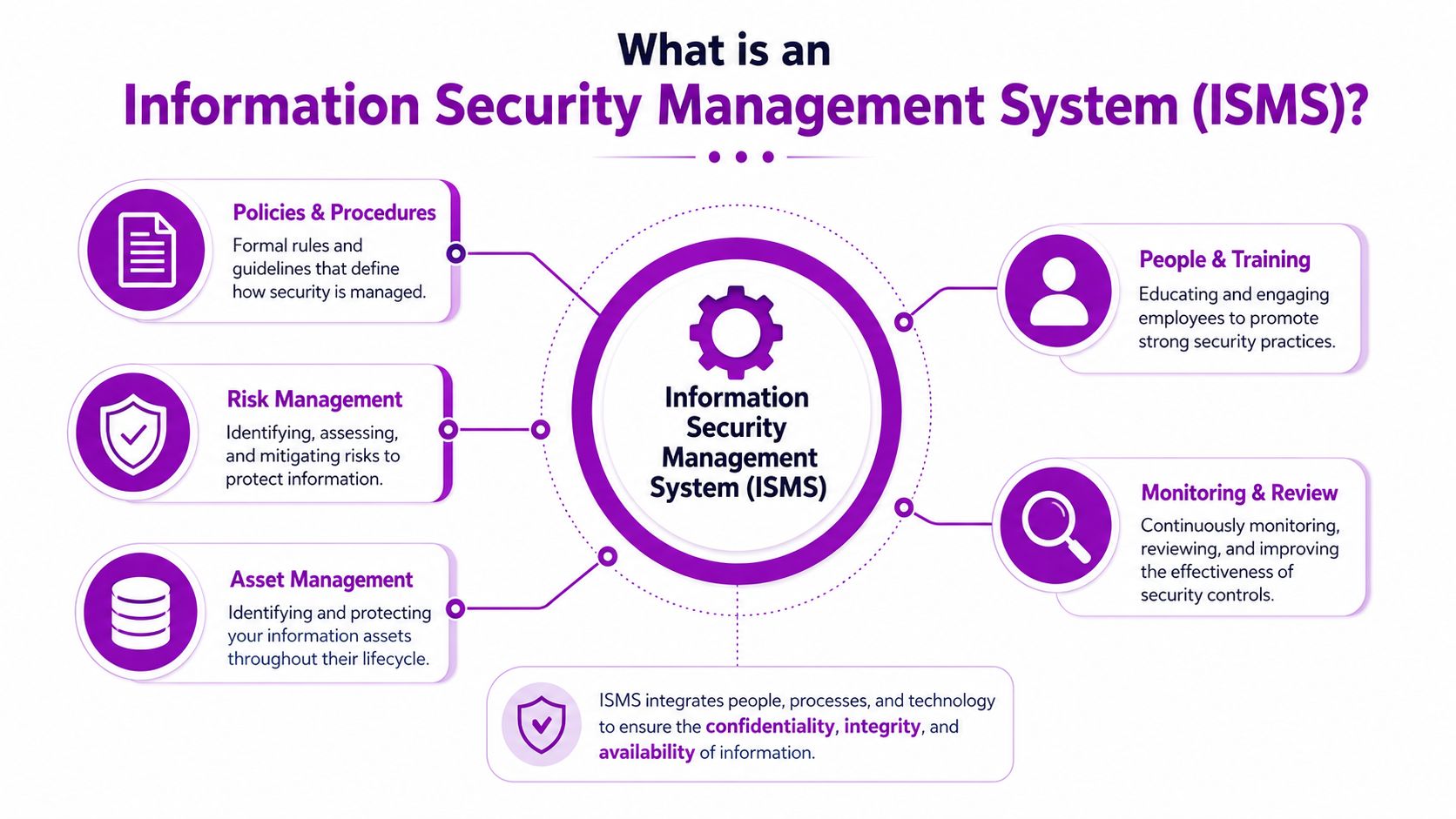
The three outcomes an ISMS protects
At the centre of any ISMS is the CIA triad.
| Principle | Plain-English meaning | Business example |
|---|---|---|
| Confidentiality | Only the right people can access information | Only payroll staff can view salary records in SharePoint or Dynamics 365 |
| Integrity | Information stays accurate and unapproved changes are prevented | A client contract can’t be edited without proper permission and version control |
| Availability | Information and systems are accessible when needed | Staff can still work if a laptop fails or a service disruption affects a key system |
That’s why an ISMS spans more than IT. It covers people, process, and technology together. It deals with access control, risk assessment, training, asset management, incident handling, documentation, and management review.
Why risk comes first
A sound ISMS starts with risk, not tools.
Before a business chooses controls, it needs to identify what information it holds, where it sits, who uses it, what could go wrong, and what the consequences would be. Only then do technical and administrative controls make sense. In a Microsoft environment, that might mean using Microsoft Entra ID for identity control, Microsoft Purview for information protection, and structured awareness training for staff handling client or financial data.
Practical rule: If you can’t explain why a control exists, it probably isn’t properly embedded in your ISMS.
The strongest implementations don’t chase every possible control. They choose the controls that fit the business, then review them routinely through the Plan-Do-Check-Act cycle.
For a wider risk view beyond cyber alone, it also helps to understand how organisations uncover fraud with forensic accounting because information security risk often overlaps with financial control, access abuse, and weak governance. For a Microsoft-focused perspective, this guide on information security for modern organisations is also useful background.
Understanding the ISO 27001 Standard
If an ISMS is the management system, ISO/IEC 27001:2022 is the recognised standard that defines what an effective one should look like.
That distinction matters. Plenty of organisations say they take security seriously. Fewer can show that their system has been built, documented, operated, and reviewed against an internationally recognised standard. For many SMEs, that’s where ISO/IEC 27001 becomes commercially useful as well as operationally valuable.
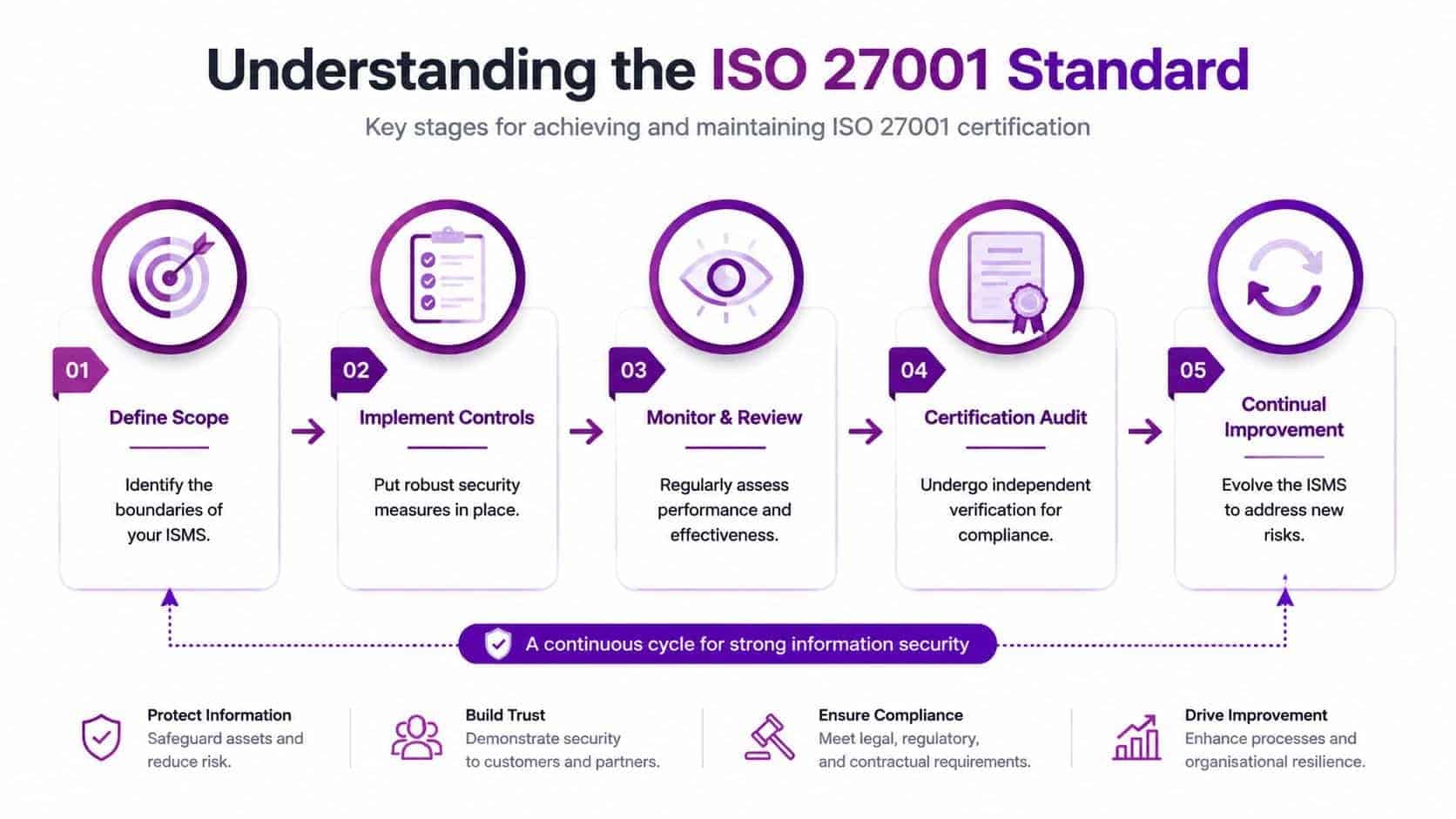
What the standard requires in practice
ISO/IEC 27001:2022 mandates preservation of confidentiality, integrity, and availability through a continuous Plan-Do-Check-Act cycle, and in the UK certification must be audited by a UKAS-accredited independent certification body, as outlined in the DCC guidance on ISO/IEC 27001 and the ISO 27000 family.
In plain terms, that means the business has to do more than write policies. It needs to define scope, assess risk, decide how risks will be treated, document which controls apply, operate those controls, and then prove the system is being monitored and improved.
Two documents often separate serious implementation from superficial effort:
- Statement of Applicability. This records which controls are relevant and why.
- Risk Treatment Plan. This links identified risks to specific actions and controls.
Those documents force discipline. They stop businesses from applying controls randomly, and they make audit conversations far easier because the reasoning is visible.
How the PDCA cycle works in the real world
The Plan-Do-Check-Act model sounds formal, but it’s practical when used properly.
Plan means deciding scope, assets, risks, responsibilities, and target controls.
Do means implementing the agreed controls and processes.
Check means monitoring results, reviewing incidents, measuring performance, and auditing.
Act means correcting weaknesses and improving the system.
A common mistake is to treat “Check” as an annual admin exercise. It isn’t. In a live business, checking should include routine review of access rights, security incidents, supplier changes, Microsoft 365 configuration drift, and whether staff behaviour matches policy.
A good ISO/IEC 27001 implementation should feel like disciplined management, not theatre for auditors.
Certification is useful, but only if the system is alive
The certificate matters because buyers, regulators, and partners recognise it. But its true value is what sits behind it. A credible ISMS gives directors a mechanism for governing security rather than reacting to it.
That’s especially relevant for SMEs trying to scale. As the business adds remote staff, cloud platforms, automation, and outsourced services, governance complexity rises quickly. A standard such as ISO/IEC 27001 gives the business a way to keep pace without improvising every control decision.
If you’re also looking at wider operating models, this overview of an IT governance framework for growing organisations helps connect security governance to broader decision-making.
Key Business Benefits of an ISMS for Your SME
The strongest reason to implement an ISMS isn’t that it looks impressive on paper. It’s that it improves how the business runs.

A properly implemented ISMS strengthens governance, clarifies ownership, and reduces the chaos that appears when security decisions are scattered across departments. According to Amtivo’s explanation of ISMS value for UK organisations, successful ISMS implementation improves information security governance and data protection, which bolsters resilience and supports confidentiality, integrity, and availability.
It helps you win and keep better business
Many SMEs first take security seriously when a larger client sends a due diligence questionnaire. Suddenly the conversation isn’t just about service quality or price. It’s about access control, incident response, training, asset registers, supplier assurance, and management review.
An ISMS helps because it gives those answers structure.
- Client trust improves when you can explain how risks are assessed and controlled.
- Tender responses get easier because policies, ownership, and governance already exist.
- Supplier assurance becomes more credible because security isn’t being described ad hoc.
That commercial effect is often underestimated. Security maturity makes the business easier to buy from.
It reduces operational friction inside the business
Without an ISMS, people waste time making judgement calls that should already be defined. Who approves access? Which systems hold sensitive information? What happens when somebody joins, changes role, or leaves? When should a policy be reviewed? Which incidents need escalation?
Those questions shouldn’t rely on memory or goodwill.
A well-run ISMS creates a cleaner operating model:
| Business area | Without an ISMS | With an ISMS |
|---|---|---|
| Access control | Inconsistent approvals and delayed removals | Defined ownership and repeatable joiner, mover, leaver processes |
| Policy management | Documents created for compliance only | Policies linked to active controls and regular review |
| Incident handling | Confusion during pressure | Agreed steps, roles, and escalation routes |
| Audit readiness | Last-minute evidence gathering | Ongoing records and clear accountability |
Here's a practical explainer that's worth watching before shaping a security programme:
It supports resilience, not just compliance
Directors often frame security as risk reduction, which is fair. But an ISMS also protects delivery.
If your team depends on Microsoft 365, Azure, line-of-business applications, and cloud data flows, resilience depends on disciplined control. Backups, permissions, change management, training, and incident response all have to work together. An ISMS gives those pieces a management wrapper.
The businesses that recover well from security incidents usually had clearer ownership before the incident happened.
That's why an ISMS shouldn't be treated as a cost centre. For an SME, it's part of how you protect reputation, support growth, and make the business more dependable to clients, staff, and insurers.
Your High-Level ISMS Implementation Roadmap
Most directors overestimate how technical ISMS implementation is and underestimate how managerial it is.
The work can be substantial, but it's not mysterious. When approached properly, it's a structured programme with clear stages, defined outputs, and sensible decisions at each point.
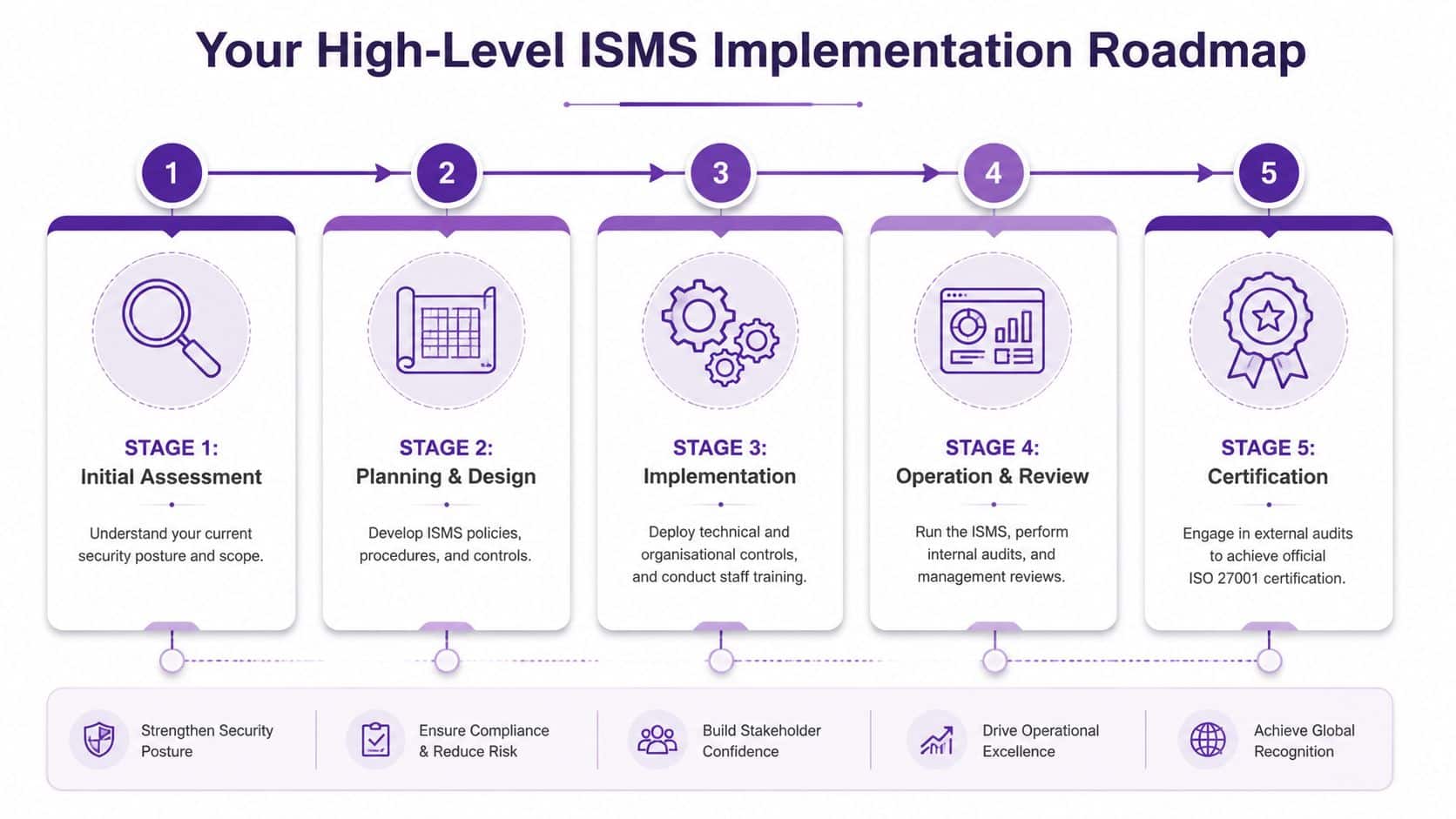
Start with leadership and scope
An ISMS fails early when management treats it as a delegated IT task.
Leadership has to define what the ISMS covers, why it matters, and how much resource the business will commit. That scope decision is fundamental. If the scope is too broad, the project becomes unwieldy. If it's too narrow, the business may protect the wrong things while leaving major exposure outside the system.
A sensible scope usually considers:
- Core business services that the company must protect and keep running
- Key information types such as client, financial, HR, or operational data
- Main platforms and locations including Microsoft 365, Azure, on-premises systems, endpoints, and suppliers
- Business boundaries so everyone understands what is and isn't in scope
Assess risk before selecting controls
Once scope is clear, the business identifies assets, threats, vulnerabilities, and likely impacts. The ISMS then becomes useful rather than decorative.
For example, a business using Microsoft 365 may identify risks around overshared SharePoint sites, weak admin separation in Entra ID, uncontrolled Power Platform development, or inconsistent mobile device management. A business running Azure workloads may focus on privileged access, backup governance, and logging.
The point isn't to produce an academic register. It's to decide what needs treatment and what level of risk is acceptable.
If a risk workshop ends with “we'll tighten security generally”, it hasn't gone far enough.
Implement a mix of technical and organisational controls
This is the stage many people imagine first, but it shouldn't come before scope and risk.
Controls usually include a mixture of documented process and technical enforcement. In a Microsoft-heavy environment, that might involve:
- Identity controls using Microsoft Entra ID for access, role separation, and conditional access
- Information protection through Microsoft Purview classification, retention, and data handling controls
- Device and application management using Intune and controlled configuration baselines
- Operational procedures covering onboarding, offboarding, incident reporting, backup checks, and supplier review
- Staff awareness measures built into induction, refresher training, and role-specific responsibilities
Not every control needs to be complicated. What matters is that controls are justified, assigned, and maintained.
Review, audit, and improve
An ISMS only becomes credible once the business starts operating it.
That means collecting evidence, checking whether controls are working, reviewing incidents, holding management reviews, and running internal audits. Weaknesses should trigger corrective action, not be parked until the next annual review.
A simple implementation sequence looks like this:
- Define governance and scope
- Identify assets and assess risks
- Select and document controls
- Implement controls and assign ownership
- Train staff and communicate responsibilities
- Run the ISMS and gather evidence
- Review performance and carry out internal audits
- Pursue external certification if it fits your objectives
External certification is optional from an operational point of view. It becomes worthwhile when clients, regulators, or commercial strategy justify the audit effort. Even without certification, the management discipline of an ISMS is still valuable.
Common Pitfalls and The Neglected Human Element
The most common mistake is assuming an ISMS is mainly a document set.
It isn't. Policies matter, but a policy that nobody understands, follows, or reviews won't protect much. Some organisations produce impressive documents, pass initial scrutiny, and still leave obvious weaknesses in day-to-day behaviour.
Where implementations go wrong
The trouble usually starts in one of three places.
First, the ISMS is treated as a one-off project with an end date. Once documentation is written, momentum disappears. Second, scope is chosen badly, so the business protects a narrow slice of information while real operational risk sits elsewhere. Third, management delegates accountability and then disengages, which strips the system of authority.
Those problems are serious, but the biggest weakness is usually people.
74% of UK ISMS implementations fail to include role-specific training, and 58% of UK data breaches stem from untrained staff, based on the UK National Cyber Security Centre's 2025 breach analysis as stated in the verified data provided for this article. That tells you something important. Security failure often comes from ordinary behaviour, not exotic technical compromise.
Why generic awareness training isn't enough
Annual cyber training for everyone has some value, but it won't cover role-specific risk on its own.
Finance teams need to recognise payment diversion attempts and sensitive data handling issues. HR teams need different guidance on employee records. Senior leaders need to understand approval fraud, privileged access, and governance duties. IT administrators need stronger operational discipline than a general user. Staff using Copilot, Power Platform, Dynamics 365, or shared Microsoft 365 workspaces need training that reflects what they touch.
A mature ISMS treats training as part of control design, not an optional add-on.
- Assign responsibility clearly so information asset owners know what they must protect.
- Assess training needs by role instead of pushing one generic module to everyone.
- Tie training to real systems such as Teams, SharePoint, Outlook, Dynamics 365, and mobile access.
- Refresh regularly so the organisation adapts when services, risks, or processes change.
A staff member can defeat a strong technical control in seconds if the organisation never taught them what “normal” should look like.
Culture is the real control environment
If staff are afraid to report mistakes, incidents get buried. If managers bypass process when they're busy, everyone else copies them. If leavers keep access because nobody owns the process, documentation won't save you.
An effective ISMS builds habits. People know what matters, what good looks like, when to escalate, and who decides. That's why the human side isn't soft. It's operational.
How F1Group Integrates Your ISMS with Microsoft 365 and Azure
For many SMEs, the difficult part isn't understanding the idea of an ISMS. It's making it work in a cloud environment that changes constantly.
That challenge is particularly relevant in this region. In the East Midlands, 68% of SMEs now use cloud services, while 42% still lack a cloud-specific ISMS update process, according to the 2025 UK Cloud Security Alliance survey referenced in the verified data for this article. When Microsoft changes capabilities, defaults, or control options, static documentation quickly falls behind operational reality.
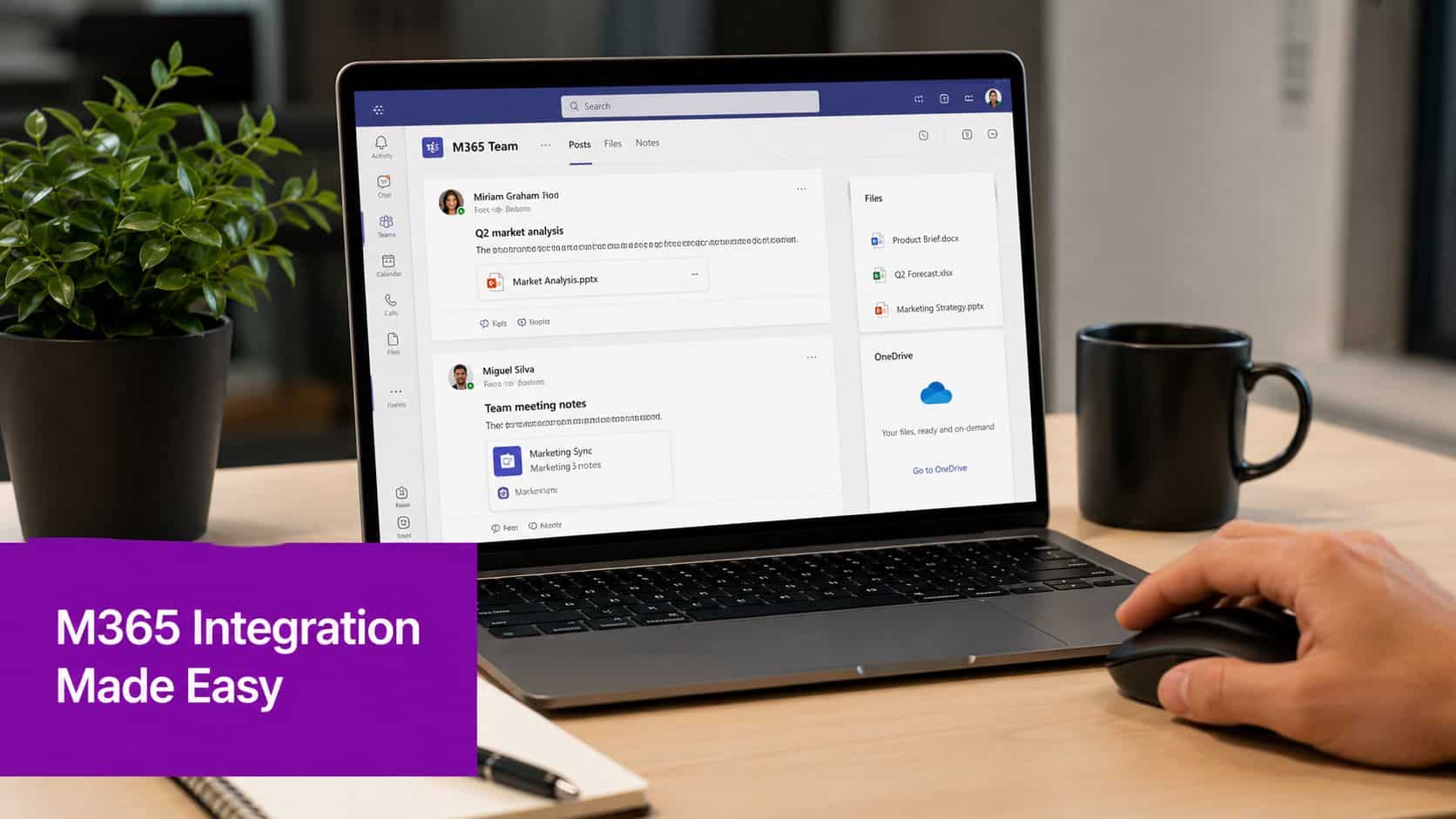
A practical Microsoft-aligned ISMS should connect policy to the actual tools your staff use every day. That means identity and access policies reflected in Microsoft Entra ID. Information classification and handling tied to Microsoft Purview. Device standards enforced through Intune. Logging, alerting, and cloud governance linked to Azure and Microsoft 365 administration. Collaboration rules matched to Teams, SharePoint, and OneDrive rather than written as abstract statements nobody can apply.
It also means the documentation has to stay live. If your business introduces Copilot, changes its supplier model, expands remote access, or builds new workflows in Power Platform, the ISMS needs to move with it. A cloud estate can't be governed with static paperwork and an annual glance.
For organisations reviewing their documentation baseline, this IT security policy template for growing businesses is a useful starting point.
F1Group helps organisations across the East Midlands turn security from patchwork into a managed system that fits the way they work with Microsoft 365, Azure, Dynamics 365, Power Platform, and Copilot. If you want practical support building or improving an ISMS that stands up in real operations, call 0845 855 0000 today or Send us a message.