
When you think about IT support in Bristol, what comes to mind? For many, it's the classic scenario: something breaks, you call for help, and someone comes to fix it. But that old model is becoming a real liability. Today, smart IT support isn't about just fixing problems—it’s about preventing them from ever happening.
Why Proactive IT Is a Game-Changer for Bristol Businesses
Let's be honest, running a business in Bristol is demanding. The last thing you need is your technology grinding to a halt without warning. Relying on a traditional “break-fix” IT model is like waiting for a flat tyre on the M32 during rush hour before even thinking about checking your tyre pressure. It’s a reactive approach that might feel cheaper at first, but the true cost comes in the form of lost sales, frustrated staff, and sudden, expensive repair bills.
This is especially true here in Bristol. Our city is a tech powerhouse, home to over 4,518 tech companies and attracting a staggering £240 million in funding in a single year. With local businesses generating over £7.9 billion in turnover, the competition is fierce. In this environment, unexpected downtime isn’t just an inconvenience; it’s a competitive disadvantage.
From Firefighting to Forward-Thinking
The alternative is a proactive, managed IT service. This approach completely flips the script. Instead of treating your IT as a collection of things that can break, it treats your technology as a core business asset that needs to be nurtured. Your IT partner isn't just waiting for the phone to ring; they are constantly monitoring, maintaining, and improving your systems behind the scenes.
The goal is to align your technology with your business objectives. A proactive partner makes sure your systems are secure, efficient, and ready to grow with you. This turns IT from a reactive cost into a powerful driver for your business.
To help you see the difference clearly, we've put together a quick comparison of the two main IT support models.
IT Support Models at a Glance
| Feature | Break-Fix Model | Managed IT Services Model |
|---|---|---|
| Service Approach | Reactive: Service is provided only when something breaks. | Proactive: Continuous monitoring and maintenance to prevent issues. |
| Cost Structure | Unpredictable: Pay-as-you-go, with costs spiking during emergencies. | Predictable: A flat, recurring monthly fee for all services. |
| Business Incentive | The provider profits from your problems and downtime. | The provider profits when your systems run smoothly. |
| Focus | Fixing immediate, specific problems as they occur. | Long-term health and performance of your entire IT infrastructure. |
| Downtime | Frequent and unexpected, leading to lost productivity. | Minimised through prevention, with faster recovery times. |
This table shows the fundamental shift in mindset. One model profits from your misfortune, while the other is invested in your success.
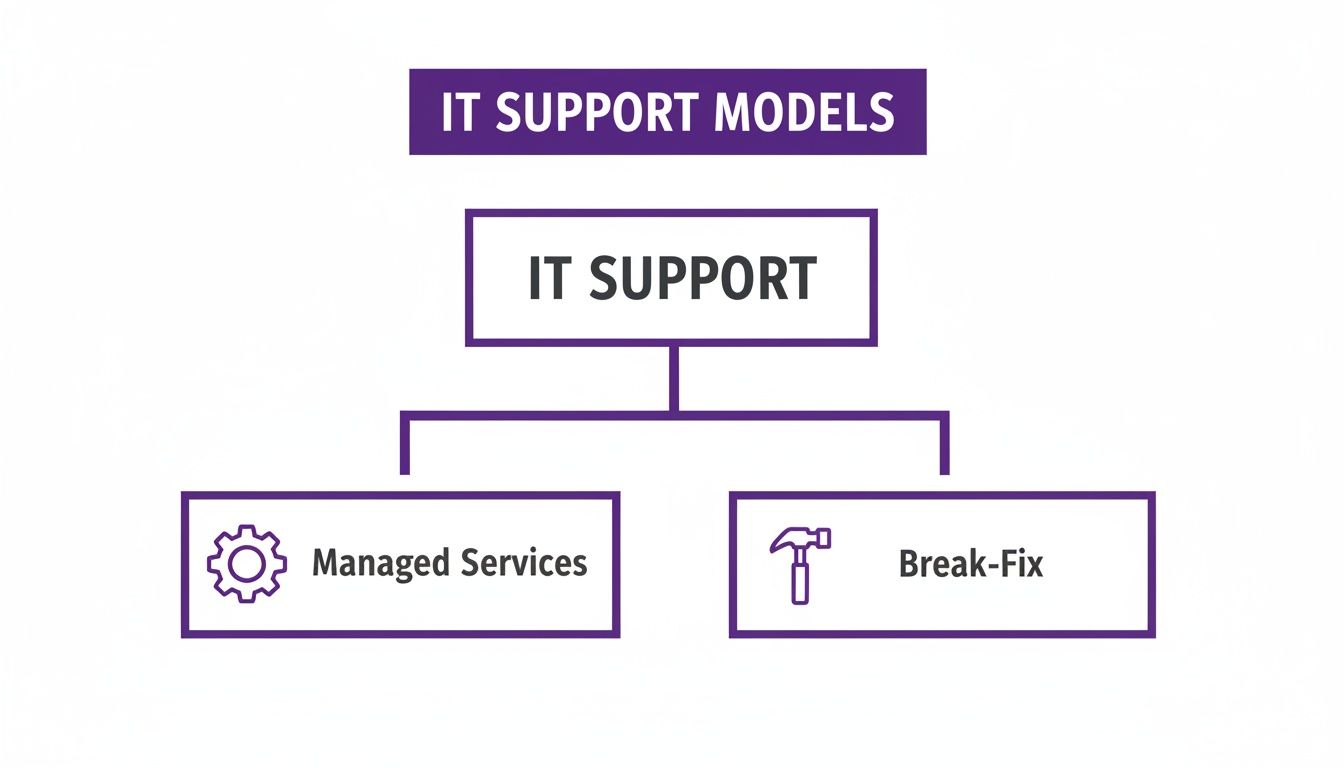
As the diagram shows, break-fix is all about responding to problems. Managed services, on the other hand, are about creating a stable, high-performing environment where problems are far less likely to happen in the first place.
For any ambitious Bristol company, that difference is everything. In a city built on innovation, a solid technology foundation is non-negotiable. You can find out more about how our proactive IT support gives businesses the freedom to focus on what they do best, knowing their IT is ready for the challenges of 2026 and beyond.
The Core IT Services Every Bristol Business Needs
Great IT support is about much more than just fixing things when they break. It’s about having a toolkit that actively helps your business grow, collaborate better, and stay secure. For any Bristol business, it’s crucial to look past the jargon and focus on the services that will make a genuine, practical difference to your day-to-day operations.
For most modern businesses, that conversation starts with Microsoft. Their suite of tools isn't just a random collection of software; it's a deeply integrated ecosystem designed to work together from the ground up, creating a single, powerful environment for your team.

Unlocking Collaboration and Efficiency with Microsoft
The bedrock of a modern workplace is almost always Microsoft 365. Forget thinking of it as just Word and Excel; it's a complete platform that brings your team together.
- Microsoft Teams: This is your central hub for work. It pulls chat, video meetings, and file sharing into one place, cutting down on endless email chains and keeping projects on track.
- SharePoint and OneDrive: This is your secure cloud storage. It gives your team the power to access, edit, and collaborate on documents from anywhere, on any device, all while keeping a clear history of changes.
- Exchange Online: You get professional, business-grade email with powerful security features baked in, so your communications are both reliable and protected.
When these tools are properly managed, your daily work just flows better. It’s a huge part of what we do as an IT support partner in Bristol because it creates a standard, secure, and user-friendly setup that we can easily manage and support for you.
Building a Scalable Foundation in the Cloud
As your business grows, your IT needs to be able to keep up. That’s where Microsoft Azure comes in. Think of it as having a world-class data centre at your fingertips without the eye-watering cost of building and maintaining it yourself.
A good IT partner can use Azure to help you:
- Host your servers and applications in the cloud for far better performance and reliability than an old server in the corner of the office.
- Set up rock-solid backup and disaster recovery to make sure your critical business data is always safe.
- Scale your resources up or down whenever you need to. You only ever pay for the power you're actually using.
This kind of agility is vital for Bristol businesses trying to navigate a competitive market. It means you can jump on new opportunities without being held back by your own hardware.
Streamlining Processes with Business Applications
Moving beyond the core infrastructure, you can start targeting specific parts of your business. Microsoft Dynamics 365 is a suite of smart business apps that connect your entire operation, from sales and customer service right through to finance and HR. It finally lets you break down those frustrating data silos.
For instance, Dynamics 365 Sales can give your sales team a much clearer view of their pipeline, while Dynamics 365 Customer Service helps your support team resolve issues faster. When these tools are managed by your IT provider, they become central to giving your customers a brilliant experience.
The real magic happens when you connect everything. When your sales, service, and operational data all talk to each other, you can uncover insights and automate tasks in ways you never thought possible.
This integrated mindset is even being adopted at a city-wide level. Bristol City Council's Digital Strategy 2022-2027 highlights a clear drive for digital maturity, achieving savings of nearly £2 million through their Digital Transformation Programme while boosting the adoption of tools like Microsoft 365. You can read more about their approach to digital evolution in the official report on the Bristol City Council Digital Strategy.
Empowering Your Team with Smart Tools
The newest tools in the Microsoft stack are all about making your team smarter and more productive. Copilot AI is like having an intelligent assistant working alongside you in your apps, helping to draft emails, summarise long meeting transcripts, or analyse data in seconds.
At the same time, the Power Platform gives you the ability to create your own solutions without needing a team of developers:
- Power BI transforms dense spreadsheets into clear, interactive visual reports.
- Power Apps lets you build simple, custom apps for very specific business needs (like site inspections or holiday requests).
- Power Automate handles all those repetitive, manual tasks that eat up your team's time.
The Non-Negotiable Layer of Cyber Security
Let's be clear: none of these fantastic tools are worth a thing if your business isn't secure. Protecting you from digital threats isn’t an optional extra; it’s one of the most important jobs any IT support provider has.
This is a constant, ongoing service that must include:
- 24/7 Threat Monitoring: Keeping a watchful eye over your network for any signs of trouble.
- Cyber Essentials Compliance: Guiding you through this government-backed scheme to prove your commitment to security.
- Employee Training: The human element is key. We help educate your staff to spot and avoid phishing emails and other scams.
For more on this, check out these excellent Cybersecurity Tips For Small Businesses. A robust security strategy is the foundation for everything else, ensuring your Bristol business can operate and grow with confidence.
Understanding IT Support Pricing and Service Models
Trying to make sense of IT support costs can feel like navigating a minefield of tech-speak and complicated quotes. For any Bristol business, getting this right is crucial. It’s not about finding the cheapest deal, but about finding a partner who provides real, measurable value for your money.

Unlike the unpredictable, often eye-watering bills that come with a break-fix service, managed IT support is built around a predictable subscription. This makes budgeting a whole lot easier. It also completely changes the dynamic with your provider. Their success is tied to your systems running smoothly, not to how many times they have to come out and fix something. This shared goal is the foundation of a great partnership, a concept we explore in our guide on what a managed service provider is.
Common Pricing Models for IT Support
As you start getting quotes for IT support in Bristol, you’ll notice a few common ways that providers structure their pricing. The best fit for you really depends on your company’s size, how your team works, and what you need support with.
-
Per-User Pricing: This is probably the most popular model you'll see. You simply pay a flat monthly fee for each person on your team. It's clear, easy to understand, and scales up or down as your business changes. For a Bristol-based SMB, you can expect this to be in the range of £25 to £75 per user per month, based on the services included.
-
Per-Device Pricing: Here, the bill is based on each piece of kit being managed—every desktop, laptop, server, and even network-connected printer. This model can be very efficient if you have several people sharing one computer, like in a workshop or a shift-based environment.
-
Tiered Packages: Many IT firms offer service bundles, often labelled something like Bronze, Silver, and Gold. A basic package might just cover remote help and system monitoring. A top-tier one, on the other hand, could include regular on-site visits, 24/7 security management, and long-term strategic planning.
Why Your Service Level Agreement Is So Important
Pricing is one thing, but the most critical document in your relationship with an IT partner is the Service Level Agreement (SLA). Think of it as the official contract that sets out exactly what level of service you’re paying for. It’s your guarantee of quality and holds the provider to account.
To properly vet a potential partner, you need to know what a good SLA looks like. You can get a feel for the specifics by reviewing these Service Level Agreement (SLA) templates, which highlight what to look for. A solid SLA leaves no room for doubt.
An SLA isn’t just a piece of paper; it’s the rulebook for your relationship. It ensures your provider lives up to their promises and gives you a clear path forward if things don’t go to plan.
Here are the key metrics you should always look for in an SLA:
- Guaranteed Response Time: How quickly will they acknowledge your request for help?
- Resolution Time: A target for fixing different problems (a critical server failure should be treated more urgently than a minor software bug).
- System Uptime: A commitment to keeping your network and servers online, usually shown as a percentage like 99.9%.
- Escalation Procedures: A defined process for what happens if an issue isn’t fixed within the agreed time.
Calculating the Real Return on Investment
Finally, it’s a mistake to see professional IT support purely as a cost. It’s an investment. The monthly fee is just one part of the story; the other is the tangible value it delivers back to your business.
Proactive IT management generates a strong return by preventing costly downtime that hits your revenue, boosting your team’s productivity with systems that just work, and protecting you from the crippling financial and reputational damage of a security breach. When you look at it that way, the right support more than pays for itself.
Choosing the right IT partner in Bristol is a massive decision for any business owner. It's not just about finding someone to fix a misbehaving laptop; it’s about bringing a specialist on board who becomes a genuine part of your team. You need someone who will take complete ownership of your technology, freeing you up to do what you do best: run your business.
With so many providers out there, how do you sort the wheat from the chaff?
It really comes down to knowing what to look for. You need to get past the slick marketing and dig into what really makes a great IT partner. Let’s walk through what actually matters.
Start With Their Credentials and Certifications
A fantastic starting point is to check for official vendor certifications. These aren't just fancy logos for a website; they are hard-won qualifications that prove an IT company has met incredibly strict standards for technical skill and customer satisfaction. A top-tier designation, like being a Microsoft Solutions Partner, is a dead giveaway that you’re talking to a serious contender.
The IT support market here in Bristol is pretty competitive. In fact, some local firms rank in the top 1% of Microsoft partners worldwide. These are companies that have secured multiple Microsoft Solutions Partner Designations in essential areas like Modern Work and Infrastructure. That doesn't happen by accident—it demonstrates a deep level of expertise built up over years, often decades. You can explore more about how this elite status supports a diverse range of local businesses by reviewing insights on the Bristol and South West IT support landscape.
Ultimately, choosing a certified partner means you’re working with a team that has proven they can deliver. They get direct access to vendor support and are always ahead of the curve on new technology, which means your business gets the best advice and execution possible.
Don't Overlook Trust and Security
When you hire an IT company, you're essentially handing over the keys to your kingdom. They have access to everything—your financial records, customer data, and strategic plans. That requires an enormous amount of trust.
This is why you must confirm that all their engineers are DBS-checked (Disclosure and Barring Service). It’s a simple but crucial layer of assurance. A clean DBS check verifies that the people accessing your network and visiting your office have undergone a proper background check. For any business that takes its security seriously, this should be non-negotiable.
A provider that invests in DBS checks for its entire team is showing you they understand the weight of their responsibility. It’s a clear sign that they are committed to protecting your critical systems and sensitive information.
Don’t feel awkward about asking a potential partner about their policy on this. Their answer will speak volumes about their professionalism. To get a better sense of our own philosophy on this, you can learn more about what it means to be a trusted managed IT services firm.
Your Vetting Checklist: Spotting the Good, the Bad, and the Ugly
Knowing what to look for is only half the battle; you also need to know which red flags to run away from. To make it easier, we've put together a simple checklist to help you evaluate your options and find a partner who will truly support your Bristol business.
IT Partner Vetting Checklist
| Evaluation Criteria | What to Look For | Red Flags to Avoid |
|---|---|---|
| Local Expertise | Do they have proven success with Bristol-area businesses like yours? Ask for recent case studies or references. | Inability to provide relevant local examples. Their client stories are all from different industries or regions. |
| Technical Credentials | Look for official vendor certifications (e.g., Microsoft Solutions Partner) and DBS checks for all engineers. | No clear certifications displayed. Vague answers when asked about background checks for their team. |
| Pricing Transparency | Can they provide a clear, itemised quote? You should understand exactly what you’re paying for each month. | Vague or “all-inclusive” pricing without a breakdown. Watch out for hidden fees or unexpected add-on costs. |
| Service Level Agreement (SLA) | A solid SLA should be in writing, with guaranteed response and resolution times for critical issues. | Hesitancy to commit to an SLA in writing. No clear guarantees on how quickly they’ll fix problems. |
| Communication Style | Are they responsive, clear, and easy to talk to during the sales process? Do they listen to your needs? | Slow responses, unreturned calls, or using confusing technical jargon. It’s a preview of what’s to come. |
| Solution Approach | A good partner will ask lots of questions to understand your unique challenges and goals before suggesting anything. | A “one-size-fits-all” package is immediately pushed. They seem more interested in selling than solving. |
Being thorough during this evaluation phase can save you from a world of frustration later on. By asking these questions and keeping an eye out for these key indicators, you’ll be in a much stronger position to find a partner who won’t just fix your IT issues, but actively help your business grow.
Ready to talk to a team that ticks all the right boxes?
Bristol IT Support Success Stories
It’s easy to talk about what good IT support can do. But what really matters are the results you can see and feel in your own business. We’ve seen it time and again right here in Bristol: the right IT partner doesn't just fix problems, they create new opportunities.
Let’s step away from the theory and look at some real-world examples. These are anonymised stories from local businesses that show how moving to a proactive IT approach changed everything for them.
Case Study 1: The Creative Agency
We started working with a fast-growing creative agency in the city centre that was being held back by its old IT setup. They were on a classic break-fix model, which meant things only got attention after they broke. For a busy agency, this was a disaster.
The Problem:
- Collaboration was a mess. Staff were saving files locally, leading to multiple versions and endless confusion.
- Frequent system crashes brought creative work to a screeching halt, causing project delays and frustrating clients.
- Their reactive support meant simple issues could drag on for days, killing momentum and morale.
The Solution:
We moved them onto a managed service plan and migrated the whole team to Microsoft 365. The first job was building a central, secure file system with SharePoint and OneDrive, so everyone could work on the same documents in real time. Our proactive monitoring also meant we could spot and fix potential issues long before they caused any downtime.
The Impact:
The change was immediate. Downtime was practically eliminated, saving the agency an estimated £20,000 a year in lost billable hours. Projects ran smoothly as the team could collaborate from the office, home, or client sites. Plus, a predictable monthly IT cost made budgeting a breeze, freeing up cash for them to invest back into growing the business.
Case Study 2: The Logistics Company
A logistics firm covering the South West had a big problem: they were drowning in data but had zero real insight. Their entire operation was a patchwork of spreadsheets and dated software. They knew they could be more efficient, but they had no way of measuring performance or spotting the bottlenecks slowing them down.
The Problem:
- A lack of real-time data meant every decision was based on guesswork.
- Drivers and warehouse staff were spending hours on manual data entry, which was slow and full of errors.
- They were missing obvious chances to optimise delivery routes and improve service.
The Solution:
We introduced them to the Microsoft Power Platform. We used Power BI to build a set of simple, interactive dashboards that pulled all their data into one place. We also created a basic Power App for drivers to update their delivery status on a mobile phone, getting rid of the old paper-based system for good.
Suddenly, they went from guessing to knowing. For the first time, the management team could see exactly what was happening across the entire business on a single screen, updated minute-by-minute.
The Impact:
The insights from Power BI helped them instantly optimise their delivery routes, leading to a 15% cut in fuel costs. The Power App saved countless admin hours and slashed data entry errors by over 90%. This newfound efficiency didn't just save them money; it gave them a genuine competitive edge and made their customers happier.
Case Study 3: The Professional Services Firm
A Bristol accountancy practice wanted to start bidding for larger corporate contracts, but they kept hitting the same wall. High-value tenders often required bidders to have Cyber Essentials Plus certification, and they didn't have it.
The Problem:
- Their lack of security credentials meant they were being automatically rejected for lucrative work.
- They were also genuinely concerned about their own vulnerability to a cyber-attack but had no idea where to start.
The Solution:
We stepped in as their IT and cyber security partner. We ran a full audit of their systems, put the required security controls in place, and delivered training to get the whole team up to speed. We then guided them through the entire certification process, making sure they ticked every box for Cyber Essentials Plus.
The Impact:
Just three months after getting certified, the firm won a major new contract worth over £100,000—work they would have been completely locked out of before. It was a huge win, and the process also massively improved their day-to-day security, giving both them and their clients total peace of mind.
These stories show that the right IT support isn't just an expense; it's a direct investment in your business's efficiency, security, and growth.
So, What's Next for Your IT?
We’ve covered a lot of ground together, from the old break-fix model to the real power of modern, managed IT support. You've seen what a fully connected Microsoft system can do for a Bristol business and what to look for in a partner you can genuinely trust.
The next step is to take an honest look at your own setup. Does any of this sound familiar? Are you constantly putting out IT fires? Is your technology a source of frustration rather than a tool for growth? If you're ready to make your IT a real asset, it might be time for a conversation.

Why F1 Group Could Be the Right Partner for You
We've been helping businesses in and around Bristol work smarter since 1995. That's a long time in tech, and we've built our reputation by taking complete ownership of our clients' IT challenges. We’re not just a supplier; we’re the people you call when you need it sorted, no questions asked.
Our team lives and breathes Microsoft. This isn't just a badge; it's our core focus. It means we know exactly how to get the most value from your investment in tools like:
- Microsoft 365 and Azure for a secure, collaborative, and incredibly scalable business foundation.
- Dynamics 365 to bring your sales, service, and operations into a single, streamlined system.
- The Power Platform and Copilot AI to finally make sense of your data and give your team a productivity boost.
We also know that letting someone into your systems requires immense trust. It's why our entire engineering team is DBS-checked, giving you complete confidence that your business's most sensitive data is in safe, professional hands.
We don't just work for you; we become an extension of your team. Our job is to understand your business goals first, then apply our technical expertise to help you hit them. We take full ownership of every IT challenge, big or small.
Choosing an IT partner is a huge decision. It's about finding a team that's as committed to your success as you are. It's about having someone on your side who has been delivering proven results for decades and has the track record to back it up.
This is your chance to stop worrying about technology and start using it to drive your business forward.
Your Bristol IT Support Questions, Answered
If you’re exploring IT support for your business, you've probably got a few questions. That's a good thing. We’ve been helping Bristol businesses for years, and these are the queries that come up time and time again.
What Should a Small Business Budget for IT Support?
Let's start with the big one: money. For a small business in Bristol, you can expect to budget somewhere between £25 to £75 per user per month for a solid managed IT support plan.
Of course, the final figure depends on what's in the box. Do you need 24/7 monitoring? How much on-site help might you need? Are you looking for advanced cyber security? The key takeaway, though, is that you're moving from a reactive, unpredictable cost to a fixed monthly fee you can actually plan for.
What’s the Difference Between Remote and On-site Support?
Another common point of confusion is how support is actually delivered. It really boils down to two methods, and a great IT partner will be an expert at both.
- Remote Support: This is your first line of defence. Our technicians can securely access your systems to troubleshoot software glitches, sort out access problems, or answer user questions. It's fast, incredibly efficient, and gets your team back to work with minimal fuss.
- On-Site Support: Sometimes, you just need an expert in the room. For hardware failures, new network setups, or complex issues that can't be diagnosed remotely, a local engineer will visit your office. This is where having a truly Bristol-based team makes all the difference.
The best IT support blends both, using the right tool for the job to solve problems as quickly and effectively as possible.
How Quickly Can I Switch IT Support Providers?
The thought of switching can be daunting, but it's usually much smoother than people fear. A well-managed handover typically takes between two to four weeks. A professional new provider will take the lead, ensuring the entire process is pain-free for you.
The goal is to make the switch almost invisible to you and your staff. Your new IT partner should work directly with the old one, methodically documenting your setup, systems, and any unique quirks. This ensures a seamless transition with zero disruption to your day-to-day business.
This managed handover isn't just a nice-to-have; it's the mark of an IT company that genuinely puts its clients first.
Ready to take the next step towards reliable, expert IT support for your Bristol business? Let's have a chat about what you need.
Phone 0845 855 0000 today or Send us a message.