
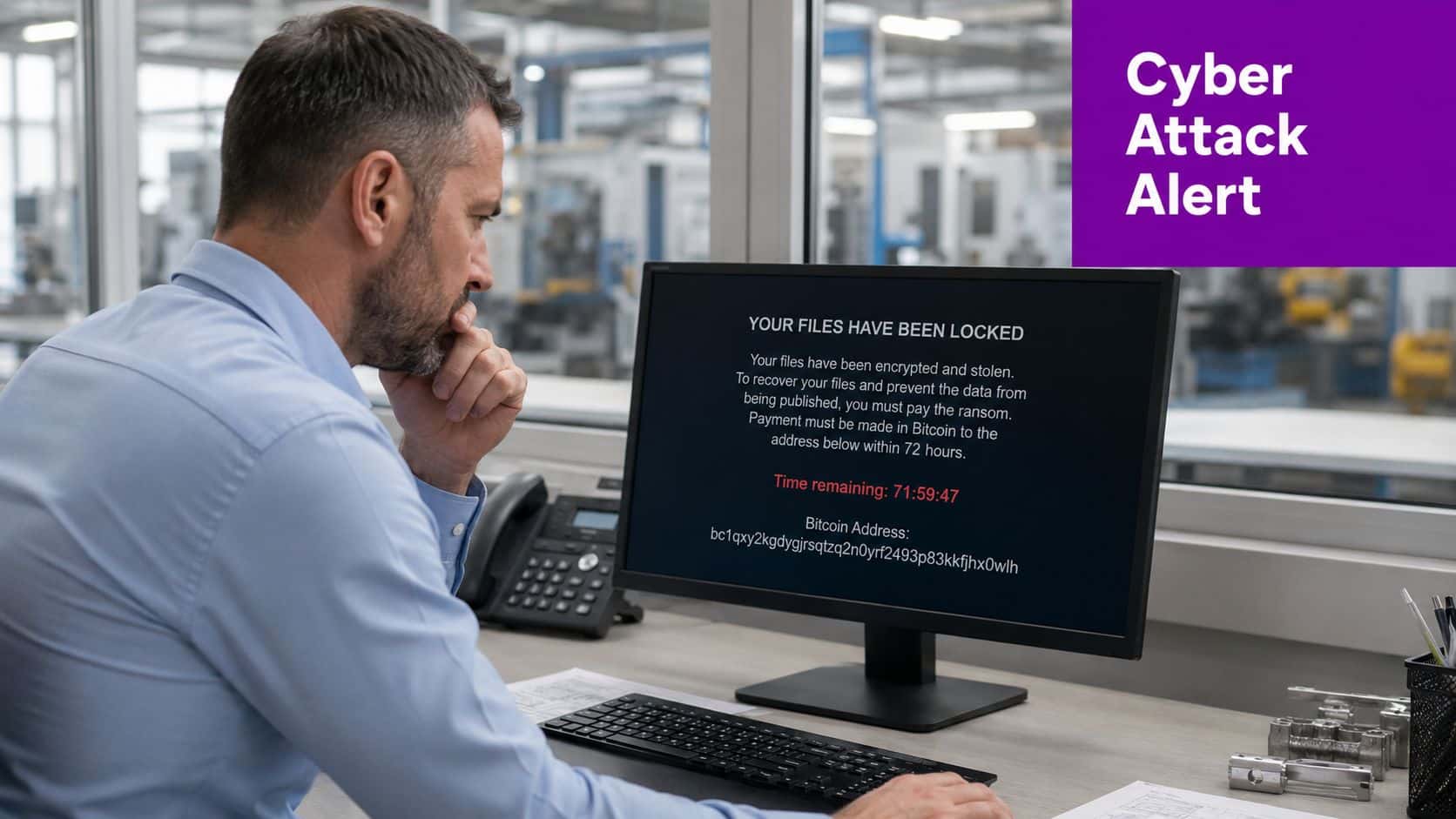
A Monday morning in Leicester can turn into a bad week very quickly. A manager opens the server room door, sees a ransom note on the screen, and realises the phones are already ringing, staff can't access files, and customers are asking questions before anyone in the building has had coffee.
That's the moment incident response services stop being a technical phrase and start being a business necessity. In the UK, the risk isn't rare or abstract, either, because the UK Government's 2024 Cyber Security Breaches Survey reported that 50% of businesses and 32% of charities experienced some kind of cyber security breach or attack in the previous 12 months, rising to 70% of medium businesses and 74% of large businesses. The same survey also said phishing remained the most common attack type, which is why rapid triage, evidence preservation, and recovery matter from the first hour, not the fifth. Beyond Surplus guide to Atlanta cyber risks is a useful reminder that attackers don't respect geography, even if your own business only serves the East Midlands.
For an East Midlands firm, the practical lesson is simple. A cyber incident is not just an IT issue, it's an operational interruption, a legal problem, and a communications problem at the same time. If you're already tightening your day-to-day controls, the cyber security tips page is a sensible companion, but it won't replace a response plan when the attack is already underway.
Why Incident Response Matters More Than Ever
The first signs are often small. A finance manager in Nottingham can't open shared files. A server in Leicester starts acting strangely. Then the screens change, the backups don't look trustworthy, and everyone wants to know whether customer data is involved.
That's why incident response can't be treated as an optional extra. Under the UK's current cyber backdrop, it's part of core resilience, because breaches and attacks are common enough that every business needs a way to contain, investigate, and recover. In the 2024 Cyber Security Breaches Survey, the higher exposure seen in medium businesses and large businesses makes one point very clear, larger teams aren't immune, they're just more visible and often more operationally exposed.
The 72-hour reality
The regulatory pressure matters just as much as the technical one. GDPR and the UK Data Protection Act 2018 turned breach handling into a time-critical business duty, because organisations must notify the relevant supervisory authority of a personal data breach within 72 hours of becoming aware of it unless the breach is unlikely to create risk to individuals, and affected individuals must be told without undue delay when the risk is high. The Information Commissioner's Office also expects breach notices to be documented and risk to be assessed quickly, which means delayed detection and messy logging can become a compliance problem as well as a security one. Splunk's overview of incident response metrics captures that regulatory shift clearly.
Practical rule: the first hour of an incident is often about preserving options, not “fixing everything”.
The business owner who waits for certainty usually loses time. The better move is to isolate what's affected, preserve evidence, and get someone who understands both the technical and regulatory sides on the call.
For a regional business, that's the difference between a controlled outage and a prolonged recovery. The value of incident response services isn't that they make attacks disappear, it's that they help you make faster, better decisions when the attack is already happening.
Understanding the Incident Response Lifecycle
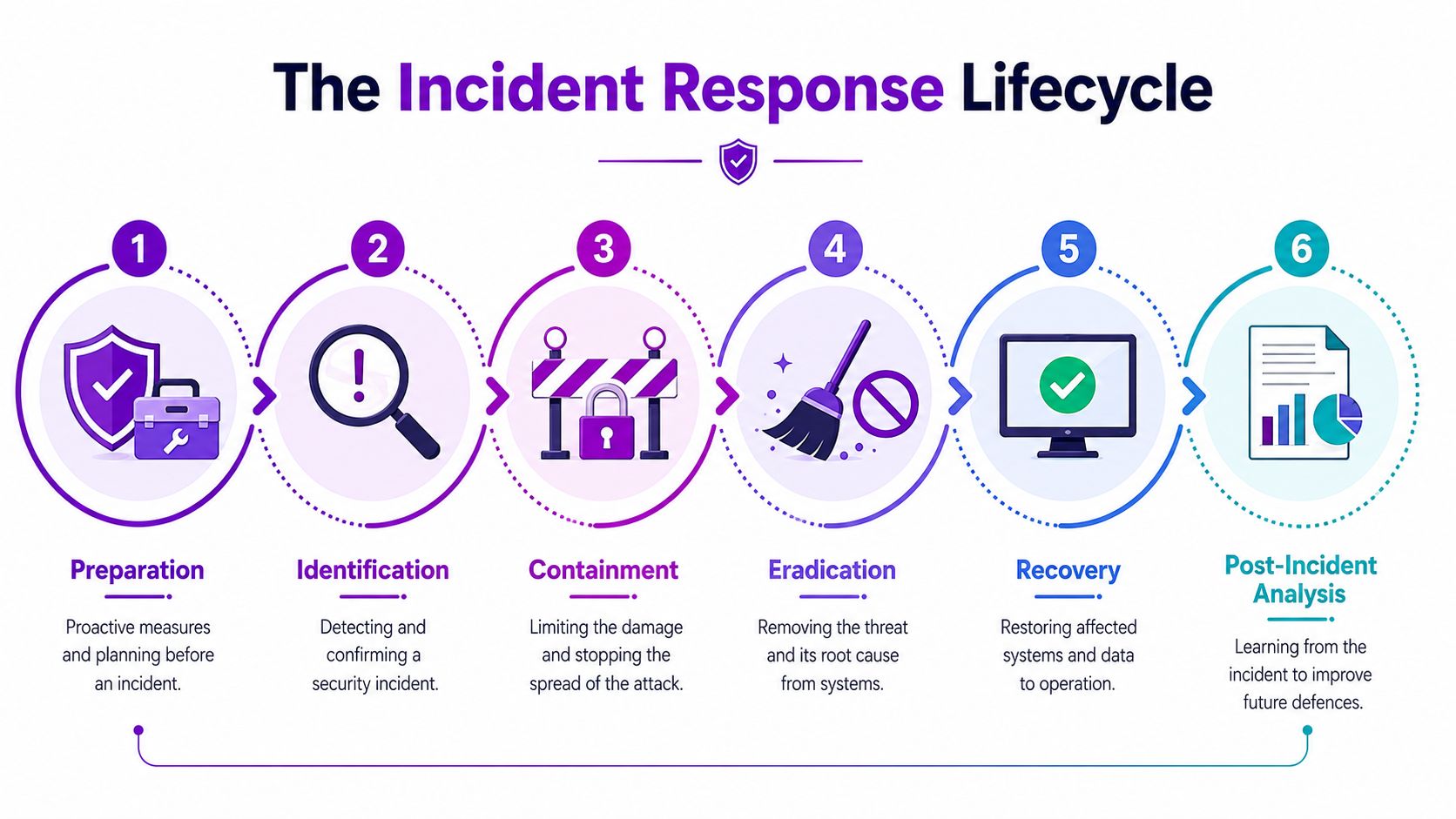
A good response works more like a fire brigade than a panic room. The crew doesn't improvise from scratch every time, it follows a disciplined process, checks the scene, contains the danger, removes the cause, and then reviews what happened so the next call goes better. Atlassian describes the standard model as six phases, preparation, identification, containment, eradication, recovery, and lessons learned, and that structure is procedural rather than reactive. Atlassian's incident response guide sets out that sequence plainly.
What each phase looks like in practice
Preparation means having a plan, roles, access, and evidence sources ready before the alarm sounds. Rapid7 is right to treat a documented plan as the starting point, not the end point, because the plan defines who acts, who approves, and how escalation works. building resilient security posture for CTOs is a useful complement if you're thinking about the leadership side of that preparation.
Identification is the moment someone confirms this isn't just a noisy alert. That might mean checking whether a suspicious login matches known staff behaviour or whether an email threat has already spread through the tenant.
Containment is about stopping the spread. In practical terms, that can mean disabling accounts, isolating endpoints, or cutting off suspicious traffic before the attacker moves further.
Eradication removes the root cause. That can include clearing malware, revoking tokens, or closing the weakness used to get in.
Recovery brings systems back carefully, not recklessly. Restoring too quickly can just reintroduce the same problem.
Lessons learned turns the incident into stronger playbooks, cleaner logging, and better decision-making next time.
If you use Microsoft 365, think of this lifecycle as the difference between ad hoc firefighting and a repeatable operating model. The process doesn't remove stress, but it does reduce confusion.
Core Offerings of an Incident Response Service
A mature provider isn't just someone who answers the phone after a breach. You're buying access to skills, process, and evidence handling that most SMEs can't keep fully staffed in-house. Eye Security's description of a high-quality service is helpful here, because it places preparation and readiness, exercises and simulations, eradication of persistence mechanisms, and a post-incident lessons-learned process alongside detection, investigation, containment, recovery, and review. Eye Security's incident response service overview shows how broad the offer should be.
What you're really paying for
A retainer is not just a fee for “being available”. It's pre-agreed access to specialists, usually with a defined scope, so you're not negotiating terms while systems are still down. Cynet notes that managed incident response services often work on retainer with a monthly cost and a clear scope of services, which is exactly why many mid-sized firms prefer them to one-off panic buying. Cynet's incident response explanation supports that commercial model.
Forensics is different from containment. Forensics answers questions like what was touched, what was taken, and how the attacker got in, while containment answers what must be stopped right now. Without that split, businesses tend to confuse speed with progress.
Rule of thumb: if a provider can't explain how they preserve evidence while taking action, they're not ready for a real incident.
The service should also help with reporting and communication. In a UK context, that means supporting the evidence trail needed for GDPR handling, helping leaders understand what to tell staff and customers, and keeping the timeline defensible if regulators later ask how the incident was handled.
For a Microsoft 365 environment, the most valuable providers don't stop at advice. They know how to use the telemetry already sitting in the tenant, then turn it into practical containment and a written account you can rely on. That's the bit many businesses underestimate, because after the noise dies down, the report is often what proves the response worked.
In-House Team vs Managed Incident Response Services
Some businesses want to build this capability themselves. Others need access to it without carrying the full overhead of a permanent team. Both approaches can work, but they solve different problems.
| Criterion | In-House Team | Managed Service |
|---|---|---|
| Availability | Dependent on staffing, holidays, and internal coverage | Usually defined by retainer terms and service scope |
| Specialist depth | Limited to the skills you can recruit and keep | Access to external specialists with broader incident experience |
| Cost profile | Ongoing payroll and tooling commitment | Often structured as monthly spend or call-out work |
| Speed of engagement | Can be quick if the team is already in place | Can be very fast if access, logging, and authority are pre-arranged |
| Scalability | Harder during multiple incidents or staff absence | Easier to scale when demand spikes |
| Evidence handling | Depends on internal maturity | Often includes structured forensics and reporting support |
The trade-off is control versus coverage. In-house staff know the environment well, which helps during fast containment, but they can be stretched if the incident is severe or if the team is small. Managed response can give you more breadth and stronger surge capacity, but only if the supplier understands your systems and has pre-agreed access to the right logs and identities.
For many East Midlands SMEs, the answer isn’t one or the other. A lean internal IT team can handle day-to-day administration, while an external specialist steps in for live incidents, forensics, and regulatory support. That model works best when responsibilities are clearly written down instead of assumed.
If your organisation also needs broader support across planning and security advice, cybersecurity consultancy services can sit alongside incident response rather than replacing it. The key is not to confuse strategic advice with live-incident capability.
Choosing a Provider in the East Midlands
The provider you choose should be able to answer simple, operational questions without jargon. If they can’t tell you what happens in the first hour of a Microsoft 365 compromise, or how they’ll keep evidence intact while they contain the damage, keep looking.
A practical buyer checklist
- Specialised expertise: Ask whether they regularly handle phishing, account compromise, ransomware, and cloud tenant incidents, not just generic “cybersecurity”.
- Local presence: Check whether they can support on-site work if needed, and whether they understand the working rhythms of manufacturing, logistics, charity, and professional services businesses across the region.
- Service level commitments: Get the response window in writing, along with what triggers escalation and who has authority to act.
- Tool coverage: Make sure they can work with Microsoft 365, Azure, Defender, and Sentinel if that’s your stack.
- Transparent costing: Ask what’s included, what’s excluded, and what happens if the incident goes beyond the base scope.
Pricing tends to be easier to understand when it’s tied to scope. Retainers are usually more predictable for businesses that want guaranteed access, while ad hoc call-out support can suit organisations that need occasional help rather than year-round standby. The trap is assuming “cheaper” means safer, because a low-cost contract that can’t engage quickly during an actual outage isn’t much use.
The SLA matters more than the sales pitch. You want clarity on whether the provider supports evenings and weekends, who answers first, whether they can act on your behalf, and how quickly they can start preserving logs and resetting access.
A practical East Midlands buyer should also check how much of the response is remote and how much can happen on site. If you rely on a small internal team, a provider with straightforward escalation and fast ownership transfer is usually worth more than a long feature list.
Optimising Response with Microsoft Security Tools
If your business already lives in Microsoft 365 and Azure, the smartest response capability is usually the one that plugs into what you’ve already bought. Microsoft’s security benchmark explicitly ties effective incident response to automated incident creation, enrichment, classification, stakeholder assignment, and playbook-driven containment using Microsoft Sentinel, Logic Apps, and Power Automate, because modern attacks can move at machine speed. Microsoft’s incident response benchmark is direct about that.

Why automation changes the first hour
Manual triage is too slow when the attack is moving through identity, email, and endpoints at once. A good Microsoft-focused response team can use Sentinel to pull signals together, then trigger repeatable actions through playbooks instead of waiting for someone to click through every alert by hand.
That matters most in the first hour. If a suspicious sign-in appears, automation can help enrich the event, identify the affected user, notify the right people, and kick off containment steps like account resets or session revocation. The point isn’t to replace human judgement, it’s to remove delay where the decision is obvious.
For an East Midlands business, a Microsoft-specialist partner earns its keep. The provider should understand how to use Defender, Sentinel, and identity controls as part of one response chain, not as separate products with separate owners. That’s especially useful if your staff are already stretched and your internal IT lead is also the person fixing printers, laptops, and access requests.
A strong Microsoft response posture is less about owning the tools and more about wiring them together properly.
F1Group is one example of a partner that sits in that Microsoft-focused space, but the important test is capability, not branding. Ask for the exact playbooks they would use for phishing, account takeover, and ransomware-style disruption, then compare that answer with how your team works day to day.
Building Your Incident Response Plan with F1Group
A workable response plan doesn’t start during the breach, it starts when systems are calm and you still have time to think. For most East Midlands businesses, the sensible goal is simple, know who to call, know what to isolate, and know how evidence will be preserved before anyone starts changing settings in a rush.
That’s also why incident response services should be treated as a strategic control, not an emergency luxury. A good partner helps you prepare the plan, test the process, and reduce the chances that a bad morning turns into a long operational outage. If you want local support across the East Midlands, F1Group can help align that response planning with Microsoft 365 and Azure environments, so your team isn’t making high-stakes decisions from scratch when time is tight.
Phone 0845 855 0000 today and Send us a message https://www.f1group.com/contact/