
If you're managing IT in a mid-sized manufacturing business in Lincoln, this probably sounds familiar. Customer records in Dynamics 365 don't quite match what sales sees on the ground. Production, finance, and service teams all keep their own spreadsheets because they don't trust the central report. Someone in leadership wants to use Copilot or build better Power BI dashboards, but the first question is awkward: which data should anyone trust?
That situation isn't unusual. It’s what data governance looks like before anyone calls it data governance. It shows up as duplicated suppliers, inconsistent part numbers, unclear permissions in Microsoft 365, and too much manual checking before a report goes to the board. The problem rarely starts with a lack of tools. It starts when ownership, rules, and basic controls haven't kept pace with growth.
From Data Chaos to Business Clarity
A typical pattern in growing firms is this. The business invests in Microsoft 365, moves files into SharePoint, adopts Azure for part of the estate, and adds Dynamics 365 to support sales or service. Each move is sensible on its own. Over time, though, data ends up split across systems, naming conventions drift, and nobody is fully sure which version is the right one.

In manufacturing, the impact is practical rather than theoretical. Sales might quote against an outdated customer record. Finance may spend too long reconciling figures that should already align. Operations may hold useful data in a format that Power BI can read, but not confidently explain. At that point, the cloud platform isn't the issue. The issue is that no one has set the rules for how data is created, named, checked, shared, and retired.
That’s where data governance consulting becomes useful. Not as a big corporate exercise, and not as a pile of policy documents that nobody reads. Done properly, it gives a business a working structure for trusted data.
Practical rule: If teams still rely on side spreadsheets to “correct” what’s in the main system, you don’t have a reporting problem. You have a governance problem.
The business risk is wider than internal inefficiency. A 2024 data governance report summary states that 84% of digital transformation projects fail due to poor data governance. For East Midlands firms putting more of the business onto Microsoft 365 and Azure, that’s a serious warning. The tools may be sound, but transformation still stalls if the underlying data is inconsistent, unsecured, or poorly owned.
What this looks like in the real world
Most firms don't call for help because they want a governance framework. They call because something concrete is getting in the way:
- Board reporting takes too long: Staff spend days validating figures before anyone will sign them off.
- Dynamics 365 adoption stalls: Teams stop trusting records and go back to email, spreadsheets, or local files.
- Access gets messy: Sensitive documents are shared too widely, or staff can't get the data they need without chasing approvals.
- AI projects feel risky: Leaders hesitate because nobody can explain data lineage, quality, or permissions with confidence.
Good governance clears those blockers. It gives management a reliable basis for decisions, helps IT reduce friction, and makes the Microsoft stack work as one connected environment rather than a collection of separate tools.
What Data Governance Consulting Really Means
Often, “data governance” is associated with restrictions, audits, and additional administrative work. In practice, good data governance consulting is about making data usable. It gives the business enough structure that staff can find the right information, trust it, and handle it safely.
A useful comparison is a warehouse that grew without a layout plan. Stock is there somewhere, but shelves are labelled inconsistently, duplicate items sit in different aisles, and valuable materials aren't properly controlled. A consultant’s job isn't only to tidy that warehouse once. It’s to set up the system that keeps it organised.

What a consultant actually does
At a practical level, data governance consulting usually starts with questions like these:
- Which data matters most to the business? Customer records, supplier data, product information, HR records, financial reporting data.
- Where does that data live? Dynamics 365, Excel files, SharePoint libraries, SQL databases, line-of-business systems, Azure storage.
- Who owns it? Not who uses it most. Who is accountable for its quality and correct use.
- What keeps going wrong? Duplicate records, missing fields, inconsistent definitions, uncontrolled sharing, weak retention habits.
That initial work matters because governance fails when firms start with tooling before they understand the operating model. If a consultant tries to sell a platform in the first conversation without working through data ownership, business priorities, and current pain points, that’s usually a bad sign.
A sensible external reference is this guide to hiring a Data Governance Consultant, which is useful for comparing how different firms approach governance work and what skills to look for in a partner.
The job is translation, not just control
The best governance consultants translate business problems into operating rules. They connect an issue such as “our sales reports don't match finance” to root causes such as inconsistent field definitions, duplicate account records, or manual exports outside approved workflows.
That often means they work across several layers at once:
- Business language: What does “active customer” mean in your business, and does every team use the same definition?
- Process: Who approves changes to key records, and what happens when a record is incomplete?
- Technology: Which Microsoft controls should classify, protect, catalogue, or monitor the data?
Later in the engagement, visual walkthroughs often help leadership and users see the difference between policy talk and operational reality.
What data governance consulting is not
It’s not a licence to create bureaucracy for its own sake. Manufacturing firms don't need an enterprise committee structure copied from a bank. They need lightweight rules that fit how the business runs.
What doesn't work:
- Writing policy before understanding workflows
- Assigning ownership to IT for business data IT doesn't control
- Trying to govern every data set at once
- Buying specialist tools when Microsoft capabilities already cover the immediate need
What does work is a focused engagement that starts with the data causing the biggest operational drag, then builds practical controls around it.
Governance only becomes real when people know who owns a field, who can change it, and what happens when standards aren't met.
Core Frameworks and Common Deliverables
Most successful governance programmes rest on three linked layers: people, process, and technology. That model matters because no single Microsoft tool can fix unclear ownership or weak working practices. A practical overview of the three-layer governance model notes that organisations using this approach typically see measurable reductions in data-related incidents within 6-12 months.
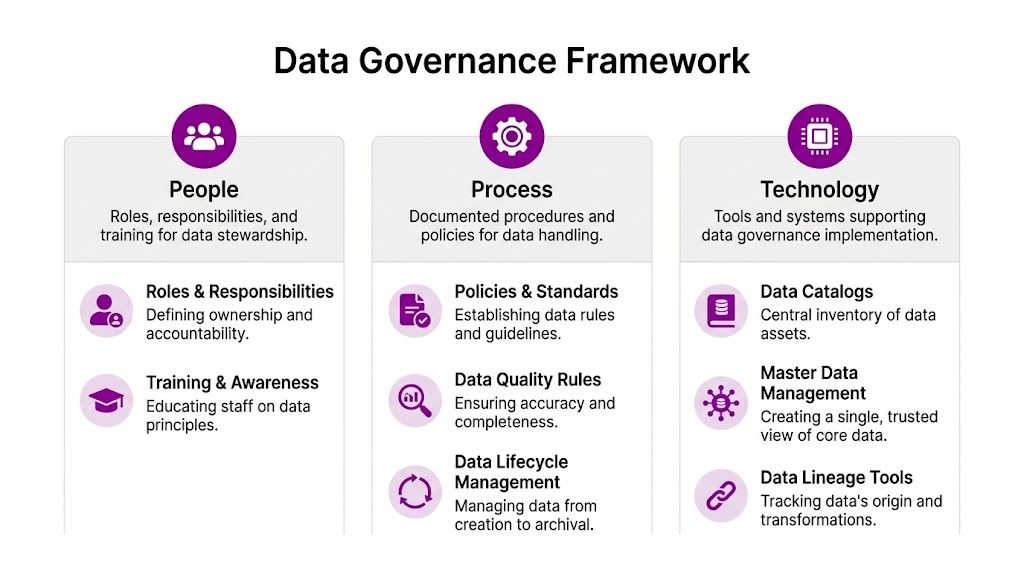
People first
This is usually the part firms underinvest in. Mid-sized businesses often don't have a formal data office, and they don't need one to start. They do need named responsibility.
In a manufacturing firm, that often means:
- A data owner: Usually a departmental lead who is accountable for a data domain such as customers, products, suppliers, or finance data.
- A data steward function: Often part-time rather than a full-time role. This person checks quality, raises issues, and keeps standards applied.
- An IT lead: Responsible for technical controls, access, automation, and integration points.
The mistake is assuming ownership sits with whoever manages the system. Your CRM administrator can manage Dynamics 365 configuration, but sales leadership still needs to own the quality rules for customer data.
Processes that stop repeat problems
Process is where governance becomes operational. This is not about giant workflow diagrams. It’s about a small number of repeatable decisions.
Examples include:
| Process area | What good looks like |
|---|---|
| New record creation | Clear mandatory fields, duplicate checks, and approval where needed |
| Access requests | Defined route for granting, reviewing, and removing access |
| Data quality review | Regular review of exceptions, missing values, and conflicts |
| Retention and deletion | Rules for how long data is kept and when it is archived or removed |
These controls reduce rework. They also make compliance easier because the business can explain how data is managed, not just where it is stored.
Technology that supports the model
Technology should reinforce people and process decisions. It shouldn't be the programme by itself.
Typical governance deliverables from a consulting engagement include:
- A data governance charter: A short document that states scope, priorities, decision rights, and success measures.
- A data catalogue or inventory: An organised view of core data assets, systems, owners, and sensitivity.
- A data quality rule set: Agreed standards for completeness, consistency, and acceptable values.
- Access and classification policies: Practical rules for sharing, storing, and protecting information.
- Issue management workflow: A simple method for logging and resolving recurring data problems.
- Reporting dashboard: Usually built in Power BI or a similar tool to show quality issues, exceptions, and trend lines over time.
What to ask for: If a consultant talks about “strategy” but can't show you the operating documents, ownership model, and reporting they’ll leave behind, the engagement is too vague.
AI makes governance more urgent
Many firms start governance because they want better reporting. Increasingly, they keep going because of AI. Copilot and similar tools increase the value of well-managed information, but they also expose weak data habits very quickly. Poorly labelled documents, inconsistent permissions, and duplicate records don't stay hidden once AI starts surfacing content across the estate.
If AI is on your roadmap, this is also a good point to review broader essential AI governance best practices. The practical overlap with data governance is strong. Clean data, clear ownership, and controlled access all matter before any AI rollout becomes credible.
The Business Case Measuring Benefits and ROI
The hardest part of selling governance internally is that the cost is visible before the benefit is. Leadership sees consultancy time, internal effort, and process change. What they don't immediately see is the time already being wasted every week because teams don't trust the data.
That’s why ROI has to be framed in operational terms, not abstract language about “data maturity”. A 2025 enterprise data governance report summary notes that 39% of data leaders struggle to demonstrate ROI for governance, yet the same source states that mid-sized firms with mature programmes suffer 45% fewer data breaches. That shifts the conversation from theory to business risk and avoidable cost.
Start with the pain already on the balance sheet
For an IT Manager, the strongest business case often comes from costs the business already accepts as normal:
- Manual reconciliation: Staff exporting, checking, correcting, and rekeying data before reports are usable.
- Delayed decisions: Management waiting for someone to validate figures from multiple sources.
- Rework in core systems: Correcting duplicate customers, inconsistent addresses, product codes, or incomplete records.
- Access-related risk: Over-permissioned files, poor handling of confidential information, or weak auditability.
These are governance costs, even if nobody labels them that way.
Measure what the business can already see
You don't need a perfect financial model on day one. You need a baseline and a small set of measurable indicators tied to daily operations.
A practical starter set looks like this:
| Measure | Why it matters |
|---|---|
| Time to prepare monthly board or management reports | Shows whether staff still have to fix data manually |
| Number of duplicate or incomplete records in Dynamics 365 | Reflects core data quality in a visible business system |
| Access exceptions or permission clean-up tasks | Indicates whether controls are improving |
| Adoption of standard reporting in Power BI | Shows whether users trust governed data outputs |
| Number of recurring data issues raised by departments | Helps distinguish one-off errors from structural problems |
For firms using reporting heavily, governed data often improves the value of analytics already in place. A practical way to connect that to leadership is through a business discussion around what Power BI is used for, then linking dashboard trust back to the quality and consistency of the underlying source data.
A better way to justify the spend
The strongest argument is usually this: governance doesn't only prevent downside. It makes the Microsoft estate you already pay for more useful.
If Dynamics 365 data is cleaner, sales forecasting becomes more credible. If Microsoft 365 permissions are structured properly, staff spend less time asking whether they can share or access documents. If Power BI reports are built on consistent definitions, managers stop maintaining shadow spreadsheets.
A governance project should pay for itself in reduced confusion before it ever claims strategic value.
Applying Governance with Your Microsoft Stack
Most mid-sized firms don't need a separate governance estate. They need to use the Microsoft tools they already have with clearer intent. That’s the practical advantage of a Microsoft-first approach. Classification, access control, catalogue capabilities, workflow automation, and reporting can be aligned without introducing unnecessary platform sprawl.
A key point for AI and CRM-led firms is this. Clean, well-catalogued data is essential for Copilot and related use cases, and implementing master data management alongside Dynamics 365 helps maintain customer consistency across Sales and Service while supporting UK data protection obligations, as outlined in this overview of data governance consulting outcomes.
Where each Microsoft tool fits
The table below maps common governance needs to the Microsoft stack.
| Governance Function | Primary Microsoft Tool(s) | Example Application |
|---|---|---|
| Data discovery and catalogue | Microsoft Purview | Identify where customer, supplier, HR, and financial data resides across Microsoft 365 and Azure |
| Information protection | Microsoft 365 sensitivity labels | Mark confidential quotes, contracts, and HR files so sharing controls follow the content |
| Access control | Entra ID and role-based access controls | Limit who can view, edit, or export data by role and team |
| Master data consistency | Dynamics 365 and Dataverse | Keep customer and service records aligned across apps and workflows |
| Data quality monitoring | Power BI and workflow alerts | Surface incomplete records, duplicate accounts, or missing mandatory fields |
| Process automation | Power Automate | Route approvals for access requests, data corrections, or exception handling |
| Retention and lifecycle | Microsoft 365 retention features and Purview policies | Manage how long records are kept and when they move to archive or deletion |
Practical use in a manufacturing environment
This becomes easier to grasp when tied to real working patterns.
A manufacturing firm may hold customer data in Dynamics 365, store specifications in SharePoint, keep finance data in an ERP platform, and run operational feeds into Azure or reporting tools. Governance doesn't require all of that to be centralised into one system. It requires a clear understanding of which system is authoritative for which data set, who owns the standards, and how changes are managed.
That often leads to decisions such as:
- Dynamics 365 is the authoritative source for customer account status.
- Product documentation in SharePoint must carry sensitivity labels where commercial or technical confidentiality applies.
- Power BI reports can only use approved fields from agreed source tables.
- Power Automate flows that update records must follow the same validation rules as manual entry.
Don’t overlook unstructured information
One common weak point is unstructured data. Firms spend time cleaning CRM records while ignoring the sprawling mass of documents, emails, PDFs, scanned forms, and shared folders that staff use every day. That’s a mistake, because governance failures often begin there.
If you're dealing with document-heavy processes, this guide on structuring unstructured data is a useful companion topic. It helps frame why catalogue, classification, retention, and searchability matter just as much for files and content as they do for rows in a database.
What tends to work well
In Microsoft environments, governance works best when controls are embedded into live workflows:
- Use sensitivity labels where users already work, rather than relying on separate manual rules.
- Apply RBAC consistently across Azure, Dynamics, and reporting access.
- Set mandatory fields and validation rules in Dynamics 365 so quality improves at entry point.
- Build a visible quality dashboard so ownership stays active rather than disappearing into IT tickets.
For organisations that need external support, firms such as F1Group provide governance around Microsoft 365, Azure, Dynamics 365, Power Platform, and AI usage as part of broader IT and transformation work. The key point isn't the supplier name. It's that your partner should understand how governance decisions affect the Microsoft tools your staff use every day.
Choosing Your Partner An Engagement Checklist
Choosing a data governance consultant isn't the same as choosing a software reseller. You're buying judgement, operating experience, and the ability to make change stick inside a busy business. For a mid-sized manufacturer, that matters more than glossy methodology.
A good partner should be able to move comfortably between business process, Microsoft tooling, compliance obligations, and day-to-day realities such as limited headcount. If they can only talk in one of those languages, the engagement usually drifts.
Questions worth asking early
Use these questions to test whether a consultant is likely to be useful rather than theoretical:
- How do you scope the first phase? Look for a focused answer around one or two data domains, not an attempt to govern everything.
- How do you handle firms without dedicated data staff? The response should include pragmatic ownership models using existing managers and key users.
- What do you deliver at the end of the first engagement? Ask for examples such as a charter, inventory, ownership model, policy set, quality dashboard, and issue log.
- How do you work with Microsoft 365, Azure, Dynamics 365, and Power Platform? If your estate is Microsoft-led, platform familiarity isn't optional.
- How do you measure success? They should talk about business outcomes, quality indicators, reduced rework, and clearer accountability.
Red flags to watch for
Some warning signs appear quickly in early meetings:
| Red flag | Why it matters |
|---|---|
| They push a tool before understanding the business problem | You may end up with technology that doesn’t address root causes |
| They make governance sound like a compliance exercise only | The business case becomes too narrow and user adoption suffers |
| They can’t explain a lightweight model for SMBs | The approach may be copied from large enterprises and won’t fit |
| They avoid concrete deliverables | You risk paying for workshops without operational change |
| They don’t ask about reporting, CRM, document management, and access together | They may be thinking in silos rather than across the full data estate |
Selection test: Ask the consultant how they'd improve one real problem in your business within the first phase. Strong partners answer with steps, owners, and tools. Weak ones answer with buzzwords.
Fit matters as much as expertise
For East Midlands firms, local understanding can help. A consultant who knows how mid-sized organisations operate will usually be more practical about resource limits, reporting pressure, and competing project demands.
It also helps to bring some structure to your buying process. If your team is formalising requirements, this IT RFP template can help you compare partners more clearly and avoid vague proposals that are hard to evaluate later.
A Practical Roadmap for East Midlands SMBs
Most SMBs shouldn't run governance as a large, enterprise-style programme. That approach creates too much overhead too early. A better route is phased, focused, and tied to one operational problem at a time.
That’s especially important where IT capacity is thin. The SMB governance resource gap discussion highlights that most SMBs can't afford dedicated data stewards, and that fractional engagements of 10-15 hours monthly can deliver measurable ROI within 90 days. For firms with lean IT teams, that’s often the most realistic way to start.
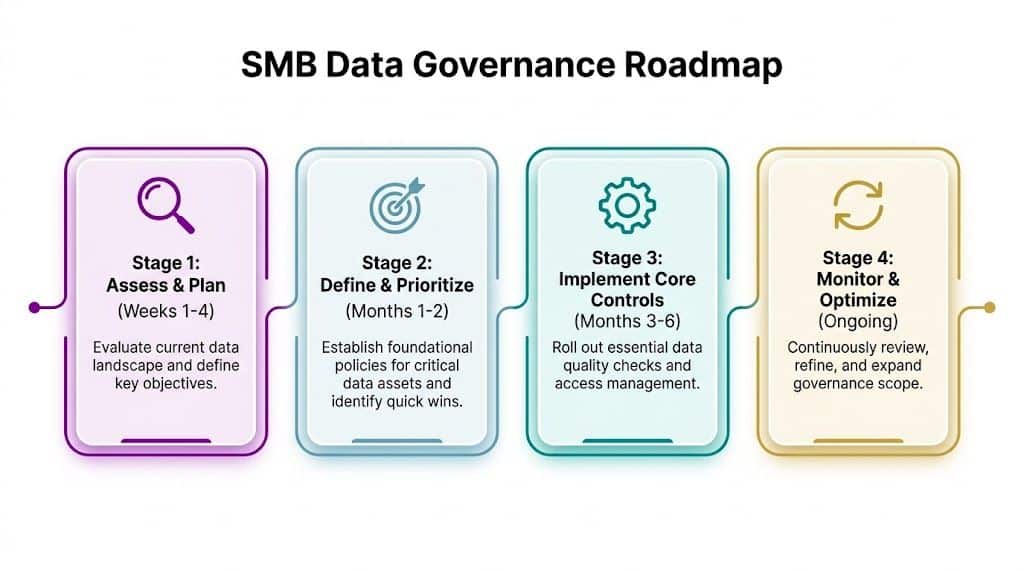
Stage one assess and plan
Start with a short assessment of the current state. Not every data set. Just the ones that affect operations, reporting, customer management, or compliance most directly.
Look for answers to a few basic questions:
- Which records create the most rework?
- Which reports trigger the most debate about accuracy?
- Where are permissions least clear?
- Which team is most exposed if data quality drops?
This stage should end with a defined scope, named owners, and a short list of priorities. If the initial phase isn't specific, governance quickly becomes too broad to manage.
Stage two define and prioritise
Once the key pain point is clear, define a small operating model around it. For many firms, that means customer or supplier data first because those records touch multiple departments.
Typical outputs at this point include:
- a named data owner
- a short rule set for mandatory fields and record standards
- a duplicate-handling process
- basic access and sharing expectations
- an agreed reporting view of what “good” looks like
Firms often realise they already own much of the technology needed. The challenge isn't absence of tooling. It’s agreeing how to use it consistently.
Stage three implement core controls
Now the business can introduce the controls that support the model. In a Microsoft estate, this often includes validation rules in Dynamics 365, access reviews, sensitivity labels in Microsoft 365, simple catalogue work, and dashboards to surface exceptions.
The key is restraint. Don’t automate a bad process. Don’t create ten policy documents where one page of working rules will do. Start with the controls that remove visible friction.
A good first implementation phase tends to focus on:
| Priority area | Example action |
|---|---|
| Customer data quality | Add mandatory fields, duplicate checks, and owner review in Dynamics 365 |
| Document control | Apply sensitivity labels and tidy access to key SharePoint libraries |
| Reporting trust | Build a Power BI exception dashboard for incomplete or conflicting records |
| Access management | Clarify approval routes and review role-based permissions |
Stage four monitor and optimise
Governance becomes sustainable when the business reviews it routinely rather than treating it as a one-off clean-up. Monthly exception reviews, periodic ownership checks, and simple dashboard reporting usually do more good than a large annual review nobody uses.
What tends to work over time is:
- Keep the scope manageable: Expand only after the first domain is stable.
- Use business owners, not only IT: Data quality improves when operational teams remain accountable.
- Embed controls into projects: New apps, automations, and AI initiatives should inherit governance requirements from the start.
Governance should feel like part of operations, not a separate programme that visits the business once a quarter.
For East Midlands SMBs, that phased model is usually enough to move from reactive fixing to controlled growth. It supports better reporting, cleaner CRM data, safer collaboration, and more credible AI adoption without requiring a dedicated governance department.
Take Control of Your Data Today
Messy data slows decisions, weakens reporting, and makes every Microsoft investment work harder than it should. Good data governance consulting fixes that by putting ownership, practical rules, and the right controls around the information your business already depends on.
For a mid-sized firm, the sensible route is not a huge transformation project. It’s a clear first step, focused on the data problem that causes the most friction today, then building from there with tools you already use.
If you’d like to talk through a practical approach to data governance for your organisation, contact F1Group. Phone 0845 855 0000 today or send us a message.