
You're probably in one of these positions right now. Your team is growing, advisers are working from home part of the week, Microsoft 365 has become the backbone of daily work, and somebody has just raised a question about phishing, backups, or an upcoming audit. The problem is that standard IT support won't carry a financial services firm very far.
A finance business in Nottingham, Leicester, Lincoln or Newark doesn't get judged only on whether laptops boot up and emails send. It gets judged on whether client data is protected, whether staff access is controlled, whether outages are contained, and whether evidence exists when regulators or auditors ask awkward questions. That's why it support for financial services has to be built differently from the start.
Why Standard IT Support Falls Short for Finance Firms
A generic support desk usually thinks in tickets. A finance firm has to think in risk, resilience and evidence.
If you run a mortgage broker, wealth practice, insurer, lender or regulated fintech in the East Midlands, your exposure is bigger than your headcount suggests. The UK's financial services sector contributed 12.2% of UK total economic output in 2023 and employed about 1.17 million people, according to this UK financial services market overview. That scale matters because even smaller regional firms operate inside a market shaped by FCA, PRA and data protection expectations.
A Leicester director might ask IT to “sort out a few access problems” after a member of staff clicks a suspicious email. A standard provider may reset the password and move on. A specialist provider asks harder questions. Was MFA enforced? Was the sign-in risky? Did the attacker access Exchange Online? Were mailbox rules created? Was privileged access exposed? Can you prove what happened?
Financial IT support isn't a helpdesk problem. It's part of your control environment.
What generic support usually misses
Standard providers often fall short in four places:
- Operational context. They treat Outlook, Teams, line-of-business apps and cloud access as separate issues, when they're tied to customer service and regulated workflows.
- Compliance evidence. They can fix an issue, but can't always show the audit trail, restore test, access review or incident record behind it.
- Security depth. They'll install antivirus and call it cyber security. That's not enough for firms handling identity, money and sensitive client records.
- Resilience planning. They respond after the outage. Finance firms need monitored dependencies, tested recovery and clear escalation before customer impact spirals.
What better looks like
Good it support for financial services starts with a different operating model. Your provider should understand Microsoft 365, Azure, endpoint security, conditional access, secure backups, and regulated operating pressures as one joined-up system. That's the level of support described in specialist IT support for regulated organisations.
If your current supplier mainly talks about response times and device fixes, you're buying a service desk. You're not buying resilience.
Navigating the Financial Services Regulatory Maze
Regulation isn't a separate document that sits in a drawer. It dictates how your systems should be built, who can access them, what gets logged, and how fast you can recover.
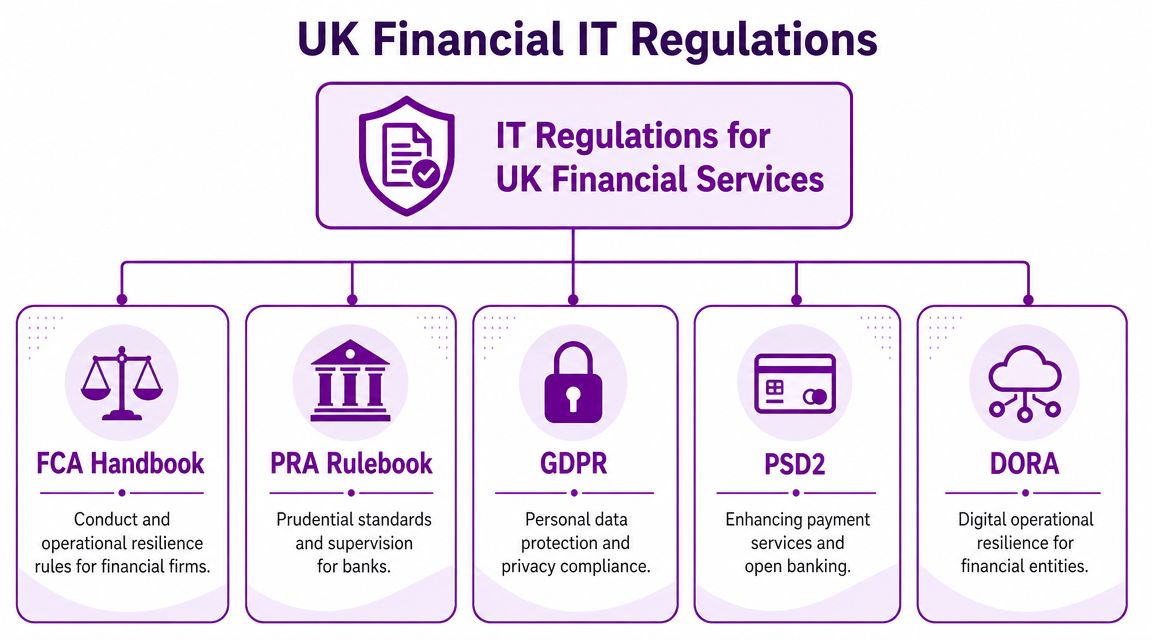
FCA and PRA rules change the IT brief
The most important practical point is this. The FCA and PRA don't just expect firms to react to incidents. They expect firms to understand which services matter most and keep them running through disruption.
The FCA/PRA framework requires firms to identify important business services, set impact tolerances, and prove they can stay within those tolerances during severe disruption, as explained in this overview of IT challenges in financial services. That pushes IT support well beyond break-fix work. You need mapped dependencies, documented recovery objectives, tested incident playbooks, and monitoring across identity, endpoints, network and cloud platforms.
That has direct Microsoft implications. If your firm runs on Entra ID, Exchange Online, Teams, SharePoint, Dynamics 365 or Azure-hosted applications, then authentication failures or service degradation can quickly affect client response times, onboarding, reporting and payments.
GDPR and payment controls affect everyday decisions
GDPR has practical IT consequences. It affects where personal data sits, who can reach it, how retention works, and what happens when staff leave or change roles. That means your provider should enforce role-based access, secure device controls, encryption, and disciplined offboarding.
If your business touches card payments or payment-related processes, payment security obligations also shape how systems are segmented, monitored and reviewed. The point isn't to turn business owners into compliance officers. The point is to stop treating regulation as someone else's problem.
Practical rule: If a compliance requirement can't be shown in a report, a policy, a log, or a tested procedure, assume it will be challenged.
Use frameworks that produce evidence
The right question isn't “Are we compliant?” The right question is “Can we demonstrate control when asked?” That's where structured assessments matter. A good starting point is a cyber assessment framework for regulated businesses that ties governance, security controls and operational resilience into something measurable.
Legal risk matters too, especially when investor harm or fraud enters the picture. Firms that want a legal perspective on post-incident recovery can review Kons Law's investor recovery guide, which helps show how technical failures and financial loss can quickly become legal disputes.
Essential Security Controls for Protecting Financial Data
Most finance firms don't fail because they lacked a policy. They fail because an attacker found a weak account, an unprotected device, a badly configured mailbox, or an admin role nobody was watching.

The threat pressure is already clear. The UK Government's Cyber Security Breaches Survey 2024 found that 78% of medium-sized businesses reported a cyber breach or attack in the previous 12 months, and phishing accounted for 84% of identified incidents, as noted in this financial services cyber support summary. If you're in financial services, these controls aren't optional.
Identity first, always
Your first line of defence is identity. Most serious incidents in Microsoft environments start with a stolen password, token theft, session hijack or weak admin practice.
That means you should expect:
- Multi-factor authentication for all users, with stronger controls for administrators.
- Conditional access that blocks risky sign-ins, unfamiliar locations, unmanaged devices or impossible travel patterns.
- Least privilege so staff only have the access they need, and no more.
- Privileged access controls for admin accounts, with separate privileged identities where appropriate.
A useful benchmark is whether your provider can clearly explain identity and access management in Microsoft-led environments without hiding behind jargon.
Endpoint, email and data controls
A secure finance firm also needs strong controls on the devices and services staff use every day.
- Endpoint detection and response should monitor laptops and desktops for suspicious activity, not just malware signatures.
- Email protection should scan for phishing, malicious links, impersonation attempts and suspicious attachments.
- Device compliance policies should stop unmanaged or unencrypted devices from reaching sensitive data.
- Encryption should protect data in transit and at rest.
- Secure backups should cover Microsoft 365 data and key business systems, with restore testing built in.
Here's a straightforward explanation of why these layers matter in practice:
Training matters, but don't stop there
Staff awareness training matters because phishing still works. But training alone is weak protection. People are busy, distracted and under pressure. Good support assumes that somebody will click something eventually, then puts technical controls in place to limit the damage.
A password reset after a phishing email is tidy support. Blocking the sign-in, checking mailbox rules, reviewing audit logs and containing the device is security support.
If your provider can't talk confidently about Entra ID, Defender, Exchange Online protection, SharePoint permissions and recovery procedures, they're not set up for financial services.
Core Managed IT Services for Modern Finance Firms
At 9:05 on a Monday, a member of staff cannot sign in to Outlook, a director cannot approve a payment from their phone, and a client file in SharePoint has the wrong access settings. For a finance firm in Leicester, Nottingham, or Derby, that is not a routine support queue. It is an operational risk with compliance consequences.
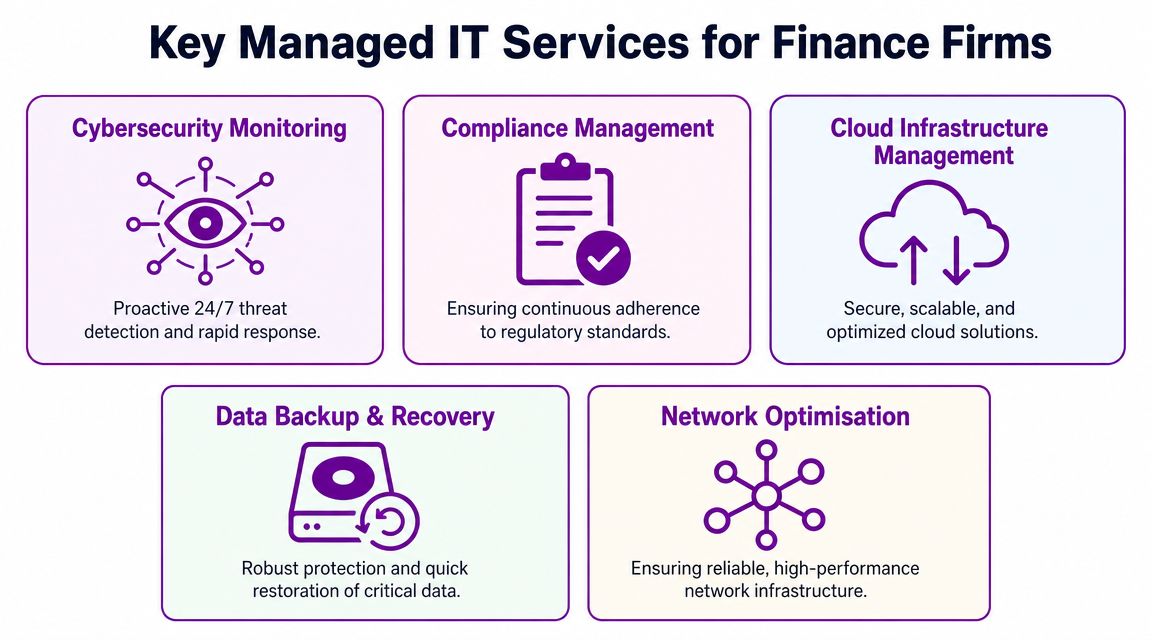
That is why standard IT support falls short. Finance firms need a managed service built for regulated work. The provider has to keep staff productive, keep records controlled, and keep Microsoft systems configured in a way that stands up to scrutiny if the FCA asks questions after an incident.
For East Midlands SMEs, the right model is usually Microsoft-first. Most firms already rely on Microsoft 365 for email, files, Teams and identity. Azure then becomes the control layer for infrastructure, monitoring, recovery and policy enforcement. If your support partner treats those platforms as separate products instead of one joined-up environment, you get gaps. Gaps turn into outages, data exposure, and expensive clean-up.
What a finance-ready managed service should include
A finance-ready service should own the day-to-day operating model, not just answer tickets.
| Managed service area | What it should do |
|---|---|
| Microsoft 365 management | Control identity, email, Teams, SharePoint, OneDrive, retention and access policies |
| Azure management | Set up secure workloads, monitoring, policy controls, virtual infrastructure and recovery options |
| Backup and disaster recovery | Protect Microsoft 365 data, business systems and cloud workloads, then test restores on a schedule |
| Security monitoring | Watch endpoints, identities, cloud apps and admin activity for signs of misuse or compromise |
| Compliance support | Maintain audit logs, access reviews, policy records and evidence needed for regulated oversight |
| Helpdesk and user support | Fix user issues fast without bypassing security rules or weakening access controls |
The table matters because these services depend on each other. A helpdesk engineer resetting access without checking conditional access, MFA status, device trust or mailbox activity can solve one problem and create a bigger one. In finance, poor support work often shows up later as a breach, failed audit trail, or customer complaint.
Managed service means controlled operations
Break-fix support is reactive. Finance firms need controlled operations.
That means your provider should manage joiners, movers and leavers properly, review privileged access, keep licensing aligned to policy, monitor failed backups, and spot configuration drift before it affects client service. It also means knowing which systems matter most to your firm. A mortgage broker, wealth manager, credit union or specialist lender will not all have the same priorities, even if they all use the same Microsoft stack.
This is also where sector context matters. Specialist organisations such as IT solutions for Church Extension Funds still need disciplined controls around financial data, user access, records and uptime. The lesson for East Midlands SMEs is simple. If you handle money, regulated records and client trust, generic support is a poor fit.
Microsoft-centric support is the practical choice for most SMEs
For most small and mid-sized finance firms, Microsoft gives the clearest route to a secure, compliant foundation. Microsoft 365 can centralise identity, communication and document control. Azure can host legacy workloads, support new cloud services, and apply policy across the environment. Dynamics 365 can support client servicing and internal workflows, but only if it is tied back to the same identity, security and data governance model.
Choose a provider that can run that stack as one service. Ask direct questions. Who owns Intune and device policy? Who reviews Entra ID risk events? Who checks SharePoint permissions after team changes? Who proves backup recovery for Microsoft 365 and Azure workloads? If the answers are vague, the service is not mature enough for financial services.
Good managed IT for finance is not about collecting tools. It is about running Microsoft 365 and Azure with discipline, documented processes, and clear accountability. That is what keeps a busy East Midlands firm operating cleanly under pressure.
Planning for Incidents and Cloud Transformation
Two things expose weak IT support faster than anything else. A real incident, and a cloud migration done badly.
Financial firms can't afford panic-led response. UK Finance reported that authorised push payment fraud losses were £459.7 million in 2023, according to this guide to IT support for financial services. That should end the debate about whether rapid response, strong authentication and immutable backups are worth the effort.
Build an incident plan before you need it
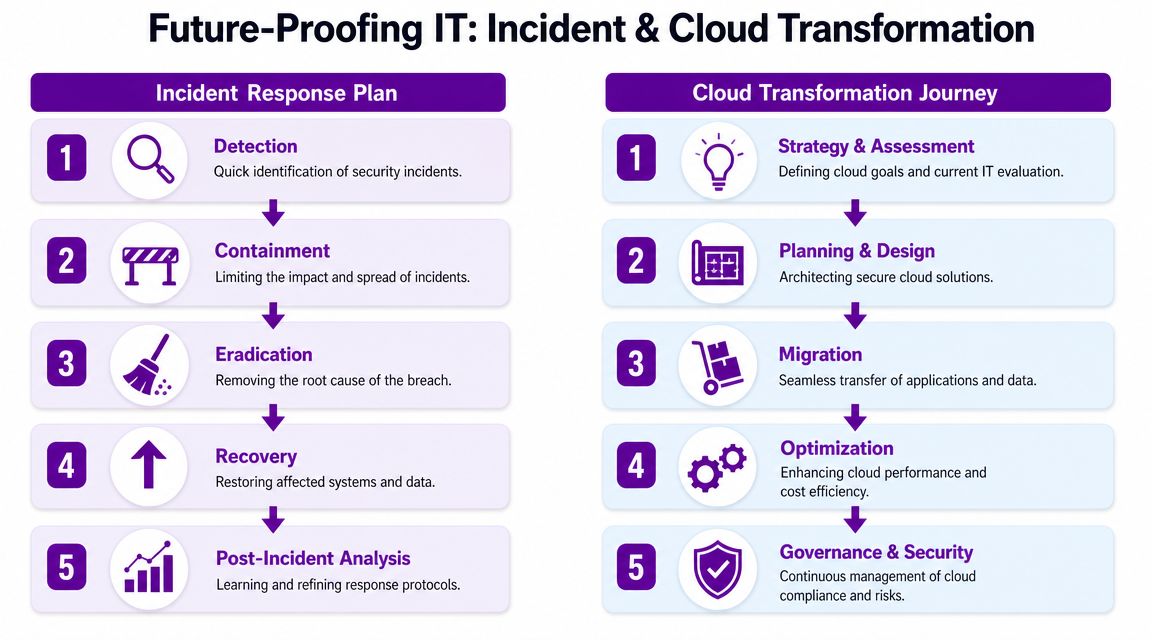
An incident response plan should be short enough to use and detailed enough to work. At minimum, it should define:
- How incidents are detected. Who monitors what, and which events trigger escalation.
- Who takes charge. Named roles for decision-making, communications, technical action and supplier contact.
- Containment steps. Account lockout, device isolation, mailbox checks, permission review, backup protection.
- Recovery steps. Restore order, data integrity checks, controlled return to service, evidence capture.
- Post-incident review. What failed, what changed, what must be documented.
When a finance firm suffers an account compromise, the first hour matters more than the first meeting.
If your current plan lives in someone's head, you don't have a plan.
Move to cloud with security designed in
Cloud transformation is worthwhile, but only if you treat Azure and Microsoft 365 as governed platforms rather than convenient hosting.
Focus on these decisions early:
- Data location and governance. Know what data is stored where, and who owns each policy.
- Shared responsibility. Microsoft secures the platform. You still secure identities, configurations, data and access.
- Landing zone design. Build with policy, logging, segmentation and security baselines from the start.
- Backup and recovery design. Don't assume cloud platforms remove the need for restore planning.
- Access discipline. Admin sprawl in Azure is one of the fastest ways to create risk.
Cloud can strengthen resilience. It can also magnify poor governance. The difference is planning.
Your IT Support Vendor Checklist for East Midlands SMEs
Plenty of IT companies say they support financial services. Far fewer can answer the right questions without becoming vague.
Use this checklist to separate a generalist from a real specialist. If a provider gives woolly answers, move on.
Vendor evaluation checklist
| Area of Focus | Question to Ask | Why It Matters |
|---|---|---|
| Regulatory awareness | Have you supported FCA-regulated firms or firms with similar control requirements? | You need a provider that understands regulated operations, not just office IT. |
| Operational resilience | How do you identify critical systems and support recovery priorities? | Finance firms need support tied to important business services and recovery expectations. |
| Microsoft expertise | How do you secure Microsoft 365, Entra ID, Exchange Online, Teams and Azure in practice? | Most East Midlands SMEs in finance rely heavily on Microsoft platforms. |
| Identity security | How do you handle MFA, conditional access, privileged accounts and joiner-mover-leaver processes? | Identity weakness is one of the most common routes into a finance environment. |
| Backup discipline | How often do you test restores, and can you show evidence? | Backups that haven't been tested are a false comfort. |
| Incident response | What happens in the first hour after a suspected account takeover or ransomware event? | You want a rehearsed process, not improvisation. |
| Logging and evidence | What audit logs, alerts and reports do you retain for investigations and reviews? | If you can't show evidence, you can't prove control. |
| Data handling | How do you manage permissions, retention, encryption and leaver access removal? | Client confidentiality depends on disciplined data governance. |
| Support model | Who answers the phone, where are engineers based, and do you offer on-site support in the East Midlands? | Local presence still matters when a business-critical issue needs hands-on help. |
| Staff assurance | Are your engineers vetted and suitable for working with sensitive client environments? | Finance firms should ask direct questions about trust and access. |
| Commercial clarity | What's included in the monthly service, and what triggers extra charges? | Hidden charging usually appears during incidents or projects. |
| Strategy input | Will you advise on roadmap, security improvements and Microsoft licensing choices? | A good supplier should help you make better decisions, not just close tickets. |
What to expect on pricing
Pricing depends on your user count, cloud estate, support hours, security tooling and compliance needs. The key point is to compare scope, not just monthly cost.
A cheaper contract often excludes security monitoring, backup testing, conditional access policy work, incident handling and strategic review time. That makes it look affordable until something serious happens. For financial services, the better buying question is this: what controls, reporting and recovery responsibilities are included?
Don't choose a provider because they're nearby. Choose them because they can prove they understand finance risk, and they happen to be nearby.
Take the Next Step Towards Secure and Compliant IT
Financial firms don't need more noise from IT providers. They need clear control over systems, users, data and recovery.
That means specialist support. Not generic outsourced helpdesk. Not occasional cyber advice. Proper it support for financial services means secure Microsoft 365 and Azure foundations, disciplined identity management, tested backups, workable incident response, and evidence that stands up when auditors or regulators ask questions.
If you're an SME in the East Midlands, that local context matters too. You need a provider that can support hybrid teams, visit site when needed, and understand that a small regulated firm still carries serious obligations. The right IT partner reduces operational risk and helps you keep the business moving.
If your current setup relies on crossed fingers, old backup assumptions, broad admin access, or a supplier that can't explain resilience in plain English, it's time to fix it.
If you want a practical conversation about secure, compliant Microsoft-focused IT for your finance firm, contact F1Group. Phone 0845 855 0000 today or send us a message to discuss your requirements.