
Most firms don't start by asking for a custom web app. They start by complaining about the same things every week. Staff rekey data from emails into spreadsheets. Sales and operations look at different versions of the truth. Someone has built a fragile process around Microsoft Excel, Outlook and a shared drive, and now the business has outgrown it.
That's usually the point where the conversation changes. You're no longer looking for “some software”. You're looking for a better way to run a process without adding more admin, more risk or more confusion. For many mid-sized businesses in the East Midlands, that means deciding whether to buy a package, extend Microsoft 365, or commission something bespoke that fits how the organisation works.
What Are Custom Web App Development Services
A custom web app is business software built around your process and accessed through a browser. It isn't the same as a public-facing website. A website mainly publishes information. A web app helps people do work, such as approving requests, updating records, tracking jobs, managing customers, or serving clients through a secure portal.

What businesses are really buying
When companies ask about custom web app development services, they're rarely buying code for its own sake. They're trying to fix one or more of these problems:
- Manual hand-offs: Staff copy data between systems, which creates delays and mistakes.
- Disconnected tools: Finance, operations and customer service all use different platforms with poor visibility between them.
- Weak control: Important processes rely on memory, inboxes or spreadsheets rather than clear rules and permissions.
- Poor scalability: The process worked with a small team, but it breaks down as volume grows.
- Limited reporting: Managers can't see current status without asking someone to compile an update.
That's why bespoke applications tend to become part of the operating model rather than just another IT purchase. A well-scoped app can centralise data, enforce process rules, improve security, and reduce the amount of routine admin that drains time from the team.
Practical rule: If your staff spend too much time chasing, copying, checking or reconciling information, the problem is usually the workflow, not the people.
Why this matters in the UK market
The wider UK picture helps explain why this demand is so strong. In 2023, the UK digital sector generated £158.3 billion in gross value added and accounted for 6.2% of total UK GVA, according to this UK digital economy reference. For a business in Lincoln, Nottingham, Leicester or the wider East Midlands, that matters because bespoke systems are no longer unusual. They sit inside a much broader software-enabled economy.
A custom app also doesn't have to mean an oversized project. Sometimes it's a secure internal workflow tool. Sometimes it's a customer portal. Sometimes it's a layer that connects Microsoft 365, Dynamics 365, Azure and line-of-business data in one place. If you're weighing that route, it helps to compare it against bespoke software development services rather than thinking only in terms of “website build”.
Choosing Your Path Custom vs Off-the-Shelf Solutions
The first decision isn't technical. It's commercial. Should you buy a ready-made product, build a custom app, or extend what you already own in Microsoft 365 and Power Platform?
When off-the-shelf is the sensible choice
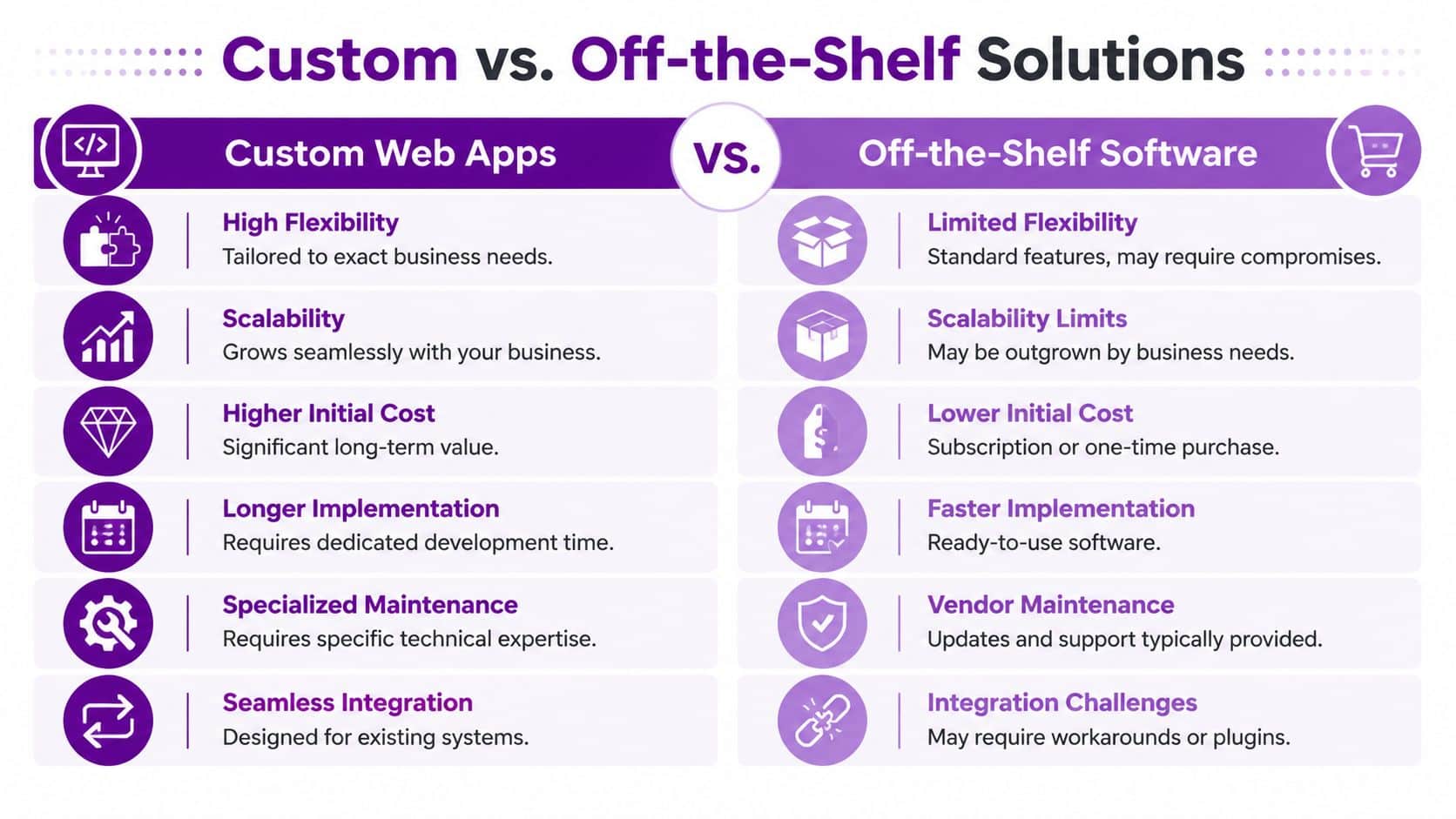
Off-the-shelf software is often the right answer when the process is standard. Accounts packages, HR systems, ticketing tools and CRM platforms already solve many common needs well enough. You get faster deployment, vendor support and a clearer support model.
The trade-off is compromise. Your business adapts to the product's structure, terminology and constraints. That's fine if the gap is small. It becomes expensive when staff build workarounds around the software because the software doesn't fit the job.
When custom earns its keep
A bespoke app makes sense when the process gives you difficulty because it is specific to your organisation, your service model or your compliance needs. That often includes customer portals, approval-heavy workflows, multi-team operational systems, and software that must join up several existing platforms without forcing users to jump between them.
Custom also tends to make sense when the primary requirement is integration and control, not a long feature list. You may need role-based access, auditability, specific dashboards, and a process that matches how teams operate on the ground.
The overlooked middle option
Many firms miss the most practical route. They think the choice is custom versus packaged software. In reality, there's a third path. Extend the Microsoft tools you already use.
According to this UK-focused view on web application development choices, the more useful buyer question is which processes are unique enough to justify full custom engineering, and which should be delivered faster through Power Apps, Power Automate or Dynamics 365 extensions. That distinction matters because low-code and SaaS extensions can reduce delivery time and maintenance burden for mid-sized UK firms.
Here's a simple decision view:
| Option | Best fit | Main upside | Main drawback |
|---|---|---|---|
| Off-the-shelf software | Standard business process | Quick to adopt | You fit the tool |
| Microsoft low-code extension | Process improvement around existing Microsoft estate | Faster delivery, strong integration | Can become awkward if pushed beyond its natural limits |
| Fully custom web app | Distinct workflow, complex rules, broader integration need | Strong fit and control | More planning and build effort |
Buy software for common processes. Build software for distinctive ones. Extend Microsoft 365 when the gap sits somewhere in the middle.
What usually works in practice
For SMEs, a hybrid approach is often the most sensible. Use established products where the market has already solved the problem well. Extend Microsoft where you need speed and good internal adoption. Reserve full bespoke development for the workflows that require it.
That’s the point many buyers miss. The goal isn’t to commission the most advanced application. It’s to put the right level of engineering against the right business problem.
Our Custom Web App Development Process
Good projects aren’t de-risked by clever technology. They’re de-risked by a disciplined process, clear decisions and steady user involvement.
Discovery first, always
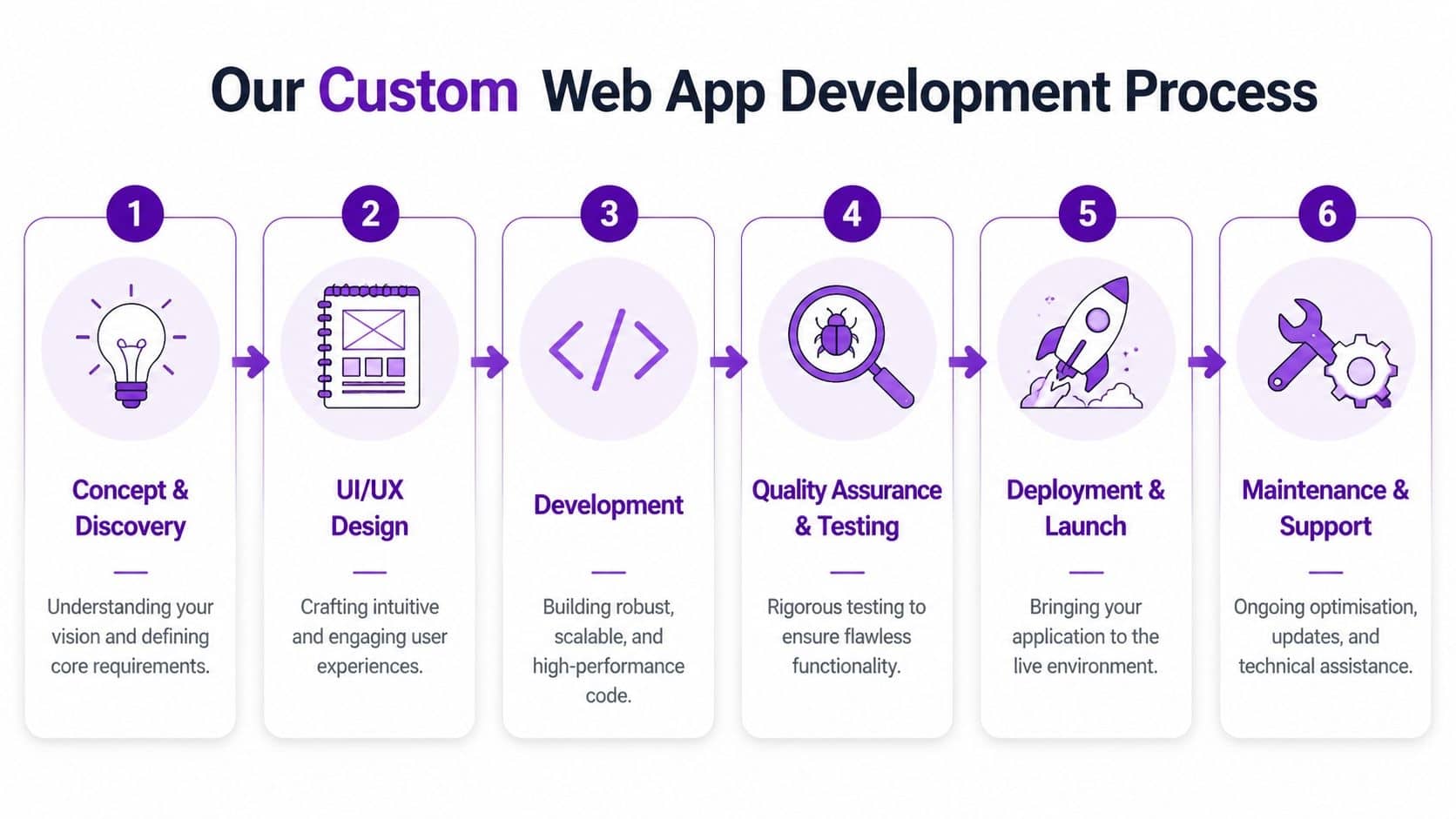
The project starts with discovery. That means understanding what the business is trying to improve, who uses the system, what data is involved, where the current pain points sit, and which rules the application must enforce.
This stage often exposes a useful truth. The first thing stakeholders ask for isn’t always their true need. A request for “a portal” may really be a need for cleaner approvals, better visibility and fewer manual updates.
Typical outputs from discovery include:
- Process mapping: What happens now, where it breaks, and what should change.
- User roles: Who needs access, what they can see, and what they can do.
- Integration scope: Which Microsoft or third-party systems need to connect.
- Prioritised requirements: What must be in the first release, and what can wait.
Design, build and test
Once the workflow is clear, the team can move into design. This covers user journeys, screen layouts, form behaviour, navigation and how information is presented. Good design isn’t decoration. It removes friction from daily use.
A short explainer can help if you want to see the wider development context before speaking to a supplier.
Development follows once the design and scope are stable enough to proceed. In practical terms, that means building the app logic, user authentication, data model, reporting, integrations and security controls. Testing should run throughout, not just at the end.
A sound test phase checks more than whether the app “works”. It should cover:
- Functional testing: Do the workflows behave properly?
- Permission testing: Can users access only what they should?
- Integration testing: Does data move correctly between systems?
- User acceptance testing: Can real staff complete real tasks without confusion?
Launch is not the finish line
Many projects fail when the software goes live, but the organisation doesn’t change with it. Staff revert to old habits. Managers don’t enforce the new process. Reporting is still done outside the system because that feels familiar.
That risk is real. As noted in this discussion of adoption barriers in custom web application development, a cheaper build can become the more expensive option if adoption is weak, because value depends on sustained workflow change rather than feature count. The same reference highlights organisational barriers such as lack of time, skills and confidence.
The strongest app in the world won’t help if the team still runs the process in email and spreadsheets.
That’s why post-launch support matters. Not just technical support, but rollout planning, training, feedback capture, and iterative improvement after real users start working with the system.
Building Future-Proof Apps with Microsoft Technology
For many UK SMEs, the most sensible technical direction is to build around Microsoft rather than beside it. That isn’t about brand loyalty. It’s about reducing friction, using the licences and platforms you already depend on, and avoiding isolated systems that create yet another support burden.
Why the Microsoft stack fits mid-sized firms
Most businesses in the East Midlands already run large parts of their day through Microsoft 365. Email sits in Outlook. Files sit in SharePoint or Teams. Identity is managed through Microsoft accounts. In many cases, reporting, CRM, device management and cloud infrastructure are already moving in the same direction.
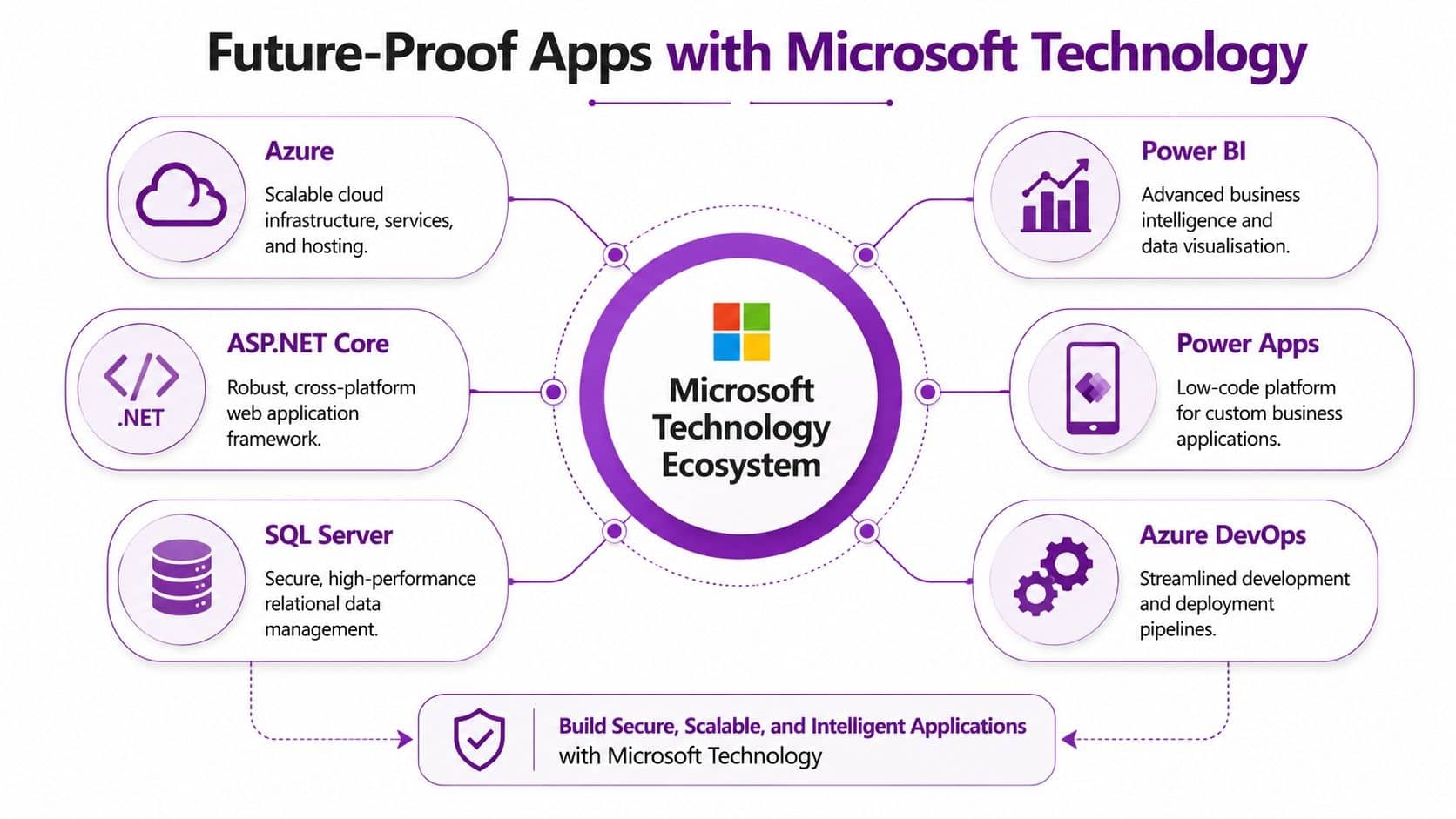
That makes Azure, .NET, SQL Server, Dynamics 365 and Power Platform a practical foundation for custom web app development services. You’re not asking staff to live in a completely separate ecosystem. You’re extending an environment they already know.
There’s also a broader UK backdrop to this. In 2022, 78% of UK businesses used at least one form of cloud computing, while 19% had adopted at least one form of AI-related technology, according to this UK business technology adoption reference. That points to a market where integrated, secure and scalable applications matter far more than standalone brochure-style systems.
What future-proofing actually means
Future-proofing isn’t about predicting every requirement for the next decade. It means making choices that leave room to adapt. In Microsoft terms, that often involves:
- Azure hosting and services: Flexible infrastructure and identity integration.
- ASP.NET Core: A mature framework for dependable business applications.
- SQL Server and data services: Structured, secure data management.
- Power BI: Reporting that gives managers a clear operational view.
- Power Automate: Automation for notifications, approvals and hand-offs.
- Power Apps: Rapid delivery where low-code is enough for the job.
A bespoke application can then act as the operational hub while Microsoft tools handle collaboration, reporting, workflow automation and integration around it. In some cases, the right answer isn’t a fully custom build at all. It’s a Power Platform solution with selected custom components. In others, the app is bespoke but integrated with Microsoft 365 and Dynamics 365.
If you’re assessing that route, Power Platform and its role in business applications is worth understanding before you commit to a heavier build than you need.
A practical Microsoft-first view
F1Group works in this Microsoft-centred space across the East Midlands, covering areas such as Azure, Microsoft 365, Dynamics 365, Power Platform and bespoke application development. That kind of partner model is useful when the app needs to fit an existing Microsoft estate rather than sit apart from it.
A key advantage is coherence. One identity model. One collaboration environment. One clearer support picture. For mid-sized organisations, that usually matters more than chasing novelty.
Understanding Timelines and Pricing for Custom Apps
The honest answer to “how long will it take?” and “how much will it cost?” is that it depends on scope, complexity and how much decision-making is done early. A simple internal workflow tool is not the same as a customer portal with multiple integrations, reporting requirements and role-based access.
What changes cost and duration
A project usually becomes slower or more expensive for a small number of predictable reasons:
- Complex workflows: More business rules mean more design, testing and edge-case handling.
- Multiple integrations: Connecting Microsoft 365, Dynamics 365, finance tools or third-party systems adds effort.
- Custom user experience: Interfaces built to specific requirements take longer than basic form-led screens.
- Security and permissions: Granular access control and audit needs increase build and test time.
- Change during delivery: New requirements introduced mid-project usually affect both timeline and budget.
The opposite is also true. Timelines improve when the process is clear, stakeholders are available, and the first release is tightly prioritised.
Custom Web App Investment Guide
The table below is illustrative. It’s a planning aid, not a fixed quotation.
| App Complexity | Example | Estimated Timeline | Estimated Cost (GBP) |
|---|---|---|---|
| Simple | Internal approval workflow, basic data capture app, light reporting | 6 to 10 weeks | £15,000 to £30,000 |
| Medium | Customer or supplier portal, multi-step workflow, Microsoft 365 integrations | 3 to 5 months | £30,000 to £75,000 |
| Complex | Line-of-business platform, multiple integrations, advanced permissions, richer reporting | 5 to 9 months | £75,000+ |
How to budget sensibly
A useful way to approach pricing is to separate the first release from the long-term roadmap. Start with the workflow that creates the most friction or risk. Get that live, adopted and delivering value. Then add improvements in planned phases.
Don't buy a wishlist. Buy the first working version of a better process.
That usually leads to a better return than trying to specify every possible feature at the start. It also gives the business a chance to learn from real use before committing to the next round of development.
How to Select the Right Development Partner
Choosing a supplier for custom web app development services is partly about technical skill, but mostly about judgement. You need a partner who can challenge poor assumptions, translate business issues into workable requirements, and support the system after launch.
What to look for
Start with evidence, not sales language. Ask how they scope projects, how they handle change, and what they do when users disagree on requirements.
Use a checklist like this:
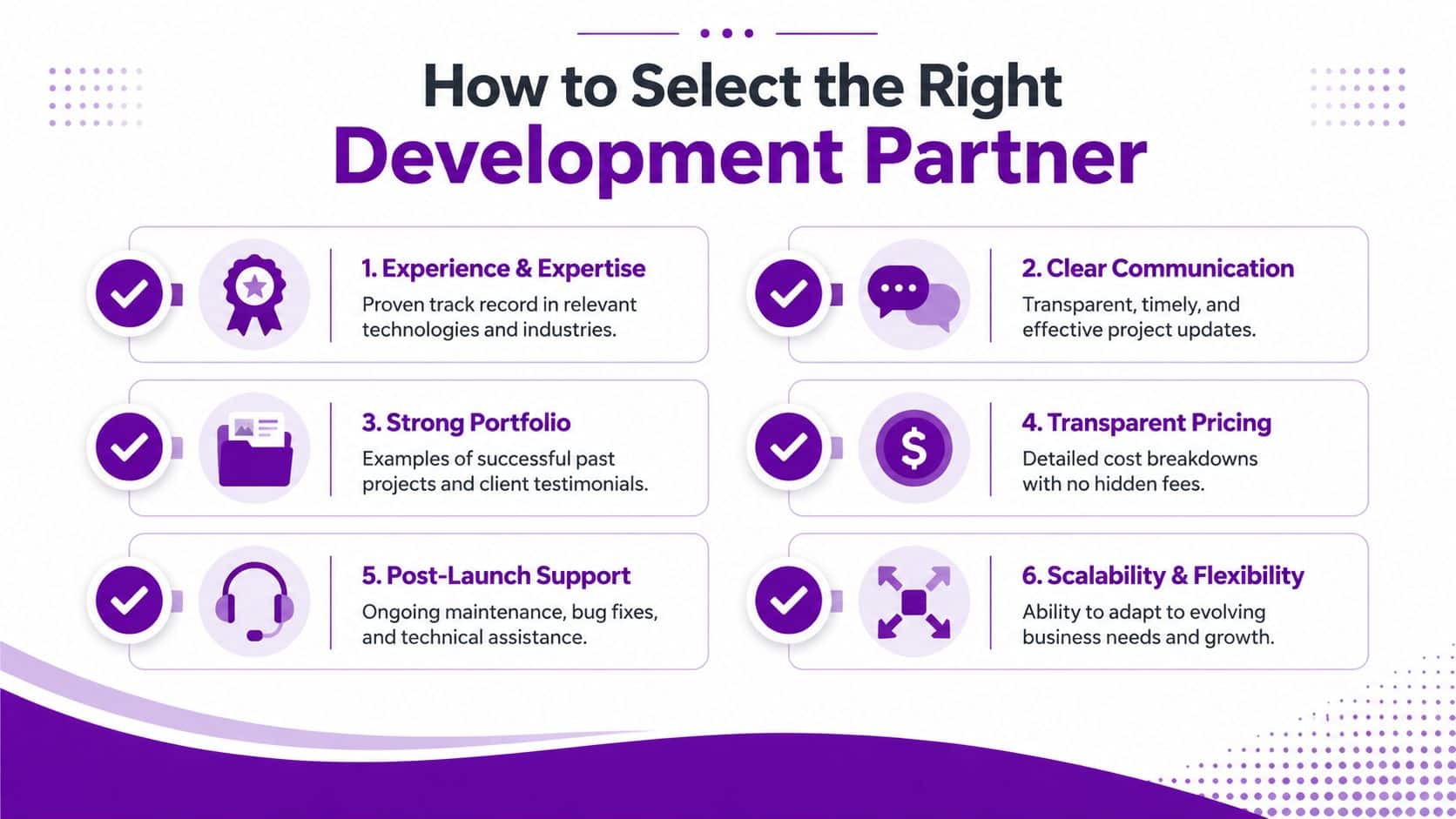
- Relevant technical experience: Can they build with the stack your business already uses, especially Microsoft technologies if that's your environment?
- Strong discovery practice: Do they spend time understanding the workflow before discussing features?
- Integration capability: Can they connect the app properly with Microsoft 365, Dynamics 365, Azure or other line-of-business systems?
- Adoption thinking: Do they talk about training, rollout and user behaviour, not just delivery?
- Support model: Who supports the app after go-live, and how are fixes and improvements managed?
- Security and trust: If the system handles sensitive information, what standards, checks and operational controls do they apply?
Questions worth asking in the first meeting
A good supplier should answer these directly:
- How do you decide whether something should be bespoke, low-code or off-the-shelf?
- What does your discovery phase produce?
- How do you manage scope changes without losing control of the project?
- How do you test permissions, integrations and real-world workflows?
- What happens in the first few months after launch?
- How do you build with reusable standards rather than reinventing everything each time?
That last point matters more than many buyers realise. In UK public-sector digital delivery, reusable components from the Government Digital Service Design System are recognised as a way to shorten custom web app build time, and this reference on custom web application services notes the value of such best practices. You may not be building a public-sector service, but the principle still applies. Mature teams reuse patterns, controls and interface conventions where appropriate instead of rebuilding from scratch for the sake of it.
For organisations buying through a formal process, it also helps to think through procurement of consultancy services early, especially if the app will become a long-term operational system rather than a short project.
Start Your Custom Web App Project Today
A custom web app should solve a business problem that your current tools can't solve cleanly. It should remove friction from work that matters, connect systems that need to share data, and give the organisation more control over how a process runs.
For most mid-sized firms, the right route isn't automatically “build bespoke”. Sometimes the answer is off-the-shelf software. Sometimes it's a Power Platform extension inside Microsoft 365. Sometimes it's a proper custom application built on Azure and integrated with the wider Microsoft estate. The important thing is making that choice deliberately, with a clear view of outcomes, adoption and long-term support.
If you're in that position now, keep the brief simple at first. Identify the process that's causing the most waste, risk or delay. Decide what must improve. Work out who needs to use the system and which tools it has to connect with. Then speak to a partner who can translate that into sensible options rather than pushing one answer for every problem.
The businesses that get the best result from custom web app development services aren't the ones with the biggest specification documents. They're the ones that know where the operational pain sits and are prepared to change the workflow, not just buy software.
If you're considering a custom app, Microsoft integration, or a more practical low-code route, speak to F1Group about your requirements. Phone 0845 855 0000 today or send us a message.