
Your finance team opens Monday morning to the same mess it had on Friday, only larger. One folder contains the VAT workings, another holds payroll adjustments, and a third spreadsheet has been emailed around three times with different formulas, half-finished reconciliations, and no clear owner. By the time someone asks whether the figures are audit-ready, the question is whether anyone still trusts them.
That's the point where finance IT systems stop being a technology topic and become a business survival issue. In the UK, finance teams now work in a world shaped by digital filing, cloud platforms, tighter controls, and rising expectations around resilience, not just speed. The organisations that handle this well treat finance systems as part of compliance, reporting, and continuity, not as a set of tools bolted together after the fact.
Why Finance IT Systems Matter More Than Ever
A finance director I've worked with described the situation perfectly. Every month-end, the team would pull figures from the accounting package, clean them in spreadsheets, chase department heads for corrections, then rework the same numbers again for management reporting. Nobody lacked effort. The problem was that the system had too many handoffs and too little control.
That pattern is exactly why finance IT systems matter now. Making Tax Digital turned digital record-keeping and software-based submission into a legal requirement for many businesses, with HMRC setting April 2019 as the start date for VAT-registered businesses above the VAT threshold and reporting that MTD for VAT would affect around 1.2 million businesses, which pushed many firms away from manual spreadsheets and paper-based filing toward integrated accounting and ERP platforms. It also helped normalise cloud finance tools, API-led integrations, and automated reporting workflows as standard parts of modern finance operations. Oracle's overview of financial management systems captures that shift clearly.
What changes in practice
The practical difference is control. A spreadsheet can calculate a result, but it can't easily prove where every figure came from, who changed it, or whether the posted entry matched the approved source. A properly designed finance platform can do all of that, while still feeding statutory reporting and management information from the same controlled data flow.
Practical rule: if the finance team is rekeying data between systems, the business has already accepted avoidable risk.
That's why finance systems now sit at the centre of audit readiness, operational resilience, and board reporting. They're no longer just back-office utilities. They're part of how the business proves it can close the books, meet obligations, and keep operating when people are absent or systems misbehave.
Core Components of Modern Finance IT Systems
Modern finance architecture works best when each layer has a clear job. One layer captures transactions, another controls sub-ledgers, another maintains the general ledger, and separate layers handle reconciliation and reporting. That separation reduces duplicated logic and manual repair work, because each control point does one thing well instead of trying to do everything badly. A finance system architecture discussion on LinkedIn reflects this layered approach.
The layers that matter
Think of the finance stack as a controlled chain, not one giant database.
- Transaction capture records invoices, payments, expenses, journals, and approvals at the point of entry.
- Sub-ledgers keep detail for areas such as receivables, payables, assets, and inventory.
- The general ledger holds the official financial record and supports statutory posting.
- Reconciliation tools compare source activity with ledger balances and expose breaks.
- Reporting layers turn the controlled data into board packs, regulatory submissions, and management dashboards.
That design matters because every layer has a distinct control function. The ledger should not become a dumping ground for every operational detail, and the reporting layer should not rely on manual copy-and-paste from half a dozen spreadsheets. That is how teams lose traceability.
Clear boundaries beat clever shortcuts. If a posting fails, someone needs to own it, fix it, and prove it was fixed.
Where Microsoft fits
For many UK firms, the most workable pattern is a modular, cloud-based stack built around Microsoft technologies. Microsoft 365 supports the document and collaboration side, Azure provides the infrastructure and integration backbone, and platforms such as Dynamics 365 Finance or Business Central supply the finance core. Power BI handles analysis, Power Automate handles approvals and workflow, and Copilot can assist with drafting, summarising, or triaging routine tasks when it's tightly governed.
For a practical entry point on selection and fit, UK small business accounting software is a useful related read because it shows how integration thinking starts long before full ERP adoption. The point isn't to add more tools. It's to make sure the ones you keep can move data cleanly and safely.
Microsoft-Focused Implementation Patterns
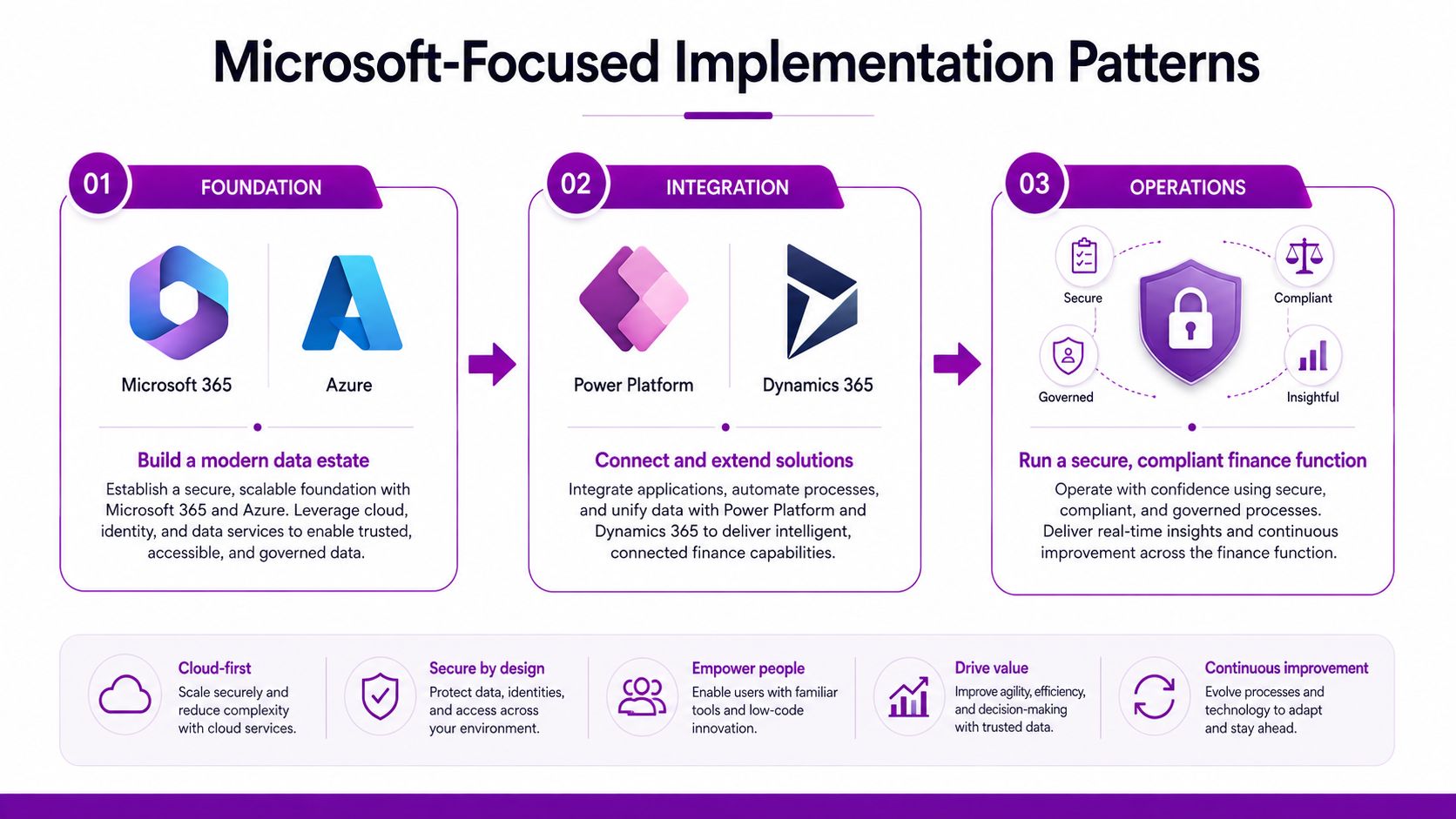
The strongest Microsoft-based finance builds are usually not the most ambitious ones. They're the ones that define what belongs in Microsoft 365, what belongs in Azure, what belongs in Dynamics 365, and what should remain outside the finance core. That discipline keeps the architecture understandable and prevents the finance team from becoming dependent on a maze of low-code workarounds.
The design pattern that works most often is API-first integration with canonical data models for accounts, payments, statements, and journals. In plain English, that means every connected system speaks the same financial language before data enters the ledger. KPMG's future-state finance data and IT architecture guidance is useful here because it puts system-of-record boundaries, observability, and exception management at the centre of the design.
What good looks like
In a well-run Microsoft stack, Dynamics 365 Finance or Business Central sits at the transactional core. Azure handles integration, identity, resilience, and hosting decisions. Power Automate routes approvals, reminders, and exception workflows. Power BI surfaces month-end performance, balance movements, and operational bottlenecks without forcing the team into spreadsheet sprawl.
The key is not the product list. It's the control model behind it.
- Foundation: establish the data estate, identity model, and security boundaries.
- Integration: connect source systems through APIs, not brittle file dumps.
- Operations: monitor failed postings, assign ownership, and resolve exceptions inside service levels.
If those three layers are blurred together, finance users end up doing IT work. If they're separated properly, the system can scale without becoming fragile.
AI belongs inside controls, not outside them
The current temptation is to bolt AI onto finance workflows and call it innovation. That's not enough. Recent UK evidence shows around 75% of firms were already using AI or planned to use it, according to the Bank of England's 2024 decision-maker panel, while the FCA has been examining AI adoption across regulated firms and the Information Commissioner has warned that organisations need to think carefully about data protection, lawful basis, transparency, and retention when using generative AI in business processes. The safe pattern is governed assistance around month-end close, invoice coding, variance analysis, and customer service, with human approval points and records management built in. Electran's discussion of underserved UK finance AI adoption captures the policy gap well.
For teams planning the broader platform shape, the internal guide on ERP in SMEs is a sensible companion because it helps connect the finance core with wider operational systems.
Regulatory Compliance and Operational Resilience
The biggest mistake I see in finance IT planning is assuming the hard part is selection. It isn't. The hard part is proving that the chosen system is secure, resilient, and governable once it's live. That is where a lot of digital transformation projects fall short, because they optimise for delivery pace and leave control design until later.
The UK regulatory context makes that gap impossible to ignore. The FCA and PRA set a deadline of 31 March 2025 for firms to remain within impact tolerances for important business services, which means mid-sized organisations need to evidence outage mapping, dependency testing, and recoverability, not just feature delivery. At the same time, the UK government's Cyber Security Breaches Survey found that 50% of businesses experienced a cyber breach or attack in the previous 12 months, so the risk profile is not theoretical. The UK Treasury's cloud report also makes the point that cloud adoption doesn't remove a firm's obligations for governance, security, resilience, and outsourcing.
What regulators and auditors will care about
A finance system that looks elegant in a demo can still fail badly in production if it can't prove the basics.
- Audit trails must show who changed what, when, and why.
- Segregation of duties must prevent one user from creating, approving, and posting the same item.
- Backup validation must be tested, not assumed.
- Tabletop recovery exercises must be run so the team knows what happens when a critical process fails.
The real resilience question is not whether the vendor has disaster recovery. It's whether your finance team can continue inside your own tolerances when a dependency fails.
That distinction matters because many organisations discover, too late, that they can't answer a simple question: how much downtime and manual fallback can the business tolerate? A compliance-first approach, such as the one discussed in build a compliance-first startup, is useful not because it is only for startups, but because it forces teams to design governance from the beginning rather than add it as a patch.
The internal note on IT support for financial services is also relevant for firms that need external support thinking about operational resilience, especially where finance platforms sit inside a wider regulated environment.
Migration Strategies and Integration Best Practices
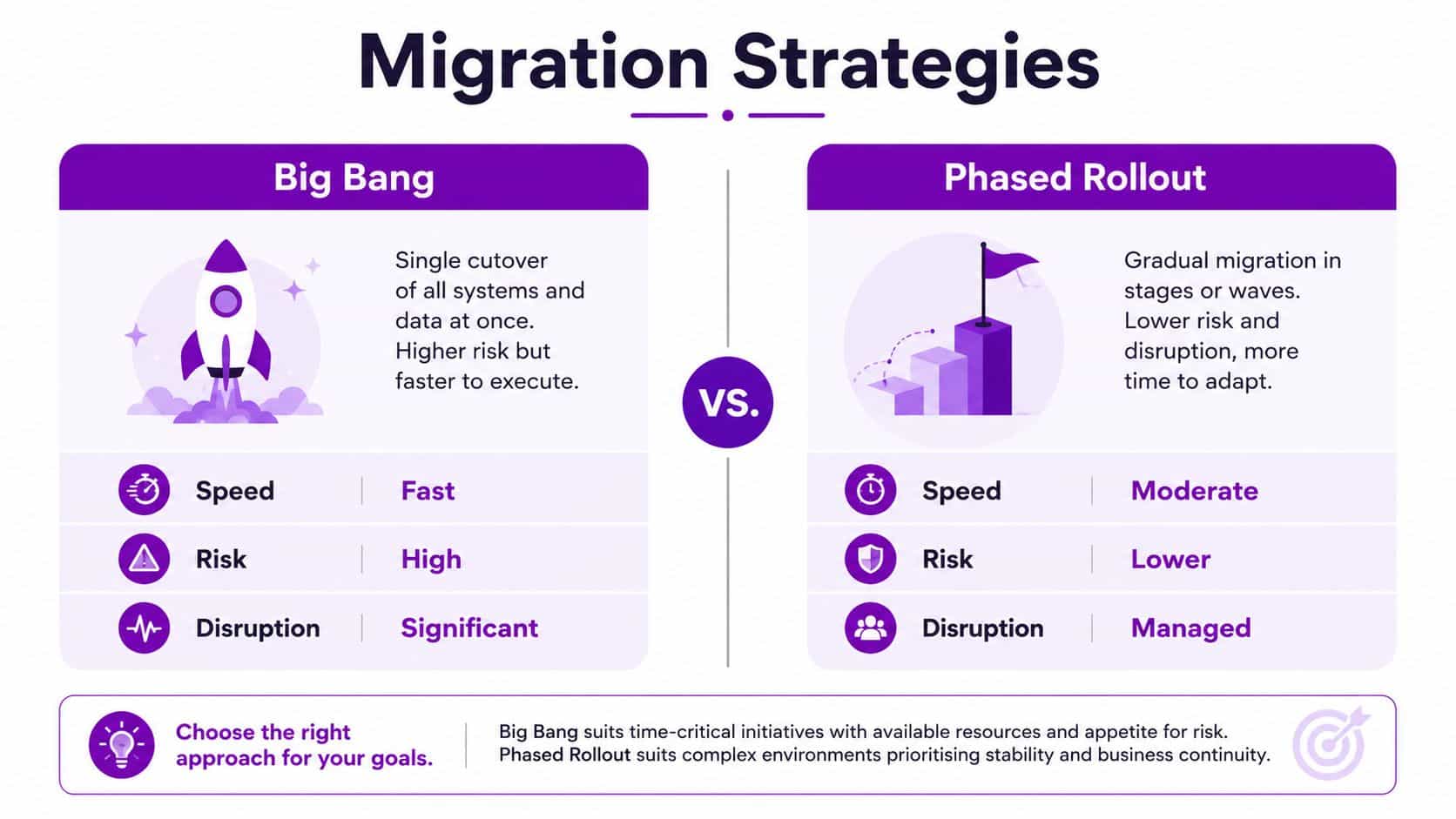
The cleanest migration is rarely the fastest one. A big bang cutover can look attractive when leaders want quick change, but it compresses risk into one moment, and finance usually pays the price if master data, integrations, or sign-off paths are not ready. A phased rollout is slower, but it gives the team a way to learn, correct, and stabilise before the next stage.
Choosing the route
The right choice depends on risk tolerance, process complexity, and how many upstream and downstream systems touch finance. If payroll, procurement, customer billing, and reporting are tightly connected, a phased path is usually safer because it lets you decouple one dependency at a time. If the current platform is severely constrained, the project still needs a sequencing plan, not just a date.
A strong migration plan also defines system-of-record boundaries early. That means deciding where customer data lives, where payment status is mastered, and which system owns the final journal. Once that's clear, API-led integrations can use a canonical model instead of creating a different mapping for every interface. F1Group's note on integrating software systems is a practical reminder that the integration layer deserves the same attention as the core application.
What tends to go wrong
The common failure modes are predictable.
- Too many direct point-to-point links create brittle maintenance.
- Missing exception handling leaves failed postings hidden until month-end.
- Weak data ownership causes finance, operations, and IT to pass problems around.
- Unclear change control leads to manual workarounds that never get retired.
For a grounded implementation reference, Stewart Accounting Services' integrating accounting software guide is worth reading because it reinforces a truth many projects miss, integration is a business control, not just a technical connector.
Integration succeeds when every failed transaction has an owner, a queue, and a deadline.
Cost Considerations and ROI Evidence
Finance IT business cases often fail because they chase licence savings and ignore operating cost. The comparison is broader. You need to weigh implementation, integration, training, support, governance, and the cost of keeping legacy workarounds alive. That's where cloud often becomes more compelling, especially when the finance estate has grown through patchwork additions over several years.
A recent market estimate projects the UK public cloud market at $39.4 billion in 2025 (CoinLaw's cloud computing in financial services statistics), which shows how normal cloud adoption has become in the UK environment. The same source notes that organisations using cloud-based finance software can report 10% to 25% lower total cost of ownership, while 56% of finance organisations plan to increase automation use and 85% say data quality is a major reporting challenge. Those figures point to a simple conclusion, cloud and automation only pay back when they reduce manual correction and improve the quality of the numbers that management uses.
Finance IT System Cost Comparison
| Cost Factor | Cloud-Based Systems | On-Premises Systems |
|---|---|---|
| Infrastructure | Lower internal hardware burden, vendor-managed scaling | Higher hardware and environment maintenance |
| Upgrades | More routine and standardised | More disruptive and often resource-heavy |
| Support effort | Shared with provider and integration partner | Heavier internal support burden |
| Reporting quality | Better when integrated and automated | Often constrained by legacy data silos |
| Expansion | Modular and easier to extend | Slower and costlier to extend |
The ROI case gets stronger when you focus on business outcomes, not just IT metrics. Faster close cycles matter because they reduce the time between performance and decision. Better reporting accuracy matters because directors stop arguing over which spreadsheet is right. Improved compliance posture matters because the finance team can show evidence, not just intent.
The most credible business case I've seen ties investment to three practical gains. First, reduced manual effort in reconciliations and journal clean-up. Second, improved traceability for audit and regulatory review. Third, a finance function that can absorb change without constant firefighting.
Action Checklist for East Midlands SMBs
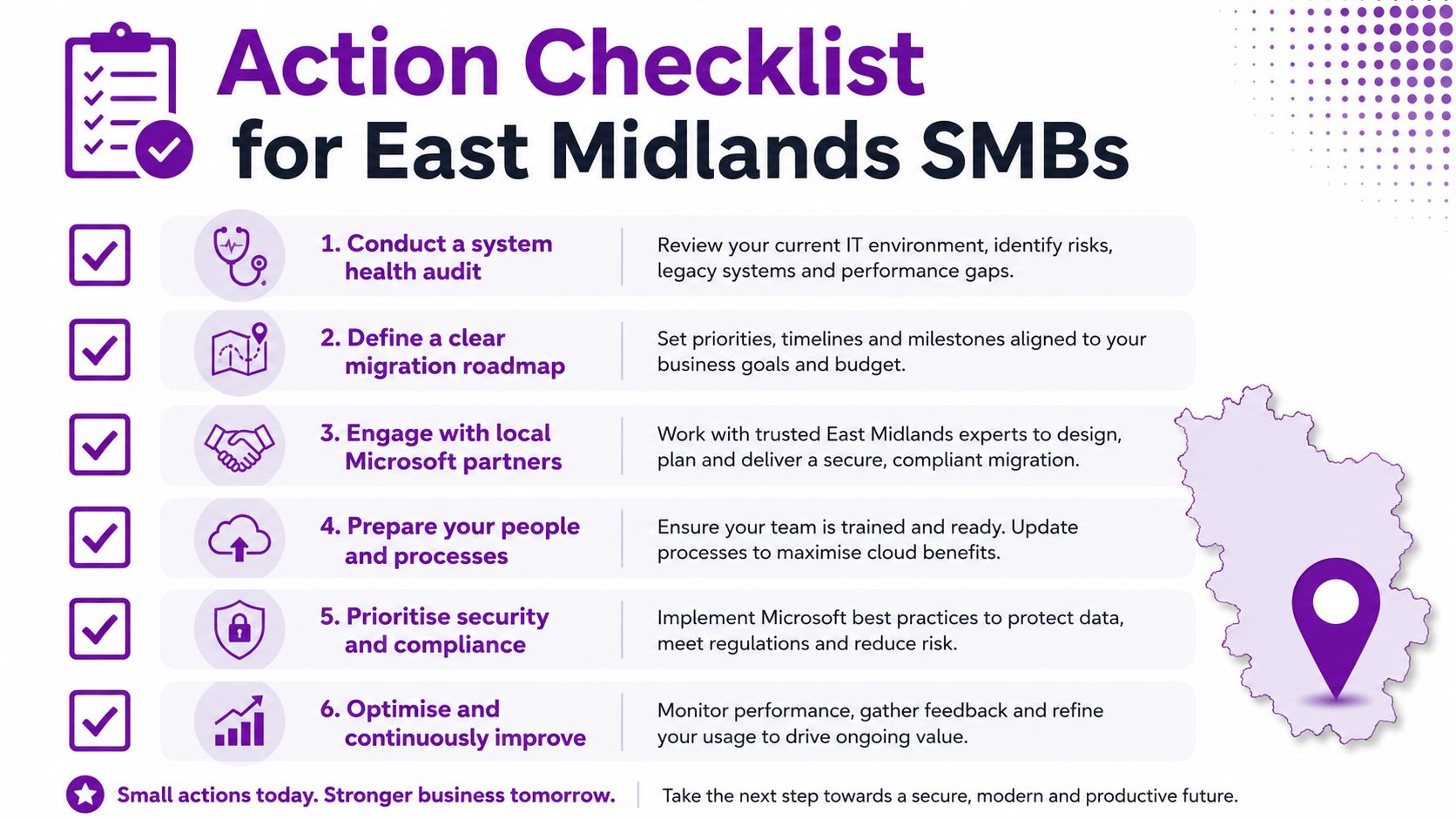
If you're running finance in an East Midlands business, start with a hard look at how your current systems behave under pressure. If month-end depends on one person's spreadsheet, one shared mailbox, or one heroic reconciliation, you already have a resilience issue.
Quick assessment steps
- Check compliance readiness: Confirm that digital filing, retention, and approval trails are working end to end.
- Map integration gaps: List every manual export, import, and rekeyed process between finance and other systems.
- Review automation candidates: Identify repetitive tasks in approvals, coding, and reconciliations.
- Test recovery assumptions: Ask what happens if the finance platform, internet connection, or main integration fails.
- Define ownership: Give every critical exception a named team and a response target.
- Choose the right partner: Prioritise practical experience with Microsoft-based finance platforms, integrations, and support.
Success here is simple to measure. If the team can explain how a transaction moves from source to ledger, where it can fail, and who fixes it, the system is moving in the right direction. If they can't, the organisation still depends too much on manual memory.
If your finance operation is still tied together by spreadsheets, patchy integrations, and undocumented workarounds, F1Group can help you turn that into a controlled, audit-ready platform. We support UK businesses with Microsoft-focused finance systems, operational resilience, and practical integration work that holds up in the real world. Visit F1Group to talk through your current setup and the next step.