
A growing East Midlands business rarely decides it needs managed security services during a calm board meeting. More often, the trigger is a late-night alert, a suspicious Microsoft 365 sign-in, or a ransomware scare that leaves an already stretched IT team checking endpoints instead of supporting customers. The managing director eventually asks the practical question: should security remain an occasional project, or become an always-on operating function?
That decision matters because security tools don't protect a business by themselves. Someone must review telemetry, investigate unusual behaviour, contain genuine threats, maintain controls, and explain the risk in terms leadership can act on. This guide sets out what managed security services are, how they connect with Microsoft 365 and Azure, what delivery models exist, and how a UK organisation should assess the commercial and operational trade-offs.
A Practical Definition of Managed Security Services
A UK mid-sized organisation can own Microsoft 365, Azure, endpoint protection and a firewall, yet still lack dependable security coverage. An alert arrives after office hours, and the IT manager must decide whether it signals account compromise, a false positive or ordinary user behaviour. That uncertainty exposes the underlying gap: owning tools is different from operating security.
Managed security services are the ongoing outsourcing of security monitoring, detection, response and advisory responsibilities to a third-party provider under agreed service levels. The provider runs defined processes, uses the customer's security telemetry, supplies human investigation and reports on agreed outcomes. The customer keeps business ownership and decision authority, while avoiding the need to build every capability internally.
For organisations centred on Microsoft 365 and Azure, this operating model should connect identity, email, endpoint and cloud signals into a routine service. The provider watches the available telemetry, investigates meaningful deviations, confirms whether an event requires action and escalates according to agreed rules. The value lies in accountable operation, not in adding another dashboard.
The UK government describes managed security services as third-party support for security protocols, monitoring, management and threat detection, generally delivered for a monthly or annual fee. The UK Cyber Security Sectoral Analysis places managed service providers and managed security service providers within an established cyber security services economy.
MSS differs from several familiar alternatives:
- Ad-hoc consultancy: A consultant assesses a problem, recommends changes or supports a project. Monitoring may stop when the engagement ends.
- Break-fix support: An engineer responds after something fails. Managed security establishes ongoing monitoring and an agreed response before a security event becomes an outage or breach.
- Standalone products: A SIEM, endpoint agent or email filter supplies capability and alerts. It does not assign investigation, escalation or business decisions.
- Tool administration: A provider may maintain a platform without owning response playbooks, incident communications or the wider security outcome.
Practical rule: Buy a defined operating service, not a collection of dashboards.
For a UK mid-sized organisation, the decision should be tied to risk reduction, operational continuity and access to expertise that would be difficult to hire and retain internally. A recurring service creates clear responsibilities and predictable expectations. Before signing, specify what is protected, which Microsoft 365 and Azure signals are included, who investigates, how incidents are escalated and which actions require customer approval.
Good security hygiene remains part of the customer's responsibility. For practical guidance on access control, updates and backups, these cyber security tips from UpTime Web Hosting provide useful background. Managed security turns those fundamentals and the surrounding telemetry into an active, measured operating function.
Core Components of a Modern Managed Security Stack
A credible managed security stack combines technology, process and human judgement. It shouldn't just collect alerts and forward them to an already busy IT manager. The provider must show what it monitors, how it reduces noise, which analysts investigate events and what happens when a threat is confirmed.
The core usually starts with a SIEM or XDR platform. Microsoft Sentinel, for example, can aggregate identity, endpoint, email and cloud signals. A third-party SIEM can perform a similar analytic role. The important point isn't the logo. It's whether the provider correlates events, applies relevant threat intelligence and produces a decision rather than an undifferentiated stream of notifications.
Endpoint detection and response should cover managed laptops, servers and other supported devices. Email and identity protection belong in the same operating picture, particularly for Microsoft 365 estates. Vulnerability management adds regular assessment, prioritised remediation and ownership of exceptions. Firewall, network and cloud workload monitoring help identify activity that endpoint tools may miss.
A mature service also considers the controls around detection:
- Backup assurance: Confirm that backup jobs, retention and recovery processes are monitored and tested rather than merely purchased.
- Incident response: Agree escalation paths, authority to isolate devices or disable accounts, evidence handling and communications responsibilities.
- Governance: Include policy reviews, phishing simulations, security awareness training and board-level reporting where those activities address a real gap.
- Threat intelligence: Use external intelligence to add context, then tune it for the organisation's sector, suppliers, geography and technology estate.
Standard and premium capability
Providers often describe similar services with very different depths. The table below is a useful starting point for separating baseline cover from a more active service.
| Capability | Standard Tier | Premium Tier |
|---|---|---|
| Security monitoring | Business-hours or defined continuous alert review | Continuous SOC monitoring with human investigation and out-of-hours escalation |
| SIEM or XDR | Platform administration and alert forwarding | Correlation engineering, detection development and regular tuning |
| Endpoint protection | Agent deployment and alert handling | Active containment, threat hunting and remediation support |
| Identity and email | Microsoft 365 alert monitoring | Risk-based investigation, account containment and attack-path analysis |
| Vulnerability management | Periodic scanning and prioritised recommendations | Continuous prioritisation, remediation coordination and exception governance |
| Incident response | Escalation advice and agreed support | Defined playbooks, active containment and incident leadership |
| Reporting | Technical alert and ticket summaries | Board-ready risk reporting, trends and service improvement actions |
| Awareness and governance | Basic policy or training support | Role-based exercises, phishing simulation and structured governance reviews |
The UK government's MSP research found that 22% of active UK MSPs performed cyber-security-related activities and 55% performed cloud-related activities. The published MSP research supports a practical buying conclusion: MSS is increasingly an overlay on cloud-managed environments, not a standalone perimeter appliance.
Ask providers to demonstrate a real alert from ingestion through investigation, decision and closure. If they can't explain that journey, their service may be platform management dressed up as managed security.
MSSP Versus MDR and Co-Managed Delivery Models
The label matters less than the decision rights behind it. Three models appear regularly in UK buying conversations, and each solves a different capacity problem.
A Managed Security Service Provider, or MSSP, usually offers broad outsourced security management. It may run monitoring, administer security tools, manage vulnerabilities and prepare compliance reports. The customer often retains responsibility for deciding whether an incident warrants containment, business interruption or external notification.
Managed Detection and Response, or MDR, is more outcome-focused. The provider's SOC investigates suspicious activity, validates threats and may contain or remediate them under agreed playbooks. This model suits organisations that want a stronger response capability rather than another source of alerts. F1Group's managed detection and response service is an example of this type of Microsoft 365 and Azure-focused service.
Co-managed security sits between internal ownership and external capacity. An organisation keeps its IT or security team, while a specialist provider supplies additional monitoring, senior analyst access, threat investigation and shared operational cover. It can work particularly well for firms with roughly 50 to 250 staff, although the deciding factor is internal maturity, not headcount.
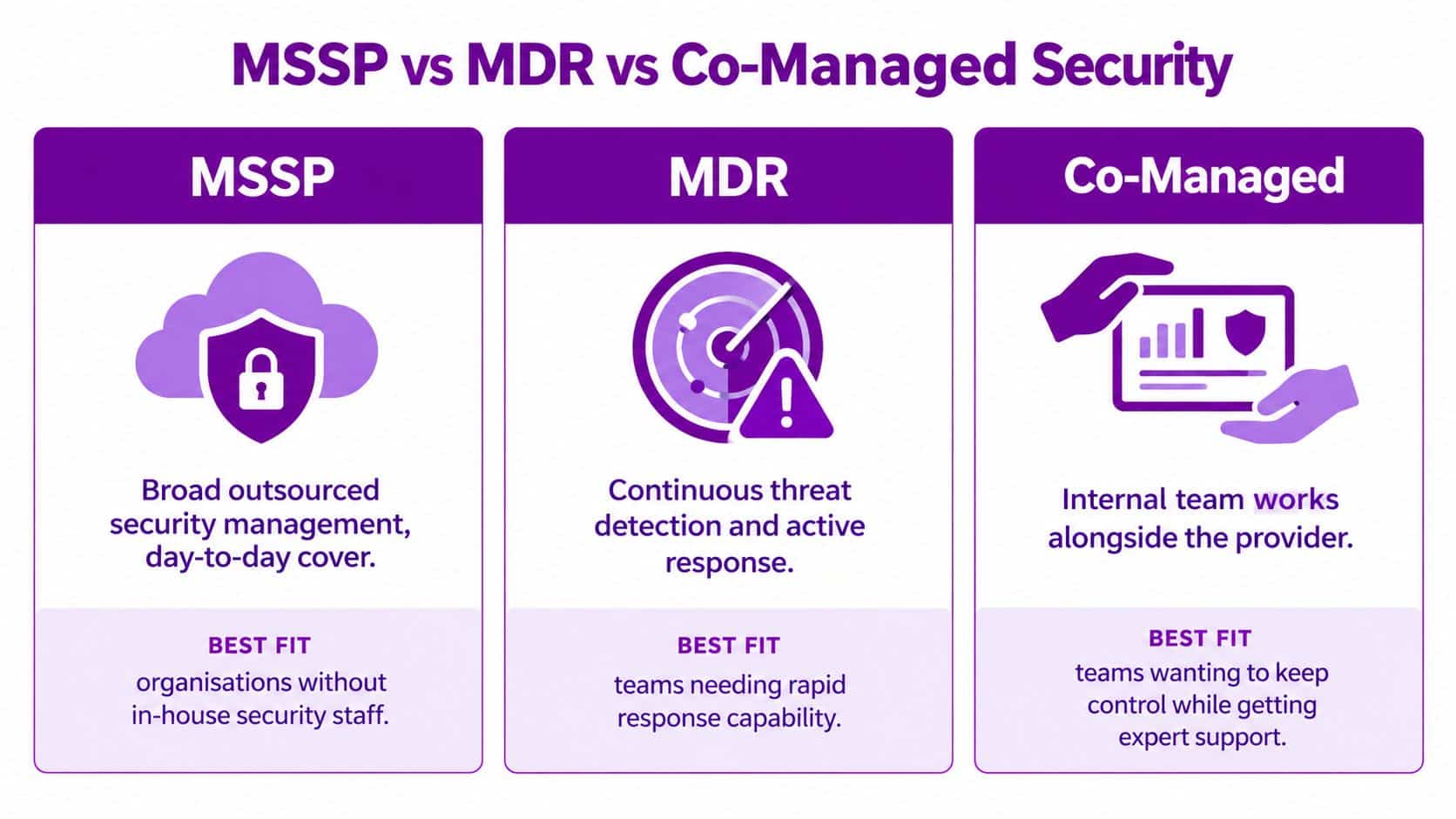
| Model | Cost position | Decision rights | Internal effort | Best fit |
|---|---|---|---|---|
| MSSP | Usually the broadest outsourced scope at a controlled recurring cost | Customer often approves major response actions | Low to moderate | Organisations without dedicated security staff |
| MDR | Higher-value response capability and specialist investigation | Provider acts within agreed containment playbooks | Low, but leadership must remain available | Teams needing rapid response capability |
| Co-managed | Shared cost and shared workload | Internal and provider teams divide ownership | Moderate to high | IT teams wanting control plus specialist support |
A pure MSSP can feel passive if the provider only reports alerts. Full MDR may be unnecessary for a very small firm if the contract includes capabilities the business can't use. Co-managed delivery fails when internal documentation is poor, ticket ownership is unclear or nobody can approve urgent action.
Use the model that matches your operating reality. If your IT lead is already effective but can't provide round-the-clock investigation, co-managed support is often sensible. If there is no internal security capability, choose a service with explicit response ownership rather than buying a monitoring-only package.
How Managed Security Integrates With Microsoft 365 and Azure
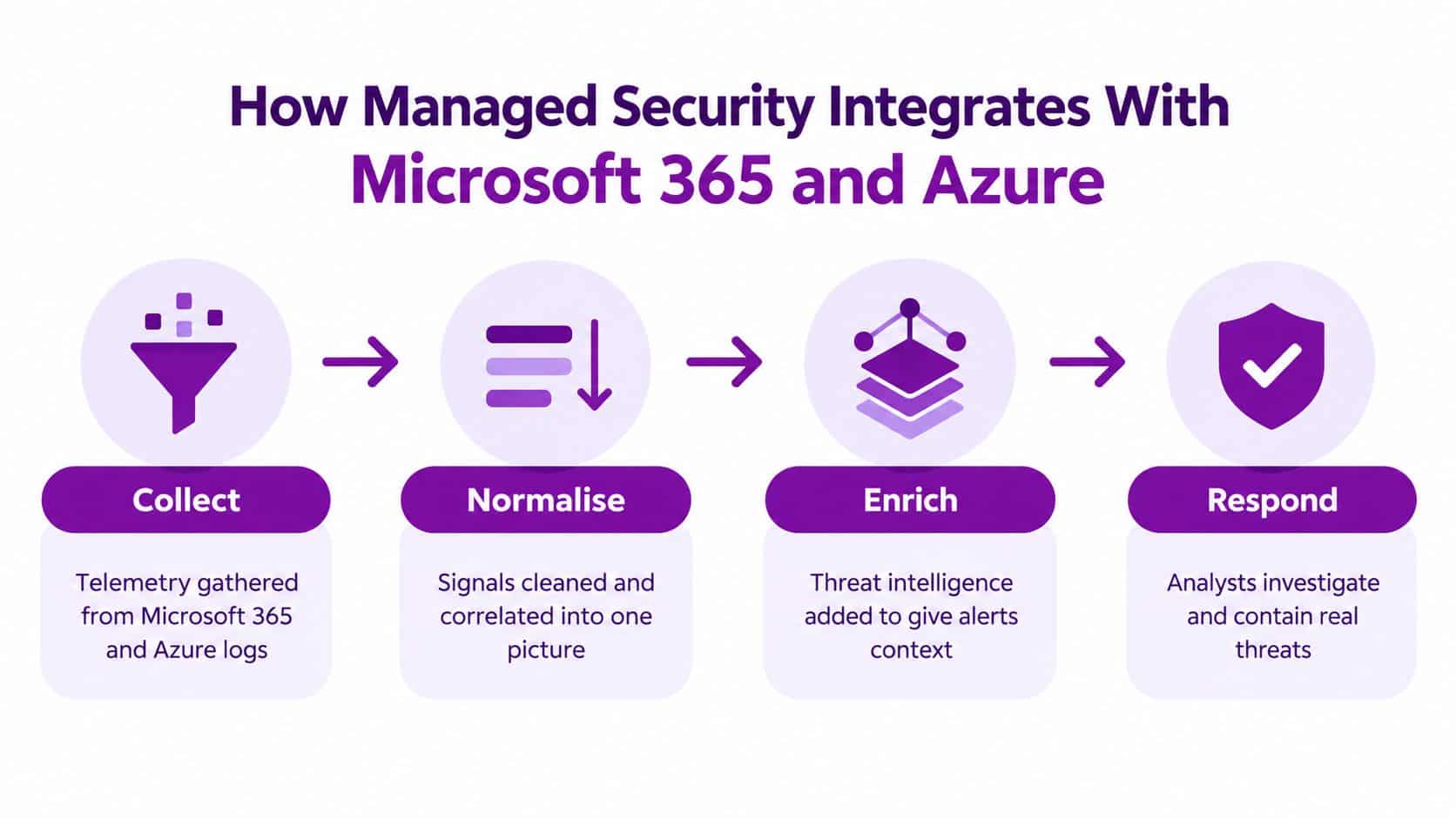
Managed security shouldn't merely “watch” Microsoft 365 and Azure. It should collect, normalise, enrich and respond to telemetry from the services that control identity, devices, data and cloud workloads.
Start with identity
Entra ID sign-in logs, audit records and risk signals help a SOC assess unusual access. The provider can correlate a sign-in from an unfamiliar location with impossible travel indicators, a new device, a privileged role change or repeated authentication failures. The service then applies the agreed policy, which might involve step-up authentication, account disablement or escalation to the customer.
Identity integration only works when scope is clear. Decide which tenants, privileged accounts, service principals and administrative actions are included. Confirm who owns conditional access policies and who can change them during an incident.
Add endpoint and user activity
Defender for Endpoint can provide signals from Windows, macOS and mobile devices where the relevant deployment and licensing are in place. Defender for Office 365 contributes email and collaboration indicators, while Purview DLP and SharePoint activity can add context around sensitive data access and sharing.
The SOC sends these feeds to Microsoft Sentinel or another SIEM, then normalises fields so an analyst can view related activity together. A suspicious email, a new inbox rule, a risky sign-in and an endpoint process should form one investigation where the evidence supports that conclusion.
Protect cloud workloads and plan response
Defender for Cloud and Sentinel connectors can extend monitoring into Azure workloads. Logic Apps or comparable automation can support actions such as isolating an endpoint, disabling an account or creating a high-priority ticket, but automation should follow approved playbooks. Uncontrolled automation can disrupt legitimate work.
Microsoft 365 support from F1Group is relevant where the provider must understand both the platform configuration and the security operating model.
Before onboarding, check licensing prerequisites, API limits, connector coverage, data residency and retention. Agree which logs are essential, which are optional and which costs belong to the customer. A provider that promises “full Microsoft monitoring” without documenting those boundaries is selling an aspiration, not a service.
Business Benefits and ROI for UK Small and Mid-Sized Firms
Managed security earns its place when it turns an open-ended internal burden into a defined operating service. A UK mid-sized organisation may not need its own full security operations centre, but it does need dependable monitoring, investigation and response across Microsoft 365, Azure and endpoint telemetry.
The business case rests on five practical gains:
- Predictable expenditure: A recurring service budget is easier to plan than emergency response, unplanned consultancy and repeated tool purchases.
- Wider coverage: The provider monitors and escalates outside the internal team's normal working pattern.
- Specialist access: Analysts, incident responders and cloud security specialists are available without permanently employing every role.
- Operational resilience: Approved playbooks reduce confusion when a suspicious account, endpoint or email campaign needs action.
- Better governance: Leaders receive prioritised risk information instead of a long list of technical alerts.
The market is established rather than experimental. The UK government estimated that by December 2025, 2,603 firms were active in cyber security, while service providers including MSPs and MSSPs generated about £8.383 billion in revenue and supported 42,425 FTE jobs in service and MSSP activities. The government's 2026 sectoral analysis places managed security within a substantial services market.
A realistic year-one view
Do not judge ROI by blocked alerts alone. Assess whether the organisation can identify important activity, make decisions quickly, demonstrate that controls operate and recover with less disruption.
| Outcome | In-House Baseline | With Managed Security |
|---|---|---|
| Monitoring | Staff check alerts when capacity allows | Defined coverage with agreed escalation |
| Investigation | IT researches incidents alongside other work | Analysts investigate and document the decision |
| Response | Actions depend on who is available | Playbooks define containment authority and approvals |
| Reporting | Technical updates vary by incident | Regular reports connect findings to business risk |
| Skills | Knowledge rests with a small number of employees | Specialist capability is available through the service |
| Continuity | Holidays, sickness and projects reduce coverage | The operating process continues beyond one person |
The buying decision should start with the estate and the response burden, not a product catalogue. A provider that monitors Microsoft 365 sign-ins, Defender alerts, Azure activity and endpoint events can reduce the time internal staff spend correlating evidence. That value depends on useful telemetry, clear ownership and service levels that match the organisation's risk.
A business leader should ask whether the service reduces exposure, shortens uncertainty and gives the organisation a controlled response when prevention fails. No responsible provider can promise to prevent every incident. Managed security is worthwhile when it supplies repeatable decisions, accountable escalation and continuity that a small internal team cannot maintain alone.
Implementation Journey From Scoping to Steady-State Operations
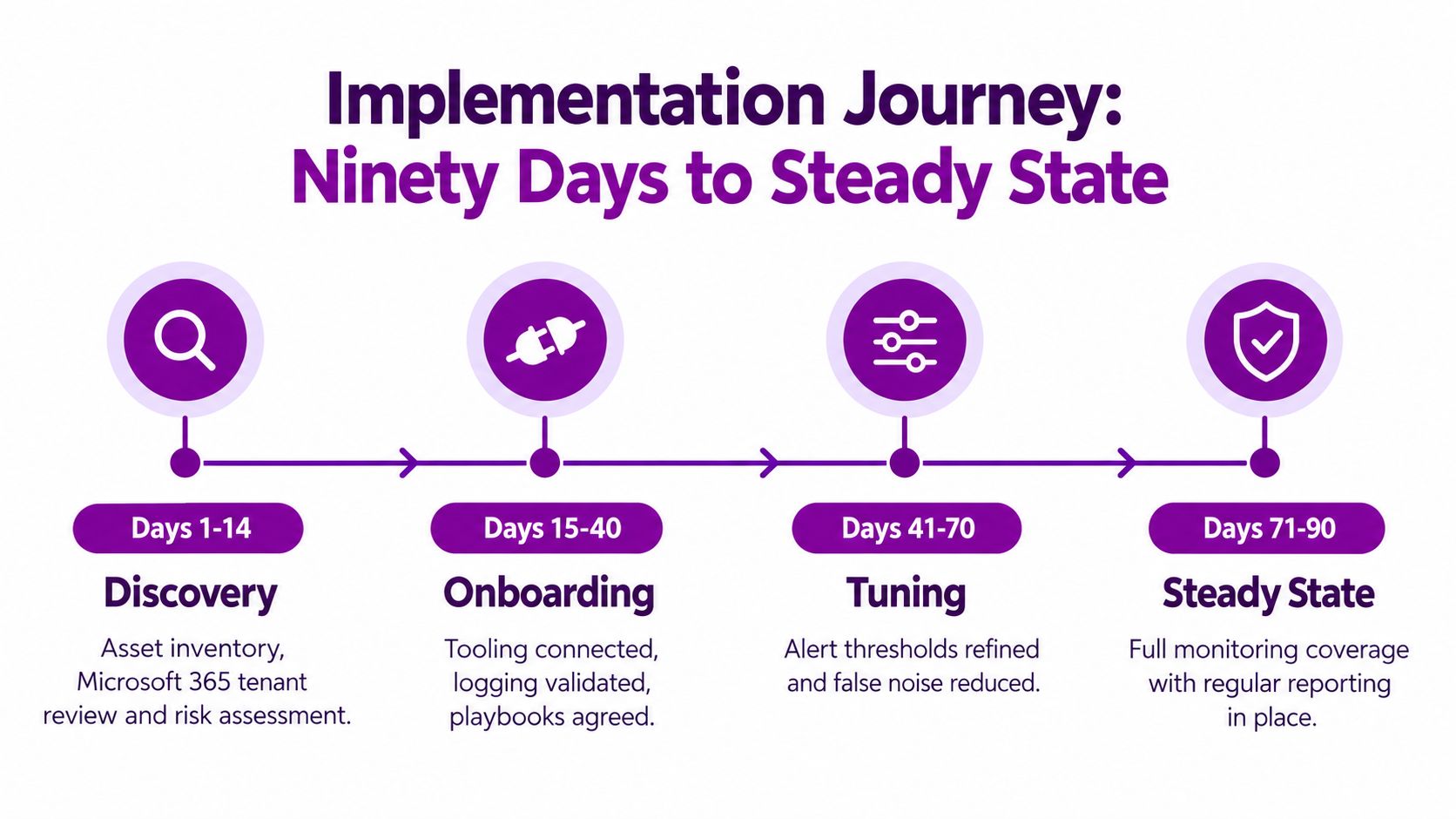
A sensible implementation takes place in stages. The exact timetable depends on the estate, but buyers should expect disciplined discovery, technical onboarding, tuning and formal handover rather than an instant switch to “24/7 protection”.
Discovery and design
Start with the protected estate. Record users, devices, servers, applications, Microsoft 365 workloads, Azure subscriptions, remote access paths, critical suppliers and sensitive data flows. Review the tenant configuration, current alerts, existing contracts and known incidents.
Then agree what the provider will monitor and what it won't. Define service levels, escalation routes, response authority, severity categories, reporting cadence and the people who can approve disruptive action. A written runbook is more valuable than a broad promise of “proactive security”.
Technical onboarding
Deploy required sensors and connectors, validate log ingestion into Sentinel or the chosen SIEM, integrate ticketing and test notifications. Check that endpoint coverage reflects all assets, including devices that rarely connect to the corporate network.
Common friction appears here. Legacy VPNs may produce incomplete telemetry. Unmanaged devices may fall outside the service. Gaps in multifactor authentication can create risk that monitoring alone won't fix. Resolve these issues openly instead of hiding them inside an onboarding report.
Tuning and operational handover
The early live period should focus on false-positive reduction, detection quality and joint incident exercises. Analysts need to learn normal business behaviour, while the customer needs to see how the provider handles a realistic escalation.
Good procurement of consultancy services depends on defining deliverables and accountability before work begins. Apply the same discipline to managed security. At steady state, hold regular service reviews, track unresolved risks and revisit the protected estate whenever the organisation changes.
Evaluation Criteria, Local Providers and GBP Pricing
Evaluate a managed security provider by demanding evidence, not by comparing logos on a product sheet. Start with the provider's assurance position. Ask whether it holds Cyber Essentials Plus or IASME certification, operates an ISO/IEC 27001-aligned management system, has SOC 2 Type II or equivalent assurance, and runs a genuine UK-based security operations centre with continuous cover. Verify the scope of each accreditation. A certificate that excludes the service you're buying has limited value.
The contract deserves equal attention. Specify telemetry residency, retention, subcontractors, incident-notification timing, service exclusions, liability caps and the customer's right to receive playbooks, tuning files and relevant configuration at exit. The National Cyber Security Centre guidance on choosing an MSP specifically advises buyers to confirm how and when security incidents will be notified. Make that timing contractual.
Questions to score before signing
- Coverage: Which identities, endpoints, cloud workloads, networks and applications are monitored?
- Investigation: Who examines alerts, and what evidence do they provide?
- Response: Can the provider isolate devices or disable accounts, and whose approval is required?
- People: Will you have a named account team, senior analyst access and UK-based escalation?
- Reporting: Does the report explain business risk, unresolved actions and service improvement?
- Exit: Will the provider release playbooks, detection rules, tuning files and relevant data?
- Commercials: Are onboarding, licensing, data ingestion, incident response and out-of-hours actions priced separately?
Regional proximity can also matter. An East Midlands provider such as F1Group may be relevant where a customer wants remote monitoring combined with engineers who can work alongside teams in Nottingham and Leicester, or provide on-site support when a situation demands it. Local knowledge can help organisations dealing with authority, NHS supplier or other customer assurance expectations, but verify the specific experience and service scope during procurement.
UK pricing bands
Pricing is commonly structured as a fixed monthly subscription rather than a day rate. One UK pricing guide places entry-level managed SOC services at about £900 per month for 50 to 100 users, standard cover at £3,000 to £4,000 per month, and enterprise cover at £8,000 to £12,000 or more per month. The UK SOC pricing guide provides those bands.
| Delivery Model | Indicative GBP Range | Typical Inclusions |
|---|---|---|
| Entry managed SOC | About £900 per month for 50 to 100 users | Core monitoring, alert review and defined escalation |
| Standard managed security | £3,000 to £4,000 per month | Broader telemetry, investigation, reporting and response support |
| Enterprise managed security | £8,000 to £12,000 or more per month | Deeper coverage, advanced response, wider estate and stronger governance |
Treat these as market reference points, not a quote. Clarify whether pricing is per user, device, tenant, data volume or protected workload, and request onboarding charges separately. A UK market estimate valued the country's managed security services market at USD 2,629.9 million in 2025 and projects USD 4,015.3 million by 2030, with a compound annual growth rate of 8.8%. The UK market estimate indicates sustained demand, but your decision should still rest on scope and response quality.
F1Group provides managed security, managed SOC and managed detection and response services for Microsoft 365 and Azure environments, combining telemetry review with defined response actions and wider IT support. If you want to assess your protected estate, service scope and escalation requirements, visit F1Group, phone 0845 855 0000 today, or send us a message.