
Custom application development is software built around a specific organisation's workflows, data and integrations rather than bought ready-made. In the UK, the custom software market is forecast to rise from USD 1,926.2 million in 2024 to USD 5,804.0 million by 2030, which implies a 20.2% CAGR from 2025 to 2030.
That growth matters if you're a director of a business whose spreadsheets, shared inboxes and software subscriptions no longer reflect how work happens. You may have a customer relationship management system, finance software, document storage and field-service tools, yet still rely on manual copying, workarounds and informal knowledge to join everything together.
The practical question isn't which parts of your operation should be custom, which should be configured, and which can be handled by low-code or Microsoft Copilot tooling. This guide explains the difference, the six-stage delivery lifecycle, realistic UK pricing and timelines, and the decision boundary between bespoke software and faster alternatives.
Custom Application Development in Plain English
A 90-person UK services firm might use one system for sales, another for finance, spreadsheets for scheduling and a shared inbox for customer requests. Each tool may work well on its own. The trouble starts when a job moves between them. Staff re-key customer details, managers ask for status updates, and someone maintains a spreadsheet that everyone knows is important but nobody fully trusts.
Custom application development means creating software around the way that organisation operates. The application reflects its workflows, data structures, user roles, integrations and compliance obligations. Instead of asking employees to change their process to match a generic product, the development team designs the product around the process.
A useful comparison is clothing:
- Off-the-peg software is available immediately, but your organisation must work within its standard shape.
- Configured software is an existing product adjusted through settings, forms, permissions and workflows.
- Custom software is designed for a particular operation, including behaviour that a standard product doesn't provide.
That doesn't mean every bespoke application is written entirely from scratch. A team might configure Microsoft Dynamics 365, connect it to a Power Apps front end and add a .NET service for a complex calculation. The result is still a customized application, even though it uses established platforms underneath.
The three levels of tailoring
Configurable software is usually the sensible starting point where your process is common and your main need is better setup. A standard customer relationship management system may already handle contacts, opportunities and reporting. Changing fields and approval rules could solve the problem without new code.
Low-code development sits between configuration and traditional programming. Platforms such as Microsoft Power Platform let teams build forms, workflows and internal applications with limited hand coding. This route can be effective when the process is well understood, the audience is contained and rapid change matters.
Custom code becomes more appropriate when the application must coordinate unusual rules, sensitive information, several external systems or a long operational life. A custom integration may need to manage authentication, data transformation, error handling and staged releases. HM Revenue and Customs developer guidance, for example, expects familiarity with HTTP, RESTful services, XML and OAuth2, and separates sandbox from production environments, each with its own ApplicationId. That illustrates why bespoke software is more than a new screen. It's an engineered service boundary.
For a broader introduction to the subject, custom app development explained can help clarify how custom applications differ from ordinary mobile or web products.
The right choice starts with the process, not the technology. Identify where people lose time, where information becomes unreliable and where a generic tool forces risky compromises. Those points reveal what should remain custom.
The Custom Application Lifecycle from Discovery to Support
A bespoke application follows a lifecycle much like a house build. You wouldn't ask builders to start laying bricks before deciding where the rooms, doors and utilities belong. Software needs the same discipline, although the “foundations” are business decisions and technical constraints rather than concrete.
Discovery and requirements
Discovery establishes what the application must solve. The team interviews process owners, observes how work is performed, identifies pain points and records the systems involved. The output might include a requirements document, a prioritised backlog, success measures and a risk register.
This stage prevents a common failure: building an efficient answer to the wrong question. “We need a portal” isn't a requirement. “Customers need to raise a service request, attach evidence and see its status without calling the office” is much more useful.
Solution design
Design turns business requirements into a technical plan. Architects define user journeys, data models, integration points, security controls and the environments needed for development, testing and production. The deliverable may include a technical design, interface specifications and screen prototypes.
Discovery fixes what problem you're solving. Design fixes how the solution will solve it. Confusing those two decisions creates expensive changes during development.
Build
Developers then create the working application. They write code, configure platforms, connect services and deliver usable increments for review. A sensible build process gives business users regular opportunities to confirm that the application matches real work rather than waiting until the end.
The build might use Power Platform for approvals and forms, .NET for complex business logic, Azure for hosting and Microsoft 365 for identity or collaboration. The technology should follow the requirement.
Test
Testing checks more than whether buttons work. It covers business rules, integrations, permissions, data quality, performance, accessibility and security. Separate test environments allow the team to find problems without disrupting live operations.
HMRC's separation of sandbox and production environments is a useful example of staged delivery in practice. A team can test credentials and behaviour safely before releasing the application to users.
Deployment and handover
Deployment moves the application into its live environment. It also includes data migration, user training, operating instructions, monitoring and support arrangements. A handover isn't complete when the software is technically live. Users need to know what has changed, and support staff need enough information to respond when questions arise.
Maintenance and iteration
A custom application needs ongoing care. The support service may cover monitoring, security patches, platform updates, incident response and planned enhancements. User feedback also reveals improvements that weren't visible during discovery.
Practical rule: Treat support as part of the application's design, not as an optional service bought after launch.
The full lifecycle is described in practical terms in this cloud app development guide from 925 studios. For organisations managing several applications, application lifecycle management guidance adds useful context around governance and long-term control.
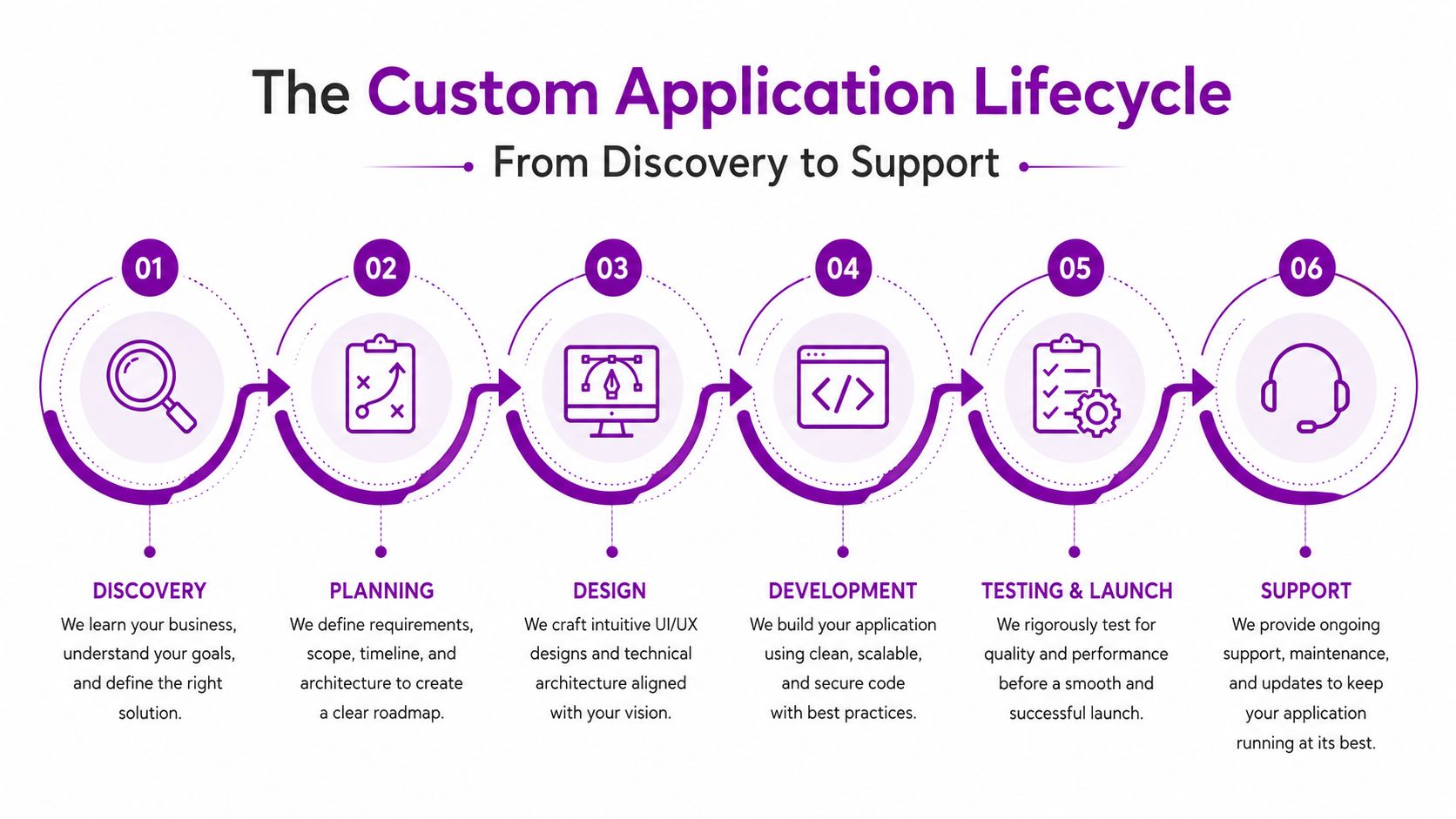
Skipping discovery usually creates scope disputes. Skipping design produces fragile integrations. Compressing testing transfers cost into production incidents. Neglecting support leaves the organisation with an application that becomes less secure and less useful over time. Lifecycle discipline is one of the strongest controls a buyer has over delivery risk, cost and adoption.
Custom Code, Low-Code and Copilot How to Choose
Consider one requirement: staff need to review incoming service requests, extract key information and route each request to the right team.
Custom code, low-code and Copilot could all contribute, but they solve different parts of the problem.
Three routes for one business need
Traditional custom code with .NET on Azure suits a core operational system with complex rules, several integrations, sensitive data and a long expected life. The organisation owns more of the technical decisions and accepts responsibility for architecture, testing, security and maintenance. It offers control, but the work demands stronger design and engineering discipline.
Power Platform low-code is often a better fit for an internal request form, approval flow or Dynamics-connected workflow. Power Apps can provide the user interface, Power Automate can coordinate actions, and Dataverse can hold structured data. Delivery is usually quicker, but the organisation still needs governance around permissions, connectors, environments and future ownership. See this guide to low-code development for more detail on that operating model.
Microsoft 365 with Copilot is suited to assistance rather than a complete system of record. It can help summarise documents, draft responses and support small repetitive tasks. It shouldn't be treated as a replacement for a controlled data model, a customer portal or a workflow that requires dependable transaction handling.
| Dimension | Custom Code (.NET/Azure) | Low-Code (Power Platform) | Copilot on Microsoft 365 |
|---|---|---|---|
| Best fit | Complex integrations, sensitive data and durable operational systems | Internal tools, approvals and Dynamics-connected workflows | Summaries, drafting and repetitive knowledge work |
| Delivery speed | Slower because architecture and code require engineering | Faster where connectors and platform controls fit | Fast for bounded assistance |
| Ownership | The organisation and its delivery partner own the application design and risk | The organisation owns platform governance and solution quality | The organisation owns usage controls, permissions and review |
| Total cost | Higher initial engineering effort, with more control over long-term behaviour | Lower complexity where the platform fits, but licensing and governance still matter | Low implementation effort for narrow tasks, with value depending on adoption and oversight |
| Main weakness | Overkill for simple, fast-changing internal processes | Can become difficult to govern when solutions expand without design | Not a substitute for transactional software or authoritative records |
UK pricing guides place small internal tools around £10,000 to £30,000, standard business applications around £10,000 to £80,000, and complex multi-role platforms at £80,000 to £150,000 or more. These ranges help explain why the delivery route matters, but they aren't a quote for your project. Scope, integrations and risk can move the figure considerably.
A practical rule works well: if the requirement changes weekly and the user base is small, low-code often wins. If the requirement is stable and the system must last five or more years, custom code may justify its higher design and ownership burden. Copilot can sit on top of either approach, helping people work with information without becoming the underlying application.
UK Costs Timelines and What Shapes Them
A UK buyer needs more than a technology recommendation. You need to understand the likely investment before approving discovery, and you need to distinguish a small workflow tool from a platform that joins several operational systems.
Independent UK pricing guidance places small internal tools at roughly £10,000 to £30,000, standard business applications at about £10,000 to £80,000, and complex multi-role platforms at £80,000 to £150,000 or more. London agencies commonly charge around £700 to £1,200 per day, while regional UK agency rates are often around £500 to £800 per day, according to UK software development pricing guidance.
A separate UK market commentary describes bespoke projects as taking around six to eighteen months, depending on complexity, with small business projects commonly ranging from £25,000 to £120,000 and enterprise transformation programmes able to exceed £500,000. Those figures show the breadth of the market rather than a guaranteed schedule or price.
| Project size | Indicative GBP range | Typical timeline | Annual support |
|---|---|---|---|
| Small internal tool | £10,000 to £30,000 | Short, contained delivery | Agreed monitoring, patching and minor changes |
| Standard business application | £10,000 to £80,000 | Several delivery stages | Managed support and planned enhancements |
| Complex multi-role platform | £80,000 to £150,000 or more | Extended delivery with staged release | Ongoing application, infrastructure and security support |
| Enterprise transformation programme | More than £500,000 in some cases | Long-term programme | Dedicated operational and improvement model |
What moves the estimate
Scope clarity has a direct effect on rework. A defined first release is easier to estimate than a broad ambition such as “digitise operations”.
Integration count matters because every connected system introduces authentication, data mapping, error handling and testing. A service that connects to one stable application is a different proposition from one that coordinates several systems.
Regulatory load can change the depth of discovery and testing. GDPR, Financial Conduct Authority expectations, ISO 27001 controls and Cyber Essentials Plus requirements may affect data handling, access permissions, audit trails and evidence.
Build approach determines who carries the technical risk. Configuring Power Platform may be appropriate for a contained workflow, while .NET and Azure may provide stronger control for a durable, integration-heavy application.
The project budget should also include managed hosting, patching, monitoring, incident response and a small enhancement retainer. A live application needs attention after launch, and ignoring that cost makes the business case look artificially attractive. Use custom app development services as a reference point when comparing the delivery and support model, not just the initial build.
Real Use Cases for Mid-Sized UK Organisations
The most useful way to understand bespoke software is to look at the workflow it replaces. A mid-sized organisation doesn't usually need a custom application because custom code is fashionable. It needs one because people are stitching together systems manually, and that creates delay, duplication or control problems.

A service desk for a field-service organisation
A facilities company may already use Dynamics 365 for customer records but manage service requests through email. Engineers receive incomplete information, coordinators update several screens and managers lack a dependable view of service-level agreement performance.
A service desk could connect Dynamics 365 Customer Service with scheduling, engineer availability and customer communications. The application might provide a single request record, enforce required information, assign work according to defined rules and show the next action to each team.
The business should measure operational results such as response handling, scheduling accuracy, missed commitments and the number of internal contacts needed to find a job's status. The application's value comes from joining the workflow, not from adding another dashboard.
An offline field application
Engineers and auditors often work in locations with unreliable connectivity. A Power Apps field tool could let them open assigned work, complete inspection forms, capture signatures and take photographs while offline. When they return to a reliable signal, the application can synchronise information with SharePoint and Dataverse.
The important design decisions concern offline data, conflict handling, permissions and evidence quality. A generic mobile form may collect answers, but it may not preserve the full sequence of work or support the organisation's reporting and audit needs.
The operational measures could include missing paperwork, time spent re-entering notes, delayed approvals and the completeness of evidence attached to each job.
An Azure-hosted customer portal
A customer portal can give clients a secure place to raise tickets, download compliance documents and view billing information. It may connect Azure-hosted services to Dynamics 365, a document repository and finance software, while using controlled identity and role permissions.
The portal replaces phone calls and email chains with a traceable self-service journey. It should still provide a clear route to human support when the request is complicated. Good design guidance from GOV.UK's service manual reinforces the importance of designing around the service transaction rather than merely adding technology.
Security must be assessed for the application itself. The National Cyber Security Centre's application-development guidance supports an approach where teams review security controls for each application instead of assuming that a vendor platform removes the need for application-level decisions.
A short visual overview can help stakeholders discuss these patterns before technical design begins:
Across all three examples, the first question is the same: which workflow is being replaced, and what evidence will show that the new one works better?
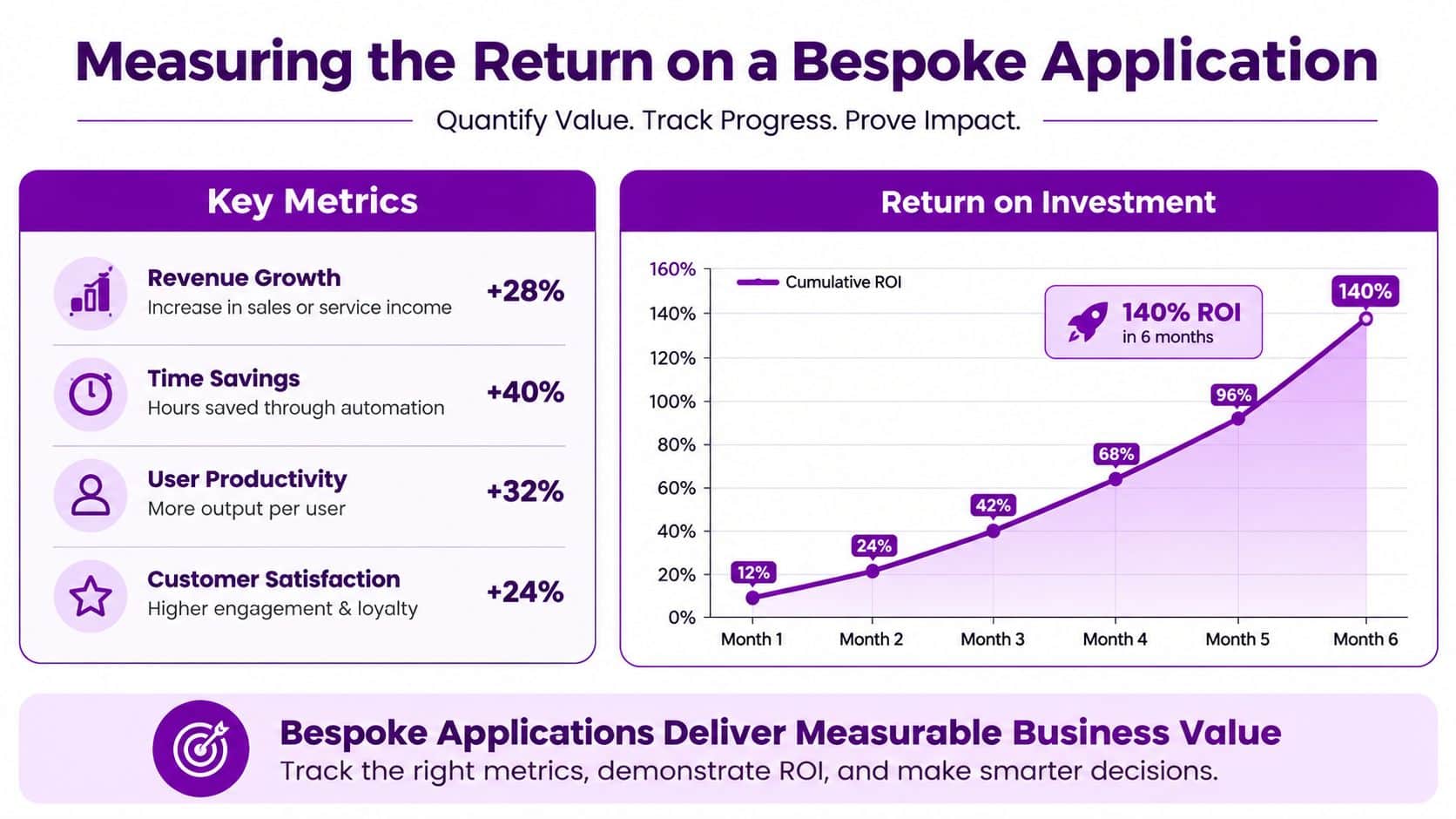
Measuring the Return on a Bespoke Application
Finance directors need a business case that connects software to measurable operational change. “Modernisation” and “agility” may describe the intention, but they don't prove that the investment is working.
Track three core measures:
- Hours reclaimed: Record how much time the affected team spends on manual entry, searching, chasing and reconciliation before and after launch.
- Error-rate reduction: Compare incidents such as incorrect records, missed approvals or incomplete submissions with the pre-launch baseline.
- Faster onboarding: Measure how many productive weeks a new employee gains because the application makes the process easier to learn.
The worked example in the brief uses a 40-person operations team reclaiming two hours per person each week. That produces 80 reclaimed team-hours per week. Annualise the result using a loaded employment cost of roughly £32 to £38 per hour, a range provided for UK administrative and operational roles in the project assumptions, then compare the resulting value with the approved build cost.
The calculation should remain transparent:
Annual labour value = reclaimed hours per week × working weeks per year × loaded hourly cost
The working-weeks assumption must come from your finance team. Don't present the result as profit automatically. Some reclaimed time may become additional customer work, some may reduce overtime and some may give staff capacity to handle existing responsibilities more reliably.
Measure behaviour before benefits. Record the old process before go-live, then compare the same activities after adoption.
Error reduction can be more valuable than time saving when a mistake creates compliance work or damages customer confidence. Faster onboarding can also reduce dependency on a small number of experienced employees.
Audit readiness, customer experience and reduced key-person risk are valid supporting benefits, but keep them separate from the primary calculation. A credible case combines direct capacity or cost evidence with documented operational improvements.
How F1Group Approaches Bespoke Software Projects
F1Group's approach starts with a discovery workshop, before development begins. The team maps workflows, user roles, pain points, data sources and integration points, then separates essential outcomes from ideas that can wait.
During design, F1Group documents user journeys, data models and the decision to build or configure each part of the solution. That matters because a sound bespoke project doesn't automatically turn every requirement into custom code. Power Platform may suit a controlled internal workflow, while .NET and Azure may be more appropriate for complex logic, customer-facing services or durable integration layers.
The build stage uses the selected Microsoft technologies in combination where needed. Power Apps, Power Automate, Power BI, Dynamics 365, Microsoft 365 and Azure can form part of the wider application estate. F1Group also provides managed support covering patching, monitoring and feedback after go-live, so the application has an operational owner rather than being left with the original project team's documentation.
F1Group's Microsoft specialism is relevant where a bespoke application must fit an existing Dynamics 365, Microsoft 365 or Copilot environment. The delivery model uses defined scopes, staged work and transparent GBP pricing, with a UK-based team remaining accountable after deployment. That gives directors a clearer route from business problem to supported application.
You don't need to decide the technology before explaining the workflow. Bring the current process, the systems involved and the outcome you need to measure. A discovery conversation can then establish whether custom code, low-code configuration, Copilot assistance or a combination of approaches is proportionate.
F1Group can help you map the workflow, compare custom development with Power Platform and Copilot, and design a supported solution across Microsoft 365, Dynamics 365 and Azure. Visit F1Group to discuss a discovery conversation, call 0845 855 0000 today, or send us a message with the process you want to improve.