
Most Microsoft 365 migrations don't fail at the mailbox. They fail in the bits firms assumed were housekeeping: old permissions, awkward identity dependencies, and user adoption after the cutover. That's why UK migration pricing spans from £750 to £2,500 for a simple move up to £28,000 to £70,000 for complex projects according to UK migration cost ranges.
That spread isn't consultancy theatre. It reflects what's sitting behind the login screen. A tidy email-only tenant is one job. A business with file servers, SharePoint sprawl, legacy line-of-business apps, hybrid identity and unclear ownership is doing something closer to an operational clean-up with a cloud platform attached.
That's the reality behind Microsoft Office 365 migration services. If you only compare mailbox copy tools, you'll underestimate the project. If you assess identity, permissions, governance and adoption before moving anything, you'll usually avoid the expensive surprises.
Why Microsoft 365 Migration Projects Diverge So Widely in Cost
Migration quotes vary because suppliers are often pricing two very different jobs under one label. One is a straightforward tenant move. The other is an estate clean-up that happens to include Microsoft 365.
That distinction matters more than the mailbox count.
As noted earlier, UK pricing can start in the low four figures for small, clean migrations and climb into the tens of thousands once multiple workloads, identity dependencies and remediation work are involved. A separate market view from this Microsoft 365 migration pricing guide shows the same pattern. Email-only projects sit at one end. Multi-workload moves with redesign, remediation and coordination sit at the other.
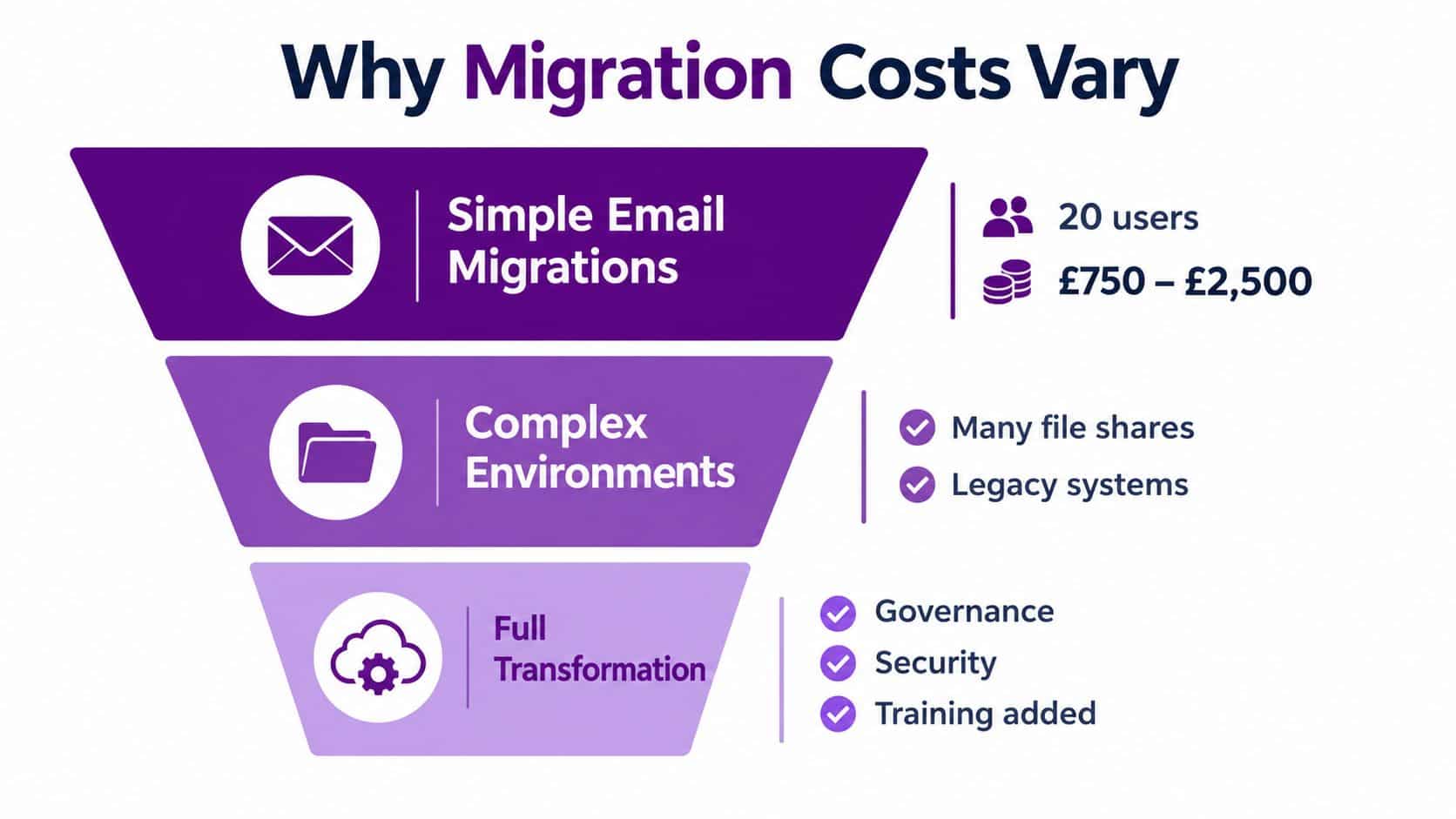
What pushes a project up the cost funnel
Mailbox volume affects effort, but it rarely drives the overruns I see in SME migrations. Cost usually rises when the project exposes old decisions nobody has documented and nobody wants to own.
The common pressure points are predictable:
- Permissions debt. Shared drives with years of inherited access, SharePoint sites with broken groups, and folders owned by staff who left three restructures ago all need decisions before migration tools can do anything useful.
- Hybrid identity coupling. If sign-in still relies on on-premises Active Directory, Azure AD Connect, legacy GPO assumptions or line-of-business apps tied to the old domain, the work expands fast.
- Application break risk. Finance systems, scanners, archive tools and document management platforms often depend on old SMTP settings, mapped drives, local Office add-ins or hard-coded file paths.
- Data sprawl. The more stale file shares, duplicate Teams, abandoned sites and unknown archives in scope, the more time gets spent on triage instead of migration.
- Adoption gap. A technical cutover can finish on Friday and still create a support surge on Monday if users do not know where files moved, how permissions changed, or which old habits no longer work.
Projects drift. Not because the copy engine failed, but because the organisation is trying to settle identity, ownership and access policy in the same week it wants mail flowing.
Practical rule: If a supplier can quote confidently before reviewing identity, data locations, application dependencies and permissions, they are pricing an assumption, not your estate.
I have seen a 40-user migration stay cheap because the tenant was clean, cloud-only and well owned. I have also seen a smaller firm spend far more because nobody could explain how shared access worked, which apps still depended on the server, or whether Teams was replacing file shares or duplicating them.
For smaller firms in the East Midlands, the sensible starting point is discovery before tool selection. A useful primer on planning your M365 move helps frame the right questions before vendor conversations, because that early scoping work often decides whether the project remains controlled or turns into a remediation exercise.
What deserves budget first
The best spend usually happens before the first mailbox moves. Put budget into inventory, permissions review, ownership mapping, app testing and user-impact analysis.
Those tasks are less visible than the migration weekend, but they are the work that stops a simple project becoming an expensive one.
Conducting a Migration Readiness Assessment
A readiness assessment decides whether you are funding a migration or funding months of cleanup under a migration label. That distinction drives cost, timing, and risk more than the mailbox move itself.

In UK SME estates, the hidden failure modes show up early. Permissions have drifted for years. Identity depends on an old sync server nobody wants to touch. Teams is meant to replace file shares, but nobody has agreed what “replace” means. If you do not expose those conditions in discovery, they surface during cutover, or worse, in the first week after it.
The five checks that matter most
Start with the parts that change delivery decisions, not just the parts that fill out a spreadsheet.
-
User population and licence intent
Count named users, shared mailboxes, room resources, service accounts, and third-party identities. Then map who needs desktop apps, frontline access, archive, compliance features, or only basic mail and files. Licence waste usually starts here. -
Workload inventory
Record what is moving across Exchange, SharePoint, OneDrive, Teams, and any surviving file shares. Email is rarely the hard part. The hard part is unowned SharePoint sites, duplicated document stores, and department folders with no agreed destination. -
Identity state
Confirm whether the estate is cloud-only, synchronised, or tied to hybrid identity for authentication, devices, or legacy applications. Hybrid can be the right answer. It also couples your migration to directory health, federation settings, and the state of on-prem infrastructure. -
Application dependencies
List every business system that depends on SMTP relay, shared drives, Office add-ins, mapped paths, old authentication methods, or local service accounts. I have seen technically successful migrations create Monday-morning outages because one finance workflow still expected a file path that no longer existed. -
Permissions hygiene
Review ownership, inheritance, external sharing, leavers' access, and role alignment. This is the check teams cut when the timetable gets tight. It is also the check that prevents overshared data, broken collaboration, and long post-migration support queues.
If your team needs a structured discovery prompt, F1Group's Microsoft 365 migration checklist covers the pre-project questions that are often missed when attention jumps straight to tools.
What deserves budget first
Budget the work that reduces uncertainty.
That usually means tenant and workload discovery, permissions review, identity validation, application testing, and decisions on what should not be migrated at all. A fast copy of bad structure is still bad structure. Old access mistakes arrive in a newer admin portal.
For smaller organisations, this is the point where cost bands start to separate in practice. Two firms with similar headcount can land in very different budgets because one has clear ownership and cloud-ready identity, while the other is carrying years of permissions debt and undocumented app dependencies. The migration engine is rarely the expensive part. The remediation work around it is.
Why adoption belongs in the assessment
A readiness assessment also needs to test whether people will use the target environment properly after cutover. Otherwise, the project ends with mail delivered but working practices still broken.
That matters even more if Copilot is on the roadmap. According to the DWP Microsoft 365 Copilot trial evaluation, change-management activity helped drive 83% overall adoption, but usage varied sharply by app, with Teams at 71% and Excel and PowerPoint at 23% and 24%. Those differences usually come down to role fit, training, information structure, and access quality.
A licence assigned to the wrong user, on top of messy permissions and weak ownership, creates cost and support overhead. It does not create adoption.
For firms that want a more disciplined landing zone, it also helps to adopt the Microsoft Cloud Adoption Framework so migration, security, governance, and user rollout are handled as one programme rather than separate clean-up exercises.
A short walkthrough helps frame the operational side before execution:
The output you need
A proper readiness assessment should finish with clear decisions, not a vague “ready to migrate” label.
- A migration scope that separates must-move content from archive, duplicates, abandoned sites, and stale mailboxes
- A risk register covering identity coupling, application dependencies, permissions exposure, and support hot spots
- A delivery plan that sets sequencing, pilot groups, rollback limits, and business-owner sign-off
- A post-migration support model for onboarding, remediation, access requests, and governance
Without those outputs, the project is still running on assumptions.
Choosing Your Tenant Strategy and Identity Model
Tenant strategy is where "simple Microsoft 365 migration" projects start getting expensive.
The mailbox move is rarely the part that causes lasting pain. Cost and delay usually come from decisions made here: whether two businesses can live in one tenant, whether identity stays tied to old Active Directory, and whether years of broken group membership and inherited permissions get copied forward into the new estate.
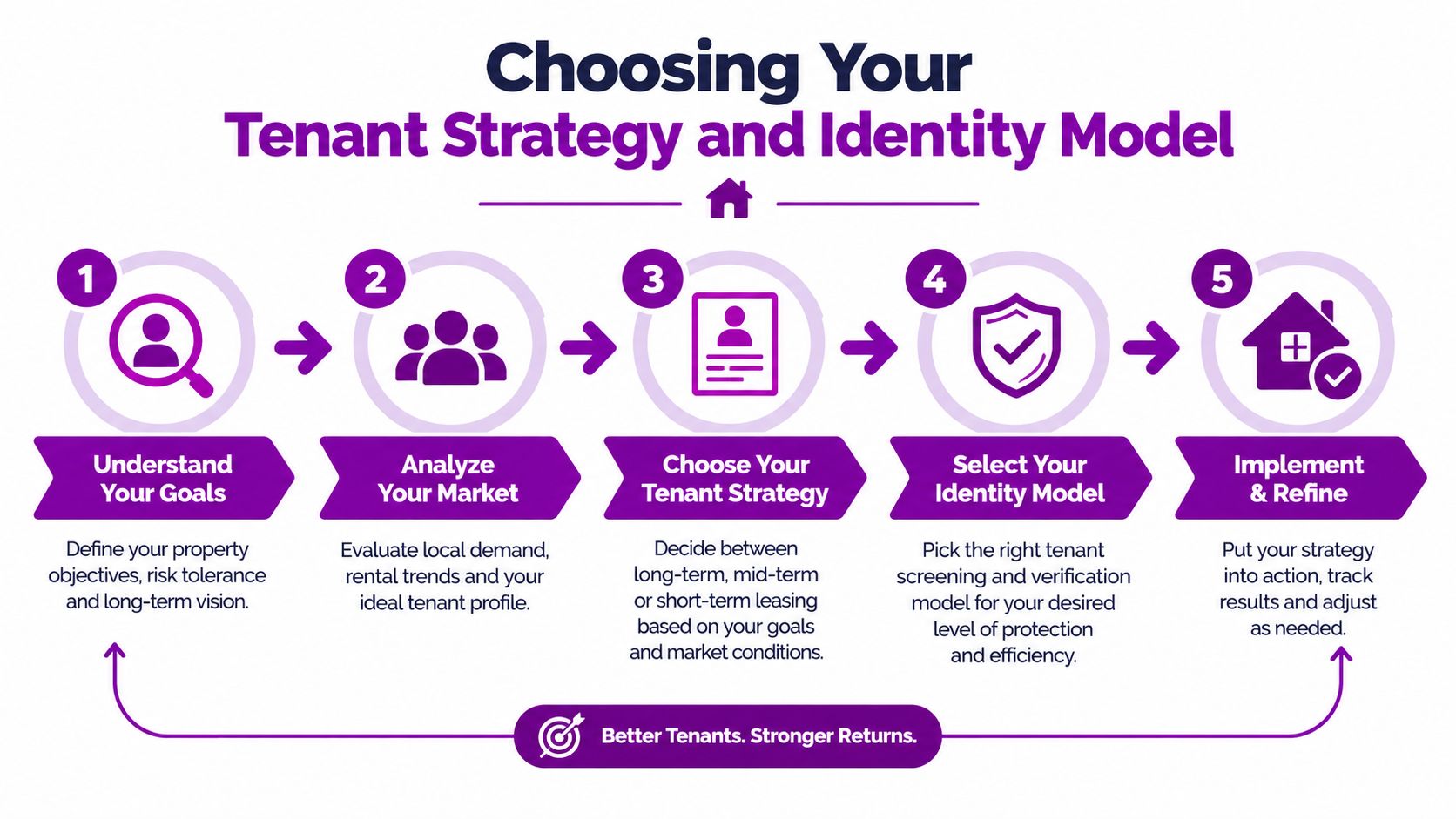
Single tenant or tenant-to-tenant
This choice sets your operating model long after migration weekend.
A single-tenant design usually gives SMEs the cleaner end state. Policies are easier to apply, Teams and SharePoint collaboration are simpler to control, and admin work does not get split across multiple estates. The catch is standardisation. Naming, retention, data ownership, external sharing, and permission models all need agreement early. If each department keeps its own exceptions, the project slows down and support demand rises after go-live.
Tenant-to-tenant migration suits mergers, carve-outs, regulated separation, or any case where one business cannot be folded into another. It preserves boundaries, but it creates more moving parts: cross-tenant mail flow, identity mapping, OneDrive ownership changes, Teams chat history decisions, and a sharper communications burden. In practice, these projects often stall because leaders agree on the destination but not on who owns the awkward edge cases.
The hard question is not "Can Microsoft do this?" It usually can. The question is whether the business is prepared to rationalise overlapping identities, shared mailboxes, distribution lists, and years of ad hoc access.
Cloud identity or hybrid identity
Identity is the decision that keeps billing your team after the migration has finished.
For many UK SMEs, cloud-first identity with Microsoft Entra ID joined devices is the cleaner long-term model. It reduces dependence on domain controllers, simplifies access policy, and makes device lifecycle management easier to run as a service rather than as a collection of exceptions.
Hybrid identity still makes sense in some estates. Line-of-business applications may still depend on on-premises Active Directory. Device build processes may be tied to Group Policy. Some firms also need a staged transition because they cannot replace old authentication patterns in one project. That is a valid reason to stay hybrid for a period. It is not a good reason to leave hybrid in place indefinitely without an exit plan.
That trade-off matters. Hybrid can reduce short-term disruption, but it also preserves coupling to old infrastructure, old admin habits, and old failure points. If AAD Connect breaks, if UPNs are inconsistent, or if service accounts have unclear ownership, those problems do not stay in the server room. They surface as login failures, missing access, sync confusion, and support tickets on Monday morning.
Directory quality decides how risky this is. If the source Active Directory is full of stale users, nested groups nobody understands, and permissions no one wants to review, syncing it into Microsoft 365 just relocates the mess. It does not fix it. F1Group's guide to Active Directory migration planning and cleanup is useful background because directory decisions affect every stage that follows.
The identity model chosen as a temporary compromise often becomes the production model for years.
Where projects usually go wrong
Permissions debt is the first hidden failure mode. File shares often contain years of broken inheritance, one-off access grants, and security groups with no clear owner. If that structure is migrated into SharePoint or Teams without review, users either lose access and flood the service desk, or they gain broader access than intended. Both outcomes are common.
Hybrid identity coupling is the second. Many migration plans assume on-premises AD, device management, legacy apps, and Microsoft 365 can coexist neatly for as long as needed. In reality, that middle state is fragile. Password writeback, sync rules, conditional access, app authentication, and endpoint compliance all need to line up. One weak dependency can hold the whole programme back.
The third problem appears after the technical move. Users may be licensed, synced, and signed in, but the operating model is still unclear. Who approves new Teams? Who owns shared mailboxes? Who reviews guest access? Who cleans up leavers with direct file permissions? If those controls are unresolved, the migration lands, then governance debt starts building on day one.
A practical decision test
A tenant and identity design is usually on the right track if the project team can answer four questions without hand-waving:
- Which identities will remain dependent on on-premises Active Directory after migration, and for how long?
- Which permissions will be rebuilt, rather than copied forward unchanged?
- Which business services cannot tolerate cross-tenant disruption during coexistence?
- Which team owns post-migration identity, access, and group lifecycle management?
If those answers are vague, the design is not ready yet.
The Cabinet Office's move from Google Workspace to Microsoft 365, covered by The Register's report on the stalled Cabinet Office migration, is a useful reminder that large programmes slip when ownership, dependency management, and delivery sequencing are not aligned. SMEs face the same categories of risk with smaller teams and less room for error.
Mail and Data Migration Approaches for Mid-Sized Organisations
The delivery method should fit the business, not the other way round. Mid-sized organisations usually have three realistic approaches for email and data moves: cutover, phased, or parallel.
Comparing the three approaches
| Approach | Where it fits | Main benefit | Main risk |
|---|---|---|---|
| Cutover | Smaller estates with low complexity | Fast and easier to explain to users | Less room for rollback if hidden issues appear |
| Phased | Most mid-sized firms with mixed workloads | Reduces disruption and lets IT learn as it goes | Requires stronger communications and coexistence planning |
| Parallel | Sensitive environments with higher continuity demands | Gives validation time before final switch | Higher management overhead and longer dual-running effort |
For most SMEs, phased migration is the pragmatic middle ground. Mailboxes can move in batches. OneDrive can follow. Shared data can be remediated before it lands in SharePoint or Teams. That sequencing helps separate technical migration from business change.
Where execution usually breaks
The difficult part isn't moving bytes. It's preserving access properly once those bytes arrive in a new structure.
A typical 200-seat UK Microsoft 365 migration covering email, SharePoint, OneDrive and file servers takes 10 to 16 weeks from kickoff to decommission. The same source says well-planned projects can achieve 99.7% data fidelity, and that inadequate permissions mapping is the root cause in 63% of failed SharePoint migrations, according to this UK SharePoint and OneDrive migration benchmark.
That last figure matters more than most firms realise. If inherited file share permissions were never designed for SharePoint, a direct lift-and-shift often reproduces confusion at cloud scale.
A sound operating pattern is:
- Stage mailboxes first where user behaviour is easier to verify
- Remediate shared data before migration instead of dragging old folder chaos into SharePoint
- Validate permissions with business owners, not only IT admins
- Run sample user testing on every batch before widening the rollout
For teams reviewing the mechanics in more detail, F1Group's article on data migration best practices is a useful companion to the planning work.
What works better than a brute-force copy
The strongest migrations treat data differently by type. Mailboxes usually move with fewer structural decisions. Shared files rarely do. Old file servers often contain duplicated content, personal storage in team areas, and broad access groups nobody would design today.
Migrate content only after deciding who should own it, where it belongs, and whether it still deserves to exist.
That sounds slower. In practice, it saves rework.
Executing Cutover and Testing Procedures
Cutover should feel quiet. If it feels dramatic, the preparation was probably thin.
The cleanest migrations are built around a tightly managed sequence: user communications, final pre-cutover checks, delta migration, service switch, validation, then controlled support. The technical switch is only one part of the job. The other part is making sure users know what changes, when it changes, and where to go if something looks wrong.
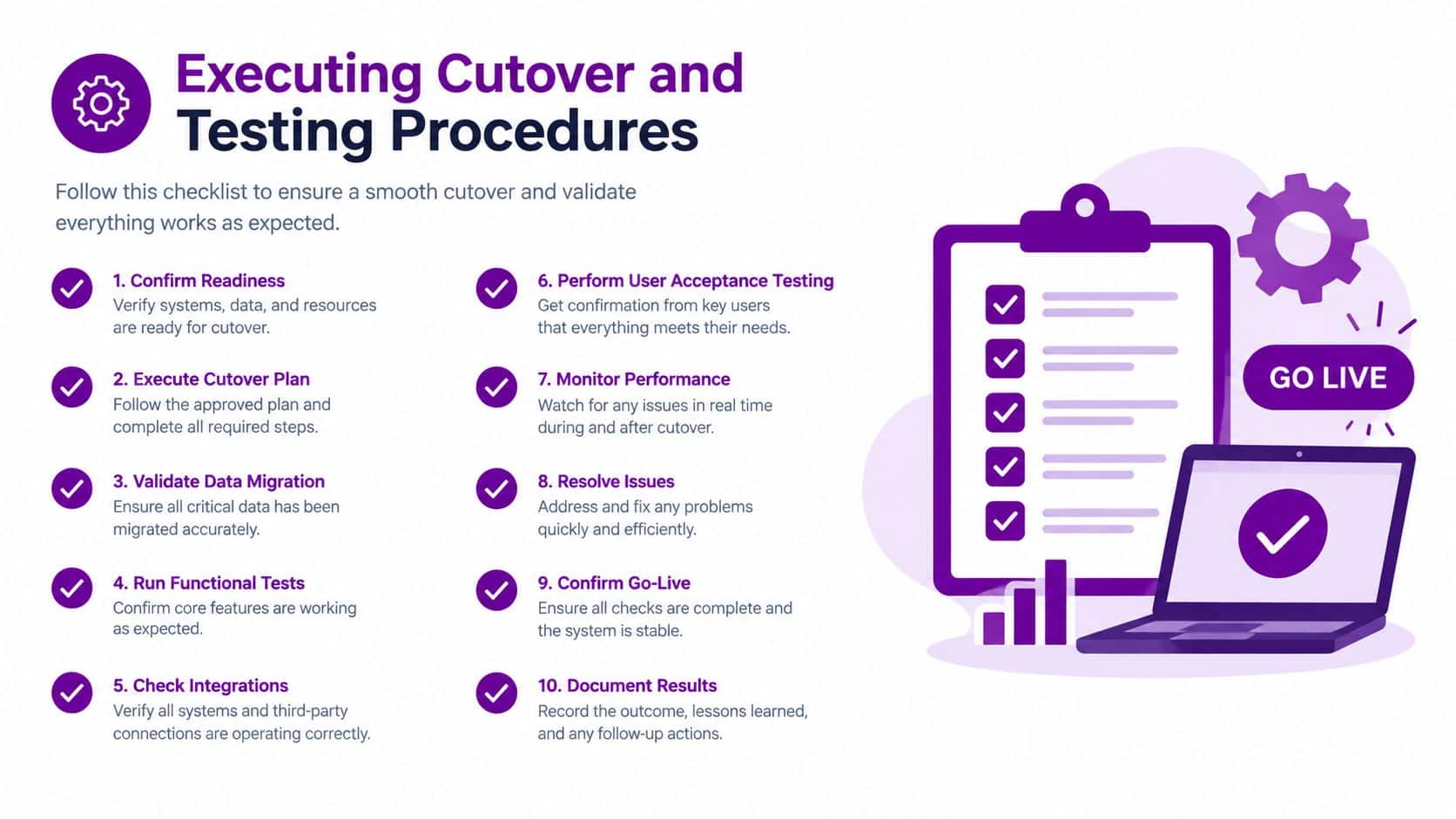
A practical cutover sequence
Use a written runbook and assign named owners to each action. Verbal coordination is not enough once the window starts.
-
Confirm readiness
Freeze non-essential change, confirm migration batches, and verify support coverage. -
Brief users clearly
Tell users what to expect, what might look different, and what should still work as normal. -
Run final sync activity
Complete the last migration pass and check for obvious exceptions before the switch. -
Switch service dependencies
Move mail flow and application connectivity in the planned order. -
Validate core access
Test sign-in, Outlook profiles, shared mailboxes, Teams access, OneDrive and SharePoint permissions. -
Open support channels
Keep the service desk, migration engineers and business champions aligned for rapid triage.
What to test before declaring success
A migration isn't complete because the admin portal looks healthy. It's complete when representative users can work without hidden blockers.
Focus testing on:
- Mailbox integrity for folders, calendar behaviour, delegates and shared access
- SharePoint permissions for team sites, libraries and restricted areas
- Teams configuration for membership, channels and file access
- Application sign-in for anything integrated with Microsoft 365 identity
- User acceptance with a real sample from finance, operations, leadership and frontline teams
For tenant-to-tenant Microsoft 365 migrations in the UK, the reported average duration is 47 days, with 3.2 TB migrated per 100 users, and 23% of migrations encounter unexpected delays, according to this UK tenant-to-tenant migration dataset. That delay rate is exactly why cutover windows need decision points rather than blind optimism.
When rollback is the right call
Rollback shouldn't be improvised. Define it before the migration window opens.
Trigger it if critical user groups can't sign in, shared access fails in a way that blocks business operations, or line-of-business applications lose essential connectivity with no quick workaround. Don't trigger it for cosmetic issues, isolated profile prompts or minor training questions. Those are support items, not rollback criteria.
Persist through manageable noise. Roll back on business-critical loss of access or control.
Managed Service Handover and Post-Migration Governance
A migration project ends twice. First when the cutover finishes. Then again when the environment is stable enough to hand into normal operations. The second ending matters more because that's where organisations either gain long-term value or settle into a new version of the old mess.

What a proper handover includes
A managed service handover should be documented, owned and easy to operate. At minimum, it needs:
- Architecture records that show identity design, workload locations, admin roles and service dependencies
- Administrative access transfer so named client contacts and support teams know who controls what
- Operational baselines for monitoring, backup expectations, alerting and escalation
- User support completion including training outcomes, known issues and champion contacts
- Governance settings covering permissions, sharing controls, retention expectations and ownership rules
Many providers stop at “migration complete”. That's too early. Users don't experience a project milestone. They experience whether collaboration, search, sharing and sign-in now make more sense than before.
Why governance has become more urgent
The pressure has increased because AI tools now sit directly on top of Microsoft 365 data. A 2026 UK and US governance finding reported that 76% of organisations had deployed or piloted an enterprise AI tool on Microsoft 365 data, cited in this analysis of Microsoft 365 business planning and governance in the UK. If permissions are untidy, AI doesn't fix that. It can expose it faster.
That changes the post-migration priority list. Governance is no longer a tidy-up phase for later. It's part of making the platform safe and useful.
What good post-migration support looks like
Support after migration should cover more than ticket handling. It should include:
- Permission review cycles so access reflects roles, not history
- Security configuration management around conditional access, sharing and admin controls
- Adoption support focused on how different teams use Outlook, Teams, SharePoint, OneDrive and Copilot
- Continuous optimisation so the tenant structure and policies improve as the business changes
That's the point where one practical option is a managed Microsoft 365 service from a regional partner such as F1Group, which supports organisations across the East Midlands with Microsoft 365 administration, migration support, security management and ongoing cloud operations.
Migration finishes the move. Governance determines whether the move was worth doing.
The UK public-sector Copilot evidence mentioned earlier makes the same point in a different way. Strong overall adoption can still hide weak app-level usage if permissions, rollout design and training don't match job roles. The organisations that realise value are the ones that keep working after the technical move is done.
If your business is weighing Microsoft Office 365 migration services, F1Group can help with the parts that usually get underestimated: discovery, permissions review, identity design, cutover planning and post-migration support. To discuss a practical migration plan for your organisation, visit F1Group, phone 0845 855 0000 today, or send us a message.