
Managed IT services in the UK typically cost £40 to £150 per user per month, depending on the level of support, security, and strategic input included. For many businesses, that means the headline number is only the starting point, because Microsoft 365 administration, backup, cyber security, and cloud management often move the monthly spend higher.
If you're running a growing business in the East Midlands, you've probably seen this already. One provider gives you a tidy per-user figure. Another sends a much higher quote. A third says it depends and asks for a discovery call before showing any numbers at all.
That leaves directors in an awkward spot. You still need to set a budget, compare options, and decide whether a quote is fair.
The good news is that managed IT services cost has become more predictable than many people think. UK pricing is now commonly structured around user count, service depth, and security scope, which makes it far easier to compare like with like once you know what sits inside the monthly fee.
Introduction to Managed IT Services Cost in the UK
A familiar example is a 25 to 50 user firm reviewing next year's spend. One quote looks low enough to approve quickly. Another is almost double. On paper, both appear to offer “managed IT support”, but the actual cover can be very different.
A provider may include helpdesk, monitoring, patching, Microsoft 365 administration, security tooling, backup oversight, and strategic advice. Another may include only the first two or three items. That's why the cheapest quote often isn't the lowest total cost once the add-ons begin.
The wider market helps explain why pricing now follows recognisable patterns. In the UK, independent market research published by the Competition and Markets Authority found that as of March 2025 there were 12,867 active managed service providers, employing 343,762 people and generating an estimated £51 billion in revenue according to this UK managed services market overview. That scale matters because it shows a mature, competitive market where standard pricing bands are common.
Why per-user pricing dominates
Most businesses buy managed support by user because it's easier to forecast. If you add staff, your IT cost rises in a predictable way. If your provider prices by person rather than by every single laptop, phone, and shared machine, budgeting becomes simpler for finance teams and less frustrating for managers.
That's also why resources explaining sector expectations can be useful when you're comparing industries and support models. If your firm sits within specialist digital or technical sectors, the Bidwell IT sectors page gives useful context around the wider information technology services.
Practical rule: Don't compare two managed service quotes until you've checked whether both include the same security, backup, cloud, and support responsibilities.
Some directors also need a clearer definition before they can judge price properly. If that's where you are, this guide on what managed IT services means in practice is a useful companion to the cost discussion.
What Managed IT Services Cover and Why Pricing Varies
The easiest way to understand pricing is to compare IT support with building management.
If you only want someone to fix a door when it jams, that's one level of service. If you want a team to inspect the building, maintain the alarms, manage access, test backups, and plan improvements, that's a different job entirely. Managed IT works the same way.
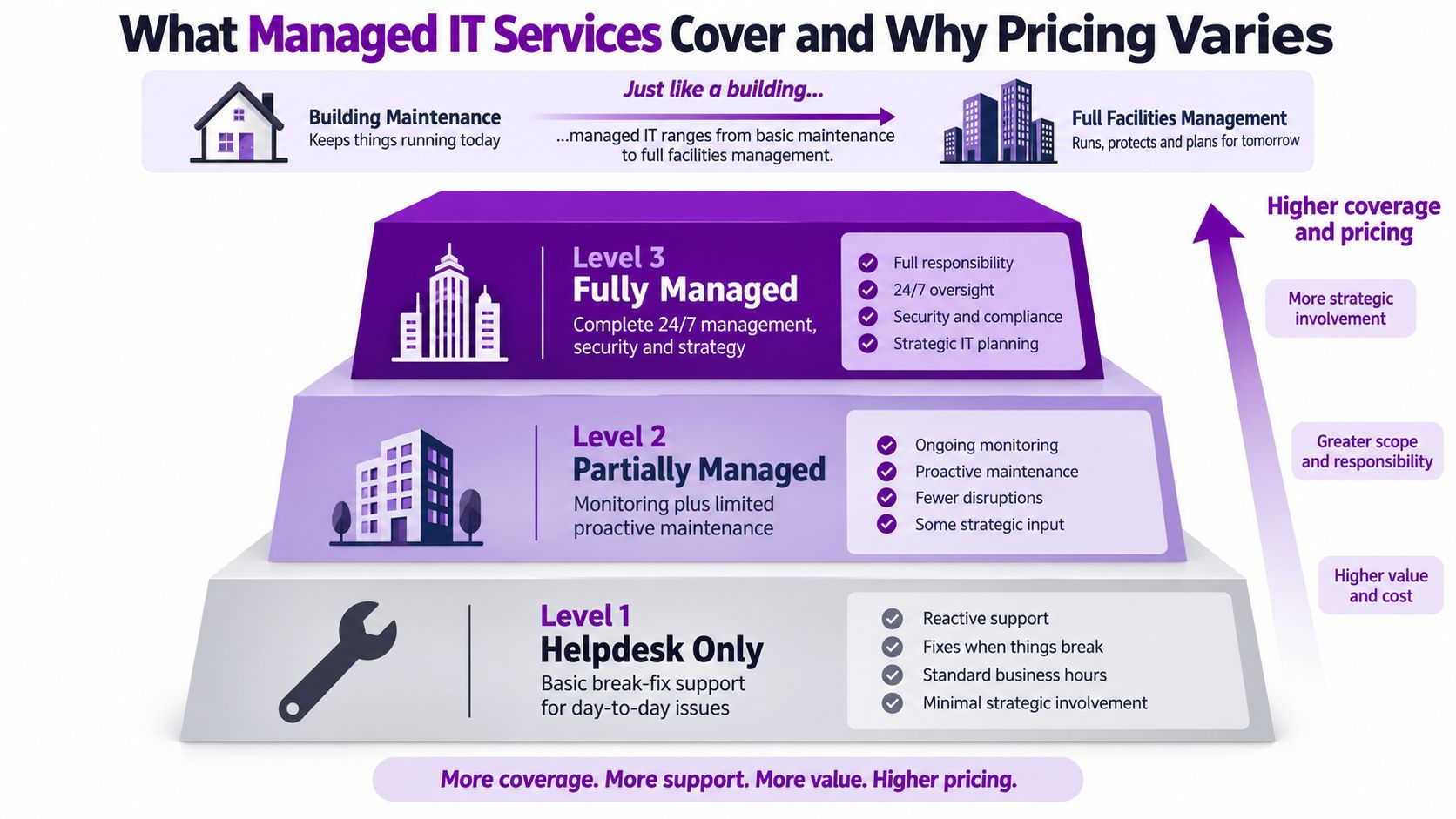
Level one is helpdesk and basic support
At the lighter end, a provider may handle user issues such as password resets, printer faults, email problems, and simple device troubleshooting. That can be enough for a small business with straightforward systems and low risk tolerance.
This kind of arrangement often looks affordable because it leaves a lot outside the contract. Backup, cyber security tooling, Microsoft 365 governance, and strategic planning may all sit elsewhere.
Mid-range cover adds proactive work
A more complete package usually includes monitoring, patching, and routine maintenance. The provider isn't just waiting for tickets. They're watching systems, applying updates, and trying to stop faults before your team notices them.
That extra layer changes the cost because you're paying for tools, scheduled labour, and responsibility for system health, not just for reactive support.
Full management includes the wider stack
At the top end, managed services typically extend into:
- Microsoft 365 administration for accounts, policies, security settings, and tenant changes
- Backup oversight so recovery arrangements are monitored and checked
- Cyber security controls such as endpoint protection, alert handling, and policy enforcement
- Cloud and infrastructure management covering services such as Azure, servers, and networking
- Strategic guidance through planning, budgeting, roadmap work, or virtual IT leadership
UK pricing guides consistently show that service depth drives cost. Basic helpdesk and monitoring packages are often quoted around £30 to £50 per user per month, mid-range managed services with patching and security controls around £50 to £80, and fully managed stacks with EDR, compliance support, and vCIO-style advisory around £80 to £150 per user per month, as outlined in this UK MSP procurement benchmarking guide.
A lot of confusion disappears once you realise two firms with the same headcount can still need very different service depth. A business using little more than email and file storage won't buy the same package as one managing regulated data, remote staff, and multiple cloud platforms.
For a fuller description of what sits inside a deeper support arrangement, this explanation of a fully managed IT service helps show why the scope changes the price so much.
Common Pricing Models Compared and When to Use Each
A finance director sees a proposal at £65 per user and assumes the budget is sorted. A month later, Microsoft 365 licences, backup, email security, endpoint protection, and server cover appear as separate lines. The headline figure looked clear, but it was only part of the stack.
That is why the pricing model matters. It shapes how predictable your costs are, what gets included, and whether a low per-user number stays low once the rest of the service is added.
Managed IT pricing models at a glance
| Pricing Model | How It Is Charged | Typical UK Range | Best For |
|---|---|---|---|
| Per user, per month | One recurring fee for each employee | £40 to £150 per user per month for managed support depending on scope, with many guides clustering core support in the middle bands according to this UK cost guide | Offices where each person uses several devices and cloud services |
| Per device | One fee per workstation, server, or other managed device | Per-device charging is commonly used in UK support agreements, as outlined in this outsourcing cost comparison | Shared-device environments or sites with fewer users than endpoints |
| Tiered package | Fixed bundle such as Basic, Professional, or Premium | Tiered plans are usually priced in ascending per-user bands, as shown in this managed IT services guide | Firms that want clearer feature bundles and fewer custom decisions |
| Co-managed support | Shared responsibility between in-house IT and provider | Market guides usually place co-managed support below fully outsourced arrangements, including this co-managed pricing discussion | Businesses with an internal IT person or team |
| Fully managed support | Provider handles the wider day-to-day service | Fully managed pricing usually sits above co-managed because the provider owns more of the service | Businesses outsourcing most or all IT operations |
| Break-fix or hourly | Charged only when work is needed | Hourly charging is still used for ad hoc support and short-term fixes | Short-term issues, not ongoing stability |
Per-user pricing is often the easiest starting point
For many office-based businesses, per-user pricing is the simplest model to budget. One person usually means one laptop, one Microsoft 365 account, one mailbox, one security profile, and one backup requirement. Charging by user follows that pattern better than counting each item separately.
It works a bit like pricing a company car by driver rather than by tyre, battery, and service visit. The single number is easier to manage, but only if you know what sits inside it.
That is the point many quotes blur. A provider may say £55 per user, but the monthly stack might be £55 for support, plus Microsoft 365, plus endpoint security, plus backup, plus any server or Azure cover. For directors comparing proposals, the useful question is not only "what is the support fee?" but "what is the total cost per user once the stack is complete?"
Per-device pricing suits environments where hardware drives the work
Per-device pricing can be fairer where several people share the same machines, such as shop floors, warehouses, receptions, or training rooms. In those settings, charging for each employee can overstate the provider's day-to-day workload.
It can also work well for infrastructure-heavy support, where servers, firewalls, and network kit need regular attention regardless of headcount.
The trade-off is visibility. Per-device pricing can look cheaper at first, then grow awkwardly once you add mobile users, home workers, and cloud services that are tied to named staff rather than machines.
Tiered packages help comparison, but you still need to read the small print
Basic, Professional, and Premium packages can make buying easier because they group features into a smaller set of choices. That is helpful for busy directors who want a quick shortlist.
Packages still vary widely between providers. One firm's mid-tier plan may include Microsoft 365 management and backup checks. Another may leave those as extras.
A simple checklist helps here. Ask what is included for user support, Microsoft 365 administration, security tooling, backup monitoring, and infrastructure management. If one quote includes only support labour and another includes the wider stack, the per-user headline will not be comparable.
Co-managed and fully managed pricing should be budgeted differently
These two models are often presented side by side, but they solve different problems.
Co-managed support means your in-house IT person or team keeps part of the responsibility. The provider may handle escalation, specialist security work, holiday cover, project delivery, or platform expertise that your internal team does not have time to maintain. Because the work is shared, the monthly charge is usually lower than a fully managed service.
Fully managed support means the provider takes day-to-day ownership across the agreed scope. That often includes helpdesk, monitoring, patching, Microsoft 365 administration, security operations, backup oversight, and supplier coordination. The price is higher because more responsibility sits with the provider, and more tools are usually wrapped into the service.
A practical way to picture it is this. Co-managed pricing buys extra hands and specialist cover. Fully managed pricing buys an outsourced IT function.
That distinction matters when you turn a headline figure into a real budget. A co-managed quote may appear lean because your salaried IT manager is still carrying part of the load. A fully managed quote may look higher, but it can replace internal effort, reduce tool sprawl, and wrap more of the stack into one contract.
The same buying pattern appears in other outsourced specialist services. Founders weighing whether to keep reporting in-house or bring in outside help often face a similar choice between collaborative and outsourced delivery, as shown in this guide to a BI service for founders.
Break-fix is easy to start and hard to budget
Hourly support feels flexible because you only pay when something goes wrong. For small firms with very light needs, that can look sensible.
In practice, it often creates the least predictable spend. Routine maintenance, patching discipline, security oversight, and backup checks are less likely to be handled consistently when every task starts a fresh bill. That can store up larger costs later, both in downtime and in emergency project work.
For most growing businesses, managed pricing is less about paying for tickets and more about paying for fewer surprises.
Key Factors That Influence Your Final Price
A quote can look straightforward at first glance. Then the detail starts to matter. Two firms with the same headcount can land at very different monthly costs because the question is not only how many people need support, but how much technology sits behind each person.
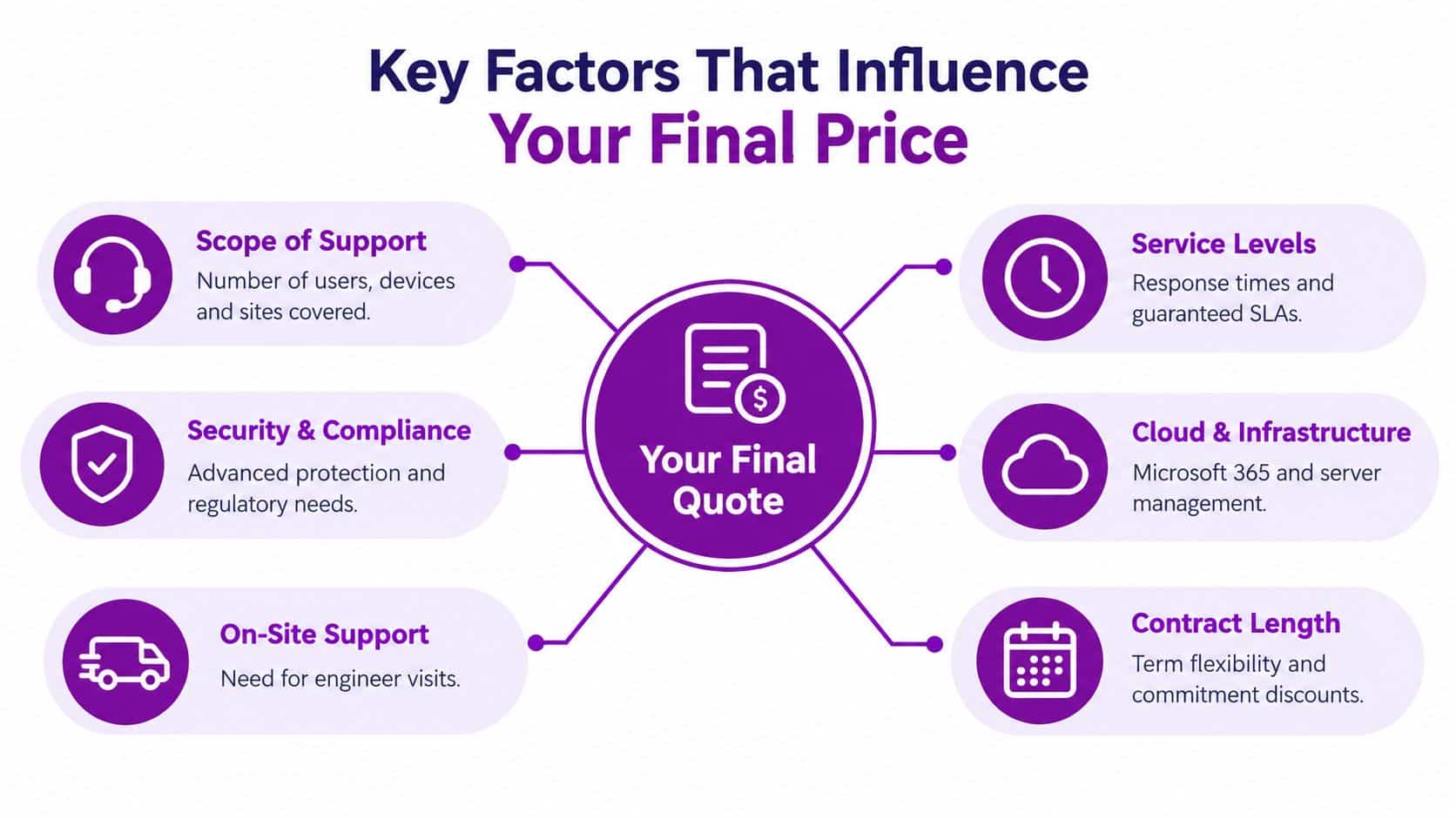
Scope changes more than headcount alone
Per-user pricing is useful as a starting point. It is not the whole budget.
A 25-user business in one office, using modern cloud apps and standard laptops, is usually simpler to support than a 25-user business spread across three sites, with on-site servers, shared PCs, specialist software, and a mix of home and office working. The user count is the same. The workload is not.
That is why headline support prices need translating into total stack cost. Once Microsoft 365 administration, endpoint security, email protection, backup, device monitoring, and user onboarding are included, the monthly figure can look very different from the basic per-user rate first shown in a proposal.
Fully managed and co-managed quotes can look similar on the surface
They often cover different things.
In a co-managed arrangement, your in-house IT lead may still handle supplier coordination, Microsoft 365 changes, licence reviews, or first-line requests. The external provider fills gaps and adds specialist cover. In a fully managed service, those tasks usually shift to the provider, along with more responsibility for day-to-day delivery.
That difference affects price because you are buying a different amount of labour, tooling, and accountability. A lower co-managed figure is not always a cheaper overall option if you still carry internal salary cost and extra software outside the contract.
Security and compliance increase work behind the scenes
Security pricing is rarely just a case of adding one product licence.
Stronger protection usually brings more setup, more monitoring, more policy control, more user guidance, and more incident response planning. If your business has to meet insurance conditions, Cyber Essentials requirements, client security questionnaires, or sector rules, the provider has more to manage and document.
For directors, this is one of the easiest areas to underestimate. The tool cost is visible. The ongoing administration often is not.
Microsoft 365, backup, and cloud management are common budget gaps
Many budgets go off course. A support quote may cover helpdesk and device management, while leaving out parts of the stack your staff rely on every day.
Microsoft 365 is a good example. Licences are one cost. Admin work is another. User changes, mailbox permissions, SharePoint structure, Teams settings, security policies, conditional access, and licence tidy-up all take time. Backup works in the same way. Buying backup software is only part of the picture. Someone still needs to set policies, check jobs, test recovery, and fix failures.
If you want accurate budgeting, ask a simple question. Does this monthly figure cover support only, or support plus the cloud, security, and backup stack?
Service levels and support hours also change the price
A contract for office-hours support is priced differently from one that includes fast response targets, senior engineer access, on-site attendance, or out-of-hours cover.
This works much like building insurance. A broader promise costs more because the provider must keep more capacity ready. If your systems support sales, operations, and customer service all day, tighter service levels may be sensible. If the business can tolerate slower response on non-urgent issues, a lighter agreement may fit better.
Practical cost drivers to review
- Number of sites: More locations usually mean more network equipment, more supplier coordination, and more chance of travel or on-site work.
- Remote and hybrid working: Home users often need more help with identity, device setup, secure access, and connectivity issues.
- Legacy systems: Older servers, unsupported software, and ageing hardware usually increase support time and risk.
- Security requirements: Extra controls such as MDR, email filtering, MFA policies, compliance reporting, and audit evidence add ongoing work.
- Microsoft 365 and cloud scope: Tenant administration, licence management, Azure services, SharePoint, and backup are not always included in the base figure.
- Strategic input: Budget planning, roadmap advice, supplier management, and virtual IT leadership usually sit above basic support.
- Contract structure: Short terms and flexible scope can be priced differently from longer agreements with clearly defined boundaries.
The clearest way to control managed IT services cost is to separate core support from the wider stack, then compare fully managed and co-managed quotes on the total monthly spend rather than the headline per-user rate alone.
Illustrative UK Pricing Ranges and Budget Scenarios
A finance director approves a managed IT quote at £65 per user and feels the budget is settled. A month later, Microsoft 365 administration, email security, backup, and extra security monitoring appear as separate lines. The support price was real, but it was only one part of the basket.
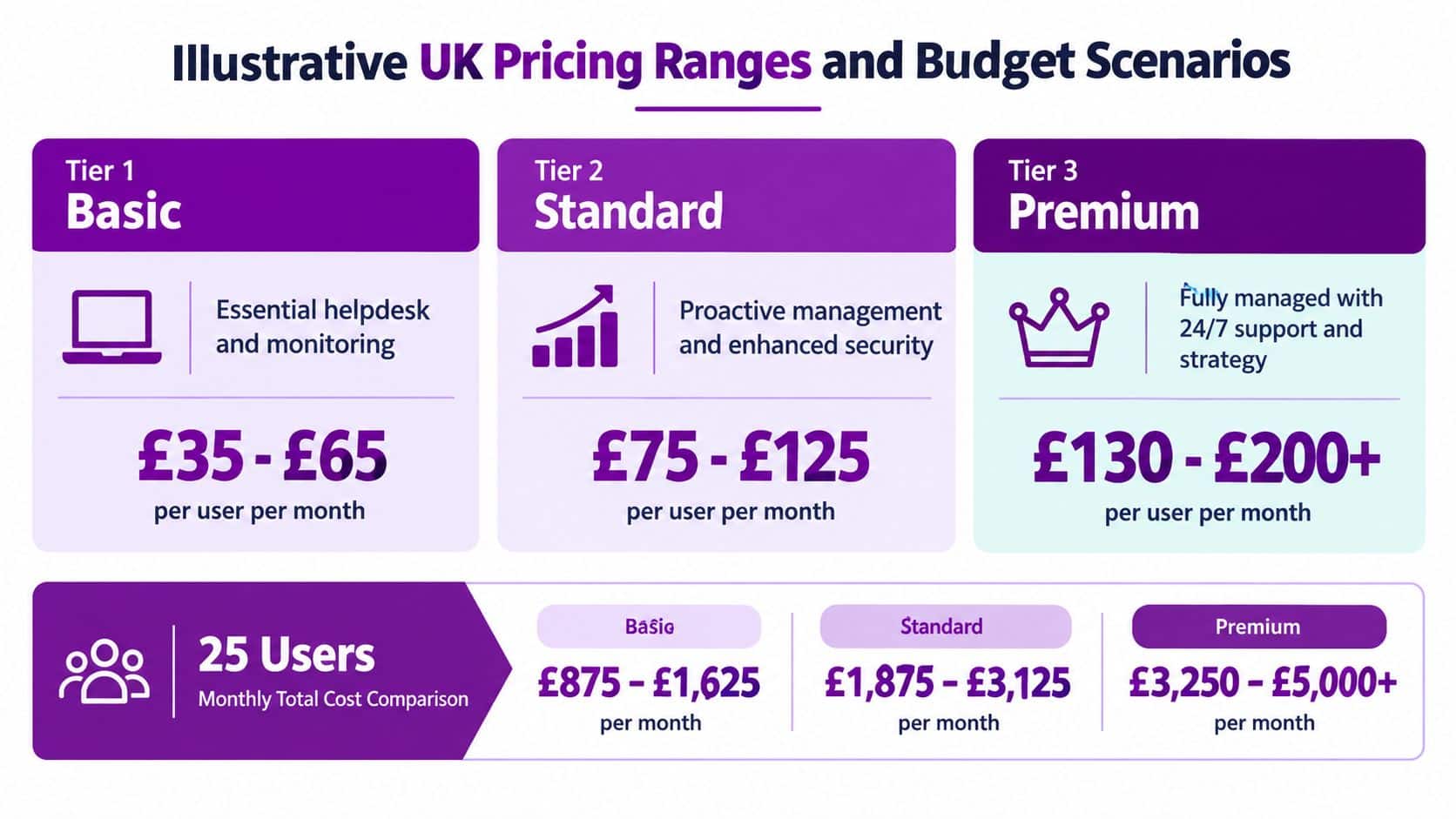
Typical price bands in the UK
Recent UK pricing guides usually group managed IT support into three broad bands. Basic cover often sits around £40 to £55 per user per month. Standard support commonly lands near £65 to £95. Premium arrangements can reach £100 to £150, especially where security work and higher-level planning are included, as outlined in this UK ICT market pricing article.
A separate UK pricing guide places core managed support at roughly £45 to £85 per user per month, with extra services such as cybersecurity, compliance support, and strategic consultancy priced on top in many cases, as described in this managed IT services pricing guide.
Those ranges are useful, but only if you read them the right way. They usually describe the support layer first. They do not always include the full operational stack your business uses every day.
What those bands mean in plain English
A basic package usually covers the service desk, monitoring, and routine fixes. A standard package often adds more proactive administration and a wider operational role. A premium package may include stronger security oversight, supplier management, and regular planning input.
The easy mistake is to compare those labels as if they were fixed products. They are not. One provider's standard package may include Microsoft 365 administration and backup checks. Another may price those separately.
Managed IT pricing works a bit like the running cost of a company car. The monthly lease matters, but so do insurance, servicing, fuel, and road tax. Support is the lease figure. The rest of the stack is what makes the vehicle usable and safe.
The number that matters for budgeting is the total monthly stack cost, not the support line on its own.
Budget scenarios
Here are simple examples using the ranges above.
- 20 users: Core support alone may sit around £900 to £1,700 per month based on the broad UK ranges already mentioned. Once you add Microsoft 365 administration, security tools, and backup, the live monthly spend can move higher.
- 25 users: At £80 per user per month for support, the annual cost is about £24,000 before stack extras.
- 50 users: At the same £80 support rate, the annual support budget reaches about £48,000.
- 100 users: At £100 per user per month, annual support comes to roughly £120,000, again before wider platform and security costs.
Those examples show why headline rates can create false comfort. A 50-user business might see an £80 support quote and assume the whole IT service is covered. In practice, the true monthly figure may also need to include Microsoft 365 management, endpoint protection, email security, backup, and user awareness training.
Here's a short explainer that helps frame the discussion commercially:
Fully managed versus co-managed budgets
The same headcount can produce very different prices depending on who does what.
With a fully managed service, the provider normally takes care of day-to-day support, platform administration, supplier coordination, and a larger share of security and operational ownership. The monthly figure is higher, but more of the work sits in one place.
With a co-managed service, your internal IT person or team keeps part of the workload. The external provider fills the gaps. That can reduce the support fee, but not always the total stack cost. You may still need the same Microsoft 365 admin, backup, security tools, and out-of-hours cover.
That is why two quotes for 50 users can look miles apart and both still be reasonable. One may be pricing a helpdesk. The other may be pricing the helpdesk plus the systems, security, and oversight around it.
Understanding ROI and Budgeting for Long Term Value
A director approves what looks like an £80 per-user support agreement, then six months later finds separate charges for backup, Microsoft 365 administration, security tools, and user onboarding. The support price was real, but it was only one layer of the total IT spend.

ROI becomes clearer when you compare the full monthly stack cost with the cost of disruption, delay, and repeated reactive fixes. Managed support is usually bought to reduce downtime, give staff quicker help, keep systems patched, and lower the chance of expensive security or backup failures. Break-fix work can still have a place for very small firms, but it often turns IT into an irregular bill attached to urgent problems rather than a planned service.
A simple way to budget is to split IT spend into three lines:
- Support cost for helpdesk, monitoring, and day-to-day administration.
- Platform and protection cost for Microsoft 365 management, security, backup, and related cloud services.
- Change cost for projects, migrations, new starters, leavers, and growth.
A headline per-user rate rarely matches the amount that leaves the bank each month. A business with 50 users may pay one figure for support, then another for the Microsoft and security stack that keeps the service usable and safe.
The fully managed versus co-managed decision also affects ROI. Fully managed support often costs more each month because the provider takes broader responsibility. Co-managed support can reduce the external fee if your internal IT person handles part of the workload. Even so, the total technology cost does not always fall by the same amount, because the business may still need the same licences, security controls, backup, and out-of-hours cover.
A good budgeting test is simple. Ask, “What are we paying to prevent, and what are we still paying extra to fix?” If the monthly agreement cuts repeated callouts, shortens outages, and removes the need to buy specialist skills ad hoc, the value often sits in steadier operations as much as in a lower incident bill.
For finance and operations leaders, the same discipline applies in other areas of technology spend. This article on managing AI cost control is useful because it focuses on visibility, ownership, and ongoing governance rather than headline subscription prices alone.
One practical example from the East Midlands market is F1Group, which provides managed IT support alongside Microsoft 365, Azure, Dynamics 365, Power Platform, and cyber security services for organisations that need either full outsourcing or support for an internal IT team. That broader Microsoft focus can matter if your budget needs to cover business systems and cloud administration as well as user support.
How to Choose a Provider and Plan Your Next Steps
Choosing on price alone is where most disappointment starts. A better approach is to make every provider quote against the same scope and then test how clearly they explain what's included.
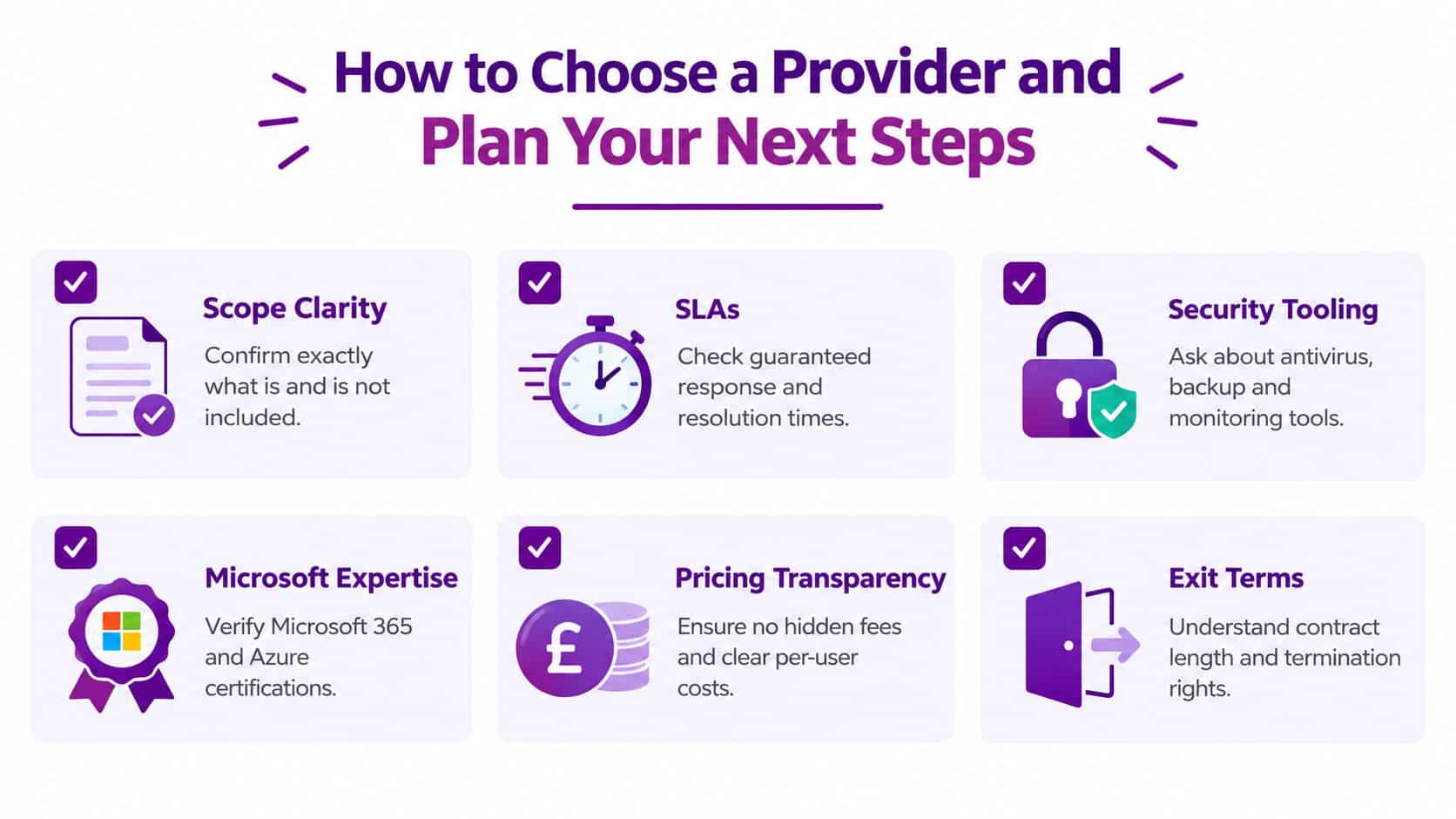
Questions worth asking before you sign
- Scope clarity: Ask which services are included as standard and which sit outside the monthly fee.
- Service levels: Check response times, resolution targets, and whether out-of-hours support is part of the agreement.
- Security tooling: Ask what protects users, endpoints, email, backup, and identity.
- Microsoft expertise: If your business runs on Microsoft 365 or Azure, confirm who manages that layer and how.
- Commercial terms: Check onboarding, project work, contract length, renewal terms, and exit conditions.
- Support model: Confirm whether you need fully outsourced cover or whether a shared model would fit better.
How to compare quotes properly
Ask every provider to price the same user count, the same support hours, and the same stack assumptions. If one quote includes backup monitoring and another treats it as extra, they aren't directly comparable.
It also helps to ask who owns problems across suppliers. When an email issue touches Microsoft 365, endpoint settings, and user access, you want clear accountability rather than finger-pointing. Businesses looking at provider selection in more detail may find this overview of a managed IT services firm helpful when building a shortlist.
A fair quote should be understandable by a non-technical director. If it isn't, keep asking questions until it is.
Phone 0845 855 0000 today or Send us a message if you want pricing in pounds sterling for your business in Lincoln, Nottingham, Leicester, Scunthorpe, Grimsby, Newark, or the wider East Midlands.
F1Group supports organisations across the East Midlands with managed IT services, Microsoft 365 and Azure administration, cyber security, and co-managed or fully managed support shaped around real business needs. If you want a clearer view of managed IT services cost and a quote you can compare, visit F1Group and start the conversation.